Statuario Marble Tiles in India: Identifying Real vs Replica
Compare natural marble and marble-look vitrified tiles for Indian homes. Learn the differences in cost, maintenance, durability, appearance, and long-term value before buying.
- What Is Statuario Marble and Why Is It So Widely Replicated?
- How to Identify Genuine Statuario Marble in India
- Price Signals: What Genuine Statuario Costs in India
- What High-Quality Statuario PGVT Looks Like
- Questions to Ask Your Dealer Before Buying
- Common Mistakes Indian Buyers Make
- How to Verify Statuario Tiles Before You Buy
Natural marble offers unmatched authenticity and premium appeal but requires sealing, polishing, and higher maintenance. Vitrified marble-look tiles provide a similar appearance with lower cost and easier upkeep. For most modern Indian homes, high-quality PGVT or GVT marble-look tiles deliver the best balance of aesthetics, durability, and long-term value.
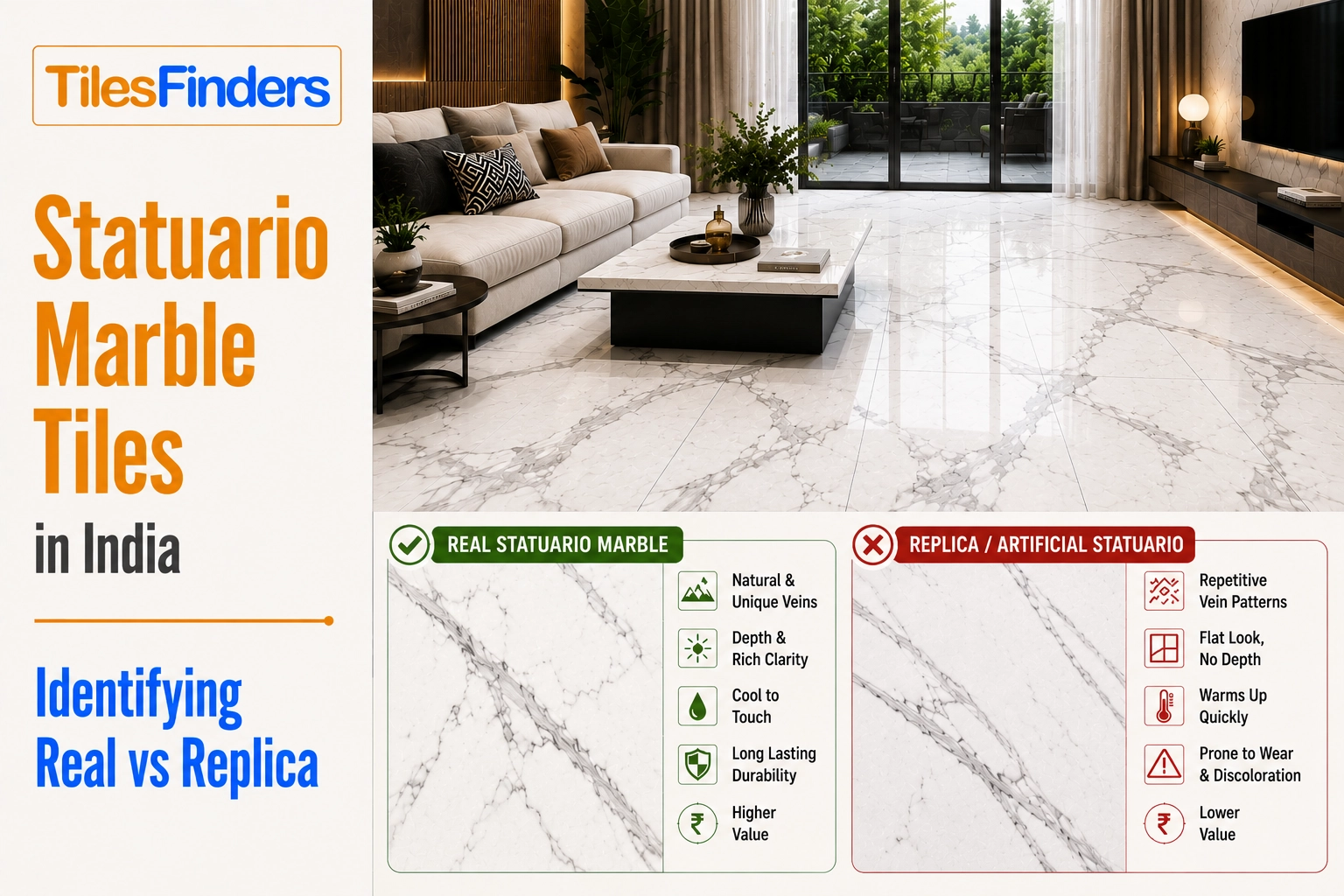
Statuario is arguably the most imitated stone in the Indian tile market. The bold grey-black veining on a brilliant white body is so widely replicated in GVT and PGVT tiles that the name Statuario now refers to a design category as much as a specific Italian stone.
This creates a genuine buying problem. In Indian showrooms, slabs described as Statuario can range from genuine quarried Italian stone at Rs. 600 per sq. ft. and above to a Makrana white marble at Rs. 80 per sq. ft. with Statuario-like veining, to a PGVT tile at Rs. 120 per sq. ft. with a printed design. All three may be presented under the same name. Knowing the difference is crucial for your budget, maintenance plan, and expectations.
This guide covers the practical tests you can perform in any Indian showroom, the price signals that indicate what you are actually looking at, and the questions to ask your dealer before signing any invoice.
What Is Statuario Marble and Why Is It So Widely Replicated?
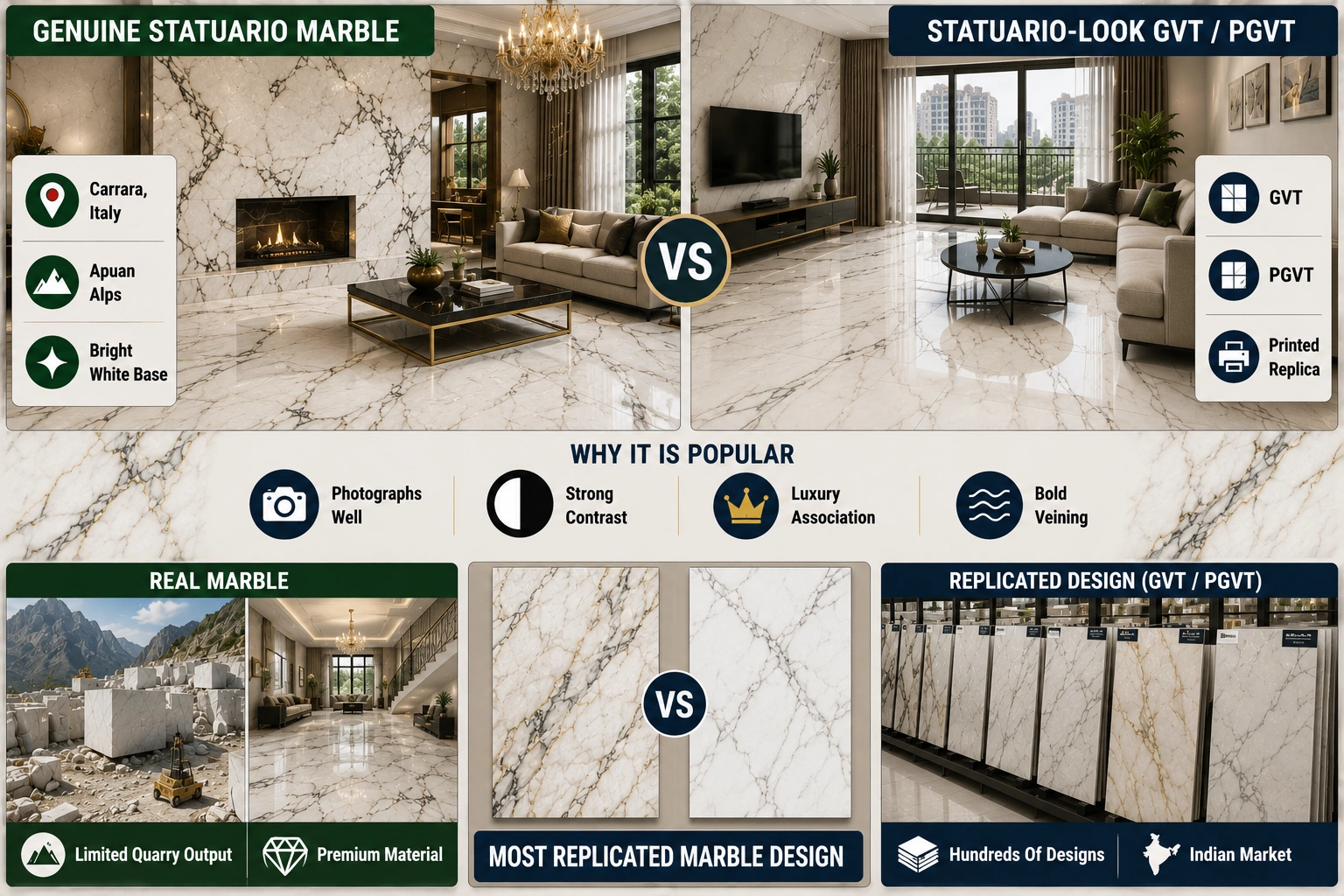
Genuine Statuario marble comes from the Apuan Alps in Carrara, Italy. It is a specific variety of white Carrara marble distinguished by its bright white body and bold, dramatic grey-to-black veining with occasional gold undertones. The quarry output is limited, which keeps prices high and makes it one of the most expensive natural stones available in India.
The design is widely replicated because it is the most commercially appealing marble pattern.
If you're still deciding between natural marble and marble-look alternatives, see our Marble vs Marble-Look Tiles Guide for a detailed comparison of cost, maintenance, durability, and suitability for Indian homes.
Bold contrast, bright white, clear veining that photographs well, and strong association with luxury in the Indian market make it the top choice for any manufacturer producing a marble-look product. There are now hundreds of GVT and PGVT tiles in the Indian market carrying the Statuario name. Many are excellent tiles that are honestly sold as printed replicas. Some are not.
The broader comparison between natural marble and marble-look vitrified tiles, including which works better for different rooms in Indian homes, is covered in the main guide on marble tile versus marble-look vitrified tile for Indian homes. This guide focuses specifically on how to tell the real from the replica once you are standing in front of both in a showroom.
How to Identify Genuine Statuario Marble in India
The Vein Test
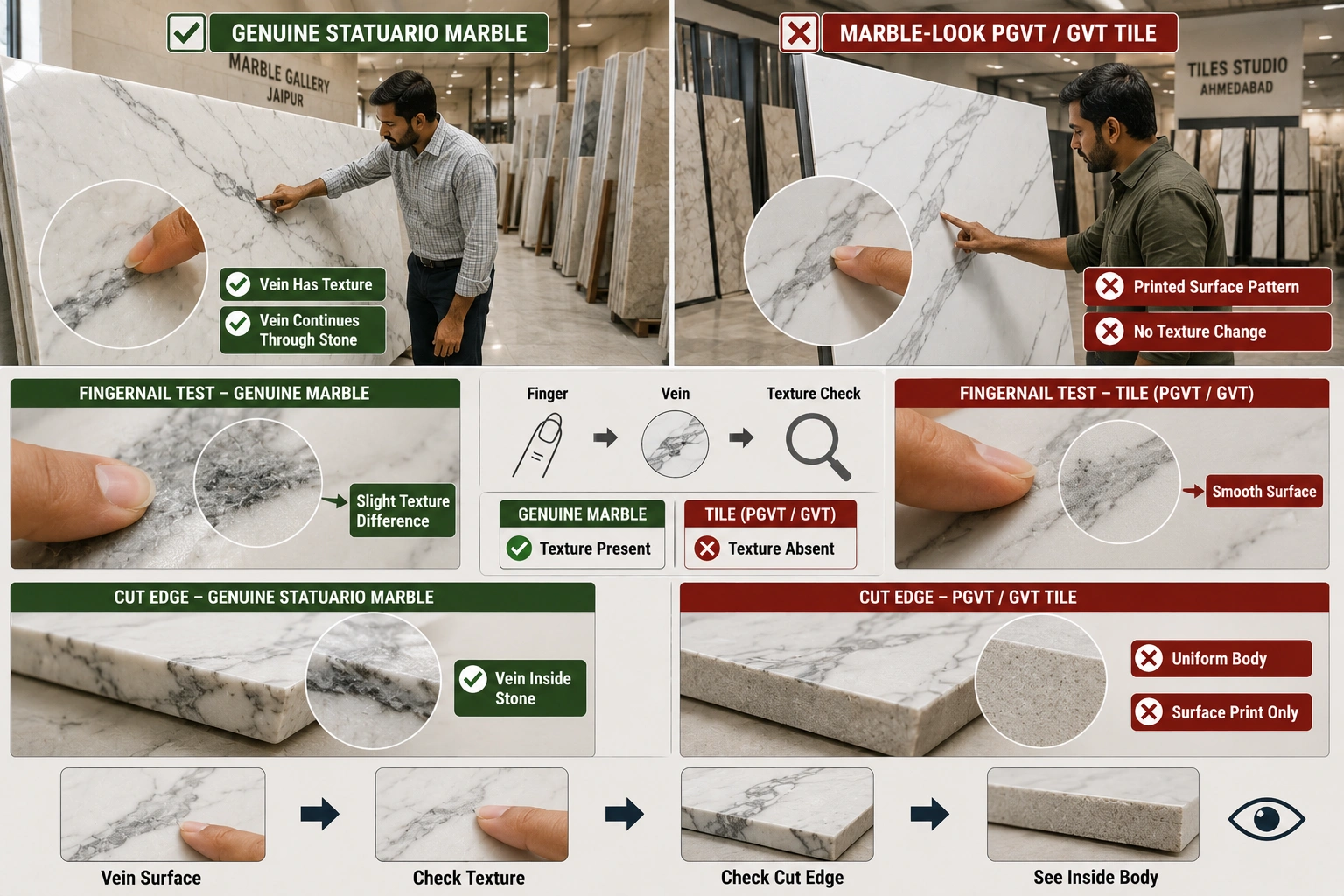
Run your fingernail along a vein in the tile or slab. In genuine marble, the vein is slightly recessed or at the same level as the surrounding stone but has a different texture. The vein runs through the stone body, not just on the surface. On a PGVT or GVT tile, the vein is purely a printed pattern on the surface. Your fingernail moves smoothly over it with no change in texture or depth.
On cut or sawn edges, the difference is even clearer. On genuine Statuario, the grey-black vein continues into the body of the stone. On a vitrified tile, the body is a uniform grey or white ceramic material with no vein pattern inside. If the dealer allows you to look at a broken sample or a cut edge, check the body colour immediately.
The Absorption Test
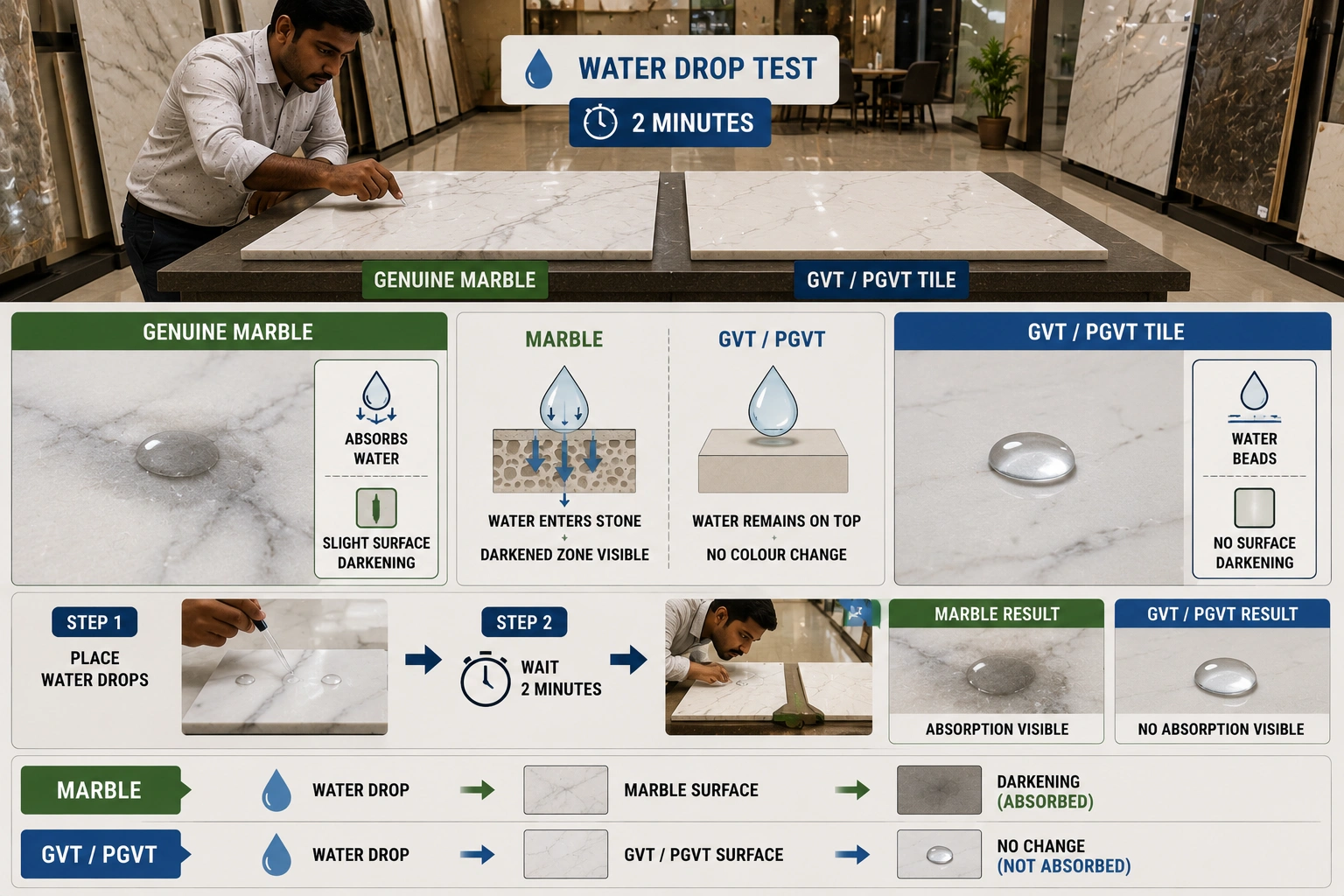
Place a few drops of water on the surface and wait 2 minutes. Genuine marble absorbs water. You will see the surface darken slightly around the water droplet as it seeps into the stone. GVT and PGVT tiles have water absorption of 0.05 percent or less. Water beads on the surface and does not darken the tile at all. This is one of the fastest and most reliable tests you can do in a showroom without any equipment.
The Cold Test
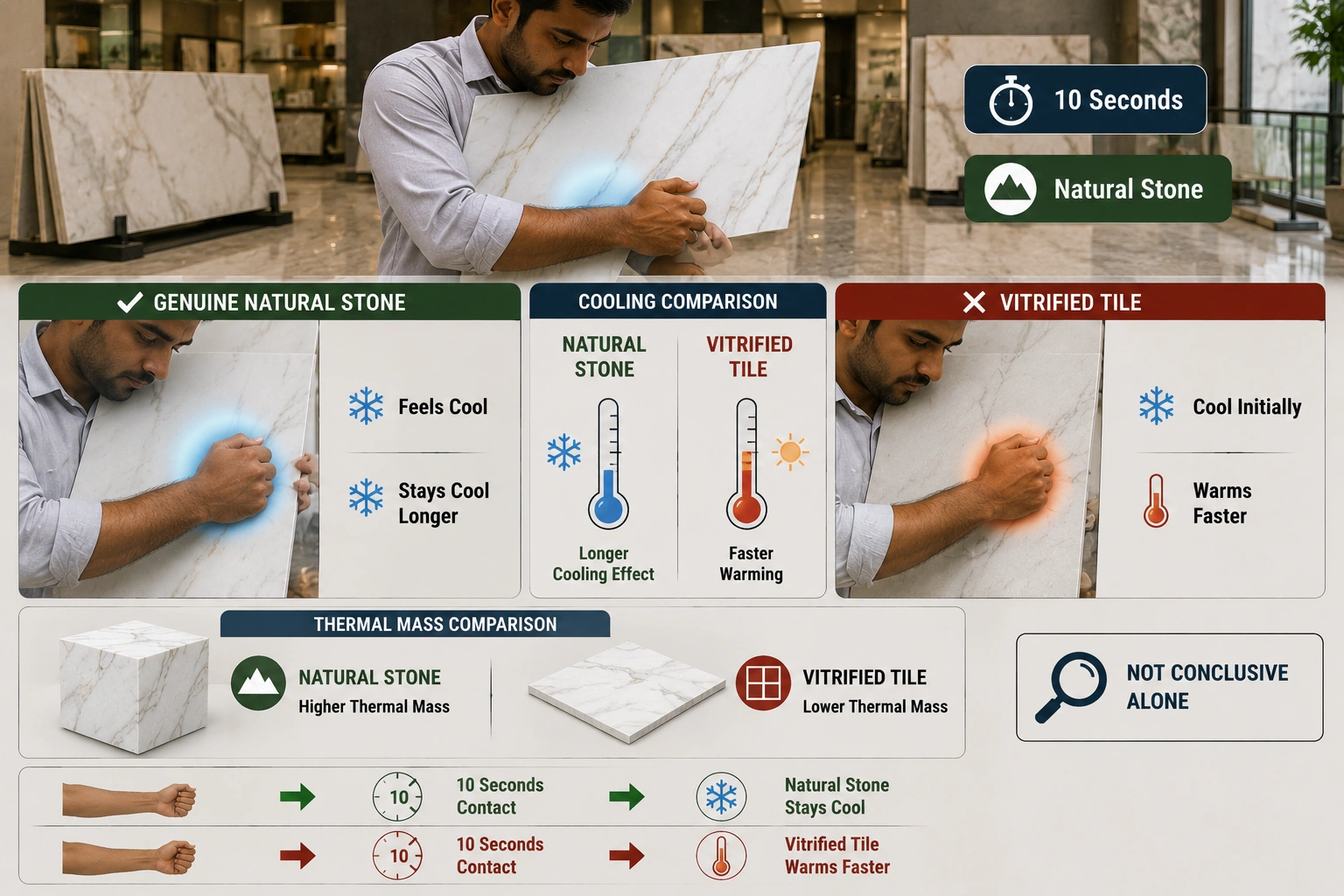
Hold the tile or slab face against your forearm for 10 seconds. Genuine natural stone feels cool and stays cool for longer because of its thermal mass. Vitrified tiles also feel cool initially, but warm up faster because ceramic material has lower thermal mass than dense natural stone. This test is not conclusive on its own but supports other findings.
The Acid Test (Use with Caution)
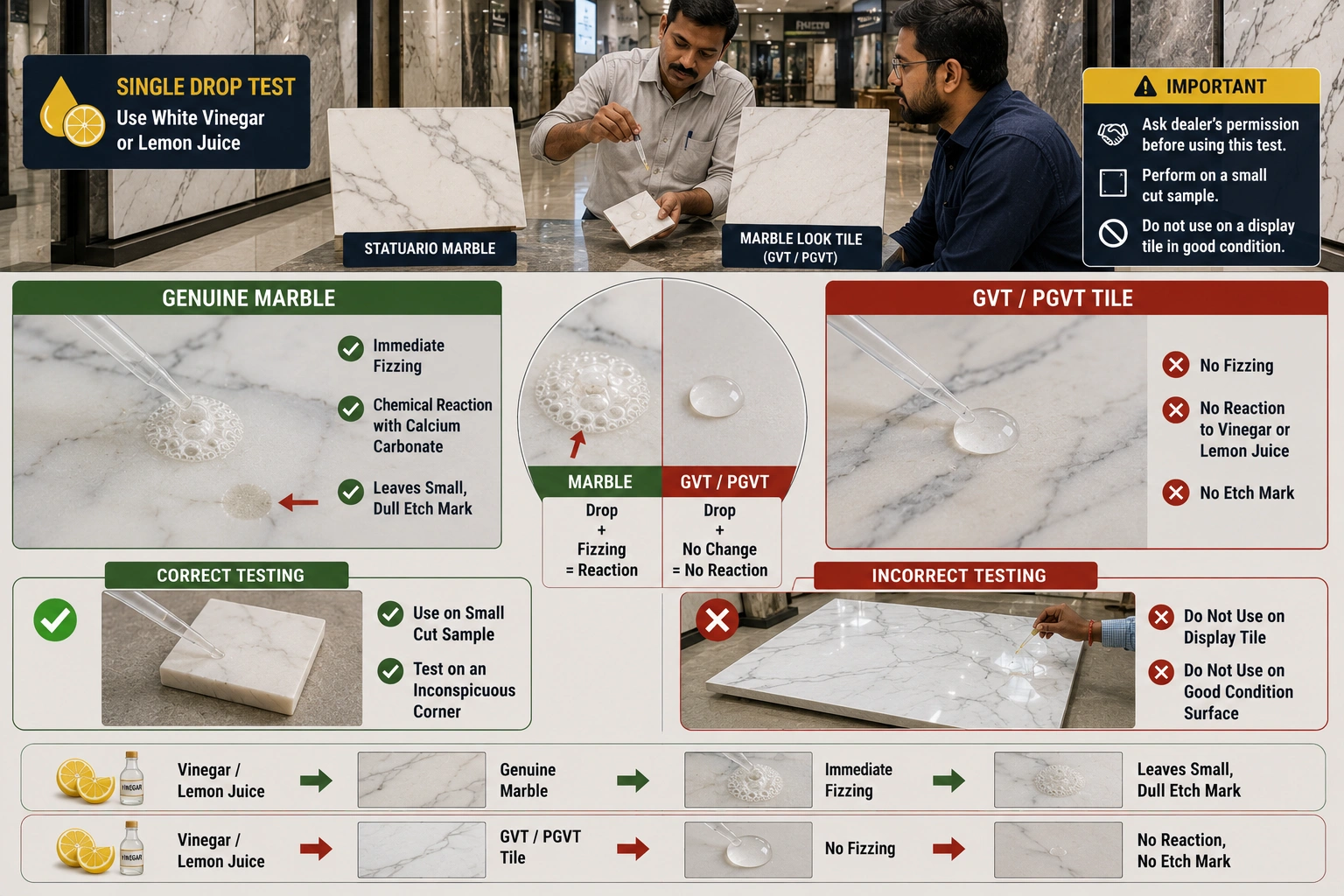
A single drop of white vinegar or lemon juice on an inconspicuous corner of the tile will cause immediate fizzing on genuine marble. This is a chemical reaction with the calcium carbonate in the stone. It will leave a small, dull etch mark. GVT and PGVT tiles show zero reaction to vinegar or lemon juice. Ask the dealer's permission before using this test, or perform it on a small cut sample. Do not use this test on a display tile in good condition.
Price Signals: What Genuine Statuario Costs in India
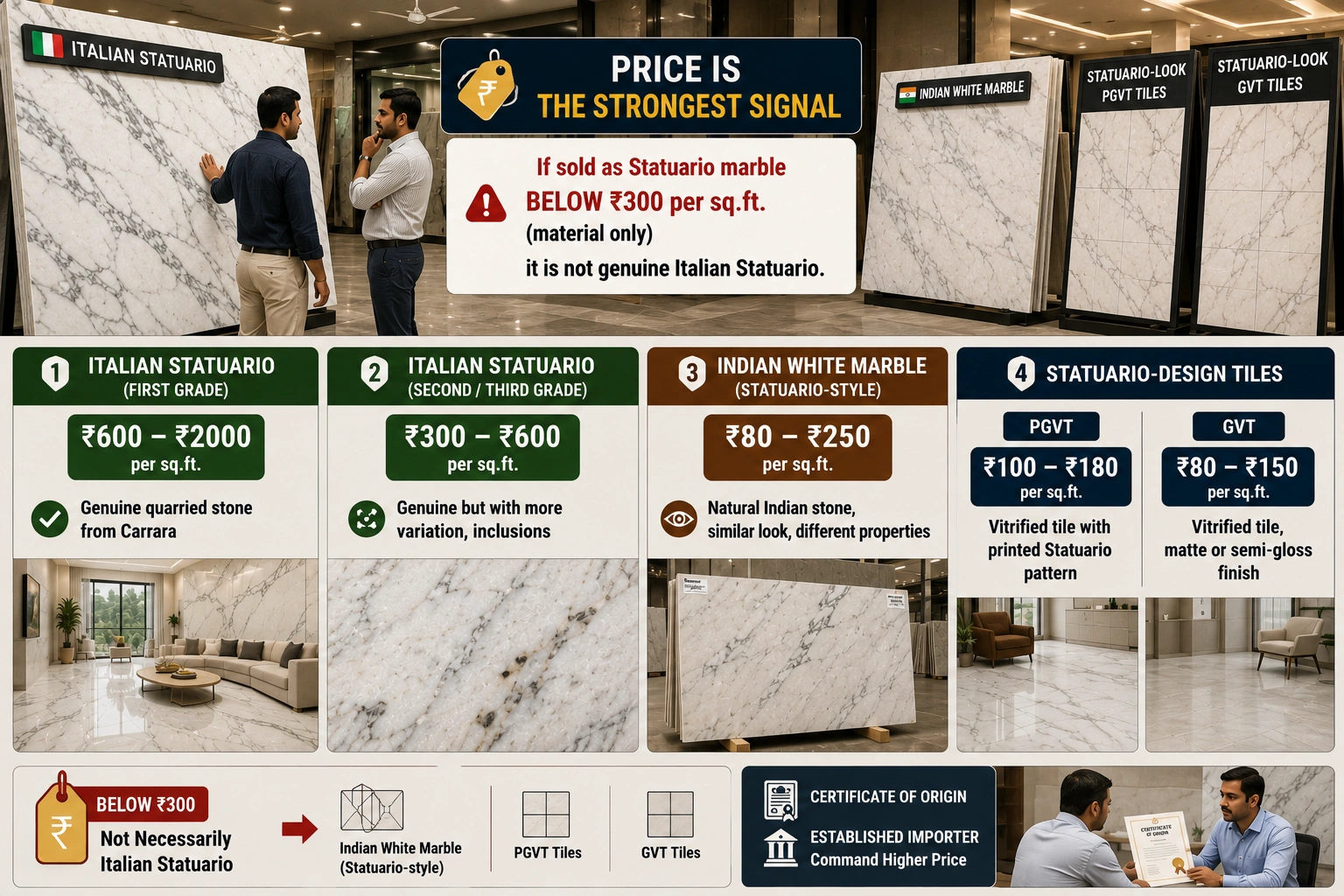
Price is the most honest signal in the Indian marble market. If a material is being sold as Statuario marble at below Rs. 300 per sq. ft. for material alone, it is not genuine Italian Statuario. It may be a very good Indian white marble with bold veining, often from Rajasthan or Andhra Pradesh, that is sold under the Statuario name because the design is similar. It is also possible that it is a PGVT tile.
Genuine Italian Statuario marble (first grade, consistent white body, bold veining) costs Rs. 600 to Rs. 2000 per sq. ft. in the Indian market, depending on slab size, grade, and source. Slabs from established Italian importers with certificates of origin command the higher end. Statuario-look Indian marble (Rajasthan or Andhra white marble with grey veining) costs Rs. 80 to Rs. 250 per sq. ft. Statuario-design PGVT tiles cost Rs. 100 to Rs. 180 per sq. ft.
| Material | Price Range (per sq. ft.) | What It Actually Is |
| Italian Statuario (first grade) | Rs. 600 to Rs. 2000 | Genuine quarried stone from Carrara |
| Italian Statuario (second/third grade) | Rs. 300 to Rs. 600 | Genuine but with more variation, inclusions |
| Indian white marble (Statuario-style) | Rs. 80 to Rs. 250 | Natural Indian stone, similar look, different properties |
| Statuario-design PGVT | Rs. 100 to Rs. 180 | Vitrified tile with printed Statuario pattern |
| Statuario-design GVT | Rs. 80 to Rs. 150 | Vitrified tile, matte or semi-gloss finish |
What High-Quality Statuario PGVT Looks Like
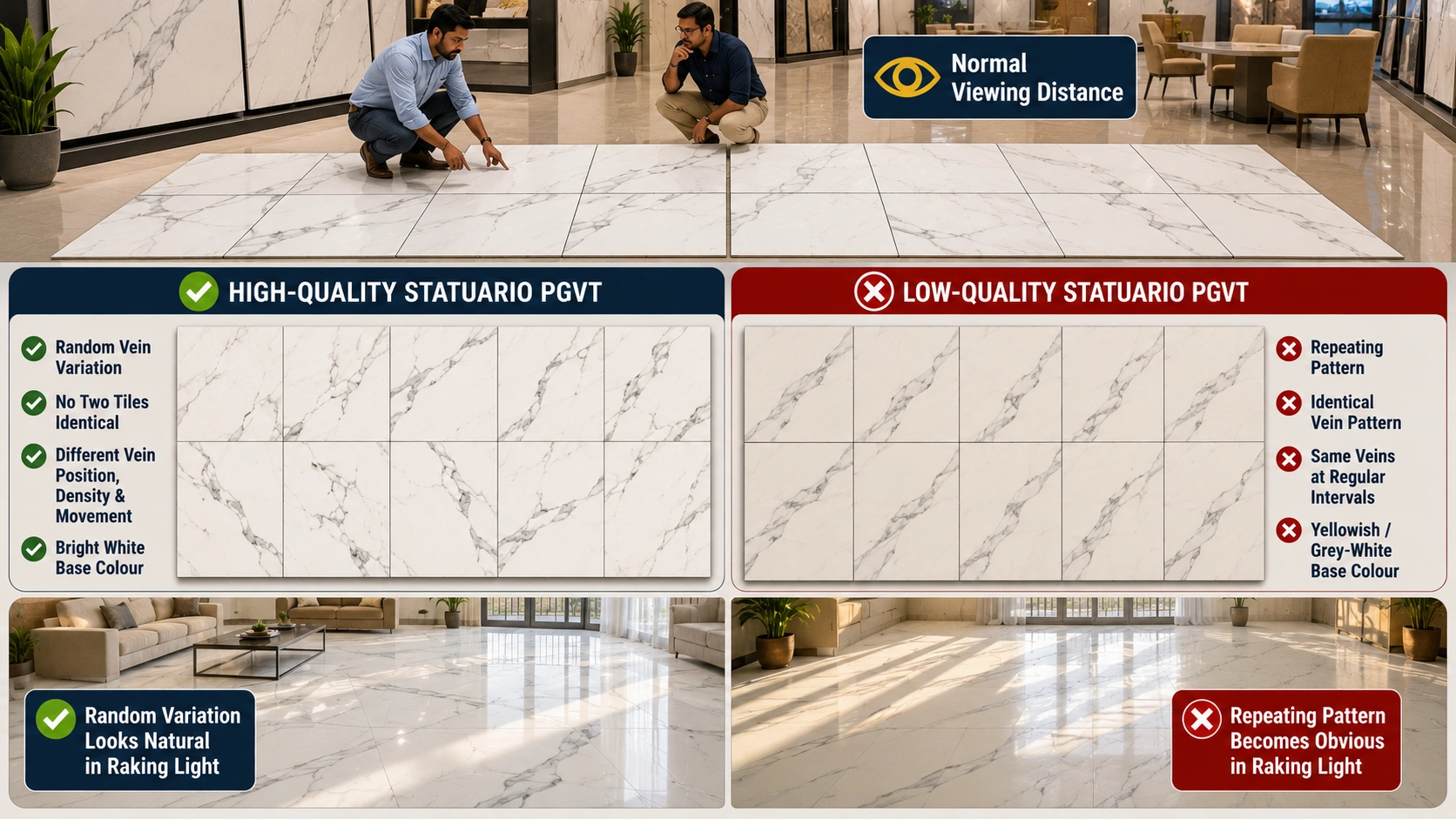
A good Statuario PGVT tile from an established Indian manufacturer is genuinely difficult to distinguish from real marble at normal viewing distance. The key quality indicator is random printing variation across the batch. Ask the dealer to lay out 8 to 10 tiles side by side on the showroom floor. In a high-quality tile, each piece shows a slightly different vein position, density, and movement. No two tiles should look identical.
Low-quality Statuario PGVT uses repeated printing cycles. When you lay 8 tiles side by side, you can see the same vein pattern repeating at regular intervals. This is the fastest way to identify a cheap replica. On a finished floor of 20 or more tiles, the repeating pattern becomes obvious in a raking light condition.
Also,o check the base colour consistency. The white body of a good Statuario tile should be consistently bright white across the batch. A yellowish or grey-white body colour suggests lower-grade raw materials in the tile body, which will also affect how the finished floor looks under Indian home lighting conditions.
Questions to Ask Your Dealer Before Buying
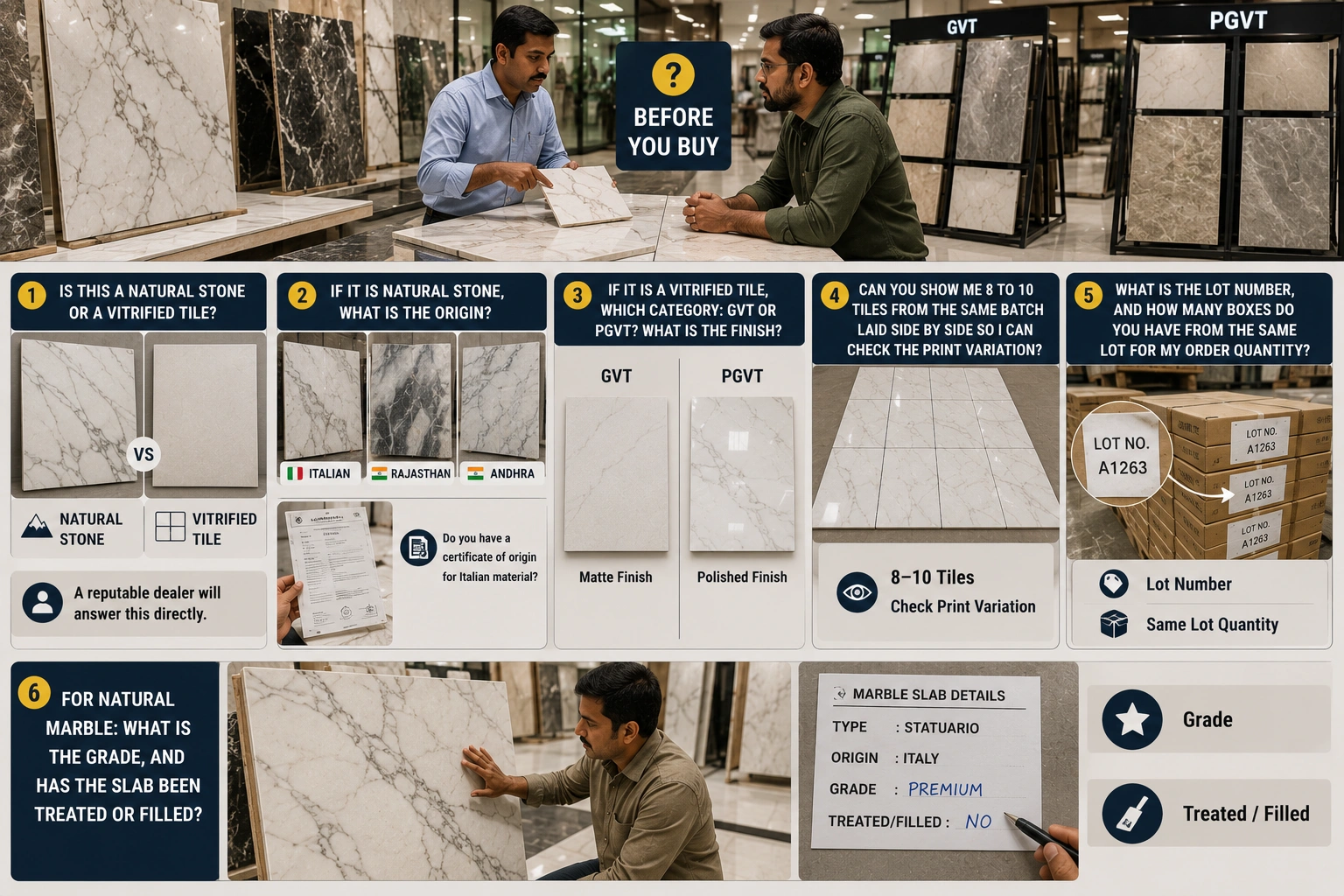
- Is this a natural stone or a vitrified tile? (A reputable dealer will answer this directly.)
- If it is natural stone, what is the origin: Italian, Rajasthan, Andhra? Do you have a certificate of origin for Italian material?
- If it is a vitrified tile, which category: GVT or PGVT? What is the finish?
- Can you show me 8 to 10 tiles from the same batch laid side by side so I can check the print variation?
- What is the lot number, and how many boxes do you have from the same lot for my order quantity?
- For natural marble: what is the grade, and has the slab been treated or filled?
Common Mistakes Indian Buyers Make
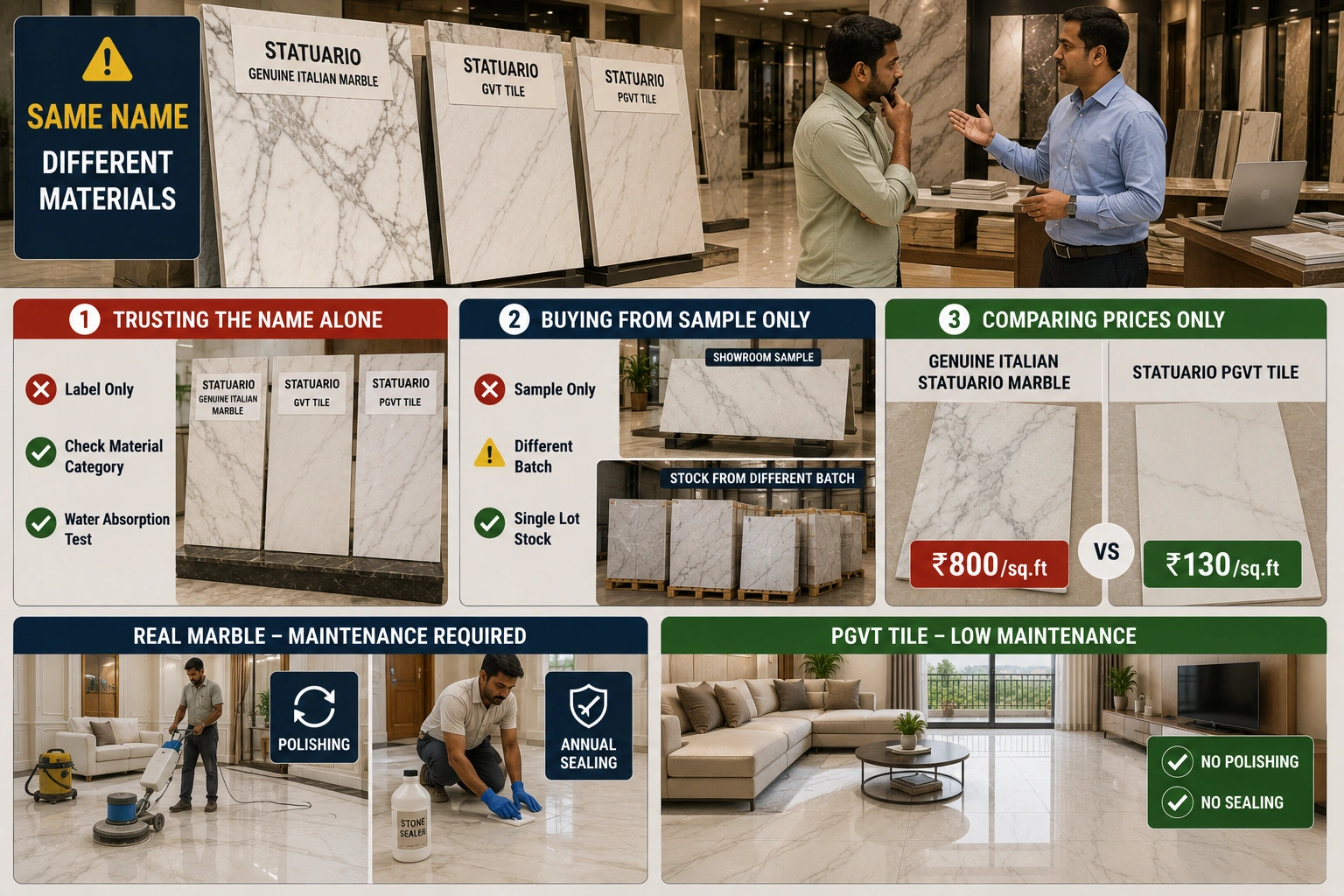
Trusting the name alone. In Indian showrooms, the word Statuario is applied to genuine Italian stone, Indian white marble, GVT tiles, and PGVT tiles without a clear distinction. Never rely on the label. Ask what the material category is and run at least the water absorption test.
Buying from showroom samples without checking the batch stock. A showroom sample tile may be a premium piece from the manufacturer's display range. The stock delivered to your project may be from a different production batch with visible differences. Confirm that your full order quantity is available from a single lot before paying any deposit.
Comparing prices without comparing maintenance costs. Genuine Italian Statuario at Rs. 800 per sq. ft. looks expensive next to a Statuario PGVT at Rs. 130 per sq. ft. But if the marble needs polishing every 3 to 4 years and sealing annually, the 20-year cost comparison looks very different. The full lifecycle cost comparison is covered in the pillar guide on marble tile versus marble-look vitrified for Indian homes.
How to Verify Statuario Tiles Before You Buy
Before buying anything described as Statuario in an Indian showroom, run the water drop test, check the cut edge, and ask the dealer directly whether it is natural stone or vitrified. These three steps take under five minutes and will tell you exactly what you are buying.
You can also browse marble-look PGVT and GVT tile options by design, finish, and price on TilesFinders to compare genuine product descriptions from Indian manufacturers before your showroom visit.
FAQs
Three quick showroom tests: place a water drop on the surface and watch for absorption (genuine marble darkens, vitrified beads water), check the cut edge for vein continuity through the body (genuine marble shows vein inside, vitrified shows plain white or grey body), and ask the price. Genuine Italian Statuario costs Rs. 600 per sq. ft. and above for material alone. Anything below Rs. 300 is either Indian white marble or a vitrified tile.
First-grade Italian Statuario marble costs Rs. 600 to Rs. 2000 per sq. ft. in India for the material, depending on grade, slab size, and importer. Second and third grade Italian Statuario (more variation, possible inclusions) runs Rs. 300 to Rs. 600 per sq. ft. Indian white marble with Statuario-style veining (from Rajasthan or Andhra Pradesh) costs Rs. 80 to Rs. 250 per sq. ft. and is a natural stone but not Italian Statuario.
For most Indian homes, yes. A high-quality Statuario PGVT tile costs Rs. 100 to Rs. 180 per sq. ft., resists acid etching and staining, needs no polishing, and is very difficult to distinguish from real marble at normal viewing distance. It performs better than real Statuario in Indian kitchens, bathrooms, and humid coastal cities. The only areas where genuine Statuario marble holds a clear advantage are formal, low-traffic spaces where natural stone's visual depth and resale value premium are the priority.
Low-quality Statuario PGVT tiles use a limited number of print variations that repeat at regular intervals across the floor. When 20 or more tiles are laid, the repeating pattern becomes visible. High-quality tiles use a large library of print variations so that each tile in a batch looks slightly different. Before buying, ask the dealer to lay 8 to 10 tiles side by side and check whether any two tiles look identical. If you see repeating patterns, choose a different manufacturer or grade.

See our tile guides first
Set TilesFinders as a preferred source and our buying guides surface ahead of the rest for you.
Add as preferred sourceTakes one tap. Nothing to install.
What Readers Say
I was about to redo my parking area with the wrong tile size until I read this. The layout comparisons saved me from a costly mistake.
We reference TilesFinders guides while briefing clients on material selection. The size and pattern breakdowns are accurate and easy to explain visually.
On site, I get asked about grout spacing all the time. This article gave me a solid reference I now share with my team before every job.
Finally a guide that doesn't just push generic advice. The oil stain removal steps actually worked on our clubhouse driveway tiles.
I run a small construction firm and now send this link to clients directly when they ask about entrance tile sizing. Saves me an hour of explaining.
Good practical detail, though I wish there were more examples for compact apartment entrances specifically, not just villas.
My mother-in-law wanted marble, I wanted vitrified. This blog gave us the neutral comparison we needed to actually decide together.
Detailed without being overwhelming. I appreciated that it covered both cost and maintenance, not just the aesthetics.
Used the algae and hard water removal tips on our terrace tiles after the monsoon. Worked better than what our regular cleaner was doing.
As someone who sources tiles for multiple builder projects, I find these comparisons genuinely useful for vendor conversations, not just consumer content.
Recommended this to a client who kept second-guessing the entrance design. The small vs large layout section settled the debate instantly.
Straightforward and honest, no unnecessary jargon. Would like to see a similar breakdown for outdoor pool-deck tiles next.
We've bookmarked several TilesFinders guides for our design handbook. Reliable source when clients want data, not just opinions.
Two paths, one marketplace.
Get free quotes from verified suppliers.
Share your room, budget, and style. Suppliers in Morbi respond within hours.
Get Free QuotesList your business, reach real buyers.
Put your showroom in front of homeowners searching for tiles right now.
List Your Business