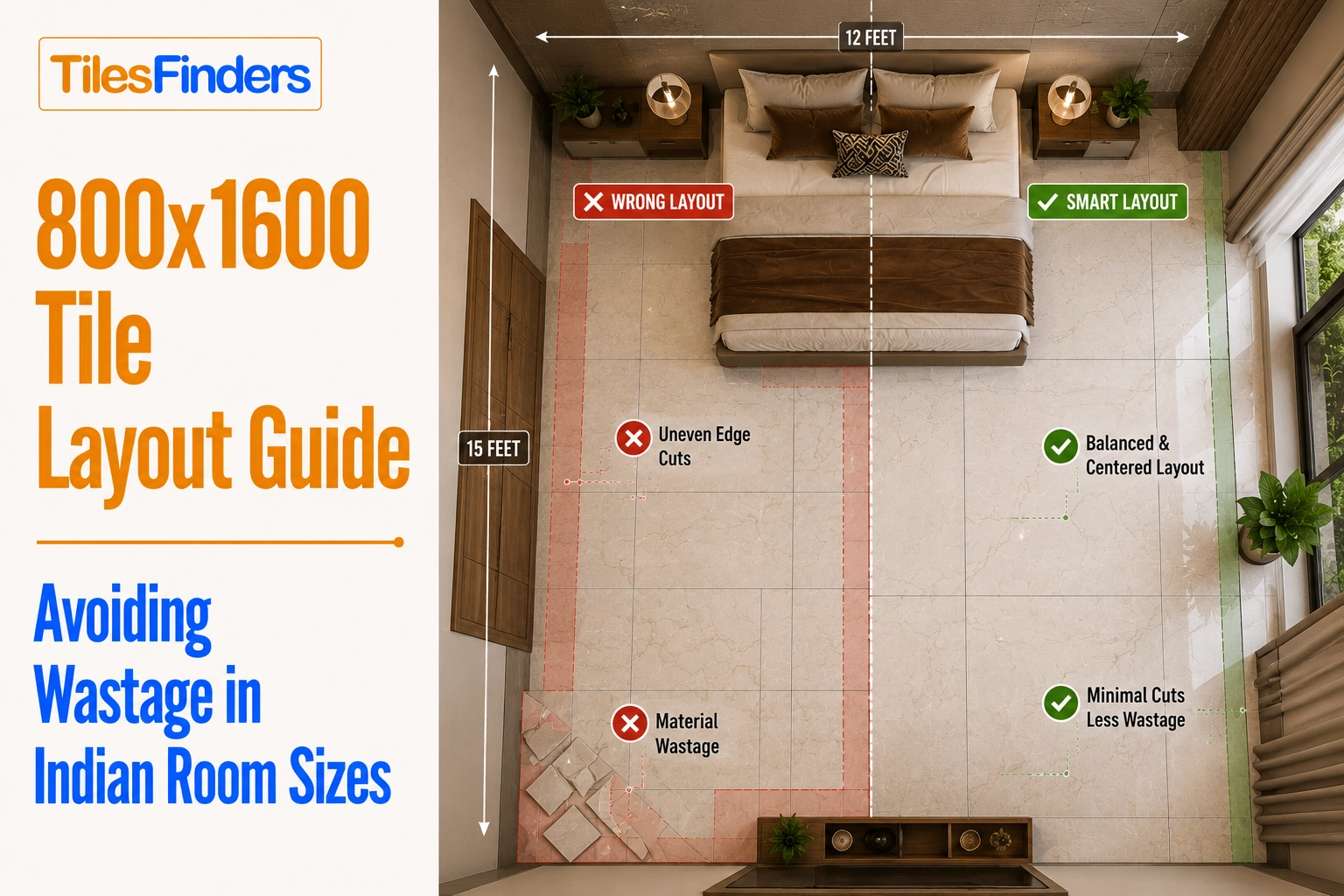
800x1600 Tile Layout Guide: Avoiding Wastage in Indian Room Sizes
Learn how to plan 800x1600 tile layouts for Indian room sizes, reduce cutting waste, calculate tile quantities accurately, and choose the best patterns for living rooms and bedrooms.
- Why Layout Planning Matters More with 800x1600 Tiles
- Standard Indian Room Sizes and How 800x1600 Tiles Fit
- How to Calculate Wastage for 800x1600 Tiles
- Laying Patterns That Reduce Cutting Waste
- GVT vs PGVT in 800x1600: Which Works Where
- Common Mistakes That Increase Wastage
- Plan Your 800x1600 Tile Layout Before You Buy
800x1600 tiles create a premium, seamless look but require careful layout planning to avoid excessive cutting waste. Measure accurately, choose the right pattern, and add 10–15% extra for wastage. Large-format tiles work best in living rooms and master bedrooms above 100 sq. ft. Proper room-size planning and tile placement can significantly reduce material costs and installation issues.
800x1600 mm tiles change how a room feels. Fewer grout lines, a cleaner surface, and a floor that reads as one continuous plane are the reasons most Indian homeowners pick this format for their living rooms and master bedrooms.
The problem starts at the cutting table. One wrong measurement, one misaligned starting point, or one room dimension that does not divide cleanly into 800 mm or 1600 mm can add 15 to 20 per cent to your tile requirement. At Rs. 80 to Rs. 250 per sq. ft., that is real money.
This guide covers how standard Indian room sizes interact with 800x1600 tiles, how to calculate wastage before you order, and which laying patterns keep cutting waste low. If you are still deciding whether this size is the right call for your budget, the comparison between 800x1600 and 600x1200 tiles covers the price-versus-value question in detail. If you have already picked this format and want design ideas, the top 800x1600 tile designs for Indian homes are a good starting point.
Why Layout Planning Matters More with 800x1600 Tiles
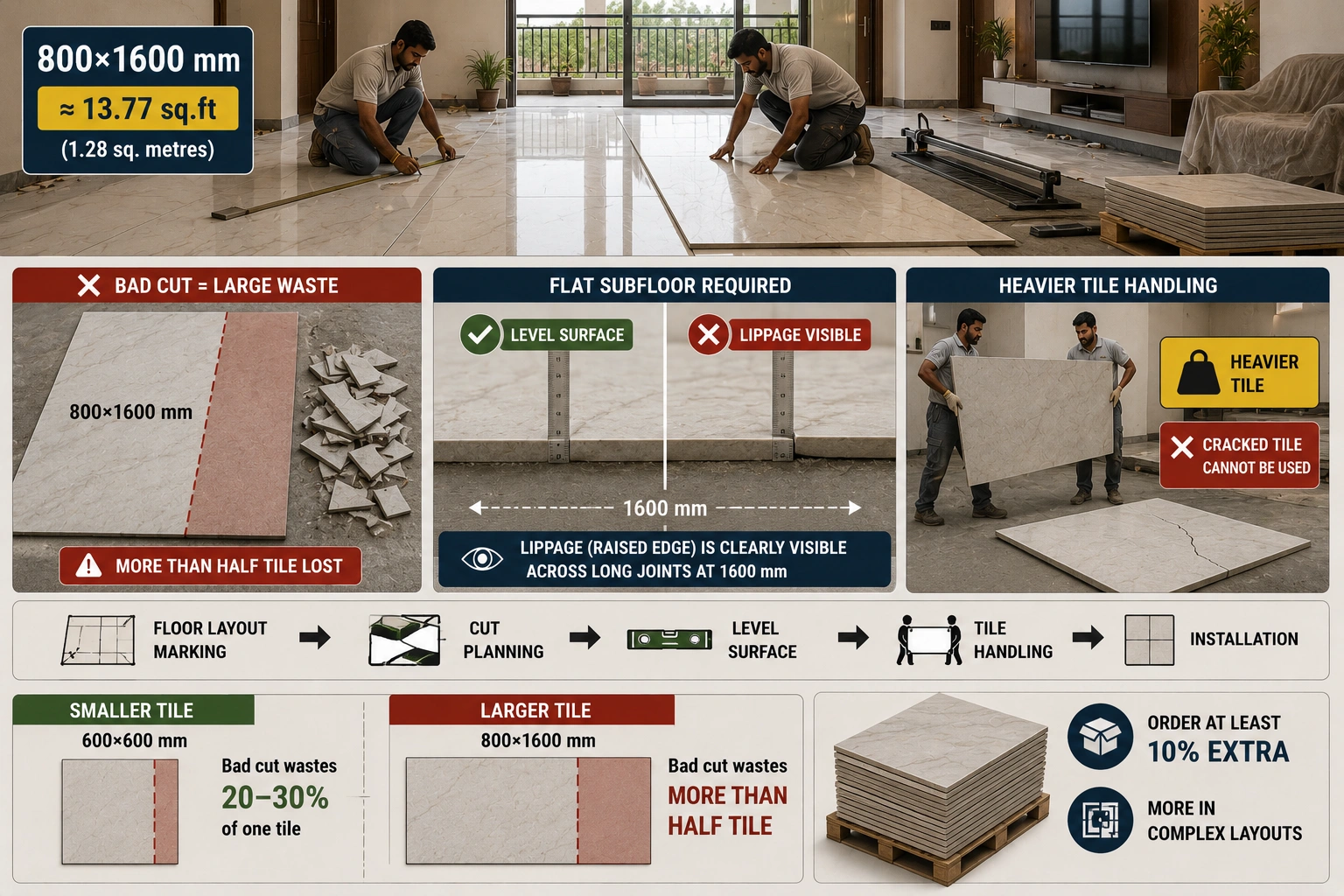
With smaller tiles like 600x600 mm, a bad cut wastes perhaps 20 to 30 per cent of one tile. With 800x1600 mm, a single bad cut can waste more than half a tile. Each tile covers roughly 1.28 sq. metres (13.77 sq. ft.), so waste adds up faster than most buyers expect.
Large-format tiles also require a flatter subfloor. Lippage (the raised edge between two tiles) is clearly visible across long joints at 1600 mm. This means your mason needs to spend more time on levelling, which raises labour costs if not planned for in advance. For a full breakdown of what contractors need to prepare before the first tile goes down, see the 800x1600 tile cutting and installation guide for Indian contractors.
The tile is also heavier than its 2x4 (600x1200 mm) counterpart. Handling errors during cutting is more common, and a cracked tile during installation cannot be used, even in a concealed area. Order at least 10 per cent extra for any 800x1600 job, more in complex layouts.
Standard Indian Room Sizes and How 800x1600 Tiles Fit
Indian apartments are sized differently from Western homes. A 2BHK in Mumbai, Pune, or Bengaluru sits very differently in terms of room dimensions compared to a 3BHK independent house in Jaipur or Nagpur. Knowing the common sizes helps you decide early if 800x1600 is the right call for each room.
Living Room and Hall
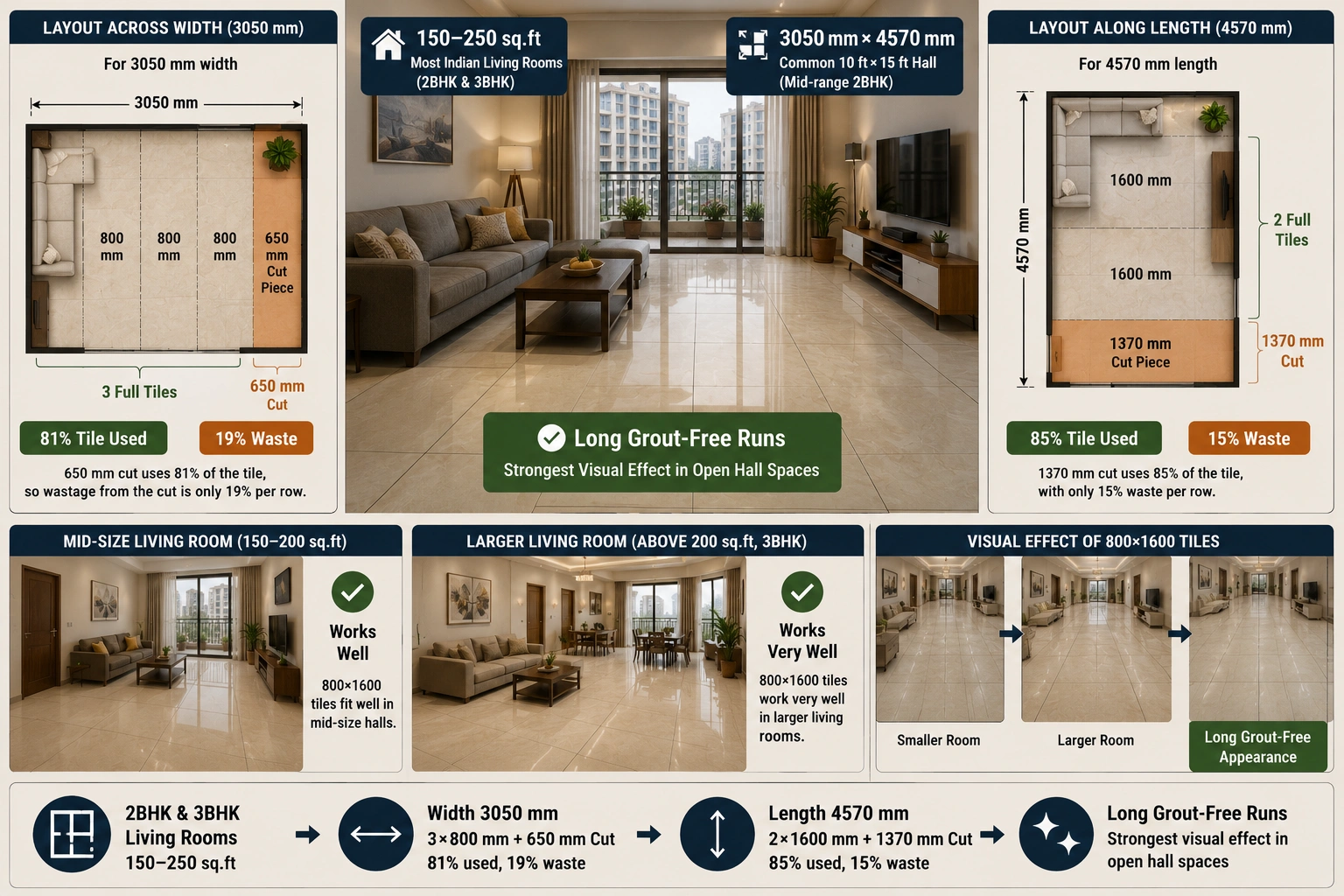
Most Indian living rooms in 2BHK and 3BHK apartments run from 150 to 250 sq. ft. A 10 ft x 15 ft hall (approximately 3050 mm x 4570 mm) is common in a mid-range 2BHK.
For a 3050 mm width, you need 3 tiles of 800 mm (2400 mm) plus a cut piece of 650 mm. That cut piece uses 81 per cent of the tile, so wastage from the cut is only 19 per cent per row, which is manageable. The long dimension of 4570 mm works out to 2 tiles of 1600 mm (3200 mm) plus a cut of 1370 mm. That is 85 per cent of a tile used per row, with only 15 per cent waste.
Larger living rooms above 200 sq. ft. in 3BHK flats work very well with 800x1600. The visual effect of long grout-free runs is strongest in open hall spaces. For specific design choices that Indian designers are recommending for this size in 2026, the guide on 32x64 tiles for living room floors covers finish combinations, colour options, and layout directions, room by room.
Master Bedroom
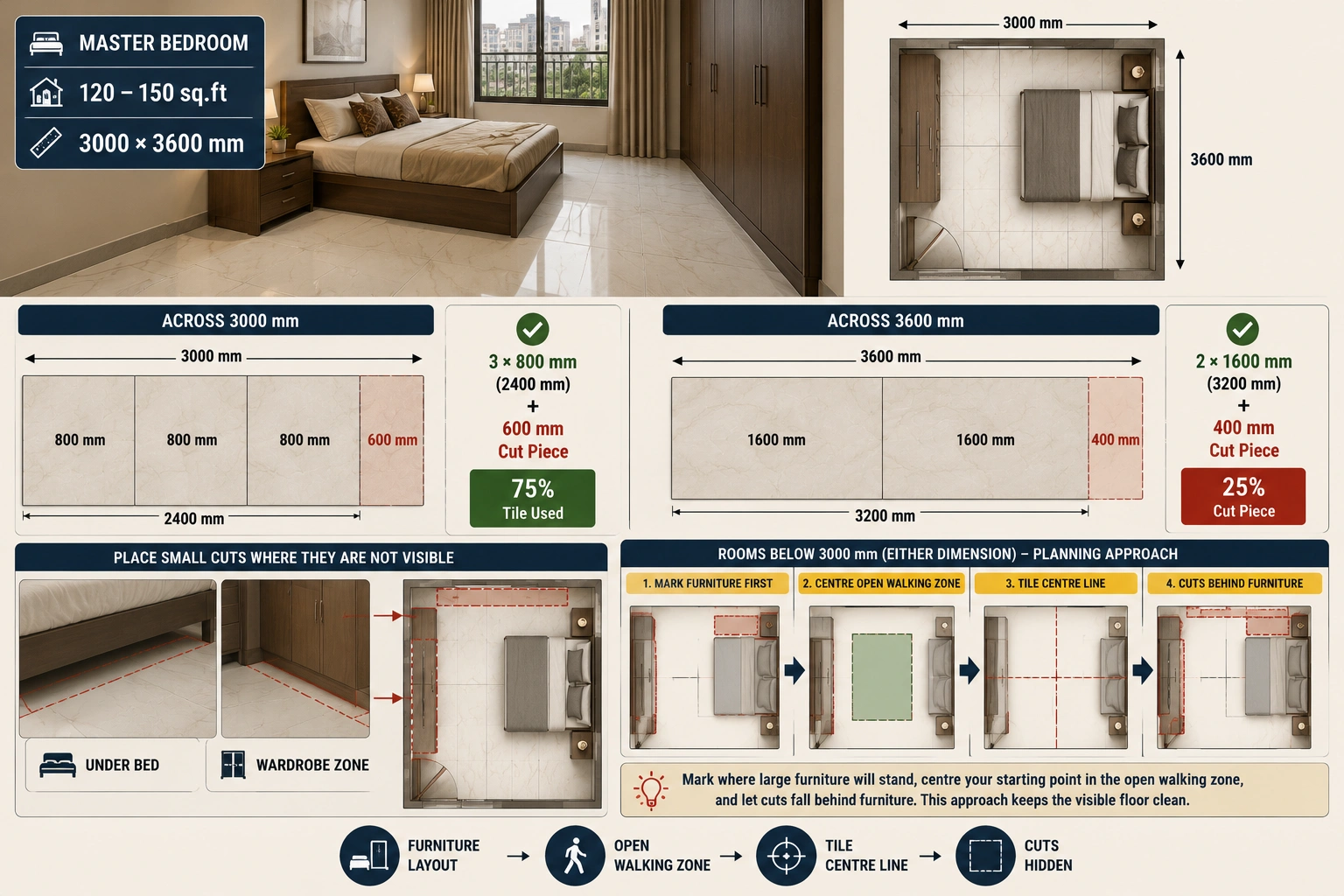
A typical Indian master bedroom in a 2BHK ranges from 120 to 150 sq. ft. This is the size range where you need to think carefully before picking 800x1600.
A 3000 mm x 3600 mm room works well. Across 3000 mm, you get 3 tiles of 800 mm (2400 mm) plus a 600 mm cut piece, which is 75 per cent of the tile used. Across 3600 mm, you get 2 tiles of 1600 mm (3200 mm) plus a 400 mm cut piece. At 25 per cent, the cut piece waste is the highest in this room. Plan to place small cuts in wardrobe zones or under the bed where they are not visible.
Rooms below 3000 mm in either dimension need a carpenter-coordinated approach. Mark where large furniture will stand, centre your starting point in the open walking zone, and let cuts fall behind furniture. This approach keeps the visible floor clean.
Children's Bedroom and Guest Room
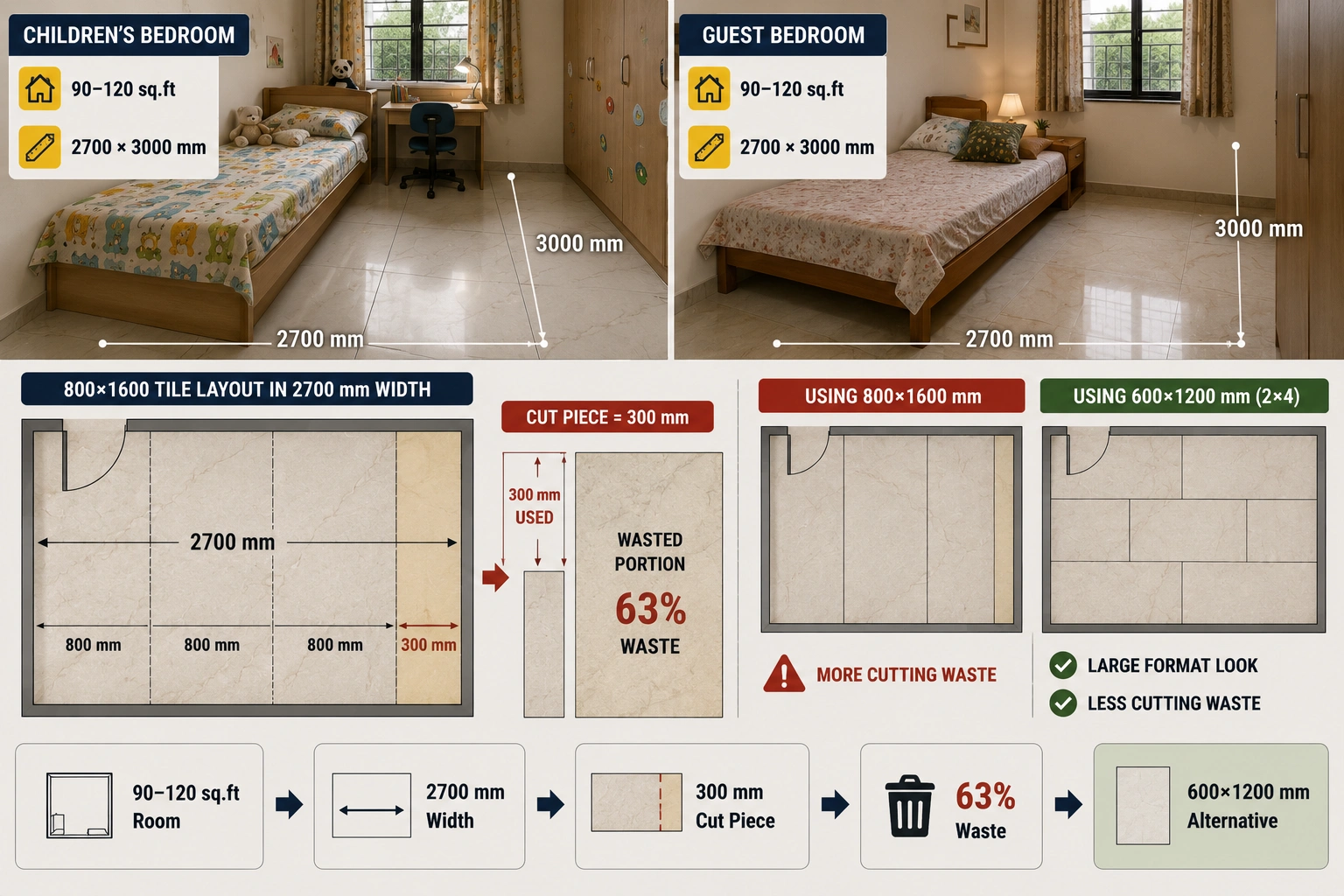
Children's rooms and guest rooms in Indian 2BHK apartments are often the smallest rooms in the house, typically 90 to 120 sq. ft. or around 2700 mm x 3000 mm.
At 2700 mm wide, you get 3 tiles of 800 mm (2400 mm) with a 300 mm cut piece. That is only 3 per cent of a tile used per row, meaning 63 per cent is waste from each cut tile. This is where 800x1600 starts working against you.
For rooms under 100 sq. ft. or with any dimension below 2400 mm, switch to 600x1200 mm (2x4). You keep the large-format look but with much less cutting waste. If you are comparing both sizes on cost and visual outcome, the article on whether 800x1600 is worth the price jump over 600x1200 breaks down exactly when the upgrade makes sense and when it does not.
| Room Type | Typical Size (mm) | 800x1600 Fit | Est. Wastage % |
| Living Room (2BHK) | 3050 x 4570 | Good | 12 to 15% |
| Living Room (3BHK) | 3660 x 5490 | Very Good | 8 to 12% |
| Master Bedroom (2BHK) | 3000 x 3600 | Acceptable | 15 to 18% |
| Master Bedroom (3BHK) | 3350 x 4270 | Good | 10 to 14% |
| Children's Bedroom | 2700 x 3000 | Poor | 20 to 25% |
| Guest Room | 2700 x 3350 | Marginal | 18 to 22% |
How to Calculate Wastage for 800x1600 Tiles
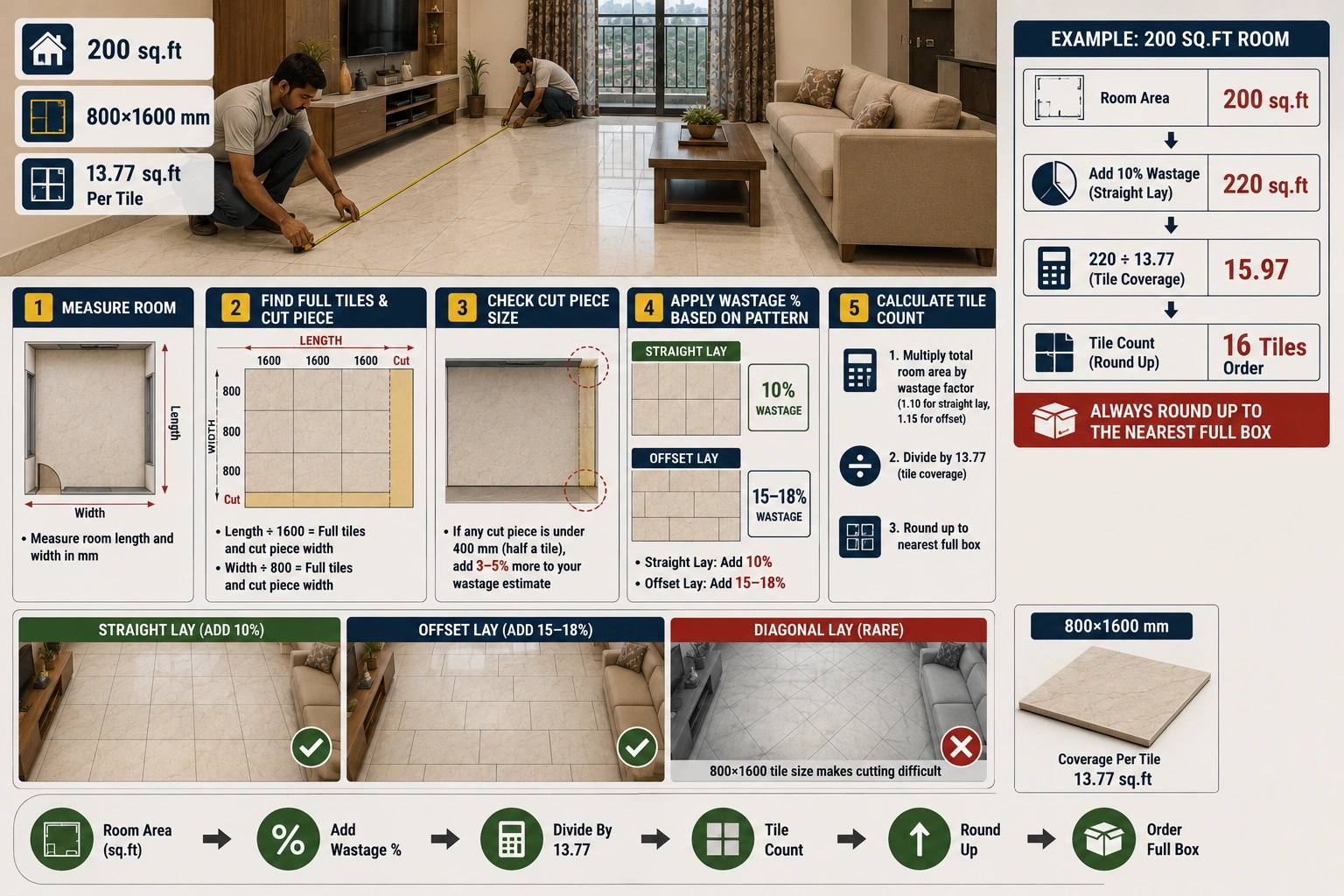
The standard formula is straightforward. Measure your room area in sq. ft., add the wastage percentage based on room size and pattern, and that gives you your order quantity.
For a 200 sq. ft. living room with a straight lay pattern, add 10 per cent. You need 220 sq. ft. of tiles. Each 800x1600 tile covers 13.77 sq. ft., so you need 16 tiles. Always round up to the nearest full box, never down.
For offset patterns, add 15 to 18 per cent instead of 10. Diagonal lay on 800x1600 are rare in Indian homes because the tile size makes cutting difficult. Most Indian masons and designers stick to straight or offset for this format.
- Measure room length and width in mm
- Divide the room length by 1600 to find the full tiles, and cut the piece width
- Divide the room width by 800 to find the full tile size, and cut the piece width
- If any cut piece is under 400 mm (half a tile), add 3 to 5 per cent more to your wastage estimate
- Multiply total room area by your wastage factor (1.10 for straight lay, 1.15 for offset)
- Divide by 13.77 to get the tile count, then round up to the nearest box
Laying Patterns That Reduce Cutting Waste
Straight Lay (Horizontal or Vertical)
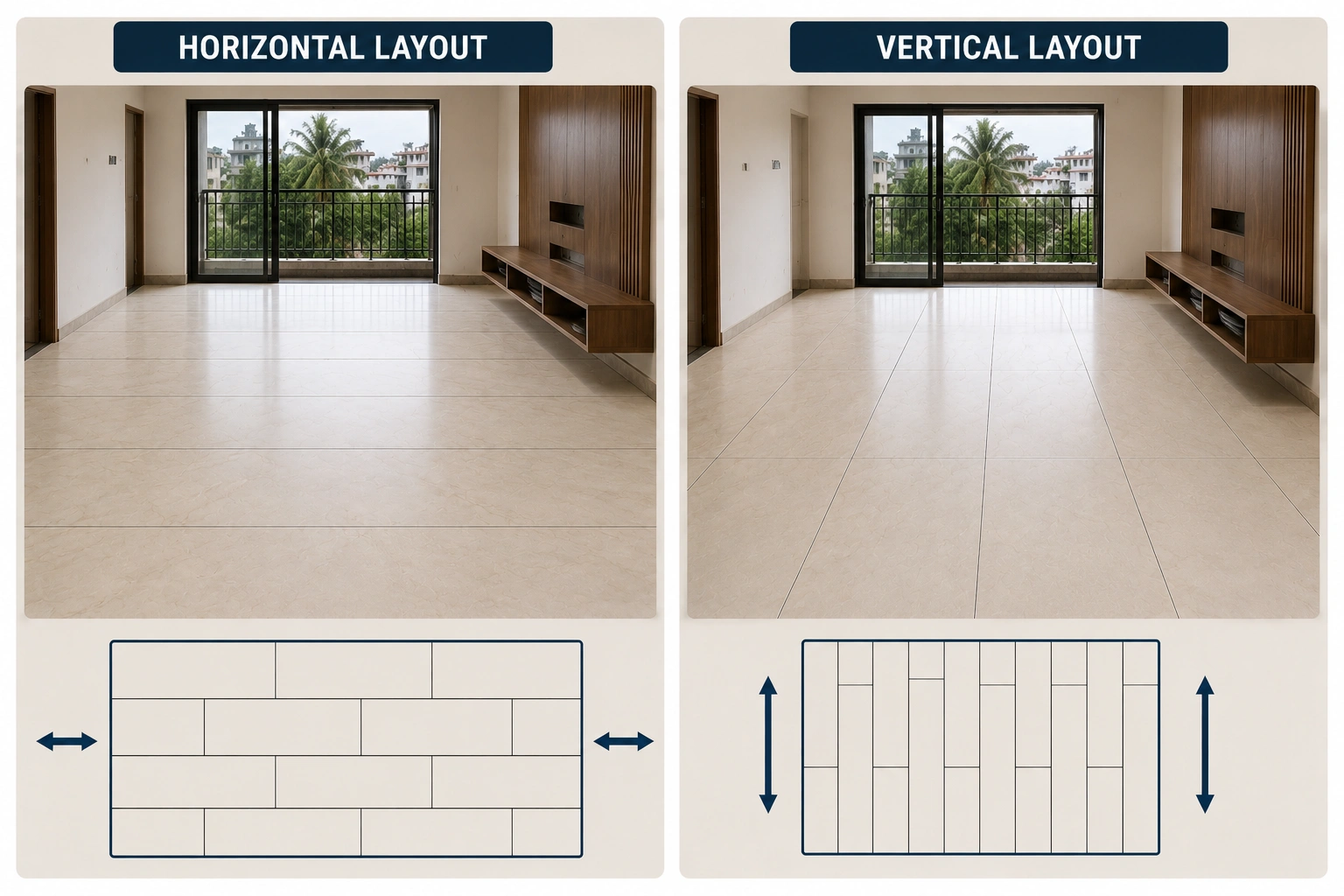
This is the most common pattern for 800x1600 tiles in Indian homes. All tiles run in one direction, either with the long side horizontal (landscape) or vertical (portrait). Landscape is the standard choice for floors.
Straight lay gives the lowest wastage of all patterns for this size. Cuts only happen at the room edges, and you get cleaner, longer grout lines that align with architectural lines like walls, doors, and skirting boards.
Offset (Half-Brick) Pattern
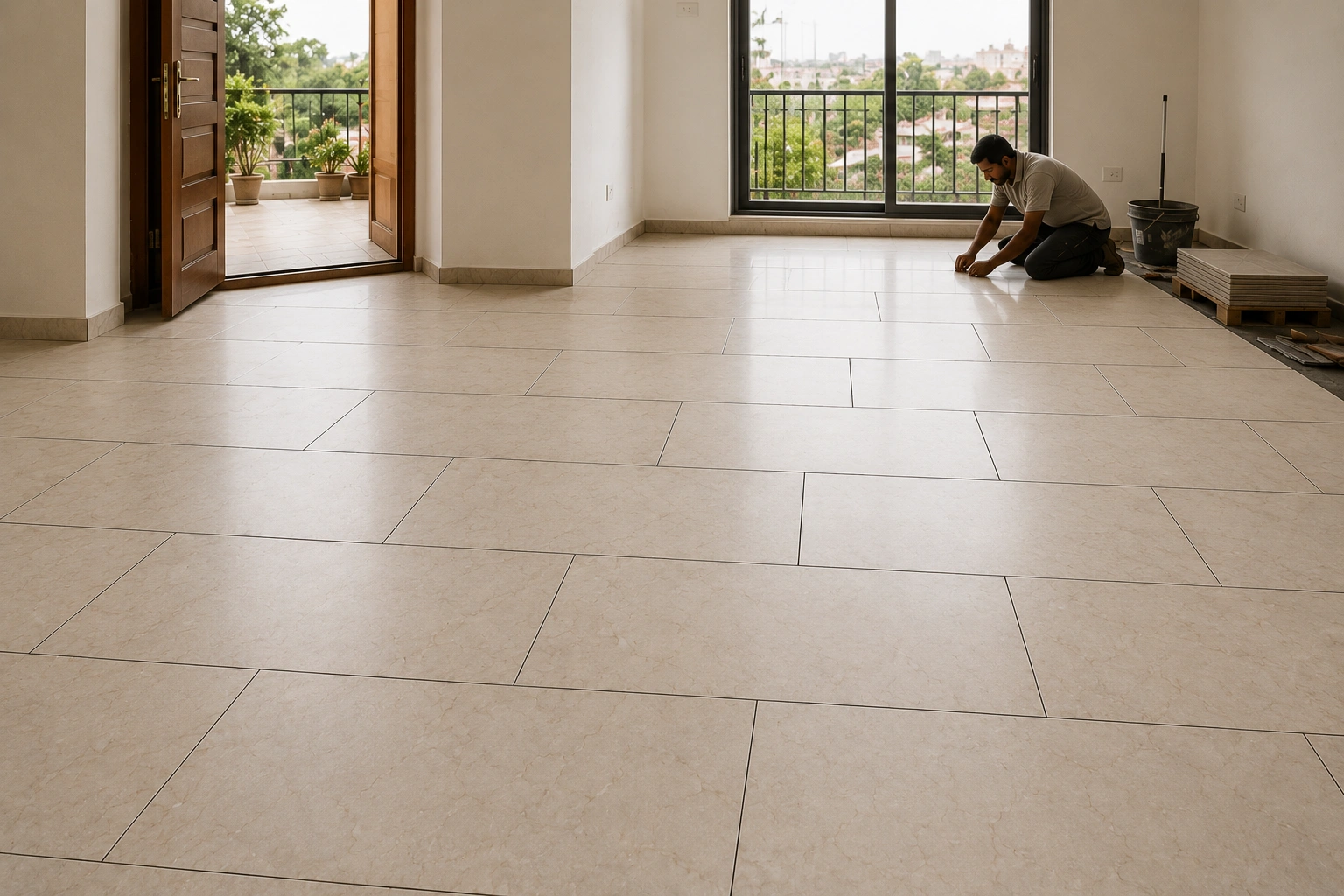
The offset pattern staggers each row by half the tile length, 800 mm. This breaks the monotony of straight joints and gives a more contemporary look that many Indian homeowners prefer for living rooms in 2026.
Wastage with offset is typically 12 to 15 per cent on a room with good dimensions. The half-tile cuts at the ends of each staggered row produce off-cuts of exactly 400 mm, which can sometimes be reused in other rows. If your mason has experience with large-format tiles, this pattern gives good results with minimal added waste.
Feature Wall Vertical Run
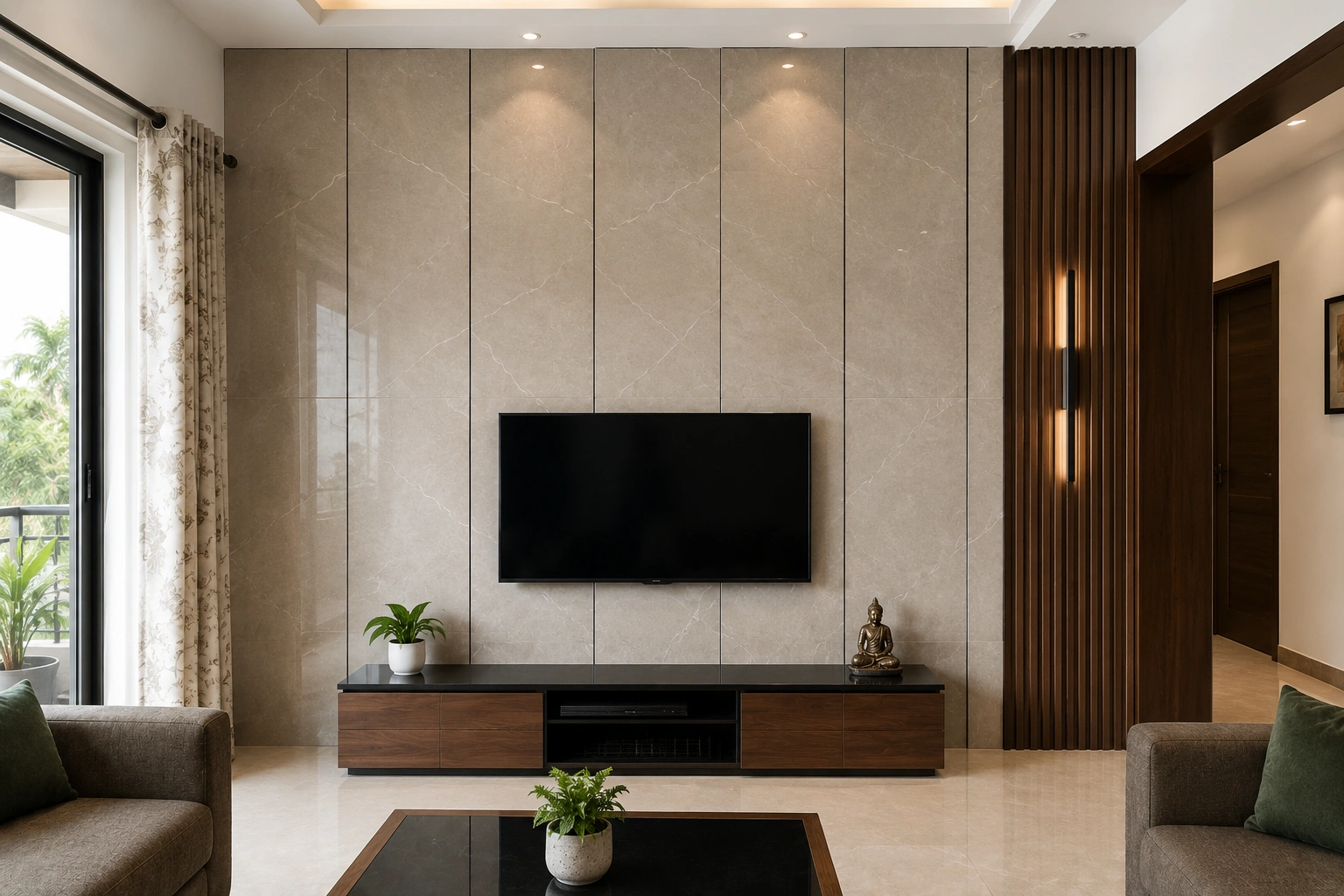
On accent walls, 800x1600 tiles are typically run vertically with the 1600 mm dimension going upward. For a standard 9 ft (2740 mm) ceiling, one tile covers from floor to near ceiling with a cut piece of only 140 mm at the top, which sits behind the false ceiling or cornice. This is one of the most efficient uses of this tile size.
If you are considering larger slab formats for your feature wall instead, the large format tile comparison covering 800x1600 vs 1200x1800 vs 1200x2400 explains how each size behaves on walls, what the cutting implications are, and which format suits which wall dimension in Indian homes.
| Laying Pattern | Typical Wastage % | Best Room Type | Visual Effect |
| Straight Lay (Horizontal) | 10 to 12% | All rooms | Classic, calm, wide |
| Straight Lay (Vertical) | 10 to 12% | Narrow corridors | Tall, elongated |
| Offset (Half-Brick) | 12 to 15% | Living rooms, halls | Contemporary, layered |
| Feature Wall Vertical | 8 to 10% | Accent walls | Dramatic, full-height |
| Diagonal (45 degrees) | 18 to 22% | Not recommended | Dynamic but wasteful |
GVT vs PGVT in 800x1600: Which Works Where
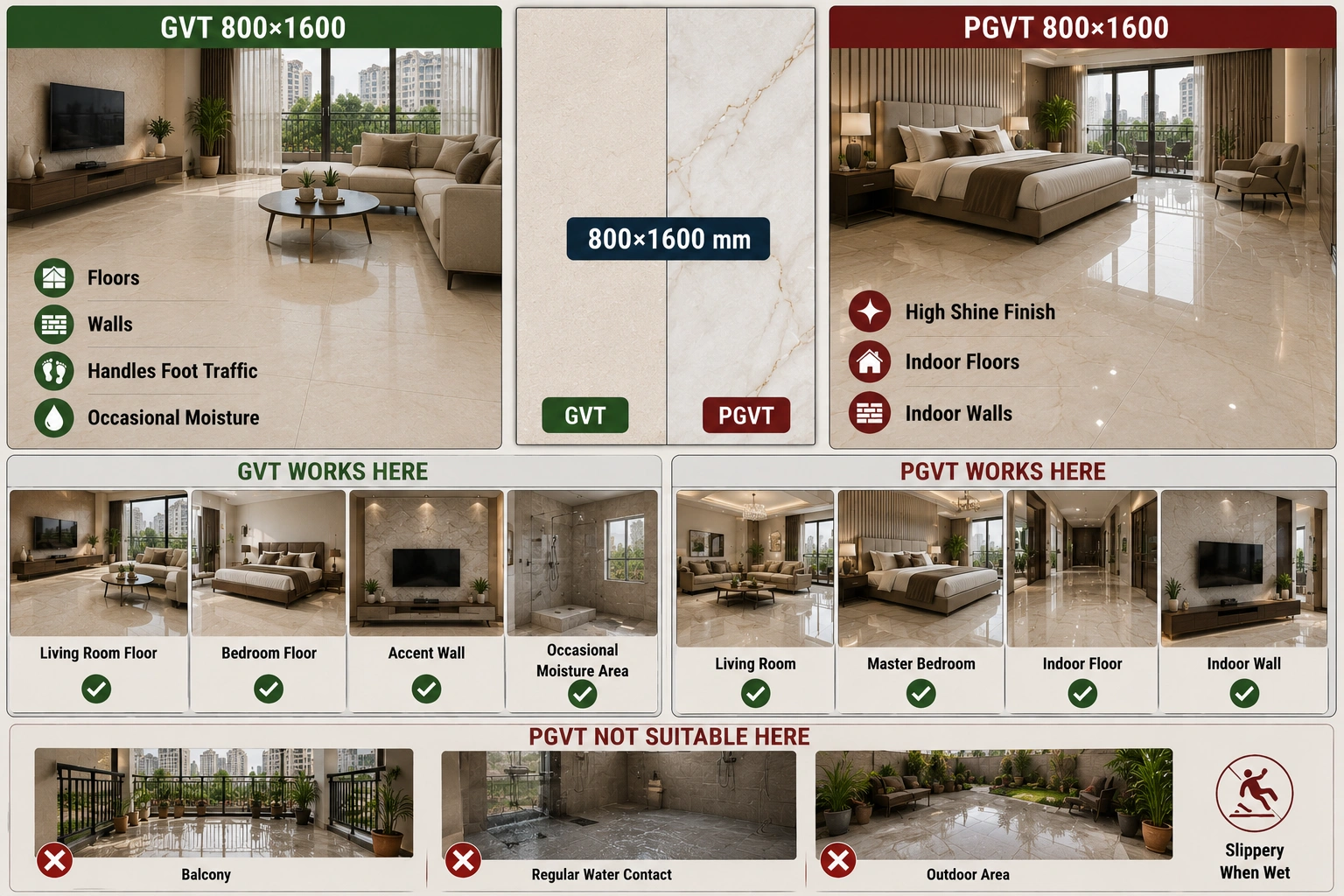
Both GVT and PGVT are available in the 800x1600 mm size. The choice depends on the room and its use, not just the look.
GVT (Glazed Vitrified Tiles) in 800x1600 works on both floors and walls. Matte, GHR, or posh finish options make it suitable for living room floors, bedroom floors, and accent walls. It handles foot traffic well and can go in areas that see occasional moisture.
PGVT (Polished Glazed Vitrified Tiles) in 800x1600 is for indoor floors and walls only. The polished surface gives a high-shine finish in living rooms and master bedrooms. But PGVT should not be used in wet zones, on balconies, or in any area with regular water contact. It is slippery when wet and not suited for outdoor use.
| Category | 800x1600 Available? | Floor OK? | Wall OK? | Wet Area? | Outdoor? |
| GVT | Yes | Yes | Yes | Yes | Yes |
| PGVT | Yes | Indoor only | Yes | No | No |
| Full Body | Yes | Yes | Yes | Yes | Yes |
| Colour Body | Yes | Yes (premium projects) | Yes | Yes | Yes |
Common Mistakes That Increase Wastage
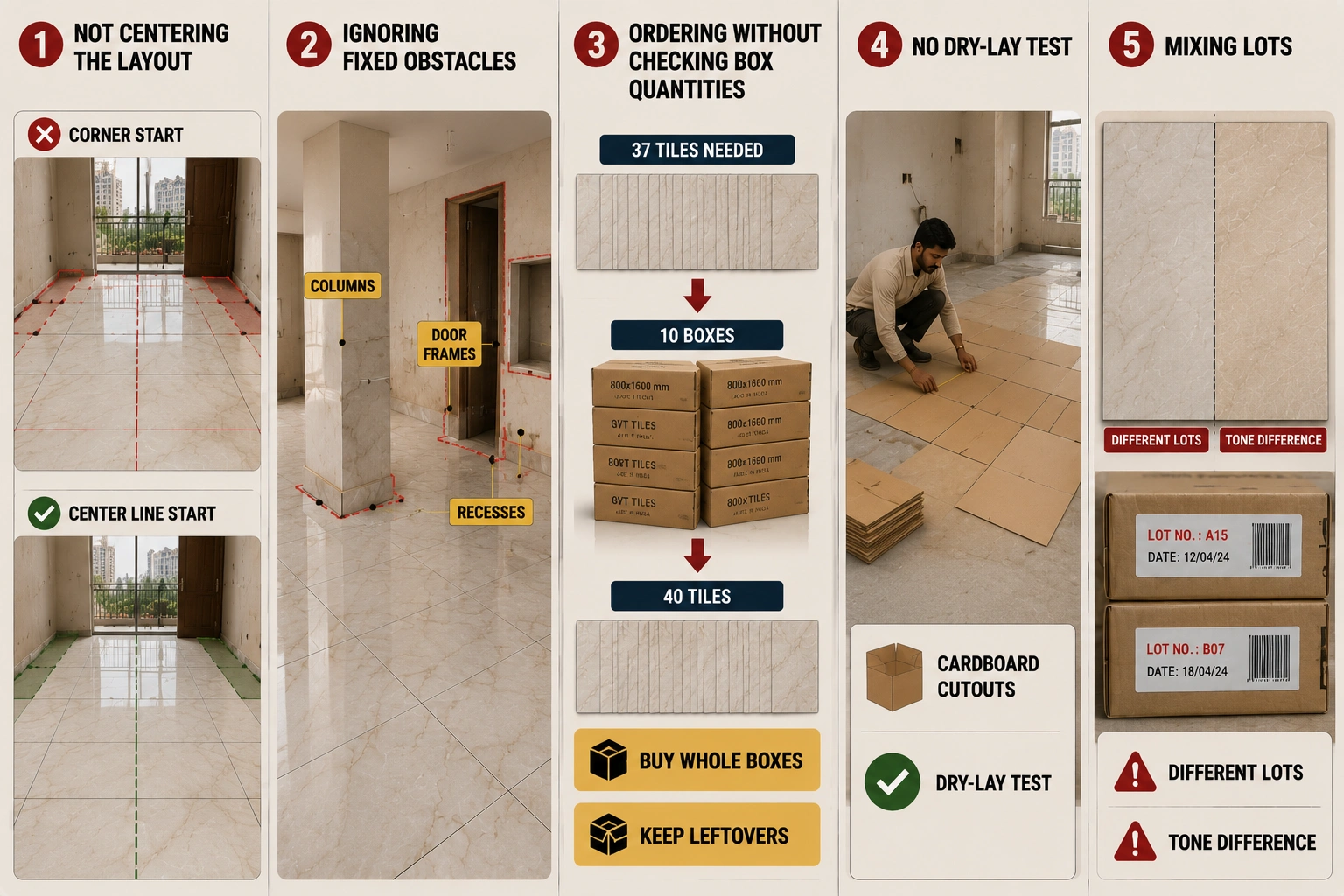
Not centring the layout. Starting tiles from a corner rather than the centre of the room means large cuts end up in the most visible spots, near doorways and furniture gaps. Always start from the centre line of the room and work outward.
Ignoring fixed obstacles. Columns, recesses, door frames, and bathroom openings create irregular cuts. Map every obstacle before laying starts. Each irregular cut on an 800x1600 tile is a near-complete tile loss.
Ordering without checking box quantities. Tiles come in boxes with a fixed number of tiles per box. If you need 37 tiles but each box holds 4, you must buy 10 boxes (40 tiles). Buy in whole boxes and treat the leftovers as your final buffer stock.
Trusting the mason to calculate without a dry-lay. Many masons still work with smaller tile sizes as their default format. Ask your contractor to do a dry-lay test with cardboard cutouts the same size as your tiles before actual work begins. This costs nothing and prevents expensive tile losses.
Mixing lots. 800x1600 tiles, especially marble-look GVT and PGVT, use random digital printing. Two tiles from different production lots can show visible tonal differences side by side. Order your full requirement from one batch number and verify the lot number on every box before the mason opens them.
Plan Your 800x1600 Tile Layout Before You Buy
Before you finalise your tile order, lay out your room dimensions against the 800x1600 size and check what the cut pieces look like at every edge. A quick sketch on graph paper or a conversation with your tile dealer about your room measurements goes a long way in avoiding over-ordering or, worse, falling short mid-installation.
You can also browse 800x1600 tiles by category, finish, and price range on TilesFinders to compare GVT and PGVT options from Indian manufacturers before you visit a showroom.
FAQs
The practical minimum is a room with both dimensions above 2400 mm (approximately 8 ft x 8 ft). Below this, cut pieces become smaller than half a tile and wastage climbs above 20 per cent. Most tile designers in India recommend 800x1600 tiles only for rooms above 100 sq. ft., with at least one dimension of 3000 mm or more.
Add 10 per cent for a straight lay pattern in a well-proportioned room. Add 12 to 15 per cent for an offset pattern. Add 15 to 18 per cent if the room has columns, niches, or irregular shapes. For feature walls with vertical runs, 8 to 10 per cent is usually enough if the ceiling height divides well into 1600 mm.
Yes, but with caution. Master bedrooms in 2BHK flats typically run 120 to 150 sq. ft., which works for 800x1600 if at least one room dimension is 3000 mm or above. Children's rooms and smaller bedrooms under 100 sq. ft. are better served by 600x1200 mm tiles to keep wastage under control.
Yes, and it is a popular choice for Indian living rooms. The offset pattern staggers rows by 400 mm (half of 800 mm). It adds 2 to 5 per cent to wastage compared to straight lay, but gives a more contemporary look with broken joint lines. Make sure your mason has experience with large-format tiles before choosing this pattern.
GVT is more versatile. It works on floors and walls, handles moisture, and comes in matte and GHR finishes that hold up in daily use. PGVT gives a polished look but is limited to indoor dry areas. For living rooms and bedrooms where the floor stays dry, PGVT is a good pick. For any area with regular water contact, choose GVT.
One 800x1600 tile covers 13.77 sq. ft. For 100 sq. ft., you need approximately 7.3 tiles, so 8 tiles minimum. Add your wastage buffer on top. For a 200 sq. ft. room with 10 per cent wastage, the calculation is: ceiling(200 x 1.10 divided by 13.77) = 17 tiles. Always round up to the nearest full box.

See our tile guides first
Set TilesFinders as a preferred source and our buying guides surface ahead of the rest for you.
Add as preferred sourceTakes one tap. Nothing to install.
What Readers Say
I was about to redo my parking area with the wrong tile size until I read this. The layout comparisons saved me from a costly mistake.
We reference TilesFinders guides while briefing clients on material selection. The size and pattern breakdowns are accurate and easy to explain visually.
On site, I get asked about grout spacing all the time. This article gave me a solid reference I now share with my team before every job.
Finally a guide that doesn't just push generic advice. The oil stain removal steps actually worked on our clubhouse driveway tiles.
I run a small construction firm and now send this link to clients directly when they ask about entrance tile sizing. Saves me an hour of explaining.
Good practical detail, though I wish there were more examples for compact apartment entrances specifically, not just villas.
My mother-in-law wanted marble, I wanted vitrified. This blog gave us the neutral comparison we needed to actually decide together.
Detailed without being overwhelming. I appreciated that it covered both cost and maintenance, not just the aesthetics.
Used the algae and hard water removal tips on our terrace tiles after the monsoon. Worked better than what our regular cleaner was doing.
As someone who sources tiles for multiple builder projects, I find these comparisons genuinely useful for vendor conversations, not just consumer content.
Recommended this to a client who kept second-guessing the entrance design. The small vs large layout section settled the debate instantly.
Straightforward and honest, no unnecessary jargon. Would like to see a similar breakdown for outdoor pool-deck tiles next.
We've bookmarked several TilesFinders guides for our design handbook. Reliable source when clients want data, not just opinions.
Two paths, one marketplace.
Get free quotes from verified suppliers.
Share your room, budget, and style. Suppliers in Morbi respond within hours.
Get Free QuotesList your business, reach real buyers.
Put your showroom in front of homeowners searching for tiles right now.
List Your Business