Semi-Polished vs Polished vs Matte Floor Tiles: Slip Safety and Maintenance Reality Check
Compare matte, semi-polished, and polished floor tiles for slip safety, maintenance, repairability, and room-wise suitability. Learn which finish works best for Indian homes and commercial spaces.
- Slip Safety: Coefficient of Friction Compared
- Maintenance Reality: What Each Finish Actually Requires
- Repairability: The Long-Term Cost Factor Most Buyers Miss
- Room-by-Room: Which Finish Is Actually Safe
- How to Choose: The Honest Version
- Matte, Semi-Polished, and Polished Tiles in India: 2026 Market Context
- Compare Floor Tile Finishes on TilesFinders
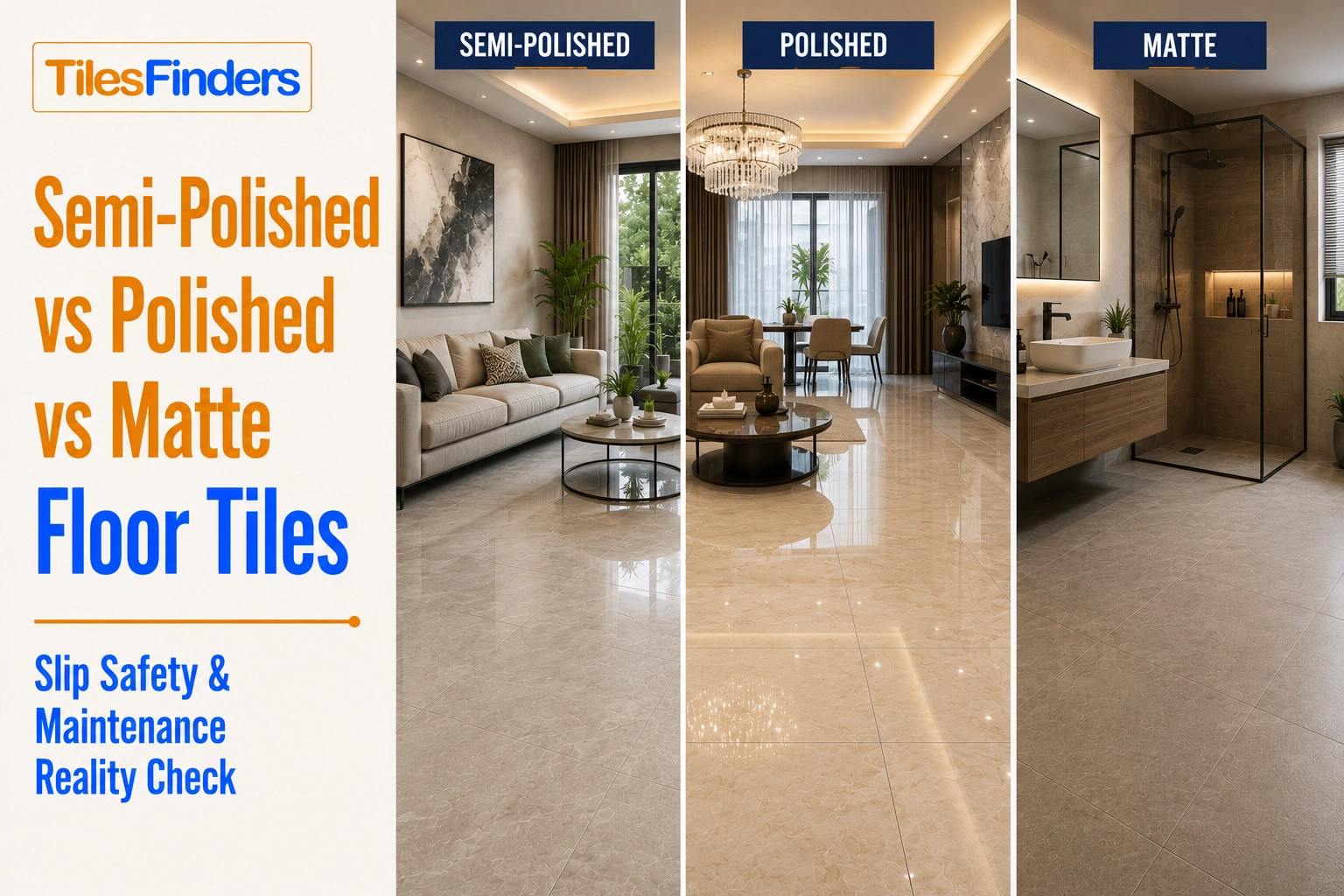
Matte tiles are the safest and lowest-maintenance choice for wet areas, while semi-polished and polished tiles are best reserved for dry spaces where appearance takes priority. Choose the finish based on slip safety, cleaning commitment, and long-term durability, not just the level of shine.
Every Indian tile buyer eventually faces the same three options for a floor: matte, semi-polished, or fully polished. The showroom presents all three as equally viable, differing only in how shiny they look. In reality, the differences between these three finishes govern whether a floor is safe to walk on when wet, and how many hours per week someone will spend mopping it to keep it looking acceptable. This guide gives an honest comparison across both dimensions.
This is a factual safety and maintenance comparison, not a design guide. For design ideas in each finish, see the dedicated guides for matte, polished, and semi-polished tile applications.
Slip Safety: Coefficient of Friction Compared
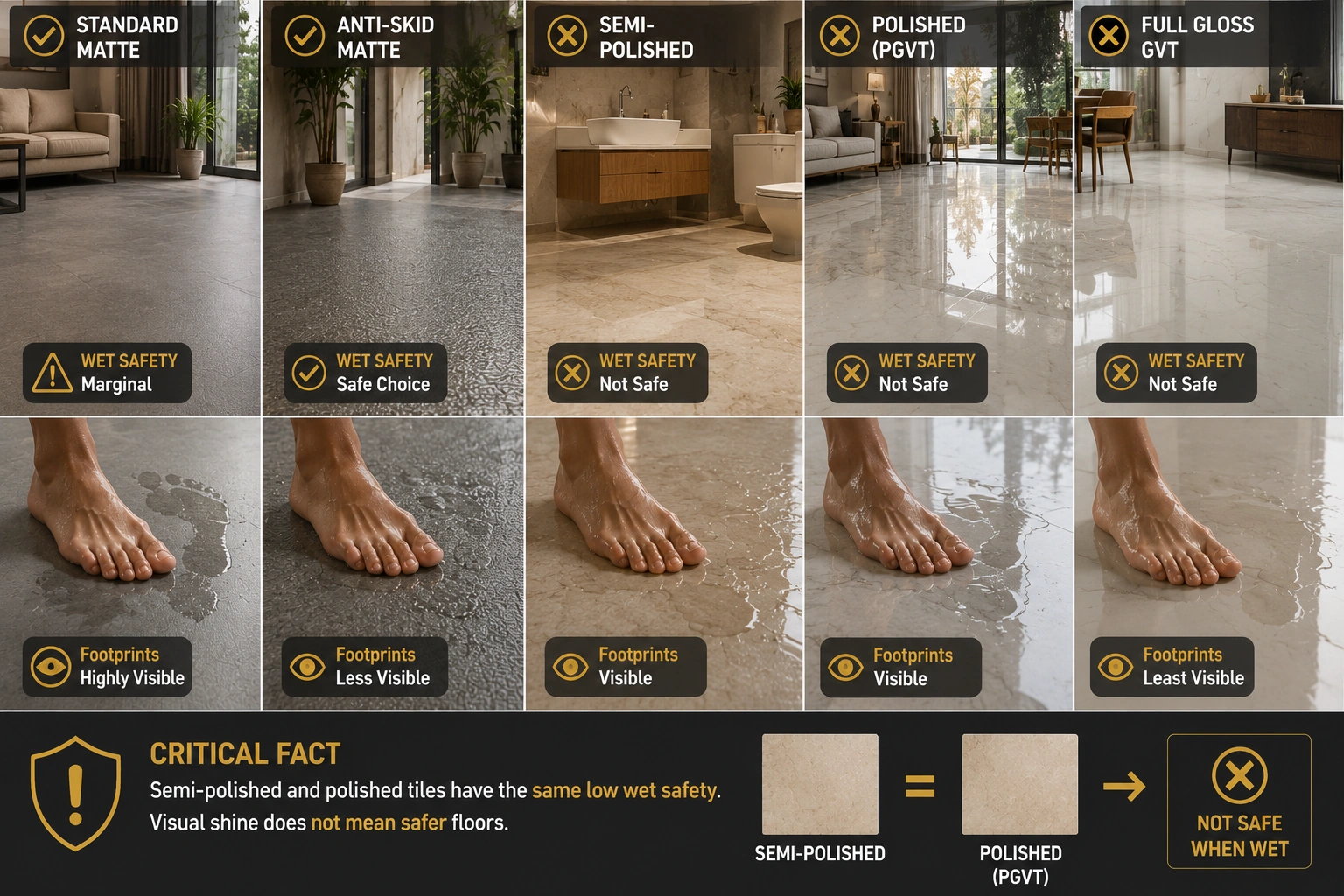
The coefficient of friction (COF) is the measurable figure that determines whether a floor is safe when wet. This is not a matter of visual judgement or showroom impression. It is a tested, quantifiable property that should appear on every tile's technical data sheet (TDS).
| Finish | Dry COF (approximate) | Wet COF (approximate) | Minimum Safe Wet COF for Indian Floors | Meets Safety Threshold? |
| Standard matte | 0.55 to 0.65 | 0.35 to 0.45 | 0.40 wet minimum | Marginal. Confirm anti-skid COF designation for any wet-area floor. |
| Anti-skid matte | 0.60 to 0.75 | 0.42 to 0.55 | 0.40 wet minimum | Yes, when specifically rated. This is the only finish category engineered to meet the safety threshold reliably. |
| Semi-polished | 0.45 to 0.55 | 0.20 to 0.30 | 0.40 wet minimum | No. Below the safety threshold by a significant margin. |
| Polished (PGVT / double charge) | 0.40 to 0.50 | 0.20 to 0.30 | 0.40 wet minimum | No. Below the safety threshold. Same range as semi-polished. |
| Full gloss ceramic or GVT | 0.35 to 0.45 | 0.15 to 0.25 | 0.40 wet minimum | No. The furthest below the safety threshold of any finish category. |
Critical fact: Semi-polished and fully polished tiles have essentially the same wet COF range, both well below the safety threshold for any Indian wet-area floor. The visual difference between semi-polished and full polish (moderate sheen versus mirror sheen) does not translate into a meaningful safety difference. Both are equally dangerous when wet, and neither should be specified for bathroom floors, kitchen floors, outdoor floors, or staircase treads without a specific anti-skid COF confirmation, which these finish categories typically do not carry.
Maintenance Reality: What Each Finish Actually Requires
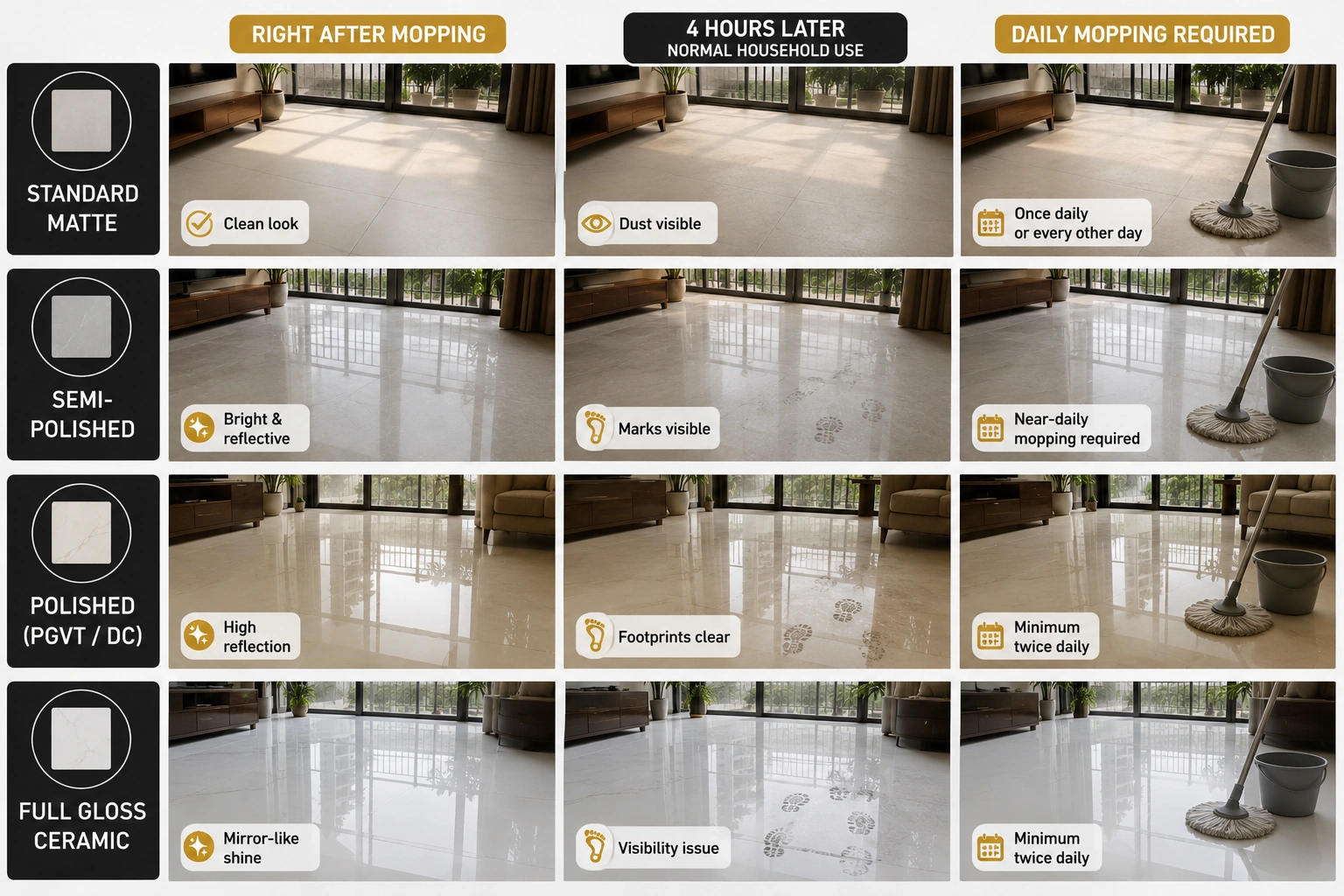
| Finish | Appearance Right After Mopping | 4 Hours Later (Normal Household Use) | Daily Mopping Required | 5-Year Appearance (No Professional Care) |
| Standard matte | Clean and even. No sheen to disrupt. | Looks the same. Dust is visible on close inspection, but does not read as a dramatic change. | Once daily or every other day is generally sufficient. | Consistent. Matte does not dull because there is no sheen to lose. |
| Semi-polished | Moderately reflective and bright. | Footprints and dust are visible as disruptions to the moderate reflection. Noticeably less crisp than immediately after mopping. | Near-daily mopping is required to maintain the intended appearance. | Visible dulling at high-traffic points. Micro-scratching accumulates and cannot be restored without professional intervention. |
| Polished (PGVT / DC) | Highly reflective, near-mirror in good examples. | Footprints are clearly visible from across the room. Any dust reads as a haze against the reflective surface. | Minimum twice daily for a household with normal activity levels. | Noticeable dulling at high-traffic points for PGVT. Double charge holds up better due to full-body colour, but both require professional re-polishing to restore original appearance. |
| Full gloss ceramic | Very bright and mirror-like. | Same visibility issue as polished GVT, and additionally, not repairable if scratched since the gloss is a fired glaze layer. | Minimum twice daily. | Permanent scratches accumulate with no restoration option. Glaze-based gloss cannot be re-polished. |
Repairability: The Long-Term Cost Factor Most Buyers Miss
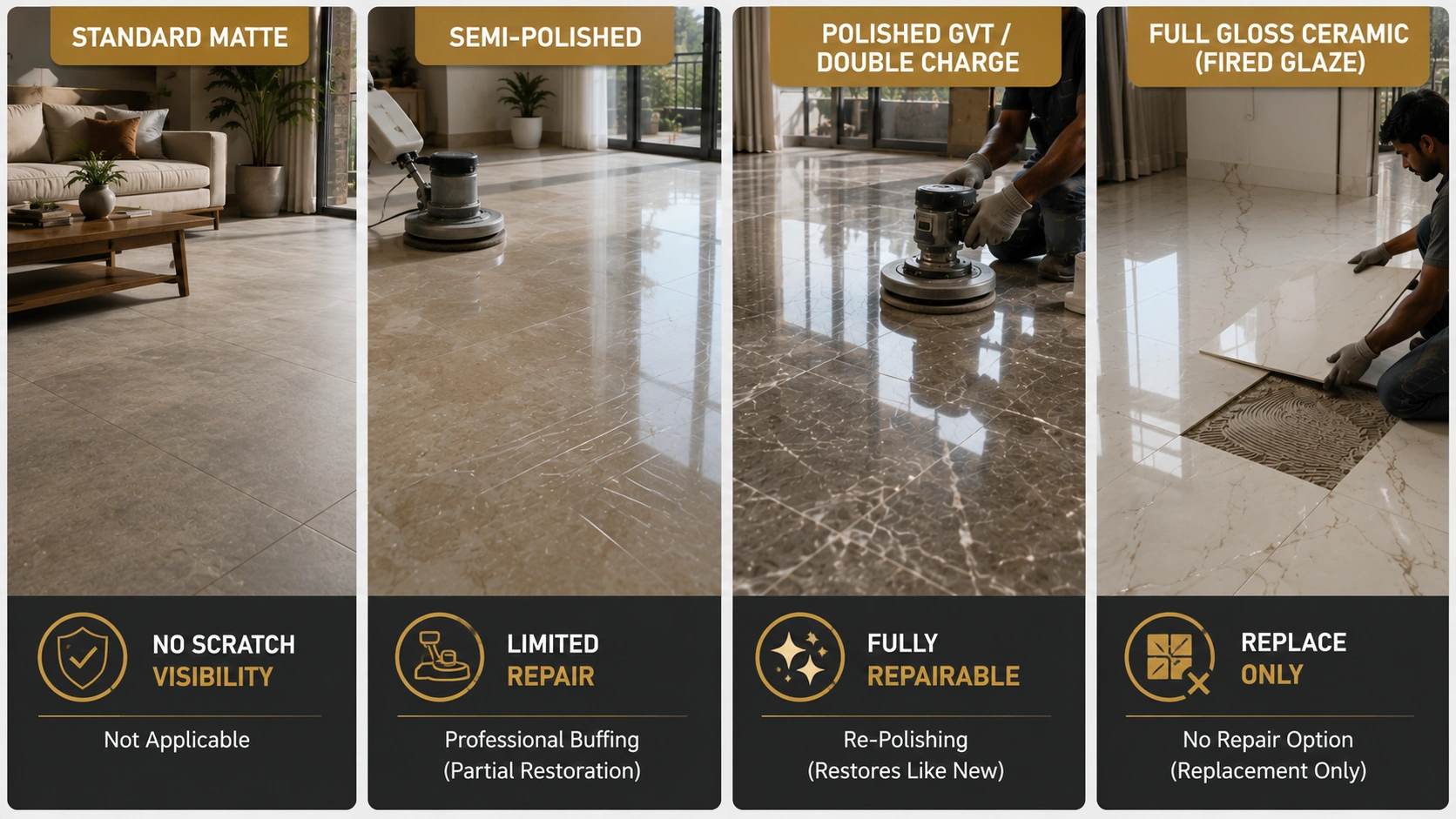
| Finish | Can Scratches Be Repaired? | Repair Method | Approximate Repair Cost (200 sq. ft. floor) |
| Standard matte | Not applicable. Matte does not show scratches the way reflective finishes do. | N/A | N/A |
| Semi-polished | Partially. Light scratches can sometimes be reduced through professional buffing, but the moderate polish depth limits how much restoration is possible. | Professional buffing with fine abrasive pads has limited effectiveness. | Rs. 4,000 to Rs. 9,000 for partial restoration, with uncertain results |
| Polished GVT / double charge | Yes. Full professional re-polishing with progressively finer diamond abrasive pads restores the surface close to original condition. | Diamond abrasive pad re-polishing is the same process used on natural stone. | Rs. 3,000 to Rs. 8,000 for full re-polishing |
| Full gloss ceramic (fired glaze) | No. The glaze is a fired surface layer that cannot be mechanically restored once scratched. | None available. Replacement is the only remedy. | Rs. 8,000 to Rs. 20,000 or more for tile replacement, including labour and colour-matching risk |
Want to understand why semi-polished tiles sit between matte and polished finishes? Read our Semi-Polished Tiles Explained guide to learn about their manufacturing process, performance characteristics, maintenance needs, and where they work best in Indian homes.
Room-by-Room: Which Finish Is Actually Safe
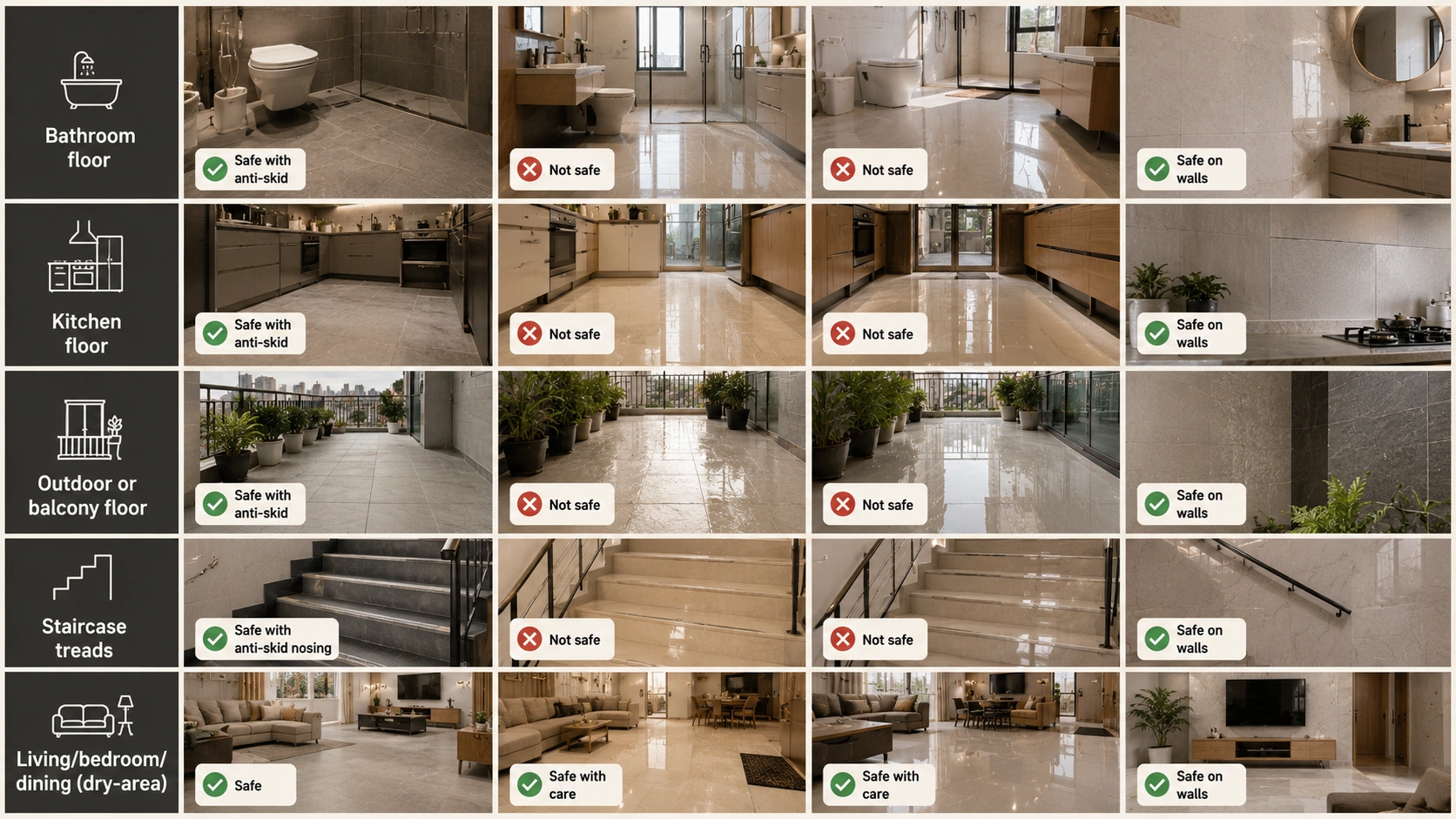
| Room | Matte | Semi-Polished | Polished |
| Bathroom floor | Safe only with confirmed anti-skid COF 0.4 wet. | Not safe under any circumstances. | Not safe under any circumstances. |
| Kitchen floor | Safe only with confirmed anti-skid COF 0.4 wet. | Not safe under any circumstances. | Not safe under any circumstances. |
| Outdoor or balcony floor | Safe only with confirmed anti-skid COF 0.5 wet and R11. | Not safe under any circumstances. | Not safe under any circumstances. |
| Staircase treads | Safe with anti-skid nosing and confirmed COF. | Not safe under any circumstances. | Not safe under any circumstances. |
| Living room, bedroom, dining room (dry-area) | Safe. No wet-contact risk in normal use. | Safe as a dry-area floor with informed maintenance acceptance. Add door mats at entries to reduce tracked-in moisture. | Safe as a dry-area floor with informed maintenance acceptance. Same precaution. |
| Any wall surface | Safe. No slip risk on vertical surfaces regardless of finish. | Safe. No slip risk. | Safe. No slip risk. |
How to Choose: The Honest Version
If the floor will ever get wet (bathrooms, kitchens, outdoors, staircases)
Matte is the only correct answer, and specifically anti-skid matte with a confirmed wet COF of 0.4 minimum. Semi-polished and polished are both unsafe regardless of price, brand, or how the showroom presents them. There is no version of semi-polished or polished tile that is appropriate for these floors.
If the floor is a dry area only (living room, bedroom, dining room)
All three are technically viable. The decision then comes down to how much daily maintenance the household can genuinely sustain. Matte: minimal maintenance, no visual drama. Semi-polished: near-daily mopping, moderate visual upgrade, partial repairability. Polished: twice-daily mopping minimum, maximum visual drama, full repairability if double charge or good-quality PGVT.
If you've decided that a semi-polished finish suits your dry areas, explore our Semi-Polished Tile Designs gallery for living rooms, bedrooms, dining spaces, and other interiors that balance subtle sheen with everyday practicality.
If long-term appearance over 10 or more years matters
Matte holds its appearance indefinitely with minimal effort. Polished GVT, specifically double charge, is the only reflective finish with a genuine restoration path through professional re-polishing. Semi-polished has limited restoration options. Full gloss ceramic has none. If a glossy dry-area floor is wanted for a decade or more, double charge tile with a periodic professional re-polishing plan is the only reflective option with a sound long-term maintenance strategy.
The honest summary: Semi-polished exists as a compromise between matte and full gloss in appearance only. It does not compromise on safety (both semi-polished and full polish are equally unsafe when wet), and it only partially compromises on maintenance demand (still close to daily mopping, still limited repairability). The clearest way to think about the choice: decide first whether the floor is a wet-area or dry-area, and only then decide how much sheen the dry-area floor should carry.
Matte, Semi-Polished, and Polished Tiles in India: 2026 Market Context
All three finish categories are manufactured extensively in Morbi, Gujarat, under IS 15622:2006 for GVT products at water absorption 0.05% or below. Anti-skid matte GVT is the most widely produced and most consistently available finish across all price tiers, from entry formats like 1x1 or 12x12 (300x300 mm) through premium slab formats like 8x4 (1200x2400 mm). Polished GVT and double charge tiles are produced primarily for dry-area residential and commercial applications, with double charge commanding a premium reflecting its more durable full-body colour construction. Semi-polished is typically a secondary finish option applied by manufacturers who also produce matte and full polish, with less consistent availability across designs and sizes.
The Indian market in 2026 continues to move toward anti-skid matte, satin matte, and sugar finish as the default residential specification, with polished and semi-polished increasingly reserved for commercial applications with professional daily cleaning, or for residential dry-area feature floors specified by buyers who understand and accept the maintenance trade-off.
Compare Floor Tile Finishes on TilesFinders
Anti-skid matte GVT for wet-area floors, and matte, semi-polished, and polished GVT for dry-area floors, are all available on TilesFinders from verified Morbi manufacturers. Request wet COF data in writing for any floor tile before ordering.
FAQs
Matte, specifically anti-skid matte with a confirmed wet COF of 0.4 minimum, is the only finish category safe for wet-area floors. Semi-polished and polished tiles both have wet COF in the range of 0.20 to 0.30, well below the 0.40 safety threshold, and are equally unsafe regardless of how different they look.
No. Both finishes have essentially the same wet coefficient of friction, typically 0.20 to 0.30, both well below the 0.40 minimum required for safe wet-area floors. The visual difference in sheen level does not translate into a meaningful safety difference between the two.
Standard matte requires the least maintenance, typically once daily or every other day, mopping. Semi-polished requires near-daily mopping. Fully polished tiles require a minimum of twice daily mopping in a household with normal activity levels to maintain their intended appearance.
Polished GVT and double charge tiles can be professionally re-polished using diamond abrasive pads to restore the surface close to original condition, typically costing Rs. 3,000 to Rs. 8,000 for a 200 sq.ft floor. Semi-polished tiles have limited restoration options through professional buffing with uncertain results. Full gloss ceramic with a fired glaze cannot be repaired at all and requires tile replacement.
0.40 wet coefficient of friction is the minimum safety threshold for Indian bathroom and kitchen floors, with anti-skid matte tiles rated R10 to R11 typically achieving 0.42 to 0.55 wet COF. This figure should be confirmed in writing from the manufacturer's technical data sheet before specifying any floor tile for a wet-area application.
Yes, on dry-area floors only: living rooms, bedrooms, and dining rooms with no wet-contact risk, and with the household or facility fully informed of and prepared for the associated maintenance demand. These finishes should never be specified for bathroom floors, kitchen floors, outdoor floors, or staircase treads under any circumstances.

See our tile guides first
Set TilesFinders as a preferred source and our buying guides surface ahead of the rest for you.
Add as preferred sourceTakes one tap. Nothing to install.
What Readers Say
I was about to redo my parking area with the wrong tile size until I read this. The layout comparisons saved me from a costly mistake.
We reference TilesFinders guides while briefing clients on material selection. The size and pattern breakdowns are accurate and easy to explain visually.
On site, I get asked about grout spacing all the time. This article gave me a solid reference I now share with my team before every job.
Finally a guide that doesn't just push generic advice. The oil stain removal steps actually worked on our clubhouse driveway tiles.
I run a small construction firm and now send this link to clients directly when they ask about entrance tile sizing. Saves me an hour of explaining.
Good practical detail, though I wish there were more examples for compact apartment entrances specifically, not just villas.
My mother-in-law wanted marble, I wanted vitrified. This blog gave us the neutral comparison we needed to actually decide together.
Detailed without being overwhelming. I appreciated that it covered both cost and maintenance, not just the aesthetics.
Used the algae and hard water removal tips on our terrace tiles after the monsoon. Worked better than what our regular cleaner was doing.
As someone who sources tiles for multiple builder projects, I find these comparisons genuinely useful for vendor conversations, not just consumer content.
Recommended this to a client who kept second-guessing the entrance design. The small vs large layout section settled the debate instantly.
Straightforward and honest, no unnecessary jargon. Would like to see a similar breakdown for outdoor pool-deck tiles next.
We've bookmarked several TilesFinders guides for our design handbook. Reliable source when clients want data, not just opinions.
Two paths, one marketplace.
Get free quotes from verified suppliers.
Share your room, budget, and style. Suppliers in Morbi respond within hours.
Get Free QuotesList your business, reach real buyers.
Put your showroom in front of homeowners searching for tiles right now.
List Your Business