Semi-Polished Tiles: India's Middle-Ground Finish Explained
From glare and cleaning effort to room compatibility and performance expectations, discover the practical factors that matter before finalising a premium surface for your project.
- What Semi-Polished Actually Is
- Semi-Polished vs Satin Matte vs Full Gloss: The Practical Difference
- Where Semi-Polished Tiles Work in Indian Homes
- Semi-Polished Tile Design Ideas for Indian Interiors
- Buying Semi-Polished Tiles: What to Confirm
- Semi-Polished Tile Price Guide: India 2026
- Semi-Polished Tile Production in India: 2026 Context
- Browse Tile Finishes on TilesFinders
Semi-polished tiles provide a noticeable reflective upgrade over satin matte without reaching the mirror finish of full gloss, making them ideal for premium dry indoor spaces. They should never be used in bathrooms, kitchens, outdoor areas, or staircases because wet surfaces significantly increase slip risk.
Semi-polished sits in a specific and often confused position on the tile sheen spectrum: more reflective than satin matte, but well short of full gloss or polished GVT. It is the finish Indian tile suppliers reach for when a buyer wants a floor that reads as clearly upgraded from matte without committing to the maintenance demands of a fully glossy surface. Understanding exactly where semi-polished sits, what it can and cannot do, and where it should never be used is the difference between a satisfying floor and a slip hazard.
This guide explains what semi-polished tile actually is, how it compares to the surrounding finishes on the sheen spectrum, where it genuinely works in Indian homes, and the buying specifications that matter.
What Semi-Polished Actually Is
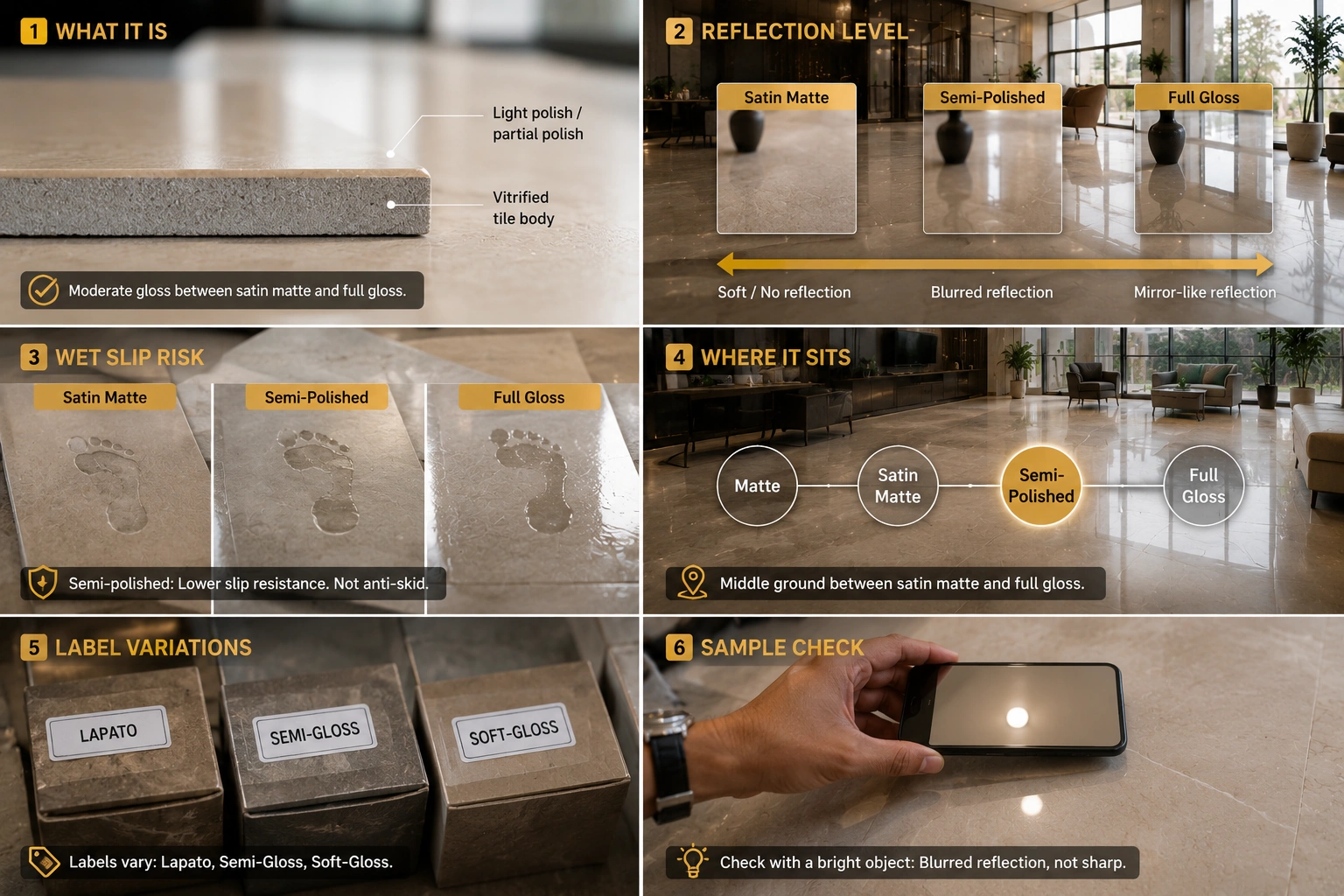
Semi-polished is a moderate-gloss surface treatment, applied either as a lightly polished glaze fired onto the tile, or as a partial mechanical polish on a vitrified tile body that stops short of the full multi-stage polishing process used for PGVT or double charge tiles. The result is a surface that begins to show reflections and room contents at close range, but does not achieve the mirror-like quality of full gloss.
| Finish | Gloss Level (GU) | Reflection Character | Wet Slip Risk | Where It Sits |
| Standard matte | 5 to 15 GU | No reflection. Fully diffuse. | Standard, safe with anti-skid confirmation | Baseline |
| Satin matte | 20 to 45 GU | Soft, even glow. No visible reflections of room contents. | Lower COF than standard matte. Not anti-skid. | One step above matte |
| Semi-polished | 45 to 70 GU | Begins to show blurred reflections of room contents and light sources at close range. | Lower than satin matte. Not anti-skid under any circumstances. | Middle ground between satin matte and full gloss |
| Full gloss / polished | 70 to 130 GU | Clear, mirror-like reflections of room contents. | Lowest COF of all finishes. Dangerous when wet. | Top of the sheen spectrum |
Note: Semi-polished is sometimes labelled by Indian suppliers as lapato, semi-gloss, or soft-gloss. These terms are used inconsistently across different Morbi manufacturers and importers. Always evaluate a physical sample under direct light: semi-polished should show a soft, blurred reflection of a bright object held close to the surface, distinctly less sharp than a fully polished or glossy tile, but clearly more reflective than a satin matte tile at the same distance.
Semi-Polished vs Satin Matte vs Full Gloss: The Practical Difference
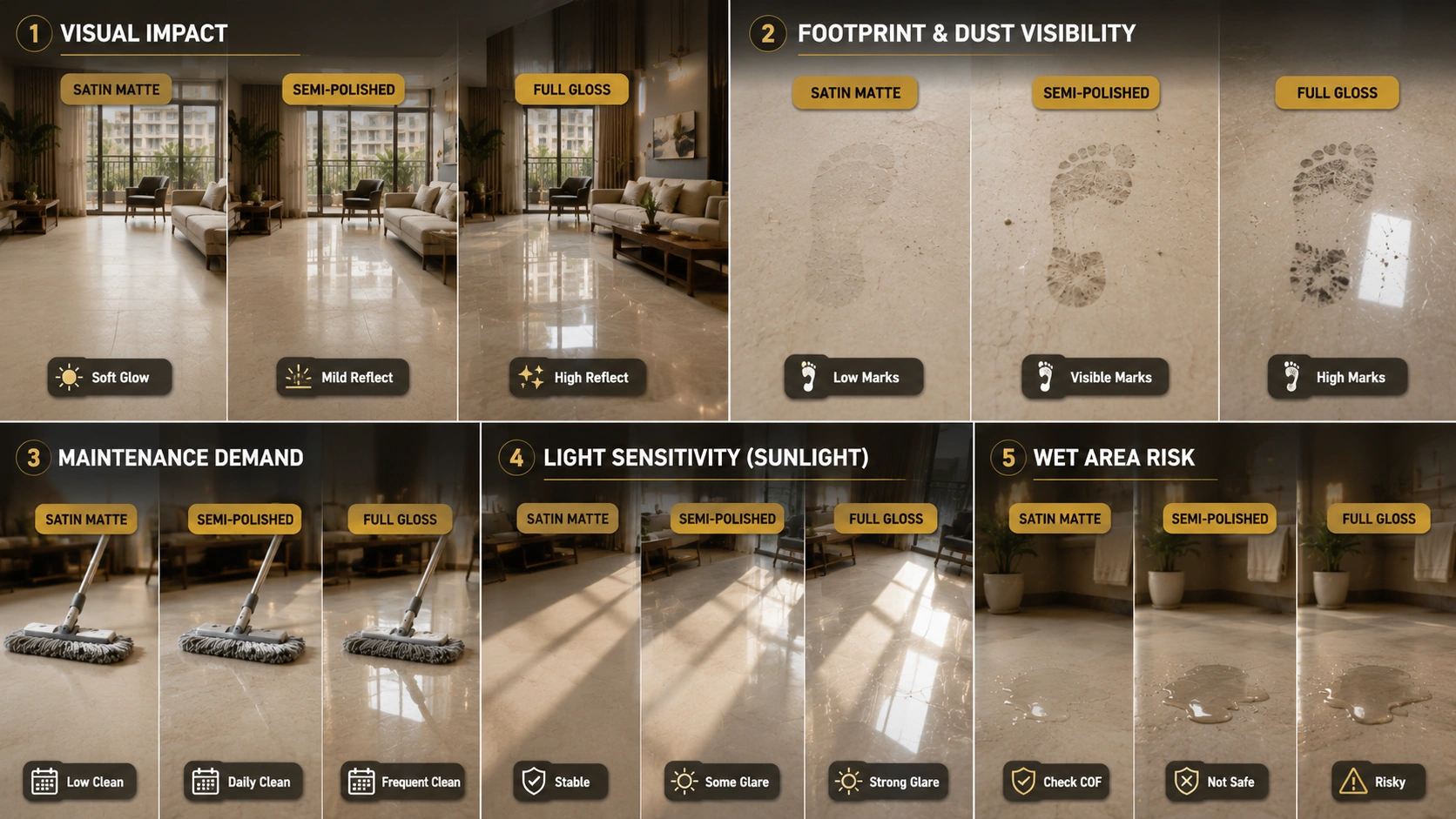
| Factor | Satin Matte | Semi-Polished | Full Gloss / Polished |
| Visual reading in a room | Refined, quiet glow. Recedes into the room. | Noticeably reflective. Draws attention as a considered material choice without dominating the room. | Dramatic, highly reflective. The floor itself becomes a visual statement. |
| Footprint and dust visibility | Low to moderate. | Moderate to high. More visible than satin matte, less than full gloss. | Highest. Every mark vis isible within minutes. |
| Daily maintenance demand (dry-area floor) | Weekly to twice-weekly mop. | Near-daily mop to maintain appearance under regular Indian household use. | Minimum twice daily mopping. |
| Light sensitivity across Indian conditions | Stable across most lighting conditions. | Moderately light-sensitive. Can show glare under direct sunlight and hot spots under strong artificial lighting. | Highly light-sensitive. Glare under direct sun, hot spots under any focused lighting. |
| Wet-area floor suitability | Not safe without anti-skid COF confirmation. | Not safe under any circumstances. Semi-polished should never be considered for wet-area floors regardless of COF claims. | Not safe without anti-skid COF confirmation, and even confirmed anti-skid glossy tiles remain a marginal specification. |
| Typical Indian application | Formal living rooms, bedrooms, and dining rooms. | Dry-area feature floors, showroom floors, some commercial dry-area applications, and decorative wall panels. | Commercial lobbies, hotel floors, luxury dry-area residential floors with maintenance acceptance. |
Verdict: Semi-polished is a genuine middle ground on the sheen spectrum, but it does not inherit satin matte's practical safety and maintenance advantages simply by being less glossy than full polish. In terms of wet-area safety, semi-polished behaves like a glossy tile, not a matte one. In terms of maintenance demand, it sits closer to full gloss than to satin matte. Buyers frequently misjudge semi-polished as a safer, lower-maintenance alternative to full gloss because of its intermediate name and appearance, when in practice, its wet-floor risk and daily upkeep are much closer to full gloss than to matte or satin matte.
Where Semi-Polished Tiles Work in Indian Homes
Dry-Area Feature Floors
-b3de4a3f-a01f-48e8-8ea9-5a953c08bbed.webp)
A semi-polished floor in a formal living room or dining room, in a home where the residents have chosen it deliberately and understand the maintenance commitment, is a legitimate application. The moderate reflectivity reads as a considered upgrade from standard matte without the extreme demands of full gloss. This works best in 2x4 (600x1200 mm) or larger formats where the reflective quality reads at room scale rather than as a busy grid of small reflective squares.
Showroom and Retail Display Floors
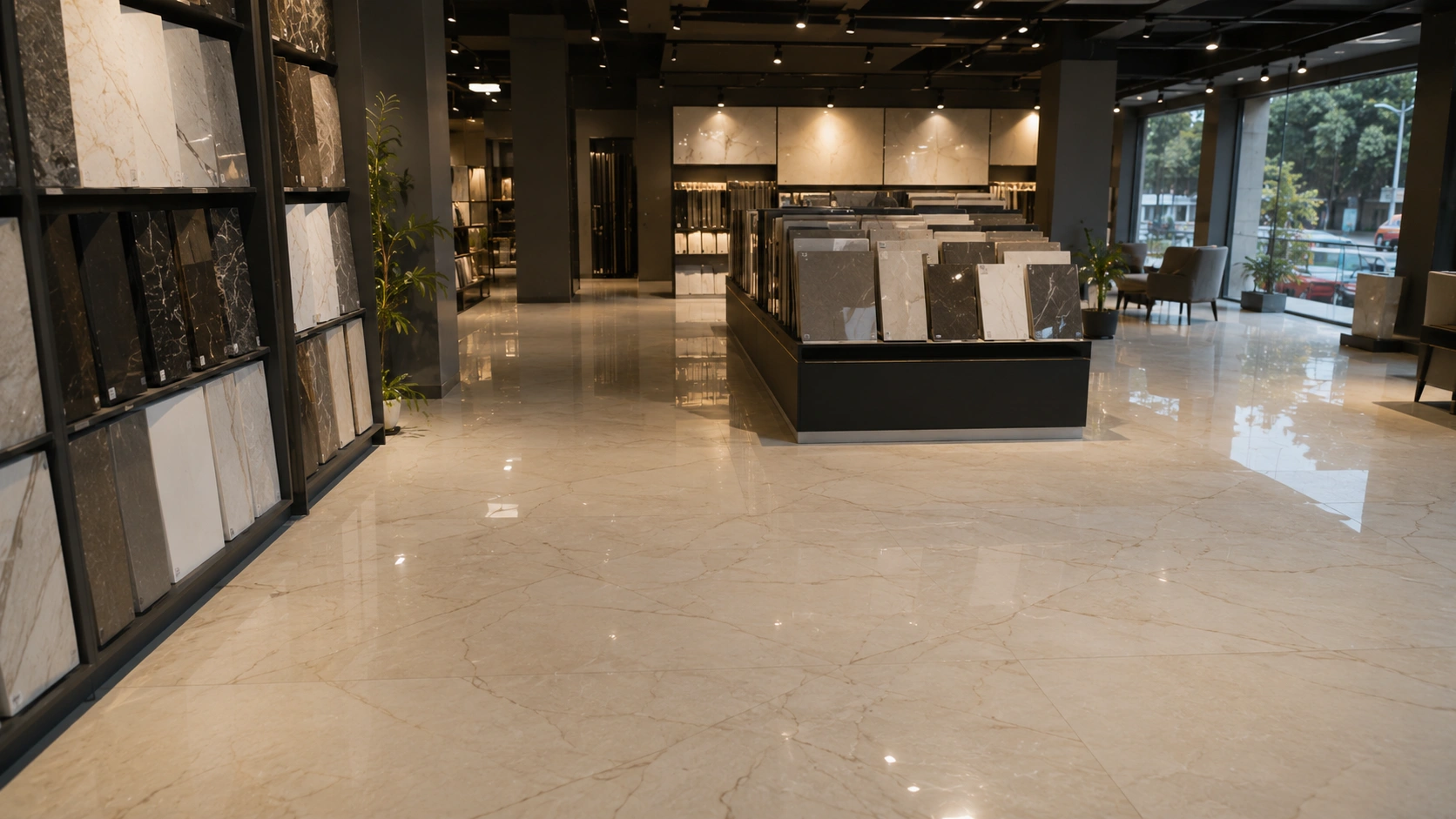
Commercial retail spaces, particularly jewellery showrooms, fashion boutiques, and premium product displays, use semi-polished flooring where daily professional cleaning is standard, and the moderate reflectivity supports the display lighting without the cost and installation complexity of full polished GVT or double charge tile.
Decorative Wall Panels and Vertical Surfaces
-161afbd5-ce84-4851-8a5e-935bc8c9611d.webp)
On any wall, semi-polished carries no slip risk and delivers a moderate reflective quality that suits a feature panel, an accent strip, or a full bathroom or kitchen wall where a step up from standard glossy ceramic is wanted without full mirror-finish drama.
Where Semi-Polished Should Never Be Used
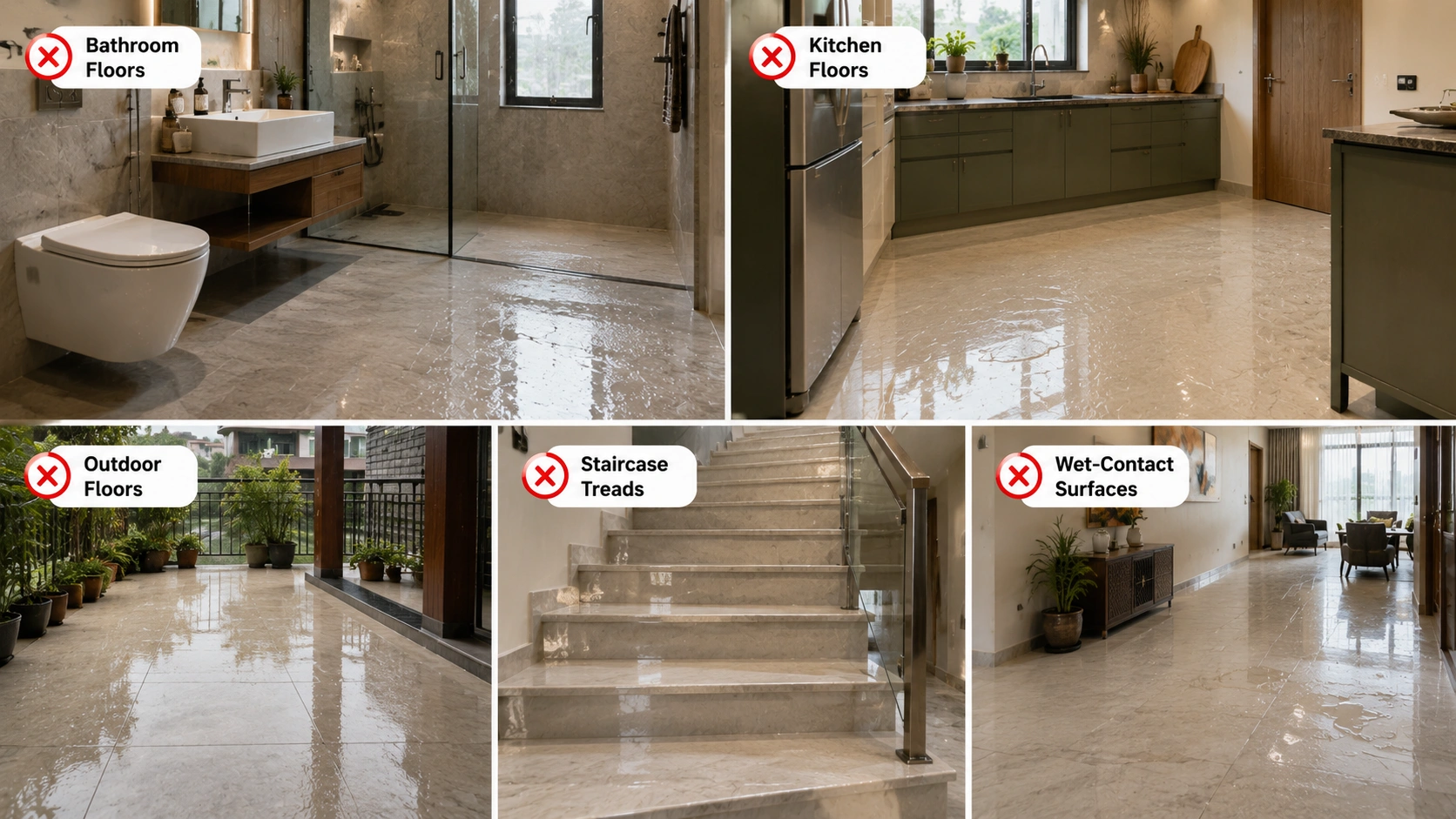
Critical caution: Semi-polished tiles must never be specified for bathroom floors, kitchen floors, outdoor floors, staircase treads, or any surface with wet-contact risk. The wet COF of semi-polished tile is close to that of full gloss, not close to standard or satin matte, despite the finish's intermediate name suggesting a middle-ground safety profile. This is the most common misunderstanding buyers have about semi-polished tile, and it is a safety-critical one. For any wet-area floor in an Indian home, specify anti-skid matte GVT with confirmed COF 0.4 wet minimum and R10 to R11 rating.
Semi-Polished Tile Design Ideas for Indian Interiors
Idea 1: Ivory Marble-Look Semi-Polished Living Room
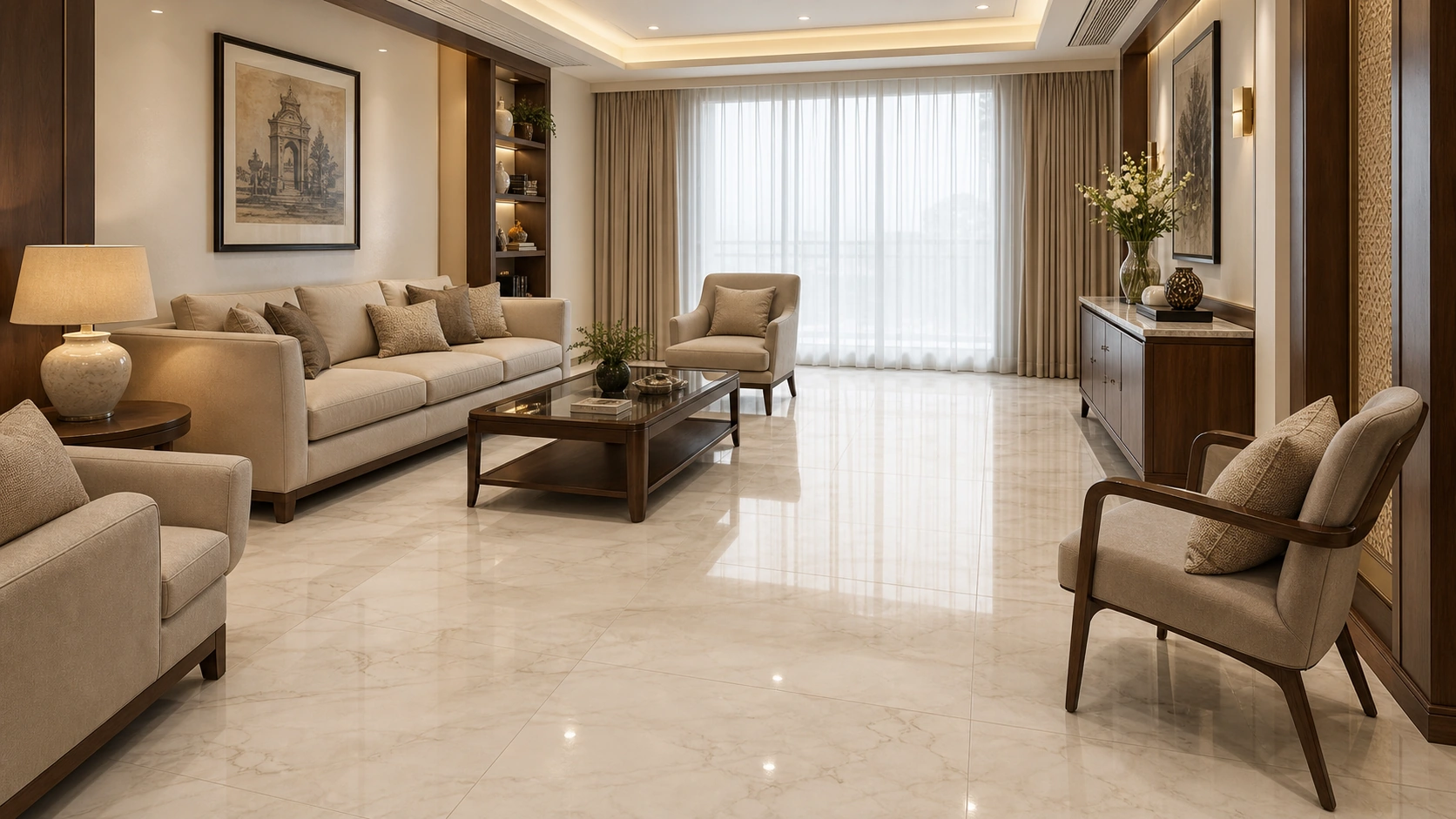
Ivory marble-look GVT | 2x4 (600x1200 mm) | Semi-polished | Rs. 110 to Rs. 160/sq.ft
An ivory marble-look GVT at 2x4 (600x1200 mm) in semi-polished finish for a living room where the household has committed to near-daily mopping delivers a noticeably upgraded appearance over standard matte with less maintenance risk than full gloss. Under warm-white recessed lighting, the moderate reflectivity reads as a soft glow with occasional blurred highlights rather than the sharp mirror effect of full polish.
Idea 2: Grey Stone-Look Semi-Polished Showroom Floor
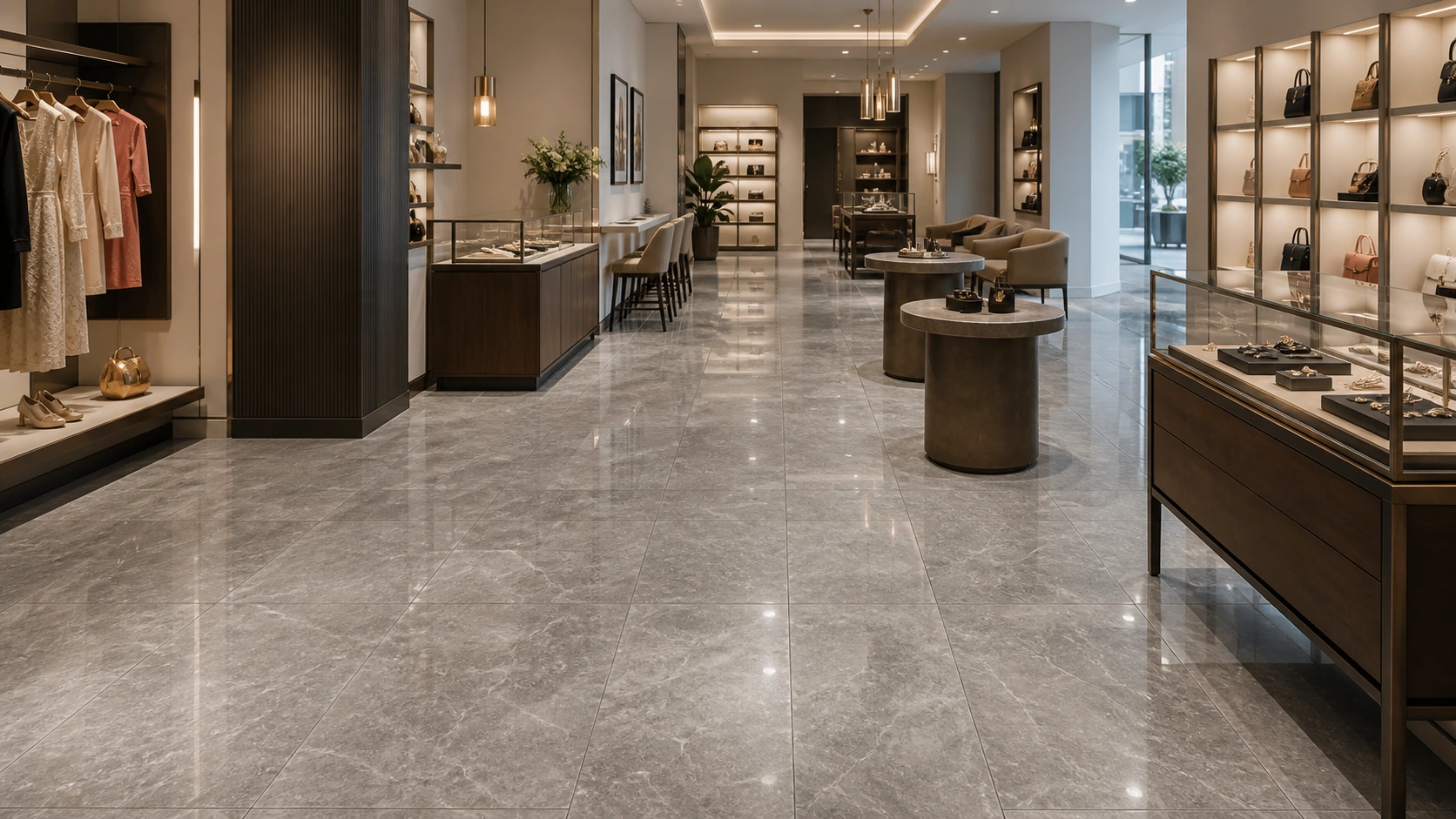
Grey stone-look GVT | 2x4 (600x1200 mm) | Semi-polished | Rs. 100 to Rs. 150/sq.ft
A grey stone-look semi-polished GVT floor for a retail showroom, where daily professional cleaning is standard, delivers a considered reflective quality that supports product display lighting without the installation complexity and cost premium of full polished GVT or double charge tile. This is one of the most common commercial applications for semi-polished tile in India.
Idea 3: White Semi-Polished Feature Wall Panel
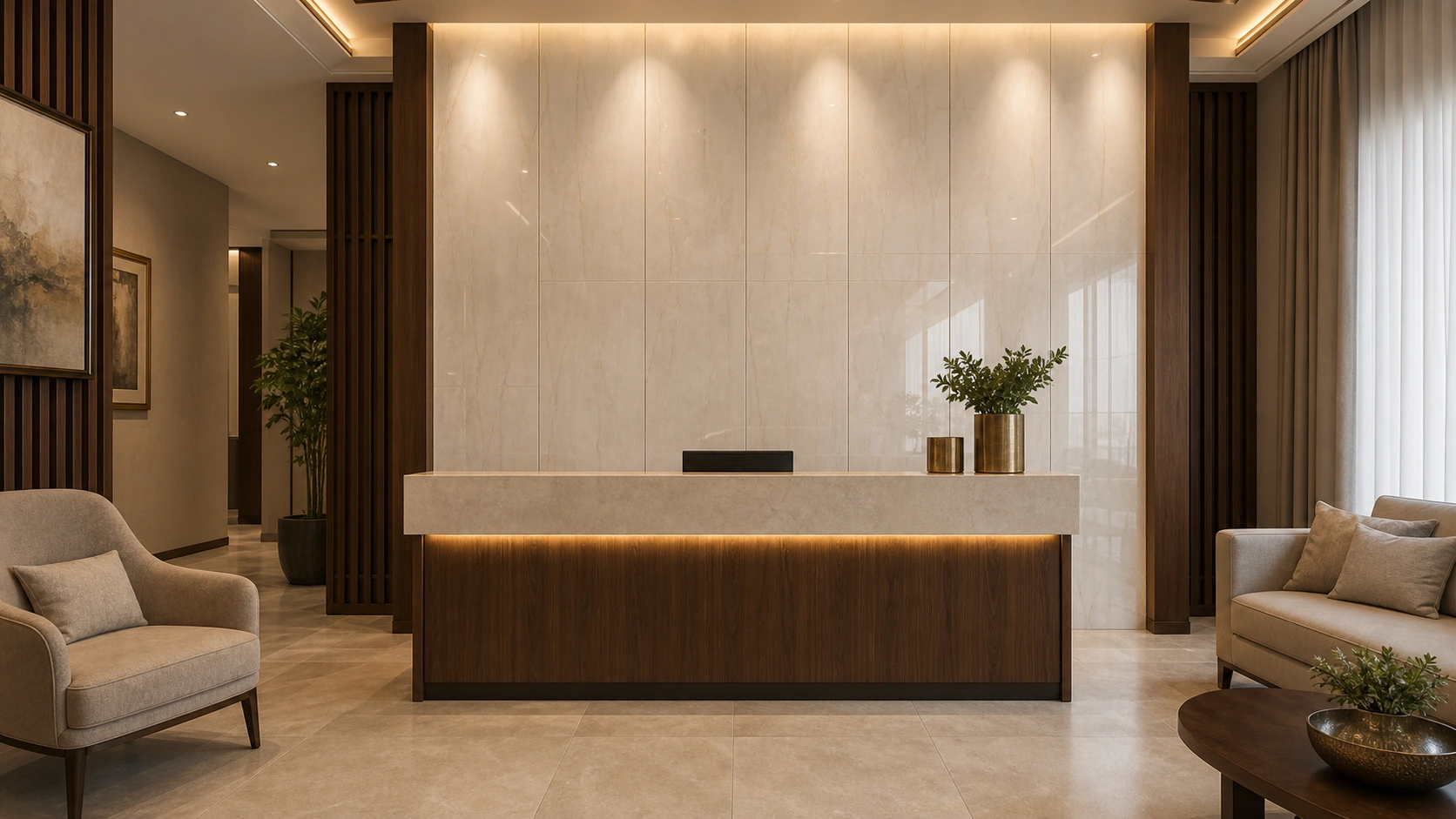
White or ivory ceramic or GVT | 2x4 (600x1200 mm) vertical | Semi-polished | Rs. 90 to Rs. 170/sq.ft
A semi-polished feature wall panel behind a reception desk, in a living room accent wall, or on a bathroom vanity wall creates a moderate reflective quality with no slip risk of any kind. This is the safest application for semi-polished tile in any Indian setting, since the wet-slip concern that governs floor use does not apply to vertical surfaces.
Buying Semi-Polished Tiles: What to Confirm
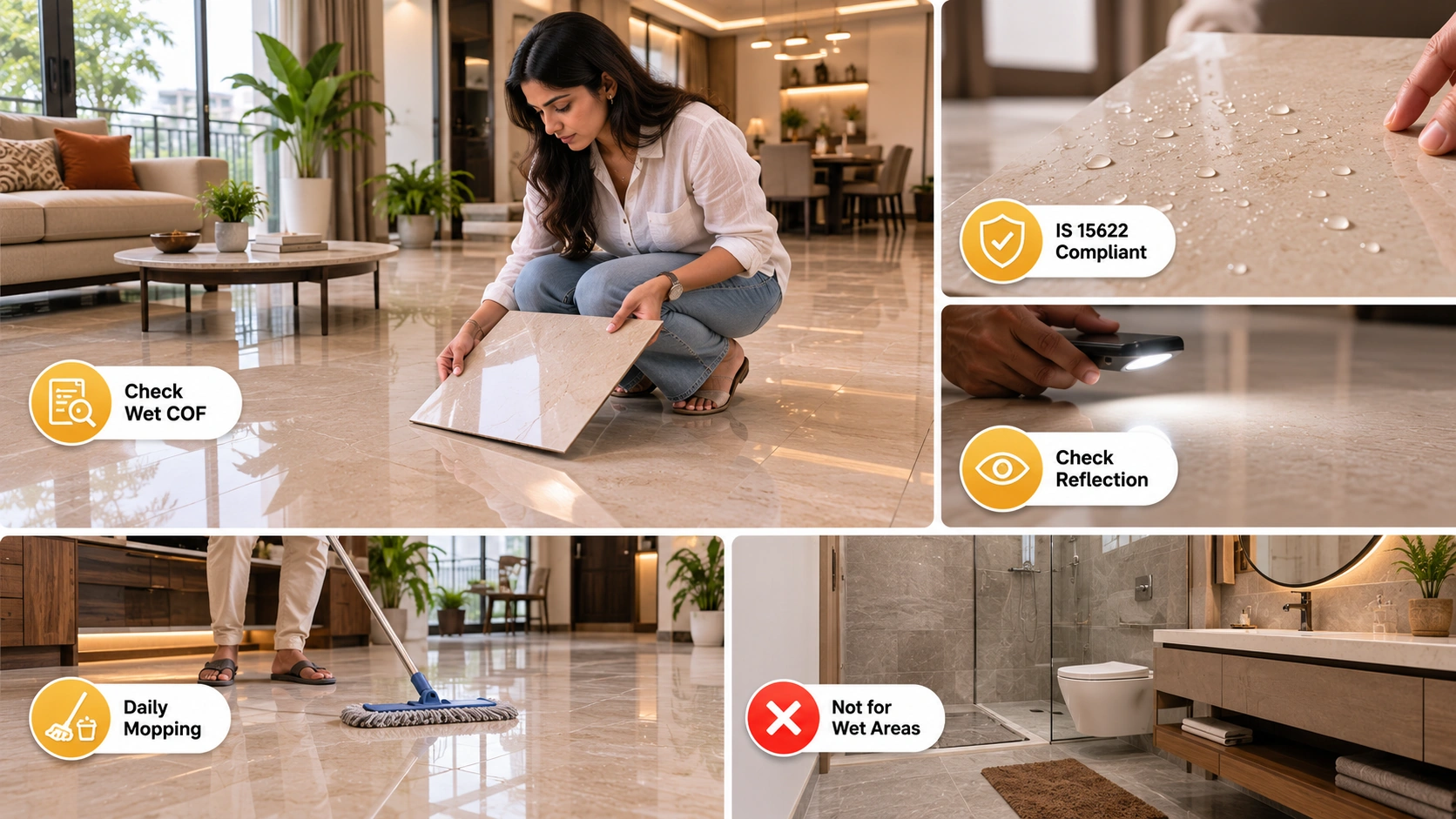
- Never assume semi-polished is safer than full gloss for wet floors. Confirm the wet COF from the TDS for any floor application. If the figure is not provided in writing, do not specify semi-polished for any floor with wet-contact risk.
- Confirm IS 15622:2006 compliance for GVT-based semi-polished. Water absorption 0.05% or below, PEI 3 to PEI 4 for floor use.
- Confirm the finish physically before ordering. Evaluate reflection quality by holding a bright object close to the tile surface: semi-polished should show a soft, blurred reflection, distinct from both satin matte's non-reflective glow and full gloss's sharp mirror image.
- Confirm daily maintenance expectations with the household or facility team before specifying for any floor. Semi-polished floors require near-daily mopping to maintain their appearance, closer to full gloss than to matte finishes.
- For any wet-area application, do not specify semi-polished under any circumstances. Specify anti-skid matte GVT with confirmed COF 0.4 wet minimum instead.
Semi-Polished Tile Price Guide: India 2026
| Design Category | Size | Price Range |
| Plain ivory or white GVT | 2x2 or 24x24 (600x600 mm) | Rs. 85 to Rs. 120/sq.ft |
| Marble-look GVT | 2x4 (600x1200 mm) | Rs. 100 to Rs. 160/sq.ft |
| Stone-look GVT | 2x4 (600x1200 mm) | Rs. 95 to Rs. 150/sq.ft |
| Ceramic wall panel (semi-polished) | 2x4 (600x1200 mm) vertical | Rs. 90 to Rs. 170/sq.ft |
Semi-Polished Tile Production in India: 2026 Context
Semi-polished GVT is manufactured across the Morbi, Gujarat cluster alongside standard matte, satin matte, and sugar finish products, typically as a secondary finish option applied to existing tile bodies via a lighter polishing pass than that used for full PGVT or double charge production. Because semi-polished is not a headline finish category for most Morbi factories, availability and consistency vary more between suppliers than for matte or sugar finish, and buyers should request physical samples and written gloss unit specifications before placing bulk orders.
In commercial and retail applications across India, semi-polished remains a standard specification for showroom and display floors where professional daily cleaning offsets the maintenance demand. In residential applications, semi-polished has become less common in 2026 as designers increasingly choose between the two clearer options at either end of its position on the spectrum, satin matte for a refined, low-maintenance look, or full polished GVT and double charge for a genuine statement floor with acknowledged upkeep.
Browse Tile Finishes on TilesFinders
Semi-polished, satin matte, sugar finish, and standard matte GVT tiles are available on TilesFinders from verified Indian manufacturers. Request physical samples and confirm wet COF ratings before specifying any finish for a floor application.
FAQs
Semi-polished is a moderate-gloss tile surface that sits between satin matte and full gloss on the sheen spectrum, measuring approximately 45 to 70 gloss units. It shows blurred reflections of room contents and light sources at close range without achieving the mirror-like quality of full polish or gloss.
No. This is the most common misunderstanding about semi-polished tile. Its wet coefficient of friction is close to that of full gloss, not close to matte or satin matte. Semi-polished must never be specified for bathroom floors, kitchen floors, outdoor floors, or any wet-contact surface under any circumstances.
Satin matte has a soft, even sheen with no visible reflections of room contents, measuring 20 to 45 gloss units. Semi-polished shows blurred reflections at close range, measuring 45 to 70 gloss units, roughly double the reflectivity of satin matte. Semi-polished also has a lower wet COF and higher maintenance demand than satin matte.
Semi-polished is most commonly used in commercial retail and showroom floors where daily professional cleaning is standard, and in decorative wall panels and feature walls where its moderate reflectivity carries no slip risk. In residential settings, it is used in dry-area feature floors where the household has committed to near-daily maintenance.
Plain ivory or white semi-polished GVT at 600x600 mm costs Rs. 85 to Rs. 120 per sq.ft. Marble-look semi-polished at 600x1200 mm costs Rs. 100 to Rs. 160 per sq.ft. Stone-look semi-polished at the same size costs Rs. 95 to Rs. 150 per sq.ft.
Semi-polished floors require near-daily mopping to maintain their appearance in a standard Indian household, closer to the maintenance demand of full gloss than to satin matte or standard matte. This should be confirmed with the household or facility team before specifying semi-polished for any floor application.

See our tile guides first
Set TilesFinders as a preferred source and our buying guides surface ahead of the rest for you.
Add as preferred sourceTakes one tap. Nothing to install.
What Readers Say
I was about to redo my parking area with the wrong tile size until I read this. The layout comparisons saved me from a costly mistake.
We reference TilesFinders guides while briefing clients on material selection. The size and pattern breakdowns are accurate and easy to explain visually.
On site, I get asked about grout spacing all the time. This article gave me a solid reference I now share with my team before every job.
Finally a guide that doesn't just push generic advice. The oil stain removal steps actually worked on our clubhouse driveway tiles.
I run a small construction firm and now send this link to clients directly when they ask about entrance tile sizing. Saves me an hour of explaining.
Good practical detail, though I wish there were more examples for compact apartment entrances specifically, not just villas.
My mother-in-law wanted marble, I wanted vitrified. This blog gave us the neutral comparison we needed to actually decide together.
Detailed without being overwhelming. I appreciated that it covered both cost and maintenance, not just the aesthetics.
Used the algae and hard water removal tips on our terrace tiles after the monsoon. Worked better than what our regular cleaner was doing.
As someone who sources tiles for multiple builder projects, I find these comparisons genuinely useful for vendor conversations, not just consumer content.
Recommended this to a client who kept second-guessing the entrance design. The small vs large layout section settled the debate instantly.
Straightforward and honest, no unnecessary jargon. Would like to see a similar breakdown for outdoor pool-deck tiles next.
We've bookmarked several TilesFinders guides for our design handbook. Reliable source when clients want data, not just opinions.
Two paths, one marketplace.
Get free quotes from verified suppliers.
Share your room, budget, and style. Suppliers in Morbi respond within hours.
Get Free QuotesList your business, reach real buyers.
Put your showroom in front of homeowners searching for tiles right now.
List Your Business