Sandune vs Beige vs Ivory Tiles: Picking the Right Warm Neutral Tone for Indian Interiors
Compare Sandune, beige, and ivory tiles by warmth, lightness, upkeep, and room appeal to find the neutral tone that fits your Indian home's lighting, furniture, and overall design.
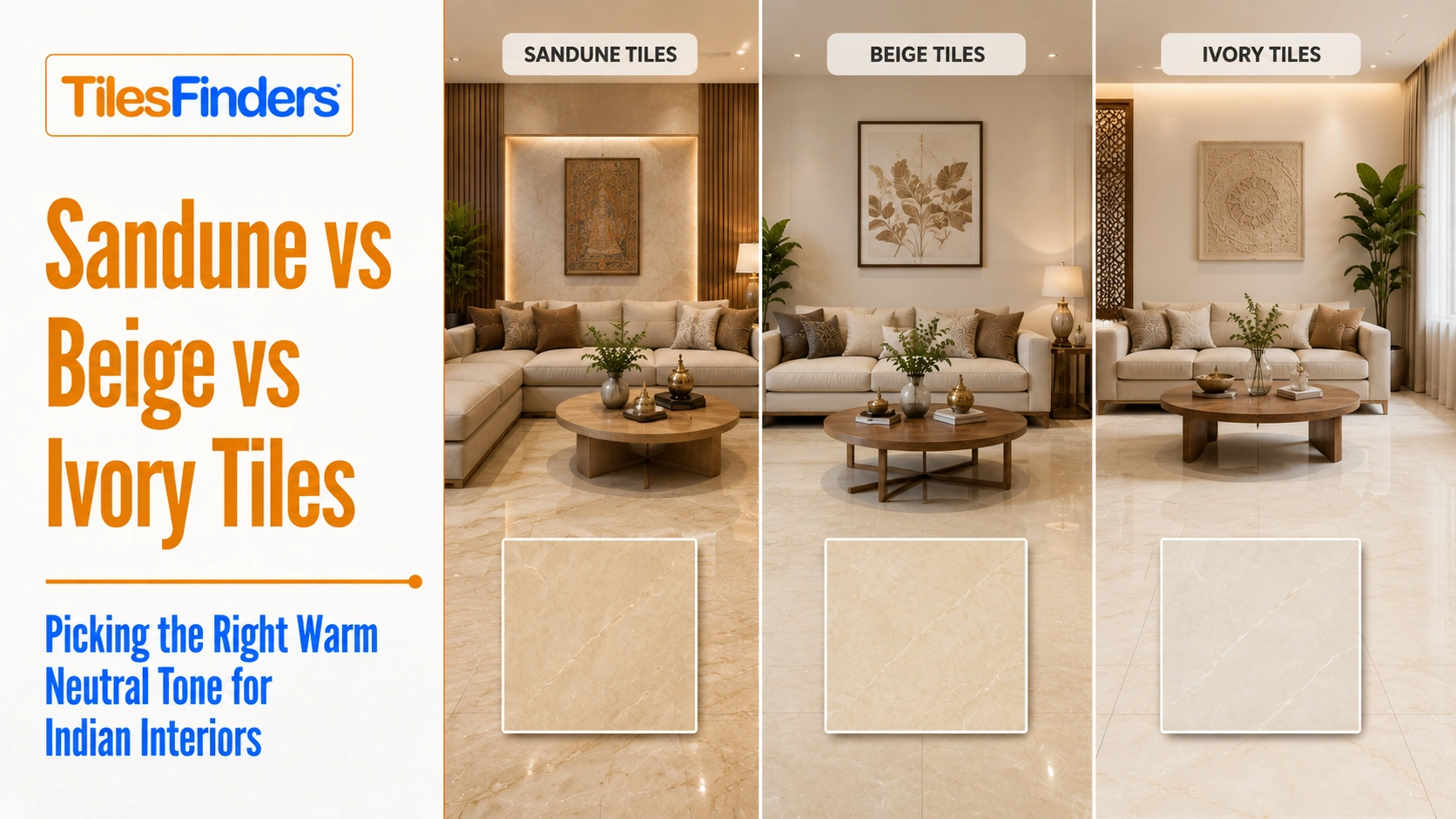
Ivory brightens compact and formal spaces; beige offers the safest all-round neutral, while Sandune adds warmer tonal depth and hides light soiling better. Choose based on room size, lighting, furniture undertones, and how much visual variation you want across the floor.
Three warm neutral tile colours sit close enough together that showroom samples often look nearly identical, yet they behave very differently once installed across a full room under real household lighting. This guide compares sandune tiles, beige tiles, and ivory tiles directly on undertone, room-scale behaviour, and practical soiling visibility for Indian interiors.
The short answer: Ivory tiles for the lightest, most formal warm neutral, closest to white. Beige tiles for the most widely available, flattest mid-warm neutral. Sandune tiles for genuine graduated warmth with more visual depth than either, best suited to minimalist rooms where the floor needs to carry the space alone.
The Three Warm Neutral Tones Defined
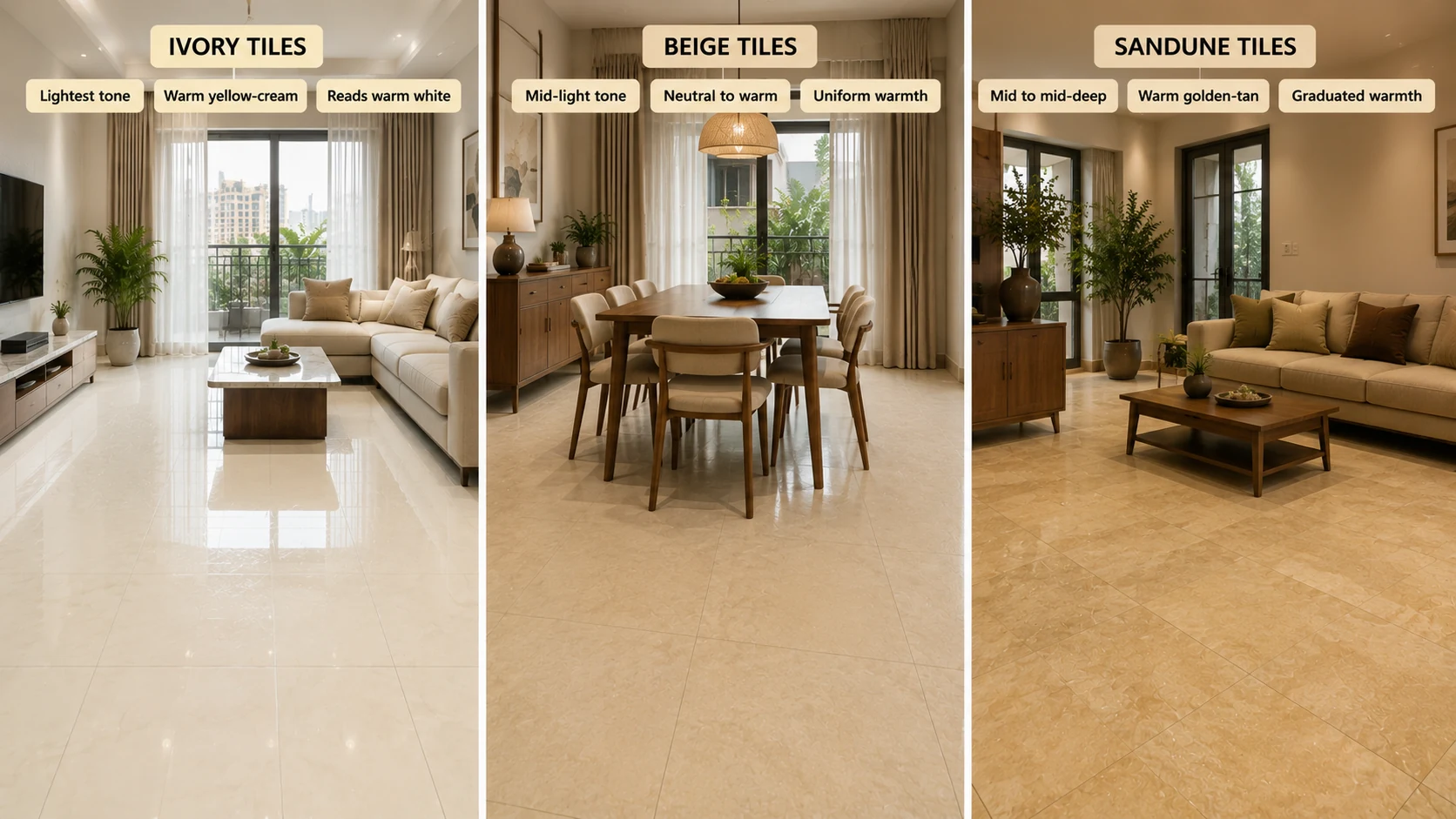
| Tone | Lightness | Undertone | Visual Character |
| Ivory tiles | Lightest of the three, closest to white | Subtle warm yellow-cream | Formal, clean, reads almost as a warm white at room scale |
| Beige tiles | Mid-light | Neutral to slightly warm | Flat, uniform warmth without a strong tonal gradient |
| Sandune tiles | Mid to mid-deep | Warm golden-tan | Graduated, sand-like warmth with visible depth between tiles |
From The Marketplace
Popular tiles right now




-8f47be3d-a42a-4928-a312-e0495cc1ad44.jpg)
How Each Tone Behaves at Room Scale
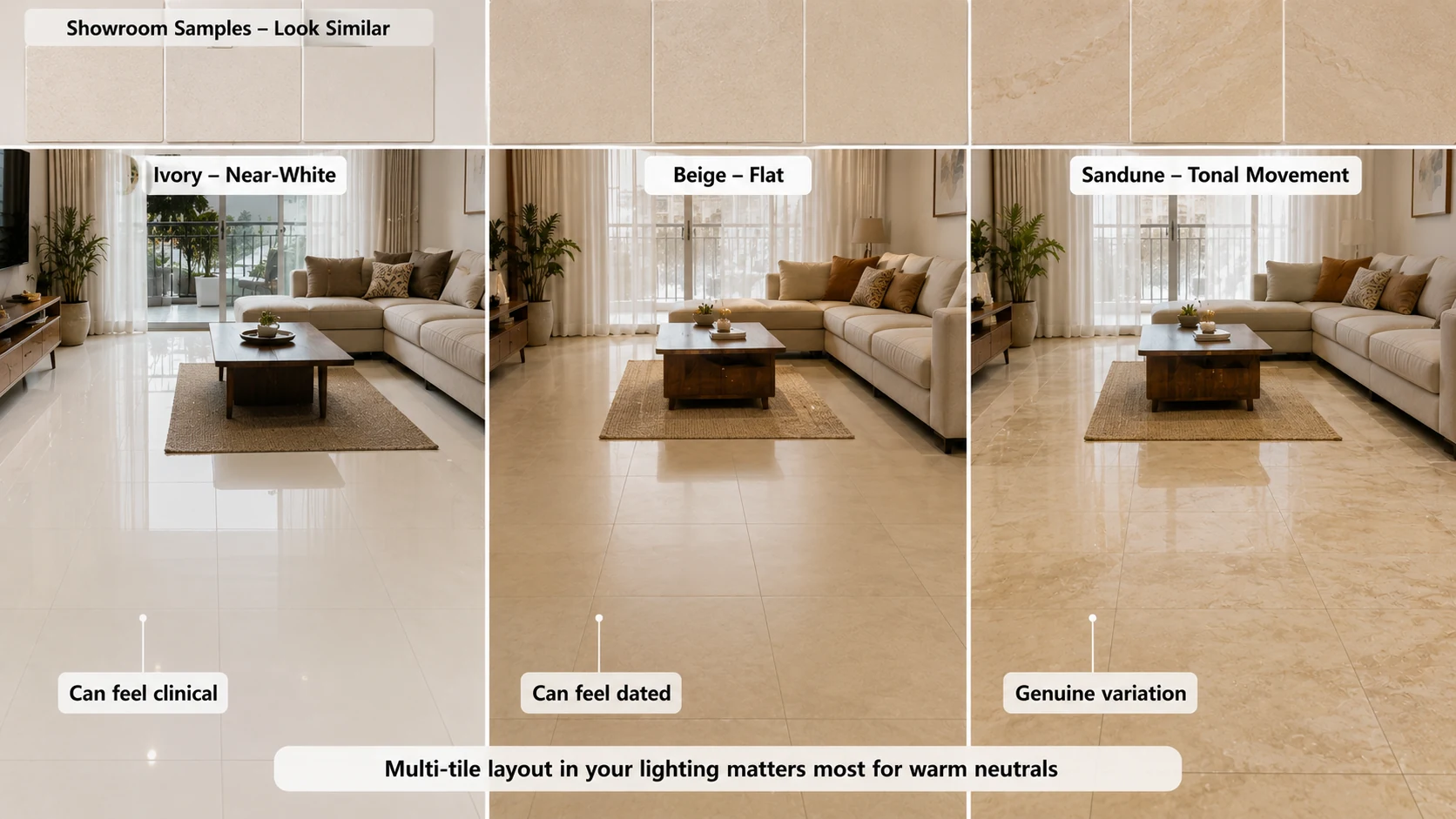
The difference showroom samples cannot show: A single tile sample of ivory, beige, and sandune can look almost interchangeable under showroom lighting. Across a full 200 sq.ft floor, the difference becomes obvious: ivory tiles read as near-white and can feel clinical without warm furnishing, beige tiles read as flat and can feel dated if the surrounding palette does not support them, and sandune tiles read with genuine tonal movement between pieces. This is why a multi-tile layout sample, viewed under your own room lighting, matters far more for warm neutrals than for a bolder colour where the difference is obvious at a glance.
If you are leaning toward Sandune but want to understand its tone beyond a simple beige comparison, Sandune Tiles in India explains its warm golden-tan character, tonal depth, and suitability for minimalist Indian interiors. It also covers how lighting, furniture, and finish can change the way Sandune reads across a larger floor.
Practical Comparison for Indian Homes
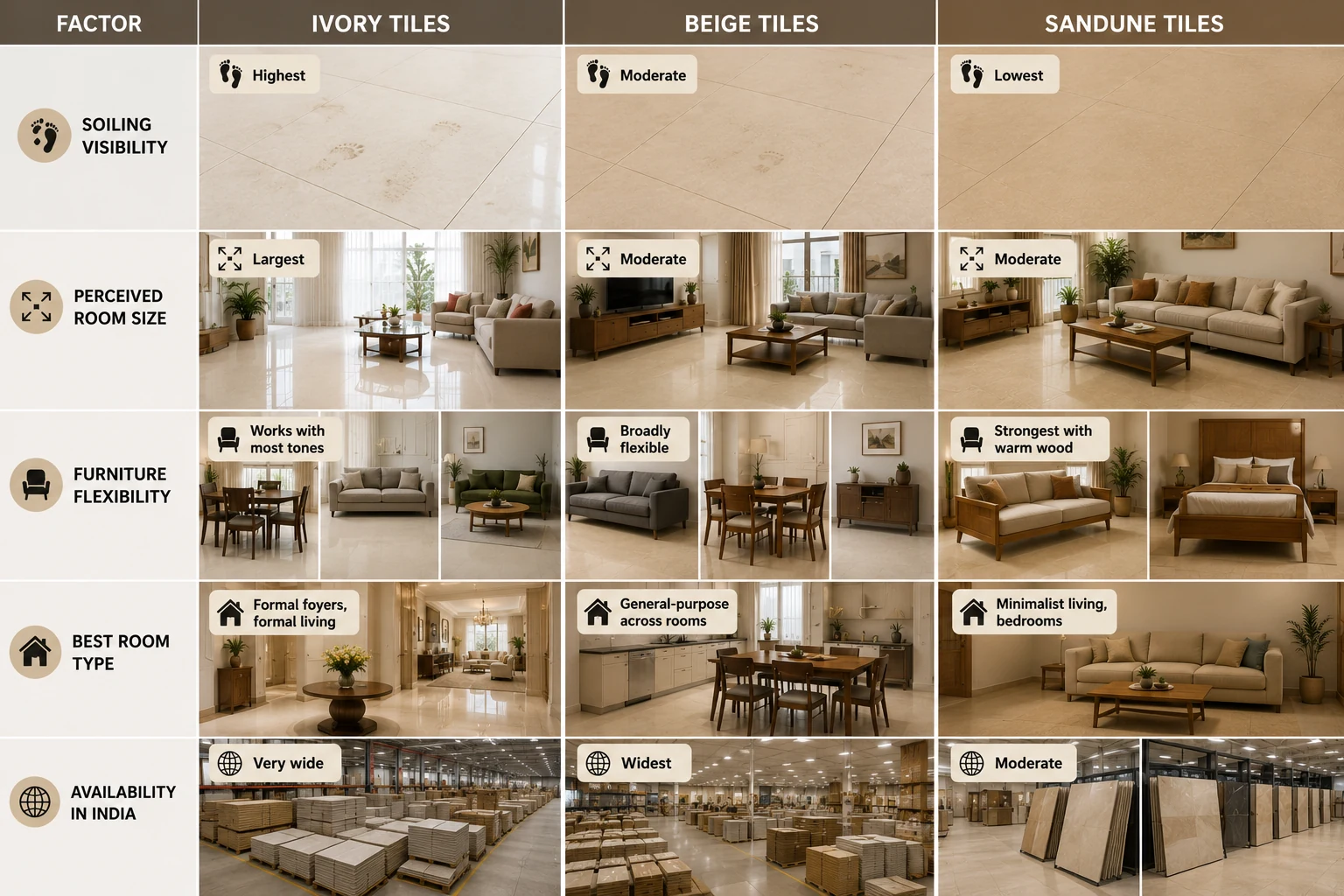
| Factor | Ivory Tiles | Beige Tiles | Sandune Tiles |
| Soiling visibility | Highest, shows footprints and dust most clearly | Moderate | Lowest of the three, the graduated tone disguises light soiling |
| Perceived room size | Largest, the pale tone maximises reflected light | Moderate | Moderate, slightly less space-expanding than ivory |
| Furniture flexibility | Works with most tones, strongest with dark wood contrast | Broadly flexible, the safest of the three | Strongest with warm or natural wood, weaker with cool grey accents |
| Best room type | Formal foyers, formal living rooms, compact rooms | General-purpose across most rooms | Minimalist living rooms, bedrooms, rooms where the floor carries the design |
| Availability in India | Very wide | Widest of the three | Moderate, a more specific warm-neutral positioning |
Which Warm Neutral Tile for Which Brief
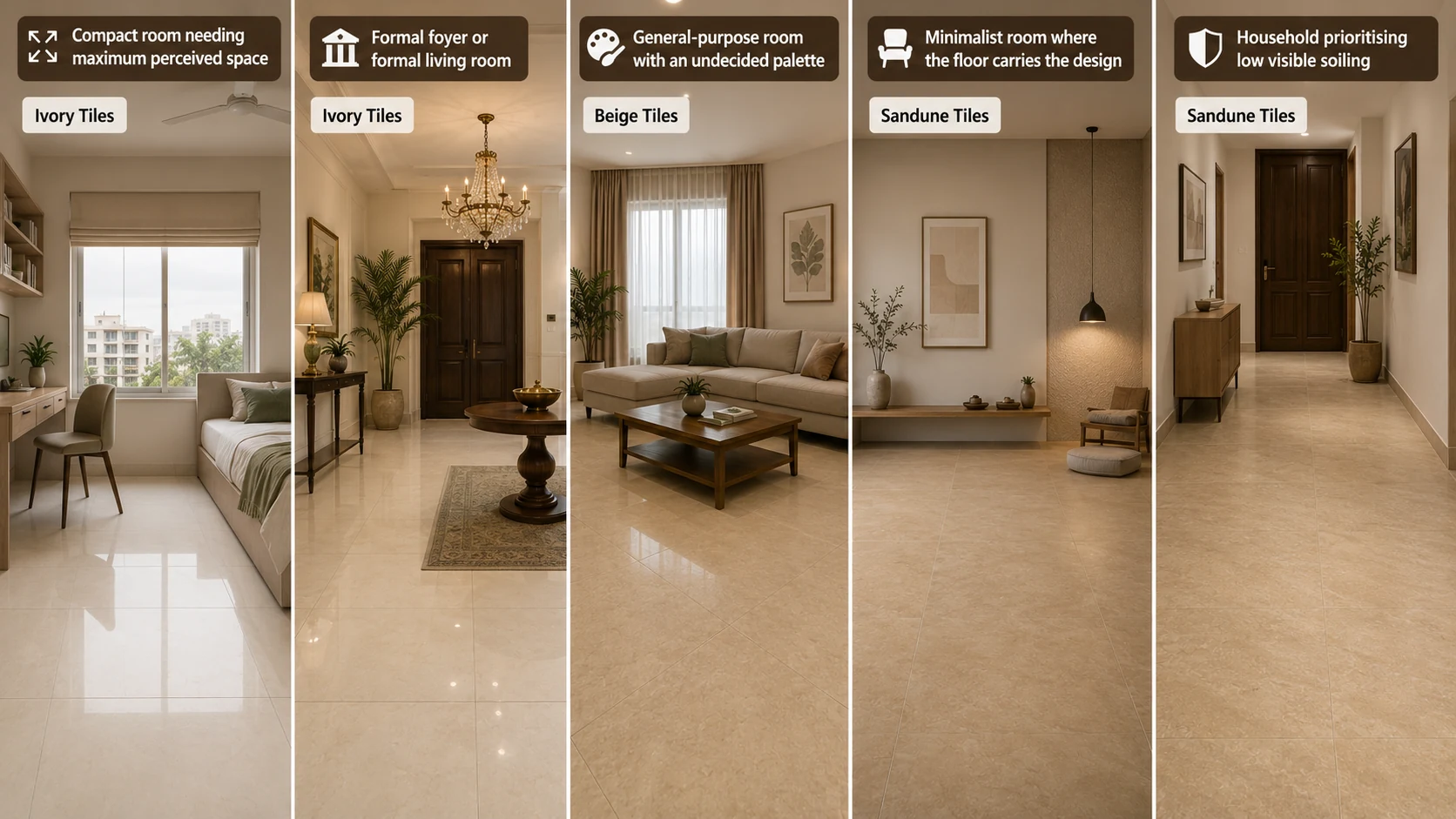
- Compact room needing maximum perceived space: ivory tiles, the lightest of the three and the strongest at maximising reflected light.
- Formal foyer or formal living room: ivory tiles, whose near-white formality suits a classically formal Indian arrival or reception space.
- General-purpose room with an undecided palette: beige tiles, the safest and most furniture-flexible of the three while the rest of the design is finalised.
- Minimalist room where the floor carries the design alone: sandune tiles, whose graduated warmth provides the depth a stripped-back room needs.
- Household prioritising low visible soiling: sandune tiles, whose tonal movement disguises light dust and footprints better than either flatter alternative.
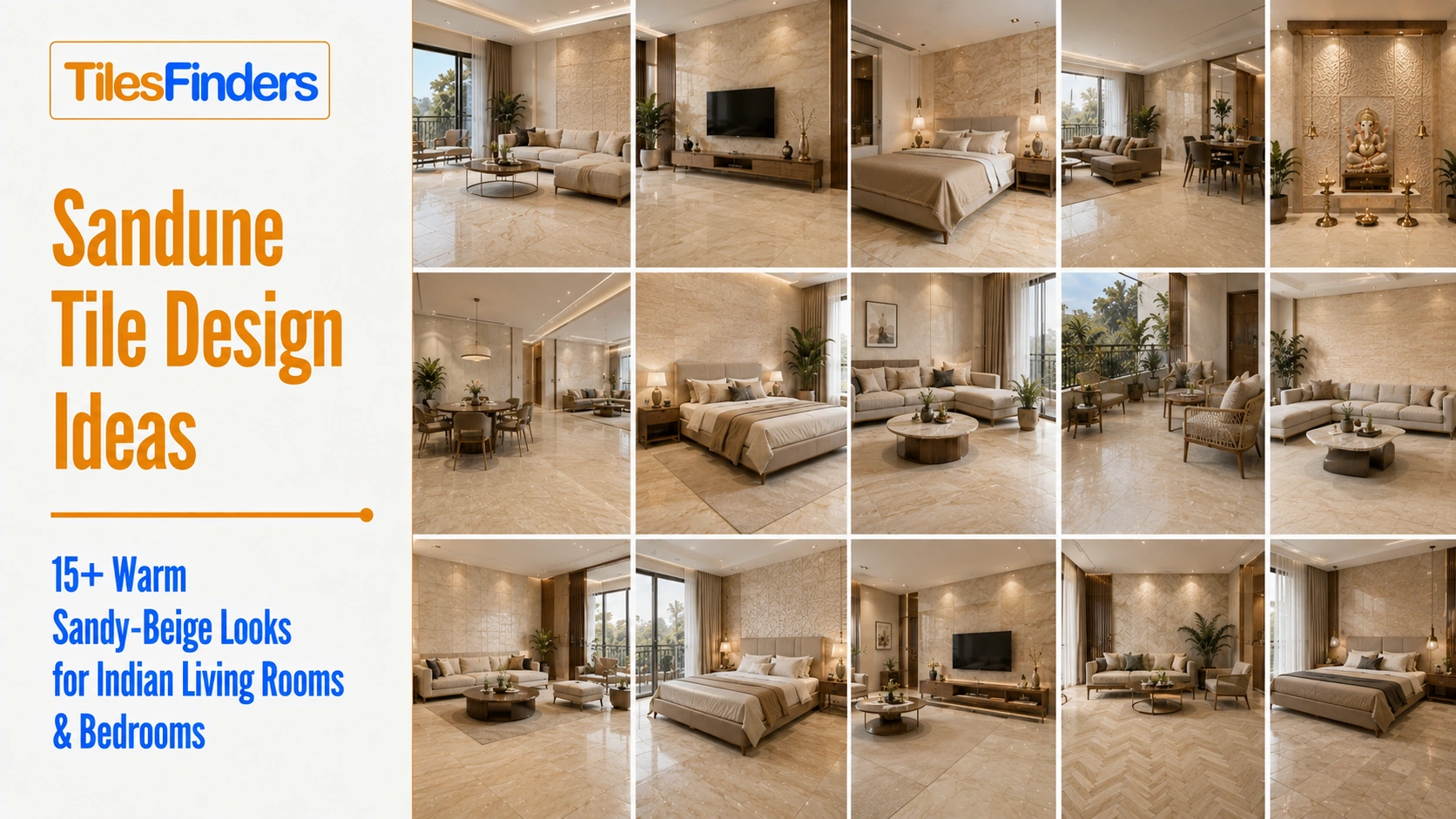
Once Sandune emerges as the right choice, Sandune Tile Design Ideas gives practical room-by-room inspiration for using pale, classic, and deep Sandune tones. The examples cover living rooms, bedrooms, compact spaces, feature walls, and whole-home continuity.
Buying Checklist
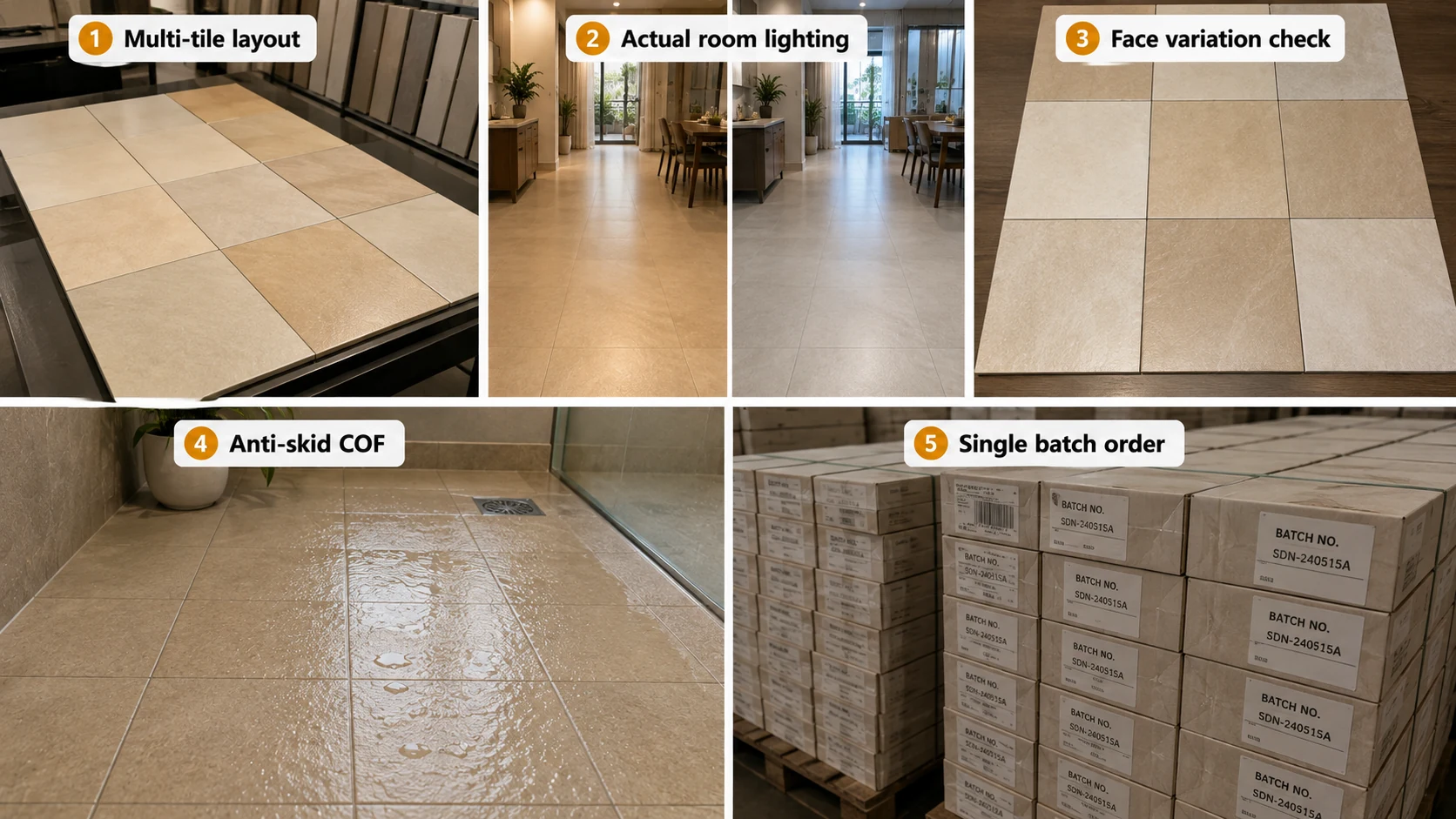
- Request a multi-tile layout sample, not a single swatch, since the difference between these three warm neutral tiles only becomes clear once several tiles are viewed together.
- Evaluate under your actual room lighting, since warm neutrals shift meaningfully between warm-white and cool-white light sources.
- Confirm face variation count, particularly for sandune tiles, whose defining visual quality depends on genuine gradient variation between pieces.
- Confirm anti-skid COF for any wet-area floor application regardless of which of the three tones is chosen.
- Order from a single confirmed batch, since all three warm neutrals show batch-to-batch inconsistency more visibly than cooler tones.
Warm Neutral Tiles in India: 2026 Context
Beige tiles and ivory tiles both have a long-established, very wide production base across Morbi, Gujarat and other Indian ceramic manufacturing centres, while sandune tiles occupy a more specific warm-neutral positioning with moderate rather than universal availability. Buyers comparing all three should request physical samples from each shortlisted manufacturer rather than relying on catalogue imagery, since warm neutral reproduction varies meaningfully between printing processes and a tone labelled identically by two manufacturers can differ visibly in person.
Compare All Three Warm Neutrals on TilesFinders
Sandune tiles, beige tiles, and ivory tiles can be sampled and compared side by side on TilesFinders, helping you judge the tonal and soiling-visibility differences that genuinely matter once a full room is installed.
FAQs
Sandune tiles carry a warmer, more golden undertone with a visible graduated quality between pieces, while beige tiles read flatter and more uniformly warm without that tonal movement across a floor.
No. Ivory tiles carry a subtle warm yellow-cream undertone that reads as a warm white rather than a pure white, softening what would otherwise be a starker, cooler surface.
Sandune tiles, whose graduated tonal movement disguises light dust and footprints more effectively than either flatter beige tiles or the considerably lighter ivory tiles, which show soiling most clearly of the three.
Ivory tiles, the lightest of the three, maximise reflected light and create the strongest sense of perceived space in a genuinely compact Indian room.
Beige tiles, the most furniture-flexible and most widely available of the three, making them a practical choice while the rest of the room's palette is still being finalised.
A single tile sample of each can look nearly interchangeable under showroom lighting, since the differences are in undertone and tonal gradient rather than obvious colour contrast. These only become clearly visible across a full installed floor under real room lighting.
Yes, commonly assigning each to a different room based on its specific brief, such as ivory tiles in a formal foyer, sandune tiles in a minimalist living room, and beige tiles in general-purpose spaces, since all three share the same underlying warm family.
Generally comparable at similar design and format tiers, though sandune tiles can carry a modest premium given their more specific warm-neutral positioning and moderate rather than universal availability across Indian manufacturers.


See our tile guides first
Set TilesFinders as a preferred source and our buying guides surface ahead of the rest for you.
Add as preferred sourceTakes one tap. Nothing to install.
What Readers Say
I was about to redo my parking area with the wrong tile size until I read this. The layout comparisons saved me from a costly mistake.
We reference TilesFinders guides while briefing clients on material selection. The size and pattern breakdowns are accurate and easy to explain visually.
On site, I get asked about grout spacing all the time. This article gave me a solid reference I now share with my team before every job.
Finally a guide that doesn't just push generic advice. The oil stain removal steps actually worked on our clubhouse driveway tiles.
I run a small construction firm and now send this link to clients directly when they ask about entrance tile sizing. Saves me an hour of explaining.
Good practical detail, though I wish there were more examples for compact apartment entrances specifically, not just villas.
My mother-in-law wanted marble, I wanted vitrified. This blog gave us the neutral comparison we needed to actually decide together.
Detailed without being overwhelming. I appreciated that it covered both cost and maintenance, not just the aesthetics.
Used the algae and hard water removal tips on our terrace tiles after the monsoon. Worked better than what our regular cleaner was doing.
As someone who sources tiles for multiple builder projects, I find these comparisons genuinely useful for vendor conversations, not just consumer content.
Recommended this to a client who kept second-guessing the entrance design. The small vs large layout section settled the debate instantly.
Straightforward and honest, no unnecessary jargon. Would like to see a similar breakdown for outdoor pool-deck tiles next.
We've bookmarked several TilesFinders guides for our design handbook. Reliable source when clients want data, not just opinions.
Two paths, one marketplace.
Get free quotes from verified suppliers.
Share your room, budget, and style. Suppliers in Morbi respond within hours.
Get Free QuotesList your business, reach real buyers.
Put your showroom in front of homeowners searching for tiles right now.
List Your Business