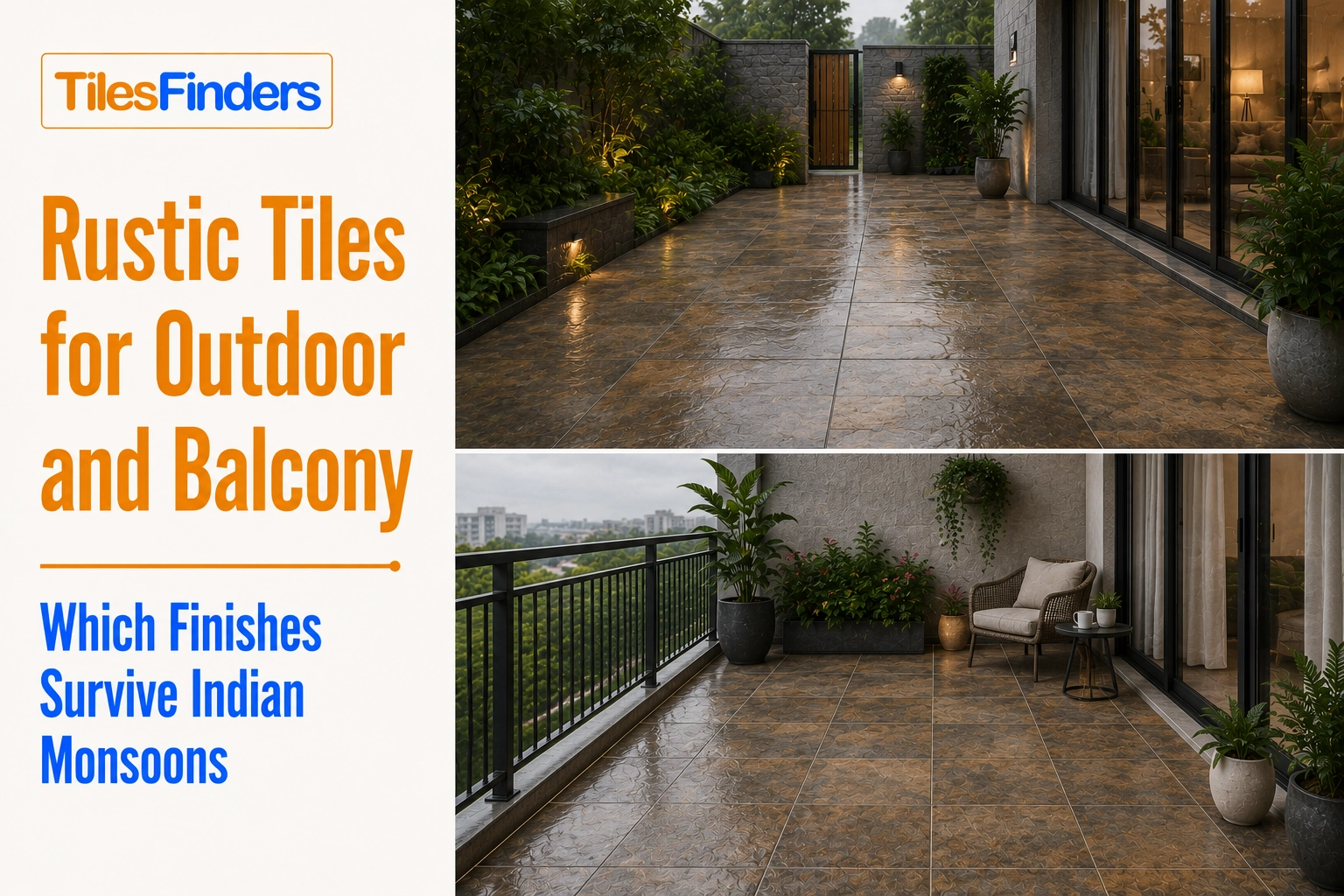
Rustic Tiles for Outdoor and Balcony: Which Finishes Survive Indian Monsoons
This guide covers which rustic tile finishes survive Indian monsoons for balcony and outdoor use. It compares matte, stone, and GHR finishes, explains R-ratings, and gives size and price guidance for Indian buyers.
- What Makes a Tile "Rustic" and Why Outdoor Areas Need a Different Standard
- Rustic Tile Finishes Ranked for Outdoor and Balcony Use
- Rustic Tile Materials That Hold Up in the Indian Climate
- Size Guide for Rustic Outdoor and Balcony Tiles
- How to Choose the Right Rustic Tile for Your Balcony
- Price Guide: Rustic Outdoor Tiles in India
- Common Mistakes Buyers Make With Outdoor Rustic Tiles
- Find Rustic Balcony Tiles With Confirmed Stock
Matte and stone finish rustic tiles rated R10 or R11 are the only finishes that survive Indian monsoons safely on balcony and terrace floors.
Every June, Indian balconies face four months of standing water, sudden temperature drops, and algae-friendly humidity. Most tiles look fine in a showroom. Many fail outdoors within two monsoon seasons.
Rustic tiles for outdoor use are built differently from their indoor relatives. The finish must grip wet feet. The body must resist water ingress. The glaze, where there is one, must handle UV exposure without fading or cracking.
This guide covers which rustic tile finishes actually survive Indian monsoons, what R-ratings mean for your balcony, and what price range to expect from Morbi and Gujarat manufacturers.
What Makes a Tile "Rustic" and Why Outdoor Areas Need a Different Standard
Rustic tiles carry a surface texture that mimics natural stone, aged wood, or unfinished clay. The defining quality is a non-uniform, rough-looking surface rather than the mirror finish of a polished vitrified tile.
That texture is the starting point for outdoor performance, but not the whole story. A tile can look rustic and still be dangerously slippery when wet. What matters for outdoor use is the R-rating, the material body, and the water absorption figure.
Surface Texture and Why It Matters More Than Looks
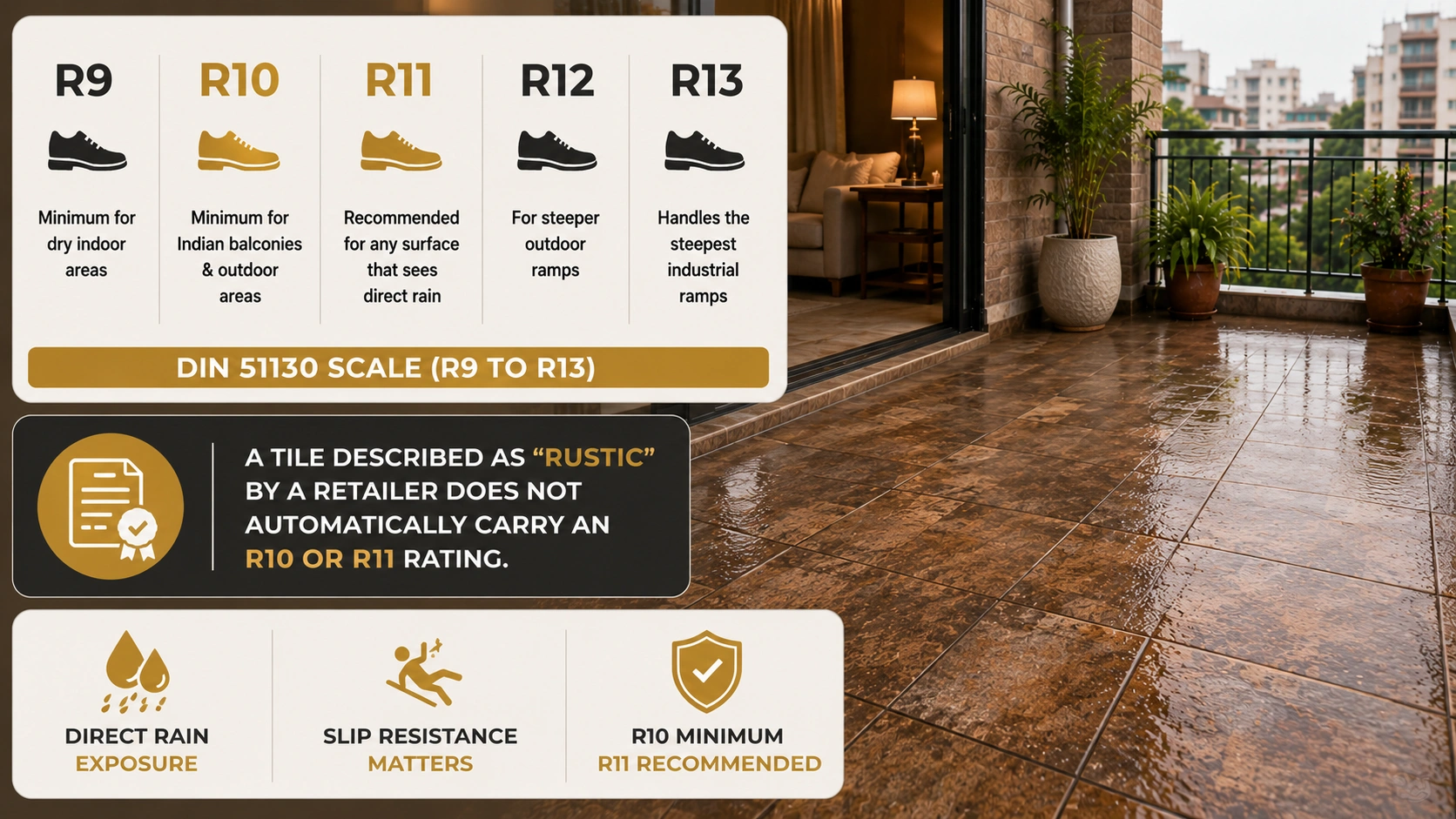
Tile surfaces are rated on the DIN 51130 scale from R9 to R13, where R9 is the minimum for dry indoor areas, and R13 handles the steepest industrial ramps. For Indian balconies and outdoor areas, R10 is the minimum, and R11 is the recommendation for any surface that sees direct rain.
A tile described as "rustic" by a retailer does not automatically carry an R10 or R11 rating. Many decorative rustic wall tiles carry no slip-resistance rating at all. Always ask for the R-rating certificate before buying for any balcony or outdoor floor.
The Monsoon Test: What Indian Balconies Face Every Year
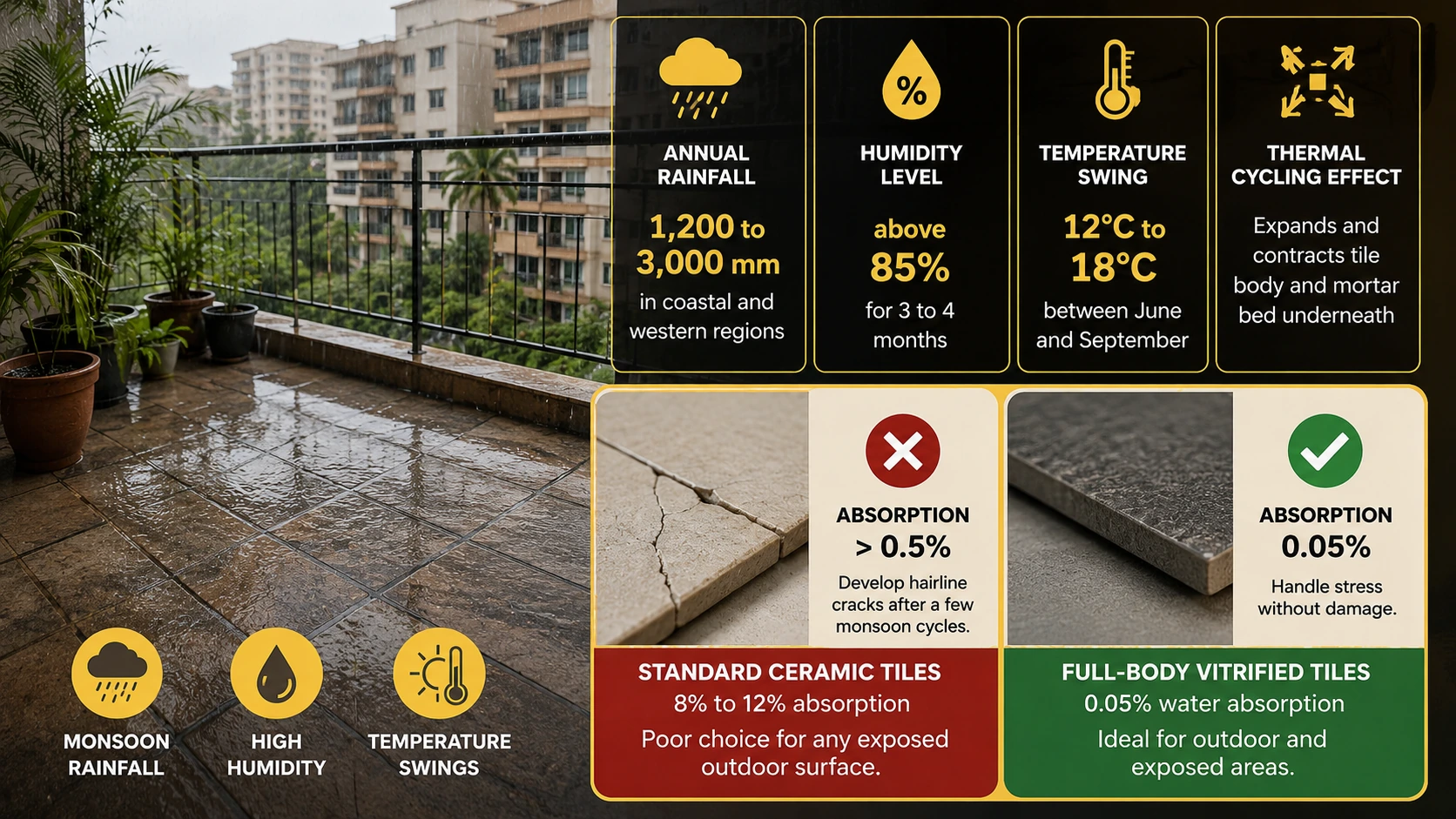
Indian balconies in coastal and western regions face 1,200 to 3,000 mm of annual rainfall, humidity above 85% for three to four months, and daytime temperatures swinging 12 to 18 degrees C between June and September. This thermal cycling expands and contracts the tile body and the mortar bed underneath.
Tiles that absorb more than 0.5% water by weight develop hairline cracks after a few monsoon cycles. Full-body vitrified tiles with 0.05% water absorption handle this stress without damage. Standard ceramic tiles with 8 to 12% absorption are a poor choice for any exposed outdoor surface.
Rustic finishes come in GVT, full-body vitrified, ceramic, and natural stone, each offering different durability, water absorption, and maintenance requirements. If you're selecting rustic tiles for indoor or outdoor projects, read our Rustic Tiles Guide to compare materials, finishes, room suitability, and buying tips before making your final choice.
Rustic Tile Finishes Ranked for Outdoor and Balcony Use
| Finish | R-Rating | Outdoor Safe? | Price Range (Rs./sq.ft) | Best For |
|---|---|---|---|---|
| Matte | R10 to R11 | Yes | Rs. 38 to Rs. 85 | Covered and open balconies, terraces |
| Stone Finish | R10 to R11 | Yes | Rs. 45 to Rs. 100 | Open terraces, farmhouse exteriors, garden paths |
| GHR (Glossy High Relief) | R10 (relief areas) | Covered balconies only | Rs. 55 to Rs. 95 | Covered balconies, semi-outdoor areas with a roof |
| Glossy / High Glossy | R6 to R8 | No | Rs. 30 to Rs. 70 | Indoor floors only |
| Sugar Finish | R9 | No (outdoor) | Rs. 40 to Rs. 75 | Indoor living room and bedroom floors |
| Polished Finish | R6 to R7 | No | Rs. 60 to Rs. 110 | Indoor use only |
Matte Finish: The Safest Choice for Most Balconies
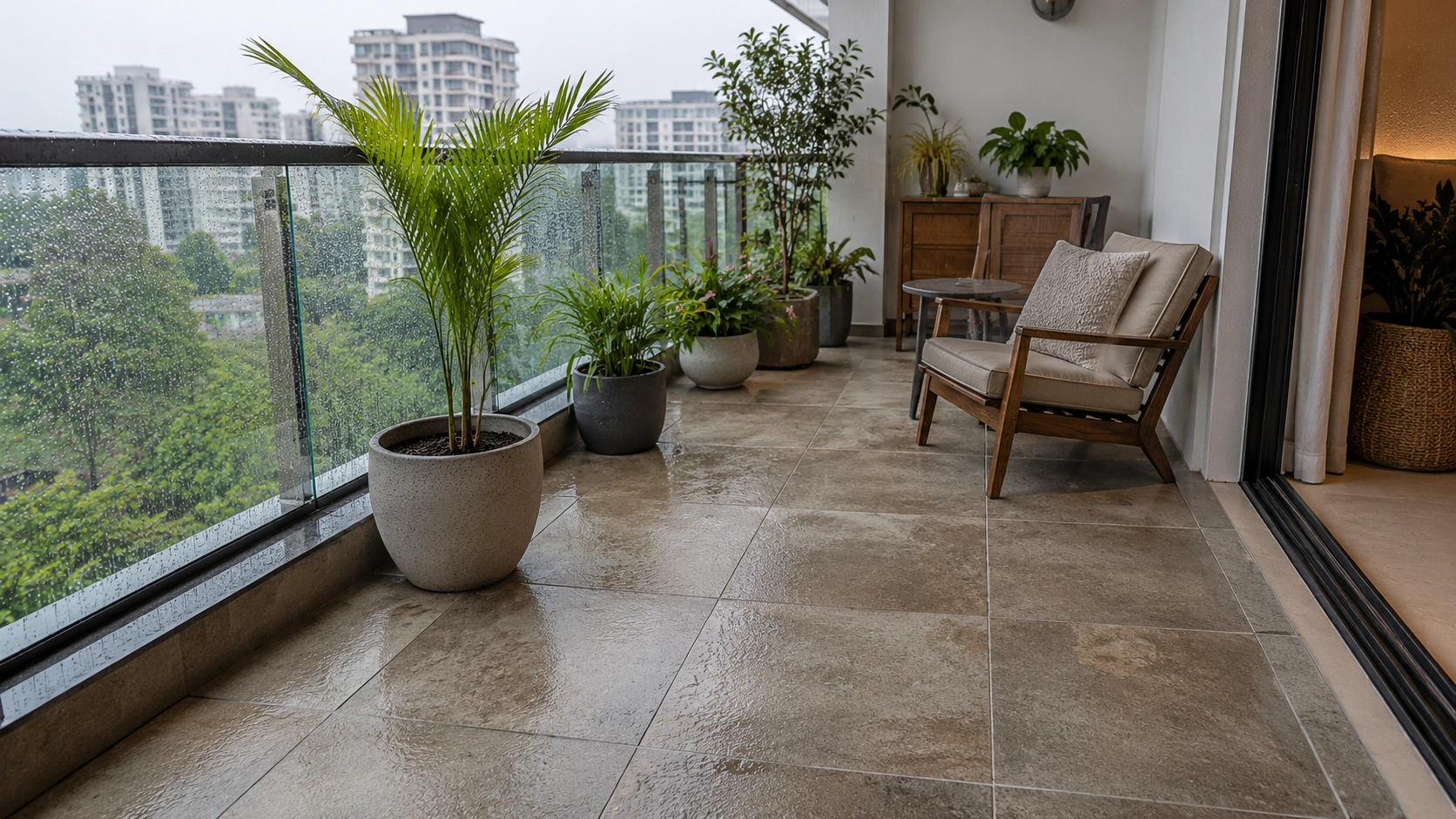
Matte finish rustic tiles carry a fully unpolished surface that grips wet feet without any added anti-skid coating. A standard matte tile rated R10 handles most covered and semi-exposed balconies across India. For open balconies in coastal Maharashtra, Kerala, or Goa, specify R11 matte tiles to handle continuous heavy rain.
Full body vitrified matte tiles from Gujarat manufacturers in Morbi cost Rs. 60 to Rs. 85 per sq.ft for standard sizes. Ceramic rustic matte tiles cost Rs. 38 to Rs. 55 per sq.ft and suit covered balconies where water exposure is limited.
Stone Finish: Best for Open Terraces and Farmhouse Exteriors
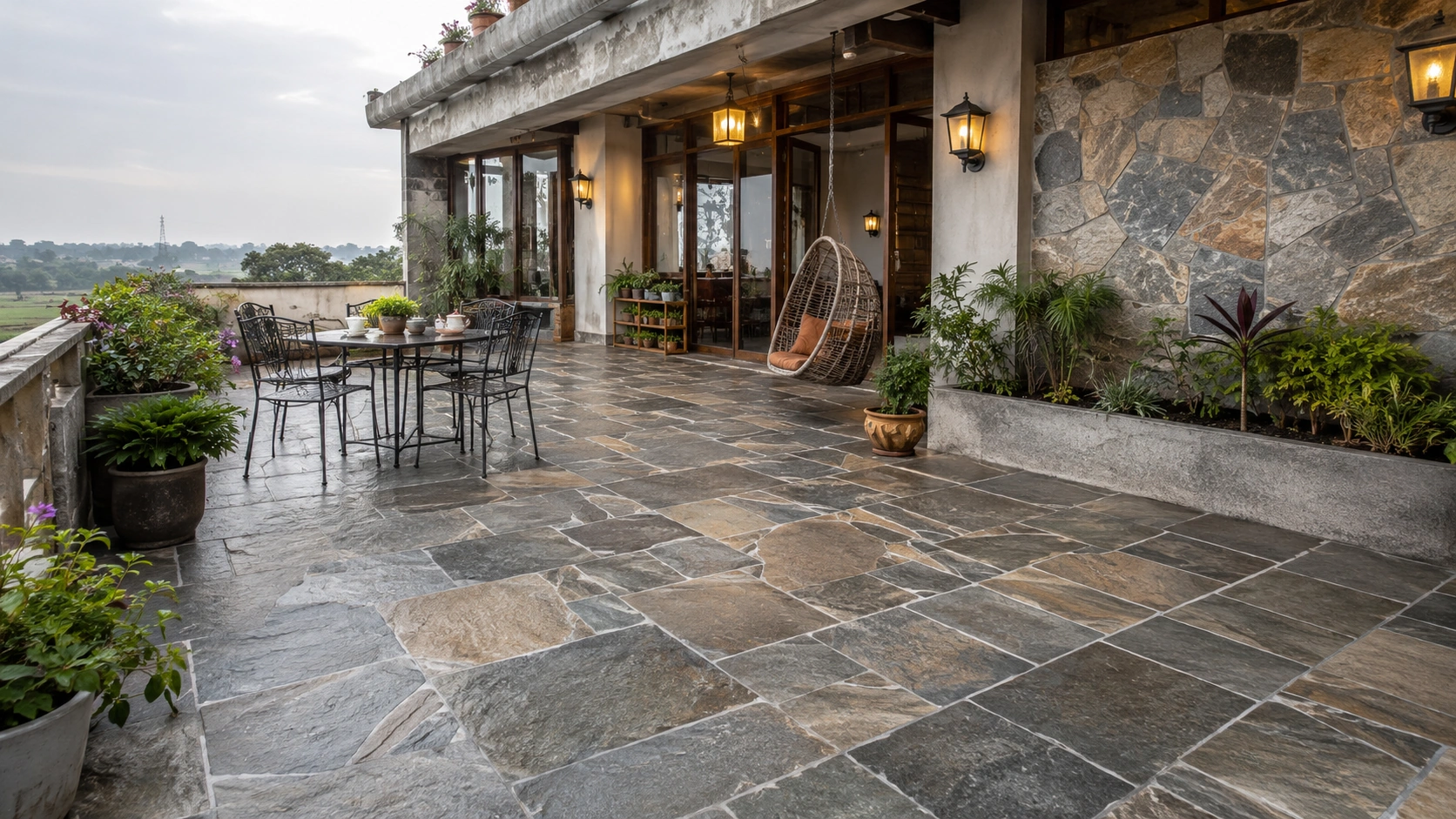
Stone finish tiles carry a textured surface that mimics granite, sandstone, or slate. The deep surface relief creates natural water channels that drain quickly during rain, which is why stone finish tiles for outdoor areas typically carry R10 or R11 ratings from the manufacturing stage.
For open terraces above 120 sq. ft., stone finish full body vitrified tiles in 600x600 mm size work well. These tiles cost Rs. 55 to Rs. 100 per sq.ft from Morbi manufacturers, depending on the body type and surface relief depth.
GHR (Glossy High Relief) Finish: Why It Works Where Plain Glossy Fails
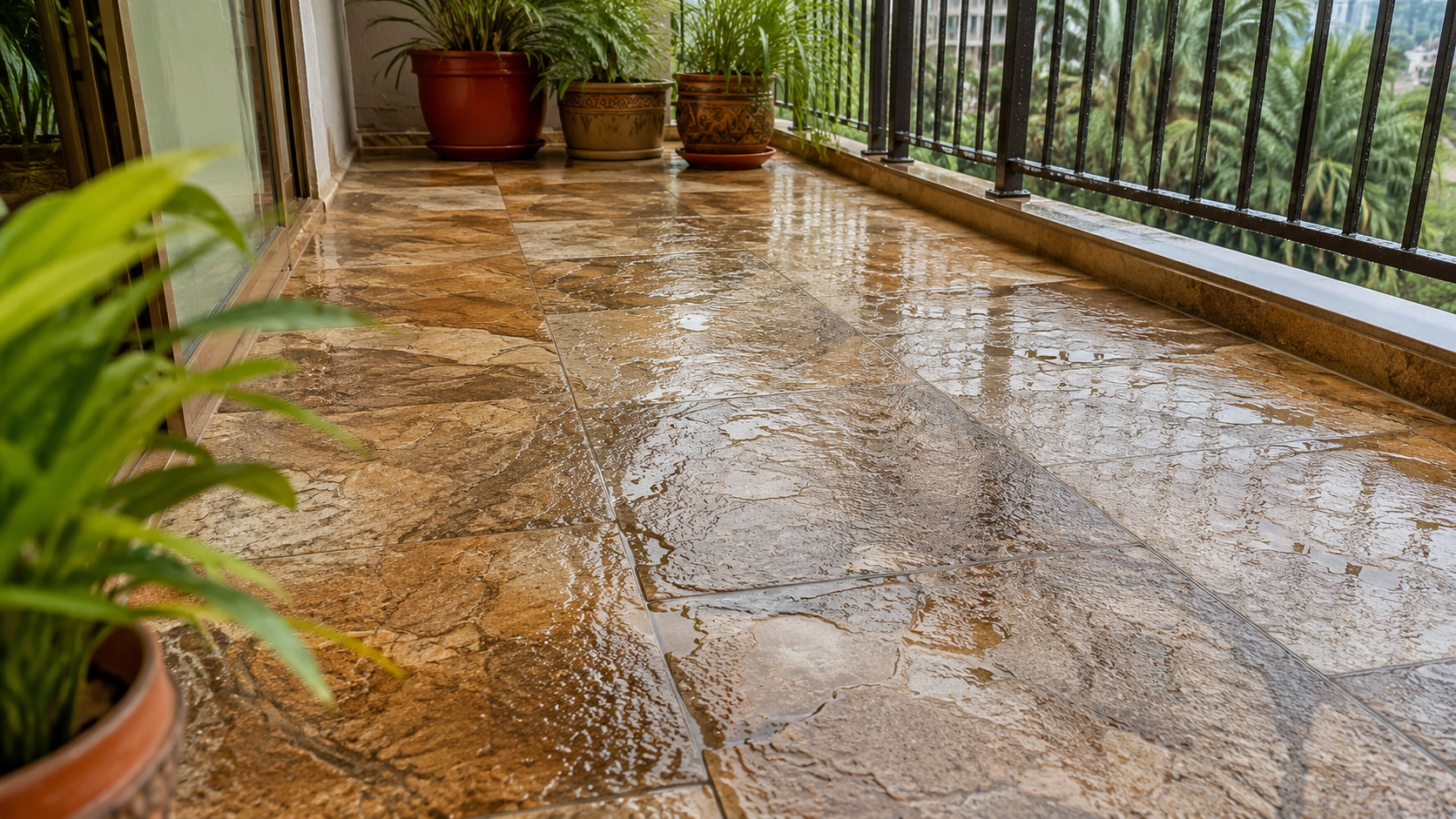
GHR, or Glossy High Relief, is often confused with a standard glossy finish. The difference is structural. A plain glossy tile has a flat, smooth surface that becomes extremely slippery when wet. A GHR tile has raised relief patterns across its surface, and the texture in those raised areas provides grip.
GHR tiles work on covered balconies where rain does not fall directly on the surface. They are not safe for open balconies or terraces exposed to direct rainfall. The glossy base between relief areas still carries a low friction coefficient when fully wet.
Finishes to Avoid Outdoors
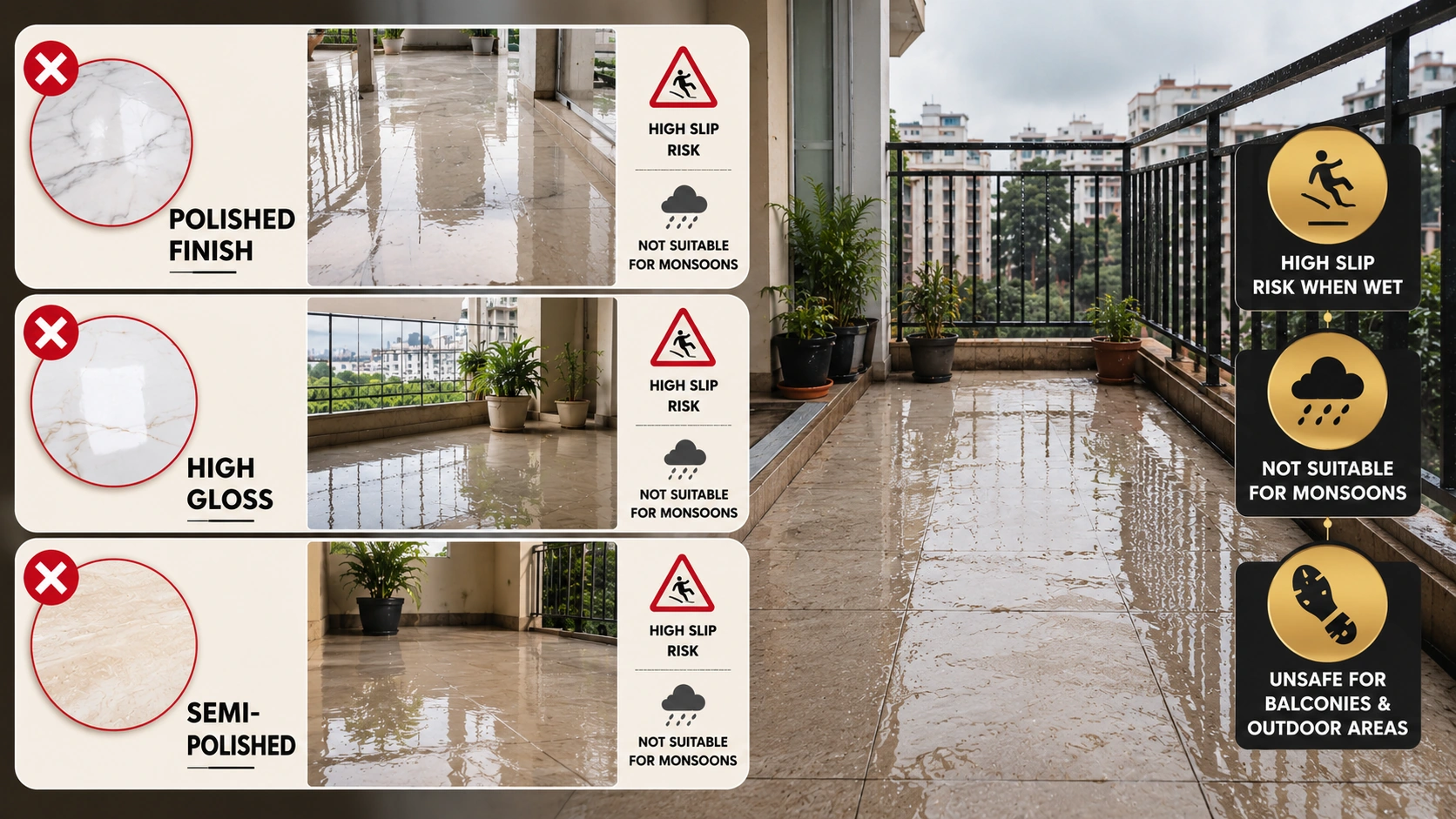
Polished finish, High Gloss, and Semi-Polished tiles are not safe on any outdoor floor surface. These finishes carry R-ratings of R6 to R8, which means they provide no meaningful grip under wet conditions. Using any polished finish on a balcony or terrace creates a slip-and-fall hazard, particularly for elderly residents and children.
Sugar finish tiles, despite their slightly textured appearance, carry an R9 rating and should stay on indoor floors only. The texture is decorative rather than functional for wet outdoor use.
Rustic Tile Materials That Hold Up in the Indian Climate
Full Body Vitrified vs Glazed Vitrified for Outdoors
Full-body vitrified tiles, made under IS 15622:2006, are the best material choice for outdoor rustic tiles in India. The clay and pigment run through the entire tile body at 0.05% water absorption, so chips do not expose a white ceramic core, and thermal cycling does not cause delamination.
Glazed Vitrified Tiles (GVT) carry a printed glaze layer over the vitrified body. For covered balconies, GVT rustic tiles perform adequately. For open terraces and fully exposed outdoor areas, the glaze can fade under continuous UV exposure over three to five years.
| Feature | Full Body Vitrified | GVT (Glazed Vitrified) |
|---|---|---|
| Water Absorption | 0.05% | 0.05% (body), glaze layer separate |
| UV Resistance | High (colour throughout body) | Moderate (glaze fades over time) |
| Chip Visibility | Colour matches body, invisible | White body visible at chip edges |
| Price Range | Rs. 65 to Rs. 120 per sq.ft | Rs. 45 to Rs. 90 per sq.ft |
| Best Outdoor Use | Open terraces, exposed areas | Covered balconies, semi-outdoor |
| IS Standard | IS 15622:2006 | IS 15622:2006 |
Ceramic Rustic Tiles: Where They Fit and Where They Don't
Ceramic rustic tiles carry 8 to 12% water absorption, which is too high for open outdoor use in India. During monsoon season, constant wetting and drying cause the tile body to expand and contract. Over time, this movement cracks the tile and loosens it from the mortar bed.
Ceramic rustic tiles work for covered balconies where rain does not reach the tile surface directly. For these sheltered spaces, ceramic tiles cost Rs. 35 to Rs. 55 per sq.ft and carry sufficient surface texture for safe use. They must not be used on open terraces, garden pathways, or any area exposed to direct rainfall.
Size Guide for Rustic Outdoor and Balcony Tiles
Small Balcony (Under 60 sq.ft): Best Sizes
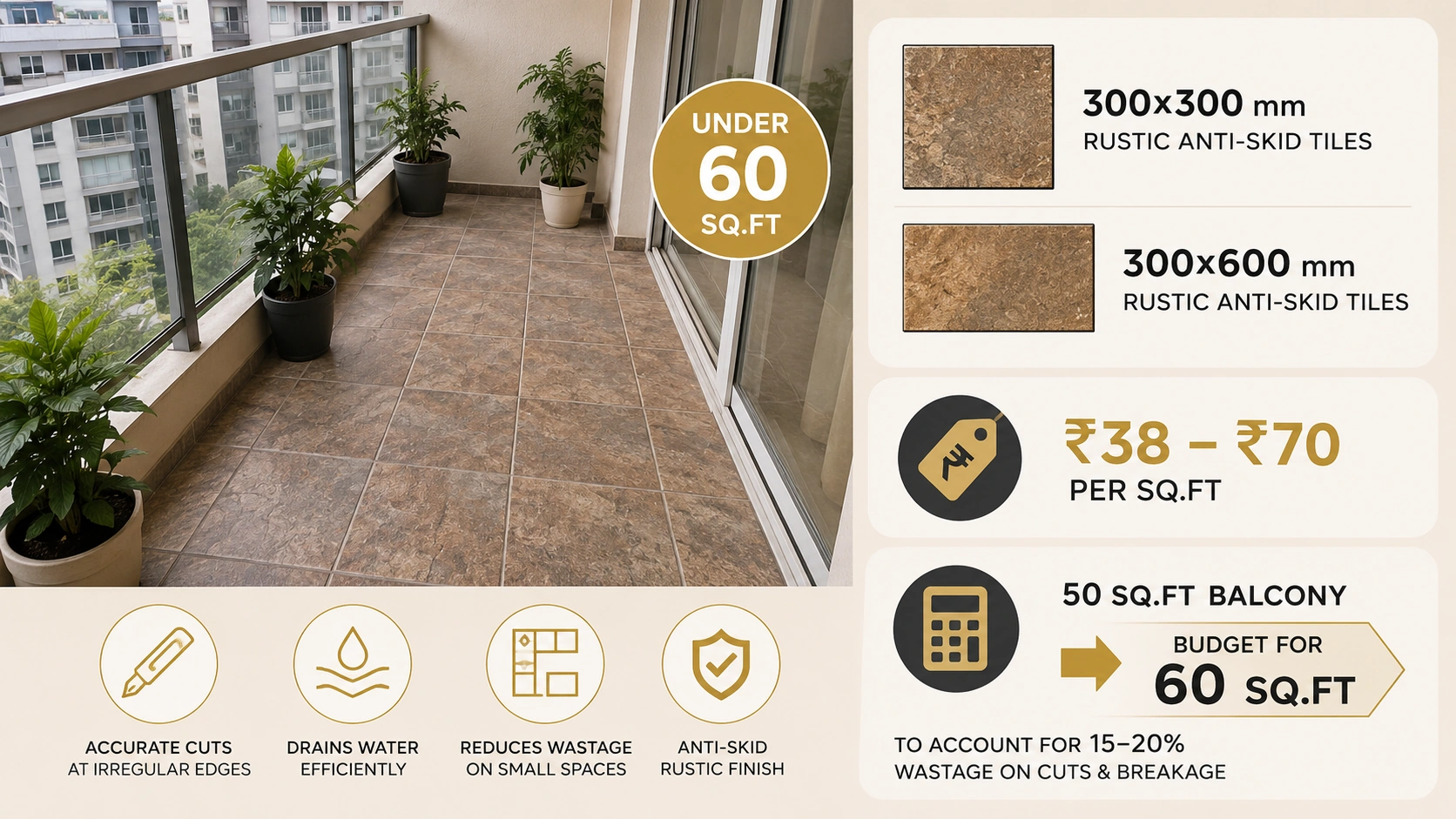
Small balconies need tiles that allow for accurate cutting at irregular edges and drain water efficiently through grout lines. The right size for a small balcony is 300x300 mm or 300x600 mm.
300x300 mm rustic anti-skid tiles cost Rs. 38 to Rs. 70 per sq.ft. The smaller format reduces wastage on L-shaped or corner balconies where edge cuts are frequent. For a 50 sq. t balcony, budget for 60 sq. ft. of tiles to account for 15 to 20% wastage on cuts and breakage.
Large Terrace and Open Outdoor Areas: Best Sizes
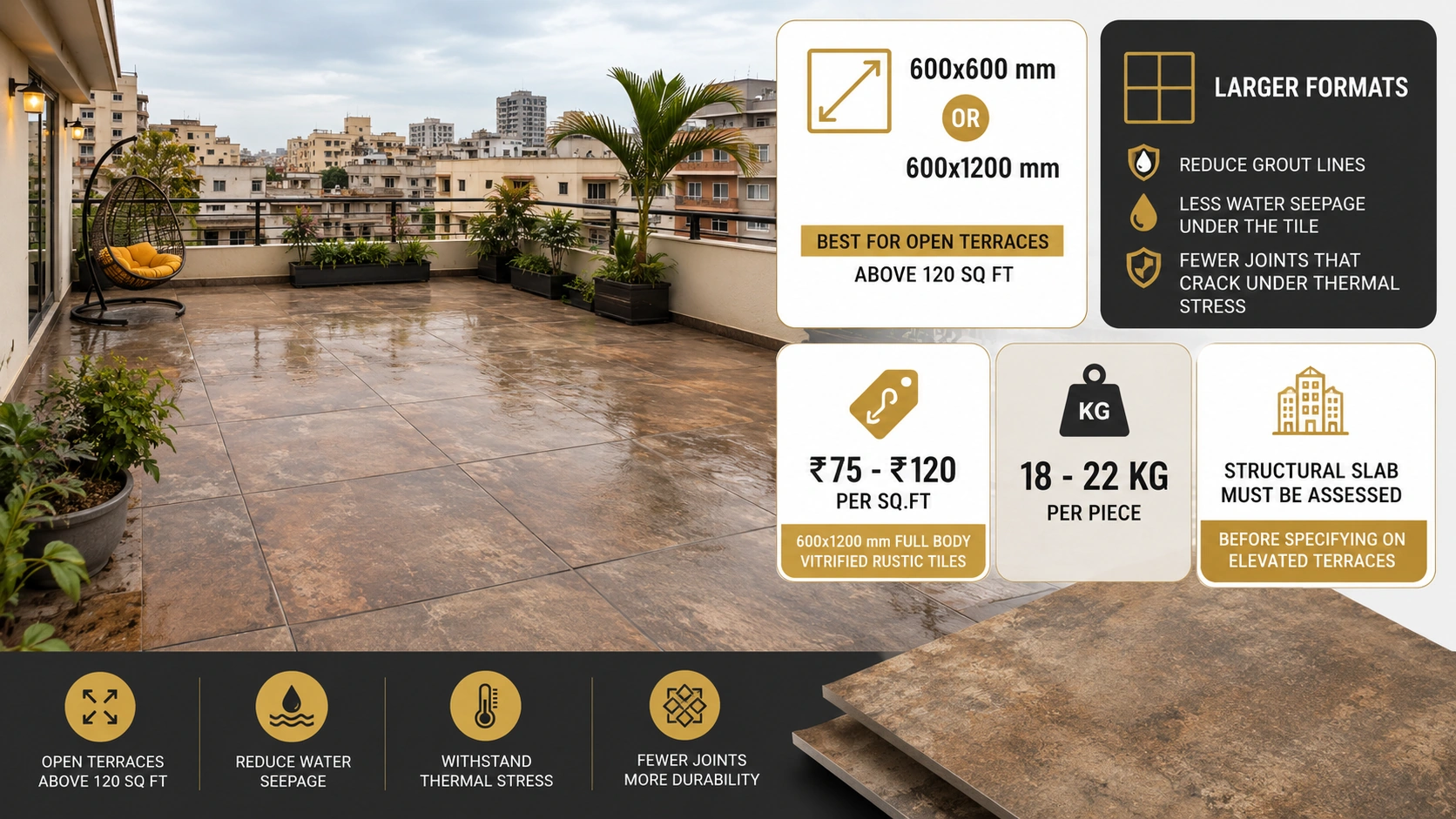
Open terraces above 120 sq ft suit 600x600 mm or 600x1200 mm rustic tiles. Larger formats reduce the number of grout lines, which means fewer points where water can seep under the tile and fewer joints that crack under thermal stress.
600x1200 mm full body vitrified rustic tiles from Morbi manufacturers cost Rs. 75 to Rs. 120 per sq.ft. These tiles weigh 18 to 22 kg per piece, so the structural slab must be assessed for load capacity before specifying them on elevated terraces.
| Area Size | Recommended Size | Material | Price Range (Rs./sq.ft) | Key Reason |
|---|---|---|---|---|
| Under 60 sq.ft (small balcony) | 300x300 mm | Ceramic matte (covered) or FBV (open) | Rs. 38 to Rs. 70 | Easy edge cuts, manageable wastage |
| 60 to 120 sq.ft (medium balcony/terrace) | 300x600 mm or 600x600 mm | Full body vitrified matte or stone finish | Rs. 55 to Rs. 90 | Balanced proportion, fewer grout lines |
| Above 120 sq.ft (large terrace) | 600x600 mm or 600x1200 mm | Full body vitrified matte or stone finish | Rs. 65 to Rs. 120 | Fewer joints, better water management |
How to Choose the Right Rustic Tile for Your Balcony
R-Rating and Slip Resistance: What You Actually Need to Ask
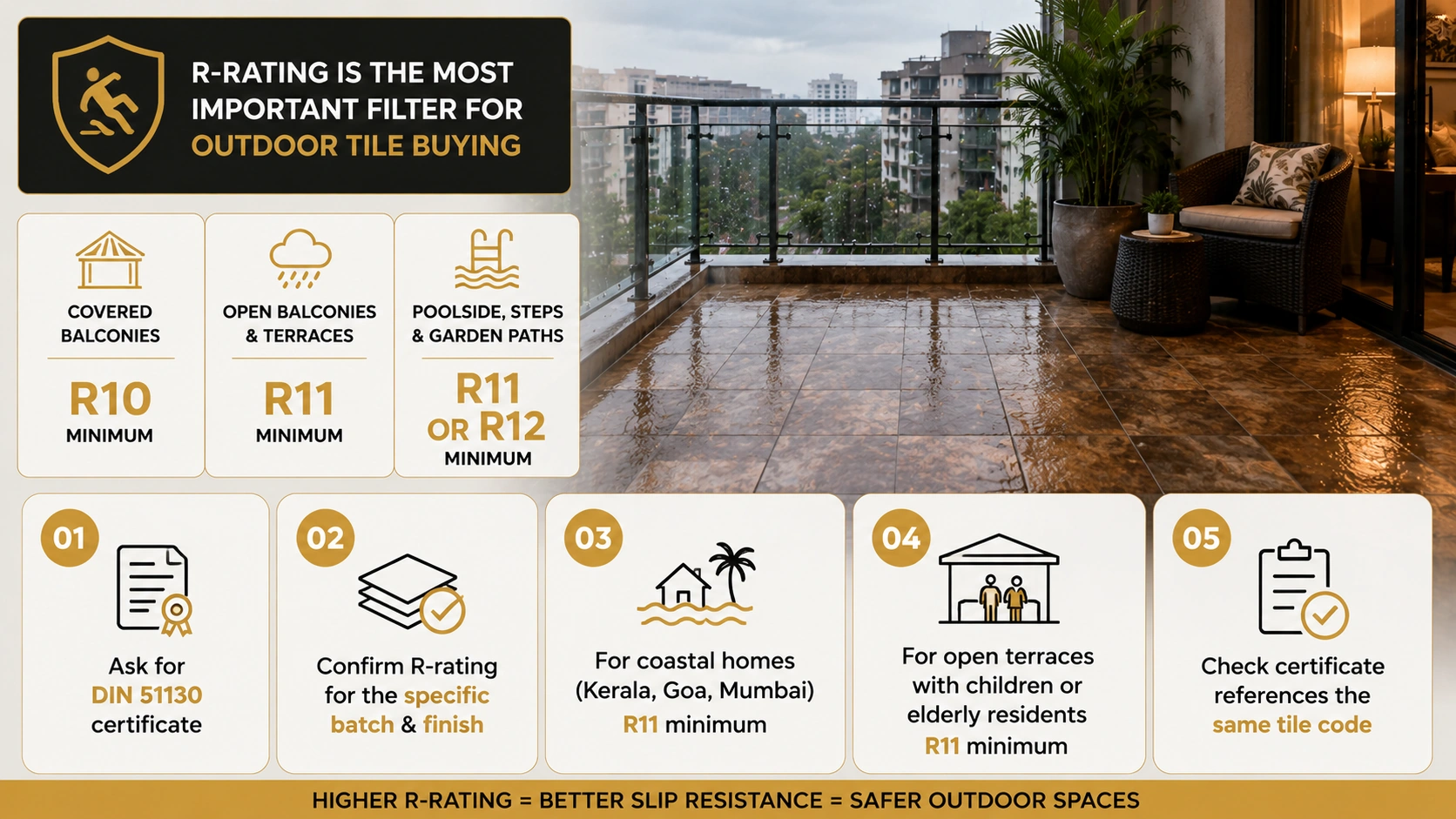
The R-rating system is the most important technical filter for outdoor tile buying in India. Most buyers ask about the finish or colour. The slip resistance certificate matters more than any other specification for a balcony or terrace floor.
Covered balconies need a minimum R10 rating. Open balconies and terraces that receive direct rain need R11. Poolside areas, steps, and garden paths need R11 or R12. When visiting a tile supplier, ask specifically for "DIN 51130 slip resistance certificate" and check that the stated rating matches the tile model you are ordering.
- Ask for the DIN 51130 certificate, not just a verbal assurance of "anti-skid"
- Confirm the R-rating is for the specific batch and finish you are ordering, not a similar model
- For coastal homes in Kerala, Goa, or Mumbai, specify R11 as the minimum for any outdoor surface.
- For open terraces with children or elderly residents, R11 is the minimum regardless of geography.y
- Check that the certificate references the same tile code as the product invoice.
Shade Variation in Rustic Tiles: Budget for More Than You Need
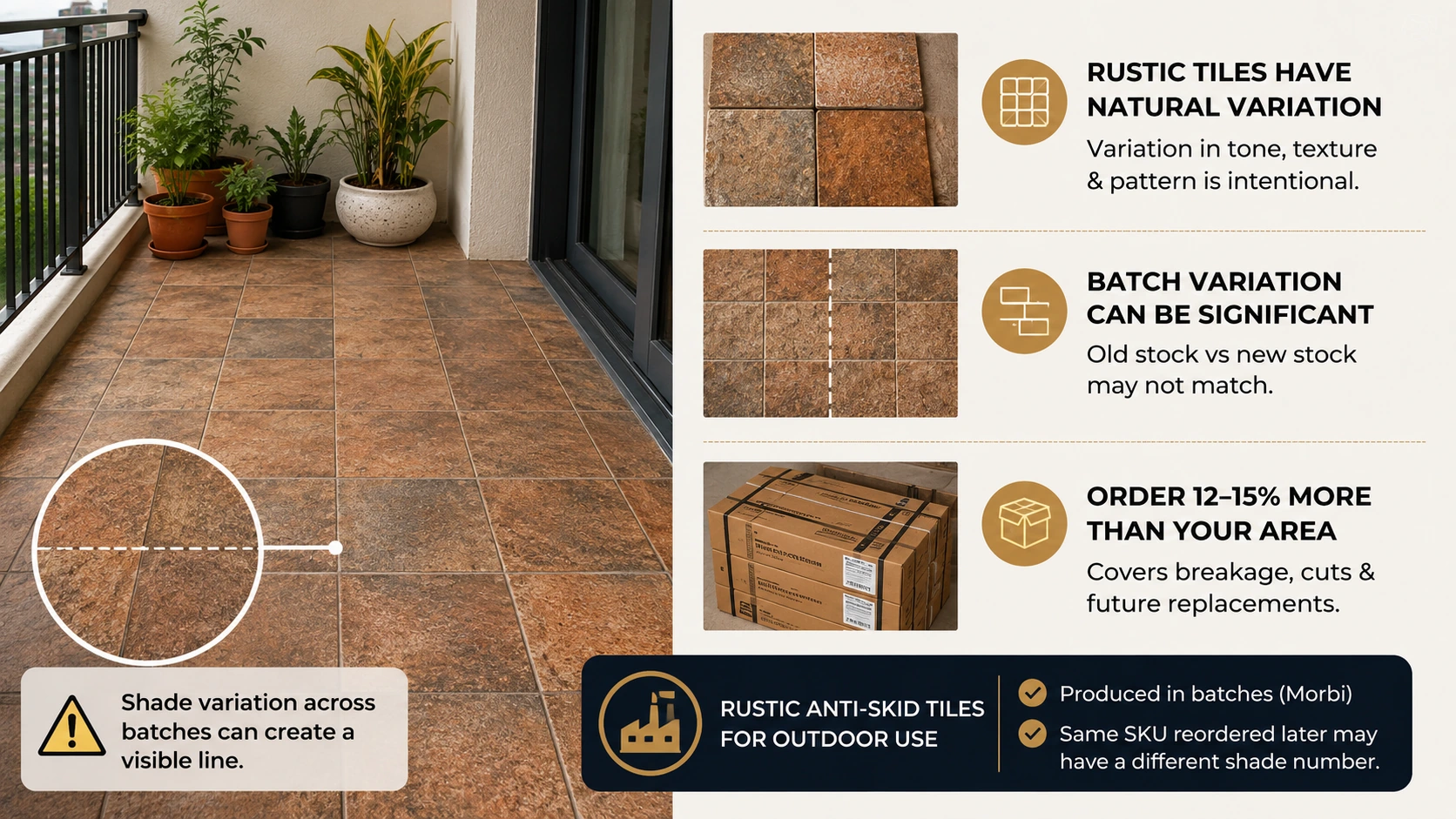
Rustic tiles, by design, carry intentional variation in tone, texture, and surface pattern from piece to piece. This variation is a feature, not a defect. However, shade variation across batches from the same manufacturer can be significant enough to create a visible line where old stock meets new stock.
Always order 12 to 15% more tiles than your measured area. The extra tiles cover breakage during installation, edge cuts, and future replacement pieces from the same batch. Rustic anti-skid tiles for outdoor use from Morbi manufacturers are batch-produced, and the same SKU in a reorder six months later may carry a different shade number.
Price Guide: Rustic Outdoor Tiles in India
| Tile Type | Finish | Size | Price Range (Rs./sq.ft) | Source |
|---|---|---|---|---|
| Ceramic rustic | Matte R10 | 300x300 mm | Rs. 35 to Rs. 55 | Morbi, Gujarat manufacturers |
| GVT rustic | Matte R10 | 300x600 mm | Rs. 45 to Rs. 75 | Morbi, Gujarat manufacturers |
| Full body vitrified | Matte R10 to R11 | 600x600 mm | Rs. 65 to Rs. 95 | Gujarat, Rajasthan manufacturers |
| Full body vitrified | Stone finish R11 | 600x600 mm | Rs. 70 to Rs. 105 | Morbi, Rajkot manufacturers |
| Full body vitrified | Matte R10 | 600x1200 mm | Rs. 75 to Rs. 120 | Morbi large-format producers |
| GVT rustic | GHR (covered use) | 600x600 mm | Rs. 55 to Rs. 90 | Gujarat tile clusters |
Installation costs in India add Rs. 50 to Rs. 90 per sq.ft for outdoor balconies, depending on whether the job involves waterproofing the slab before tiling. For a 100 sq ft terrace, waterproofing the slab adds Rs. 6,000 to Rs. 10,000 to the total project cost and is strongly recommended for any elevated outdoor surface.
After choosing the right R-rating, finish, and material, the next step is selecting a design that complements your home. Explore our Rustic Tile Design Ideas for inspiring outdoor patios, balconies, courtyards, living rooms, kitchens, and farmhouse-style interiors using warm earthy tile designs.
Common Mistakes Buyers Make With Outdoor Rustic Tiles
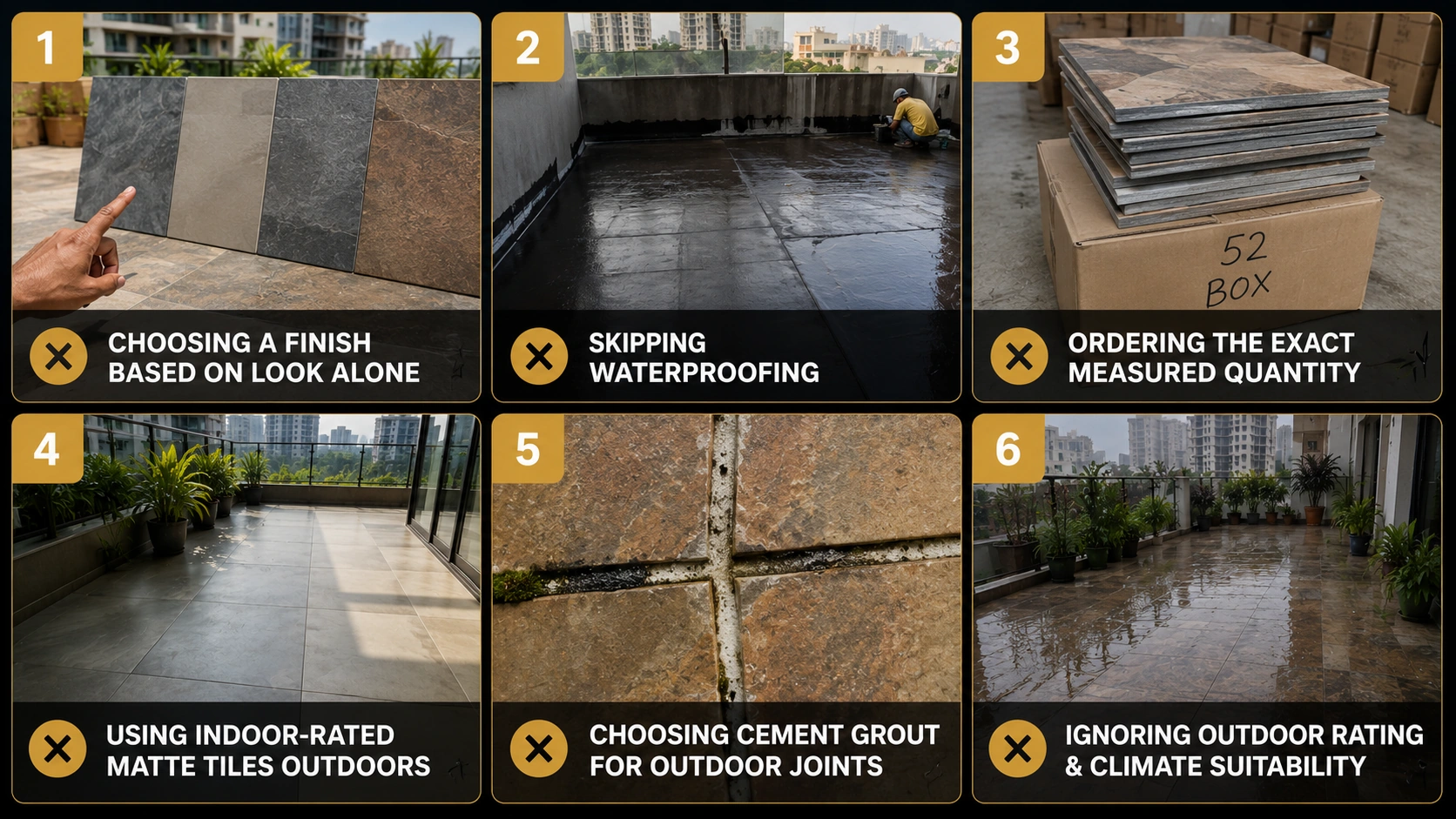
- Choosing a finish based on look alone. The biggest error is selecting outdoor tiles based on showroom photographs rather than R-rating certificates. A tile can look natural and textured and still carry an R8 or R9 rating, which is not suitable for any wet balcony.
- Skipping waterproofing. Tiling directly onto a terrace slab without a waterproofing membrane allows monsoon water to seep through grout joints and into the slab, causing spalling, seepage into the rooms below, and tile lifting within two to three years.
- Ordering the exact measured quantity. Rustic tiles break more often during cutting due to their varied thickness and surface texture. Order 12 to 15% over the measured area for any outdoor project.
- Using indoor-rated matte tiles outdoors. Satin matte and decorative matte finishes are different from outdoor-rated matte tiles. Satin matte tiles must not be used on any floor surface. Confirm the tile is rated for wet floor use before buying.
- Choosing cement grout for outdoor joints. Cement grout absorbs water, stains from algae and mineral deposits, and cracks with thermal expansion. Epoxy grout costs Rs. 200 to Rs. 400 per kg versus Rs. 40 to Rs. 80 per kg for cement grout, but it lasts five to ten times longer on outdoor surfaces exposed to Indian monsoons.
Find Rustic Balcony Tiles With Confirmed Stock
Choosing rustic tiles for outdoor and balcony floors takes more care than most indoor tile decisions. The finish, the R-rating, the body material, and the batch all affect how the tile performs over ten or more monsoon seasons. Skipping any of these checks shows up in the second or third year when tiles crack, slip, or lose their surface texture.
On TilesFinders, every listing shows stock that manufacturers have confirmed as currently available, so the tile you select is the tile you receive. Browse rustic tiles for outdoor areas by finish, size, or R-rating to match your balcony dimensions and climate requirements without contacting ten suppliers separately.
FAQs
Matte finish with an R10 or R11 slip rating is the safest choice for wet balcony floors. The unpolished surface grips wet feet and stays non-slip during monsoon rains. Avoid glossy and polished finishes on any outdoor wet surface.
Rustic tiles with matte or stone finish do not get slippery during rains if they carry an R10 or R11 rating. Tiles with a polished or glossy surface become dangerous when wet and should not be used outdoors in any Indian climate.
300x300 mm or 300x600 mm tiles suit small balconies under 60 sq.ft. These sizes are easier to cut at edges, reduce grout cracking from thermal expansion, and give balanced proportions to compact spaces. Avoid 600x600 mm or larger on balconies under 60 sq.ft.
Rustic outdoor tiles in India range from Rs. 35 to Rs. 120 per sq.ft depending on material and finish. Basic ceramic rustic tiles start at Rs. 35 to Rs. 55 per sq.ft. Full body vitrified rustic options range from Rs. 65 to Rs. 120 per sq.ft from Morbi-based manufacturers.
Yes. Rustic tiles work well on terraces, entrance pathways, parking forecourts, and garden walkways when the finish carries an R10 or R11 rating. For open terraces exposed to full sun, choose full body vitrified tiles with 0.05% water absorption to resist thermal cycling.
The R-rating measures slip resistance under wet conditions. R9 covers dry indoor areas only. R10 suits covered balconies and semi-exposed outdoor areas. R11 handles open terraces, poolside areas, and surfaces exposed to direct rain. Always ask for the R-rating certificate when buying outdoor tiles.
Full body vitrified tiles are more suitable for outdoor use. Their colour runs through the entire tile body, so chips and surface wear do not show a white base layer. GVT tiles have a printed glaze layer that can fade under UV exposure and show wear at high-traffic edges.
Use epoxy grout for all outdoor and balcony tile installations. Epoxy grout resists water ingress, algae, and staining from monsoon runoff. Standard cement grout absorbs moisture, cracks during thermal expansion, and allows water to seep under tiles over time.
600x600 mm or 600x1200 mm tiles suit open terraces above 120 sq.ft. Larger formats reduce grout lines, which means fewer water ingress points. Ensure the structural slab can carry the extra weight, as 600x1200 mm full body vitrified tiles weigh 18 to 22 kg per piece.

See our tile guides first
Set TilesFinders as a preferred source and our buying guides surface ahead of the rest for you.
Add as preferred sourceTakes one tap. Nothing to install.
What Readers Say
I was about to redo my parking area with the wrong tile size until I read this. The layout comparisons saved me from a costly mistake.
We reference TilesFinders guides while briefing clients on material selection. The size and pattern breakdowns are accurate and easy to explain visually.
On site, I get asked about grout spacing all the time. This article gave me a solid reference I now share with my team before every job.
Finally a guide that doesn't just push generic advice. The oil stain removal steps actually worked on our clubhouse driveway tiles.
I run a small construction firm and now send this link to clients directly when they ask about entrance tile sizing. Saves me an hour of explaining.
Good practical detail, though I wish there were more examples for compact apartment entrances specifically, not just villas.
My mother-in-law wanted marble, I wanted vitrified. This blog gave us the neutral comparison we needed to actually decide together.
Detailed without being overwhelming. I appreciated that it covered both cost and maintenance, not just the aesthetics.
Used the algae and hard water removal tips on our terrace tiles after the monsoon. Worked better than what our regular cleaner was doing.
As someone who sources tiles for multiple builder projects, I find these comparisons genuinely useful for vendor conversations, not just consumer content.
Recommended this to a client who kept second-guessing the entrance design. The small vs large layout section settled the debate instantly.
Straightforward and honest, no unnecessary jargon. Would like to see a similar breakdown for outdoor pool-deck tiles next.
We've bookmarked several TilesFinders guides for our design handbook. Reliable source when clients want data, not just opinions.
Two paths, one marketplace.
Get free quotes from verified suppliers.
Share your room, budget, and style. Suppliers in Morbi respond within hours.
Get Free QuotesList your business, reach real buyers.
Put your showroom in front of homeowners searching for tiles right now.
List Your Business