Rain Drops vs Stucco vs Matte Carving Tiles: Which Textured Finish Is Best for Indian Wet Floors
Compare Rain Drops, Stucco and Matte Carving tiles across grip, cleaning, monsoon exposure and oil resistance to find the most practical textured finish for Indian wet floors.
- What Each One Was Actually Designed to Do
- The Difference That Decides Wet Floors
- Stress Test One: Soap Film
- Stress Test Two: Cooking Oil
- Stress Test Three: Sustained Monsoon Rain
- Stress Test Four: Hard Water
- Stress Test Five: Bare Feet Versus Footwear
- Stress Test Six: Five Years of Cleaning
- Verdict by Zone
- What Degrades Each One
- Confirm Before Ordering, Whichever You Choose
- Compare All Three on TilesFinders
Rain Drops offers the most consistent wet-floor grip, while Matte Carving is easier to maintain and Stucco provides a coarser textured alternative. For bathrooms, balconies and outdoor steps, choose by actual wet COF, drainage, outdoor rating and your cleaning habits, not texture alone.
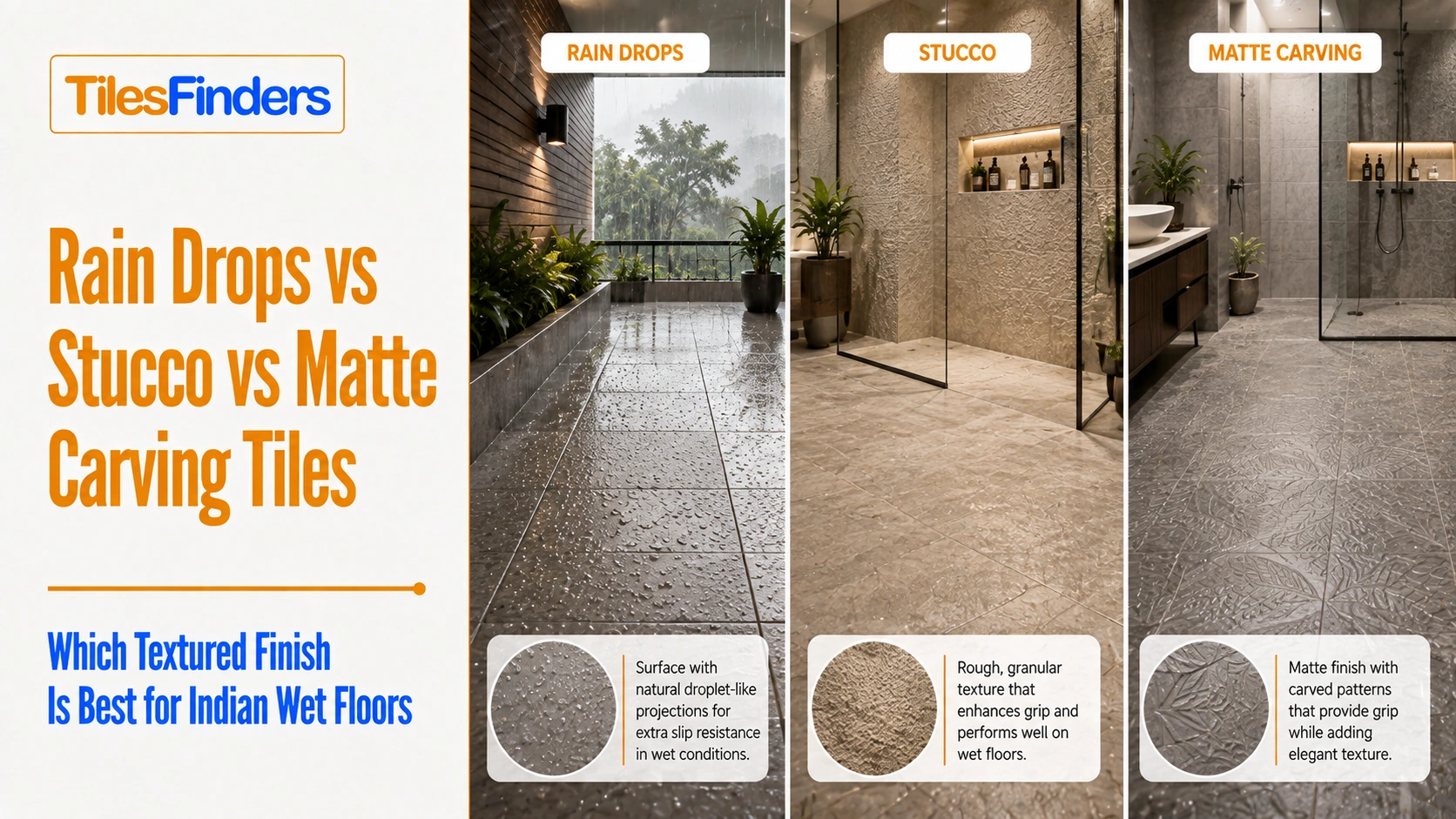
All three are textured, all three are marketed for wet areas, but Rain Drops tiles are designed around a specific anti-skid mechanism that becomes relevant under real conditions. The differences only appear when an actual Indian bathroom or balcony faces soap film, cooking oil, months of monsoon, hard water and years of mopping. This guide puts all three through those conditions rather than comparing their sales descriptions.
What Each One Was Actually Designed to Do
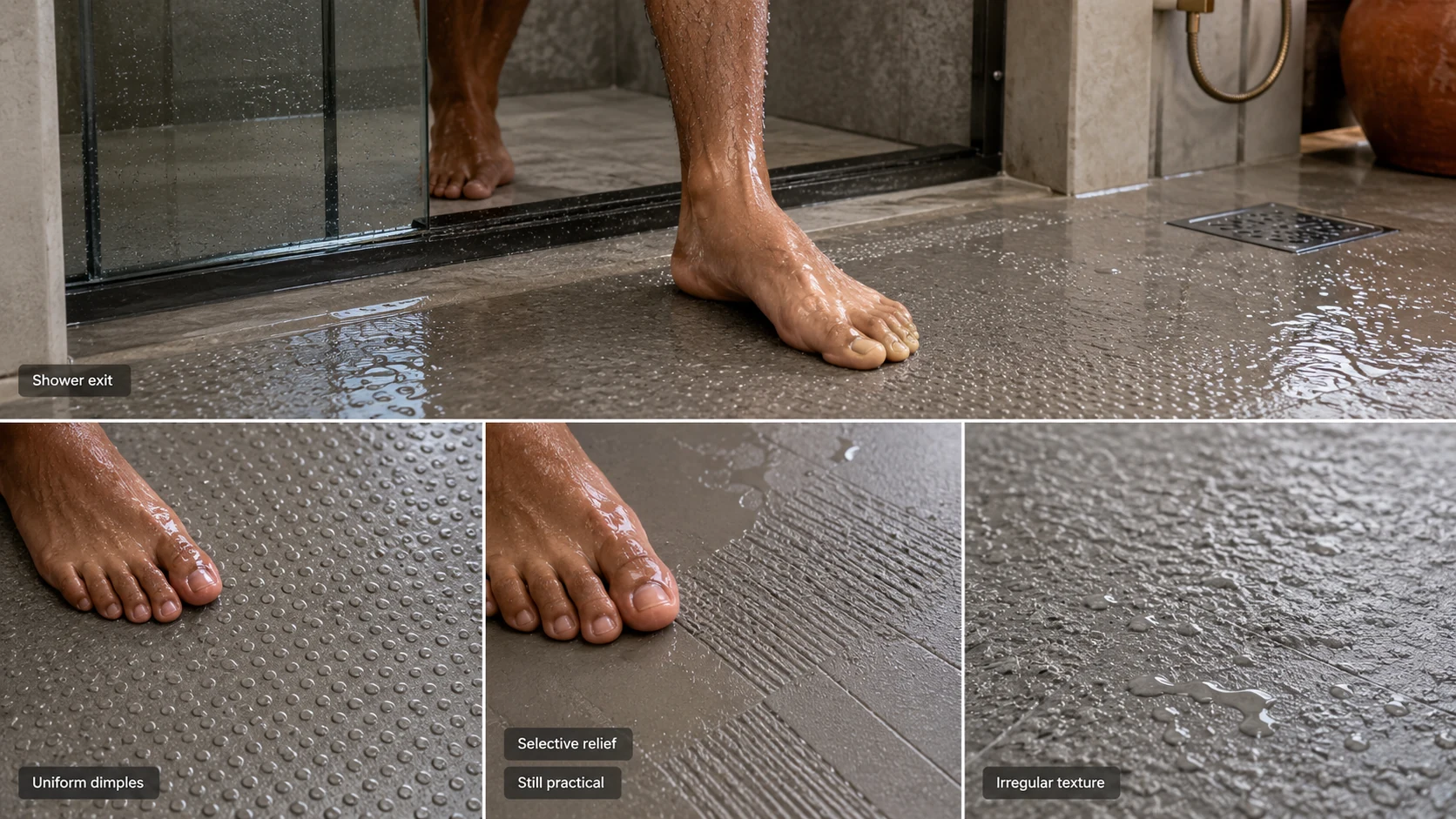
- Raindrops is a functional finish first. The uniform dimpled surface exists to break the water film between a wet foot and the tile, and its appearance follows from that job rather than driving it.
- Stucco originates as a decorative finish, imitating the irregular character of hand-applied plaster. Its texture is coarser and less regular, and grip is a consequence of the look rather than its purpose.
- Matte carving is a matte surface with selectively carved areas, so parts of the face carry relief and parts remain plain matte. It is designed to catch light at angles while remaining a practical floor finish.
The Difference That Decides Wet Floors
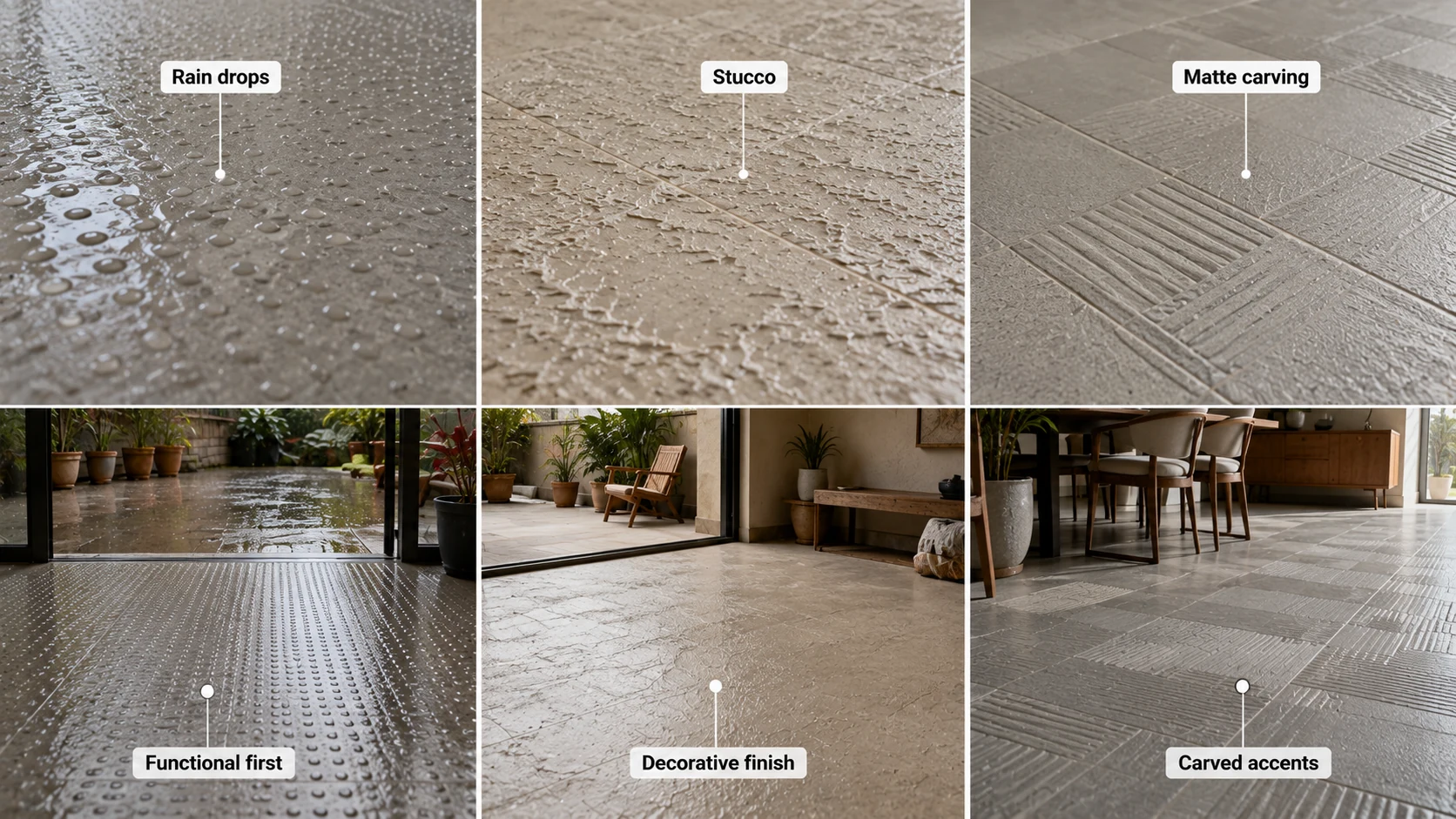
Uniformity matters more than depth, and this is where the three genuinely separate: A foot does not choose where it lands. It arrives at an arbitrary point on the floor, and whatever is at that point is what determines whether it grips. Rain drops carries the same fine dimple pattern across every square centimetre, so wherever a foot lands, the mechanism is present. Matte carving concentrates its relief into selected areas with plain matte between them, which means grip varies across the face depending on where contact happens. Stucco sits in between, textured throughout but irregularly, so the texture is everywhere while its depth and character vary. For a dry decorative wall, none of this matters. For the strip of floor immediately outside a shower, where a wet foot lands unpredictably, and there is nothing to grab, uniformity is worth more than any other property on the specification sheet. |
If you want to understand the Rain Drops finish beyond this comparison, our Rain Drops Finish Tiles Guide explains its dimpled surface, wet-area applications, maintenance needs and key specifications to check before buying. It is especially useful when deciding between bathroom, balcony and outdoor flooring.
An important qualification: This does not make matte carving unsafe. Its plain matte areas are themselves a wet-floor-appropriate finish, which is why it sits alongside plain matte, punch and sugar among finishes suitable for wet floors. The point is narrower: where risk is highest, a uniformly textured surface removes a variable that a selectively textured one leaves in play. In lower-risk wet zones that variable matters considerably less. |
Stress Test One: Soap Film
The most common cause of grip loss in any Indian bathroom, and it affects all three, but not equally.
| Finish | How It Copes | What Restores It |
| Rain drops | Film settles into the dimples and reduces the effect. Because the recesses are shallow and regular, a brush reaches into all of them | Brush cleaning followed by a plain water rinse, done routinely |
| Stucco | Irregular texture holds residue in the deeper pockets, and those pockets are harder to reach consistently | More thorough brush work, since a mop passes over the deeper areas entirely |
| Matte carving | The plain matte areas clean easily. Residue concentrates in the carved sections, but those are a smaller proportion of the face. | Standard cleaning handles most of it, with occasional brush work in the carved areas. |
Stress Test Two: Cooking Oil
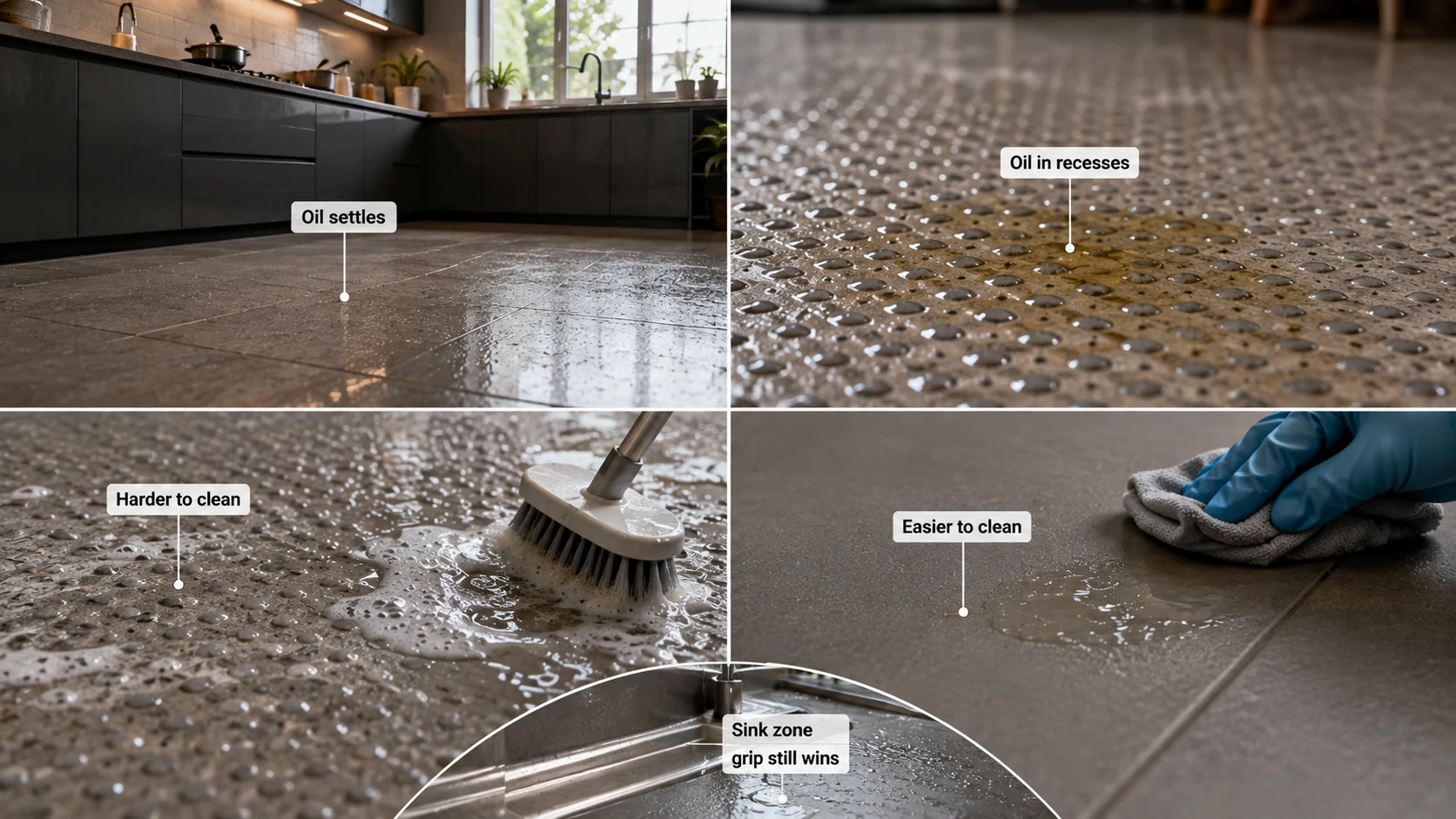
Oil is the hardest test any textured floor faces, and it favours the least textured option: Airborne cooking oil settles as a fine film that is considerably harder to remove from a recessed surface than a flat one, because detergent has to reach into the recess, lift the oil and be rinsed back out. Deeper and more irregular texture makes that harder. Across a kitchen floor tile away from the sink, this is a real argument against heavy texture and in favour of a plain matte or a lightly carved surface. In the splash zone at the sink itself, grip still wins, but the maintenance cost is genuine and worth accepting knowingly rather than discovering. |
Stress Test Three: Sustained Monsoon Rain
An exposed balcony stays wet for hours or days rather than minutes, which changes what matters.
| Finish | Performance Under Sustained Rain |
| Rain drops | Strongest of the three. Continuous water is exactly the condition the uniform dimple pattern was designed for, and rain rinses the recesses rather than filling them |
| Stucco | Performs well, with the coarser texture giving good grip. Its irregular pockets can retain water slightly longer after rain stops |
| Matte carving | Adequate with a confirmed outdoor rating, though the plain matte areas do more of the work than the carved ones in genuinely heavy conditions |
Whichever you choose outdoors, drainage does more than texture: No surface finish compensates for standing water. A balcony with a proper fall toward a correctly sized outlet will be safer in a plain matte than a badly drained balcony in the most aggressive texture available. Get the fall right first, then choose the finish. This is also why the outdoor R-rating and the wet coefficient of friction are both worth confirming, since they describe different aspects of the same problem. |
From The Marketplace
Popular tiles right now
Stress Test Four: Hard Water
Much of India has hard water, and evaporating water leaves mineral deposits that build inside the texture over time.
| Finish | Deposit Visibility | Long-Term Effect |
| Rain drops | Low, since the texture already breaks up reflection | Deposits accumulate in the dimples and gradually reduce grip if cleaning is inconsistent |
| Stucco | Low to moderate | Deeper irregular pockets accumulate more and are harder to clear fully |
| Matte carving | Low | Deposits concentrate in the carved areas while the plain matte majority stays clear, so overall impact is limited. |
Stress Test Five: Bare Feet Versus Footwear
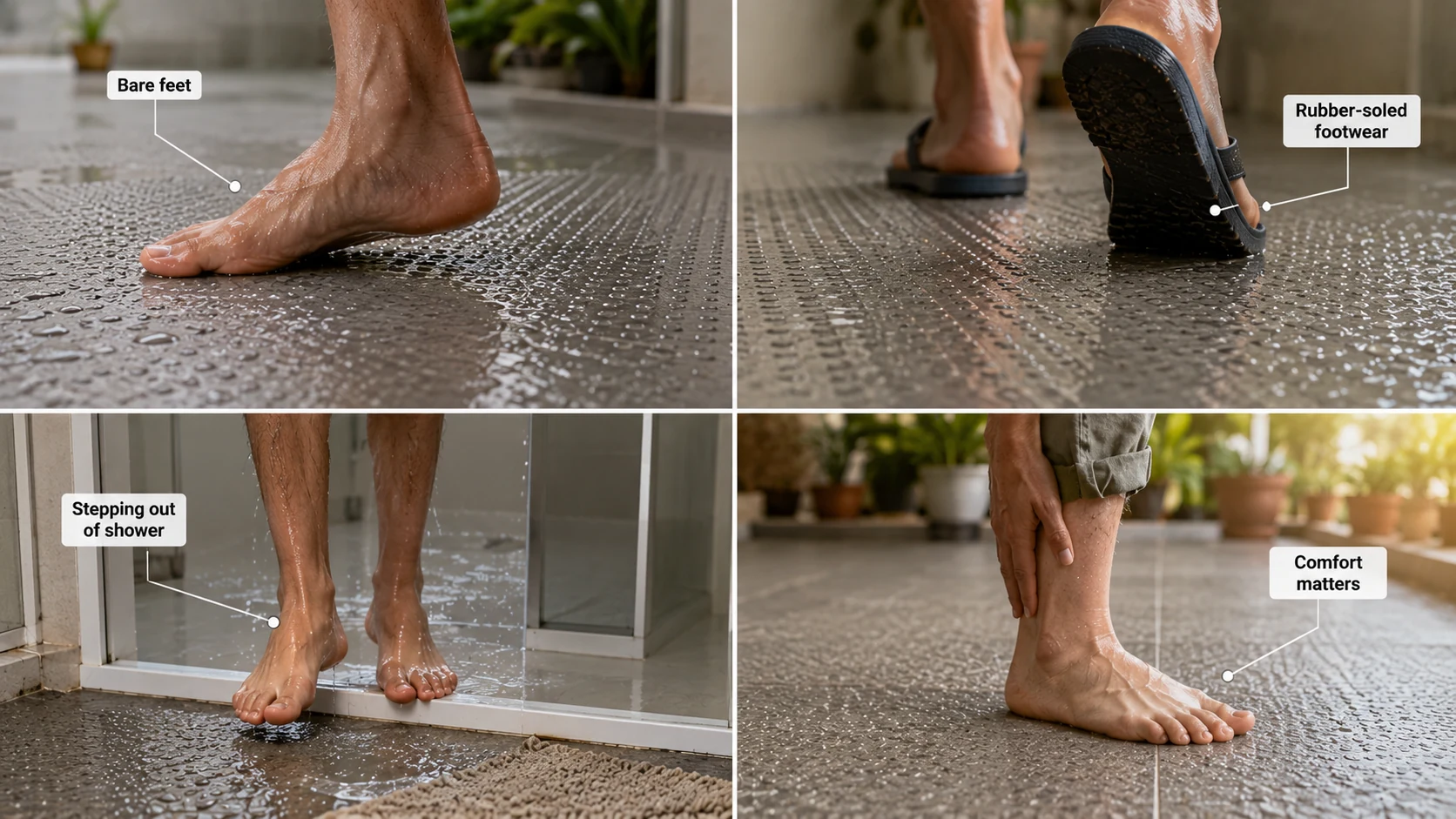
- Bare feet is the demanding case, and the one that matters in Indian homes. Skin needs the water film broken to grip, which favours a fine uniform texture that maximises contact points. Raindrops perform best here.
- Rubber-soled footwear grips adequately on any of the three, since the sole deforms into the texture and generates friction regardless of pattern regularity.
- Wet feet in the moment of stepping out of a shower is the single highest-risk instant in a home, and it combines bare skin, maximum water and unpredictable foot placement.
- Comfort matters too. A coarse stucco texture that grips well can feel abrasive underfoot in a room used barefoot daily, which is a legitimate reason to prefer a finer texture even at equal grip.
Stress Test Six: Five Years of Cleaning
Every finish here performs well when new. The honest question is what happens after several years of ordinary household maintenance.
| Finish | After Five Years, Cleaned Well | After Five Years, Cleaned Casually |
| Rain drops | Close to original performance, since shallow regular recesses clear readily with a brush | Noticeably reduced, as film fills the dimples that the mechanism depends on |
| Stucco | Good, though deeper pockets need deliberate attention | Most affected of the three, since irregular deep pockets are the hardest to clear and easiest to neglect |
| Matte carving | Very close to original | Least affected, because the plain matte majority of the surface does not depend on recesses staying clear |
The finding worth sitting with: Rain Drops starts with the best wet grip and matte carving ages the most gracefully under inconsistent cleaning. That is a genuine trade-off rather than a ranking. A household that will brush the bathroom floor tile properly every week gets the most from Rain Drops. A household that will mop and move on gets more real-world safety over ten years from matte carving, because a finish that depends less on recesses staying clear degrades less when they do not. Choosing honestly here means being realistic about your own cleaning habits rather than aspirational about them. |
Verdict by Zone
| Zone | Best Choice | Why |
| Immediately outside a shower | Rain drops | Highest-risk spot in the home, where uniform grip under wet bare feet outweighs every other consideration |
| Shower enclosure floor | Rain drops | Continuous water and soap, with unpredictable foot placement while standing |
| General bathroom floor | Any of the three | Splash rather than continuous water, so all three are adequate with confirmed wet COF |
| Wash and utility area | Rain drops or stucco | Standing water and detergent film reward stronger texture; both handle it better than a selectively carved surface |
| Exposed balcony or terrace | Rain drops or stucco | Sustained rain suits stronger uniform or coarse texture, with outdoor rating confirmed |
| Outdoor steps | Rain drops | The highest-consequence outdoor location, where uniformity matters most |
| Kitchen floor at the sink | Matte carving | Grip where needed while remaining far easier to clear of cooking oil than deeper texture |
| General kitchen floor | Matte carving | Oil settles across the whole floor, and a less recessed surface is genuinely easier to keep clean |
| Bathroom or feature walls | Matte carving or stucco | Grip is irrelevant vertically, so choose on appearance; both read better on a wall than a functional dimple. |
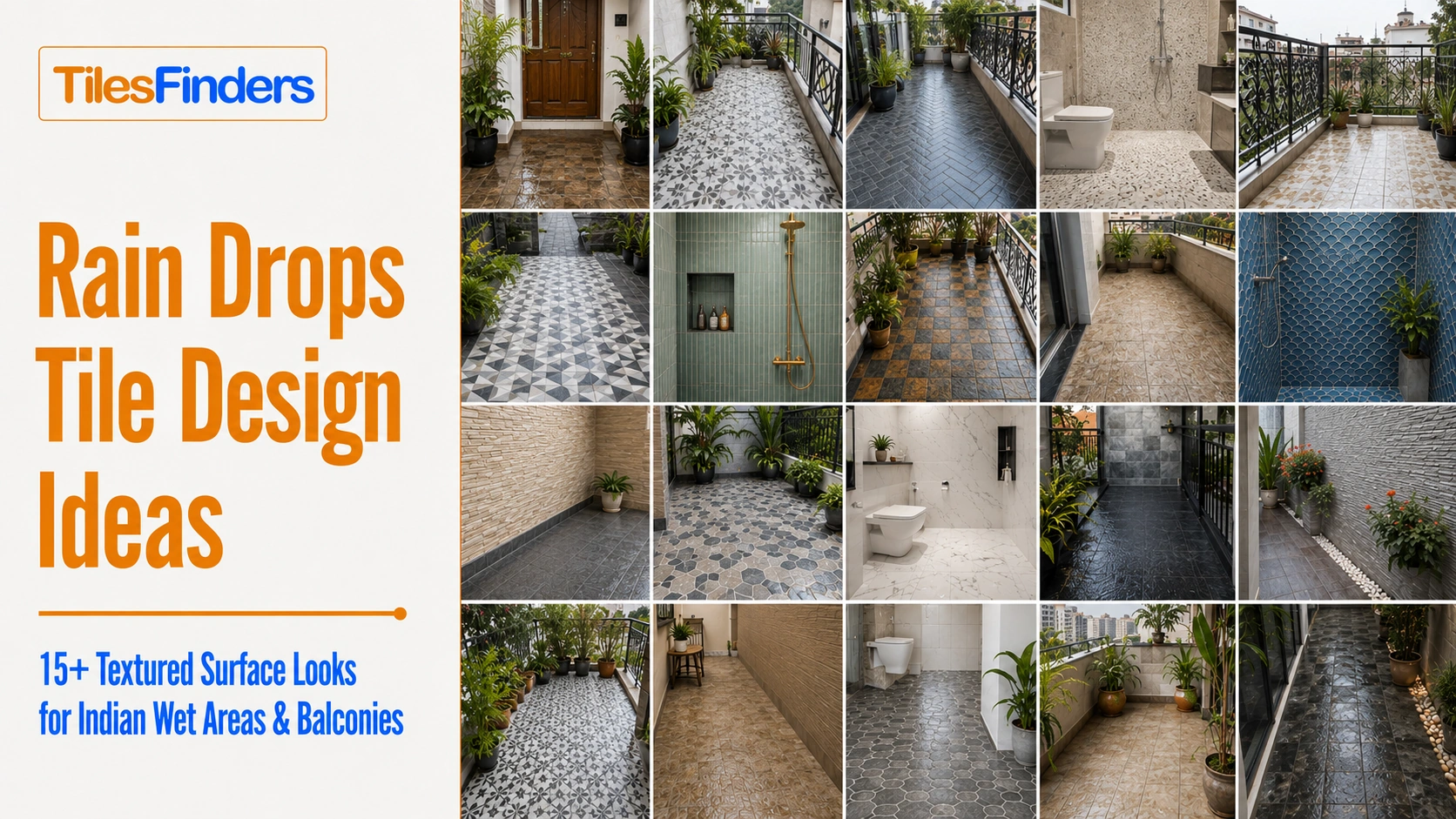
Once you have narrowed the finish down by zone, the next step is seeing how Rain Drops works across real Indian spaces. Explore Rain Drops Tile Design Ideas for practical bathroom, balcony, utility and outdoor applications, including different household and climate requirements.
What Degrades Each One
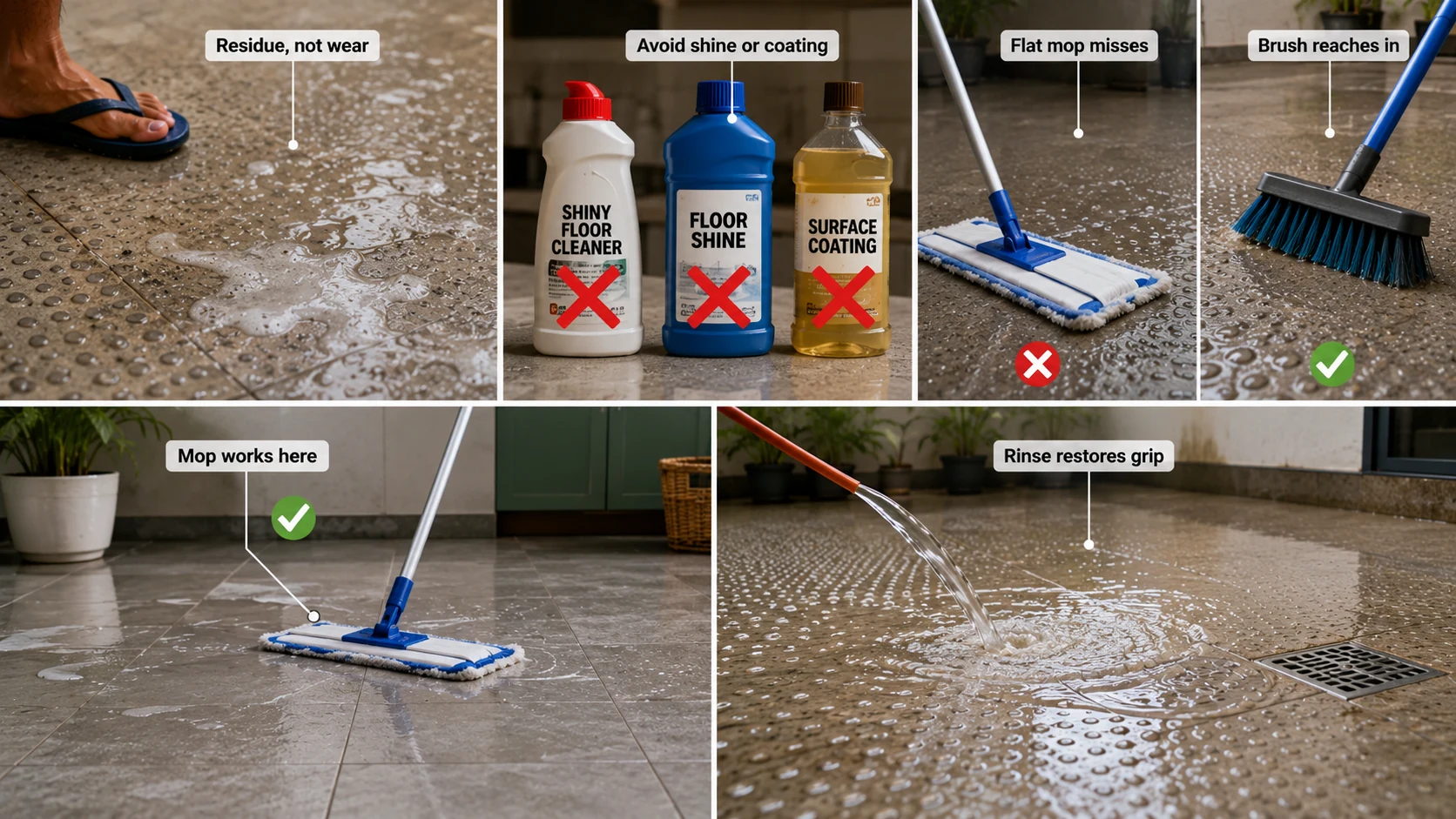
- All three lose grip to residue rather than to wear. Soap film, cleaner film and oil are the enemies, not foot traffic, and a floor that feels slippery after a few years usually needs cleaning rather than replacing.
- Cleaners that leave a shine or coating work directly against every finish here, since any film that fills texture defeats the mechanism regardless of which pattern it is.
- A flat mop is the wrong tool for raindrops and stucco, passing over recesses rather than into them. A soft brush reaches what a mop cannot.
- Matte carving tolerates a mop better, because the majority of its surface is plain matte that a mop cleans properly.
- Rinsing with plain water after cleaning restores more grip than any product, on all three, and costs nothing.
Confirm Before Ordering, Whichever You Choose
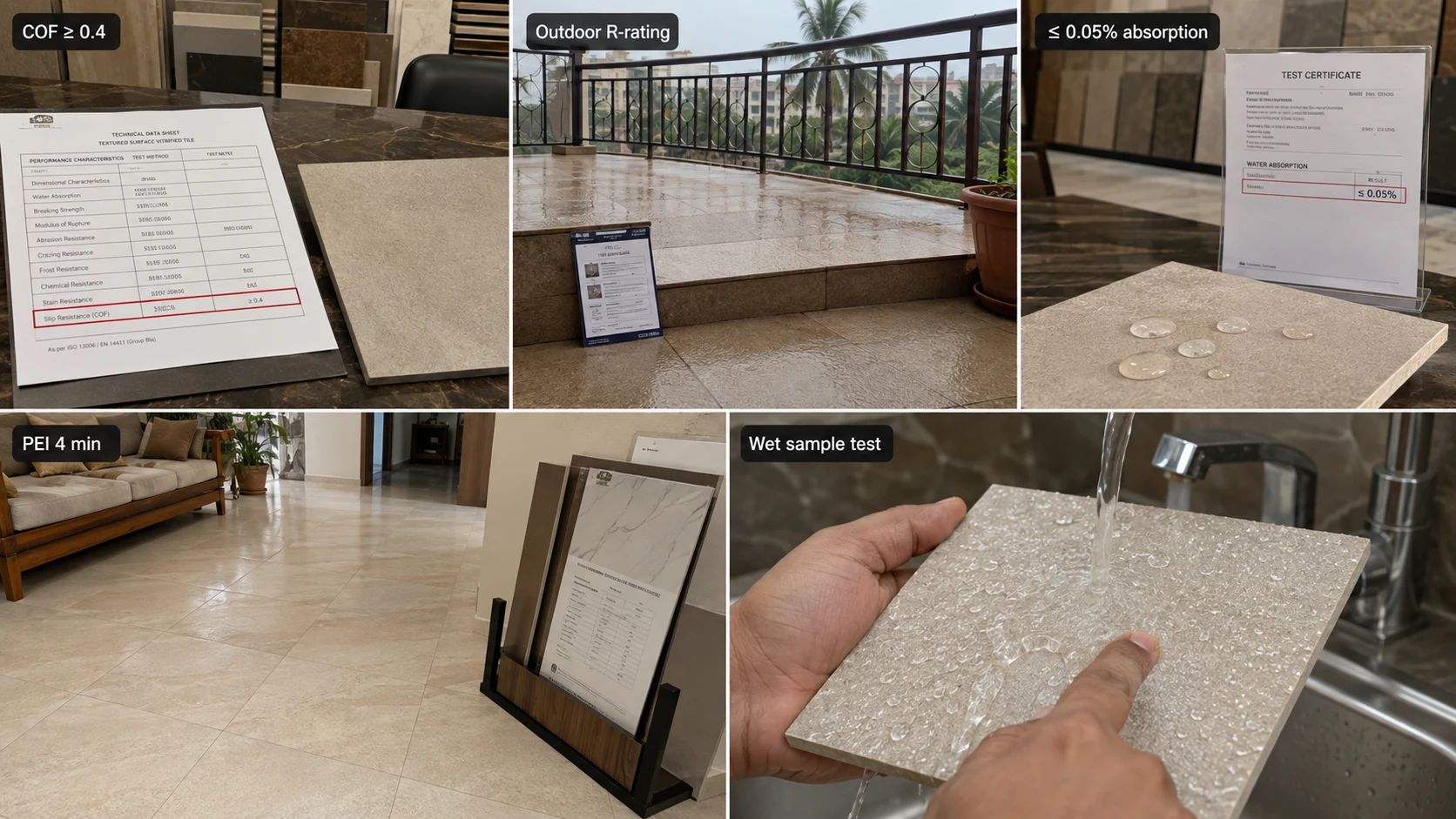
- Wet coefficient of friction of 0.4 minimum, taken from the technical data sheet rather than inferred from the word textured, which describes appearance rather than performance.
- Outdoor R-rating in addition to wet COF for any balcony, terrace or outdoor step.
- Water absorption of 0.05% or below for vitrified tile, the benchmark set by the Bureau of Indian Standards under IS 15622, with the test certificate requested.
- PEI 4 minimum for residential floors, as stated on the manufacturer's technical data sheet.
- A wet sample in your hand. Run water over it and feel the surface with a fingertip, which tells you more about real behaviour than any photograph or description.
Compare All Three on TilesFinders
Rain drops, stucco and matte carving ranges can each be filtered on TilesFinders by finish, format and outdoor rating, so you can match the texture to the zone rather than applying one finish across an entire home.
FAQs
Rain drops, because its uniform dimple pattern is present wherever a foot lands. A foot does not choose its landing point, and matte carving concentrates relief into selected areas while stucco varies in depth, so both leave more to chance in the highest-risk spots.
Yes. Its plain matte areas are themselves a wet-floor-appropriate finish, which is why it sits alongside plain matte, punch and sugar among suitable options. The narrower point is that where risk is highest, a uniformly textured surface removes a variable that a selectively textured one leaves in play.
Matte carving, because most of its surface is plain matte that a standard mop cleans properly, with only the carved areas needing occasional brush attention. Stucco is the hardest, since irregular deep pockets are difficult to clear consistently.
Matte carving. Cooking oil settles across a whole kitchen floor and is considerably harder to lift out of deep or irregular texture than off a largely plain matte surface, so heavy texture creates a maintenance burden that outweighs the grip benefit away from the sink.
All three do, but to residue rather than wear. Soap film, cleaner film and oil fill the texture the mechanism depends on. Rain drops and stucco are most affected because they rely more on recesses staying clear; matte carving is least affected for the same reason.
Rain drops or stucco, with outdoor R-rating confirmed alongside wet COF. Rain drops handles sustained rain best since continuous water rinses the recesses rather than filling them, and stucco's coarser texture also performs well.
No. A balcony with a proper fall to a correctly sized outlet will be safer in a plain matte than a badly drained balcony in the most aggressive texture available. Fix the fall first, then choose the finish.
Not necessarily, and it carries costs. Coarse texture can feel abrasive underfoot in a room used barefoot daily, holds more residue, and is harder to clean. A fine uniform texture frequently delivers better real-world grip than a coarse irregular one.
Be honest about your cleaning habits. A household that will brush the bathroom floor properly each week gets the most from rain drops. A household that will mop and move on gets more real-world safety over a decade from matte carving, which depends less on recesses staying clear.


See our tile guides first
Set TilesFinders as a preferred source and our buying guides surface ahead of the rest for you.
Add as preferred sourceTakes one tap. Nothing to install.
What Readers Say
I was about to redo my parking area with the wrong tile size until I read this. The layout comparisons saved me from a costly mistake.
We reference TilesFinders guides while briefing clients on material selection. The size and pattern breakdowns are accurate and easy to explain visually.
On site, I get asked about grout spacing all the time. This article gave me a solid reference I now share with my team before every job.
Finally a guide that doesn't just push generic advice. The oil stain removal steps actually worked on our clubhouse driveway tiles.
I run a small construction firm and now send this link to clients directly when they ask about entrance tile sizing. Saves me an hour of explaining.
Good practical detail, though I wish there were more examples for compact apartment entrances specifically, not just villas.
My mother-in-law wanted marble, I wanted vitrified. This blog gave us the neutral comparison we needed to actually decide together.
Detailed without being overwhelming. I appreciated that it covered both cost and maintenance, not just the aesthetics.
Used the algae and hard water removal tips on our terrace tiles after the monsoon. Worked better than what our regular cleaner was doing.
As someone who sources tiles for multiple builder projects, I find these comparisons genuinely useful for vendor conversations, not just consumer content.
Recommended this to a client who kept second-guessing the entrance design. The small vs large layout section settled the debate instantly.
Straightforward and honest, no unnecessary jargon. Would like to see a similar breakdown for outdoor pool-deck tiles next.
We've bookmarked several TilesFinders guides for our design handbook. Reliable source when clients want data, not just opinions.
Two paths, one marketplace.
Get free quotes from verified suppliers.
Share your room, budget, and style. Suppliers in Morbi respond within hours.
Get Free QuotesList your business, reach real buyers.
Put your showroom in front of homeowners searching for tiles right now.
List Your Business