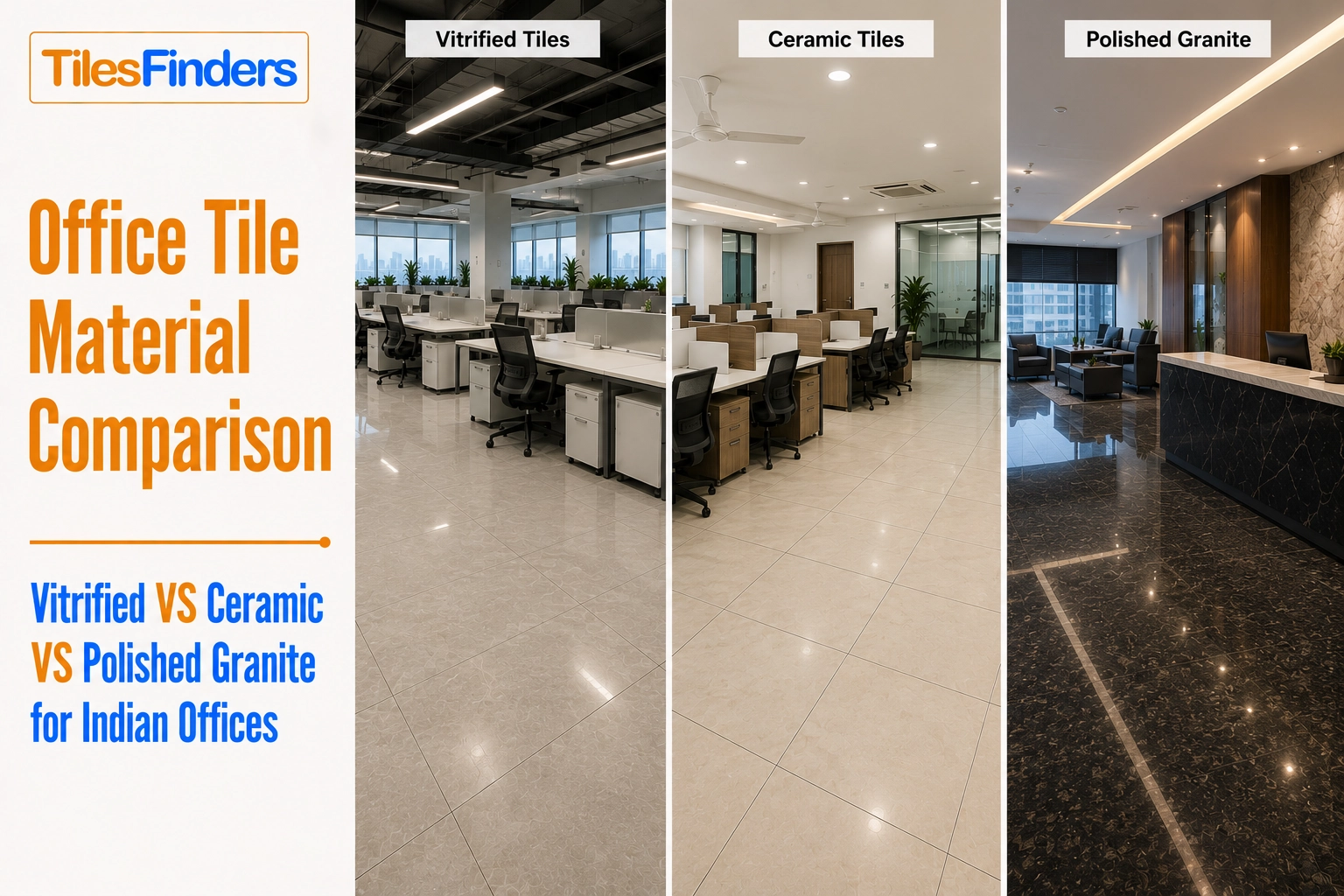
Office Tile Material Comparison: Vitrified vs Ceramic vs Polished Granite for Indian Offices
Compare vitrified, ceramic, and polished granite office flooring across wear resistance, slip safety, maintenance, cost, and climate suitability to choose the best commercial tile material in India
- Who Are the Three Contenders?
- Round 1: Abrasion and Wear Resistance
- Round 2: Slip Safety
- Round 3: Water Absorption and Stain Resistance
- Round 4: Installation and Replacement Cost
- Round 5: Maintenance Load on the Facility Team
- Round 6: Design Range and Visual Longevity
- Round 7: Climate Suitability for Indian Offices
- Seven-Round Scorecard
- Which Material Should Actually Go Where in Your Office
- The Numbers Behind GVT's Dominance in Indian Commercial Flooring
- Use This Comparison in Your Next Procurement Brief
This 7-round comparison evaluates GVT vitrified tiles, ceramic tiles, and polished granite on durability, safety, maintenance, cost, and long-term office performance. For most Indian commercial spaces, PEI 4–5 GVT tiles with matte or GHR finish deliver the best balance of durability, slip resistance, low maintenance, and lifecycle value.
Ask three different tile dealers in India which floor material is best for an office, and you will get three different answers, each shaped by what they stock. This guide takes a different approach: it sets seven criteria that actually matter in a commercial office context, then scores each material against them.
The three materials are GVT (Glazed Vitrified Tiles), ceramic tiles, and polished granite, which, together, cover most of what is specified for Indian office floors. Natural stone, such as marble, is excluded because it falls into a different price bracket and is rarely compared directly against the three above in standard commercial procurement.
At the end of each round, a winner is declared. At the end of the guide, a zone-by-zone table tells you which material wins where, so you can use this comparison directly in a procurement brief.
Who Are the Three Contenders?
GVT (Glazed Vitrified Tiles)
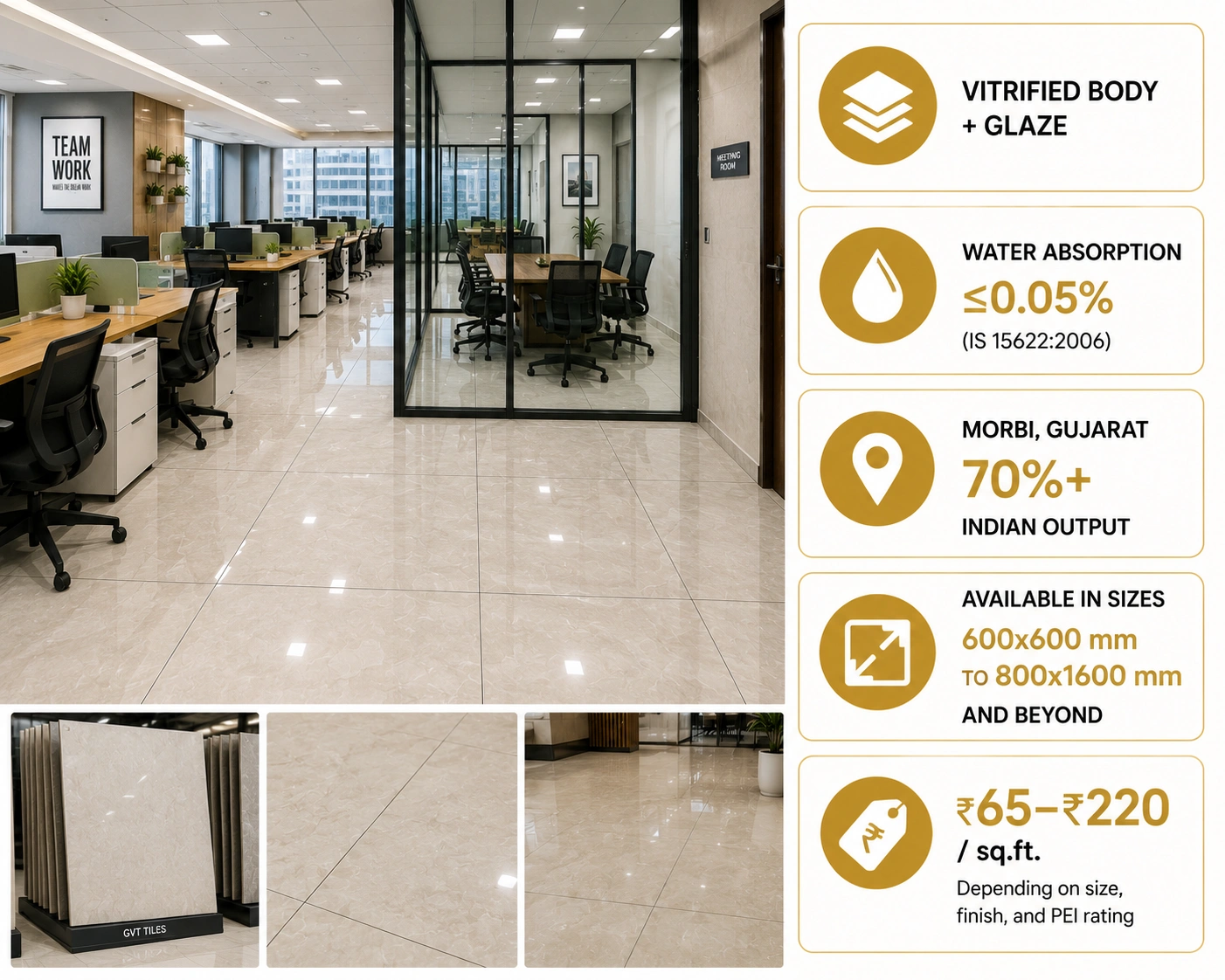
GVT tiles press a vitrified body (fired at high temperature for density) and fuse a design glaze on top. Water absorption sits at 0.05% or lower under IS 15622:2006. Manufactured primarily in Morbi, Gujarat, which supplies over 70% of India's vitrified tile output. Available in sizes from 600x600 mm to 800x1600 mm and beyond. Price: Rs. 65 to Rs. 220 per sq. ft., depending on size, finish, and PEI rating.
Ceramic Tiles
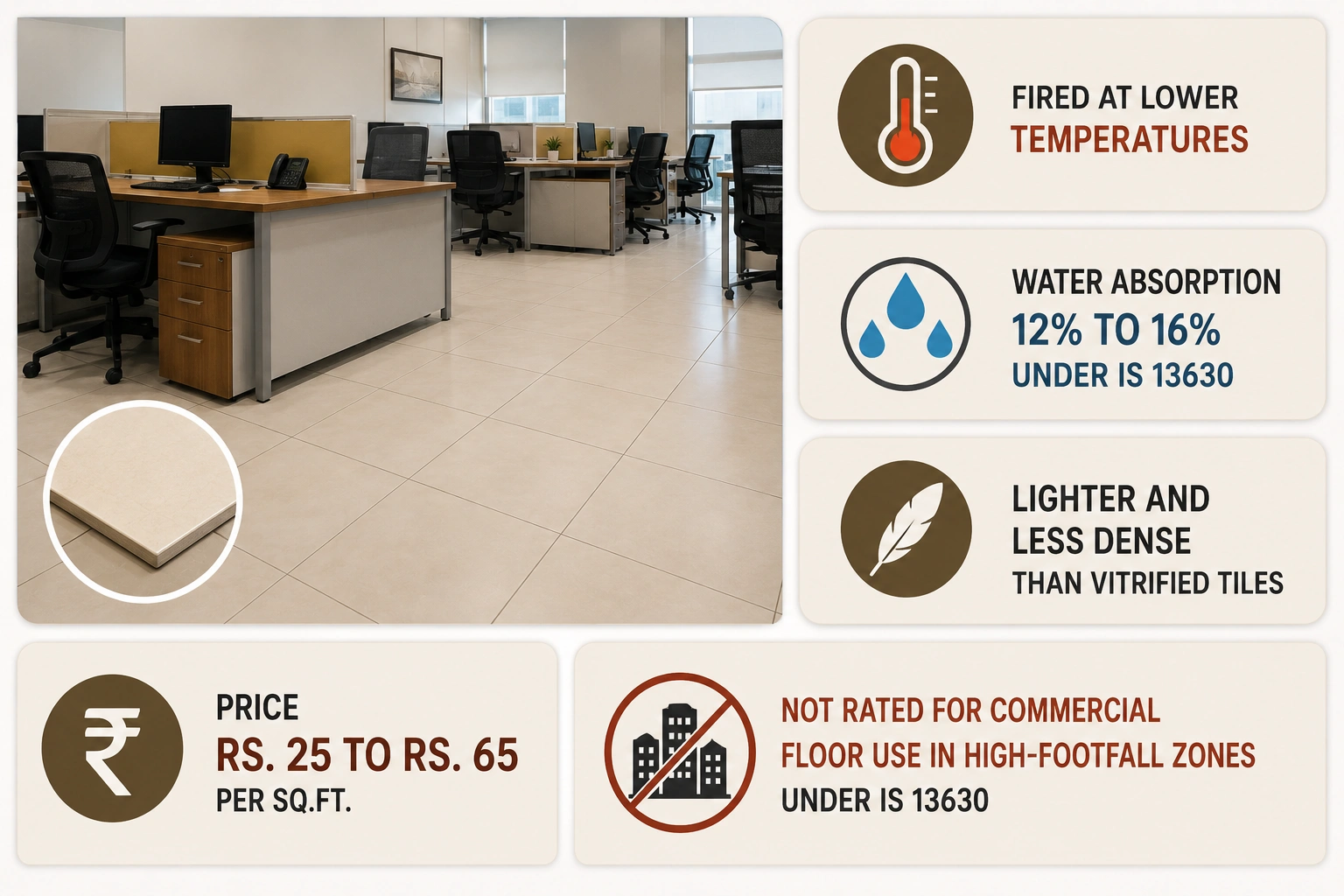
Ceramic tiles are fired at lower temperatures and carry a water absorption of 12 to 16% under IS 13630. They are lighter and less dense than vitrified tiles. Price: Rs. 25 to Rs. 65 per sq.ft. Standard ceramic tiles are not rated for commercial floor use in high-footfall zones, a fact that becomes relevant quickly in the comparison rounds below.
Polished Granite
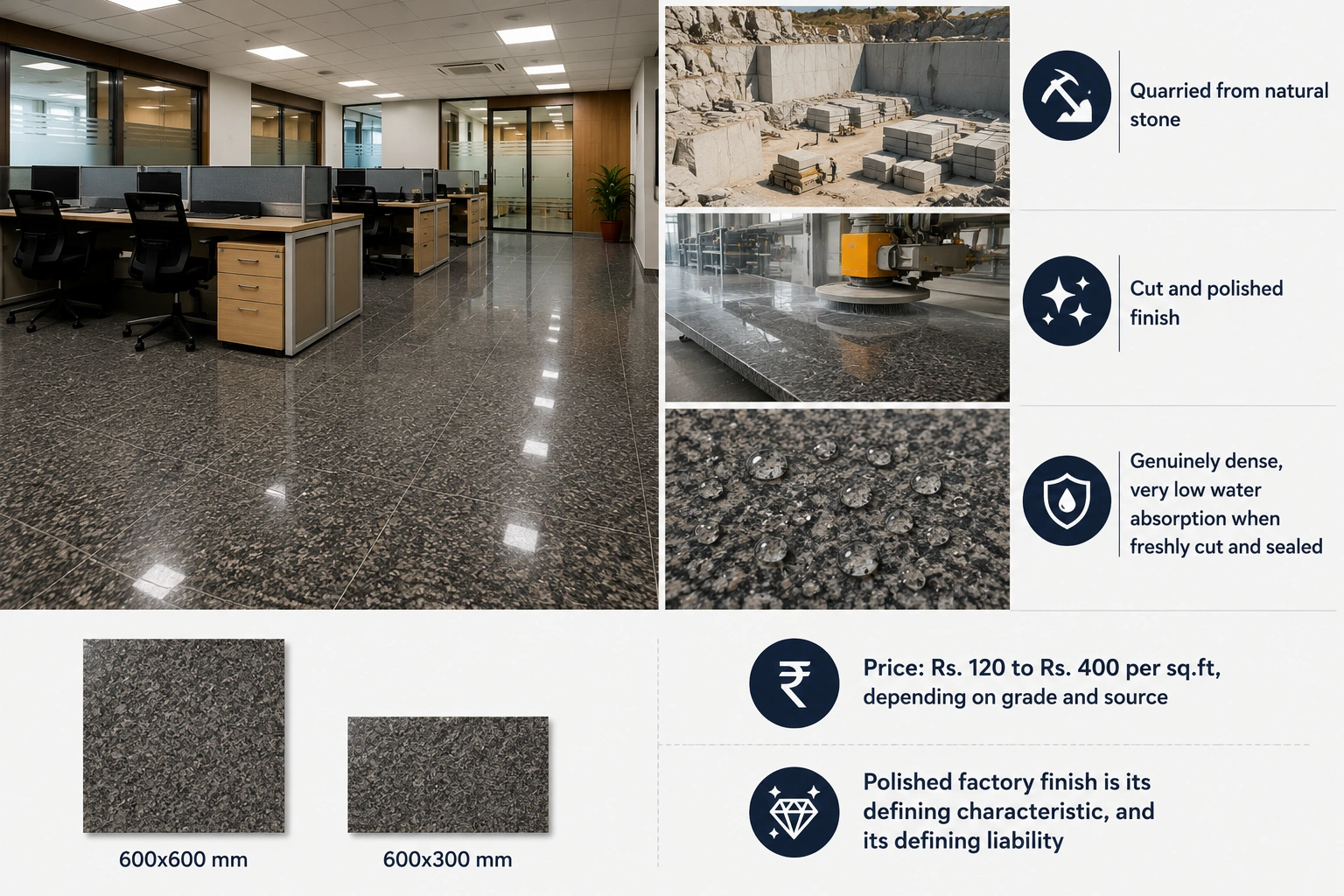
Natural granite is quarried, cut, and polished. It is genuinely dense, with very low water absorption when freshly cut and sealed. In Indian offices, polished granite typically arrives in 600x600 mm or 600x300 mm slabs. Price: Rs. 120 to Rs. 400 per sq.ft, depending on grade and source. The polished factory finish is its defining characteristic, and, as this comparison will show, its defining liability.
Round 1: Abrasion and Wear Resistance
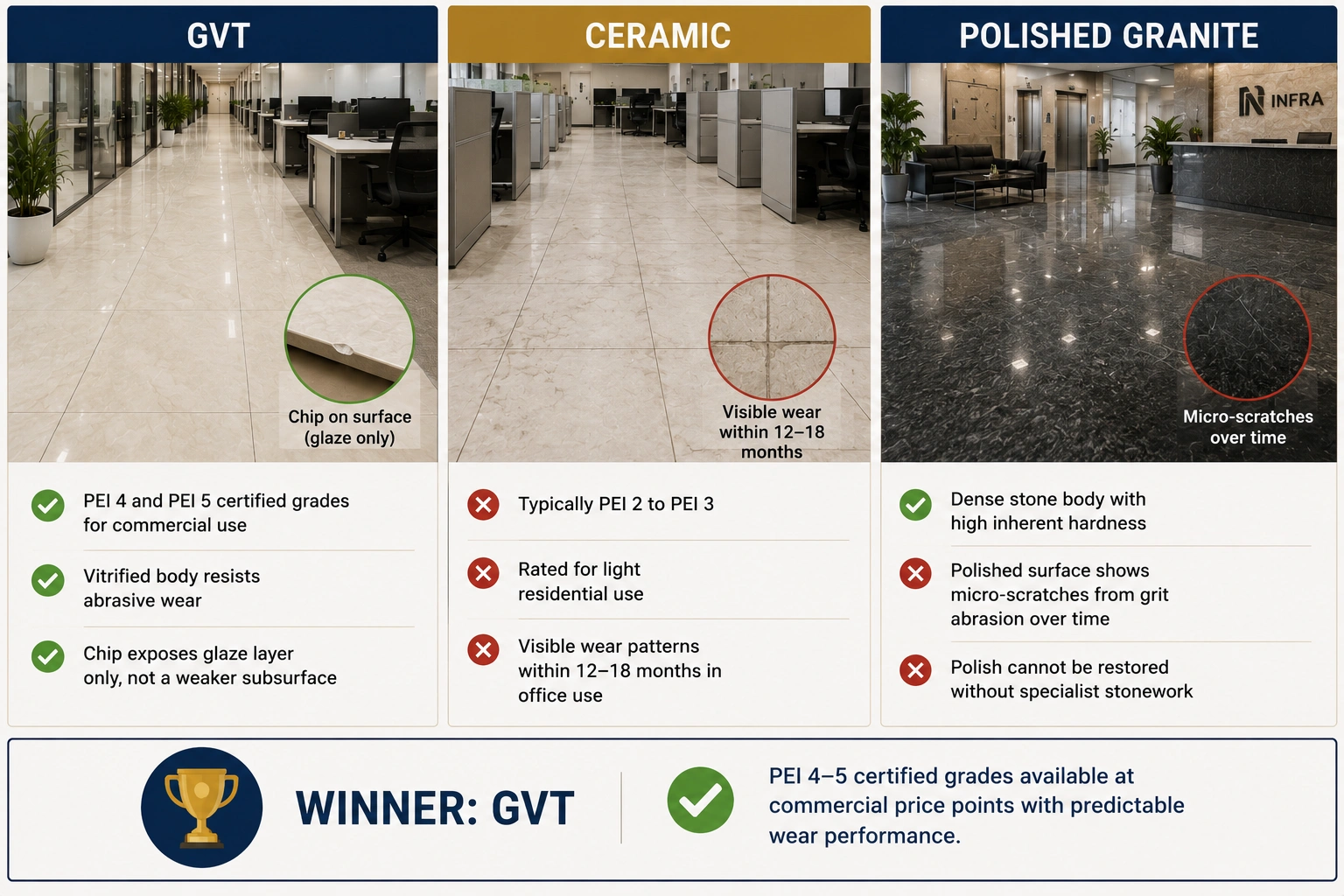
Office floors face continuous abrasion from outdoor grit tracked in on footwear. This is measured by the PEI (Porcelain Enamel Institute) scale, from PEI 1 (lightest use) to PEI 5 (heavy commercial). PEI 4 is the minimum for general office zones; PEI 5 for lobbies and corridors.
- GVT: Available in PEI 4 and PEI 5 certified grades for commercial use. The vitrified body resists abrasive wear. A surface chip exposes the glaze layer but not a structurally weaker subsurface.
- Ceramic: Standard ceramic tiles are typically PEI 2 to PEI 3, rated for light residential use. Using them in a commercial office floor plate accelerates visible wear patterns within 12 to 18 months in any zone above low-traffic storage.
- Polished Granite: Dense stone body with high inherent hardness. Resists deep abrasion well. However, the polished surface layer, which is the only layer most visitors ever see, shows micro-scratches from grit abrasion over time and cannot be re-polished without specialist stonework. Once the polished sheen degrades, the visual impact that justified the cost is gone.
Winner: GVT - PEI 4-5 certified grades available at commercial price points with predictable wear performance.
Round 2: Slip Safety
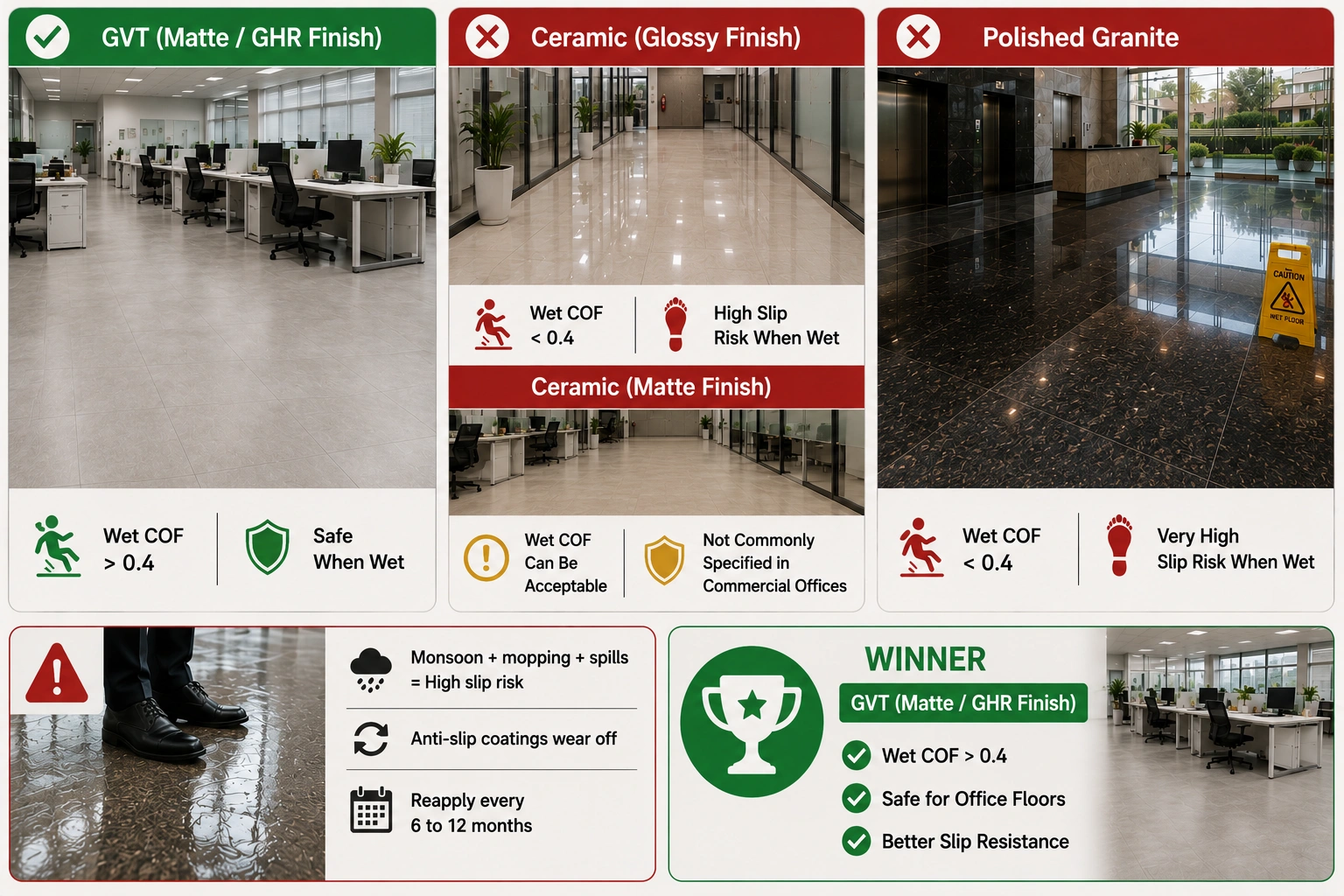
Slip resistance is measured by COF (Coefficient of Friction), tested dry and wet. Commercial offices require a wet COF of 0.4 or higher for general floor use, and higher for food service and washroom-adjacent zones.
- GVT (matte / GHR finish): Wet COF above 0.4 in matte and GHR finishes. The finish, not the vitrified body itself, determines slip safety, which is why finish specification matters alongside PEI rating.
- Ceramic: Wall-grade ceramic tiles are often supplied in a glossy finish, which carries a low wet COF. Floor-rated ceramic tiles in matte finish can achieve acceptable COF, but are not commonly specified in commercial projects because the underlying body strength and PEI rating are already inadequate for office floors.
- Polished Granite: This is where polished granite fails most visibly. A polished stone surface under wet conditions, whether from mopping, tracked-in rain during monsoon, or cafeteria spills, has a wet COF that drops well below 0.4. Polished granite in an Indian office lobby during monsoon season is a documented liability risk. Many facilities managers who specified it in older buildings have been trying to replace it for years.
Caution: Polished granite in lobbies and entrance zones is one of the most common sources of slip incidents in Indian commercial buildings, particularly during the June to September monsoon when tracked-in moisture is unavoidable. If your existing office floor is polished granite, anti-slip treatment coatings exist, but they wear off and require reapplication every 6 to 12 months. Winner: GVT - Matte and GHR finish GVT tiles deliver safe wet COF above 0.4, unlike polished granite, which cannot be re-specified without re-laying.
Round 3: Water Absorption and Stain Resistance
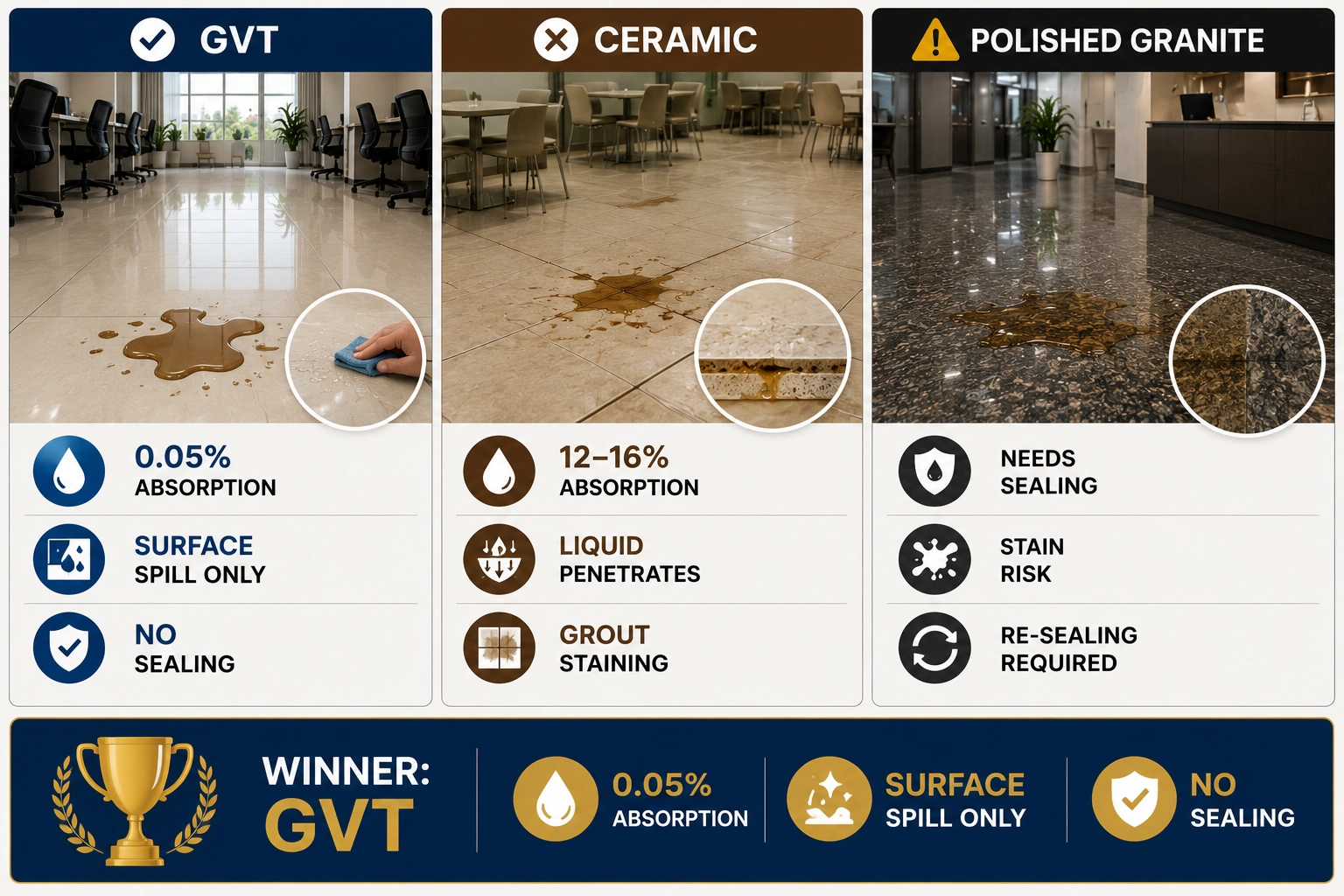
- GVT: 0.05% or lower water absorption. Spills sit on the surface. Standard cleaning agents used by commercial housekeeping crews do not penetrate the tile body.
- Ceramic: 12 to 16% water absorption. Liquid penetrates the tile body. In a food service zone, cooking oil carried from the cafeteria into a corridor by foot traffic soaks into ceramic tile joints and grout within weeks of installation and is effectively impossible to remove completely.
- Polished Granite: Very low absorption when freshly sealed. However, granite is a natural material with grain variation, and the sealant applied at installation wears off under commercial-grade cleaning agents within 6 to 18 months, depending on traffic. Once unsealed, granite stains from cooking oil, spilled beverages, and acidic cleaning products. Re-sealing requires specialist service and floor downtime.
Winner: GVT - Permanent 0.05% absorption, no sealing required, and resistant to commercial cleaning agents.
Round 4: Installation and Replacement Cost
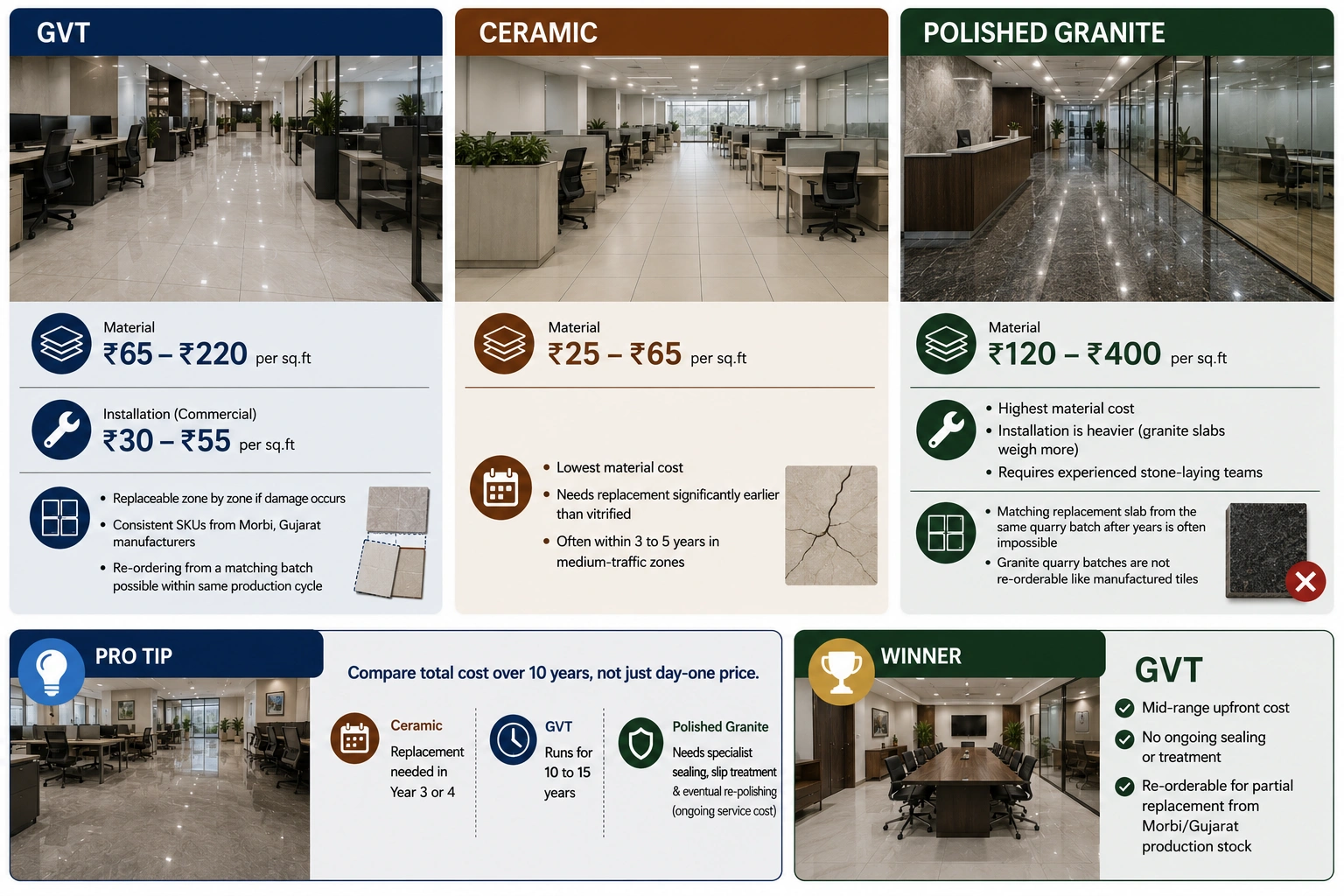
- GVT: Rs. 65 to Rs. 220 per sq.ft for material. Installation Rs. 30 to Rs. 55 per sq.ft for commercial-scale work. Replaceable zone by zone if damage occurs, since Morbi, Gujarat manufacturers stock consistent SKUs over longer production runs than natural stone. Re-ordering from a matching batch is possible within the same production cycle.
- Ceramic: Rs. 25 to Rs. 65 per sq.ft for material, the lowest of the three. But on an office floor, the effective total cost is higher than it appears because ceramic tiles in commercial traffic need replacement significantly earlier than vitrified, often within 3 to 5 years in medium-traffic zones.
- Polished Granite: Rs. 120 to Rs. 400 per sq.ft for material, the highest of the three. Installation is also heavier because granite slabs weigh more and require experienced stone-laying teams. Matching a replacement slab from the same quarry batch after years is often impossible, since granite quarry batches are not re-orderable the way manufactured tiles are.
Pro tip: When comparing costs across these three materials, model the total cost over 10 years, not just the day-one price. Ceramic on an office floor that needs replacement in year 3 or 4 is more expensive than GVT that runs for 10 to 15 years. Polished granite that requires specialist sealing, slip treatment, and eventual re-polishing adds ongoing service cost that rarely appears in the original procurement budget.
Before finalizing specifications, review our Office Floor Tiles Guide for PEI ratings, zoning recommendations, budgeting, and commercial flooring procurement tips for Indian offices. Winner: GVT - Mid-range upfront cost, no ongoing sealing or treatment, and re-orderable for partial replacement from Morbi/Gujarat production stock.
Round 5: Maintenance Load on the Facility Team
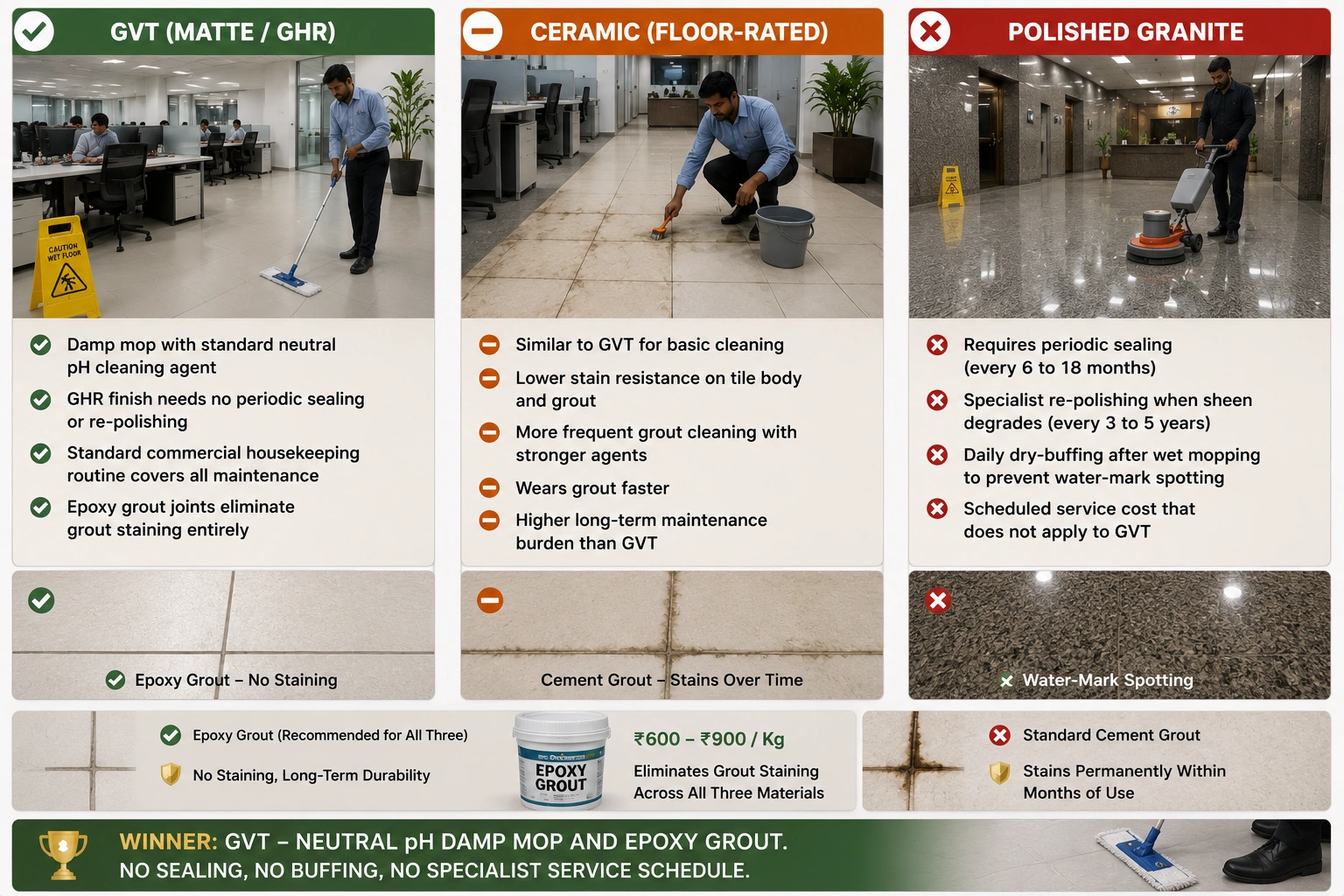
- GVT (matte / GHR): Damp mop with standard neutral pH cleaning agent. GHR finish needs no periodic sealing or re-polishing. A standard commercial housekeeping routine covers all maintenance. Epoxy grout joints, recommended for any commercial floor, eliminate grout staining entirely.
- Ceramic (floor-rated): Similar to GVT for basic cleaning, but lower stain resistance on the tile body and grout means more frequent grout cleaning with stronger agents, which in turn wears grout faster. Higher long-term maintenance burden than GVT despite comparable day-one cleaning routine.
- Polished Granite: Requires periodic sealing (every 6 to 18 months in commercial traffic), specialist re-polishing when sheen degrades (every 3 to 5 years), and daily dry-buffing after wet mopping to prevent water-mark spotting. Each of these is a scheduled service cost that does not apply to GVT.
Note: Epoxy grout is strongly recommended for all three materials in commercial use. Standard cement grout in any commercial floor, regardless of tile material, stains permanently within months of cafeteria or pantry service. Epoxy grout at Rs. 600 to Rs. 900 per kg eliminates this across all three material choices. Winner: GVT - Neutral pH damp mop and epoxy grout. No sealing, no buffing, no specialist service schedule.
Round 6: Design Range and Visual Longevity
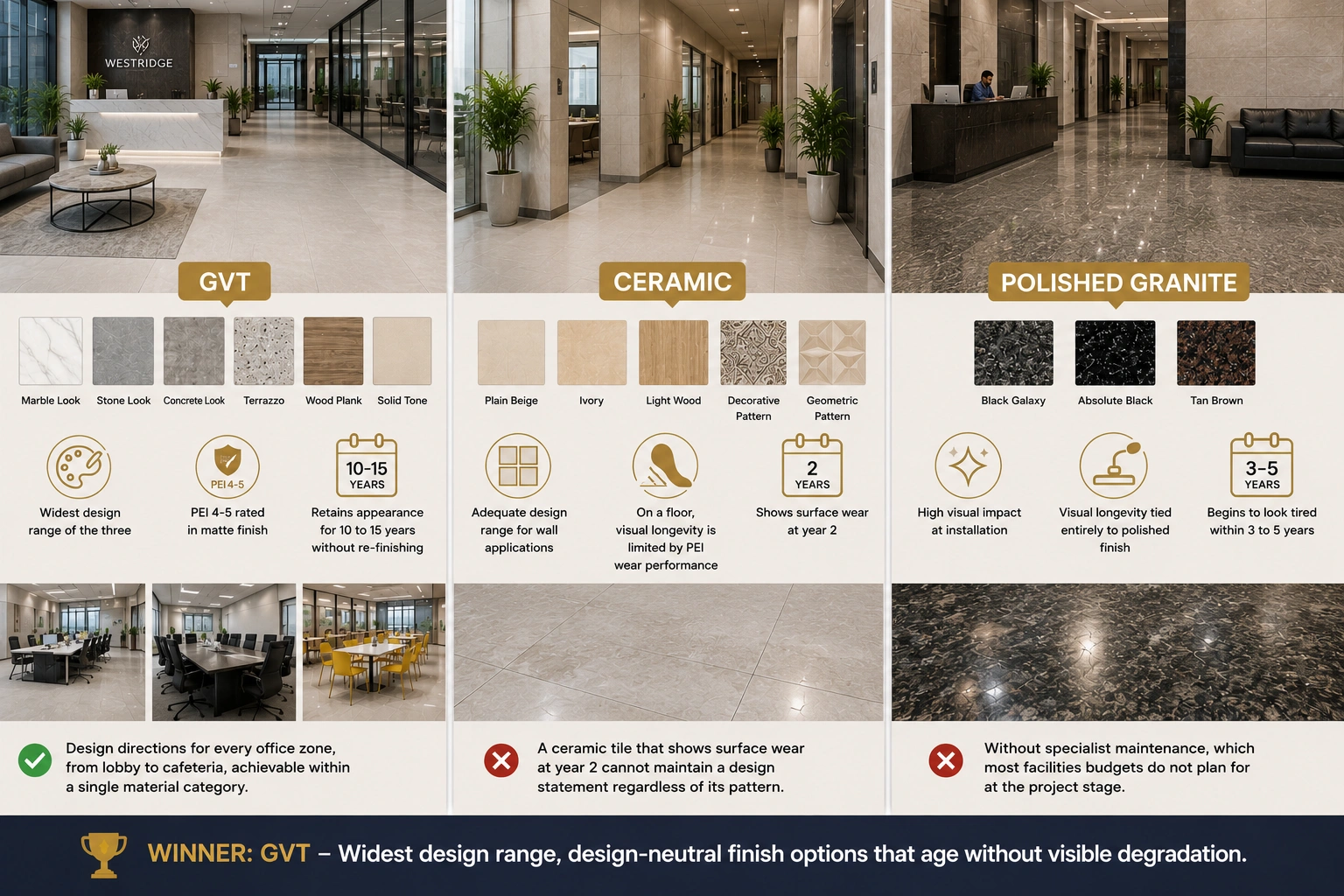
- GVT: Widest design range of the three: marble look, stone look, concrete look, terrazzo, wood plank, and solid tone. PEI 4-5 rated GVT in matte finish retains its appearance for 10 to 15 years without re-finishing. Design directions for every office zone, from lobby to cafeteria, are achievable within a single material category.
- Ceramic: Adequate design range for wall applications, where it is the right material. On a floor, the visual longevity is limited by PEI wear performance: a ceramic tile that shows surface wear at year 2 cannot maintain a design statement regardless of its original pattern.
- Polished Granite: High visual impact at installation. Visual longevity is tied entirely to the polished finish, which degrades under commercial traffic. A polished granite lobby that looked striking at handover begins to look tired within 3 to 5 years without specialist maintenance, which most facilities budgets do not plan for at the project stage.
Winner: GVT - Widest design range, design-neutral finish options that age without visible degradation.
Round 7: Climate Suitability for Indian Offices
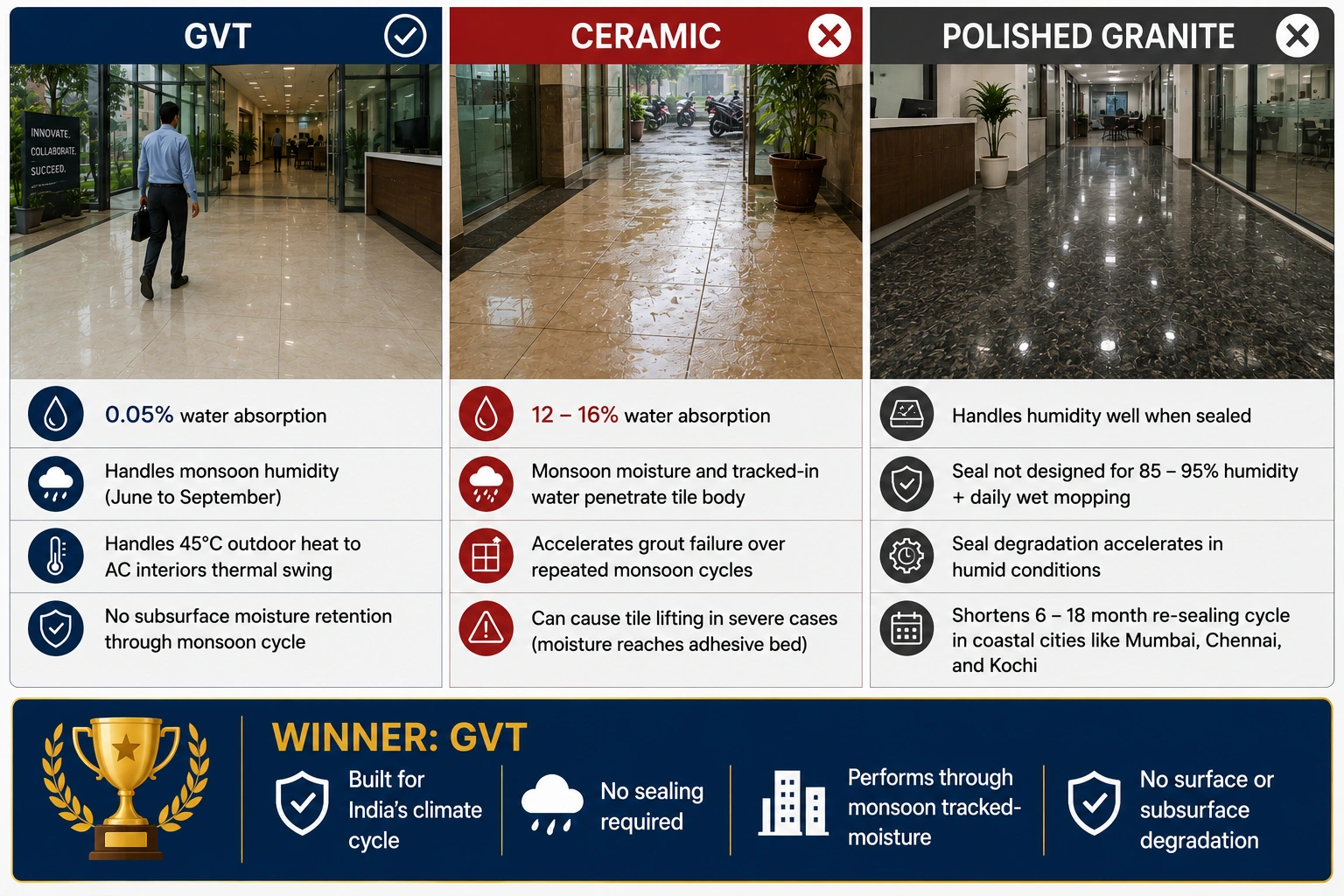
- GVT: Manufactured to handle India's climate conditions, specifically the monsoon humidity tracked into ground-floor lobbies from June to September, and the thermal swing between 45-degree Celsius outdoor temperatures and air-conditioned interiors. The 0.05% water absorption ensures no subsurface moisture retention through the monsoon cycle.
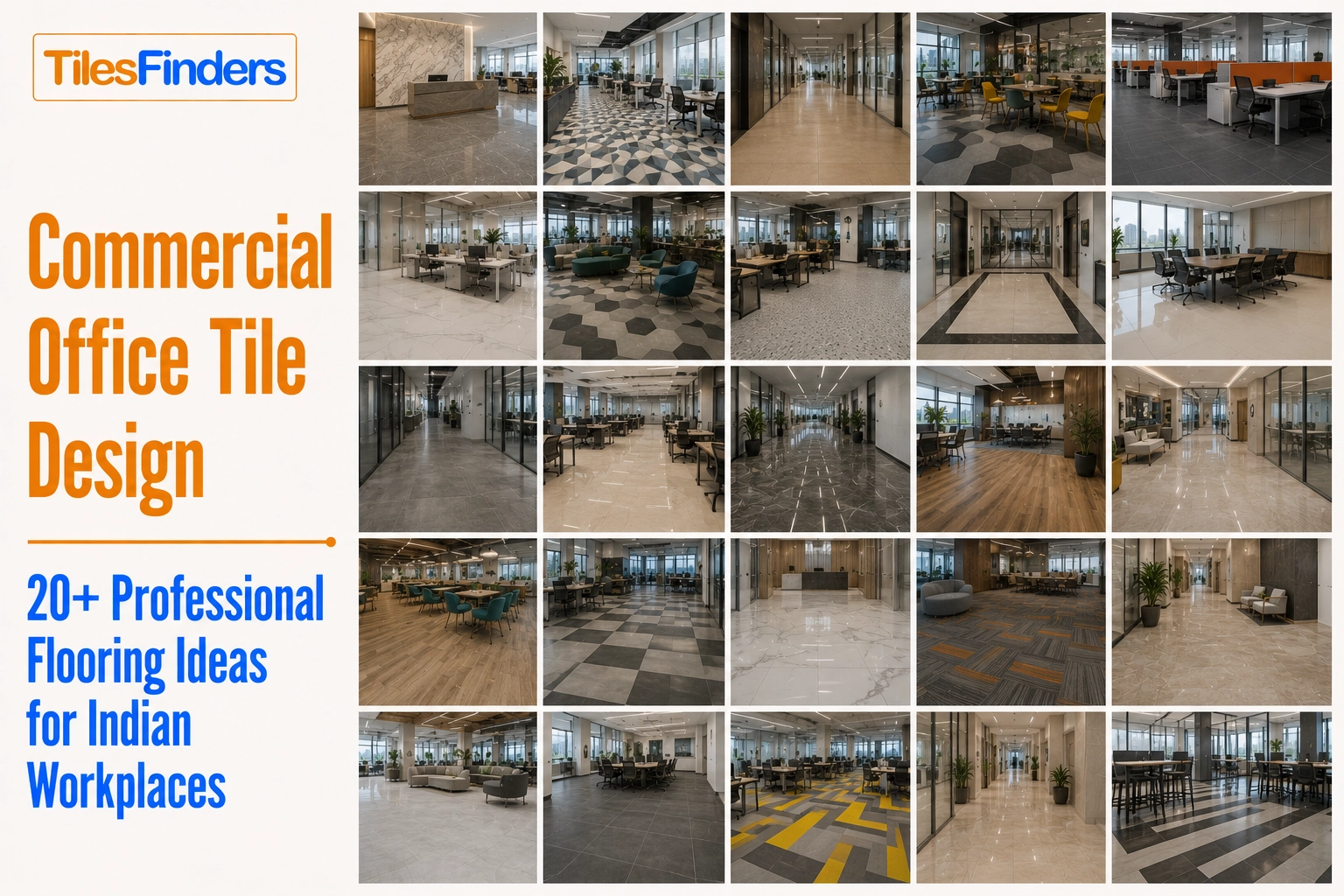
Looking for inspiration beyond material selection? Explore our Office Tile Design Ideas featuring 20+ professional flooring concepts for modern Indian workplaces, lobbies, corridors, meeting rooms, and cafeterias.
- Ceramic: Higher water absorption (12 to 16%) means monsoon moisture and tracked-in water penetrate the tile body in the entrance and ground-floor zones. Over repeated monsoon cycles, this accelerates grout failure and can cause tile lifting in severe cases where moisture reaches the adhesive bed.
- Polished Granite: The natural stone body handles humidity well when sealed. The problem is the seal itself, which is not designed for 85 to 95% humidity environments combined with daily wet mopping. Seal degradation accelerates in humid conditions, shortening the 6 to 18-month re-sealing cycle further in coastal cities like Mumbai, Chennai, and Kochi.
Winner: GVT - Built for India's climate cycle, no sealing required, performs through monsoon tracked-moisture without surface or subsurface degradation.
Seven-Round Scorecard
| Round | Criterion | GVT Winner? | Ceramic Winner? | Polished Granite Winner? |
| 1 | Abrasion / Wear | Yes | No | Partial (body only, not surface) |
| 2 | Slip Safety | Yes | No | No |
| 3 | Water Absorption / Stain | Yes | No | No (needs sealing) |
| 4 | Installation / Replacement Cost | Yes | No (shorter lifespan) | No (highest cost) |
| 5 | Maintenance Load | Yes | No | No (specialist service) |
| 6 | Design Range / Visual Longevity | Yes | No | Partial (visual impact, poor longevity) |
| 7 | Indian Climate Suitability | Yes | No | No |
| Total | 7 / 7 | 0 / 7 | 0 / 7 (2 partial) |
Overall verdict: GVT in PEI 4-5, matte or GHR finish wins across all seven criteria for Indian office floors. Ceramic tiles belong on walls, not commercial floors. Polished granite has a visual impact at installation but fails on slip safety, stain resistance, maintenance cost, and climate suitability over a commercial lifecycle.
Which Material Should Actually Go Where in Your Office
| Office Zone | Recommended Material | Reason Ceramic Fails Here | Reason Granite Fails Here |
| Lobby / Entrance | GVT, Full Body Vitrified | PEI too low for footfall | Slip risk in monsoon, sheen degrades fast |
| Open Workstations | GVT PEI 4, matte | PEI too low, wears in 2-3 years | Overspecified cost, no benefit over GVT |
| Meeting Rooms | GVT PEI 4, matte/sugar | PEI is marginal for castor wear | Cost premium with no performance gain |
| Cafeteria / Pantry | GVT PEI 5, GHR/anti-skid | Staining from food, grout failure | Dangerous when wet, requires a specialist seal |
| Corridors | Full Body Vitrified, PEI 5 | Wears visibly within 18 months | Polished sheen shows traffic marks fast |
| Cabins (low traffic) | GVT PEI 3-4, sugar/matte | Acceptable, but no advantage | Cost premium not justified by traffic |
| Walls (any zone) | Ceramic tiles, GVT | Ceramic appropriate for walls | Granite can be used as accent, not full wall |
Pro tip: If your office is being handed over with polished granite already installed by the developer, request the building's stone sealing maintenance schedule before occupancy. If none exists, factor specialist sealing service and eventual anti-slip coating cost into your facilities budget before the first monsoon season.
The Numbers Behind GVT's Dominance in Indian Commercial Flooring
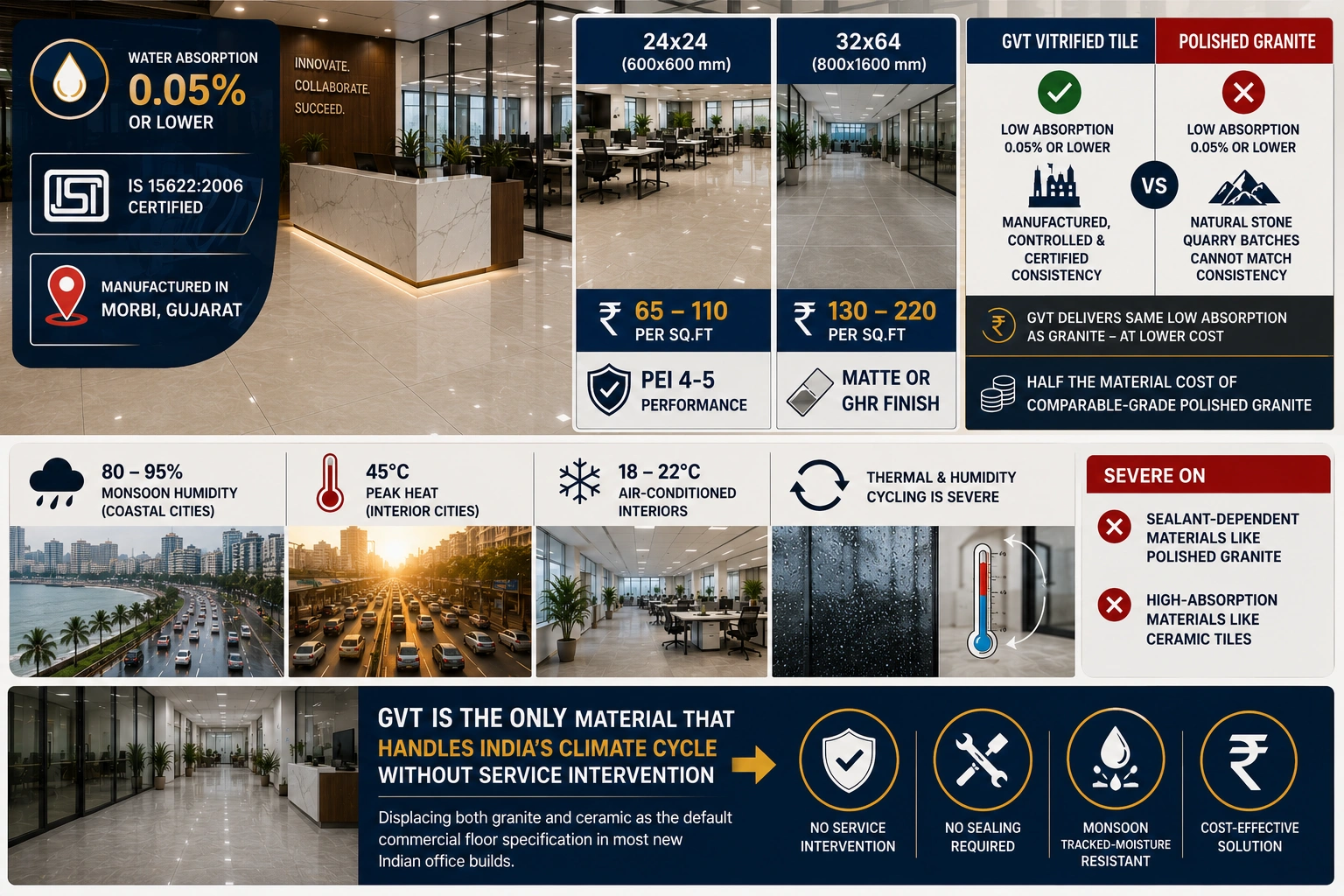
GVT vitrified tiles manufactured in Morbi, Gujarat, to IS 15622:2006 specification carry water absorption of 0.05% or lower, the same low-absorption figure that makes natural granite an ostensibly good material choice, but at a manufactured, controllable, and certified consistency that granite quarry batches cannot match. The 24x24 (600x600 mm) format at Rs. 65 to Rs. 110 per sq.ft from Morbi suppliers delivers PEI 4-5 performance at roughly half the material cost of comparable-grade polished granite, without any of granite's ongoing service requirements.
India's commercial building stock spans climate zones from 80 to 95% monsoon humidity in coastal cities to 45-degree Celsius peak heat in interior cities like Ahmedabad and Nagpur, followed by air-conditioned interiors running 18 to 22 degrees year-round. The thermal and humidity cycling this creates is severe on both sealant-dependent materials like polished granite and on high-absorption materials like ceramic tiles. The 32x64 (800x1600 mm) GVT slab in matte or GHR finish at Rs. 130 to Rs. 220 per sq.ft from Gujarat manufacturers is the only material in this comparison that handles that cycle without service intervention, which is why it has displaced both granite and ceramic as the default commercial floor specification in most new Indian office builds.
Use This Comparison in Your Next Procurement Brief
The seven-round scorecard and zone-by-zone table in this guide can be shared directly with an interior designer, procurement team, or developer during specification. On TilesFinders, GVT and full-body vitrified tiles for commercial office projects are filterable by PEI rating, finish, and size, with verified Morbi and Gujarat suppliers and current pricing.
FAQs
It reads as premature on the day of handover. Over a 3 to 5 year commercial lifecycle, polished granite lobbies require re-polishing service, specialist sealing, and, in monsoon-affected ground floor entrances, anti-slip coating applications. The total cost of ownership over 10 years often exceeds GVT's large format alternatives that deliver comparable visual impact without those maintenance cycles.
Office size does not change the PEI rating requirement. Even a 10-person office sees daily commercial footfall that exceeds the PEI 2-3 rating of standard ceramic floor tiles. A small office with ceramic floors will show wear patterns in the entry zone within 12 to 18 months. GVT in 600x600 mm at Rs. 65 to Rs. 100 per sq.ft is the right entry-level choice even for small offices.
Yes. Coastal cities and cities with heavy monsoon footfall increase the risk profile for both polished granite (faster seal degradation from humidity) and ceramic tiles (moisture penetration into the tile body from tracked-in water). For ground-floor offices in Mumbai, Chennai, Kochi, or Kolkata, GVT in matte or GHR finish is even more clearly the right choice over the alternatives.
Vitrified tiles are manufactured ceramic products fired at high temperature to achieve near-zero water absorption, similar to granite. They differ from natural granite in that they are manufactured to a consistent specification under IS 15622:2006, meaning PEI rating, water absorption, and surface finish are controlled and certified. Natural granite varies by quarry batch and cannot be PEI-rated or certified the same way.
GVT at Rs. 90 per sq.ft with no sealing or specialist maintenance runs at base material cost plus standard cleaning. Polished granite at Rs. 200 per sq.ft adds sealing every 12 months (Rs. 15 to Rs. 30 per sq.ft per cycle), re-polishing every 4 to 5 years (Rs. 40 to Rs. 80 per sq.ft per cycle), and anti-slip treatment for wet zones (Rs. 20 to Rs. 40 per sq.ft per application). Over 10 years, the total cost of granite ownership in a commercial office is typically 1.8 to 2.5 times the day-one material cost.
GHR (Glazed High Resistance) is a matte-category finish engineered for high stain and scratch resistance, available on GVT tiles across stone-look, marble-look, and solid-tone designs. It does not carry the reflective sheen of polished granite but maintains a consistent, clean surface appearance for 10 to 15 years without service. For offices where the polished granite look was chosen for client impression, a large-format marble-look GVT in GHR finish in 800x1600 mm delivers comparable visual weight at a fraction of the lifecycle cost.
Yes: exterior steps, podium facades, and low-traffic decorative wall cladding where the polished surface is not walked on, and moisture exposure is managed. Inside a commercial office, polished granite's benefits, primarily visual impact, are outweighed by slip risk, maintenance cost, and climate-performance limitations in most Indian settings.
Morbi, Gujarat, manufactures over 70% of India's vitrified tile output, including the GVT and full-body vitrified tiles recommended throughout this comparison. Sourcing directly from verified Morbi or Gujarat manufacturers on bulk commercial orders above 5,000 sq ft typically saves 15 to 20% against branded retail pricing for the same IS 15622:2006 certified specification.

See our tile guides first
Set TilesFinders as a preferred source and our buying guides surface ahead of the rest for you.
Add as preferred sourceTakes one tap. Nothing to install.
What Readers Say
I was about to redo my parking area with the wrong tile size until I read this. The layout comparisons saved me from a costly mistake.
We reference TilesFinders guides while briefing clients on material selection. The size and pattern breakdowns are accurate and easy to explain visually.
On site, I get asked about grout spacing all the time. This article gave me a solid reference I now share with my team before every job.
Finally a guide that doesn't just push generic advice. The oil stain removal steps actually worked on our clubhouse driveway tiles.
I run a small construction firm and now send this link to clients directly when they ask about entrance tile sizing. Saves me an hour of explaining.
Good practical detail, though I wish there were more examples for compact apartment entrances specifically, not just villas.
My mother-in-law wanted marble, I wanted vitrified. This blog gave us the neutral comparison we needed to actually decide together.
Detailed without being overwhelming. I appreciated that it covered both cost and maintenance, not just the aesthetics.
Used the algae and hard water removal tips on our terrace tiles after the monsoon. Worked better than what our regular cleaner was doing.
As someone who sources tiles for multiple builder projects, I find these comparisons genuinely useful for vendor conversations, not just consumer content.
Recommended this to a client who kept second-guessing the entrance design. The small vs large layout section settled the debate instantly.
Straightforward and honest, no unnecessary jargon. Would like to see a similar breakdown for outdoor pool-deck tiles next.
We've bookmarked several TilesFinders guides for our design handbook. Reliable source when clients want data, not just opinions.
Two paths, one marketplace.
Get free quotes from verified suppliers.
Share your room, budget, and style. Suppliers in Morbi respond within hours.
Get Free QuotesList your business, reach real buyers.
Put your showroom in front of homeowners searching for tiles right now.
List Your Business