Office Floor Tiles in India: Complete Commercial Buyer's Guide
Choose the best office floor tiles in India with PEI 4–5 ratings, GVT and full-body vitrified options, anti-skid finishes, pricing, footfall suitability, and commercial buying tips.
- Decision One: Match the Tile to Your Footfall Level, Not Your Budget
- Decision Two: Get the Finish Right, or the Floor Becomes a Liability
- Decision Three: GVT vs Full Body Vitrified vs Vitrified Composite, for Office Floors
- Decision Four: Budgeting an Entire Office Floor Plate, Not Just One Room
- Pre-Order Checklist for Office Floor Tile Procurement
- What the IS 15622:2006 Rating Actually Guarantees
- Why Monsoon Season Changes What You Should Specify
- Source Office-Grade Tiles for Your Project
Office floors perform best with PEI 4–5 rated GVT or full-body vitrified tiles in matte or GHR finishes. These offer superior durability, slip resistance, and lower maintenance for commercial spaces. Choose tiles based on footfall, safety requirements, and zone usage rather than appearance alone. Commercial-grade vitrified tiles typically cost ₹65–₹220 per sq.ft and deliver the best long-term value.
A facilities manager picks office floor tiles the way they would pick tiles for a home: based on look, then price. Six months later, the lobby tile shows traffic-pattern wear, the cafeteria floor is slippery after spills, and the conference room tile has chipped edges from chair castors rolling across it daily.
Office floors carry a different load profile than residential floors. An office space sees continuous footfall across an 8 to 10-hour working day, repeated wheelchair movement, and, in many cases, food service zones with the same spill risk as a restaurant. The tile that looks identical to a home product in a showroom often has a completely different wear rating underneath.
This guide is built around the decisions that actually go wrong in commercial tile buying: rating the tile correctly for footfall, choosing a finish that survives a cleaning crew's daily routine, and budgeting realistically across an entire office floor plate rather than room by room.
Decision One: Match the Tile to Your Footfall Level, Not Your Budget
The single biggest driver of office tile failure is buying a residential-grade tile for a commercial footfall level. Indian manufacturers rate tiles using the PEI (Porcelain Enamel Institute) abrasion scale, from PEI 1 (very light use) to PEI 5 (heavy commercial and industrial use).
Why PEI Rating Decides Everything Else
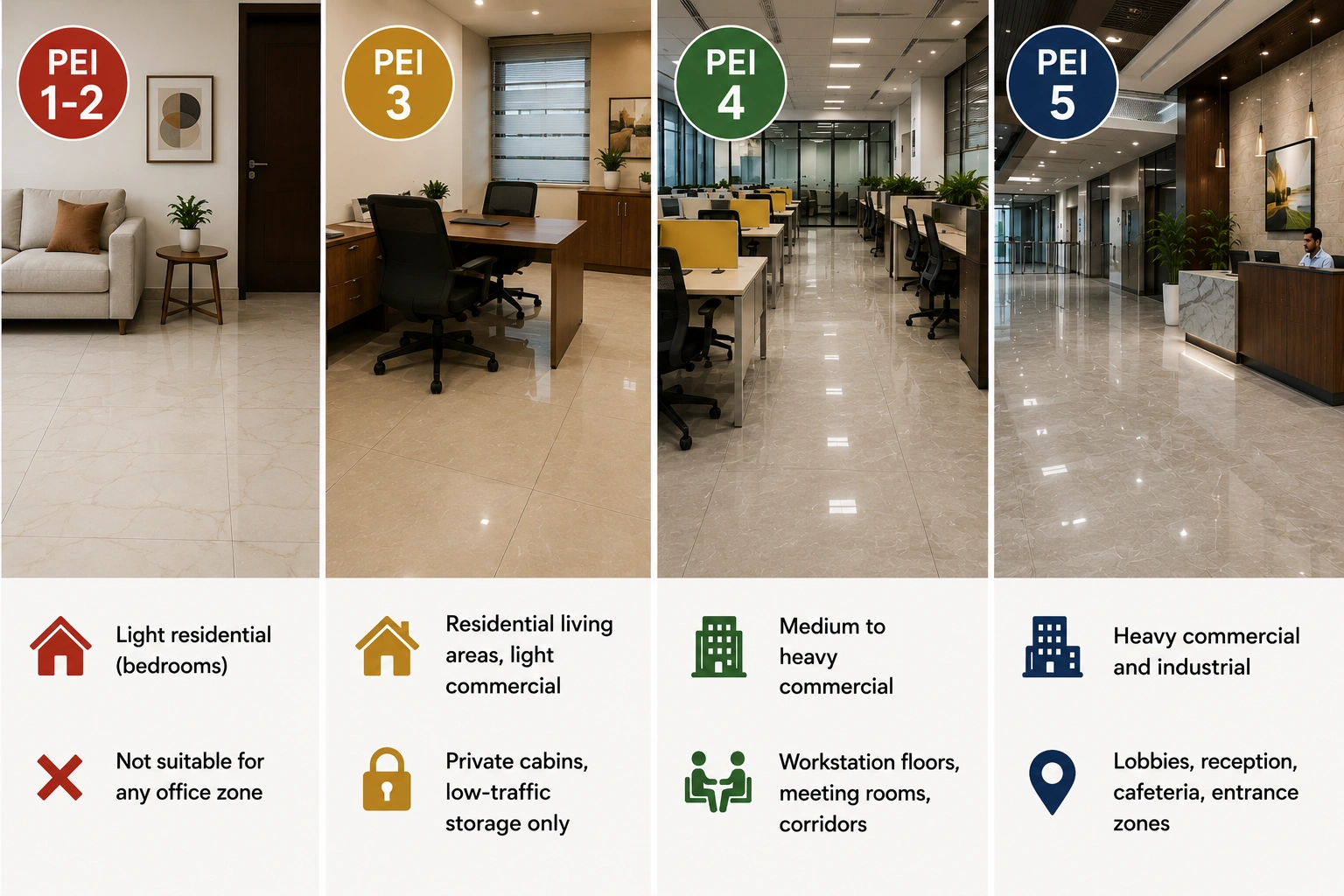
A reception lobby in a 200-person office building takes thousands of footsteps daily, much of it from outdoor shoes carrying grit. That grit acts as an abrasive against the tile glaze. A PEI 3 tile, sold widely for residential living rooms, will show visible wear patterns within 12 to 18 months under this load. A PEI 4 or PEI 5 tile is built to resist this.
| PEI Rating | Recommended Use | Suitable for Office Areas |
| PEI 1-2 | Light residential (bedrooms) | Not suitable for any office zone |
| PEI 3 | Residential living areas, light commercial | Private cabins, low-traffic storage only |
| PEI 4 | Medium to heavy commercial | Workstation floors, meeting rooms, corridors |
| PEI 5 | Heavy commercial and industrial | Lobbies, reception, cafeteria, entrance zones |
Note: Many dealers do not display PEI rating prominently because most residential buyers never ask for it. For an office project, request the PEI rating in writing for every tile SKU before placing a bulk order. A tile without a stated PEI rating should be treated as unverified for commercial use.
Zone-by-Zone Footfall Mapping
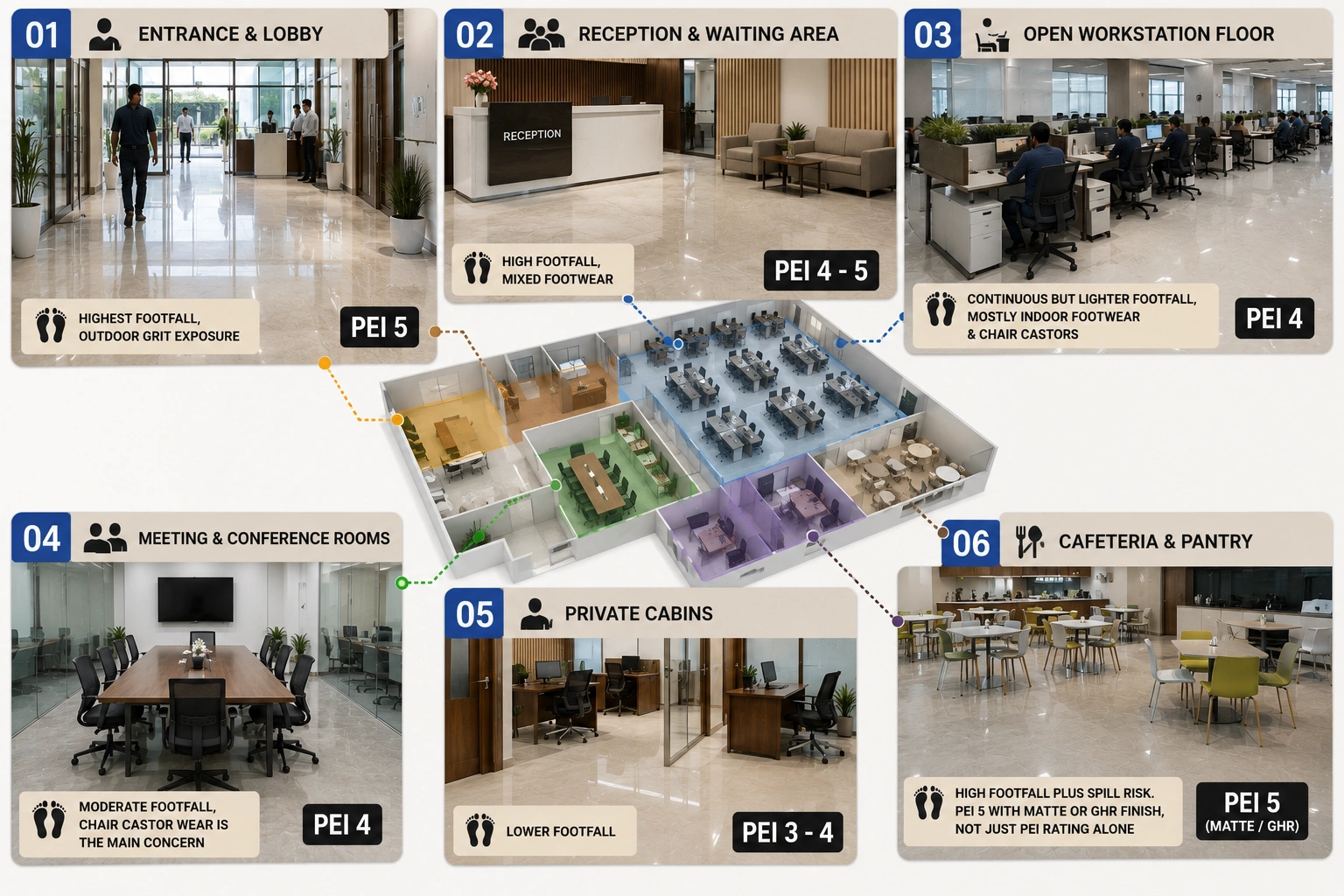
Not every part of an office carries the same footfall. Mapping PEI rating to zone, rather than buying one tile for the entire floor plate, is the more cost-efficient approach since PEI 5 tiles cost more than PEI 3 or 4.
- Entrance and lobby: Highest footfall, outdoor grit exposure. PEI 5 required.
- Reception and waiting area: High footfall, mixed footwear. PEI 4 to PEI 5.
- Open workstation floor: Continuous but lighter footfall, mostly indoor footwear and chair castors. PEI 4 is sufficient.
- Meeting and conference rooms: Moderate footfall, chair castor wear is the main concern. PEI 4.
- Private cabins: Lower footfall. PEI 3 to PEI 4 is acceptable.
- Cafeteria and pantry: High footfall plus spill risk. PEI 5 with a matte or GHR finish, not just PEI rating alone.
Decision Two: Get the Finish Right, or the Floor Becomes a Liability
PEI rating addresses wear. It does not address slip risk, which is a separate and equally important concern in a commercial space where the employer carries liability for workplace injuries.
Anti-Skid Requirements for Indian Offices
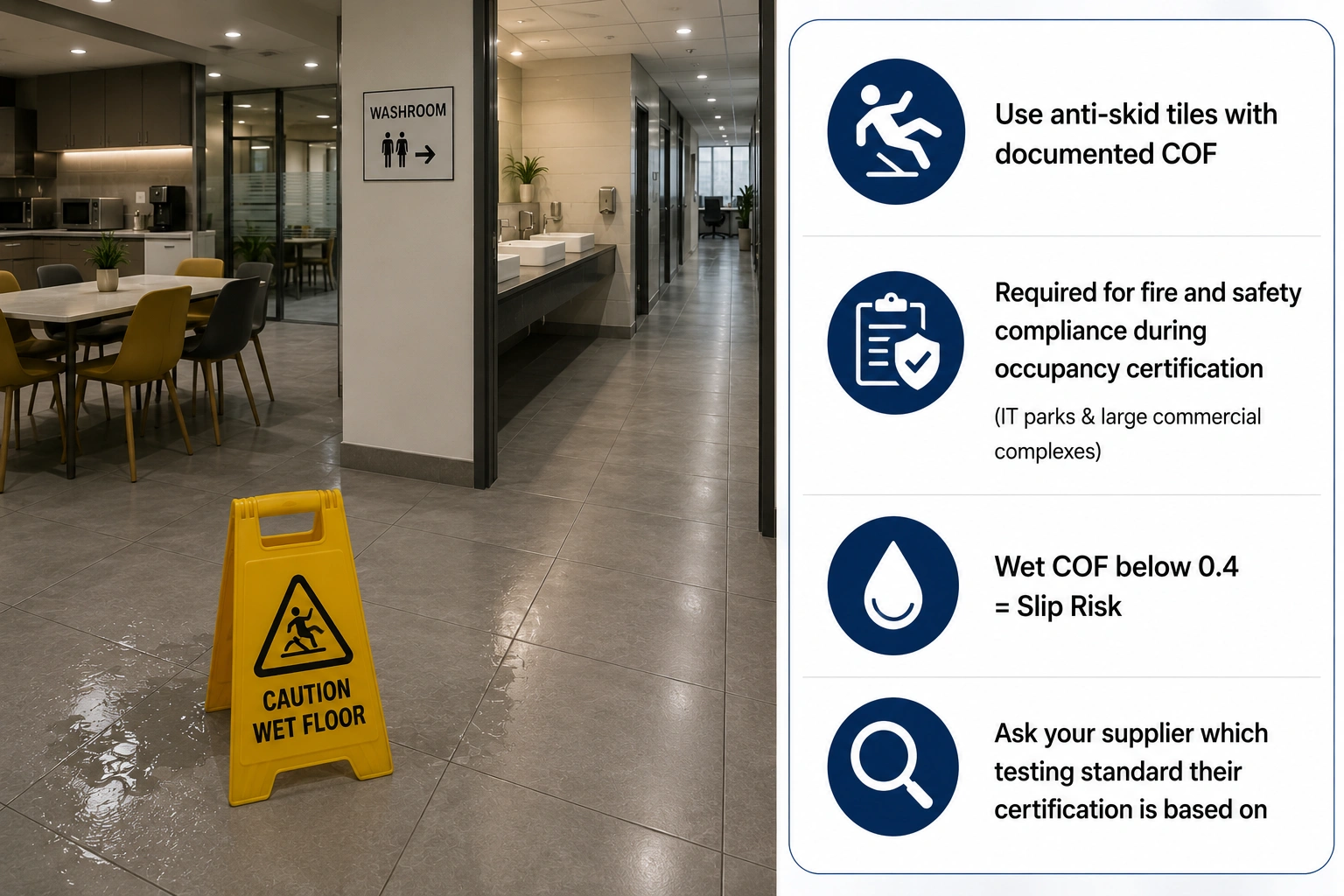
Office floors that include any food service, pantry, or washroom-adjacent zone need anti-skid certified tiles with a documented coefficient of friction (COF). Indian commercial buildings increasingly require this as part of fire and safety compliance during occupancy certification, particularly for IT parks and larger commercial complexes.
Note: A wet COF (R-value or DCOF, depending on the testing standard used by the manufacturer) below 0.4 is considered a slip risk in commercial use. Ask your supplier which testing standard their certification is based on, since DCOF and R-value ratings are not directly interchangeable.
Finish Comparison for Office Use
| Finish | Wear Resistance | Slip Safety (Wet) | Cleaning Effort | Office Suitable |
| Matte | High | High | Low | Yes, all zones |
| GHR (Glazed High Resistance) | Very High | High | Very Low | Yes, high-traffic zones |
| Sugar (Lappato) | High | Medium | Low | Yes, low-spill zones |
| Polished | Medium (shows scratches) | Low | High | Not recommended |
| High Glossy | Low (shows wear fast) | Low | High | Not recommended |
Pro tip: Polished tiles photograph well in architectural renders and are a common request from interior designers for the lobby. Push back if the design team specifies polished for a high-traffic zone, and offer GHR finish instead. GHR tiles can be specified in the same colour range with comparable visual sheen, at a fraction of the long-term liability and maintenance cost.
Decision Three: GVT vs Full Body Vitrified vs Vitrified Composite, for Office Floors
Three vitrified tile categories dominate the Indian commercial tile supply. The right one depends on your budget tier and whether the office floor plate includes heavy equipment zones (server rooms, print/copy areas with heavy machines).
Full Body Vitrified Tiles
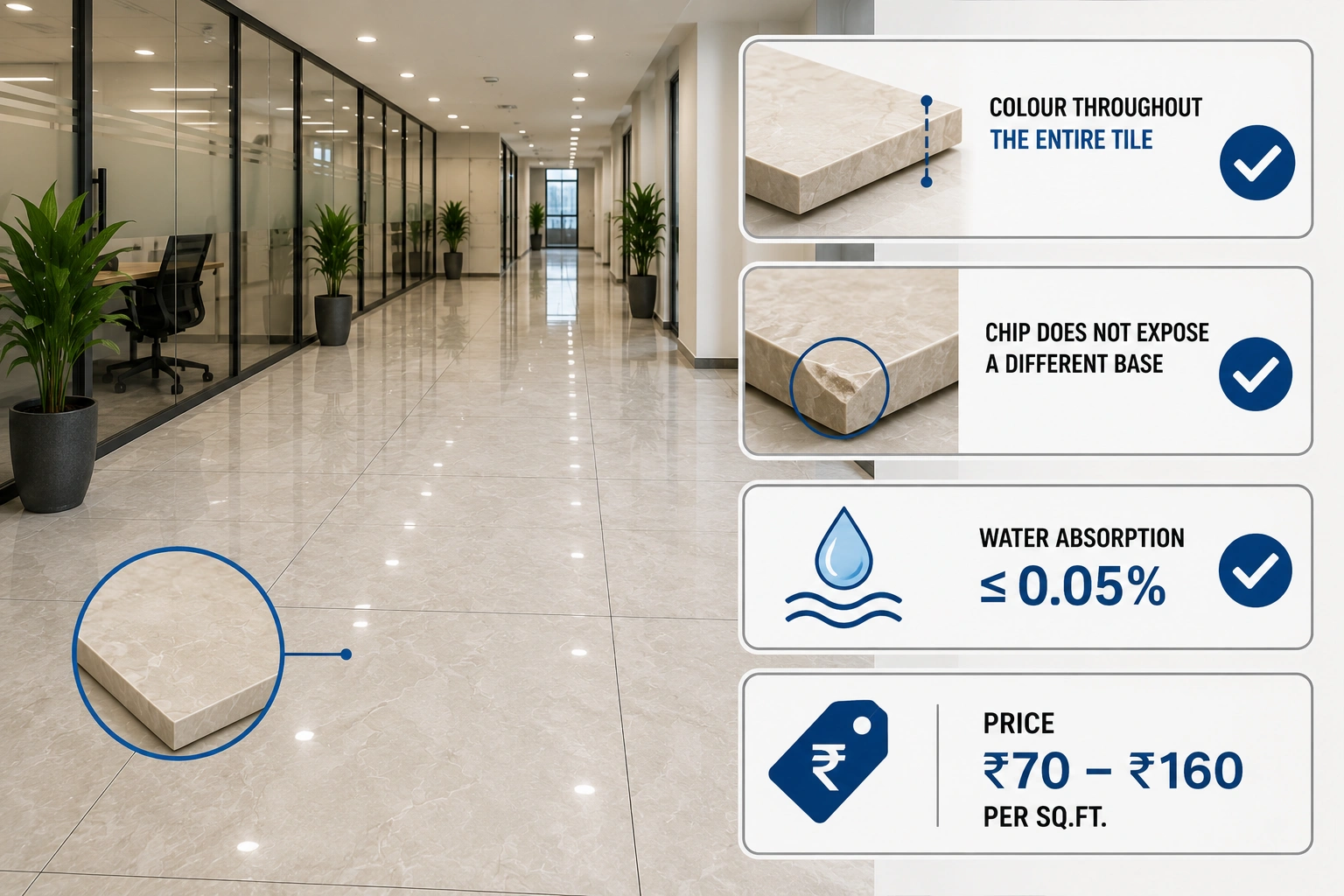
Colour runs through the entire tile thickness. A chip does not expose a different base layer, which matters in a high-footfall corridor where edge chipping happens over the years. This is the standard recommendation for office corridors, lobbies, and open floor plates. Water absorption is 0.05% or lower under IS 15622:2006. Price: Rs. 70 to Rs. 160 per sq.ft.
GVT (Glazed Vitrified Tiles)
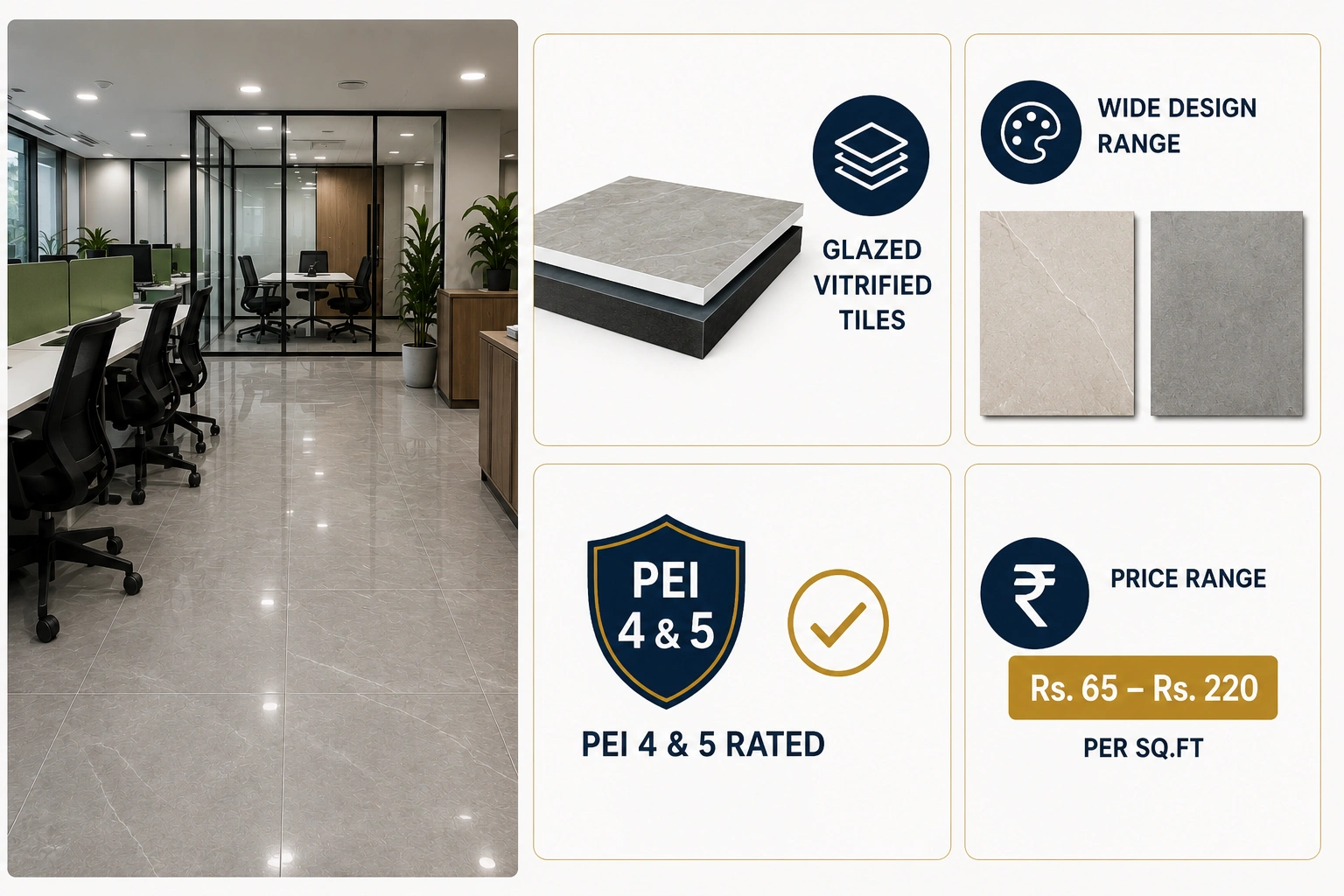
A glaze and design layer fused to a vitrified body. Wider design range than full body vitrified, including stone-look and concrete-look finishes popular in modern office interiors. PEI 4 and 5 rated GVT is widely available from Morbi, Gujarat manufacturers. Price: Rs. 65 to Rs. 220 per sq.ft, depending on size and finish.
Heavy-Duty Vitrified for Server Rooms and Equipment Zones
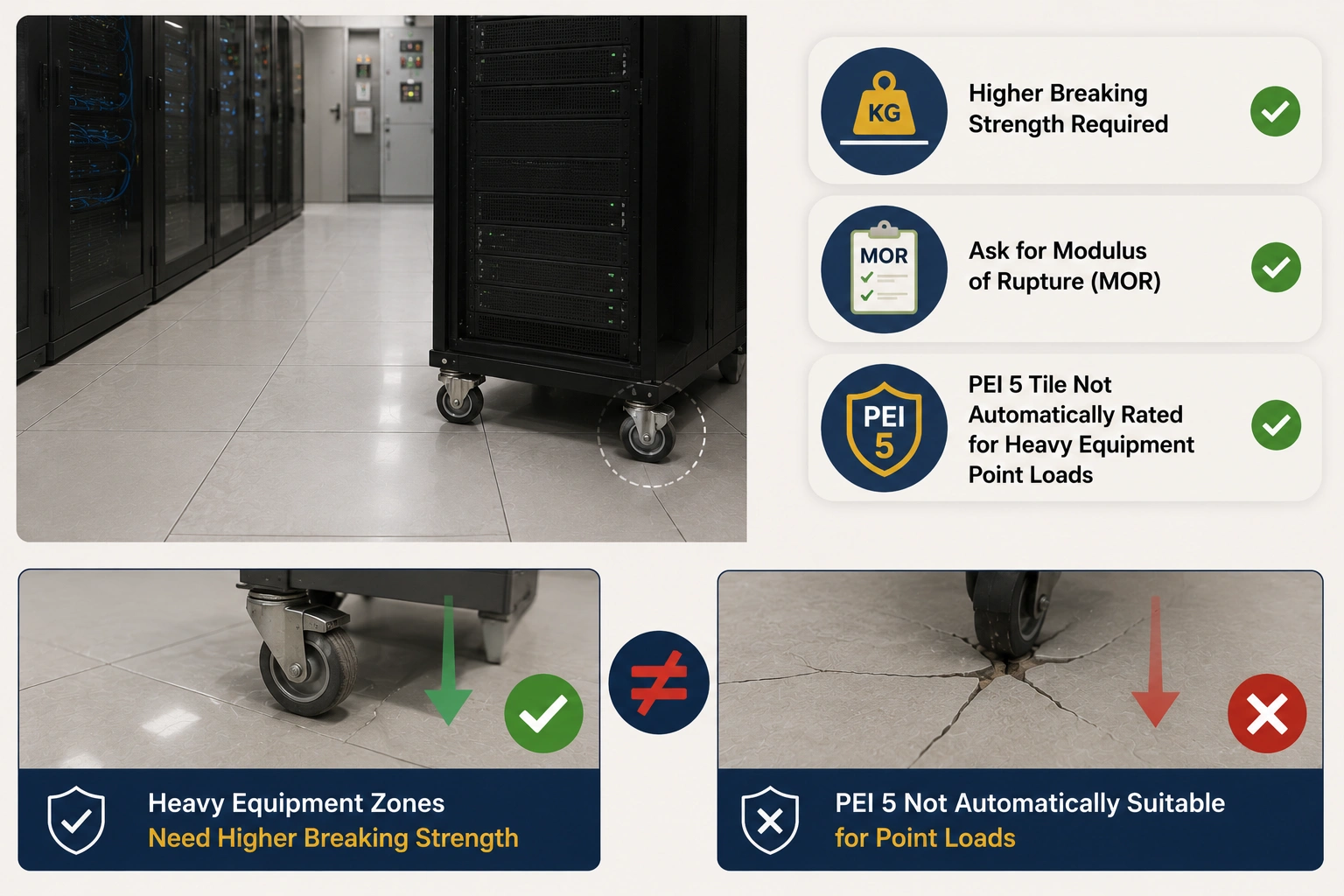
Server rooms, print rooms, and any zone with rolling heavy equipment need a tile rated for higher breaking strength, not just PEI abrasion rating. Ask specifically for the modulus of rupture (MOR) specification, not just PEI, for these zones. A standard office-grade PEI 5 tile is not automatically rated for point loads from heavy equipment castors.
Verdict: For most office floor plates, GVT in PEI 4-5 with matte or GHR finish is the best balance of design flexibility, cost, and durability. Reserve full-body vitrified for the highest-traffic corridors and lobby zones where edge-chip resistance matters most.
Decision Four: Budgeting an Entire Office Floor Plate, Not Just One Room
Residential tile budgeting happens room by room. Commercial tile budgeting happens by zone, because each zone has a different PEI and finish requirement, and bulk procurement pricing changes the per-sq.ft costs significantly at scale.
Typical Office Floor Plate Cost Breakdown (per sq.ft)
| Zone | Tile Spec | Price Range | Share of Typical Floor Plate |
| Lobby / Entrance | Full body vitrified, PEI 5, matte | Rs. 110 to Rs. 220/sq.ft | 5 to 8% |
| Reception / Waiting | GVT, PEI 5, GHR | Rs. 90 to Rs. 180/sq.ft | 5 to 10% |
| Open Workstations | GVT, PEI 4, matte | Rs. 65 to Rs. 110/sq.ft | 50 to 60% |
| Meeting Rooms | GVT, PEI 4, matte/sugar | Rs. 70 to Rs. 120/sq.ft | 8 to 12% |
| Cafeteria / Pantry | GVT, PEI 5, GHR, anti-skid | Rs. 90 to Rs. 180/sq.ft | 5 to 8% |
| Corridors | Full body vitrified, PEI 5, matte | Rs. 100 to Rs. 200/sq.ft | 8 to 12% |
For a 10,000 sq ft office floor plate using this zone mix, blended average material cost typically lands between Rs. 80 and Rs. 140 per sq ft, bringing total tile material cost to roughly Rs. 8,00,000 to Rs. 14,00,000. Bulk procurement direct from Morbi, Gujarat manufacturers, rather than per-zone retail purchase, typically reduces this by 15 to 20% on projects above 5,000 sq.ft.
Note: Labour and adhesive for commercial-scale installation runs Rs. 30 to Rs. 55 per sq.ft, higher than residential due to the larger continuous floor areas, levelling requirements, and expansion joint work needed across an open floor plate. Factor this into the total project cost, not just the tile material cost.
Bulk Procurement: What Changes the Price
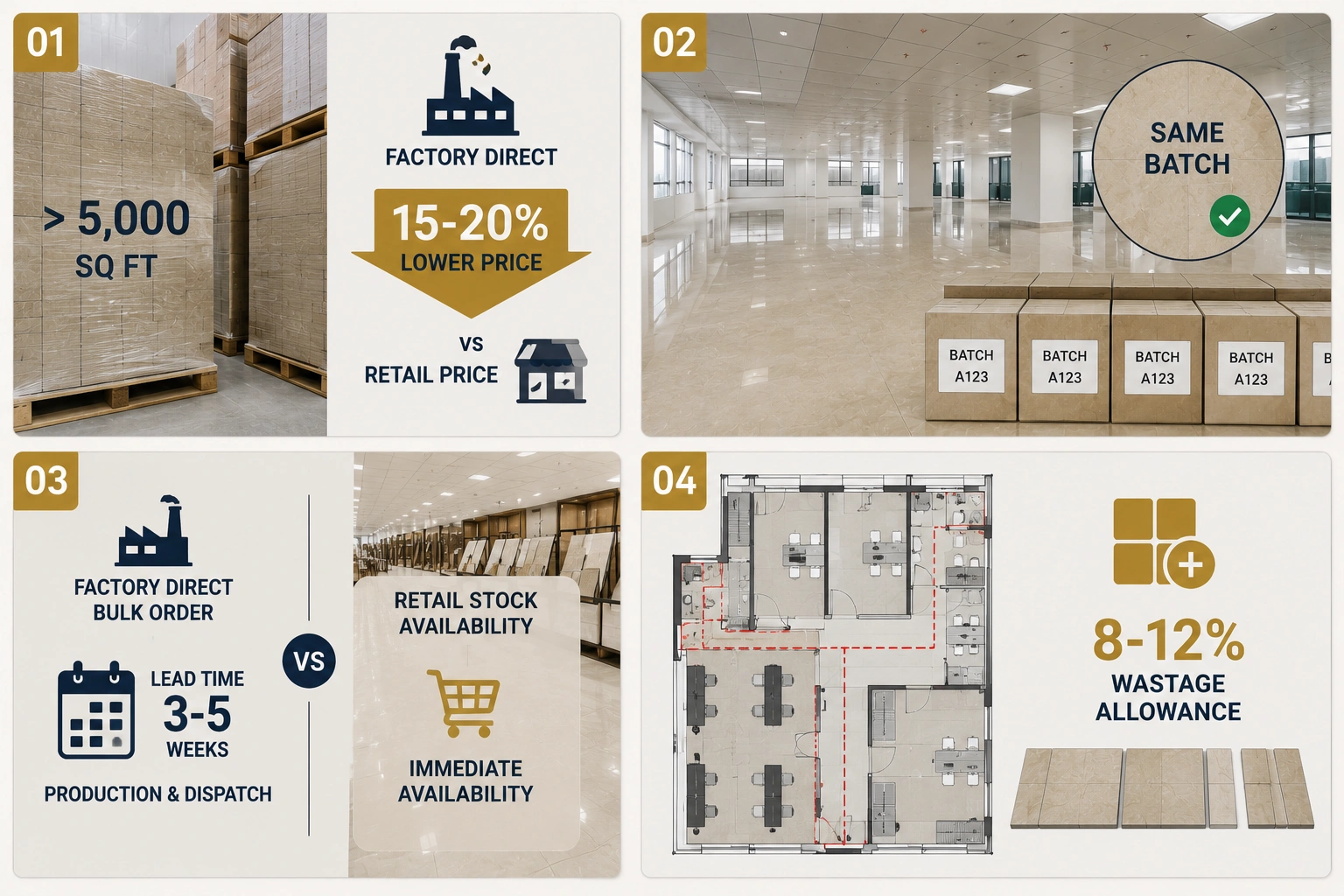
- Order volume: Orders above 5,000 sq ft typically unlock factory-direct pricing 15 to 20% below retail, especially from Morbi, Gujarat manufacturers who supply commercial projects directly.
- Single-batch consistency: Commercial floor plates need every tile from the same production batch, since shade variation across a 10,000 sq. ft. open floor is far more visible than in a single room. Confirm batch capacity before committing to a supplier for a large order.
- Lead time vs cost trade-off: Factory-direct bulk orders often need a 3 to 5 week lead time for production and dispatch, versus immediate retail stock availability at a higher price. Plan procurement timeline around your fit-out schedule.
- Wastage allowance: Commercial layouts with corridors, cabin partitions, and irregular floor plate shapes typically need 8 to 12% wastage allowance, higher than the 10% standard residential buffer in some layouts due to more cuts.
Pre-Order Checklist for Office Floor Tile Procurement
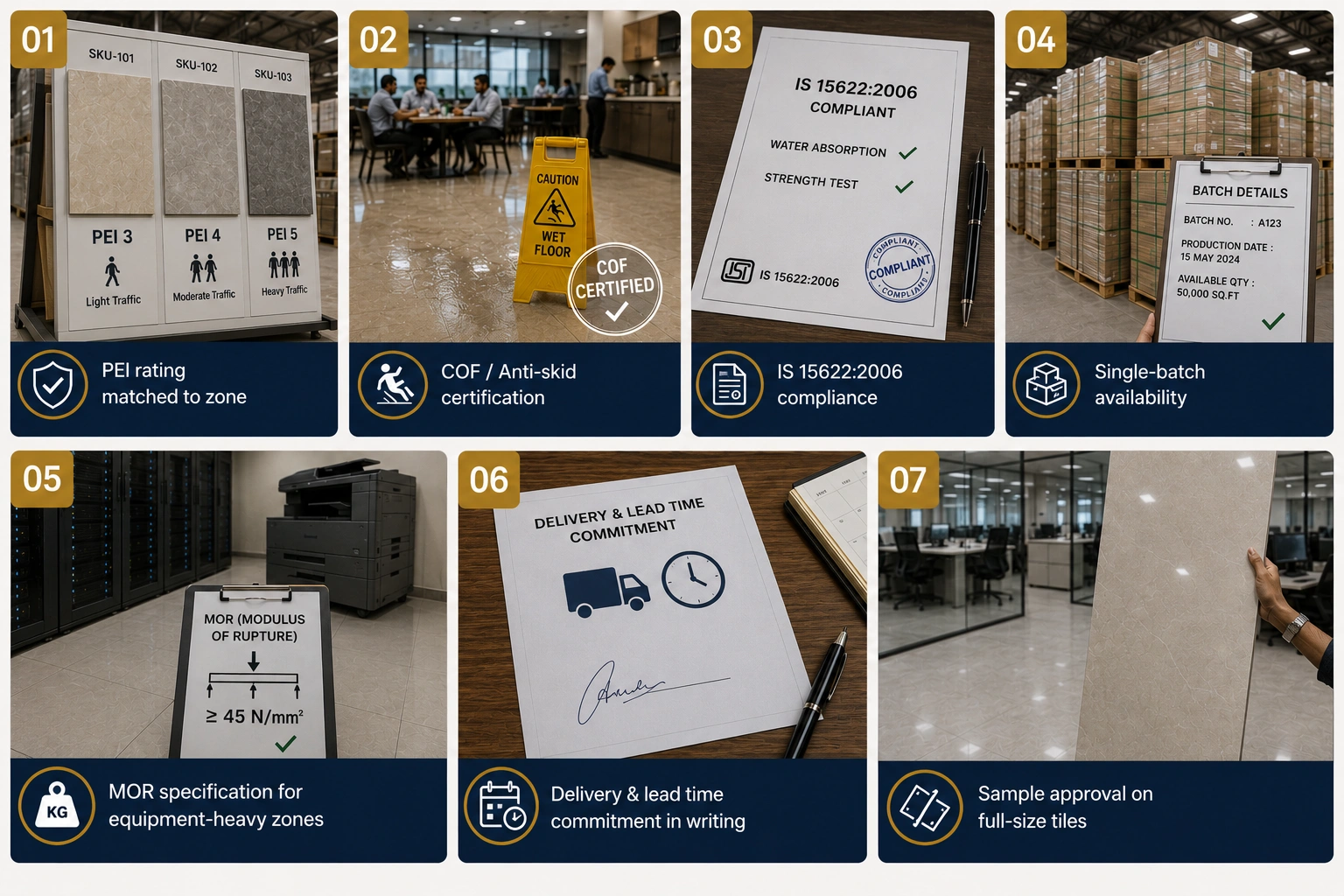
Before finalising a supplier or placing a bulk order, confirm these in writing:
- PEI rating for every SKU, matched to the zone it is intended for.
- COF or anti-skid certification for cafeteria, pantry, and any food or washroom-adjacent zones.
- IS 15622:2006 compliance documentation confirming water absorption and strength testing.
- Batch capacity confirmation that the full order quantity is available from a single production batch.
- MOR (modulus of rupture) specification for any equipment-heavy zones, like server or print rooms.
- Delivery and lead time commitment in writing, tied to your fit-out schedule.
- Sample approval on full-size tiles, not cut swatches, viewed under the office's actual lighting conditions where possible.
What the IS 15622:2006 Rating Actually Guarantees
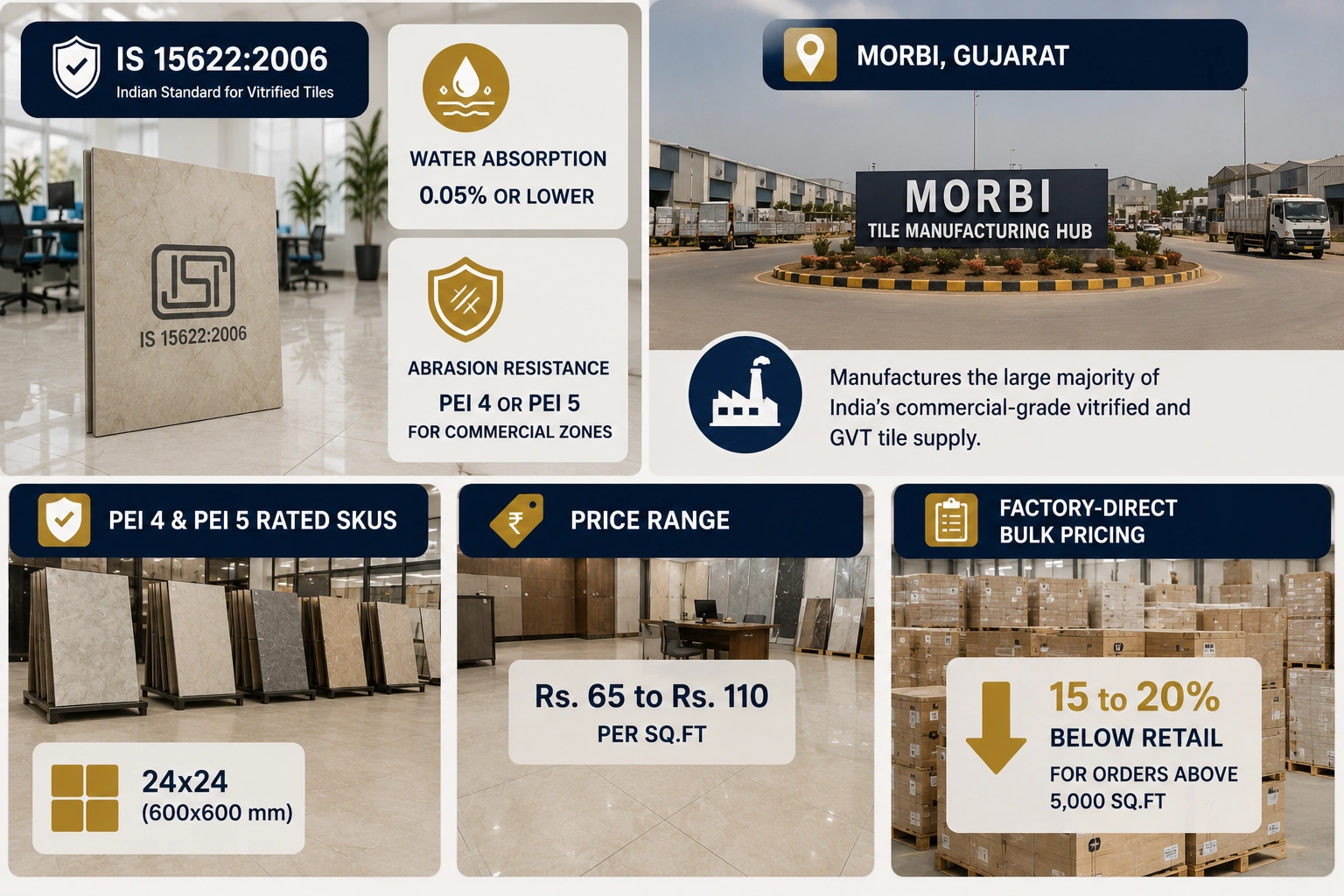
Office floor tiles in India should be specified against IS 15622:2006 for vitrified tile water absorption (0.05% or lower) and PEI 4 or 5 for abrasion resistance in commercial zones. Morbi, Gujarat, manufactures the large majority of India's commercial-grade vitrified and GVT tile supply, including PEI 4 and PEI 5 rated SKUs in the 24x24 (600x600 mm) format at Rs. 65 to Rs. 110 per sq.ft, with factory-direct bulk pricing typically running 15 to 20% below retail for orders above 5,000 sq.ft.
Why Monsoon Season Changes What You Should Specify
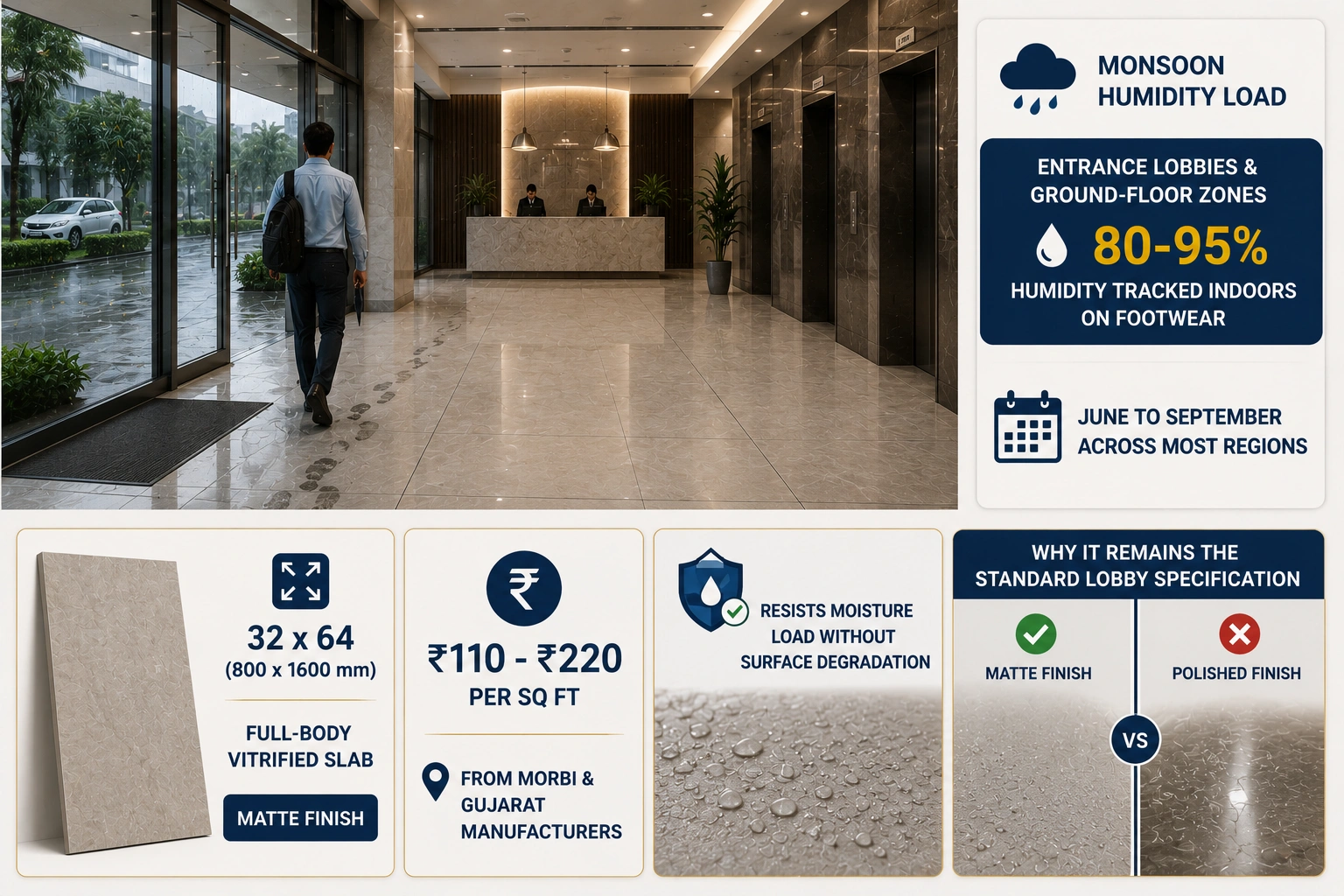
Commercial buildings in India face the same monsoon humidity load as residential ones, but at a larger exposed floor area. Entrance lobbies and ground-floor zones see 80 to 95% humidity tracked indoors on footwear between June and September across most regions. A 32x64 (800x1600 mm) full-body vitrified slab in matte finish at Rs. 110 to Rs. 220 per sq ft from Morbi and Gujarat manufacturers resists this moisture load without surface degradation, which is why it remains the standard lobby specification over polished alternatives that show water spotting.
Source Office-Grade Tiles for Your Project
Commercial procurement runs faster when PEI rating, finish, and batch capacity can be filtered in one place rather than verified dealer by dealer. On TilesFinders, you can filter office and commercial floor tiles by PEI rating and finish, and compare bulk pricing from verified Morbi and Gujarat manufacturers with documented IS certification.
FAQs
PEI 4 is the minimum for general office floor zones like workstations and meeting rooms. PEI 5 is required for high-footfall zones, including lobbies, reception, corridors, and cafeterias. PEI 3 should only be used in low-traffic private cabins, never in shared or high-traffic areas.
GVT office floor tiles in PEI 4 rating cost Rs. 65 to Rs. 110 per sq.ft for general workstation zones. PEI 5 tiles for lobbies and high-traffic zones cost Rs. 90 to Rs. 220 per sq.ft. Blended average across a typical office floor plate falls between Rs. 80 and Rs. 140 per sq.ft, before labour.
Anti-skid or slip-certified tiles are increasingly required as part of workplace safety compliance for food service and washroom-adjacent zones in commercial buildings, particularly larger IT parks and managed office complexes. Even where not formally mandated by your specific building authority, anti-skid tiles with a documented wet COF above 0.4 are strongly recommended to limit liability.
It is possible, but not cost-efficient. Using a single PEI 5 GHR-finish tile across the entire floor plate, including low-traffic private cabins, increases material cost unnecessarily. Zone-based specification, matching PEI rating and finish to actual footfall per area, is the standard commercial approach and typically reduces blended cost by 15 to 25%.
Full body vitrified carries colour through the entire tile thickness, so chips do not expose a different base layer, making it the stronger choice for high-traffic corridors and lobbies. GVT offers a wider design range at a typically lower price point and works well for workstation floors, meeting rooms, and most general office zones.

See our tile guides first
Set TilesFinders as a preferred source and our buying guides surface ahead of the rest for you.
Add as preferred sourceTakes one tap. Nothing to install.
What Readers Say
I was about to redo my parking area with the wrong tile size until I read this. The layout comparisons saved me from a costly mistake.
We reference TilesFinders guides while briefing clients on material selection. The size and pattern breakdowns are accurate and easy to explain visually.
On site, I get asked about grout spacing all the time. This article gave me a solid reference I now share with my team before every job.
Finally a guide that doesn't just push generic advice. The oil stain removal steps actually worked on our clubhouse driveway tiles.
I run a small construction firm and now send this link to clients directly when they ask about entrance tile sizing. Saves me an hour of explaining.
Good practical detail, though I wish there were more examples for compact apartment entrances specifically, not just villas.
My mother-in-law wanted marble, I wanted vitrified. This blog gave us the neutral comparison we needed to actually decide together.
Detailed without being overwhelming. I appreciated that it covered both cost and maintenance, not just the aesthetics.
Used the algae and hard water removal tips on our terrace tiles after the monsoon. Worked better than what our regular cleaner was doing.
As someone who sources tiles for multiple builder projects, I find these comparisons genuinely useful for vendor conversations, not just consumer content.
Recommended this to a client who kept second-guessing the entrance design. The small vs large layout section settled the debate instantly.
Straightforward and honest, no unnecessary jargon. Would like to see a similar breakdown for outdoor pool-deck tiles next.
We've bookmarked several TilesFinders guides for our design handbook. Reliable source when clients want data, not just opinions.
Two paths, one marketplace.
Get free quotes from verified suppliers.
Share your room, budget, and style. Suppliers in Morbi respond within hours.
Get Free QuotesList your business, reach real buyers.
Put your showroom in front of homeowners searching for tiles right now.
List Your Business