Nano Tiles vs PGVT vs Polished Vitrified: What Is the Actual Difference Indian Buyers Should Know
Nano, PGVT, and polished vitrified tiles explained for Indian buyers, covering their real differences, pricing logic, base construction, nano coating, safety, and what to verify before buying.
- The Decoder: What Each Term Actually Means
- Why This Confusion Costs Buyers Money
- The Two Questions That Actually Matter
- The Safety Point Worth Being Blunt About
- How To Verify What You Are Being Sold
- What To Ask In The Showroom
- Red Flags Worth Noticing
- So What Should You Actually Buy?
- Compare What You're Actually Being Sold on TilesFinders
PGVT and polished vitrified usually describe the same polished finish, while nano is a surface coating applied over a polished tile, not a separate base construction. Compare the underlying GVT, double-charge or full-body construction first, then decide whether the nano coating justifies its premium for your specific use.
If a showroom has quoted you three different prices for what look like three similar glossy tiles, labelled polished vitrified, PGVT, and nano, the most useful thing to understand is this: those three words do not describe three parallel product tiers. Two of them frequently describe the same thing, and the third describes something added on top. This guide decodes what each term actually refers to, which price differences are genuinely justified, and how to verify what you are being sold before you pay for it.
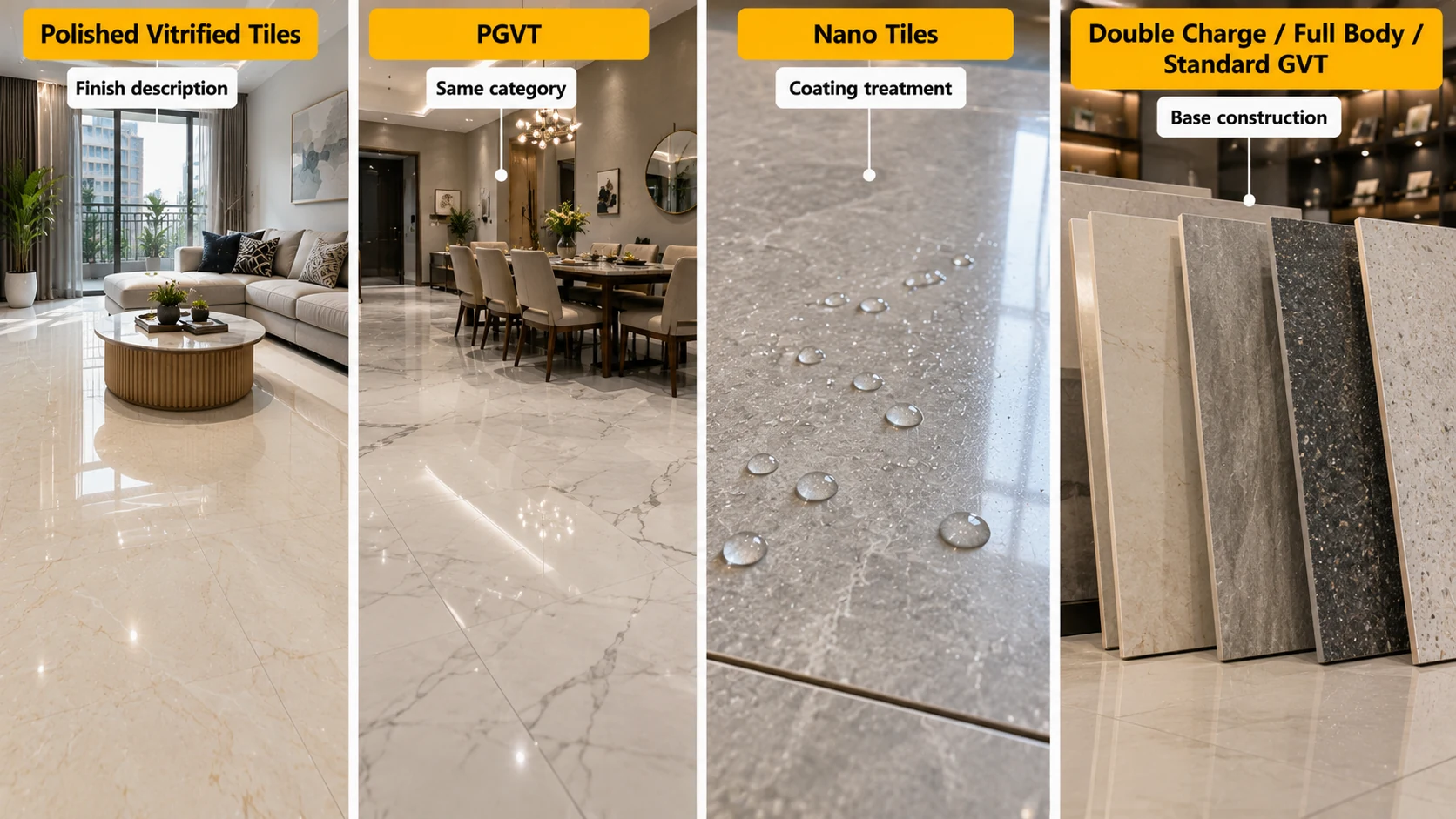
Quick answer: PGVT and polished vitrified usually refer to the same product; PGVT simply stands for Polished Glazed Vitrified Tile. Nano is not a different tile category at all; it is a surface coating applied after polishing to fill the micro-pores that polishing opens up. So the honest question is not which of the three to buy, but two separate questions: what base construction is underneath, and is a nano coating applied on top. A price gap justified purely by calling one tile PGVT and another polished vitrified deserves a direct question. |
The Decoder: What Each Term Actually Means
| Term You Hear | What It Actually Refers To | Is It a Separate Product Tier? |
| Polished vitrified tiles | A vitrified tile whose surface has been mechanically polished to a gloss finish | No, this is a description of the finish |
| PGVT | Polished Glazed Vitrified Tile, the same category described by its full technical name | No, usually the same thing as above |
| Nano tiles | A nano-particle coating applied after polishing, filling the micro-pores that polishing opens | No, this is a treatment applied on top of a polished tile |
| Double charge, full body, standard GVT | The actual base construction of the tile body itself | Yes, this is the axis that genuinely differs and genuinely affects price |
Why This Confusion Costs Buyers Money
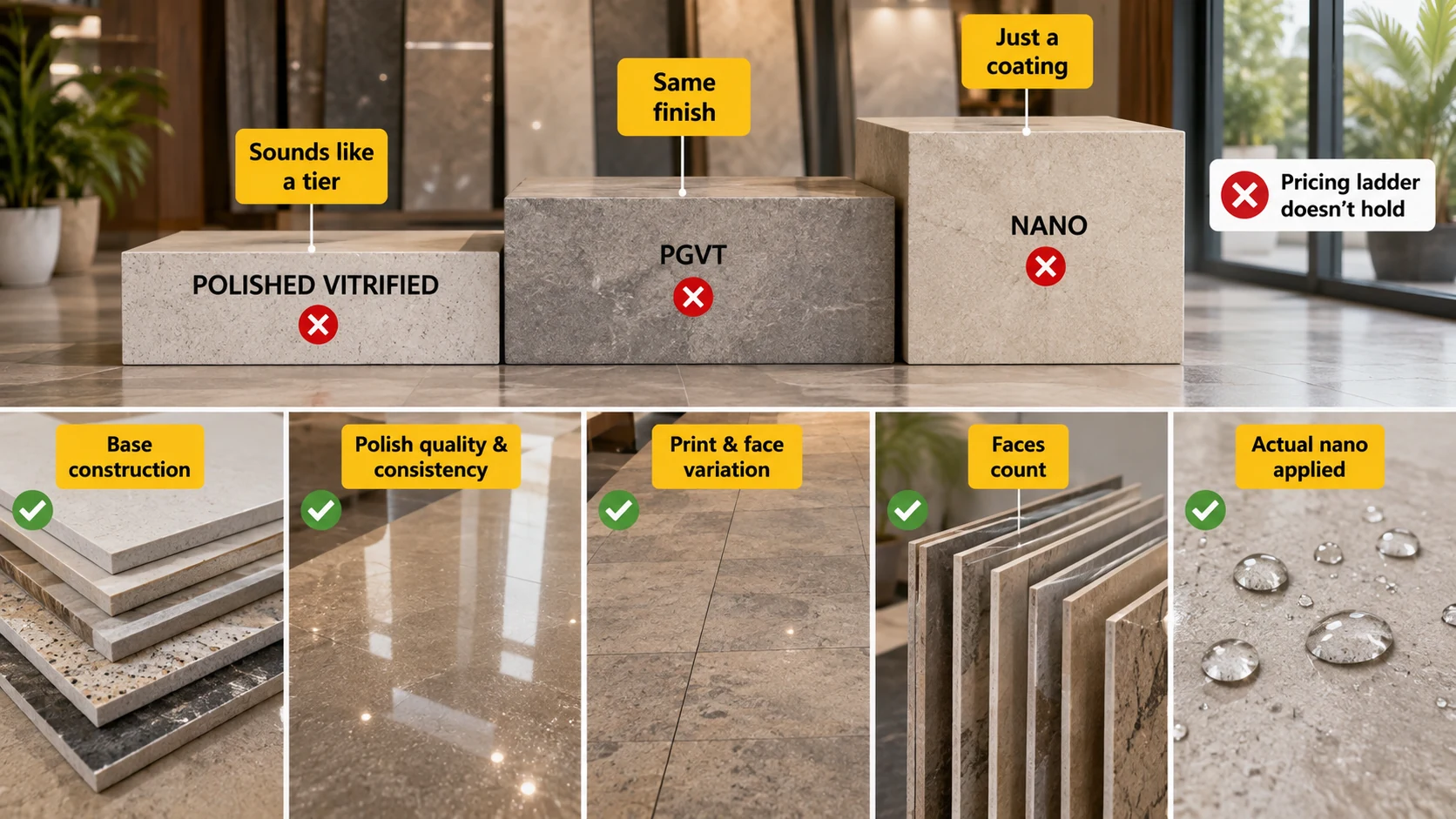
The pricing logic that does not hold up: Because polished vitrified, PGVT, and nano sound like ascending tiers, they are sometimes presented that way, with prices to match. But two of those words describe the same finish and the third describes a coating, so a straight three-step price ladder built purely on terminology is not describing three genuinely different products. What legitimately drives price difference sits elsewhere: the base construction underneath, standard GVT versus double charge versus full body, the quality and consistency of the polish, the print and face variation count, and whether a nano coating has genuinely been applied. Ask about those, and the pricing conversation becomes checkable rather than vague. |
If you want to understand the technology behind the Nano Tiles in India, it helps to look beyond the glossy appearance and understand what the nano coating actually changes. The treatment improves surface stain resistance, but it does not alter the tile's underlying construction or make it suitable for wet floors.
From The Marketplace
Popular tiles right now






The Two Questions That Actually Matter
Question 1: What is the base construction?
This is the genuine tier axis and the one that most affects both price and long-term performance.
| Base Construction | What It Means | Practical Consequence |
| Standard GVT | A vitrified body with the design printed on the surface layer | Most accessible. If the surface wears through deeply, the pattern is gone beneath |
| Double charge | Two layers of pigment pressed together, giving the design meaningful depth into the tile | More resilient to deep surface wear than a printed layer, at a moderate price premium |
| Full body | Colour runs consistently through the entire thickness of the tile | Most resilient to deep wear and chipping, since the body colour is the same all the way down. Typically the most premium |
Question 2: Has a nano coating been applied?
Polishing a vitrified tile opens up micro-pores on the surface, which is precisely what makes a polished tile more prone to absorbing stains than a matte one. A nano coating fills those pores. This is a genuine, real benefit and worth paying a reasonable amount for, but it is worth being precise about what it does and does not address.
| Nano Coating | Reality |
| What it genuinely helps with | Stain resistance and easier cleaning, by filling the micro-pores that polishing opens on the surface |
| What it does NOT do | It does not make a glossy tile safe for a wet floor. Slip resistance is a separate property measured by wet COF, and no nano coating converts a polished tile into an anti-skid one |
| Whether it is permanent | It is a surface treatment, so it wears with the surface over years of traffic rather than lasting indefinitely regardless of use |
| Whether it changes the base | No. A nano-coated tile can still have a basic standard GVT body underneath; the coating says nothing about the construction below it. |
The Safety Point Worth Being Blunt About
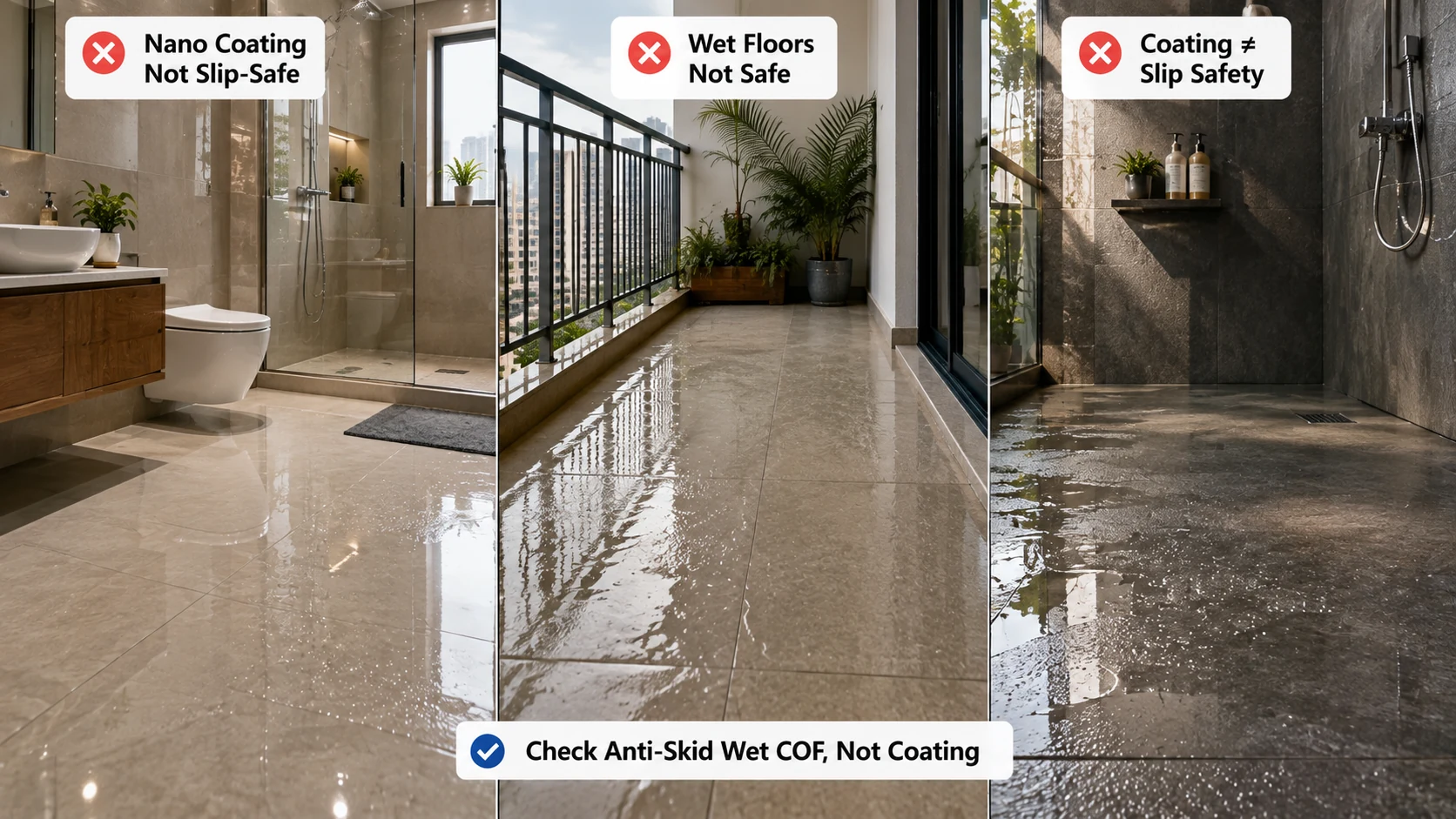
Nano coating is not a slip-safety feature, and should never be treated as one: The single most consequential misunderstanding in this category is assuming that because a nano coating makes a surface smoother, cleaner, and more repellent, it is somehow safer underfoot when wet. It is not. Polished and glossy finishes remain unsuitable for bathroom floors, wash areas, balconies, and any other wet-contact floor regardless of whether a nano coating has been applied. If a floor will get wet and be walked on, the property to confirm is anti-skid wet COF, not the presence of a coating. |
How To Verify What You Are Being Sold
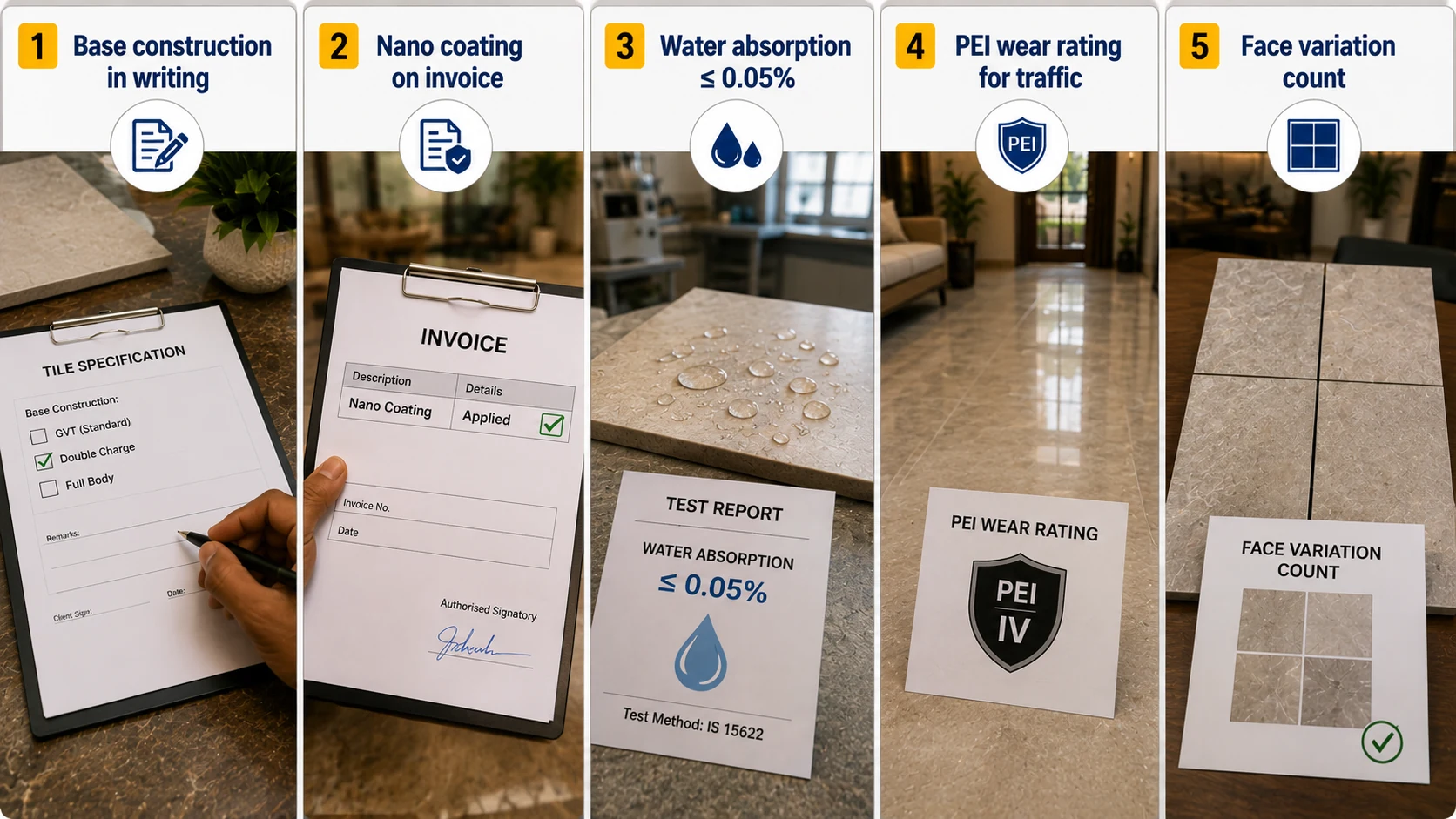
- Ask for the base construction in writing: standard GVT, double charge, or full body, since this is the genuine tier and the one that should carry the price difference.
- Ask whether nano coating is applied, and request it stated on the invoice or specification sheet, rather than accepting it as a verbal descriptor.
- Ask for the water absorption figure, which should be 0.05% or below for vitrified tile per IS 15622, and is a checkable specification rather than a marketing term.
- Ask for the PEI wear rating, particularly relevant if the floor will see heavy daily traffic.
- Ask for the face variation count, since a low count on a large-format floor produces visible pattern repetition regardless of how premium the terminology sounds.
What To Ask In The Showroom
Specific questions get specific answers. These are worth asking directly rather than accepting the category label alone.
When two tiles are priced differently, and both are called polished: "These are both polished vitrified. What is the actual difference between them? Is it the base construction, the polish quality, the face variation count, or the nano coating? I would like the specific difference that accounts for the price gap." |
When a tile is being described as nano: "Is the nano coating confirmed on the specification sheet, and what is the base construction underneath it, standard GVT, double charge, or full body?" |
If nano is being presented as making a floor safer: "I need this for a floor that will get wet. What is the confirmed wet coefficient of friction for this tile? I understand nano coating addresses staining rather than slip resistance, so I need the anti-skid figure specifically." |
Before finalising a large order: "Can I have the specification sheet showing water absorption, PEI rating, and whether nano coating is applied, along with the batch number for the quantity being supplied?" |
Red Flags Worth Noticing
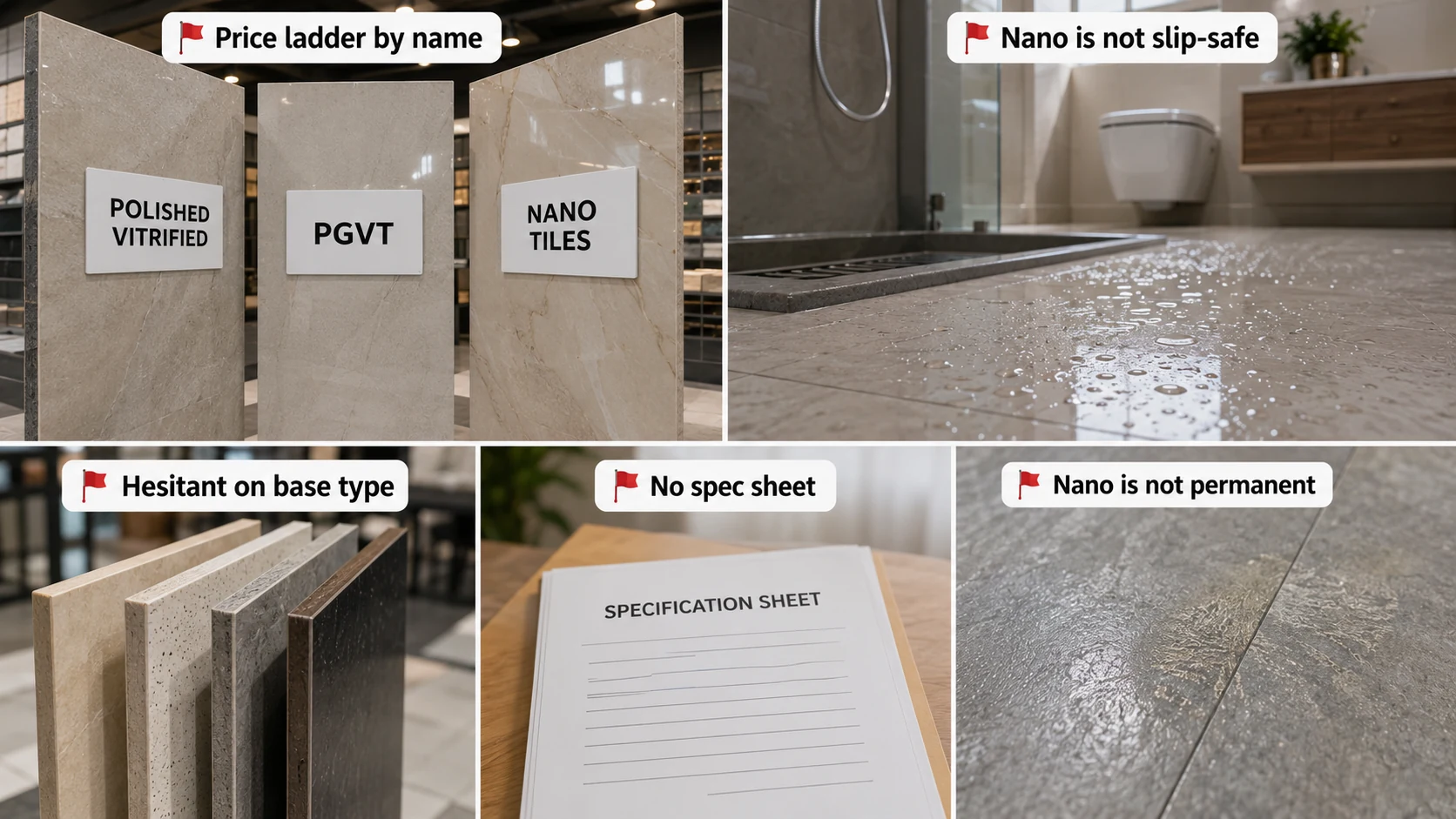
- A price ladder explained purely by terminology, polished vitrified at one price, PGVT at another, with no stated difference in base construction, polish quality, or coating.
- Nano presented as a slip-safety benefit, which it is not, and which matters because acting on that belief in a bathroom is genuinely unsafe.
- Reluctance to state the base construction, since standard GVT, double charge, and full body are basic product facts that any legitimate supplier can confirm.
- No specification sheet available, when water absorption and PEI rating are standard documented figures rather than proprietary information.
- Nano described as permanent, when it is a surface treatment that wears with the surface over time.
So What Should You Actually Buy?
| Your Situation | What To Specify | Why |
| Dry living room or bedroom floor, budget-conscious | Standard GVT, polished, nano coating optional | The polished finish is fine in a dry room; nano is a genuine convenience for staining but not essential |
| Dry living room floor, heavy family use | Double charge base, polished, nano coating worthwhile | The base construction gives real wear depth, and nano meaningfully eases stain management |
| High-traffic or long-term investment floor | Full body base, polished, nano coating worthwhile | Colour through the full thickness handles deep wear and chipping best |
| Any wet-contact floor, bathroom, wash area, balcony | Do not use polished or nano-coated glossy at all; specify anti-skid matte with confirmed wet COF | No coating makes a polished floor appropriate for wet foot traffic |
Once the construction and coating are clear, the next decision is how the finish should actually look in your space. These Nano Tile Design Ideas show how white, ivory, grey, and darker nano surfaces work across living rooms, dining areas, and high-traffic commercial interiors.
Compare What You're Actually Being Sold on TilesFinders
Polished, PGVT, and nano-coated vitrified tiles can be compared on TilesFinders by the specifications that genuinely differ: base construction, water absorption, PEI rating, and confirmed coating, so a price difference is something you can check rather than take on trust.
FAQs
Usually yes. PGVT stands for Polished Glazed Vitrified Tile, which is the same category most people mean when they say polished vitrified. A price difference justified purely by using one name rather than the other deserves a direct question about what genuinely differs.
No. Nano refers to a nano-particle coating applied after polishing, filling the micro-pores that the polishing process opens. It is a treatment applied to a polished tile, not a separate tile category, and it says nothing about the base construction underneath.
No, and this is the most important misunderstanding in this category. Nano coating addresses stain resistance, not slip resistance. Polished and glossy finishes remain unsuitable for bathroom floors, wash areas, and balconies regardless of coating. For any wet floor, confirm anti-skid wet coefficient of friction instead.
The base construction, standard GVT versus double charge versus full body, the polish quality and consistency, the face variation count, and whether a nano coating is genuinely applied. These are checkable specifications, unlike the category label alone.
No, it is a surface treatment and wears with the surface over years of foot traffic rather than lasting indefinitely regardless of use. It is a genuine benefit, worth understanding accurately rather than as a permanent property.
Yes, which is exactly why the two questions should be asked separately. A nano coating can be applied over a basic standard GVT body, so confirming the coating tells you nothing about the construction beneath it.
0.05% or below is the standard benchmark for vitrified tile under IS 15622, and it is a documented, checkable specification rather than a marketing description.
Full body, where colour runs consistently through the entire tile thickness, handles deep wear and chipping best, followed by double charge. Standard GVT is genuinely fine for most normal residential floors at a more accessible price.
Request the specification sheet showing water absorption and PEI rating, ask for base construction and nano coating to be stated on the invoice rather than described verbally, and request the batch number for the quantity supplied.


See our tile guides first
Set TilesFinders as a preferred source and our buying guides surface ahead of the rest for you.
Add as preferred sourceTakes one tap. Nothing to install.
What Readers Say
I was about to redo my parking area with the wrong tile size until I read this. The layout comparisons saved me from a costly mistake.
We reference TilesFinders guides while briefing clients on material selection. The size and pattern breakdowns are accurate and easy to explain visually.
On site, I get asked about grout spacing all the time. This article gave me a solid reference I now share with my team before every job.
Finally a guide that doesn't just push generic advice. The oil stain removal steps actually worked on our clubhouse driveway tiles.
I run a small construction firm and now send this link to clients directly when they ask about entrance tile sizing. Saves me an hour of explaining.
Good practical detail, though I wish there were more examples for compact apartment entrances specifically, not just villas.
My mother-in-law wanted marble, I wanted vitrified. This blog gave us the neutral comparison we needed to actually decide together.
Detailed without being overwhelming. I appreciated that it covered both cost and maintenance, not just the aesthetics.
Used the algae and hard water removal tips on our terrace tiles after the monsoon. Worked better than what our regular cleaner was doing.
As someone who sources tiles for multiple builder projects, I find these comparisons genuinely useful for vendor conversations, not just consumer content.
Recommended this to a client who kept second-guessing the entrance design. The small vs large layout section settled the debate instantly.
Straightforward and honest, no unnecessary jargon. Would like to see a similar breakdown for outdoor pool-deck tiles next.
We've bookmarked several TilesFinders guides for our design handbook. Reliable source when clients want data, not just opinions.
Two paths, one marketplace.
Get free quotes from verified suppliers.
Share your room, budget, and style. Suppliers in Morbi respond within hours.
Get Free QuotesList your business, reach real buyers.
Put your showroom in front of homeowners searching for tiles right now.
List Your Business