GVT Tiles vs PGVT Tiles: Differences, Uses & Which to Buy
Compare GVT vs PGVT tiles by finish, durability, slip resistance, pricing, and room suitability to choose the right vitrified tiles for floors, walls, and luxury interiors.
- What GVT and PGVT Actually Have in Common
- Where GVT and PGVT Differ: A Direct Comparison
- GVT Tiles: What They Are and Where They Work
- Room-by-Room: Which Tile Fits Where
- Can GVT and PGVT Be Used Together in the Same Space?
- The Buyer Decision Table: Which to Choose Based on Your Situation
- What to Check Before Buying Either
The most common question Indian homeowners ask when choosing vitrified tiles is the GVT vs PGVT question. It comes up in tile showrooms daily, in renovation WhatsApp groups, and in conversations with contractors who have their own opinions, which are not always technically accurate.
Both categories share the same vitrified body, the same water absorption rate, and many of the same sizes. What separates them is the surface finish and what that finish means for where each tile can safely and practically go. Modern vitrified tiles design has advanced to a point where both GVT and PGVT can mimic natural stone, wood, fabric, and concrete at high fidelity.
Choosing between them is not a question of which looks better. It is a question of where in the home each tile is being installed.
What GVT and PGVT Actually Have in Common
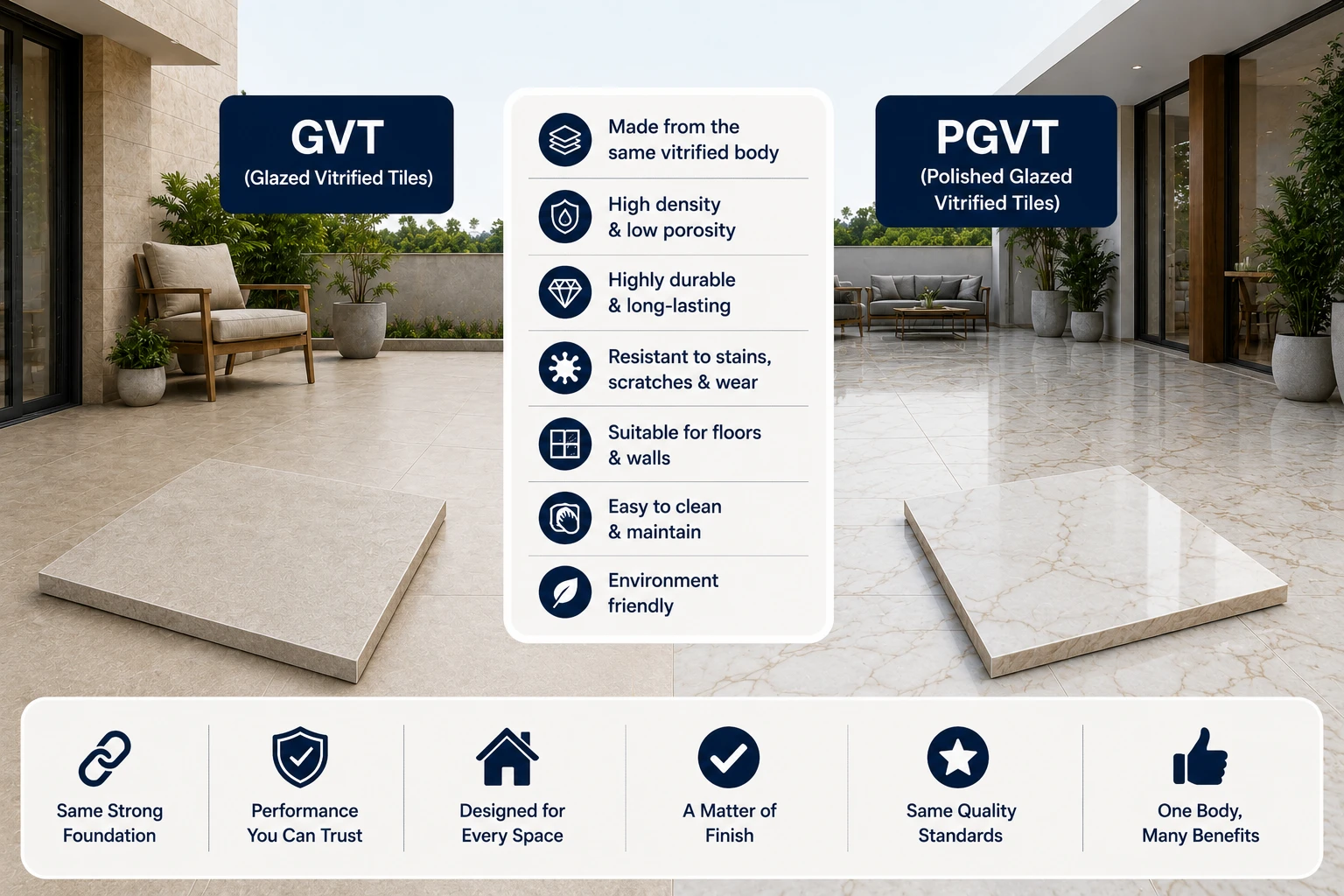
Before comparing the two, it is worth being clear on what they share, because most of the specifications that matter for tile performance are identical between GVT and PGVT.
| Specification | GVT | PGVT |
| Tile body type | Vitrified | Vitrified |
| Water absorption | Less than 0.05% | Less than 0.05% |
| Strength (vs porcelain) | Better | Better |
| Stain resistance | High | High |
| Manufacturing origin in India | Primarily Morbi, Gujarat | Primarily Morbi, Gujarat |
| Common sizes | 2x2, 2x4, 32x48, 6x4, 8x4, 32x96, 32x120, 8x48 | 2x2, 2x4, 32x48, 6x4, 8x4, 32x96, 32x120 |
| Wall use | Yes | Yes |
| Indoor floor use | Yes | Yes (dry areas only) |
| Called 'porcelain' correctly? | No. Always say vitrified or GVT. | No. Always say vitrified or PGVT. |
The shared vitrified body means both categories are significantly stronger than standard porcelain, handle Indian climatic conditions well, and resist the staining from cooking oils, hard water, and cleaning agents that most Indian floors and walls face daily. The difference between GVT and PGVT begins and ends at the surface.
If you want a broader understanding of vitrified tile categories, finishes, strengths, and where each type works best, read our complete vitrified tiles buying guide for Indian homes.
Where GVT and PGVT Differ: A Direct Comparison
| Feature | GVT (Glazed Vitrified) | PGVT (Polished Glazed Vitrified) |
| Surface finish | Multiple: matte, glossy, GHR, Rain Drops, Sugar, Texture, Matte Carving, Embossed and more | Polished high-shine only |
| Light reflection | Varies by finish. Matte absorbs light. Glossy reflects moderately. | Very high. Mirror-like reflection. |
| Slip resistance (floor) | Matte, GHR, Rain Drops, Texture finishes are anti-skid. Glossy GVT is not. | Not anti-skid. Polished surface is slippery when wet. |
| Scratch resistance | High for matte and GHR finishes | Lower than matte GVT. Polished surfaces show scratches more visibly. |
| Wet area floor use | Yes, in matte or GHR finish | No. Never on wet floors. |
| Outdoor floor use | Yes, in matte or GHR finish | No. |
| Design variety | Wide. Matte, textured, embossed, carving, and multiple finish options | Limited to polished surface. Design variety is in the print, not the finish. |
| Price range (per sq. ft.) | Approximately ₹60 to ₹150 | Approximately ₹70 to ₹160 |
| Preferred indoor floor finish | Matte or GHR | Not recommended for floors |
| Preferred wall finish | Matte, Glossy, Sugar depending on the room | Polished. Works well on feature walls and bathroom walls. |
GVT Tiles: What They Are and Where They Work
GVT Tile Design Range
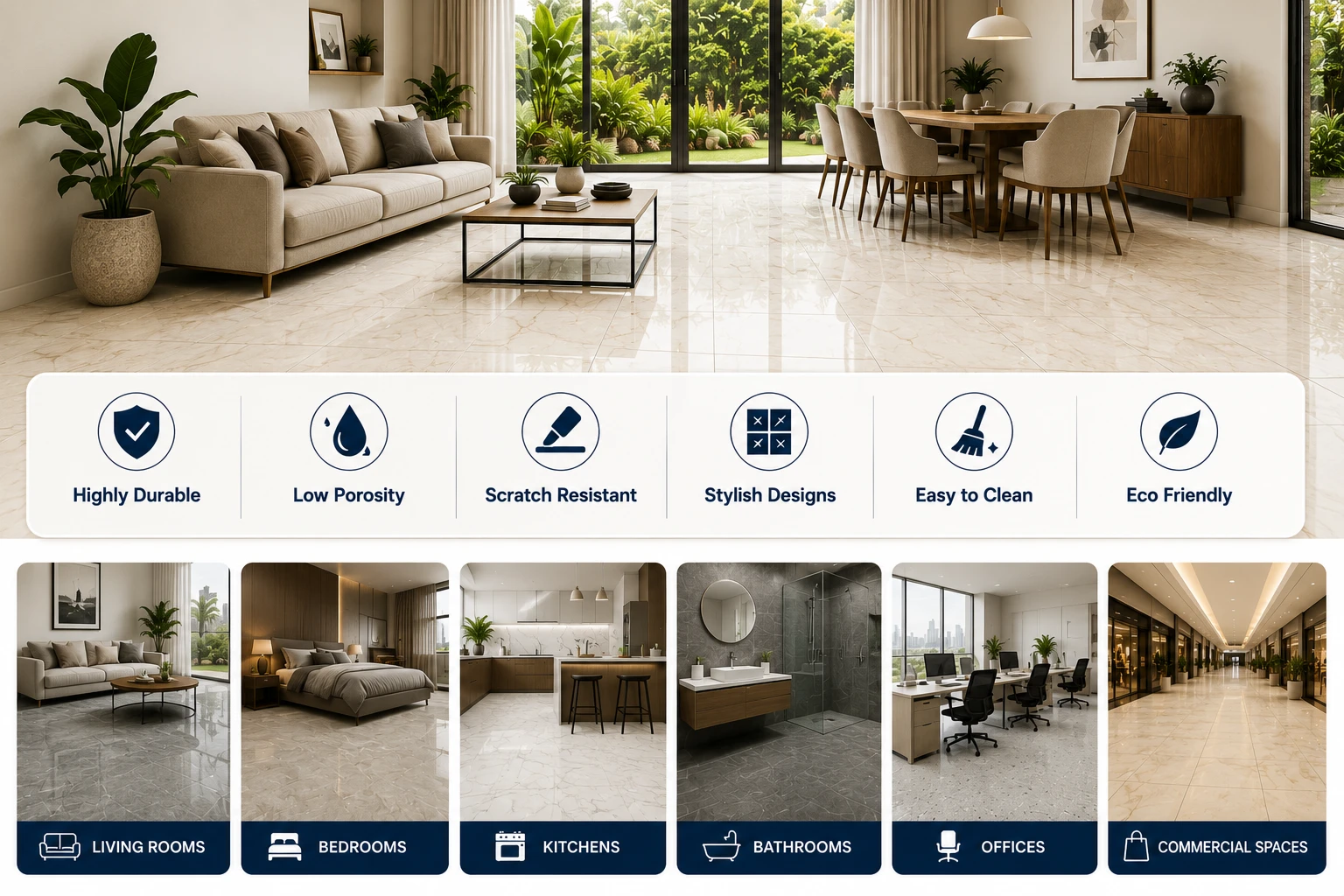
GVT tiles design spans the widest range of any vitrified category. The glazed surface accepts digital prints at high resolution, which means GVT tiles can carry marble-look, wood-look, stone-look, concrete-look, fabric-texture, abstract, and solid colour designs with accurate surface depth and colour intensity.
Beyond the print, GVT has the most finish variety. Matte, GHR, Rain Drops, Sugar, Texture punch, Matte Carving, Embossed, Glossy, High Glossy, Satin Matte, and Glitter are all available on GVT bodies. This range of finishes is what makes GVT the most versatile vitrified category: the same marble-look print can be ordered in a polished-equivalent glossy for a wall or a matte anti-skid finish for a floor.
Where GVT Works Best
GVT floor tiles are the standard recommendation for any Indian home floor that sees regular foot traffic, cooking activity, or moisture contact. The matte or GHR finish versions handle wet conditions safely. The wide size range, from 2x2 to 8x4 slabs, gives GVT coverage across small apartment floors and large open-plan living areas.
On walls, GVT in a glossy or matte finish tiles is a strong choice for kitchen backsplashes, bedroom accent walls, and living room feature walls where the design priority is a specific look rather than maximum light reflection. Where PGVT's polished finish would be the visual priority, GVT's glossy finish serves a similar purpose at a slightly lower price point.
GVT also has the wooden plank format (8x48 in 200x1200 mm) which PGVT does not carry. For wood-look floor applications in living rooms, dining areas, and bedrooms, GVT in the 8x48 plank format in a matte finish is the only vitrified option.
PGVT Tiles: What They Are and Where They Work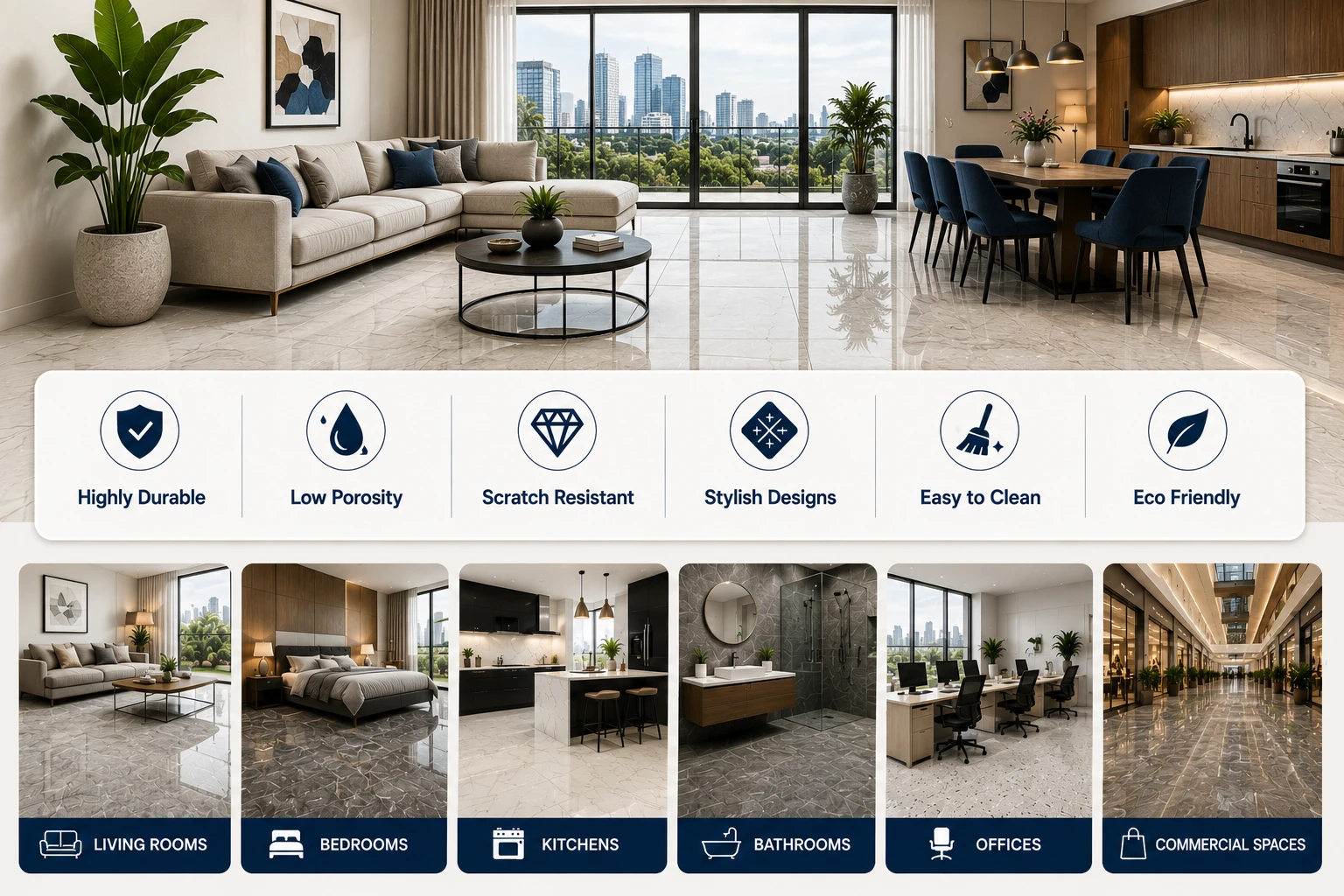
PGVT Tile Design Range
PGVT has one finish: polished. The design variation comes entirely from the print applied before polishing. Marble-look PGVT tiles are the dominant application, particularly the Statuario, Calacatta, and Carrara-style marble prints that show up in Indian living rooms, pooja rooms, and master bedrooms. The polished surface amplifies the depth and contrast of the veining pattern in a way that matte GVT of the same print does not.
PGVT also carries solid colour and abstract prints, but the polished surface is the constant. Every PGVT tile, regardless of design, has the high-shine reflective quality that is its defining characteristic.
Where PGVT Works Best
PGVT wall tiles are the strongest choice for interior feature walls where light reflection and a premium visual are the primary goals. Living room feature walls, bedroom headboard walls, pooja room deity walls, and lobby walls in apartments are all applications where PGVT's polished surface consistently delivers more visual impact than any GVT finish.
Large format PGVT tiles in 2x4, 6x4, 8x4, and 32x96 slab sizes on a feature wall create a near-continuous surface with minimal grout interruption that reads as a polished stone slab. In a living room where the feature wall behind the sofa or TV unit is the primary design statement, a large-format PGVT in a marble-look print is one of the most effective tiles available in the Indian market.
PGVT also works on dry indoor floors in rooms that do not receive water contact during normal use. A living room floor in PGVT that is not adjacent to a wet area, does not have elderly residents who might slip on a polished surface, and is cleaned with dry or barely damp mopping can carry PGVT without the slip hazard that appears in wet kitchens or bathrooms. The caveat is real: any water on a PGVT floor, from a spilled glass to a mopped surface, creates a slip risk that matte GVT does not.
Where PGVT Should Not Go
PGVT must not be used on kitchen floors, bathroom floors, outdoor floors, balcony floors, or any surface that regularly contacts water. The polished surface becomes slippery when wet without exception. This is not a quality issue with the tile but an inherent property of its finish.
PGVT also wears more visibly in high foot-traffic areas than matte GVT does. The polished surface shows scuff marks, micro-scratches from sand or grit underfoot, and dulling over time in areas like hallways and entrances. For high-traffic indoor floors, matte GVT or Double Charge vitrified is the stronger long-term choice.
Room-by-Room: Which Tile Fits Where
Vitrified tiles for the living room, kitchen, bathroom, bedroom, and outdoor areas each have different requirements. Here is the GVT and PGVT recommendation by room.
| Room / Area | Floor Recommendation | Wall Recommendation | Notes |
| Living room floor | GVT matte or GHR in 2x2, 2x4, or 8x48 plank | PGVT or GVT glossy on feature wall | PGVT on living room floor is possible only if dry-use and no elderly or children at risk of slipping |
| Living room feature wall | — | PGVT 2x4 or 6x4 in marble-look, polished | Strongest visual impact. Marble-look PGVT is the dominant choice for this application. |
| Kitchen floor | GVT matte or GHR in 2x2 or 2x4 | GVT or ceramic on backsplash | PGVT is never on the kitchen floor. GVT tiles for the kitchen floor in matte finish are the standard. |
| Kitchen wall (backsplash) | — | GVT glossy or ceramic glossy 12x24 | PGVT on the backsplash near the hob shows oil film fast and requires more cleaning than GVT glossy. |
| Bathroom floor | GVT matte or GHR in 2x2 or 1x1 | PGVT or GVT on walls | PGVT is never on the bathroom floor. Wet area floor must be matte, or GHR finish GVT. |
| Bathroom wall | — | PGVT tiles for bathroom walls in 2x2 or 2x4 | Vitrified bathroom tiles on walls in polished PGVT look premium and are easy to clean from soap and hard water. |
| Bedroom floor | GVT matte in 2x2 or 2x4 | GVT or PGVT on accent wall | Bedroom floors in matte GVT are safe and low-maintenance. PGVT on a bedroom feature wall is a strong choice. |
| Pooja room floor | GVT matte or GHR in 2x2 or 1x1 | PGVT on deity feature wall | Mandir floors receive ritual water. Matte GVT only. PGVT works well on the pooja room wall. |
| Balcony / outdoor | GVT matte or GHR only | GVT matte only | PGVT is not rated for outdoor use. GVT in matte or GHR handles Indian weather and monsoon conditions. |
| Hallway and entrance | GVT matte or GHR in 2x2 | GVT or PGVT on the wall | High-traffic areas wear polished surfaces quickly. GVT matte or GHR on floors lasts better. |
Can GVT and PGVT Be Used Together in the Same Space?
Yes. In fact, combining GVT and PGVT in the same room is a common and effective approach in Indian home interiors, particularly in living rooms and pooja rooms, where the floor and wall serve different functions and benefit from different tile properties.
The most common combination: PGVT marble-look tiles in 2x4 on the living room feature wall, matte GVT in a coordinated marble-look design on the floor. The wall tile reflects light and carries the visual statement. The floor tile provides a safe, anti-skid surface in the same design family. When both tiles use the same marble-look print in different finishes, the room reads as one composed environment without the visual clash of completely different tile designs.
The rule for combining them: always use PGVT on the wall and matte or GHR GVT on the floor. Never reverse this. A matte GVT feature wall paired with a PGVT polished floor creates a safety issue on the floor without delivering the visual benefit that a polished wall provides.
The Buyer Decision Table: Which to Choose Based on Your Situation
| Your Situation | Choose GVT | Choose PGVT |
| Tiling a kitchen floor | Yes. Matte or GHR finish. | No. |
| Tiling a bathroom floor | Yes. Matte or GHR finish. | No. |
| Tiling a bathroom wall | Yes, glossy finish works. | Yes. Polished PGVT on bathroom walls is a strong choice. |
| Living room feature wall | GVT glossy works, but PGVT gives more impact. | Yes. PGVT polished is the stronger visual choice for feature walls. |
| Living room floor (family with elderly or children) | Yes. Matte GVT is safer. | No. A polished surface is a slip risk. |
| Living room floor (adult household, dry use) | Yes. | Yes, with awareness of polished slip risk on wet mopping days. |
| Bedroom accent wall | Yes, if matte or sugar finish preferred. | Yes, if high-shine polished is preferred. |
| Outdoor or balcony | Yes. Matte or GHR only. | No. Not rated for outdoor. |
| Pooja room deity wall | GVT glossy works. | Yes. PGVT polished gives the best light reflection for a mandir. |
| High-traffic hallway floor | Yes. GHR finish. | No. Scratches are visible in high-traffic areas. |
| Wood-look plank floor (8x48) | Yes. Only GVT has this format. | No. PGVT does not have the 8x48 plank size. |
| Large-format slab feature wall | Yes, GVT in glossy or matte. | Yes. Large format PGVT slabs in 32x96 are a strong premium wall choice. |
What to Check Before Buying Either
Confirm the finish name, not just the category. A dealer may show a tile labelled as GVT that has a Satin Matte finish. Satin Matte looks matte but is slippery when wet and should not go on any wet-contact floor. Always ask for the specific finish name and verify it against the safe-for-floor list: Matte, GHR, Rain Drops, Texture, Matte Carving are floor-safe. Glossy, High Glossy, Satin Matte, Semi Polished, and all PGVT finishes are not safe on wet floors.
Check the tile size against your room dimensions before ordering. Large-format tiles in 2x4 and 6x4 reduce grout lines and look better in rooms above 150 sq. ft. In compact rooms below 80 sq. ft., the same format generates more cutting wastage and can visually overpower the space. Match the tile format to the room area, not just the design preference.
Ask whether the tile is rectified. Rectified tiles are cut to precise dimensions after firing, allowing grout joints as narrow as 1 to 2mm. Non-rectified tiles have natural size variation and need wider grout lines. For large-format PGVT and GVT tiles where the seamless look is part of the appeal, rectified tiles are strongly preferred. Ask the dealer before purchasing.
Do not rely on showroom lighting to judge light reflection. Showroom LEDs are set up to show every tile at its best. A PGVT tile that looks bright and luminous under showroom spotlights may behave very differently under your home's tube lighting or warm recessed LEDs. Request a sample, take it home, and check it in the actual room at the time of day the light matters most.
Buy 10% more than the measured area. Cutting wastage, breakage during installation, and future repair needs all consume tiles beyond the measured area. This applies to both GVT and PGVT. For large-format tiles above 2x4 size, budget 12 to 15% extra because cutting in large formats wastes more material per cut.
The GVT versus PGVT decision gets straightforward once you apply the floor-wall rule: matte or GHR finish GVT on any floor that sees moisture, PGVT on interior feature walls where polished light reflection is the goal.
For most Indian homes, the answer is both, used in the right places. Take the room dimensions, the lighting setup, and the presence of elderly family members or children into account before confirming the floor finish. And always take a physical sample of the tile home before ordering at scale.
You can compare GVT and PGVT tiles across sizes, finishes, and marble-look or stone-look designs on TilesFinders to shortlist options from Indian manufacturers before visiting a showroom.

FAQs
Neither is categorically better. They serve different purposes. GVT is the right choice for floors in any room that contacts moisture (kitchen, bathroom, balcony, pooja room) because its matte and GHR finish options are anti-skid and safe in wet conditions. PGVT is the right choice for interior feature walls, bathroom walls, and pooja room walls where the polished surface's light reflection and visual depth are the priority. In many Indian homes, both are used together in the same room: PGVT on the feature wall and matte GVT on the floor in a coordinated design family.
For a living room floor, GVT in a matte or GHR finish in 2x2 or 2x4 size in a marble-look or stone-look print is the most practical choice. It handles daily foot traffic safely and resists the scuff marks and dulling that a polished surface would develop over time. For the living room feature wall behind the sofa or TV unit, PGVT in 2x4 in a marble-look print gives the most visual impact. Combining matte GVT on the floor with PGVT on the feature wall in the same design family is the approach most used in Indian living room renovations in 2026.
Yes. PGVT tiles have a polished surface that becomes slippery when wet. This is an inherent property of the polished finish, not a defect. Water, mopping, spills, or any moisture on a PGVT floor creates a slip risk, which is why PGVT should never be used on kitchen floors, bathroom floors, balconies, outdoor areas, or any surface that regularly contacts water. On walls, PGVT is completely appropriate. On dry indoor floors in households with no slip risk concern, PGVT can be used with awareness, but matte GVT is always the safer floor option.
Yes. PGVT is the most widely used vitrified tile category in luxury residential interiors in India. The polished surface, large format sizes (2x4, 6x4, 32x96 slab), and the fidelity of marble-look and stone-look prints on the polished body make PGVT the closest a tile can get to a polished natural stone appearance at a fraction of the natural stone cost and maintenance burden. Feature walls, bathroom walls, pooja room walls, and lobby walls in premium apartments and villas across India use PGVT as the primary tile material. The key is keeping PGVT on walls and dry indoor surfaces, never on wet floors.
Matte vitrified tiles (GVT with matte, GHR, or Texture punch finish) absorb light, have a calm low-reflection appearance, and are anti-skid, making them safe for floors including wet areas. Glossy vitrified tiles (GVT with glossy or high-glossy finish, or PGVT with its polished finish) reflect light strongly, look brighter and more luminous, but are slippery when wet and must not be used on wet-area floors. For most Indian floors, matte is the practical and safe choice. For walls and feature surfaces where visual impact matters more than slip resistance, glossy or polished finishes deliver significantly more presence.
GVT tiles cost approximately ₹60 to ₹150 per sq. ft. depending on size, finish, and design. PGVT tiles cost approximately ₹70 to ₹160 per sq. ft. in the same size range. The price difference between the two categories is not large for standard sizes. Where the cost diverges more noticeably is in the large-format sizes: PGVT in 6x4, 8x4, and 32x96 slab sizes for premium feature walls can reach ₹200 per sq. ft. or more depending on the marble-look design and brand. GVT in the same large formats in a matte or glossy finish typically stays within ₹90 to ₹160 per sq. ft. All prices are approximate and vary by brand, dealer, and city.
Yes, and this is a common approach in Indian home interiors. The most effective combination is PGVT in a polished marble-look finish on the feature wall, with matte GVT in the same design family on the floor. Both tiles share the same vitrified body and similar design prints, so they coordinate visually without looking like two unrelated choices. The rule to follow: always PGVT on the wall and matte GVT on the floor. Reversing this, placing matte GVT on the wall and PGVT on the floor, creates a safety issue on the floor without any visual benefit on the wall.

See our tile guides first
Set TilesFinders as a preferred source and our buying guides surface ahead of the rest for you.
Add as preferred sourceTakes one tap. Nothing to install.
What Readers Say
I was about to redo my parking area with the wrong tile size until I read this. The layout comparisons saved me from a costly mistake.
We reference TilesFinders guides while briefing clients on material selection. The size and pattern breakdowns are accurate and easy to explain visually.
On site, I get asked about grout spacing all the time. This article gave me a solid reference I now share with my team before every job.
Finally a guide that doesn't just push generic advice. The oil stain removal steps actually worked on our clubhouse driveway tiles.
I run a small construction firm and now send this link to clients directly when they ask about entrance tile sizing. Saves me an hour of explaining.
Good practical detail, though I wish there were more examples for compact apartment entrances specifically, not just villas.
My mother-in-law wanted marble, I wanted vitrified. This blog gave us the neutral comparison we needed to actually decide together.
Detailed without being overwhelming. I appreciated that it covered both cost and maintenance, not just the aesthetics.
Used the algae and hard water removal tips on our terrace tiles after the monsoon. Worked better than what our regular cleaner was doing.
As someone who sources tiles for multiple builder projects, I find these comparisons genuinely useful for vendor conversations, not just consumer content.
Recommended this to a client who kept second-guessing the entrance design. The small vs large layout section settled the debate instantly.
Straightforward and honest, no unnecessary jargon. Would like to see a similar breakdown for outdoor pool-deck tiles next.
We've bookmarked several TilesFinders guides for our design handbook. Reliable source when clients want data, not just opinions.
Two paths, one marketplace.
Get free quotes from verified suppliers.
Share your room, budget, and style. Suppliers in Morbi respond within hours.
Get Free QuotesList your business, reach real buyers.
Put your showroom in front of homeowners searching for tiles right now.
List Your Business