
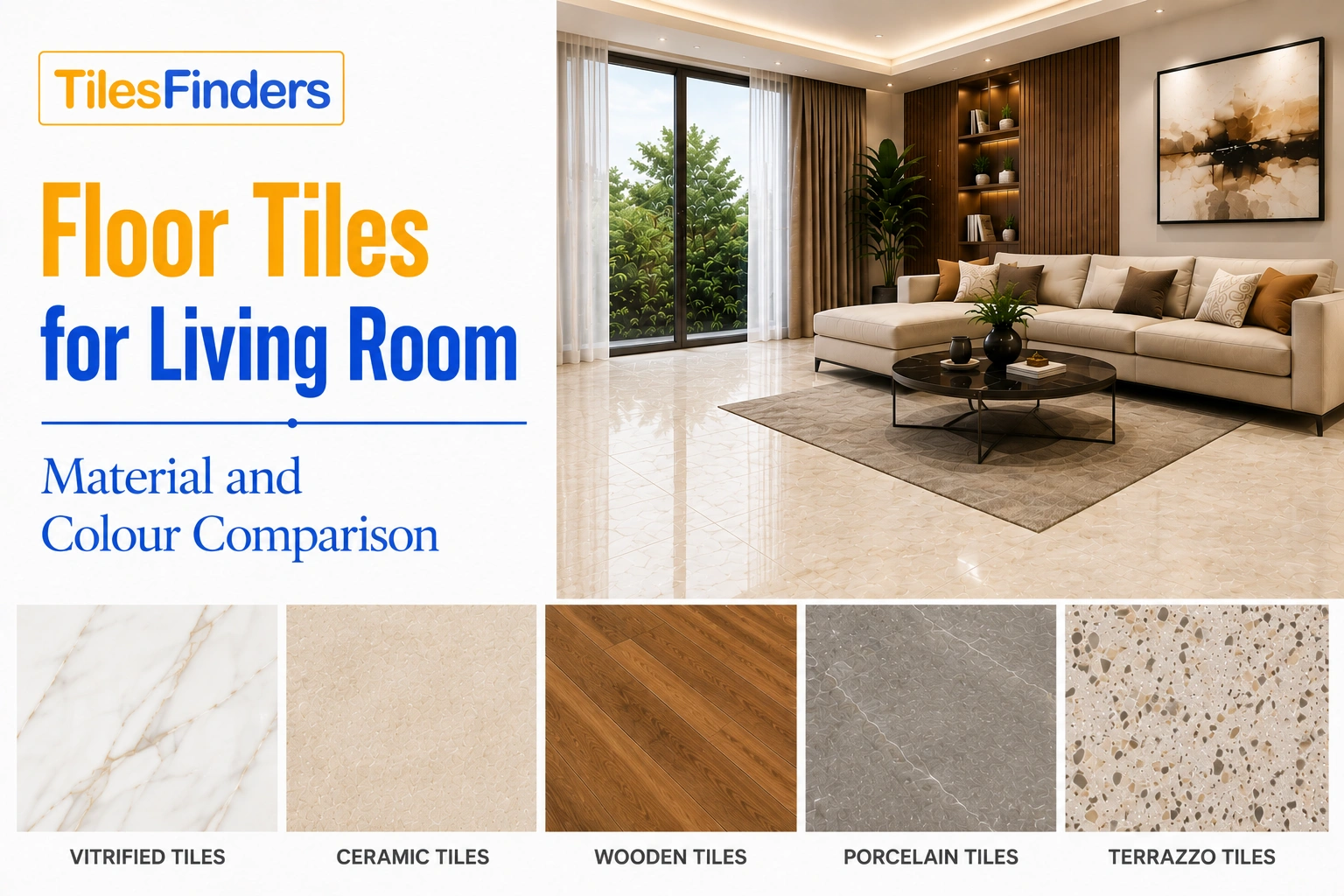
Floor Tiles for Living Room: Material and Colour Comparison
Compare living room floor tiles by material, colour, finish, size, and price. Explore GVT, PGVT, marble-look, wood-look, and vitrified tile options for Indian homes in 2026.
- Why the Living Room Floor Tile Is the Most Important Tile Decision in the House
- Floor Tile Materials for Living Rooms: Full Comparison
- Living Room Tile Colour: Full Comparison Guide
- Tile Colour Comparison Table
- Matte vs Glossy Floor Tiles for Living Room: Which Is Better?
- Floor Tile Size for Living Room: What Makes the Room Look Bigger
- Latest Floor Tile Design for Living Room in India
- How to Choose Floor Tiles for the Living Room: A Practical Framework
- Expert Buying Tips for Living Room Floor Tiles
- Common Mistakes When Choosing Living Room Floor Tiles
- Living Room Tiles Price in India 2026
- Choosing the Right Floor Tiles for Your Living Room
The living room floor makes more decisions than any other floor in the house. It has to handle daily foot traffic, look good enough to impress guests, stay cool in Indian summers, and hold up for fifteen years without looking tired.
Most homeowners start this decision at the wrong end. They go to a showroom, point at a tile that looks good under those ceiling lights, and order it. Three months later, the tile looks very different under the actual lighting in the actual room, at the actual size they ordered.
This guide works through the decision from the right end. It covers the tile materials available for living room tiles in India, compares them honestly on durability and maintenance, maps colours to room conditions and furniture, and gives a size and price reference to plan the project with clear numbers. By the end, the showroom visit becomes a confirmation, not a starting point.
Why the Living Room Floor Tile Is the Most Important Tile Decision in the House
The living room floor is the largest single visible surface in most Indian homes. It covers more area than any wall, ceiling, or floor in the house. Every piece of furniture sits on it. Every guest looks at it the moment they walk in. Every morning begins and ends on it.
Tiles for the living room also carry specific demands that bedroom or balcony tiles do not. The living room gets foot traffic from the entire family, guests who may not remove footwear, furniture legs under sofa sets and dining tables, and festival activity from Diwali rangoli to Navratri celebrations. The floor needs to handle all of this while looking clean and maintained between mop cycles.
The living room tile also sets the visual tone for the rest of the home. A well-chosen living room floor tile design creates a foundation that makes furniture, walls, and decor look better. A poorly chosen one creates a constant background note that no decor can fully fix. Getting this decision right at the start makes everything else in the room easier.
Floor Tile Materials for Living Rooms: Full Comparison
Five tile material categories work well for living room floors in India. Each has a different visual character, maintenance needs, and suitability for the Indian home context.
Choosing a tile is about more than just appearance. The right material, finish, size, and colour combination can completely change how a living room feels and functions. Explore our living room tiles guide to discover practical tips, design ideas, and buying considerations for Indian homes.
GVT (Glazed Vitrified Tiles)
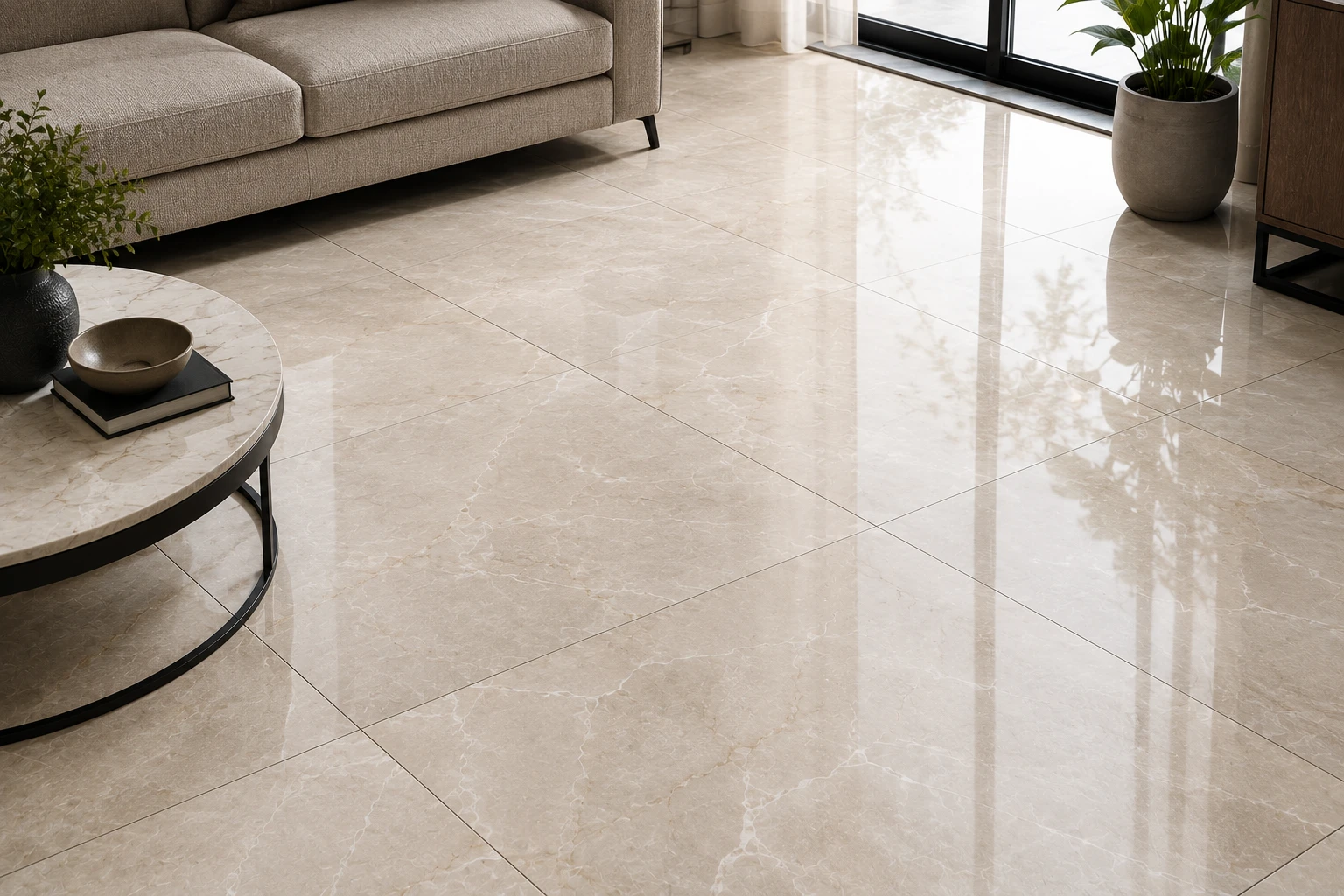
GVT tiles are the most popular floor tiles for living rooms in India. They have 0.05% water absorption, making them among the toughest indoor floor tiles available. GVT comes in the widest design range of all tile categories, covering marble look, stone look, concrete look, wood finish, and abstract digital prints. They work well for both floor and wall applications and are available in all major living room sizes from 600x600 mm (2x2) to 1200x1800 mm (6x4).
The matte, Posh, and GHR finishes in GVT are the safest and most practical for living room floors. These finishes hide light marks and dust better than polished surfaces and need fewer mop cycles per week to look clean. GVT in a matte finish is scratch-resistant and handles furniture movement without surface wear.
Price range: approximately ₹60 to ₹150 per sq. ft. for standard residential grades. Premium large-format GVT in 800x1600 mm (32x64) runs ₹120 to ₹200 per sq. ft.
PGVT (Polished Glazed Vitrified Tiles)
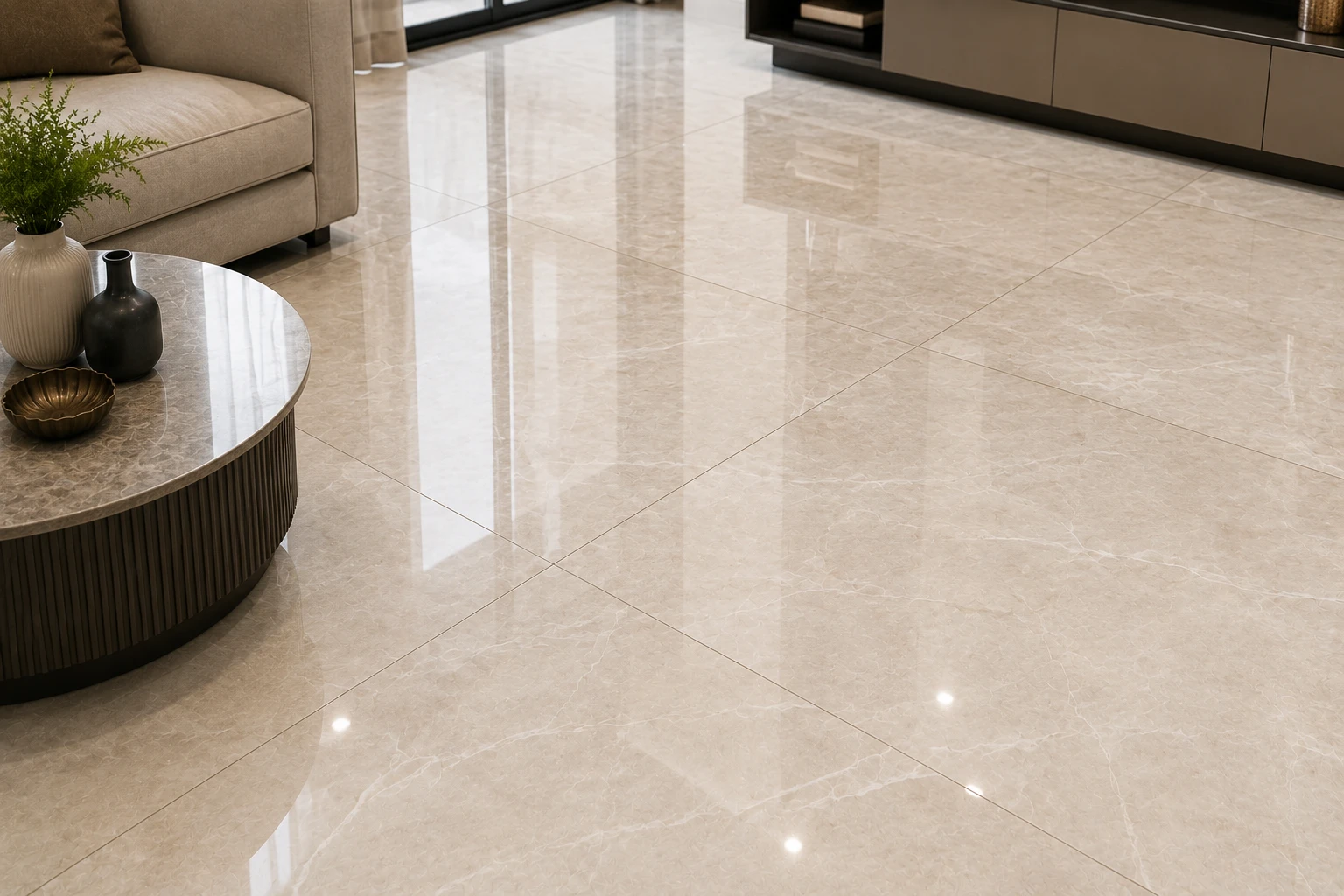
PGVT tiles give the highest gloss, mirror-like finish of all vitrified tile categories. They are widely used in living rooms and formal drawing rooms in Indian homes because the polished surface reflects ceiling lights and makes the room feel larger and more refined. PGVT is the go-to category for marble finish tiles and Italian marble look designs in Indian homes.
PGVT is suitable for dry indoor living room floors. It should not be used in areas near an entry door where monsoon water or outdoor moisture reaches the floor, because the polished surface becomes slippery when wet. In a covered, dry living room that connects to a separate dry hallway, PGVT floors work well for years with normal care.
Maintenance for PGVT: Avoid grit accumulation by dust mopping daily before wet mopping. Grit dragged under a mop scratches the polished surface gradually. Use a pH-neutral floor cleaner; avoid acidic or abrasive products. Price range: approximately ₹70 to ₹150 per sq. ft.
Double Charge Vitrified Tiles
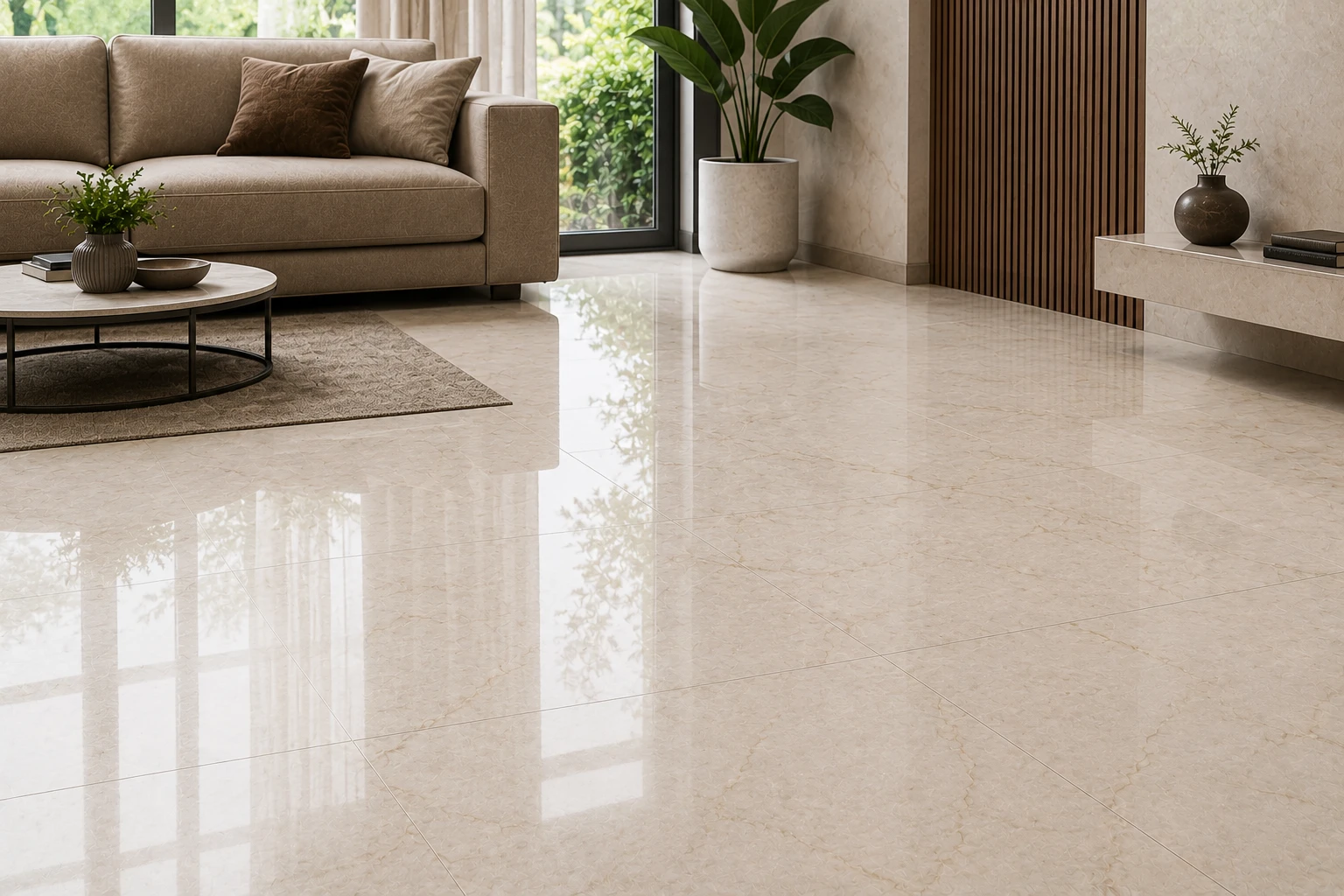
Double-charged vitrified tiles have the highest scratch resistance of all vitrified categories. The manufacturing process applies two layers of pigment under pressure before firing, creating a surface that holds up under heavy foot traffic, chair movement, and heavy furniture sliding better than standard GVT or PGVT. Double charge tiles are particularly suited to living rooms in joint family homes, ground-floor flats in societies, and any space that sees above-average daily traffic.
Double charge is available in a limited design variety compared to GVT or PGVT. Most designs are in neutral marble-inspired or plain tones rather than the wide digital print range GVT offers. Sizes are 600x600 mm (2x2), 800x800 mm (32x32), and 600x1200 mm (2x4). Not suitable for wet areas. Price range: approximately ₹70 to ₹140 per sq. ft.
Full Body Vitrified Tiles
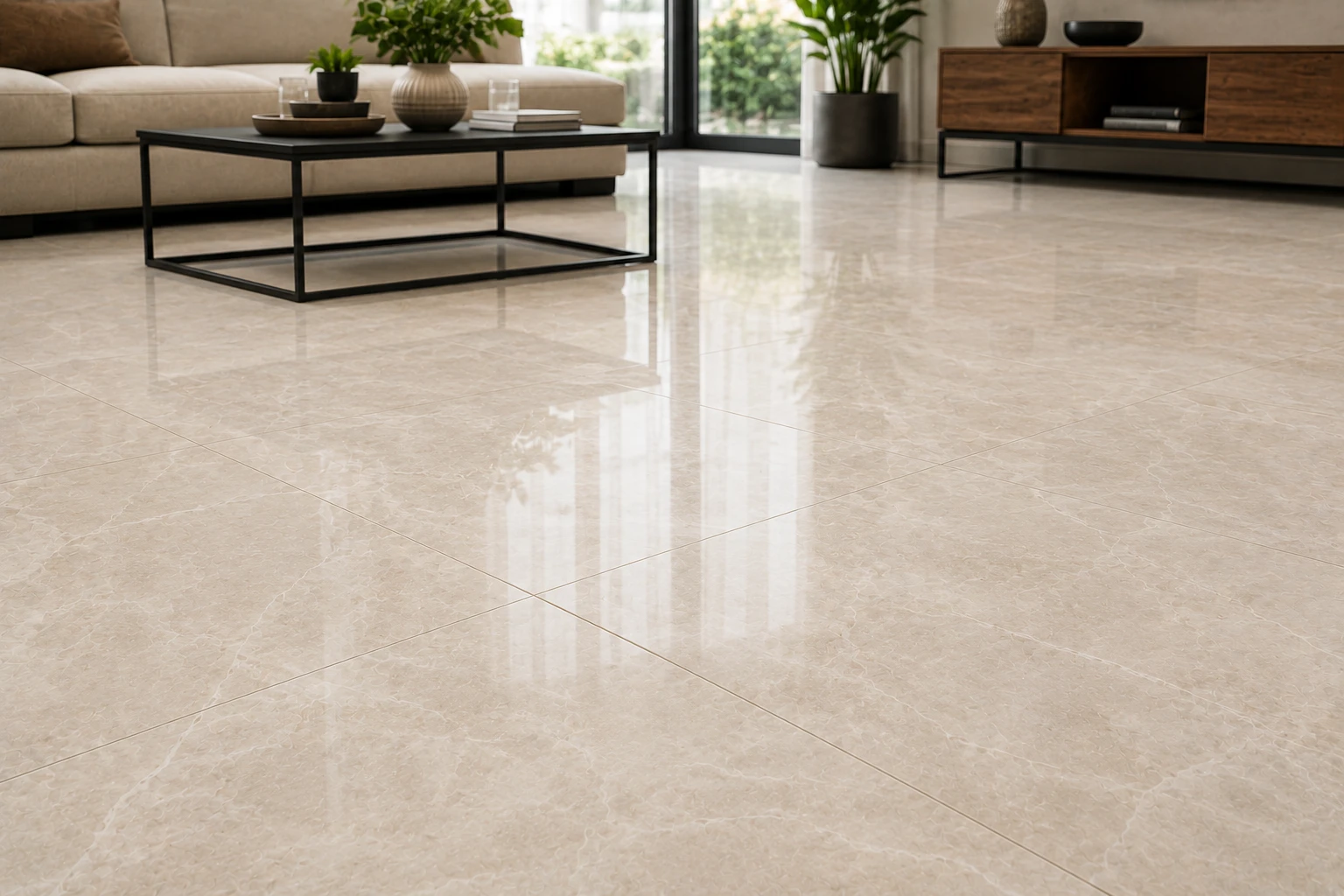
Full body vitrified tiles have their colour and pattern running through the full tile body, not just the surface layer. This means chips and edge damage show the same colour as the surface, making them less visually obvious over the years of use. Full body tiles are preferred in living rooms where the floor needs to last 20 or more years without visible surface wear, and in homes where the furniture layout changes frequently, causing edge nicks.
Full body vitrified gives a strong, consistent appearance across a wide range of sizes, from 600x600 mm (2x2) to 1200x1800 mm (6x4). The available design range is narrower than GVT but covers key living room looks, including marble finish, stone look, and concrete look. Price range: approximately ₹90 to ₹200 per sq. ft.
Marble Look Tiles vs Natural Marble
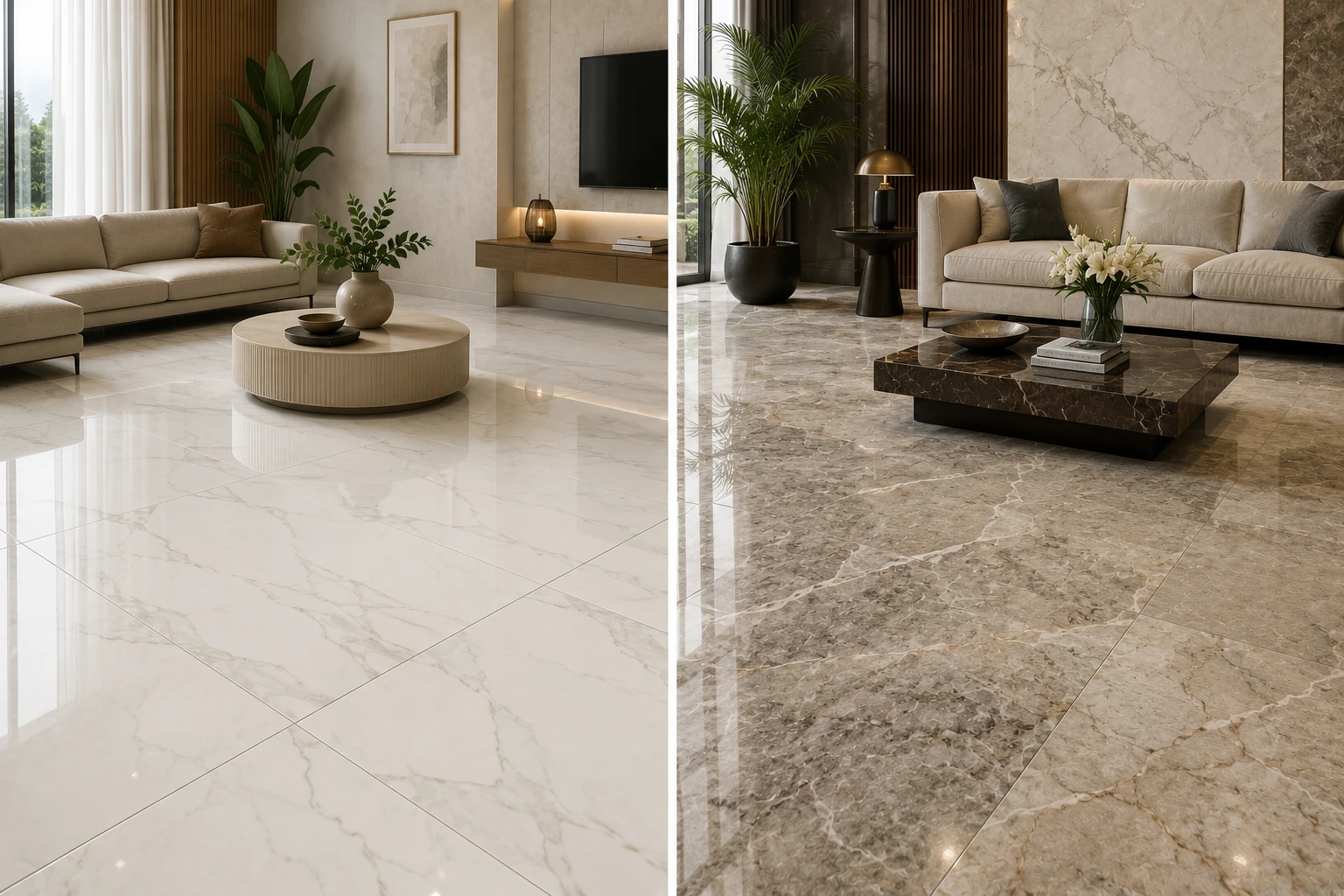
Natural marble, whether Indian (Makrana, Rajnagar, Katni) or Italian (Carrara, Statuario, Calacatta), gives the living room a visual depth and material prestige that no manufactured tile fully replicates. Indian marble is harder and denser than Italian marble, making it more suitable for living room floors with daily family traffic. Italian marble is softer and more porous, better suited for formal, lower-traffic drawing rooms or feature walls.
The practical alternative for most Indian homeowners is GVT or PGVT tiles in a marble look finish. These marble finish tiles give the veined marble appearance in a vitrified body that needs no sealing, handles spills without staining, and costs a fraction of natural stone. For families with children, active households, or living rooms that see heavy daily use, marble-look vitrified tiles are a more manageable choice than natural stone.
Wood Look Floor Tiles for Living Room
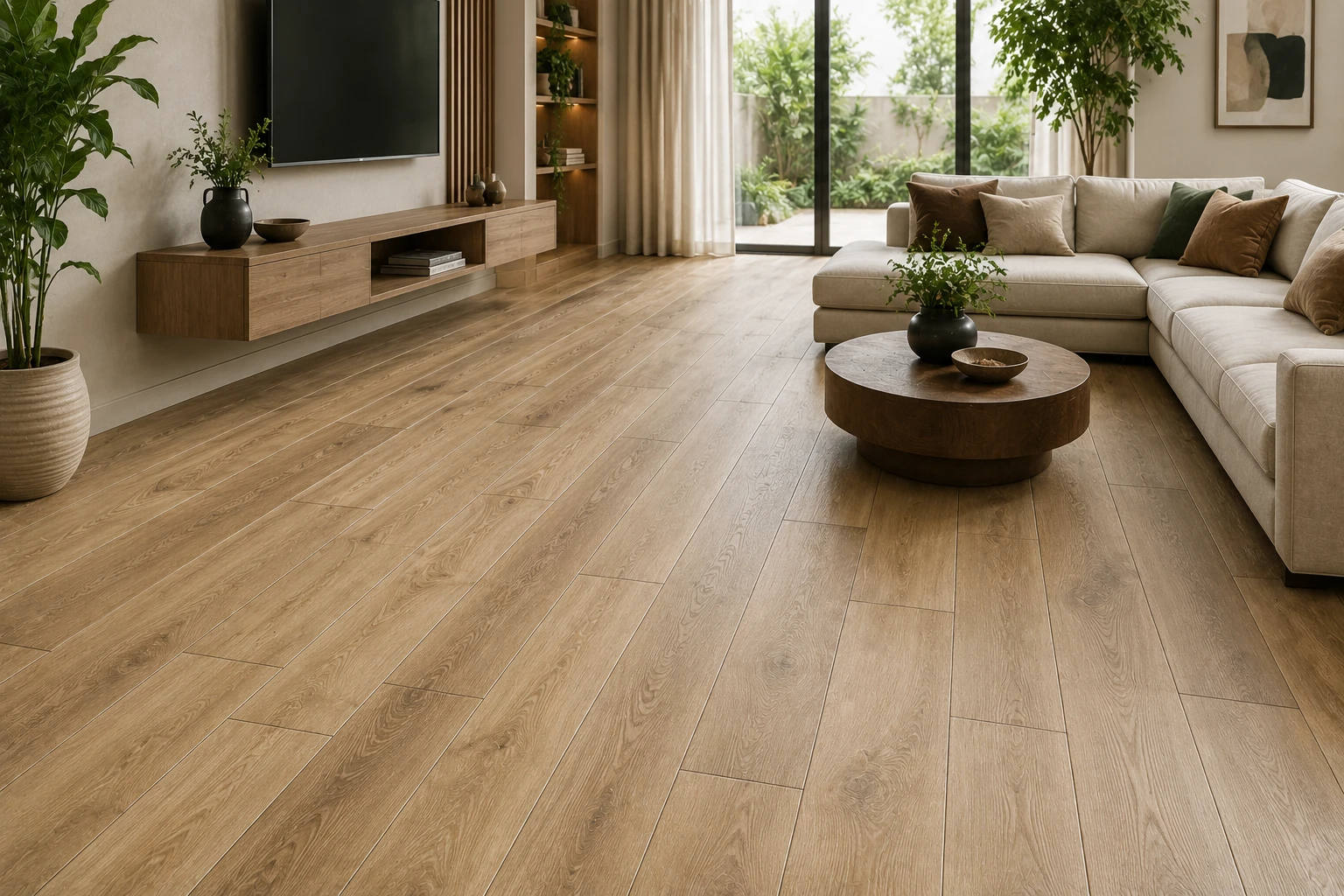
Wood look floor tiles for living room use are a growing trend in Indian homes in 2026, particularly in South Indian homes and in apartments where a warm, residential feel is the priority. GVT wood finish tiles in 200x1200 mm (8x48) plank format give the character of real wood flooring without the swelling, warping, and maintenance demands of natural wood in Indian humidity.
Wood finish tiles in a living room pair well with warm cream or off-white walls and natural wood or cane furniture. They work particularly well in open-plan layouts where the living and dining area share a floor, creating a warm continuity across both zones.
| Material | Water Abs. | Scratch Res. | Maintenance | Design Range | Price/sq.ft. | Best Living Room Use |
| GVT matte/Posh | 0.05% | High | Low | Very wide | ₹60 to ₹150 | All living rooms are most practical for daily use |
| PGVT polished | 0.05% | Moderate | Low to moderate | Wide | ₹70 to ₹150 | Dry covered living rooms; formal drawing rooms |
| Double Charge | 0.05% | Very High | Low | Limited | ₹70 to ₹140 | High-traffic living rooms; heavy daily use |
| Full Body Vitrified | Near zero | High | Low | Moderate | ₹90 to ₹200 | Long-life projects; renovation homes expecting 20+ years |
| Marble look GVT/PGVT | 0.05% | High (GVT) / Moderate (PGVT) | Low | Wide | ₹80 to ₹250 | Any living room wanting marble aesthetics without natural stone maintenance |
| Natural Indian Marble | Low to medium | High (Makrana) | Moderate (seal, pH neutral) | Natural variation | ₹150 to ₹350 | Premium living rooms and formal drawing rooms |
| Wood look GVT plank | 0.05% | High | Low | Good | ₹80 to ₹180 | Warm, residential living rooms; open-plan family spaces |
Living Room Tile Colour: Full Comparison Guide
Tile colour is the most visible and most discussed part of any living room tile decision. It affects how big the room feels, how often the floor needs mopping, and how well the floor works with the walls and furniture. The right tile colour combination in a living room is not about personal taste alone; it is about how the room's dimensions, lighting, and use pattern interact with the tile.
White and Light Cream
White and cream living room floor tiles reflect the maximum light and make any room feel larger and brighter. In north-facing Indian living rooms that get limited natural daylight, a white or light cream floor tile compensates for the shadow. The trade-off is visibility of marks: white tiles show dust, light footprints, and splashed water more quickly than any other colour. They suit living rooms with lower daily traffic, good cleaning habits, or households without young children and pets.
White PGVT in a polished finish works beautifully in a dry, covered living room that gets afternoon sunlight. White GVT in a matte or Posh finish is more forgiving between cleans. Pair white tiles with off-white or light grey walls for a calm, open interior look that suits both contemporary and traditional Indian furniture.
Grey and Greige (Grey-Beige)
Grey is the most versatile and the most practically forgiving living room tile colour for Indian homes in 2026. Light grey marble look tiles in 600x1200 mm (2x4) hide everyday dust, light grit, and foot marks better than white, while still reflecting enough light to keep the room open. Grey pairs with almost every furniture tone, from light Scandinavian wood to dark Indian teak.
Greige (a warm grey with beige undertones) is a close second. It reads as cooler than pure beige and warmer than cool grey, making it a middle-ground colour that suits both contemporary minimalist interiors and traditional Indian drawing rooms. Greige tiles in a Posh or matte finish are one of the most sought-after living room floor tiles in Indian apartment renovations in 2026.
Warm Beige and Cream
Warm beige living room tiles suit Indian homes with traditional interiors, warm-toned furniture, and brass or copper accents. Beige absorbs warm light from evening LEDs and Indian amber lamps, giving the room a soft, welcoming glow that cooler whites and greys do not produce. The practical advantage over white is that beige hides light marks and dust significantly better.
Beige is the most popular living room tile colour in South Indian homes, where warm wood tones, dark furniture, and traditional architectural elements create an interior context that white or grey tiles can make feel cold. Katni beige marble or a warm beige GVT tile in 600x1200 mm (2x4) with a matte or Posh finish is the most common living room flooring choice in this context.
Dark Grey, Charcoal, and Black
Dark floor tiles for the living room are growing in popularity in Indian urban apartments in 2026. Deep charcoal grey, anthracite, and very dark stone-look GVT tiles create a bold, architectural interior that suits contemporary Indian homes with white walls, clean-line furniture, and metal or glass accents. Dark tiles absorb light rather than reflecting it, which reduces the perceived size of the room; they work best in living rooms above 200 sq. ft. with good natural light.
The practical advantage of dark tiles: they hide grit, dust, and everyday marks far better than any light colour. Between full mop cycles, a dark tile living room looks clean longer. The trade-off is that white mineral deposits from hard water and soap residue show more clearly on dark surfaces.
Earth Tones: Terracotta, Brown, and Rust
Earth-tone living room floor tiles are one of the strongest 2026 trends in Indian homes. Terracotta, warm rust brown, and earthy ochre-toned GVT tiles give living rooms a nature-connected, grounded feel that suits homes leaning into organic Indian aesthetics. These tones pair with cane furniture, handwoven textiles, natural stone accents, and indoor plants.
Earth tones do not suit every Indian home. They read as traditional and warm rather than contemporary and cool. In apartments with modern white kitchens and light wood laminate furniture, earth-tone living room tiles can feel mismatched. Confirm the full colour scheme before choosing this direction.
A well-designed hall creates the first impression of your home and sets the tone for the entire interior. If you're looking for fresh inspiration, browse these hall tiles ideas featuring modern layouts, trending finishes, and stylish design concepts for Indian spaces.
Tile Colour Comparison Table
| Tile Colour | Room Size Effect | Mark Visibility | Pairs With | Best Living Room Type |
| Pure white | Opens space significantly | High (shows dust fast) | Light grey or cream walls; any furniture | Formal, low-traffic drawing rooms; smaller rooms needing maximum light |
| Light grey marble look | Opens space; reflects light | Low to moderate | White or soft grey walls; any furniture tone | Most practical for Indian family living rooms; versatile and forgiving |
| Warm beige / greige | Slight warmth; feels residential | Low | Warm cream or white walls; wood furniture | Traditional and transitional Indian living rooms; South Indian homes |
| Dark charcoal grey | Absorbs light; visually anchors the room | Very low (hides grit well) | White walls; brass or chrome accents | Large contemporary living rooms with good natural light |
| Earth tones (terracotta, rust brown) | Grounding; feels cosy | Low | Warm white walls; cane and natural wood | Traditional and organic aesthetic Indian homes; 3BHK and 4BHK with natural decor |
| Wood finish (oak, walnut tone) | Warm and residential | Low | Cream or off-white walls; any wood furniture | Open-plan family living rooms; homes wanting a warm, non-tile look |
Matte vs Glossy Floor Tiles for Living Room: Which Is Better?
This is the question most Indian homeowners get wrong. The answer is not about which looks better in a showroom. It is about how each finish behaves in actual daily use.
| Factor | Matte Finish (GVT matte, Posh, GHR) | Glossy Finish (PGVT polished, high glossy) |
| Slip resistance | High; safe in all dry conditions | Lower; slippery when wet; not for entry zones near outdoors |
| Scratch resistance | Very high; hides micro-scratches from grit | Moderate; grit dragged under the mop creates fine scratches over time |
| Light reflection | Low; the room looks calm and grounded | High; the room feels larger and brighter from reflected light |
| Mark visibility | Lower; everyday dust and light marks are less visible | Higher fingerprints, watermarks, and foot outlines are visible on the polished surface |
| Cleaning frequency needed | Less frequent; looks clean longer between mops | More frequent, visible marks require prompt cleaning |
| Best suited for | Family living rooms, joint family homes, homes with children; any living room connected to an entry hall | Formal dry drawing rooms, covered living rooms with no outdoor exposure, showcase rooms |
The short answer for most Indian households: choose a matte or Posh finish for living room floor tiles. The polished or high gloss finish looks better in photographs, but performs less well in daily Indian family life. If the visual depth of a polished tile matters, use PGVT polished on the feature wall and matte GVT on the floor; the combination gives both the aesthetic impact and the practical durability.
Floor Tile Size for Living Room: What Makes the Room Look Bigger
Tile size affects perceived room scale more than most homeowners expect. The fewer the grout lines, the more the floor reads as a continuous surface rather than a grid, and the larger the room feels. Here is a practical guide to tile sizes for Indian living rooms.
| Size (mm) | Size Name | Best Living Room Application |
| 600x600 mm | 2x2 | Compact living rooms below 150 sq. ft.; works for border tiles and diagonal patterns; use light tones to avoid visual clutter |
| 600x1200 mm | 2x4 | The most widely used living room floor tile size in India in 2026; suits rooms from 120 to 400 sq. ft.; reduces grout lines versus 2x2; works in both matte and polished finishes |
| 800x1200 mm | 32x48 | Medium to large living rooms above 200 sq. ft.; fewer grout lines than 2x4; good for open-plan hall and living room combination floors |
| 800x1600 mm | 32x64 | Large living rooms above 250 sq. ft. in 4BHK and villa homes; near-slab visual effect; requires a perfectly flat subbase and skilled installation |
| 1200x1800 mm | 6x4 | Grand living rooms above 400 sq. ft. in bungalows and large independent homes; maximum large format impact; specialist installation mandatory |
| 200x1200 mm | 8x48 | Wood look plank format for living rooms wanting a warm, non-marble character; lay lengthwise for a corridor-widening effect. |
For small living rooms below 180 sq. ft., the most common advice is to use a larger tile than instinct suggests. A 600x1200 mm (2x4) tile in a 150 sq. ft. living room creates half the grout lines of a 600x600 mm (2x2) tile, and the floor reads as more open. Pair large-format tiles for the living room with a light or neutral tone and rectified edges for the maximum seamless effect.
Latest Floor Tile Design for Living Room in India
Living room flooring ideas in India are shaped by three clear directions: large format tiles with minimal grout lines, warm and earthy colour tones replacing all-white, and marble look tiles continuing to dominate as the primary aesthetic choice.
Large format living room tiles: 600x1200 mm (2x4) is now the default size in Indian apartment renovations. 800x1600 mm (32x64) is growing fast in premium 3BHK and 4BHK homes where the subbase quality allows it. The seamless floor effect from large-format tiles gives living rooms a hotel-lobby quality that remains the aspirational standard for Indian homeowners.
Warm earthy tones replacing cool whites: Grey remains dominant, but warm beige, greige, and earth-toned GVT tiles are gaining ground in 2026. The shift is from pure white and cool grey toward warmer, more grounded tones that suit the wood and natural material trend in Indian interior design.
Marble look tiles as the primary living room aesthetic: Marble finish tiles in GVT and PGVT continue to be the most asked-for living room floor design in India. Statuario-inspired white with bold grey veining and Calacatta-inspired warm cream with thick veining are the two most popular print directions in the marble look category in 2026.
Concrete and stone look tiles are growing: Cement and stone tiles in grey, charcoal, and warm beige are a growing trend in contemporary Indian living rooms. The Stucco and concrete-look finish gives a raw, architectural character that suits modern Indian interiors with exposed brick accents, natural wood, and industrial light fixtures.
Wood look plank tiles for open-plan living: GVT wood finish plank tiles in 200x1200 mm (8x48) are growing in Indian apartment living rooms, particularly in South Indian homes and in families who want a warm residential feel in the open living and dining zone. The plank tile gives the warmth of wood without any of the maintenance demands.
How to Choose Floor Tiles for the Living Room: A Practical Framework
This section answers the question directly: given a specific living room situation, what floor tile decision makes the most sense? Work through these five factors in sequence.
Factor 1: Room size and lighting: Measure the living room. For rooms below 150 sq. ft., choose 600x1200 mm (2x4) in a light tone (white, light grey, or warm cream) for maximum visual openness. For rooms between 150 and 300 sq. ft., the same size works well with either light or medium tones. For rooms above 300 sq. ft., move to 800x1200 mm (32x48) or 800x1600 mm (32x64) for a proportionally large format feel. North-facing rooms with limited natural light benefit from lighter tile tones that reflect whatever light is available.
Factor 2: Household traffic and use: A family with children, elderly family members, and regular guests needs a matte or GHR finish tile with high scratch resistance and a non-slip surface. A formal drawing room that is used occasionally for guests and kept clean between uses can carry a polished or high gloss floor. Match the finish to the actual household, not the aspirational one.
Factor 3: Tile material based on maintenance commitment: GVT tiles in matte finish need the least maintenance. Dust mop daily, mop with a mild cleaner weekly. No sealing required. Natural marble needs pH-neutral cleaning, sealing every 3 to 5 years for Indian varieties, and more frequent attention in kitchens and bathrooms. For living rooms in busy Indian households, GVT or PGVT marble look tiles give an aesthetic with minimal ongoing care.
Factor 4: Tile colour based on the furniture and wall plan: If the furniture is teak or dark wood, a warm beige or greige tile works better than cool grey. If the furniture is light or white, grey or white tiles create a clean, open interior. If the walls are cream or warm white, avoid a very cool grey tile; the contrast will feel harsh. Take a sample tile home and observe it against the actual walls and furniture before ordering.
Factor 5: Budget and total project cost: Material cost for vitrified living room tiles runs from ₹60 to ₹250 per sq. ft., depending on category, size, and finish. Installation adds ₹30 to ₹60 per sq. ft. for standard GVT and ₹50 to ₹80 for large format tiles above 800x1200 mm. Natural marble adds installation cost for polishing. Always order 10% extra stock from the same production batch for wastage and future replacements. GST on tiles currently applies at 18%; confirm the total landed cost with your dealer before finalising the budget.
Expert Buying Tips for Living Room Floor Tiles
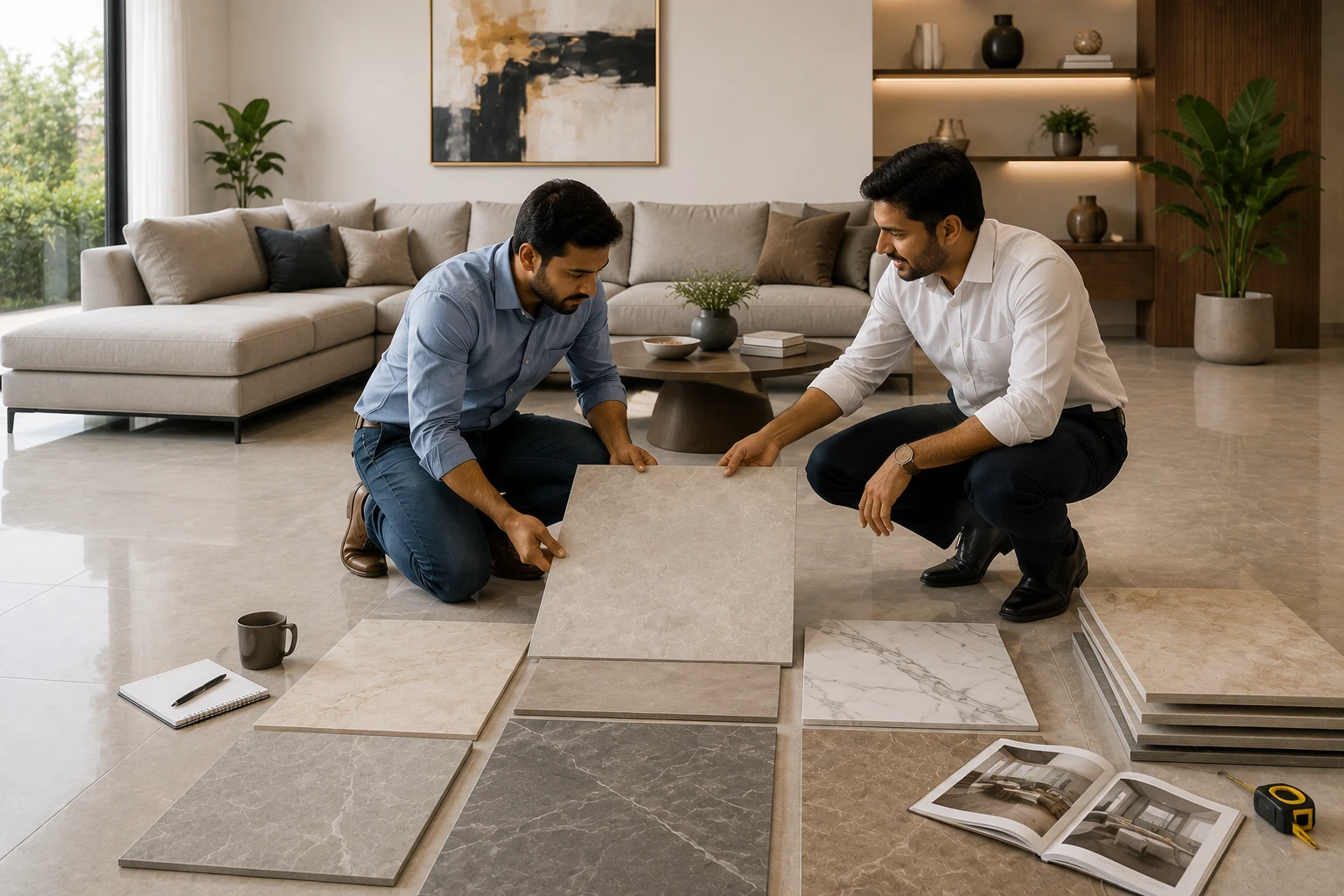
1. Test sample tiles in the actual room, not the showroom: Take at least two or three tile samples home. Lay them flat in the actual living room. Observe them in morning natural light, afternoon indirect light, and evening LED artificial light. Tile colour temperature shifts significantly between showroom halogen lighting and Indian home LED lighting. A tile that looks like warm cream in the showroom can look like cold ivory at home, or vice versa.
2. Order rectified edge tiles for any size above 600x600 mm: Rectified tiles are cut to precise dimensions, allowing 1 to 2 mm grout lines. Non-rectified tiles need 3 to 5 mm grout lines, and the living room floor reads as more segmented. For any tile above 600x600 mm (2x2) in the living room, confirm rectified edges before ordering.
3. Choose epoxy grout in the same tone as the tile: White cement grout stains in living rooms that see spills. Epoxy grout is more resistant to staining and lasts longer. A grout tone 1 to 2 shades darker than the tile colour stays clean-looking between mop cycles and avoids the discolouration that standard cement grout develops within 2 to 3 years.
4. Confirm the subbase level before specifying large format tiles: 800x1200 mm (32x48) and larger tiles crack under them when the subbase has unevenness greater than 3 mm over a 2 metre span. Have the contractor check and level the subbase before ordering large-format tiles. Replacing cracked large-format tiles is far more expensive than preparing a good subbase at the start.
5. Do not mix finishes from different tile batches: Two tiles with different production batch numbers can have slightly different sheen levels that show as inconsistency in the finished floor, especially in angled light. Order all tiles for the living room from the same production batch and confirm the batch number before taking delivery.
6. Plan the floor-to-hall tile transition before either room is tiled: If the living room and hall connect without a step, decide before either is tiled whether you want the same tile running through both spaces or a defined threshold. Running the same tile through both spaces makes the combined area feel larger. A threshold tile creates a clear definition. Either decision needs to be made before the subbase is finalised for both areas.
Common Mistakes When Choosing Living Room Floor Tiles
Using polished PGVT tiles near an entry door that gets monsoon water: Polished finish tiles are indoor dry-room tiles. When monsoon rain tracks in from outside on footwear, the polished surface becomes slippery. Use matte or GHR finish GVT tiles in any part of the living room that is within 3 to 4 ft of an entry door.
Choosing a tile colour in isolation, without checking wall and furniture tone: The most common living room tile regret in Indian homes is ordering a tile that looks right by itself but clashes with the wall colour or furniture once installed. Always test the tile against the actual room context before ordering.
Using small 600x600 mm tiles in a large living room to reduce cost: Using 2x2 tiles in a 300 sq. ft. living room creates a grid of visible grout lines that makes the room feel busy and fragmented. Investing in 600x1200 mm (2x4) or 800x1200 mm (32x48) tiles gives a dramatically cleaner floor appearance for a cost difference that is usually modest per sq. ft.
Not accounting for tile waste in the order quantity: Standard tile waste from cuts, breakage during transport, and installation runs 8 to 12% above the measured room area. Order at a minimum 10% extra from the same production batch. Getting matching replacement tiles from a different batch 18 months later is very difficult because shades and print patterns vary between production runs.
Choosing the tile based on showroom lighting alone: Showroom lighting uses bright halogens and spotlights designed to make tiles look their best. Indian home lighting, especially in living rooms with ceiling fans and standard LED panels, creates very different reflections on polished and matte surfaces. Always view samples in actual home conditions before deciding.
Ignoring the tile maintenance commitment over the chosen material: Homeowners who choose natural marble for the living room often underestimate the ongoing care. Indian marble needs sealing and pH-neutral cleaning. Italian marble needs even more frequent attention. Many homeowners switch to marble tiles on the second renovation precisely because the first round of natural marble maintenance was more than the household could manage. Choose the tile that suits the maintenance routine your household will actually follow, not the best-case scenario.
Living Room Tiles Price in India 2026
The table below gives approximate material cost ranges for floor tiles for living room use in India in 2026. All prices exclude GST (currently 18% on most tile categories) and installation. Installation adds approximately ₹30 to ₹80 per sq. ft., depending on tile size, category, and city.
| Tile Category and Type | Material Cost (per sq. ft.) | Notes |
| GVT matte / Posh / GHR finish | ₹60 to ₹150 | Most practical living room floor tile; wide design range; suits all Indian homes |
| PGVT polished (marble look, high gloss) | ₹70 to ₹150 | Dry indoor living rooms only; not for areas near entry doors exposed to the outdoors |
| Double charge vitrified | ₹70 to ₹140 | High-traffic living rooms; limited design range; strongest scratch resistance |
| Full body vitrified | ₹90 to ₹200 | Long-life living room floor; colour runs through the full tile body; good for renovation |
| Marble look GVT / PGVT (premium large format) | ₹80 to ₹250 | Marble aesthetics without natural stone maintenance; 800x1600 mm and above at the higher end |
| Wood look GVT plank (200x1200 mm, 8x48) | ₹80 to ₹180 | Warm residential living room look; no maintenance beyond standard mopping |
| Natural Indian marble (Makrana, Rajnagar, Katni) | ₹150 to ₹350 (material only) | Add ₹40 to ₹70 per sq. ft. for installation and polishing; seal before use |
| Italian marble (Botticino, Statuario standard) | ₹400 to ₹2,000+ | Luxury living rooms and formal drawing rooms; specialist installation required |
For a standard 200 sq. ft. Indian 2BHK or 3BHK living room, total floor tile project cost (material plus installation) runs from approximately ₹18,000 to ₹45,000 for GVT or PGVT options, and from ₹50,000 upward for premium large-format or natural marble choices. Always confirm GST separately with your dealer and add 10% to the tile quantity for wastage.
Choosing the Right Floor Tiles for Your Living Room
The right floor tiles for living room use in your home come from matching three things: the room's actual size and lighting, the household's real traffic level and maintenance habits, and the colour and material that works with the furniture and walls already planned.
The decision is not about which tile looks best in a showroom photograph. It is about which tile works best in the actual room, under the actual lighting, with the actual family using it every day.
Take sample tiles home. Observe them at different times of day. Confirm that the finish suits the room's entry exposure. Then compare options across GVT, PGVT, marble look, and wood look categories through TilesFinders to find living room flooring ideas from verified Indian tile suppliers that match your specific combination of size, colour, finish, and budget.

FAQs
GVT tiles in a matte, Posh, or GHR finish in 600x1200 mm (2x4) are the most practical floor tiles for living rooms in India for most households. They handle daily family traffic, need no sealing, come in the widest design range covering marble look, stone look, concrete look, and wood finish, and are available at accessible price points from ₹60 to ₹150 per sq. ft. For showcase or formal drawing rooms with lower traffic, PGVT polished tiles in a marble finish give the most refined appearance in a dry, covered room.
Matte finish tiles are better for most Indian living rooms. They are non-slip, scratch-resistant, hide everyday dust and marks better than glossy surfaces, and need mopping less frequently to look clean. Glossy or polished tiles look more impressive in photographs and reflect more light, but they show fingerprints, watermarks, and fine scratches from grit more visibly. For living rooms with children, joint family use, or any connection to an entry that gets monsoon weather, matte or Posh finish is the right choice. Glossy or PGVT polished tiles suit dry, formal living rooms with lower daily traffic.
Larger tiles make living rooms look bigger. A 600x1200 mm (2x4) tile in a 150 sq. ft. living room has half the grout lines of a 600x600 mm (2x2) tile covering the same area. The fewer grout lines there are, the more the floor reads as a continuous surface rather than a grid. For rooms above 250 sq. ft., 800x1200 mm (32x48) or 800x1600 mm (32x64) tiles give a slab-like appearance that significantly amplifies the room's perceived scale. Pair large format tiles with rectified edges and a grout colour matching the tile for the maximum seamless effect.
The leading trends in living room floor tiles design in India are large format 600x1200 mm (2x4) and 800x1600 mm (32x64) tiles with minimal grout lines, Statuario and Calacatta marble look prints in GVT and PGVT, warm greige and earthy tones replacing the earlier all-white preference, concrete and stone look GVT in grey and charcoal for contemporary urban apartments, and wood look plank tiles in open-plan family living rooms. Rectified tile edges and epoxy grout in matching tile tones are the installation choices that distinguish finished-quality floors from builder-grade work.
Start by identifying the wall colour and furniture tone already in the room or planned. Warm beige or greige tiles suit homes with warm wood furniture, brass accents, and cream or warm white walls. Light grey or white tiles suit homes with cool-toned furniture, chrome or black accents, and white walls. Dark charcoal tiles suit large rooms with white walls and modern furniture. Take at least two sample tiles home, place them flat on the floor, and observe them in the room's actual lighting at different times of day before placing any order.
Living room tiles price in India varies from approximately ₹60 to ₹150 per sq. ft. for standard GVT in matte or Posh finish, ₹70 to ₹150 for PGVT polished, and ₹80 to ₹250 for premium large format marble look tiles. Natural Indian marble costs ₹150 to ₹350 per sq. ft. for material (installation is extra). Italian marble starts at ₹400 per sq. ft. for standard grades and goes much higher for premium Statuario or Calacatta. Installation adds ₹30 to ₹60 per sq. ft. for GVT and ₹50 to ₹80 for large format tiles. All prices exclude GST, currently at 18% on most tile categories. Order 10% extra from the same batch for wastage.

See our tile guides first
Set TilesFinders as a preferred source and our buying guides surface ahead of the rest for you.
Add as preferred sourceTakes one tap. Nothing to install.
What Readers Say
I was about to redo my parking area with the wrong tile size until I read this. The layout comparisons saved me from a costly mistake.
We reference TilesFinders guides while briefing clients on material selection. The size and pattern breakdowns are accurate and easy to explain visually.
On site, I get asked about grout spacing all the time. This article gave me a solid reference I now share with my team before every job.
Finally a guide that doesn't just push generic advice. The oil stain removal steps actually worked on our clubhouse driveway tiles.
I run a small construction firm and now send this link to clients directly when they ask about entrance tile sizing. Saves me an hour of explaining.
Good practical detail, though I wish there were more examples for compact apartment entrances specifically, not just villas.
My mother-in-law wanted marble, I wanted vitrified. This blog gave us the neutral comparison we needed to actually decide together.
Detailed without being overwhelming. I appreciated that it covered both cost and maintenance, not just the aesthetics.
Used the algae and hard water removal tips on our terrace tiles after the monsoon. Worked better than what our regular cleaner was doing.
As someone who sources tiles for multiple builder projects, I find these comparisons genuinely useful for vendor conversations, not just consumer content.
Recommended this to a client who kept second-guessing the entrance design. The small vs large layout section settled the debate instantly.
Straightforward and honest, no unnecessary jargon. Would like to see a similar breakdown for outdoor pool-deck tiles next.
We've bookmarked several TilesFinders guides for our design handbook. Reliable source when clients want data, not just opinions.
Two paths, one marketplace.
Get free quotes from verified suppliers.
Share your room, budget, and style. Suppliers in local area respond within hours.
Get Free QuotesList your business, reach real buyers.
Put your showroom in front of homeowners searching for tiles right now.
List Your BusinessMore Blogs
See all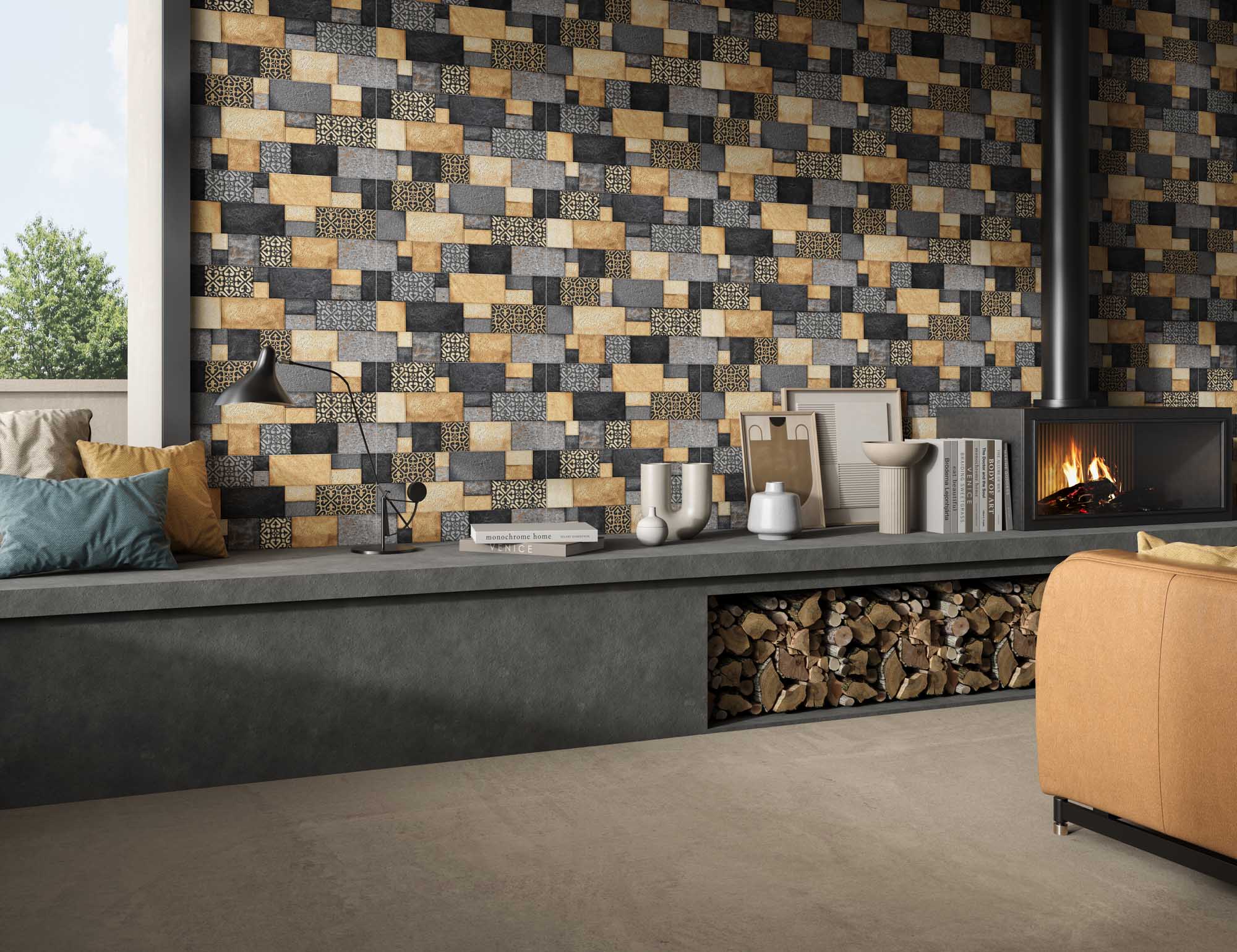
Living Room Wall & Floor Tile Combination for Modern Homes
Create a cohesive living room with expert tile combinations. Explore seamless floor-to-wall looks...
Read More
Best Living Room Tiles in Mumbai: Designs, Price & Where to Buy in 2027
A 2027 guide to living room tiles in Mumbai. Discover large-format trends, local pricing (₹35–₹22...
Read More
Abstract Tile Design Ideas: 20+ Artistic Patterns for Indian Living Rooms and Bathrooms
Explore 20+ abstract tile ideas for Indian living rooms and bathrooms, including feature walls, t...
Read More