Best Tiles for Schools in India: Material, Design and Durability Guide
Sourcing school flooring? Compare the best safety tiles for Indian schools based on real R-ratings and PEI durability classes across classrooms, stairs, and washrooms.
- The Two Numbers That Matter More Than Brand Name
- Zone-by-Zone Tile Recommendations
- Material Comparison at a Glance
- Design Considerations Beyond Safety
- The Real Cost Question: Lifecycle, Not Just Purchase Price
- Budgeting by School Type
- Common Mistakes in School Tile Specification
- Specification Checklist for Procurement Committees
- Sourcing Compliant Tiles for a School Project
The right school tile depends on the zone: PEI 4-5, R9 vitrified for classrooms and corridors, R10-R11 anti-skid for washrooms and canteens, with full-body vitrified paying back its higher upfront cost over a 15 to 20 year lifespan.
Most guides to school flooring stop at a generic recommendation: choose anti-skid, choose vitrified, choose something durable. None of that is wrong, but it is not specific enough to actually act on, since a school building has at least six functionally different flooring zones, each with a different real risk profile, from a dry classroom to a wet washroom to an outdoor covered walkway that floods every monsoon.
This guide is built around the standards that actually govern tile safety and durability, slip resistance R-ratings and PEI abrasion classes, mapped zone by zone across a typical Indian school building, with realistic installed and lifecycle costs so a procurement decision can be made on total cost of ownership rather than the lowest quote per box.
The Two Numbers That Matter More Than Brand Name
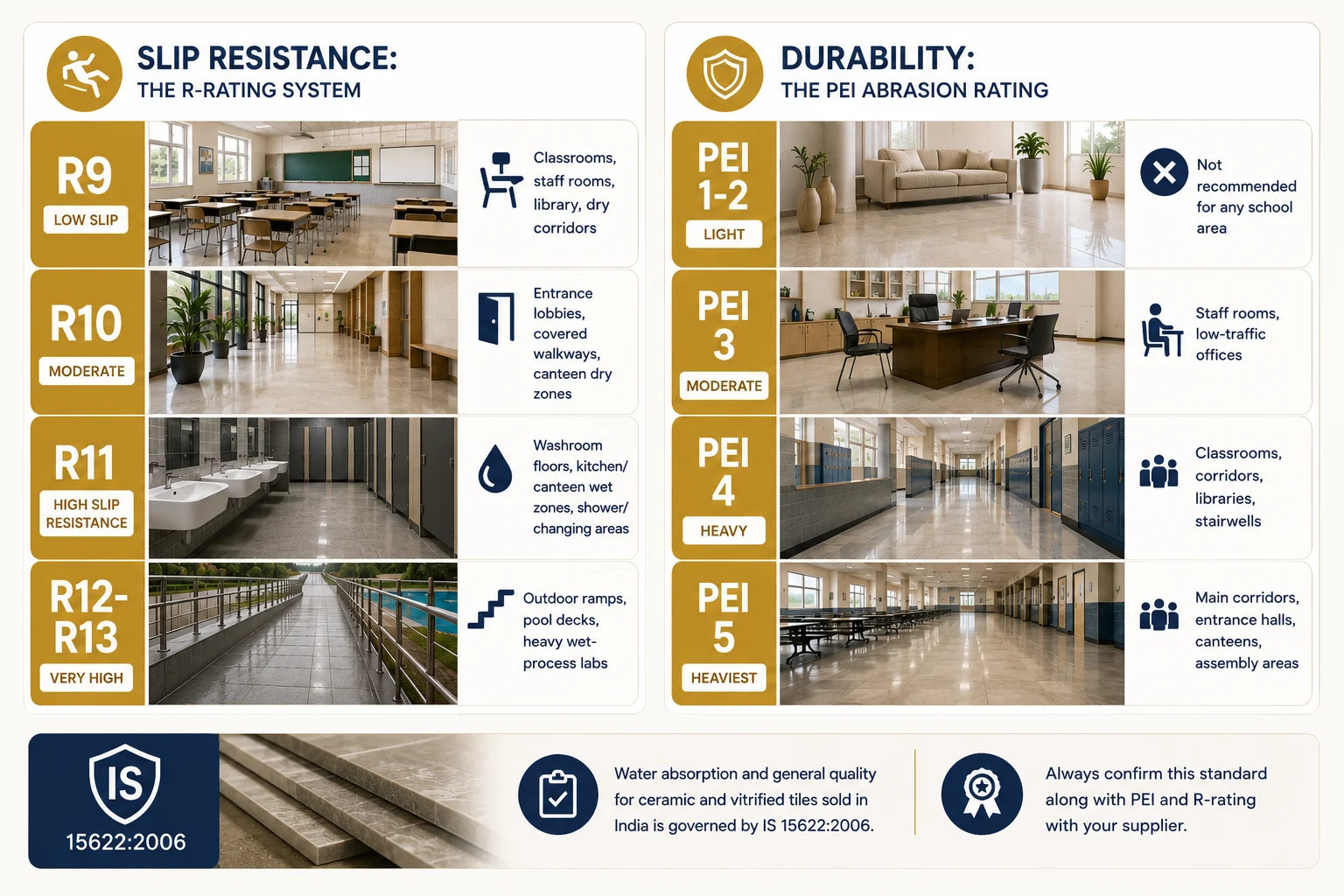
Before comparing tile types, it helps to understand the two ratings that actually determine whether a tile is safe and durable enough for a school, since neither shows up prominently in most retail tile marketing.
Slip Resistance: The R-Rating System
Slip resistance for tiles is most widely measured using the R-rating system (R9 through R13), based on a ramp test that measures the angle at which a test surface becomes unsafe to walk on when wet. Higher numbers mean better grip. Indian manufacturers increasingly quote this rating for anti-skid ranges, and it is worth asking for by name rather than accepting a vague "anti-skid" label with no number attached.
| R Rating | Slip Resistance Level | Where It Belongs in a School |
| R9 | Low-slip, suitable for mostly dry areas | Classrooms, staff rooms, library, dry corridors |
| R10 | Moderate slip resistance | Entrance lobbies, covered walkways, canteen dry zones |
| R11 | High slip resistance, for regularly wet areas | Washroom floors, kitchen/canteen wet zones, shower/changing areas |
| R12-R13 | Very high, industrial-grade slip resistance | Outdoor ramps, pool decks, heavy wet-process labs |
Durability: The PEI Abrasion Rating
PEI (Porcelain Enamel Institute) rating measures how well a tile's surface resists wear from foot traffic, on a scale of 1 to 5. This matters enormously for schools specifically, since a corridor used by hundreds of students daily for a decade will expose a tile's surface to far more cumulative abrasion than a typical home floor ever sees.
| PEI Class | Abrasion Resistance Level | Suitable School Zones |
| PEI 1-2 | Light residential traffic only | Not recommended for any school area |
| PEI 3 | Moderate residential and light commercial traffic | Staff rooms, low-traffic offices |
| PEI 4 | Heavy commercial traffic | Classrooms, corridors, libraries, stairwells |
| PEI 5 | Heaviest commercial and institutional traffic | Main corridors, entrance halls, canteens, assembly areas |
Water absorption and general quality for ceramic and vitrified tiles sold in India is also governed by IS 15622:2006, worth confirming with any supplier alongside the PEI and slip ratings above.
Zone-by-Zone Tile Recommendations
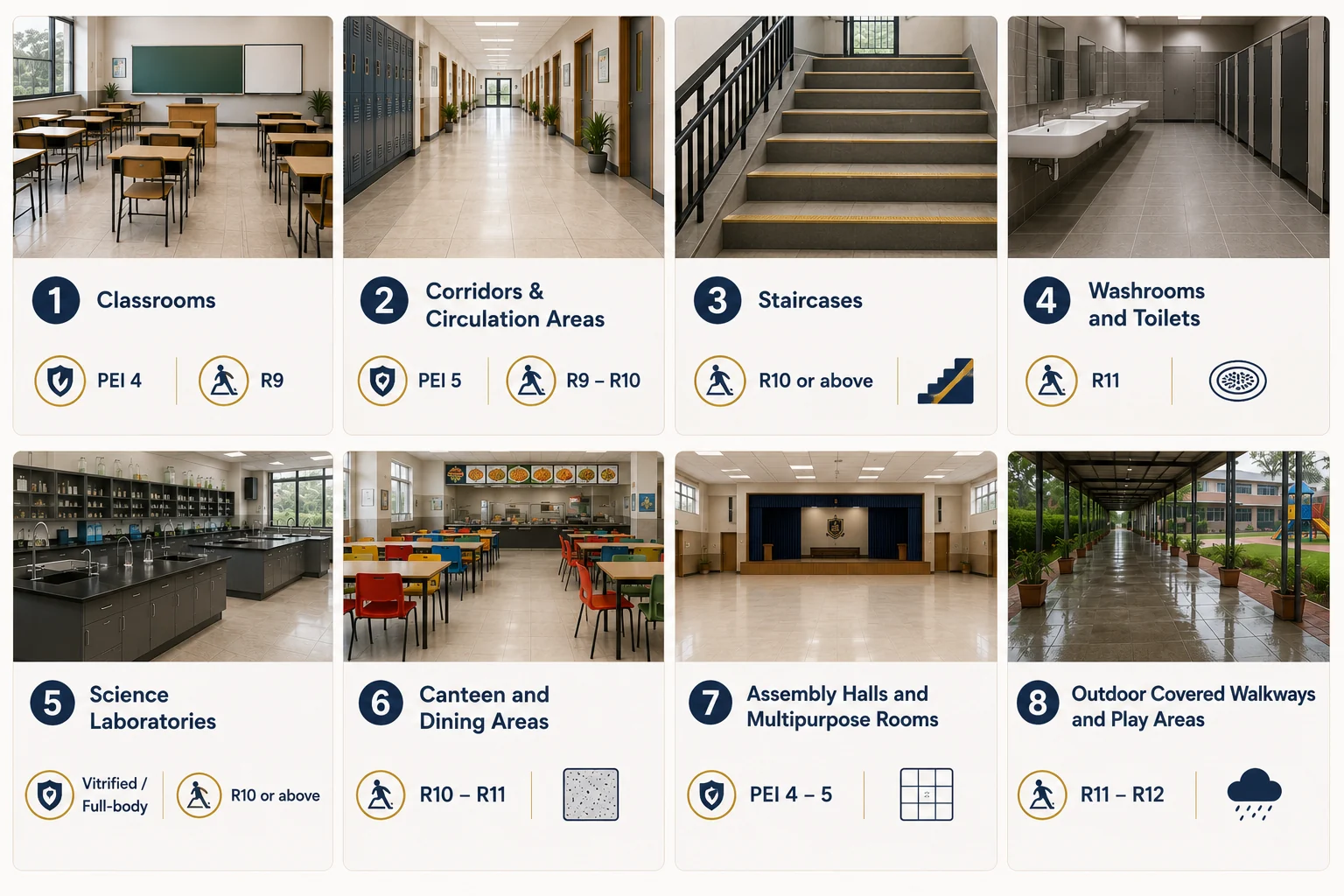
A school is not one flooring decision; it is several, and treating every zone the same, usually by defaulting to whatever tile is cheapest at bulk order volume, is where most avoidable slip injuries and premature floor replacement actually originate.
Classrooms
Mostly dry, moderate foot traffic, but constant chair and desk movement. A PEI 4 vitrified tile with an R9 rating is generally sufficient, and a matte or satin finish, rather than high-gloss, both hides scuff marks better and reduces glare under classroom lighting and projector use.
Corridors and Circulation Areas
The highest cumulative foot traffic in the building, with hundreds of students moving through in short bursts between periods. PEI 5 vitrified tiles are worth the premium here specifically because corridor floors wear faster than any other zone, and an R9 to R10 rating covers both dry stretches and sections near entrances that track in rainwater.
Staircases
Needs a higher slip rating than flat corridors, generally R10 or above, paired with a contrasting nosing strip on each step edge. This detail matters disproportionately for younger children moving quickly between classes, where a visually distinct step edge measurably reduces trip risk.
Washrooms and Toilets
Consistently wet for extended periods and among the highest fall-risk zones in any school. R11 anti-skid tiles are the appropriate baseline here, not R9, and floor gradients toward drains should be confirmed as part of the installation, not left to the tile alone to compensate for standing water.
Science Laboratories
Beyond slip resistance, lab floors need chemical and stain resistance, since minor spills are routine. A dense, low-porosity vitrified or full-body vitrified tile with at least an R10 rating handles both concerns better than standard ceramic, which can stain or etch under repeated chemical contact.
Canteen and Dining Areas
Food spills, tray drops, and cleaning-water exposure make this a genuine wet zone despite feeling like an indoor dry space. R10 to R11 anti-skid vitrified tiles, in a tone that does not show every crumb and stain immediately, are the practical combination here.
Assembly Halls and Multipurpose Rooms
Large, open, high-traffic during events but otherwise moderate daily use. PEI 4-5 vitrified in a large format reduces grout lines across a big open floor, which both looks better for assemblies and events and simplifies cleaning.
Outdoor Covered Walkways and Play Areas
Directly exposed to monsoon rain and constant running feet. R11 to R12 rated, full-body vitrified or specifically exterior-rated anti-skid tiles are necessary here, since standard indoor-rated tiles, even matte ones, are not built for sustained outdoor wet-weather exposure.
Material Comparison at a Glance
Bringing the zone-specific requirements above together, here is how the main flooring material categories stack up on the two ratings that matter most, along with realistic cost and upkeep.
| Material | Durability (PEI) | Slip Options | Approx. Cost/sq ft | Maintenance |
| Vitrified (GVT/PGVT) | PEI 4-5 | R9 to R11 available | Rs. 40-120 | Low, easy wipe-clean |
| Full-body vitrified | PEI 5 | R10-R11 common | Rs. 60-180 | Low, colour holds under wear |
| Ceramic (glazed) | PEI 3-4 | R9-R10 | Rs. 25-70 | Low to moderate |
| Anti-skid porcelain | PEI 4-5 | R10-R13 | Rs. 45-140 | Low, textured surface needs more scrubbing |
| Kota/natural stone | PEI 4 (varies) | Moderate, needs treatment | Rs. 40-100 | Higher, needs periodic sealing |
| Vinyl/rubber flooring | N/A, separate wear rating | Good, cushioned | Rs. 60-150 | Moderate, avoid harsh chemicals |
Design Considerations Beyond Safety
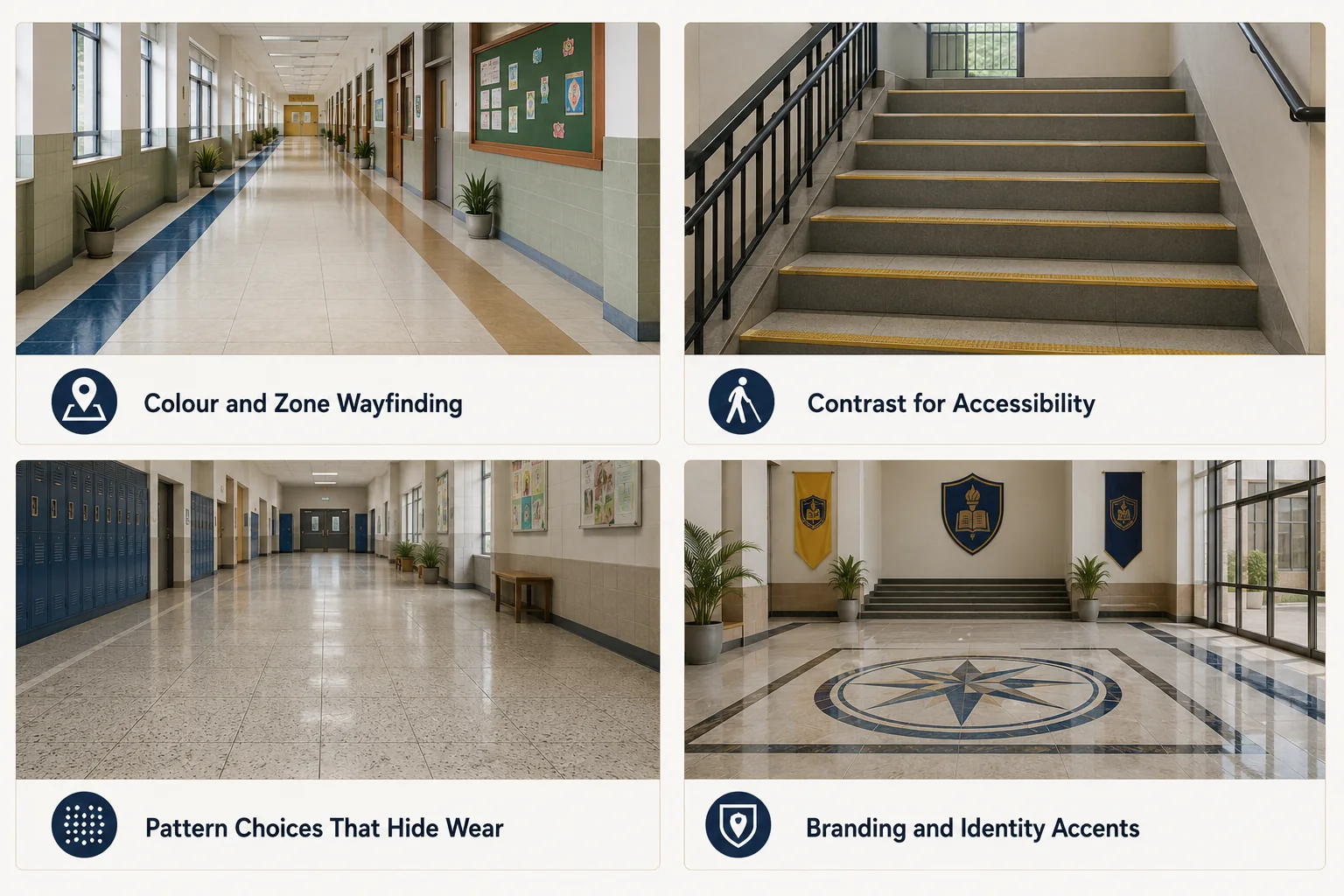
Once slip resistance and durability are settled, design choices still meaningfully affect how a school functions day to day, not just how it looks in a brochure photo.
Colour and Zone Wayfinding
Assigning a distinct floor tone or accent border to each wing, primary versus senior secondary, for instance, helps younger children navigate a large campus independently and reduces the everyday congestion of students asking for directions between periods.
Contrast for Accessibility
A visually distinct strip at staircase edges and doorway thresholds benefits every student, but is especially important for children with low vision. This is a low-cost design addition, typically a contrasting accent tile or nosing strip, with a genuine safety payoff.
Pattern Choices That Hide Wear
A subtly textured or lightly speckled tile design hides scuff marks, dust, and minor staining far better than a plain solid colour, particularly in corridors and classrooms where daily cleaning may not happen between every period.
Branding and Identity Accents
Many schools now use accent tiles, in a house colour or a simple geometric motif, at entrances and assembly areas to reinforce institutional identity, a detail competitor guides rarely mention but one procurement committee increasingly ask about.
The Real Cost Question: Lifecycle, Not Just Purchase Price
The single biggest gap in most school flooring advice is stopping at the installed price per square foot. A cheaper ceramic tile that needs replacing in seven years, across an entire corridor system, almost always costs more over a 10 to 15 year horizon than a vitrified tile priced higher at installation.
| Material | Install Cost/sq ft | Expected Lifespan | 10-Year Cost Estimate/sq ft |
| Ceramic (glazed) | Rs. 45-90 | 6-9 years | Rs. 75-160, incl. one replacement cycle |
| Vitrified (GVT) | Rs. 65-140 | 12-18 years | Rs. 70-150, no replacement needed |
| Full-body vitrified | Rs. 90-200 | 20+ years | Rs. 95-210, minimal upkeep |
| Kota/natural stone | Rs. 70-140 | 15-20 years with sealing | Rs. 110-220, incl. periodic sealing cost |
| Vinyl/rubber | Rs. 80-170 | 8-12 years | Rs. 130-260, incl. one replacement cycle |
Figures are indicative market estimates for budgeting purposes, not fixed quotes. Actual costs vary by city, order volume, and finish.
Budgeting by School Type
Government and budget-constrained private schools understandably prioritise upfront cost, but the zone-based approach in this guide still applies: spend the available budget on PEI 5 anti-skid tiles specifically in washrooms and staircases, the two highest-injury-risk zones, even if classrooms and corridors use a more economical PEI 4 ceramic option to stay within budget.
Premium private schools with a longer capital planning horizon generally see better value specifying full-body vitrified across all high-traffic zones from the outset, since the higher upfront cost is repaid within a single replacement cycle avoided over 15 to 20 years.
Common Mistakes in School Tile Specification
- Specifying the same tile for the entire building regardless of how wet or high-traffic each zone actually is
- Choosing a tile based on slip resistance marketing language without confirming an actual R-rating number
- Ignoring PEI rating entirely and selecting based on price and appearance alone
- Using a high-gloss finish on any floor a young child will run across, regardless of slip rating
- Skipping a contrasting nosing strip on staircases to save a marginal cost
- Comparing only the tile's purchase price rather than a realistic lifecycle cost over a decade or more
Specification Checklist for Procurement Committees
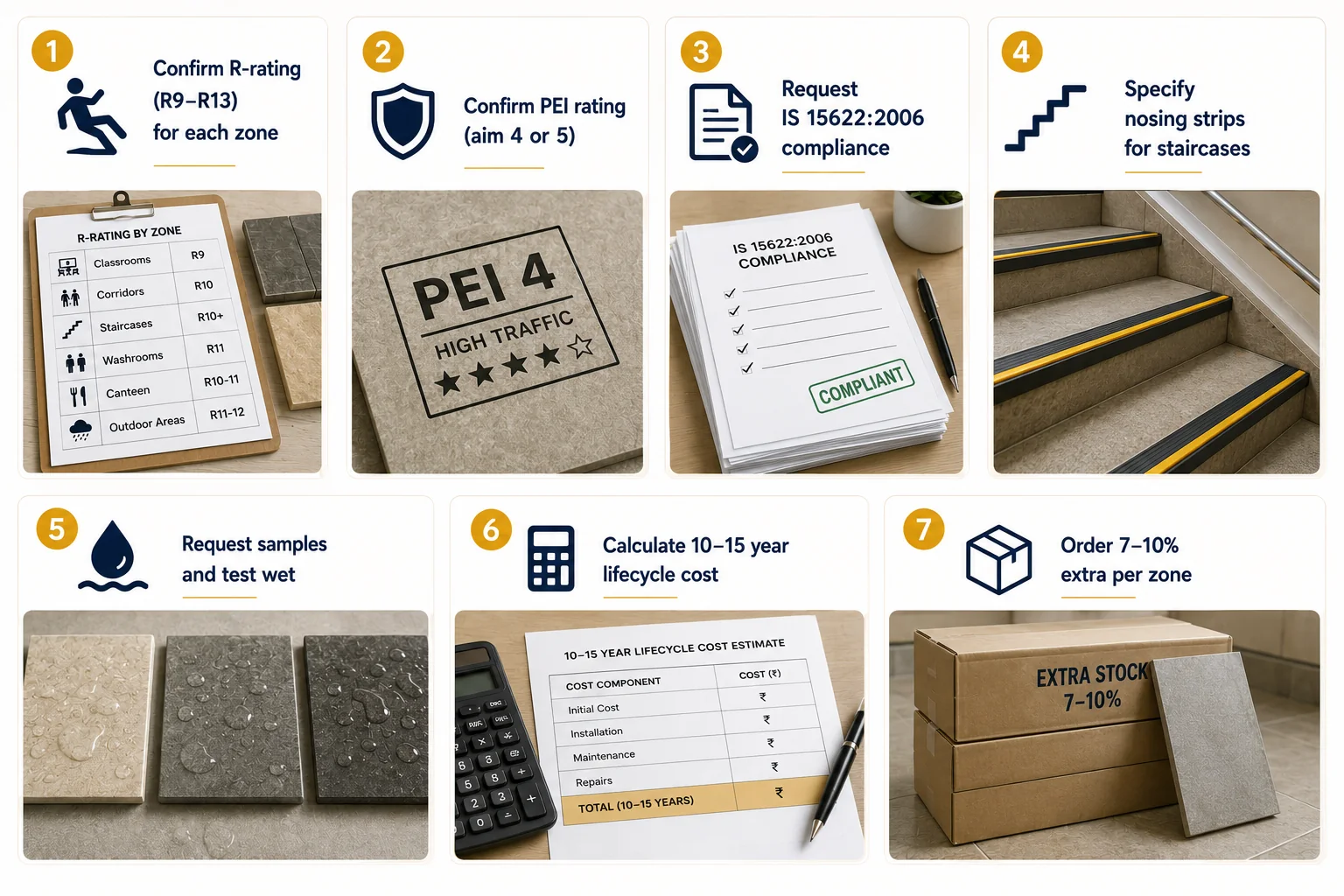
- Confirm the R-rating (R9 to R13) for every zone separately, not one blanket rating for the whole building
- Confirm the PEI rating (aim for 4 or 5) for all high-traffic indoor zones
- Request IS 15622:2006 compliance documentation from the supplier
- Specify contrasting nosing strips for every staircase as a line item, not an afterthought
- Request physical samples and test them wet, not just dry, before finalising an order
- Calculate a 10 to 15 year lifecycle cost estimate alongside the upfront quote before comparing suppliers
- Order 7 to 10 percent extra tile per zone to allow for future repairs without a shade mismatch
Sourcing Compliant Tiles for a School Project
Specifying the right R-rating and PEI class per zone is only half the job; the other half is finding suppliers who can actually confirm and document those ratings rather than simply calling a tile "anti-skid" with no number behind it. TilesFinders lists verified tile suppliers across India, filterable by finish and category, which is a reasonable starting point for a procurement committee comparing options zone by zone rather than buying one tile for the whole building.
FAQs
Vitrified tiles with a PEI 4 or higher abrasion rating and an R9 slip rating are generally the best fit for classrooms, since they combine low maintenance, colour consistency under years of chair and desk movement, and adequate grip for a mostly dry indoor space.
Anti-skid ceramic or vitrified tiles rated R10 or R11 are recommended for school washroom floors, since these areas are wet for extended periods during the day and see heavy student traffic between classes.
R9 is generally adequate for covered, mostly dry corridors, but R10 is safer for entrance lobbies, covered walkways exposed to rain, or any corridor near a washroom or canteen where water tracking is common.
For most school zones, yes. Vitrified tiles have lower water absorption and a higher PEI abrasion rating than standard ceramic tiles, meaning they hold up better under the sustained heavy foot traffic a school floor experiences daily for a decade or more.
Costs vary enormously with school size and material choice, but using a blended estimate of Rs. 55 to Rs. 130 per square foot installed across classrooms, corridors, and common areas, a mid-sized school of around 40,000 square feet of flooring would typically budget between Rs. 22 lakh and Rs. 52 lakh for the tiling work alone, excluding washroom and kitchen zones which often cost more per square foot.
PEI (Porcelain Enamel Institute) rating measures a tile's resistance to surface abrasion on a scale of 1 to 5. Schools should specify PEI 4 or 5 for nearly all indoor zones, since anything lower is rated for light residential use and will visibly wear within a few years under constant student foot traffic.
Many newer school designs use colour or pattern coding, for instance a distinct floor tone for primary versus senior wings, or a contrasting colour strip marking staircase edges, both to aid wayfinding for younger children and to support visually impaired students moving through the building.
Anti-skid and textured tiles typically cost slightly more than an equivalent smooth-finish tile in the same size and brand, generally a 10 to 20 percent premium, which is a reasonable tradeoff for the fall-risk reduction in high-traffic wet zones like washrooms and canteens.
Staircases need a higher slip rating than flat corridors, generally R10 or above, along with a contrasting nosing strip on each step edge, a detail that meaningfully reduces trip and fall risk for young children moving quickly between classes.
With a properly specified vitrified or full-body vitrified tile at PEI 4 or 5, school floors in high-traffic zones can reasonably last 15 to 20 years before replacement, compared to 6 to 9 years for a lower-grade ceramic tile under the same daily traffic volume.

See our tile guides first
Set TilesFinders as a preferred source and our buying guides surface ahead of the rest for you.
Add as preferred sourceTakes one tap. Nothing to install.
What Readers Say
I was about to redo my parking area with the wrong tile size until I read this. The layout comparisons saved me from a costly mistake.
We reference TilesFinders guides while briefing clients on material selection. The size and pattern breakdowns are accurate and easy to explain visually.
On site, I get asked about grout spacing all the time. This article gave me a solid reference I now share with my team before every job.
Finally a guide that doesn't just push generic advice. The oil stain removal steps actually worked on our clubhouse driveway tiles.
I run a small construction firm and now send this link to clients directly when they ask about entrance tile sizing. Saves me an hour of explaining.
Good practical detail, though I wish there were more examples for compact apartment entrances specifically, not just villas.
My mother-in-law wanted marble, I wanted vitrified. This blog gave us the neutral comparison we needed to actually decide together.
Detailed without being overwhelming. I appreciated that it covered both cost and maintenance, not just the aesthetics.
Used the algae and hard water removal tips on our terrace tiles after the monsoon. Worked better than what our regular cleaner was doing.
As someone who sources tiles for multiple builder projects, I find these comparisons genuinely useful for vendor conversations, not just consumer content.
Recommended this to a client who kept second-guessing the entrance design. The small vs large layout section settled the debate instantly.
Straightforward and honest, no unnecessary jargon. Would like to see a similar breakdown for outdoor pool-deck tiles next.
We've bookmarked several TilesFinders guides for our design handbook. Reliable source when clients want data, not just opinions.
Two paths, one marketplace.
Get free quotes from verified suppliers.
Share your room, budget, and style. Suppliers in Morbi respond within hours.
Get Free QuotesList your business, reach real buyers.
Put your showroom in front of homeowners searching for tiles right now.
List Your Business