Best Kitchen Tiles in Chennai: Designs, Price and Where to Buy in 2027
A 2027 guide to Chennai kitchen tiles. Discover low-absorption matte & full-body vitrified options built for daily mopping, along with 2027 pricing (₹30–₹180/sq ft) and top tile hubs.
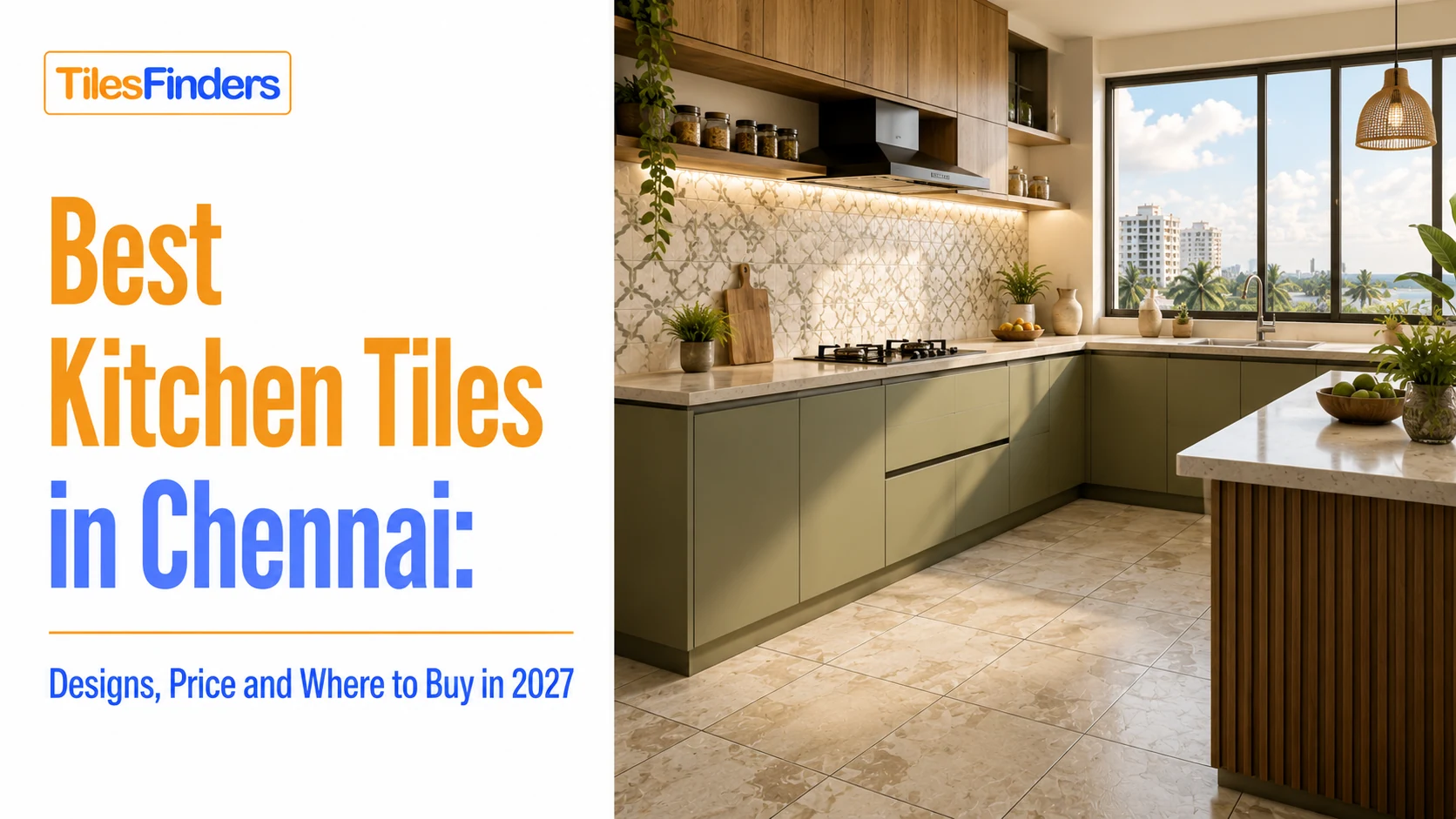
- Why a Chennai Kitchen Floor Sees So Much Water
- The Kolam Threshold: A Small Detail With Real Tile Implications
- What This Means for Floor Tile Choice
- The Backsplash and Wall Zone
- Design Directions for Chennai Kitchens in 2027
- What a Chennai Kitchen Actually Costs in 2027
- Where to Buy Kitchen Tiles in Chennai
- Keeping a Frequently Mopped Floor Looking Right
- Explore Kitchen Tile Options
Daily wet mopping and the kolam tradition at many Chennai kitchen thresholds mean floor tiles face more repeated water exposure than climate alone suggests, making near-zero absorption matte tile the practical 2027 pick, at Rs. 30 to Rs. 180 per sq ft.
Most guides to kitchen tiles talk about climate, water hardness, or oil splatter. In Chennai, there is another factor that matters just as much and rarely gets mentioned, how the floor actually gets used day to day. A Tamil household's kitchen floor gets wet mopped more often, and with more ritual attached to the practice, than in most Indian homes, and that daily habit puts more cumulative water through the same few square feet of tile than climate alone would explain.
Why a Chennai Kitchen Floor Sees So Much Water
Wet mopping the kitchen floor once or twice a day, sometimes more during festivals, is a standard part of housekeeping in a large share of Tamil homes, tied closely to ideas of cleanliness and ritual purity around the cooking space. Pongal, the Tamil harvest festival, traditionally involves a thorough cleaning of the kitchen and the area just outside it before the new pot of rice is boiled, and this kind of periodic deep clean sits on top of the routine daily mopping most households already do. None of this is unique to any one home; it is a broadly shared cultural habit across the state, and it means a Chennai kitchen floor spends more of its life wet than a dry climate calculation alone would suggest.
This matters because water absorption and drying speed become a bigger factor here than in a kitchen that only gets mopped occasionally. A tile that dries slowly between mopping sessions stays damp longer, which affects grip underfoot and, over years, can allow more moisture to work into grout lines that see this cycle repeated daily rather than weekly.
It is worth being clear that this is a difference of degree rather than an entirely different requirement. Every Indian kitchen floor needs a reasonably water-resistant tile, and nothing here suggests Chennai kitchens need some exotic category unavailable elsewhere. The point is narrower and more practical: within the normal range of vitrified and porcelain options, a household that mops daily gets more real-world benefit from choosing toward the lower end of the water absorption scale than a household that mops twice a week, even if both are shopping from the same showroom shelf.
The Kolam Threshold: A Small Detail With Real Tile Implications
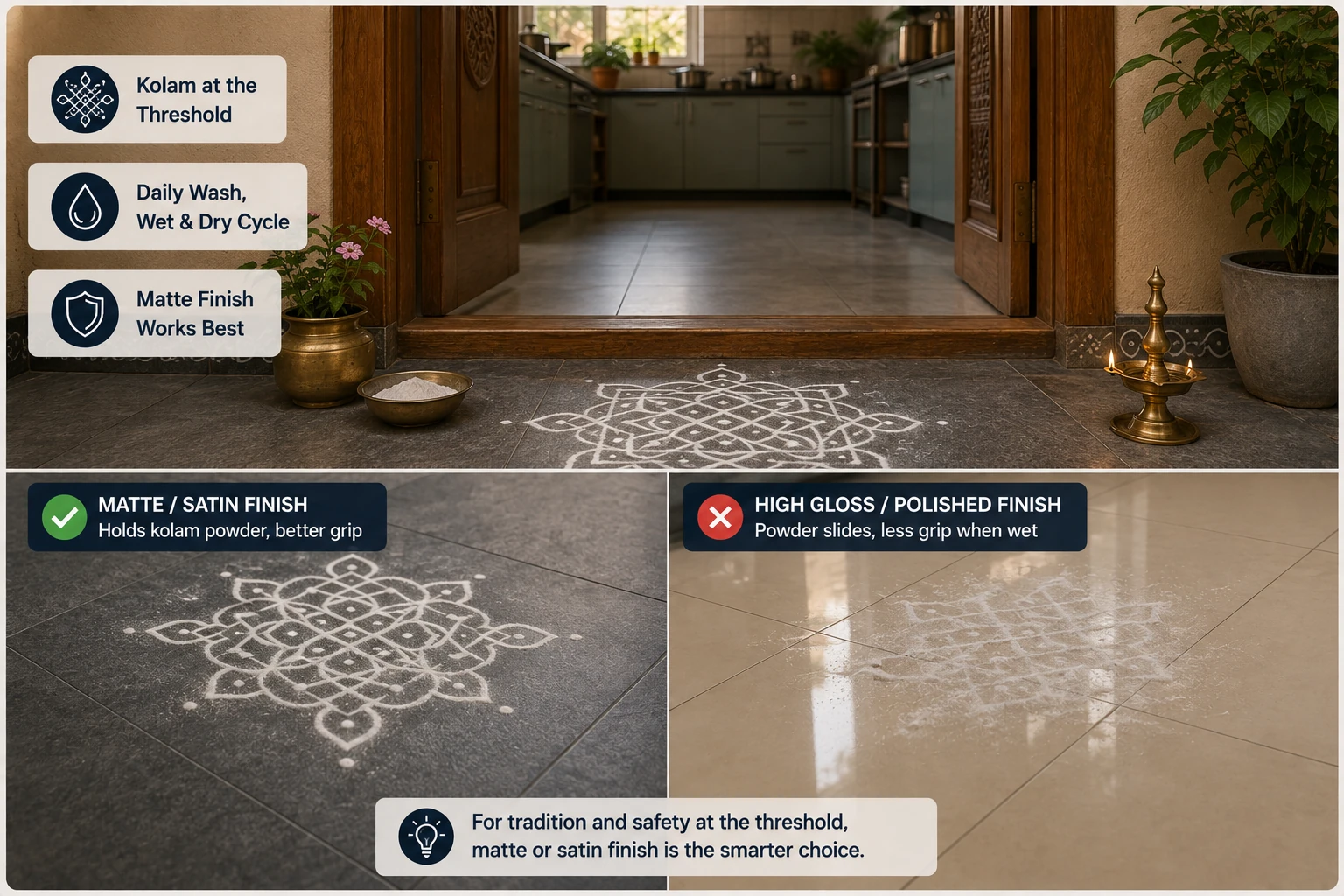
Kolam, the geometric rice flour design drawn at the threshold of Tamil homes each morning, is one of the most recognisable everyday traditions in the state, and it is relevant here for a practical reason rather than a decorative one. Many households, particularly older or more traditional ones, wash the entrance area before drawing the kolam, and in homes where the kitchen door or a kitchen-adjacent threshold doubles as a kolam spot, this adds one more daily wet and dry cycle to that specific patch of floor.
A highly glossy or polished tile does not hold rice flour or kolam powder well, since the fine powder tends to slide rather than sit in place the way it does on a slightly textured, matte surface. Households that maintain this tradition regularly are usually better served by a matte or satin finish at the kitchen threshold specifically, both for the practical reason of getting the kolam to hold and for the same anti-skid benefit that matters on any repeatedly wet section of floor.
From The Marketplace
Popular tiles right now
-a7bc331f-ba60-41ce-834f-5a1d0c7ac3b1.jpg)
-54305345-d67d-458d-88e8-493199951e92.jpg)
-2cf0c368-3677-4860-a12f-ab5f1ba1a963.jpg)
-17d8f441-13a9-44fe-b5a0-5fc5de7baac4.jpg)
-63e34e37-2cd9-4464-8048-20c4fd97d70a.jpg)
-4a5a3ada-af65-4c38-8990-eaf70829c59b.jpg)
-039c8fa9-2a2c-482f-9482-da1f0679a179.jpg)
What This Means for Floor Tile Choice
Given how often the floor gets wet, a genuinely low water absorption tile matters more in a Chennai kitchen than the general Indian guidance on kitchen flooring usually emphasises. Full-body vitrified tiles, with water absorption below 0.5 percent under IS 15622, dry faster and resist the gradual grout wear that comes from daily rather than occasional mopping. A matte or satin anti-skid finish is the safer choice across the whole kitchen floor, not only at the entrance, since the combination of cooking oil, splashed water, and frequent mopping makes a glossy surface meaningfully more slippery here than in a kitchen that sees lighter use.
Grout deserves the same attention it gets in any frequently wet space. Epoxy or polymer-modified grout holds up far better against daily water contact than standard cement grout, which tends to show wear, discolouration, and eventually crumbling at the joints noticeably sooner in a kitchen mopped this often.
The Backsplash and Wall Zone
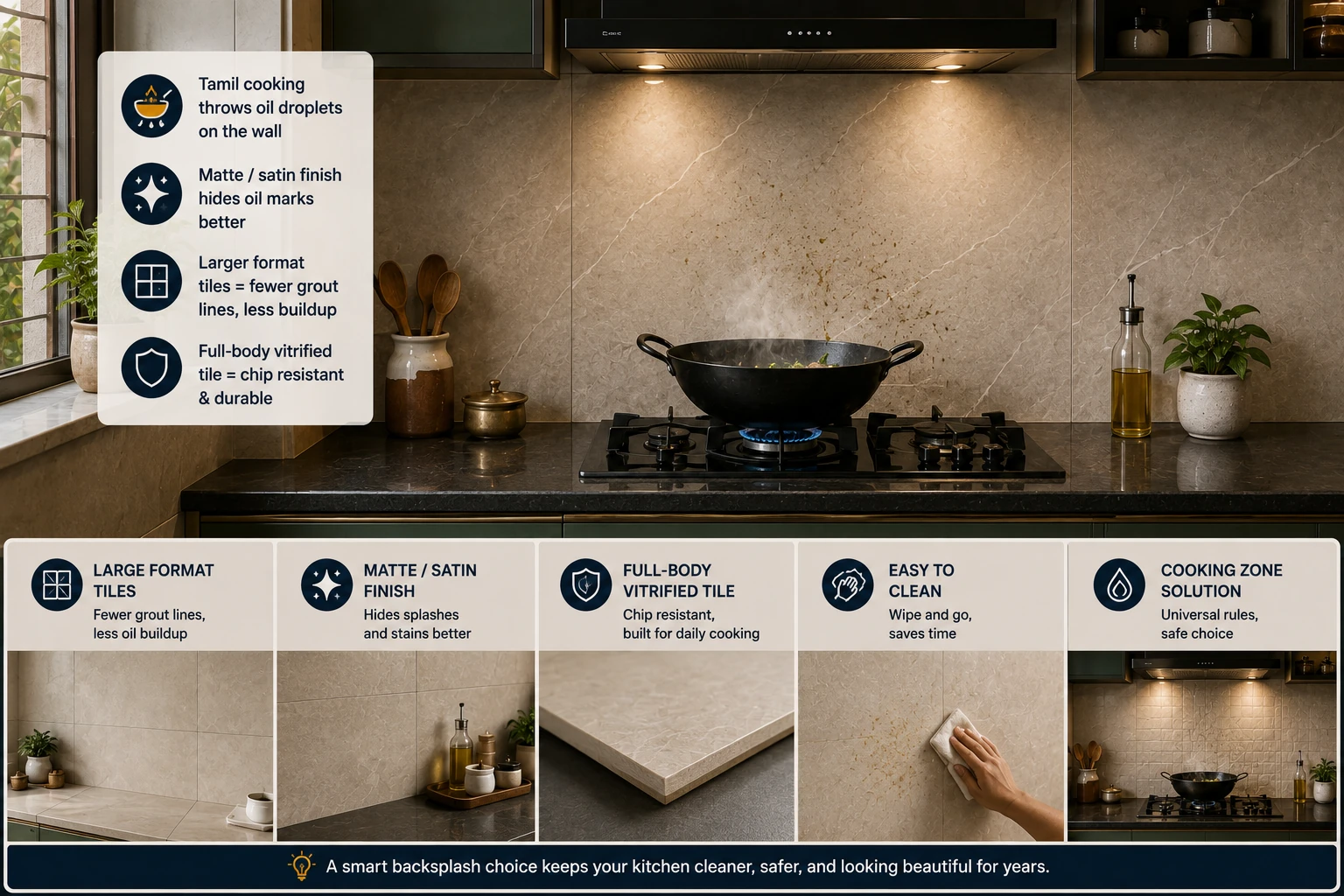
Tamil cooking leans heavily on tempering, mustard seeds and curry leaves dropped into hot oil at the start of most dishes, which throws fine oil droplets onto the wall behind the stove in the same way this happens in most Indian kitchens. A matte or satin finish behind the hob hides these marks better than a glossy one, and a larger format tile with fewer grout lines in this specific zone keeps oil from collecting in the joints the way it would across a wall tiled with many smaller pieces. This part of the kitchen answers to a fairly universal set of rules rather than anything unique to Chennai, so a full-body vitrified tile directly behind the stove, chosen mainly for chip resistance under daily cooking, is a safe default.
Design Directions for Chennai Kitchens in 2027
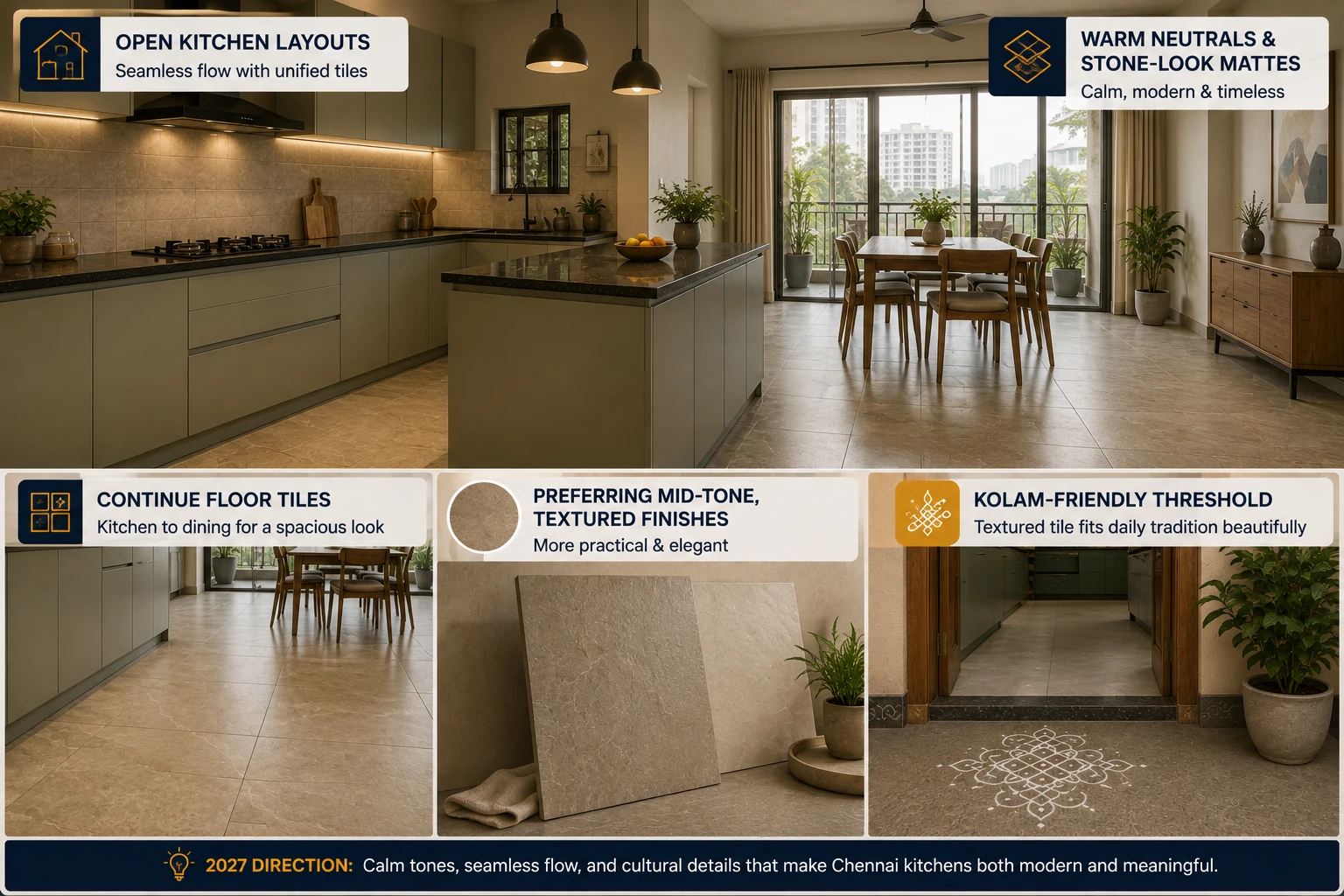
Open kitchen layouts, once mostly seen in independent houses, are increasingly common in the apartment developments along OMR and Sholinganallur, which has pushed more homeowners to continue the kitchen floor tile into the adjoining dining space rather than treating the kitchen as a separate room. Warm neutral tones and stone-look matte finishes are edging out the brighter, more colourful kitchen tile combinations common a few years ago, giving these open layouts a calmer, more unified look against the rest of the home.
A textured, mid-tone tile at the kitchen threshold, sized to comfortably fit a small kolam without needing to be drawn across a grout-heavy joint pattern, is a detail some homeowners are now specifying directly with their tile dealer or interior designer, particularly in independent houses where the kolam tradition remains a strong daily habit rather than an occasional festival practice.
What a Chennai Kitchen Actually Costs in 2027
| Tile Use | Price Range (Rs/sq ft) | Notes |
| Ceramic backsplash | Rs. 30 to Rs. 65 | Budget friendly, dry zone use |
| Porcelain floor (matte) | Rs. 55 to Rs. 110 | Good grip, moderate absorption |
| Full body vitrified floor | Rs. 80 to Rs. 160 | Best for daily wet mopping, low absorption |
| GVT backsplash (slab style) | Rs. 70 to Rs. 180 | Fewer grout lines, easier upkeep |
For a typical 90 to 110 square foot Chennai kitchen with a full body vitrified matte floor and a mid-range GVT backsplash, material costs generally land around Rs. 11,000 to Rs. 24,000, before installation and any epoxy grout upgrade, which is worth the modest added cost given how often the floor gets cleaned.
Where to Buy Kitchen Tiles in Chennai
Egmore remains the city's densest tile shopping stretch, with multiple brand display centres along Ethiraj Salai, Montieth Road, and Anna Salai carrying both backsplash and flooring ranges suited to daily heavy use. Vadapalani and OMR serve the IT corridor and its growing number of open kitchen apartment layouts, while Tambaram, Madipakkam, and Kovilambakkam remain a solid option for South and South West Chennai homeowners handling full kitchen renovations. It is worth mentioning the daily mopping habit directly to a dealer when discussing options, since this shifts the recommendation toward a genuinely low absorption range rather than a mid-grade tile that looks similar on the showroom floor but is not built for the same frequency of water contact.
For builders or gated community projects fitting out kitchens across many units, sourcing matching full body vitrified flooring directly from Morbi manufacturers through a supplier platform such as TilesFinders keeps batch shade consistent across a large project and typically costs less than buying the same volume through Chennai retail.
Keeping a Frequently Mopped Floor Looking Right
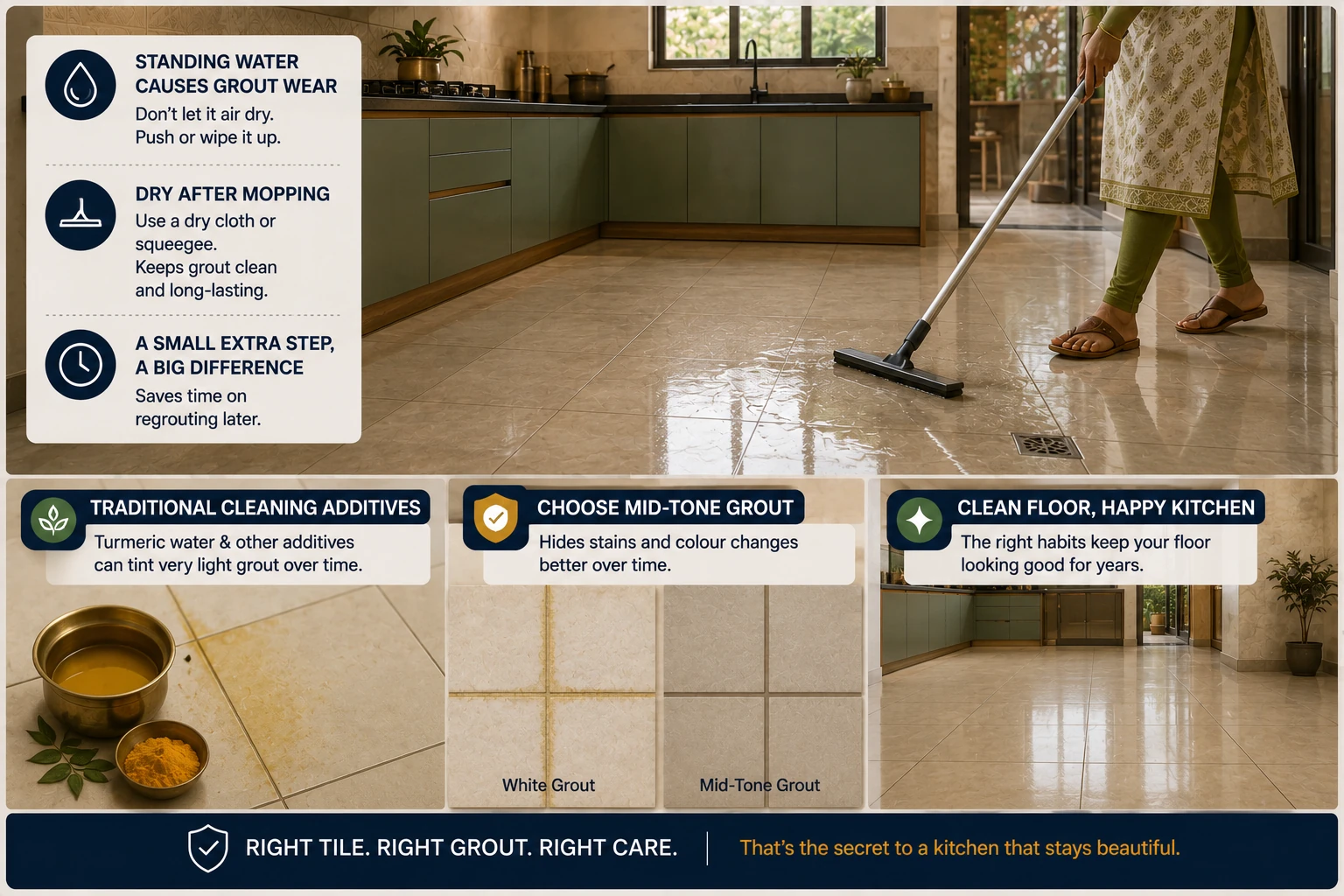
Choosing the right tile and grout only covers half the picture in a kitchen that gets this much routine water contact. Standing water left to air dry after mopping, rather than being pushed toward a floor drain or wiped up while still fresh, is what actually causes most of the long-term grout wear in a heavily used Tamil kitchen, more than the mopping itself. A quick pass with a dry cloth or squeegee after mopping, rather than letting the floor air dry on its own, meaningfully extends how long grout lines stay clean and intact between full regrouting jobs.
Households using turmeric water or other traditional cleaning additives as part of the mopping routine should be aware that some of these can leave a faint tint on very light coloured grout over time, similar to the staining issue seen in pooja rooms elsewhere in the house. A mid-tone grout, rather than stark white, hides this gradual change far longer and suits a frequently used kitchen floor better regardless of what specific cleaning routine a household follows.
Explore Kitchen Tile Options
Getting a Chennai kitchen right starts with accounting for how often the floor actually gets wet, daily mopping and, in many homes, the kolam tradition, rather than climate alone. If you are planning a kitchen renovation or sourcing in bulk for a builder project, TilesFinders connects you with verified Chennai dealers and Morbi manufacturers to explore current options and place an informed order.
FAQs
The climate difference is modest, but the usage pattern is not. Frequent daily wet mopping, common in Tamil households, puts more cumulative water through the floor than in cities where kitchens are mopped less often, which makes low absorption and quick drying more important here than general guidance usually suggests.
For households that maintain it regularly, yes, in a small but practical way. A matte or lightly textured tile holds rice flour kolam powder far better than a glossy one, which is why some homeowners specify this finish specifically for the kitchen threshold.
A matte or satin anti-skid finish is the safer choice throughout, since the combination of cooking oil, water, and frequent mopping makes a glossy surface noticeably more slippery in a kitchen that gets wet this often.
It is worth the extra cost. Epoxy or polymer-modified grout holds up far better against daily water contact than standard cement grout, which wears and discolours faster under this kind of frequent cleaning.
Prices generally range from Rs. 30 per square foot for basic ceramic backsplash tile to Rs. 180 per square foot for a GVT slab-style backsplash. Full-body vitrified flooring, the better choice for frequent mopping, running Rs. 80 to Rs. 160 per square foot.


Discover Similar Styles
See our tile guides first
Set TilesFinders as a preferred source and our buying guides surface ahead of the rest for you.
Add as preferred sourceTakes one tap. Nothing to install.
What Readers Say
I was about to redo my parking area with the wrong tile size until I read this. The layout comparisons saved me from a costly mistake.
We reference TilesFinders guides while briefing clients on material selection. The size and pattern breakdowns are accurate and easy to explain visually.
On site, I get asked about grout spacing all the time. This article gave me a solid reference I now share with my team before every job.
Finally a guide that doesn't just push generic advice. The oil stain removal steps actually worked on our clubhouse driveway tiles.
I run a small construction firm and now send this link to clients directly when they ask about entrance tile sizing. Saves me an hour of explaining.
Good practical detail, though I wish there were more examples for compact apartment entrances specifically, not just villas.
My mother-in-law wanted marble, I wanted vitrified. This blog gave us the neutral comparison we needed to actually decide together.
Detailed without being overwhelming. I appreciated that it covered both cost and maintenance, not just the aesthetics.
Used the algae and hard water removal tips on our terrace tiles after the monsoon. Worked better than what our regular cleaner was doing.
As someone who sources tiles for multiple builder projects, I find these comparisons genuinely useful for vendor conversations, not just consumer content.
Recommended this to a client who kept second-guessing the entrance design. The small vs large layout section settled the debate instantly.
Straightforward and honest, no unnecessary jargon. Would like to see a similar breakdown for outdoor pool-deck tiles next.
We've bookmarked several TilesFinders guides for our design handbook. Reliable source when clients want data, not just opinions.
Two paths, one marketplace.
Get free quotes from verified suppliers.
Share your room, budget, and style. Suppliers in Morbi respond within hours.
Get Free QuotesList your business, reach real buyers.
Put your showroom in front of homeowners searching for tiles right now.
List Your BusinessMore Blogs
See all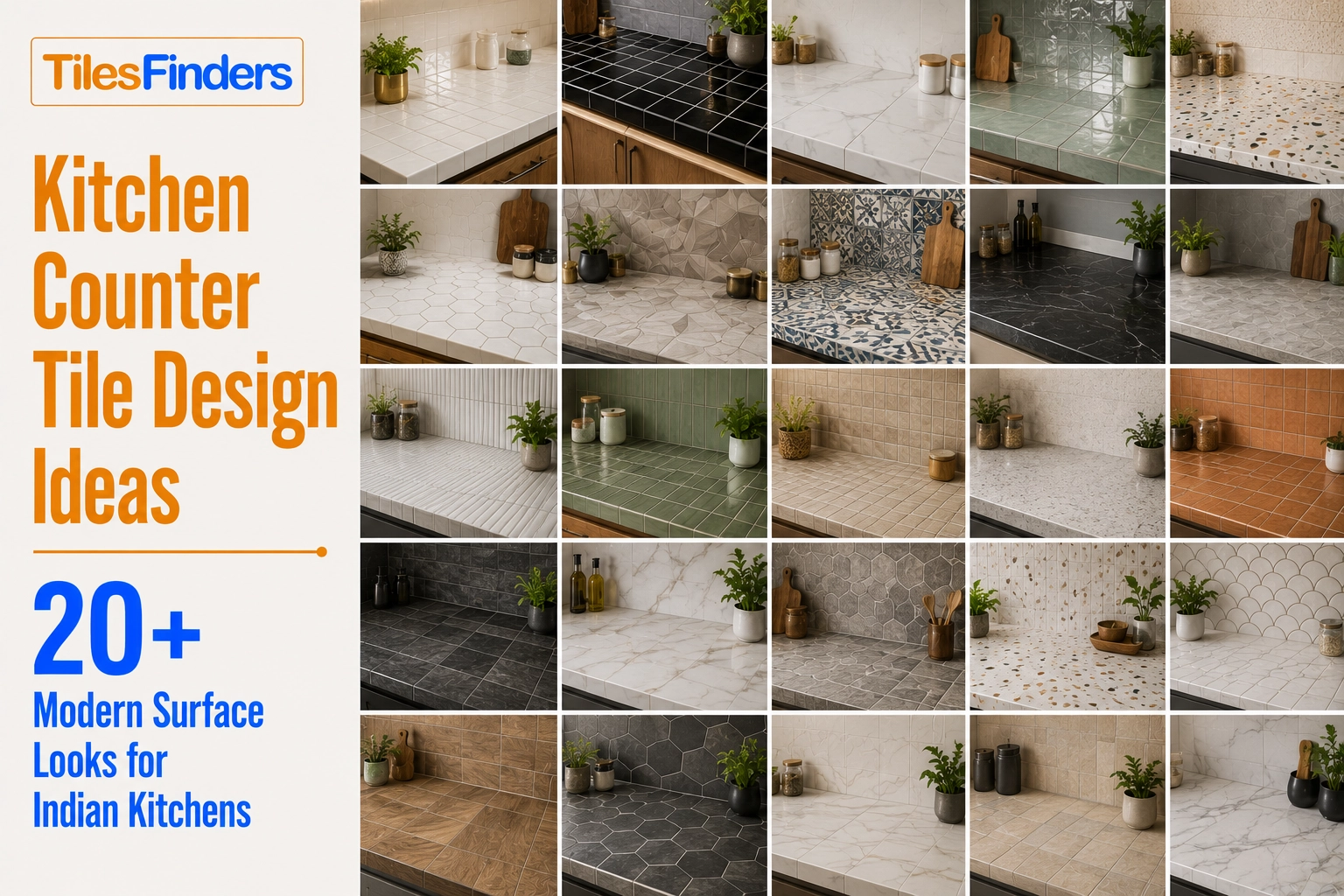
Kitchen Counter Tile Design Ideas: 20+ Modern Surface Looks for Indian Kitchens
Built for daily cooking, these countertop tile ideas combine heat resistance, stain protection, a...
Read More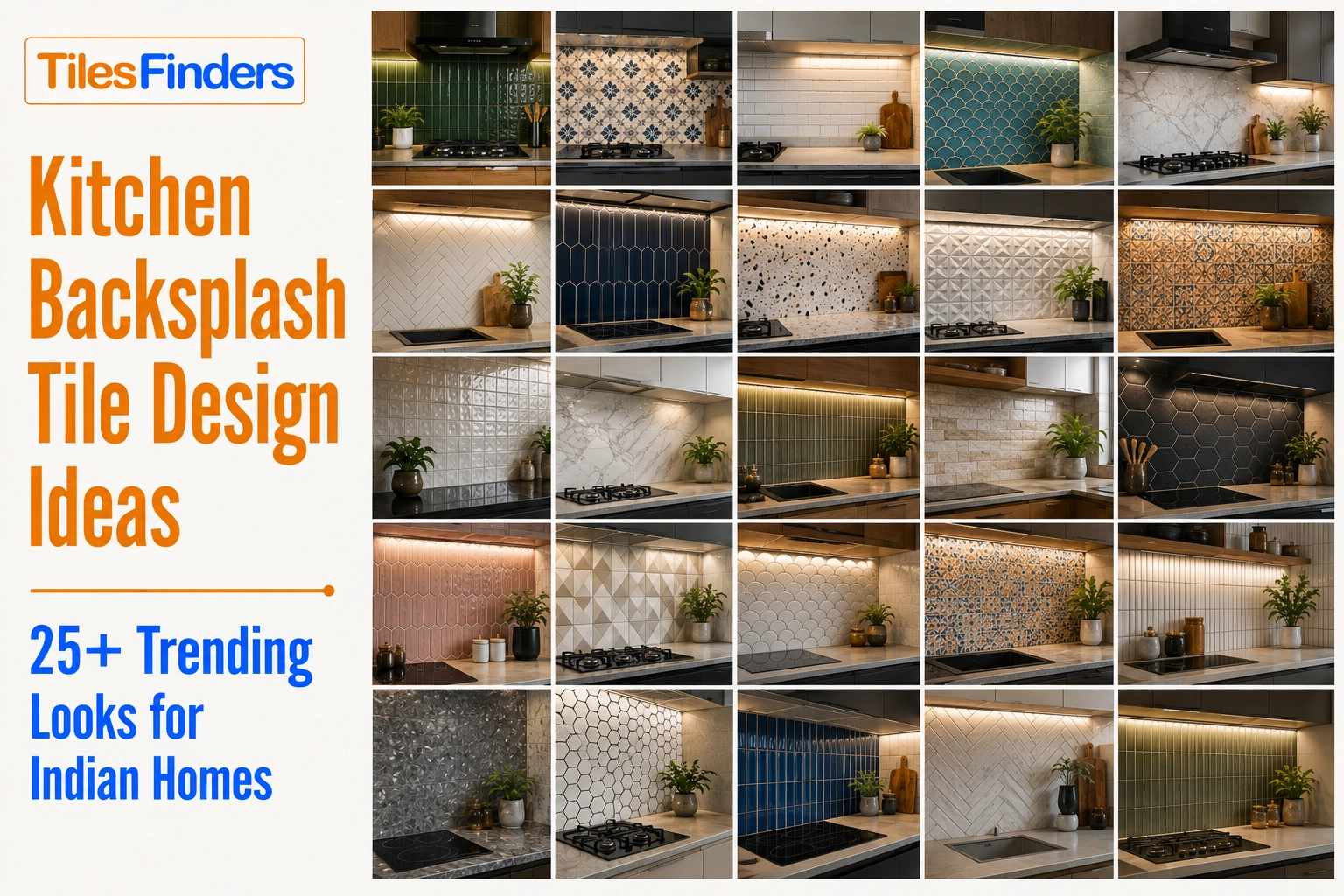
Kitchen Backsplash Tile Design Ideas: 25+ Trending Looks for Indian Homes 2027
Discover 25+ kitchen backsplash tile ideas for Indian homes in 2027. Compare subway, marble-look,...
Read More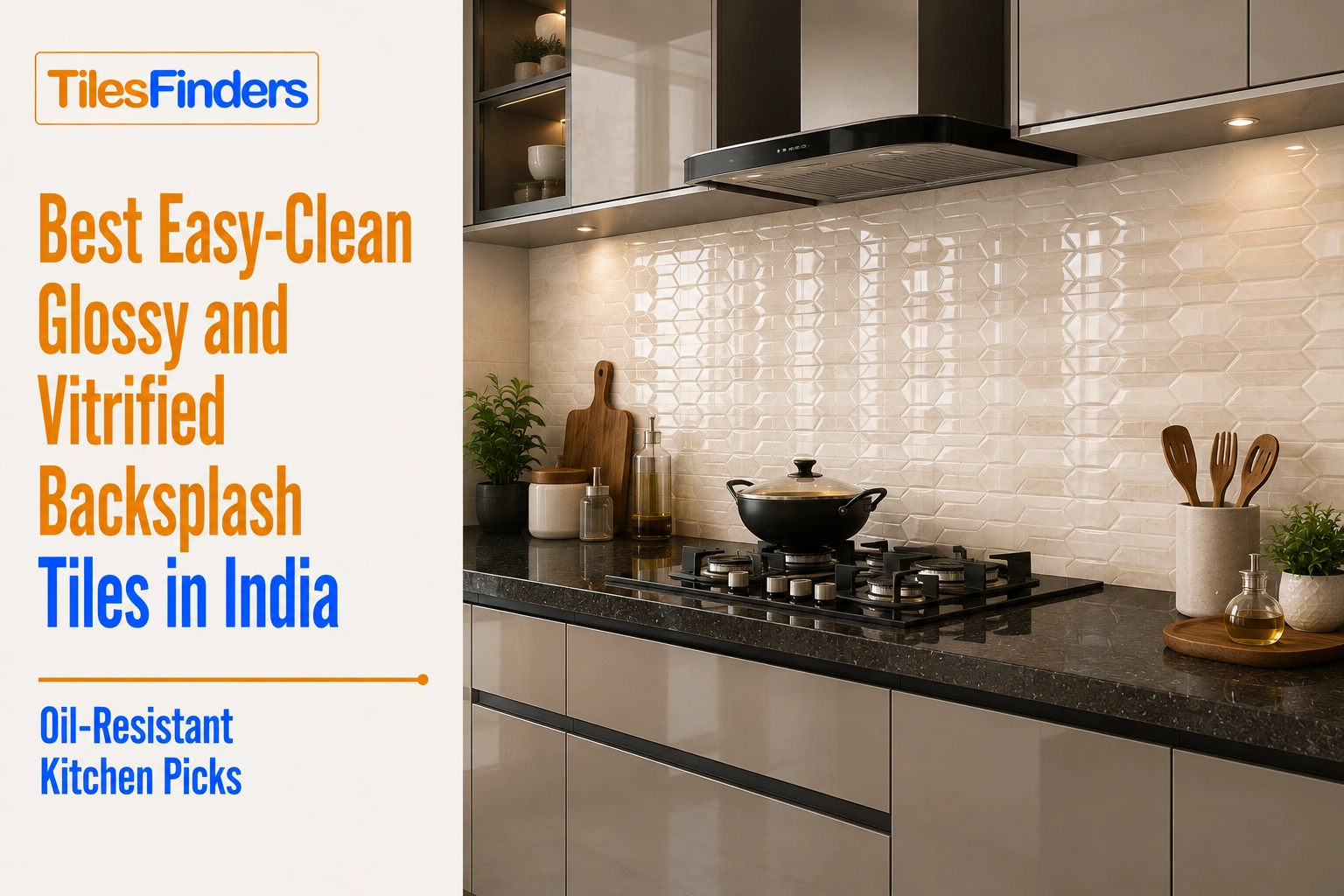
Best Easy-Clean Glossy and Vitrified Backsplash Tiles India 2027: Oil-Resistant Kitchen Picks
Upgrade your kitchen with backsplash tiles engineered for easy upkeep. Compare oil-resistant cera...
Read More