Best Bathroom Tiles in Chennai: Designs, Price and Where to Buy in 2027
Discover how Chennai's saline groundwater affects bathroom tile & grout choices in 2027. Learn wet vs. dry zone design, 2027 prices (₹25–₹180/sq ft), and top local showrooms.

- Chennai's Other Water Problem
- Wet Zone and Dry Zone Are Not the Same Decision
- Grout and Fixtures Take the Real Damage
- Bathroom Tile Categories That Handle This Well
- Design Directions Chennai Bathrooms Are Choosing in 2027
- What a Chennai Bathroom Actually Costs in 2027
- Where to Buy Bathroom Tiles in Chennai
- A Routine Worth Adopting in Saline Water Households
- Explore Bathroom Tile Options
Seawater intrusion has made groundwater brackish across parts of coastal and North Chennai, so bathroom tile and grout choice here has to handle salt corrosion, not just routine humidity, at roughly Rs. 25 to Rs. 180 per sq ft in 2027.
Every Indian city's bathrooms deal with humidity. Chennai's deal with something more specific, and it rarely comes up in a showroom conversation. Decades of heavy groundwater extraction along the coast have let seawater creep steadily inland beneath large parts of the city, and in the worst affected pockets that intrusion now reaches ten to fifteen kilometres from the shoreline. A household drawing water from a borewell in one of these areas is not just dealing with hard water the way a Bangalore home might. It is dealing with water carrying real salinity, and that changes what belongs on a bathroom wall and around the fittings far more than most renovation guides account for.
Chennai's Other Water Problem
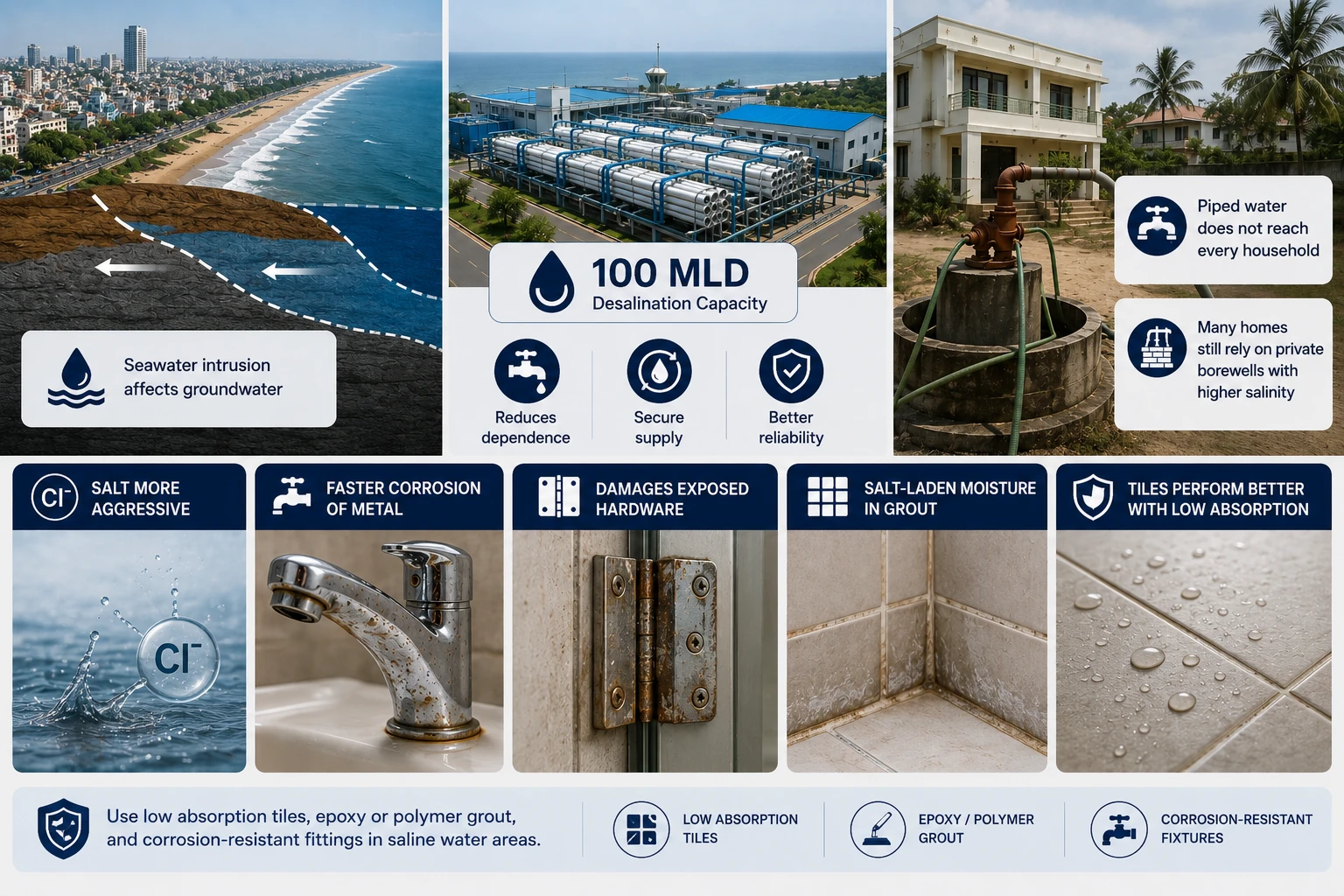
Seawater intrusion has been documented extensively along Chennai's coastline, with research from Anna University and multiple independent hydrology studies tracing saline groundwater well inland in the city's northern and coastal stretches. The city has responded partly by building desalination capacity, including a 100 million litres per day plant, precisely to reduce dependence on this compromised groundwater for municipal supply. But piped municipal water does not reach every household equally, and older independent houses, particularly in coastal neighbourhoods and areas still reliant on private borewells, often still draw water carrying higher salinity than the rest of the city.
This matters in a bathroom specifically because salinity behaves differently from the calcium and magnesium hardness more commonly discussed elsewhere in India. Chloride, the component that makes seawater intrusion so damaging, is considerably more aggressive toward metal than ordinary hardness minerals, meaning chrome fittings, tap fixtures, and exposed hinges corrode faster in a saline water household than the same fixtures would in a home on cleaner municipal supply. Tile and grout are not immune either, since porous grout absorbs and holds this salt-laden moisture against the wall far longer than a dense, glazed surface does.
Wet Zone and Dry Zone Are Not the Same Decision
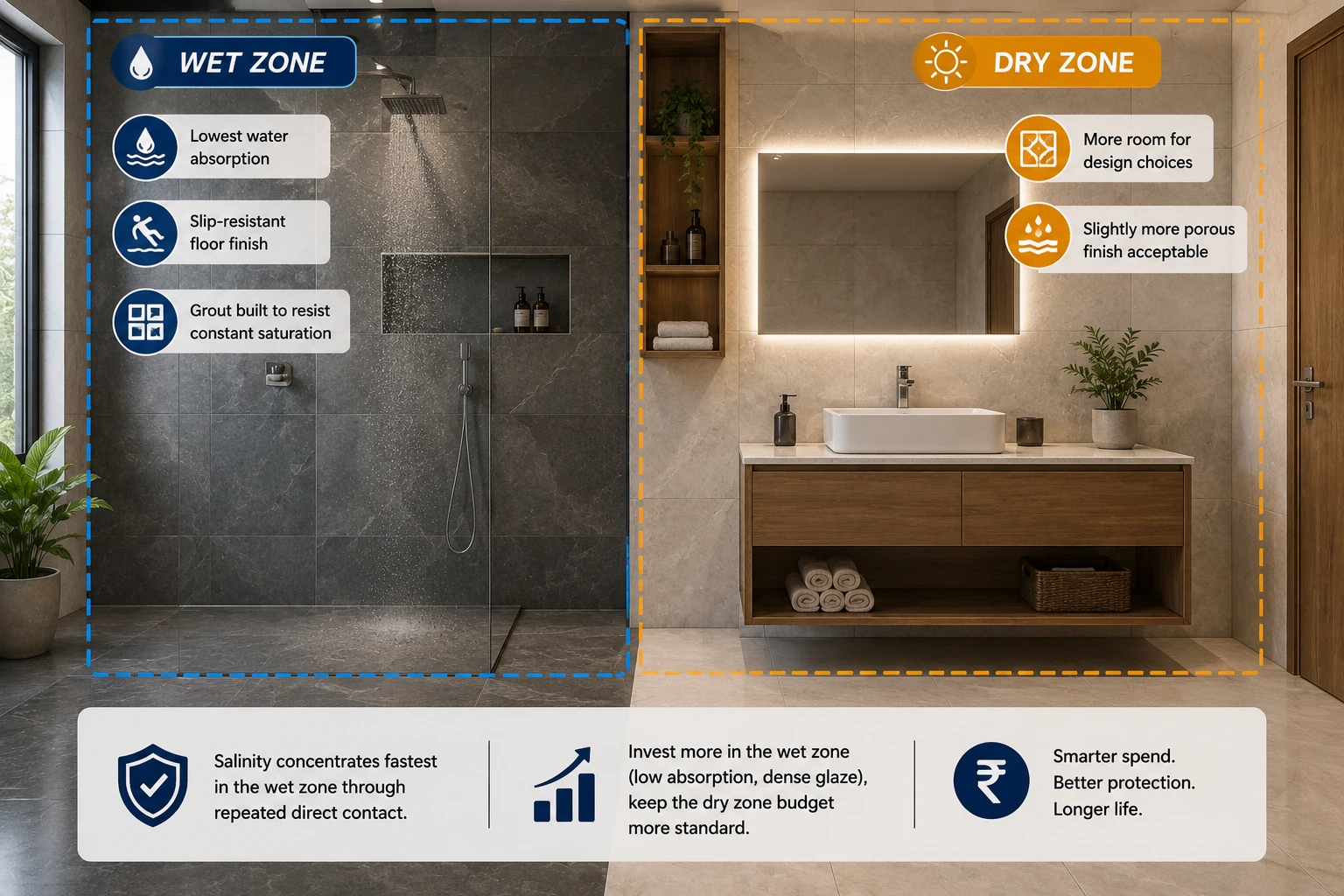
Every bathroom, regardless of what is coming through the taps, actually contains two different rooms pretending to be one. The wet zone, covering the shower area and anywhere water regularly hits the wall directly, needs the lowest possible water absorption, a slip-resistant floor finish, and grout built to resist constant saturation. The dry zone, covering the vanity, storage, and any area that only sees incidental splash, has more room for a design-led tile and a slightly more porous finish without the same consequences.
Chennai's salinity issue makes this split more consequential than it would be in a city with cleaner water, since the wet zone in a saline water household is where salt residue concentrates fastest through repeated direct contact. A homeowner on borewell water in a coastal pocket of the city gets more practical benefit from spending on a genuinely low absorption, densely glazed tile in the wet zone specifically, even while keeping the dry zone budget more standard, than from applying one uniform tile grade across the whole room.
Grout and Fixtures Take the Real Damage
Tile itself, once fired and glazed, resists salt fairly well. Grout is the weaker link, and in a saline water bathroom, plain cement grout can show visible white salt crusting and gradual crumbling well before the tile around it shows any wear at all. Epoxy or polymer-modified grout, already the general recommendation for wet Indian bathrooms, becomes closer to essential in Chennai's saline pockets specifically, since its far lower porosity keeps chloride-laden water from penetrating and crystallising within the joint over repeated wet and dry cycles.
Metal fixtures deserve a mention alongside tile, since a bathroom renovation happening anyway is the easiest moment to address both together. Households on known saline supply benefit from asking specifically for corrosion-resistant fittings, brass with a heavier chrome or PVD coating rather than a thinner standard finish, since a fitting that starts showing pitting or discolouration within a year or two is a far more common complaint in these pockets of the city than most homeowners expect going in.
From The Marketplace
Popular tiles right now
-bea14548-b7a5-4f8a-8ec5-6014df4f6672.jpg)





Bathroom Tile Categories That Handle This Well
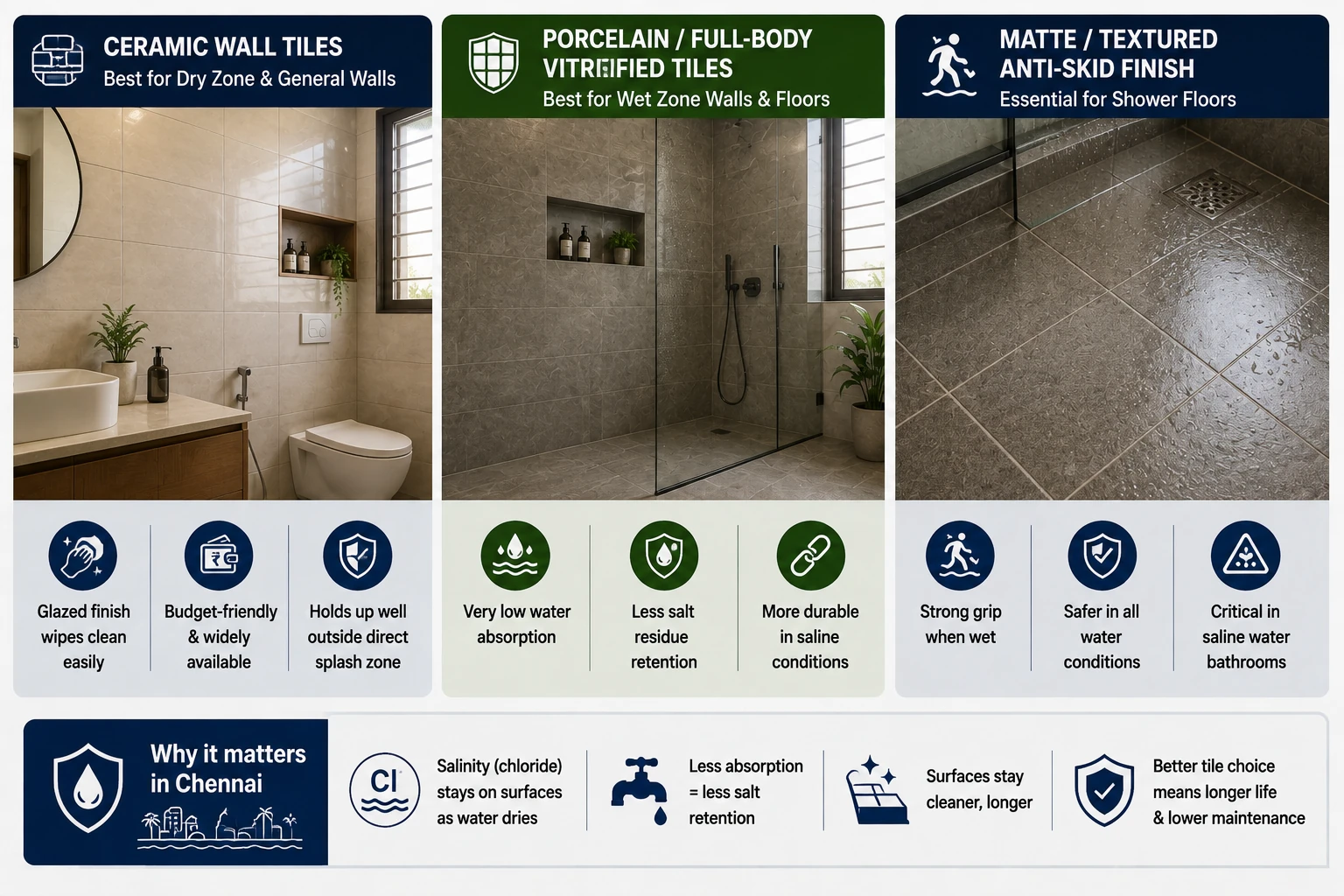
Ceramic wall tiles remain the standard, budget-friendly choice for dry zone walls and general bathroom use, with a glazed finish that wipes clean easily and holds up fine outside the direct splash zone. For the floor and any wet zone wall, porcelain or full-body vitrified tiles, carrying meaningfully lower water absorption than standard ceramic, are worth the extra cost specifically in Chennai's saline pockets, since less water absorbed means less salt residue left behind as the surface dries between uses.
A matte or textured anti-skid finish is non-negotiable for the shower floor regardless of water source, given how much more slippery a wet ceramic surface becomes than most homeowners expect, but this matters even more in a saline water bathroom, where a fine film of dried salt can make an already glossy floor noticeably more treacherous underfoot than the same tile would be in a freshwater household.
Design Directions Chennai Bathrooms Are Choosing in 2027
Large format tiles with minimal grout lines are the clearest trend this year, chosen as much to reduce the total grout area exposed to salt and humidity as for the cleaner look. Warm stone look and soft taupe tones are edging out the starker white subway tile combinations common a few years ago, partly because these tones hide the faint mineral haze that can develop on a wet zone wall in a saline water home far better than bright white does between cleanings.
Curbless, walk-in shower designs, once mostly seen in higher-end renovations, are becoming more common across ordinary Chennai apartment renovations too, removing the raised threshold between wet and dry zones in favour of a gentle floor slope toward a linear drain. This works well with the wet zone versus dry zone tile strategy described above, since it makes the boundary between the two a deliberate design line rather than an afterthought.
What a Chennai Bathroom Actually Costs in 2027
| Tile Use | Price Range (Rs/sq ft) | Notes |
| Ceramic wall (dry zone) | Rs. 25 to Rs. 55 | Budget-friendly, wide colour range |
| Porcelain floor/wet zone wall | Rs. 50 to Rs. 100 | Lower absorption, better for saline households |
| Full body vitrified (wet zone) | Rs. 70 to Rs. 140 | Best salt and moisture resistance |
| GVT stone/marble look accent | Rs. 60 to Rs. 180 | Feature wall or vanity backdrop |
For a typical 45 to 60 square foot Chennai bathroom, splitting tile grade by zone, standard porcelain for the wet zone and ceramic for the dry zone, generally lands between Rs. 3,000 and Rs. 7,500 for material, with epoxy grout adding a modest amount over standard cement grout that is well worth it in a saline supply area.
Where to Buy Bathroom Tiles in Chennai
Egmore remains the city's densest tile shopping stretch, with multiple brand display centres along Ethiraj Salai, Montieth Road, and Anna Salai carrying both standard and low absorption ranges suited to bathroom use. Vadapalani and OMR serve the IT corridor and newer apartment developments, while Tambaram, Madipakkam, and Kovilambakkam remain a solid option for South and South West Chennai homeowners handling full bathroom renovations rather than single accent walls.
Buyers in coastal neighbourhoods such as Besant Nagar, Adyar, Thiruvanmiyur, or further along the East Coast Road, where borewell salinity tends to run highest, are worth specifically asking dealers about water absorption figures for both tile and grout, since standard stock is not always suited to this specific water condition and a dealer used to serving these localities will usually know to point toward the lower absorption ranges without needing much prompting. For builders or gated community projects specifying bathroom tile across many units, sourcing matching low absorption ranges directly from Morbi manufacturers through a supplier platform such as TilesFinders keeps quality consistent across a large project.
A Routine Worth Adopting in Saline Water Households
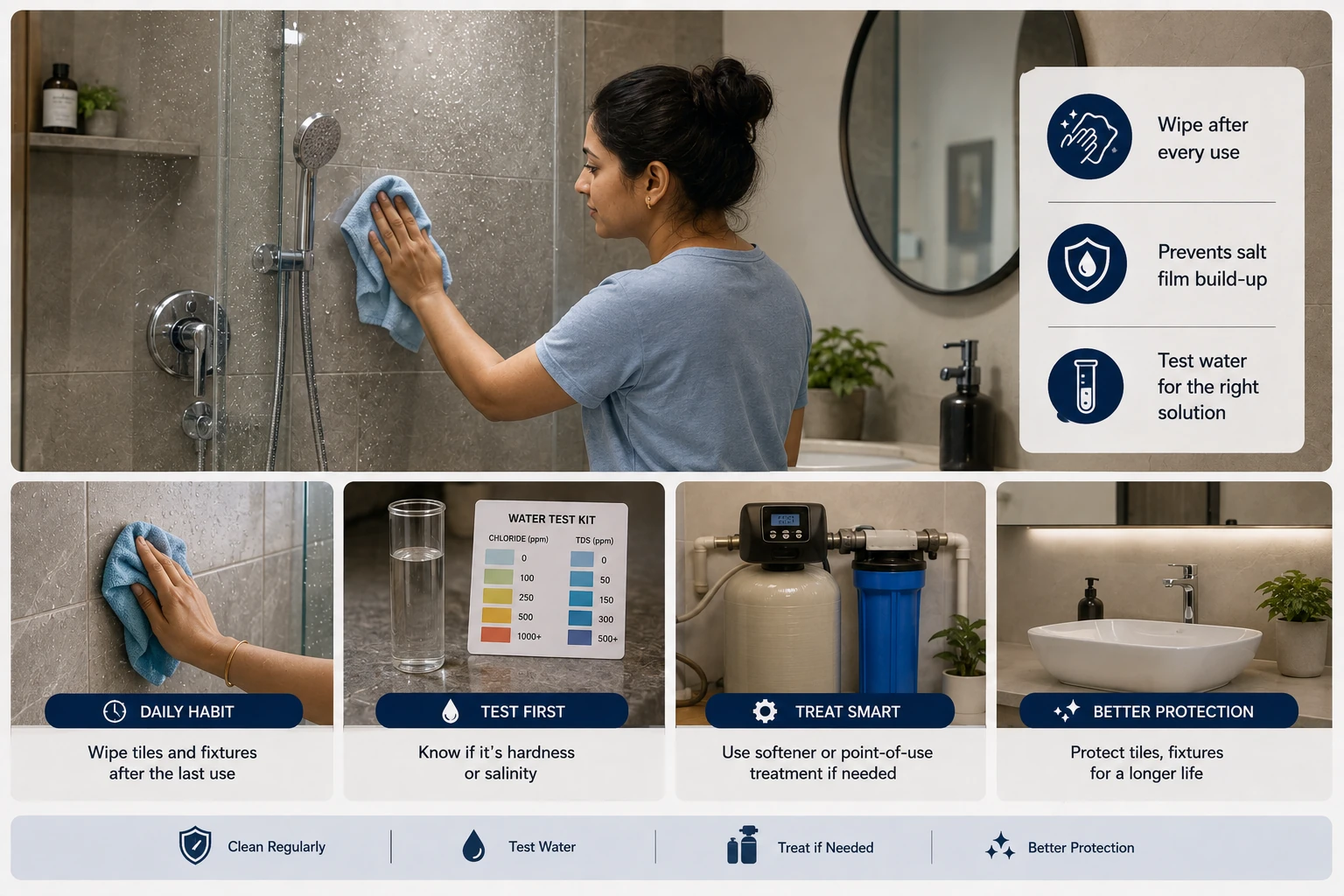
Tile and grout choice solves most of the problem, but a small maintenance habit closes the rest of the gap in a household running saline borewell water. Wiping down wet zone tile and fixtures after the day's last use, rather than leaving water to air dry on the surface, prevents most of the mineral and salt film that would otherwise build up overnight. This takes a couple of minutes and matters more here than the equivalent habit would in a household on cleaner municipal supply, since the salt left behind after each evaporation cycle is genuinely more aggressive than ordinary hard water residue.
For households noticing early signs of grout discolouration or fixture pitting despite reasonable care, it is worth getting the water tested rather than assuming the tile or fittings were simply poor quality. A basic water test distinguishes between ordinary hardness, which responds well to routine cleaning adjustments, and genuine salinity from seawater intrusion, which is better addressed by treating the water itself through a softener or point-of-use treatment, alongside the tile and grout choices covered here.
Explore Bathroom Tile Options
Getting a Chennai bathroom right starts with knowing whether your household's water carries the salinity that affects parts of the coast and the city's north, then matching tile and grout to the wet zone and dry zone accordingly. If you are planning a bathroom renovation or sourcing in bulk for a builder project, TilesFinders connects you with verified Chennai dealers and Morbi manufacturers to explore current options and place an informed order.
FAQs
It genuinely does in coastal and North Chennai pockets still reliant on borewell water, where documented seawater intrusion has raised groundwater salinity. Lower-water-absorption tiles and epoxy grout resist this far better than standard ceramic and cement grout, particularly in the shower wet zone.
A simple TDS meter reading gives a rough indicator, with readings noticeably above what neighbouring municipal supply areas show suggesting borewell salinity. Households in coastal localities or areas known for groundwater issues should treat this as a real possibility worth checking before finalising a tile order.
Yes, and this matters more in Chennai's saline pockets than elsewhere. The wet zone benefits from the lowest absorption tile and grout a budget allows, while the dry zone can use a more standard, design-led ceramic tile without the same consequences.
Epoxy or polymer-modified grout is the safer choice generally, and becomes more necessary in saline water households, since plain cement grout crusts and crumbles faster under repeated contact with chloride-laden water.
Prices generally range from Rs. 25 per square foot for basic ceramic dry zone wall tile to Rs. 180 per square foot for a stone or marble look GVT feature panel, with wet zone porcelain and full body vitrified options falling between the two.


See our tile guides first
Set TilesFinders as a preferred source and our buying guides surface ahead of the rest for you.
Add as preferred sourceTakes one tap. Nothing to install.
What Readers Say
I was about to redo my parking area with the wrong tile size until I read this. The layout comparisons saved me from a costly mistake.
We reference TilesFinders guides while briefing clients on material selection. The size and pattern breakdowns are accurate and easy to explain visually.
On site, I get asked about grout spacing all the time. This article gave me a solid reference I now share with my team before every job.
Finally a guide that doesn't just push generic advice. The oil stain removal steps actually worked on our clubhouse driveway tiles.
I run a small construction firm and now send this link to clients directly when they ask about entrance tile sizing. Saves me an hour of explaining.
Good practical detail, though I wish there were more examples for compact apartment entrances specifically, not just villas.
My mother-in-law wanted marble, I wanted vitrified. This blog gave us the neutral comparison we needed to actually decide together.
Detailed without being overwhelming. I appreciated that it covered both cost and maintenance, not just the aesthetics.
Used the algae and hard water removal tips on our terrace tiles after the monsoon. Worked better than what our regular cleaner was doing.
As someone who sources tiles for multiple builder projects, I find these comparisons genuinely useful for vendor conversations, not just consumer content.
Recommended this to a client who kept second-guessing the entrance design. The small vs large layout section settled the debate instantly.
Straightforward and honest, no unnecessary jargon. Would like to see a similar breakdown for outdoor pool-deck tiles next.
We've bookmarked several TilesFinders guides for our design handbook. Reliable source when clients want data, not just opinions.
Two paths, one marketplace.
Get free quotes from verified suppliers.
Share your room, budget, and style. Suppliers in Morbi respond within hours.
Get Free QuotesList your business, reach real buyers.
Put your showroom in front of homeowners searching for tiles right now.
List Your BusinessMore Blogs
See all
Mosaic Tiles for Indian Bathrooms: Size, Grout Width, and Water Resistance Explained
Learn how mosaic-pattern tiles perform in Indian bathrooms. Compare sizes, grout width, water res...
Read More
Best Black and White Monochrome Tiles India 2026: GVT Picks for Bathrooms and Living Rooms
Explore the best black and white monochrome GVT tiles for Indian bathrooms and living rooms. Comp...
Read More
Wash Area vs Bathroom Tiles: Key Differences in Water Resistance and Slip Safety Ratings
Compare wash area and bathroom tiles with respect to water exposure, anti-skid R-ratings, grout s...
Read More