Anti-Skid Marble-Look Tiles for Foyers: Monsoon-Safe Picks in India
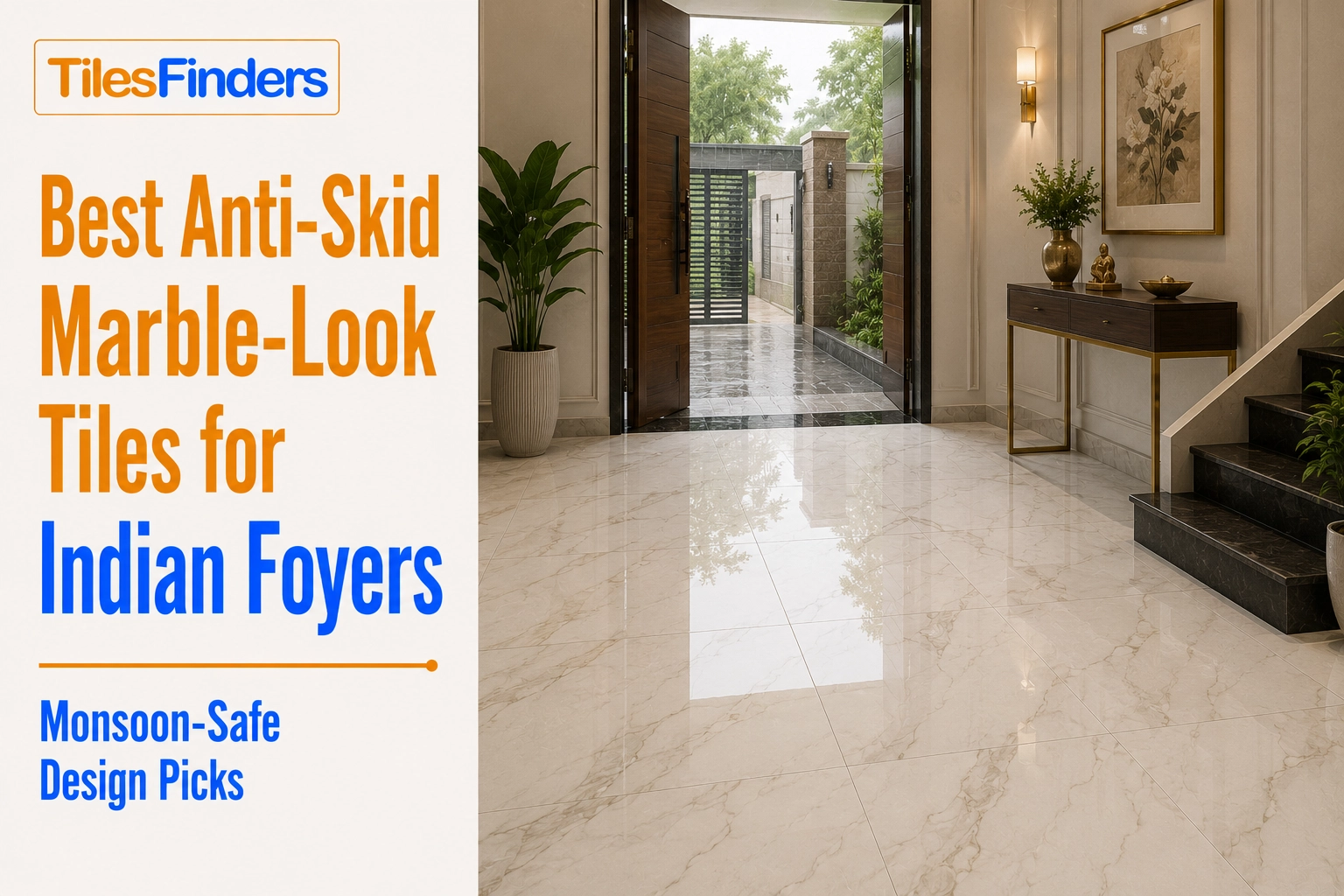
Create a stylish first impression with foyer flooring that balances safety, durability, and timeless marble-inspired designs. Compare finishes, layouts, and expert installation advice.
- Marble-Look Tiles vs Natural Marble for a Foyer
- Why Glossy Marble-Look Tiles Turn Risky in the Monsoon
- How to Read Slip Ratings for an Anti-Skid Foyer
- Anti-Skid Finishes That Keep a Marble-Look Foyer Safe
- Eight Monsoon-Safe Marble-Look Design Picks for Indian Foyers
- Choosing the Right Marble-Look Colour for Your Foyer
- Matching Tile Size to Your Foyer
- Laying and Sub-Floor Prep for a Wet Entrance
- Keeping a Marble-Look Foyer Clean Through the Monsoon
- Cost Breakdown for a Marble-Look Foyer Floor
- Common Mistakes Buyers Make
- Why a Morbi-Made Vitrified Foyer Lasts
- Planning a Monsoon-Ready Foyer
Matte and GHR marble-look GVT at R10 or above are the safe foyer picks; PGVT and polished marble-look tiles are slippery when wet and must not be used.
A foyer is the first floor anyone sees when they walk into your home, and during the monsoon, it is also the first spot to collect rainwater from shoes, dripping umbrellas, and wet dog paws. That mix of first impression and standing water makes the entrance one of the trickier floors to get right.
Anti-skid marble-look tiles handle both jobs at once. They carry the clean, marble-style look of natural stone at a far lower cost, and the right finish keeps the surface grippy even when a film of water sits on top.
The trouble is that most buyers still picture a shiny, mirror-polished marble floor for the entrance, and that shine turns risky the second water reaches it. This guide breaks down how marble-look tiles compare with real marble, how to read slip ratings, which finishes stay safe, colour and size choices, laying and upkeep for a wet-prone entrance, a cost breakdown, and eight design picks that hold up in Indian foyers through the rains.
Marble-Look Tiles vs Natural Marble for a Foyer
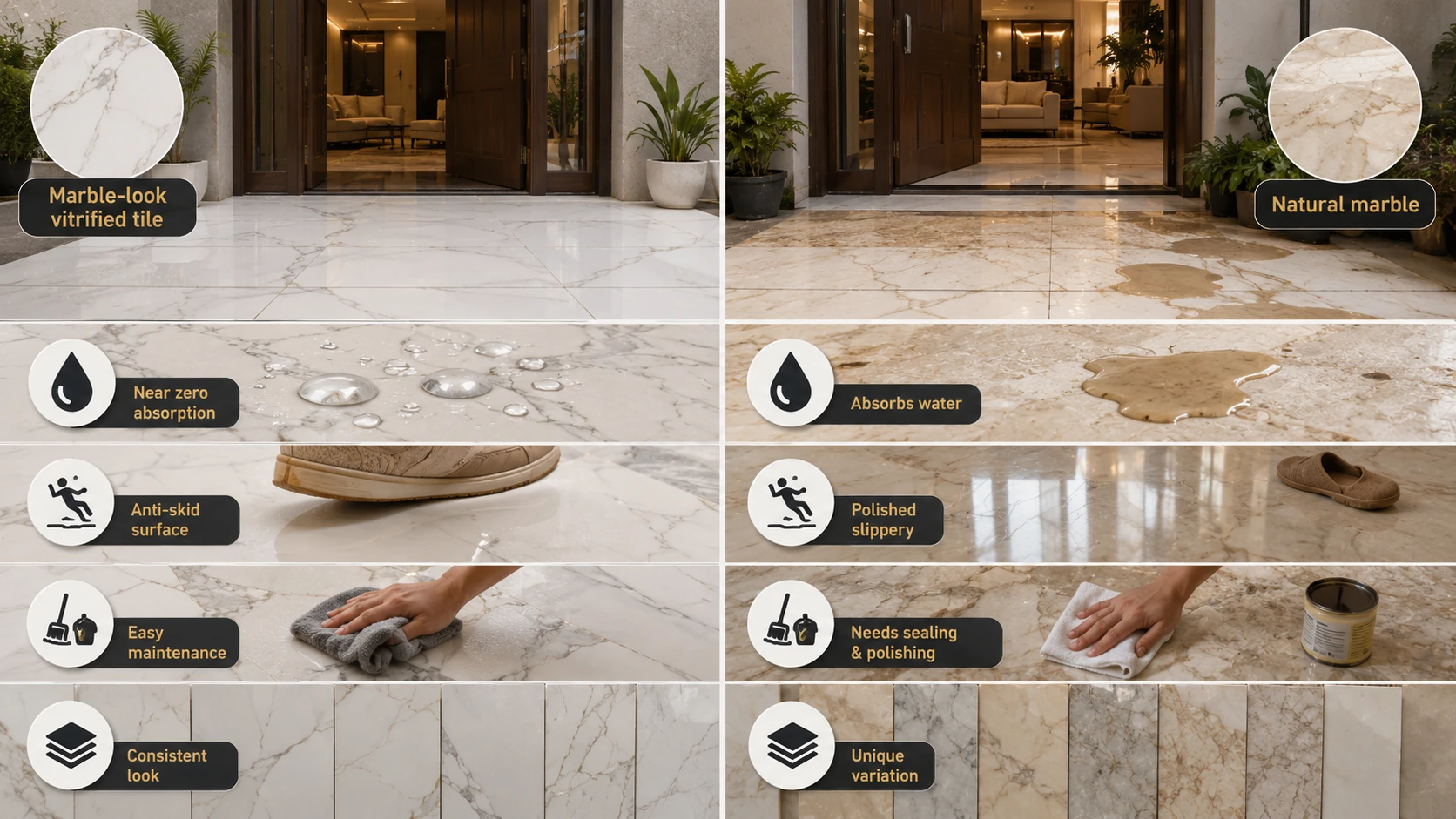
Natural marble looks beautiful, but it is a soft, porous stone. It soaks up water, stains from wet footwear, and etches when acidic spills or cleaning chemicals touch it. In a monsoon-soaked entrance, this means dull patches and dark rings within a season or two, unless you seal and polish it regularly.
Marble-look vitrified tiles replicate the veining and colour of stones like Statuario, Carrara, and Emperador on a hard, nearly zero-absorption body. They do not need sealing, they do not etch, and they hold up to daily foot traffic without polishing.
| Factor | Marble-look vitrified tile | Natural marble |
| Water absorption | Near 0.05 per cent | 0.5 to 3 per cent needs sealing |
| Anti-skid options | Matte, GHR, matte carving, sugar | Polished is slippery, needs honing |
| Monsoon behaviour | Shrugs off damp and spills | Stains, etches, and absorbs water |
| Upkeep | Mop, no sealing | Regular sealing and polishing |
| Price (Rs./sq.ft) | 55 to 240 | 150 to 800 plus fitting |
| Shade matching | Repeatable, match batch number | Every slab differs |
Pro tip: If you love the natural marble look but want a rain-safe entrance, a matte or carved marble-look tile gives you the veining without the slip risk or the yearly polishing bill.
Why Glossy Marble-Look Tiles Turn Risky in the Monsoon
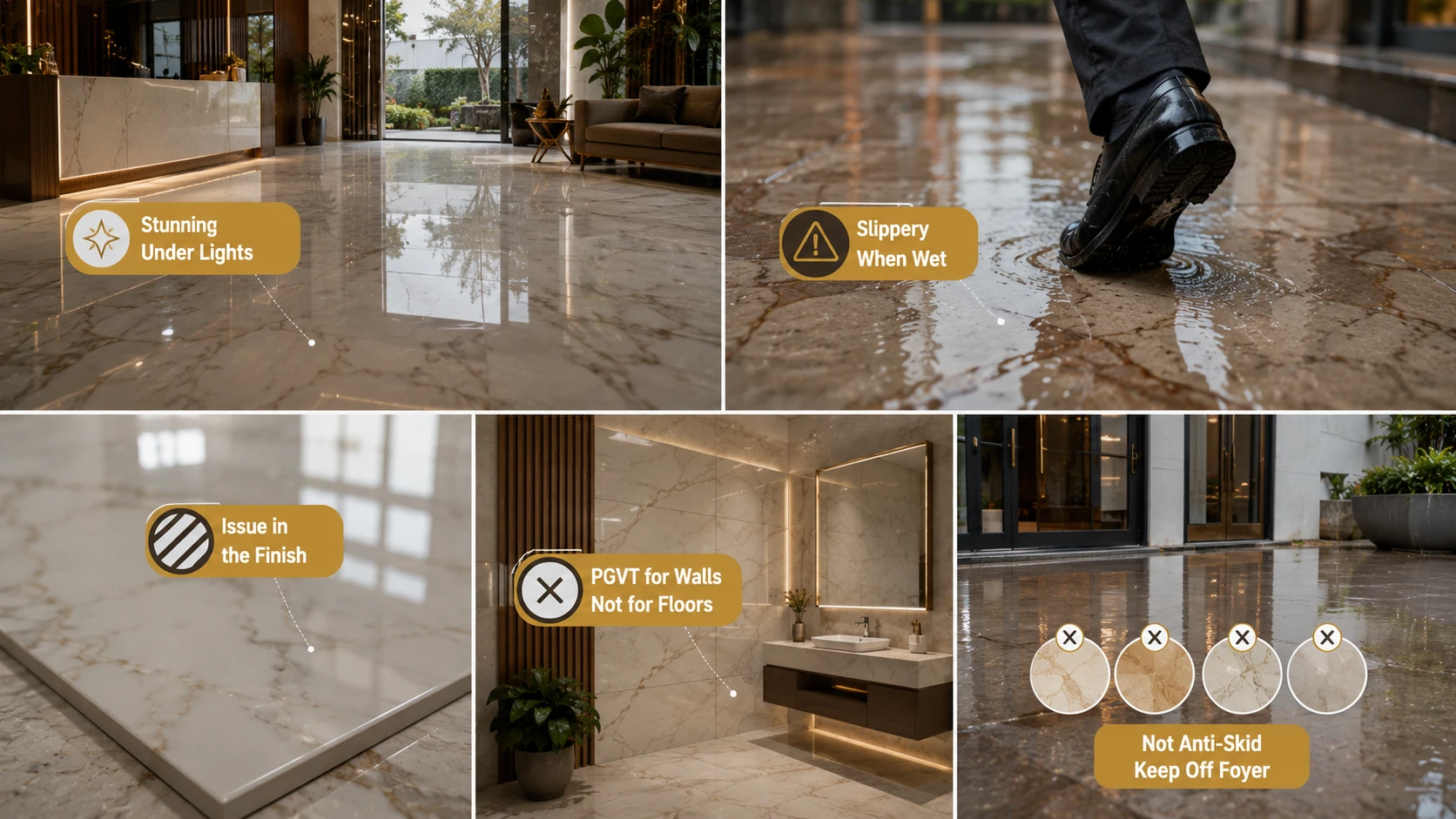
Polished marble-look tiles look stunning under showroom lights. Under a thin film of rainwater, that same polish loses grip and behaves like wet glass.
The problem sits in the finish, not the tile body. A glazed vitrified tile with a high-gloss surface reflects light nicely, yet it gives almost no traction once water spreads across it. The smoother the surface, the faster a wet shoe slides.
PGVT marble-look tiles, the fully polished glazed vitrified type, are made for walls and dry feature panels. They should never go on a foyer floor that catches monsoon water.
Note: Satin matte, semi-polished, and baby-polished tiles are not anti-skid despite the soft look. Keep all of them off a rain-exposed entrance floor, along with any glossy or polished surface.
How to Read Slip Ratings for an Anti-Skid Foyer
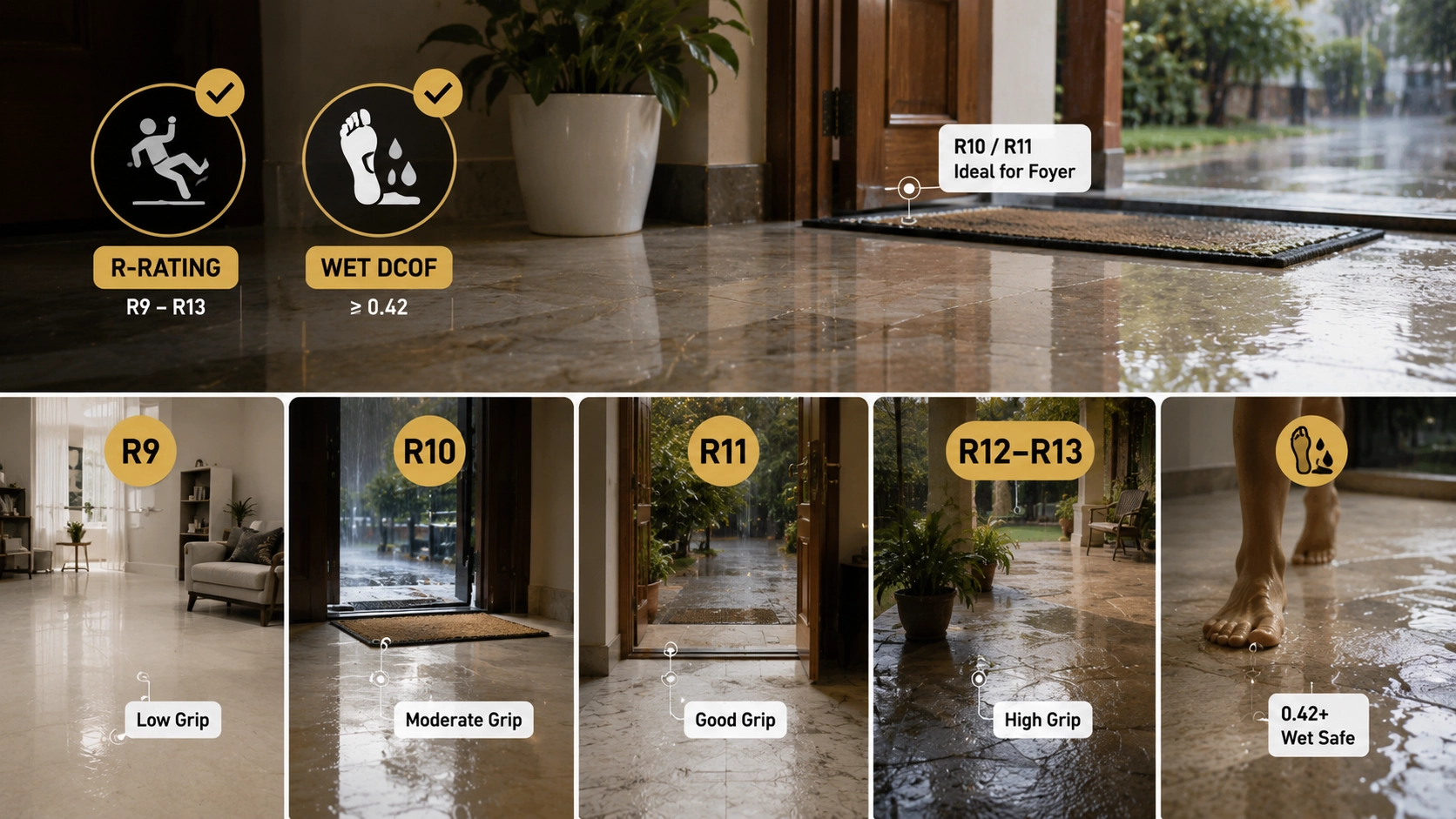
Two numbers tell you whether a tile is safe to walk on when wet. Ask your dealer for both before you buy.
The R-rating comes from a ramp test and runs from R9 to R13. A higher number means more grip. The wet DCOF, or dynamic coefficient of friction, is a lab figure where 0.42 and above is the common benchmark for floors that get walked on while wet.
| Slip rating | What it means | Where it fits |
| R9 | Low grip | Dry inner rooms, not a rain-exposed entrance |
| R10 | Moderate grip | Covered foyer with light rain reaching in |
| R11 | Good grip | Foyer next to an open door with monsoon splash |
| R12 to R13 | High grip | Open verandah, porch, outdoor steps |
| Wet DCOF 0.42 or more | Passes wet-walking benchmark | Any foyer that sees standing water |
For most Indian foyers that sit just inside the main door, an R10 or R11 matte or GHR marble-look tile with a wet DCOF of 0.42 or higher gives a safe margin through the monsoon.
Anti-Skid Finishes That Keep a Marble-Look Foyer Safe
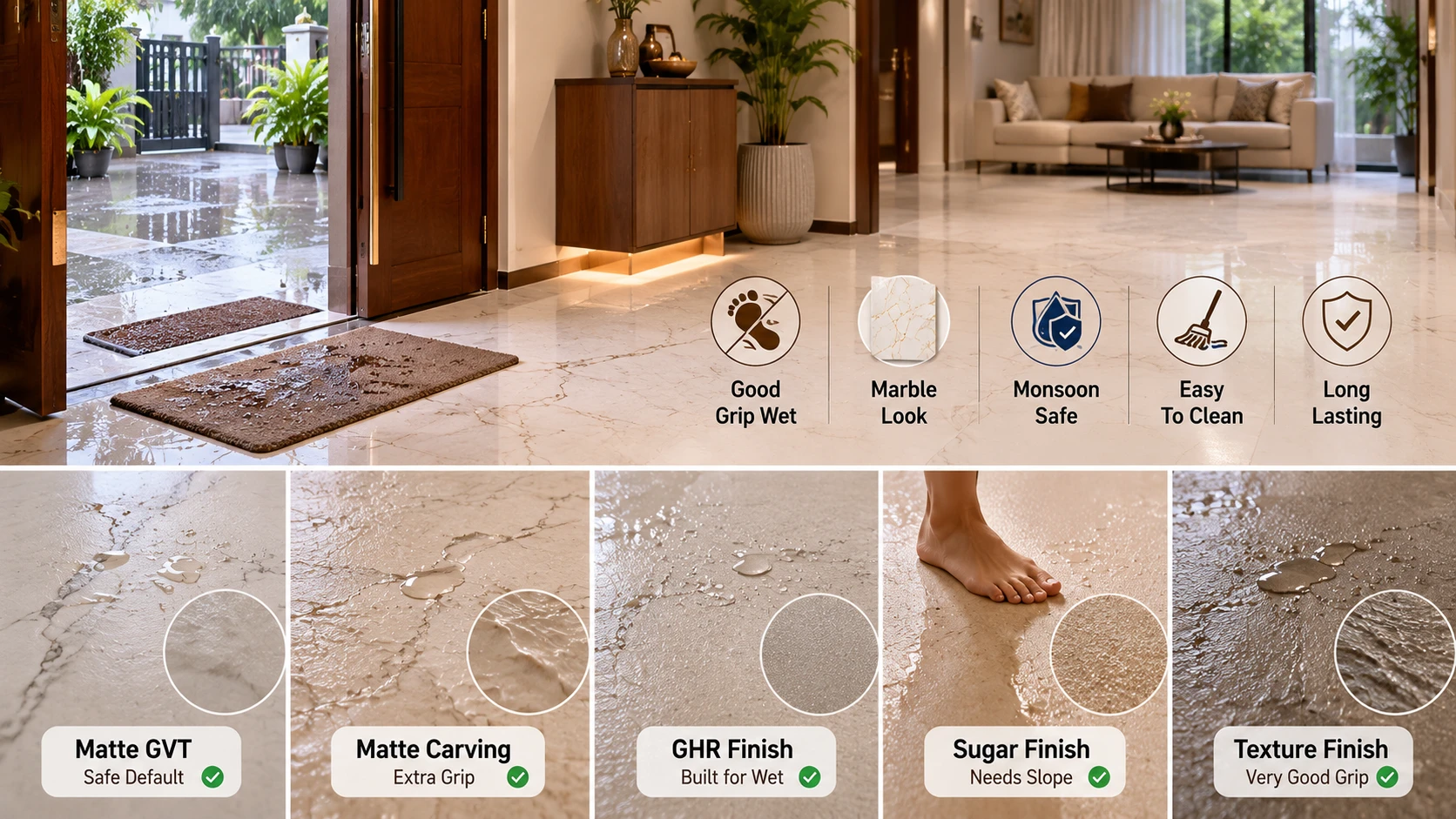
The finishes below hold traction even with rainwater on top, so they suit a foyer that opens close to the main door.
| Finish | Grip when wet | Marble look available | Price (Rs./sq.ft) |
| Matte GVT | Good, around R10 | Yes, wide range | 55 to 130 |
| Matte Carving | Very good, R10 to R11 | Yes, veined prints | 75 to 160 |
| GHR (Glaze High Resistance) | Very good, R11 | Yes | 60 to 130 |
| Sugar finish | Good, needs 1:100 slope | Yes | 75 to 160 |
| Texture | Very good, R11 | Limited prints | 60 to 140 |
Matte GVT is the safe default. It carries realistic marble veining, cleans with a regular mop, and stays grippy underfoot.
Matte carving adds a light surface relief along the veins, which lifts traction further and hides water marks between mopping. GHR, short for Glaze High Resistance, is built for wet and outdoor use, so it works for a covered foyer that still catches wind-blown rain.
Sugar finish has a fine-grained texture that grips well, but it holds a little more dust in the pits, so it wants a slight floor slope and regular mopping. Double charge is strong but stays a dry-indoor floor, so save it for an inner lobby rather than the rain-facing entrance.
Still comparing different entrance flooring options? Read our complete Foyer & Entrance Tiles Guide to learn about tile materials, finishes, colours, maintenance, pricing, and expert buying tips for creating a welcoming Indian home entrance.
Eight Monsoon-Safe Marble-Look Design Picks for Indian Foyers
1. Statuario White Matte GVT
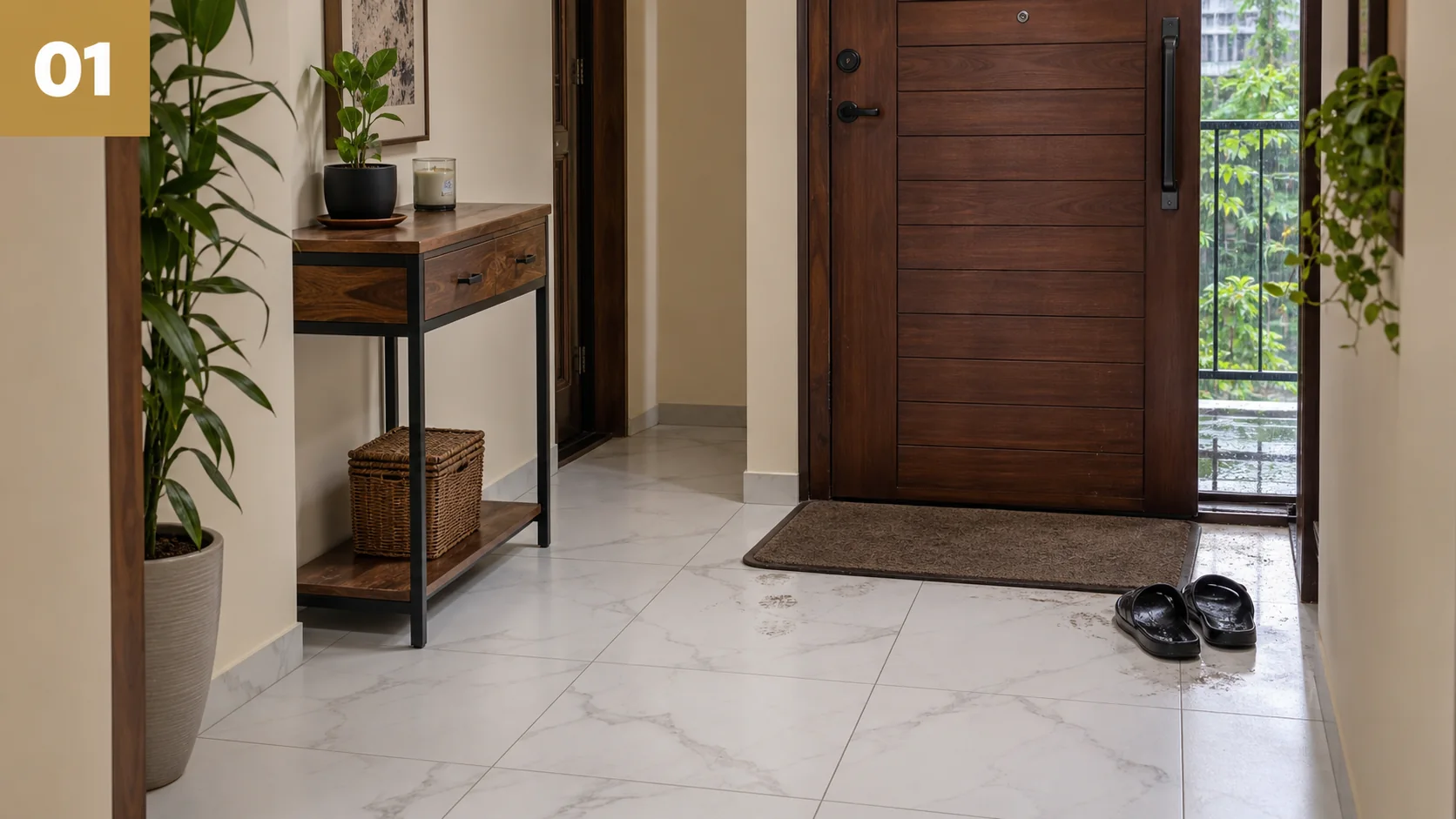
White ground with soft grey veins that brightens compact foyers and bounces daylight into a narrow entrance. In 24x24 inch (600x600 mm), it runs about Rs. 70 to Rs. 130 per sq.ft. Shows slush faster, so it wants a good entry mat.
2. Carrara Grey Matte Carving
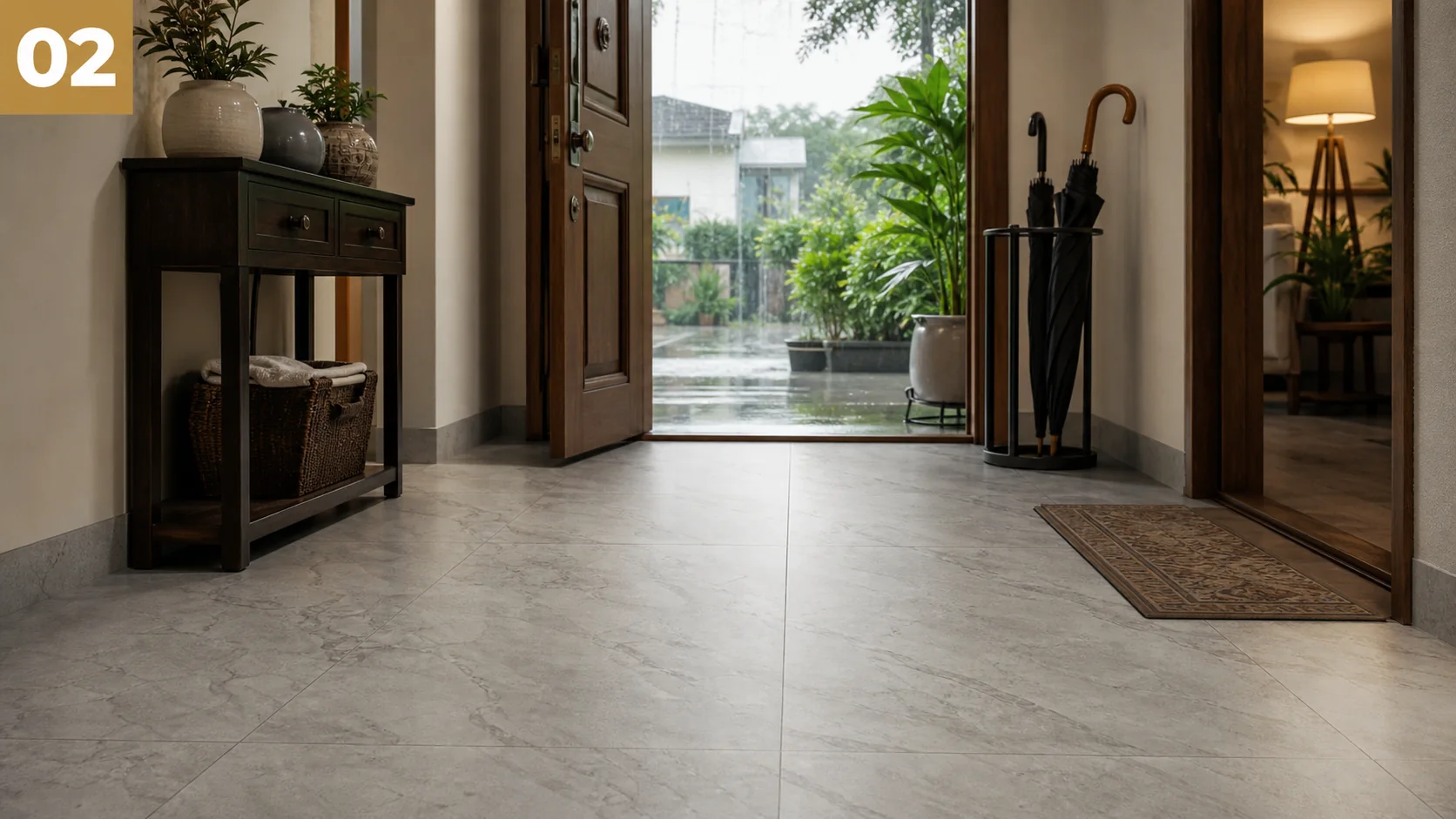
Muted grey veining with a lightly carved surface, forgiving of dust and water spots near the door. The 24x48 inch (600x1200 mm) format keeps grout lines low and reads calm against most wall colours.
3. Beige Sugar-Finish Marble Look
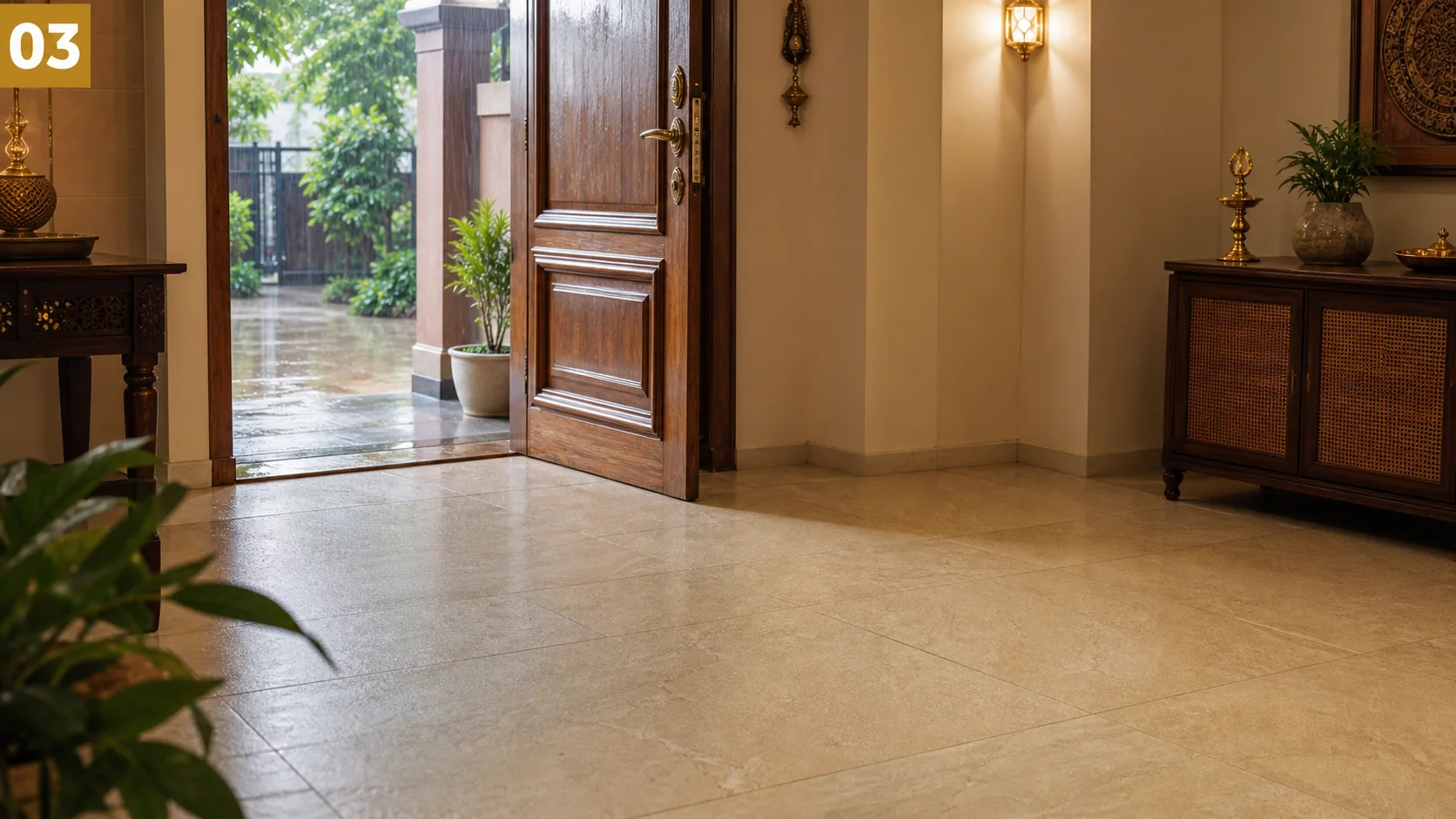
Warm beige tone with a sugar texture that grips underfoot, pairing well with wooden main doors and brass fittings. Expect Rs. 80 to Rs. 150 per sq. ft., and lay it with a slight slope so water drains rather than pools.
4. Dark Emperador GHR
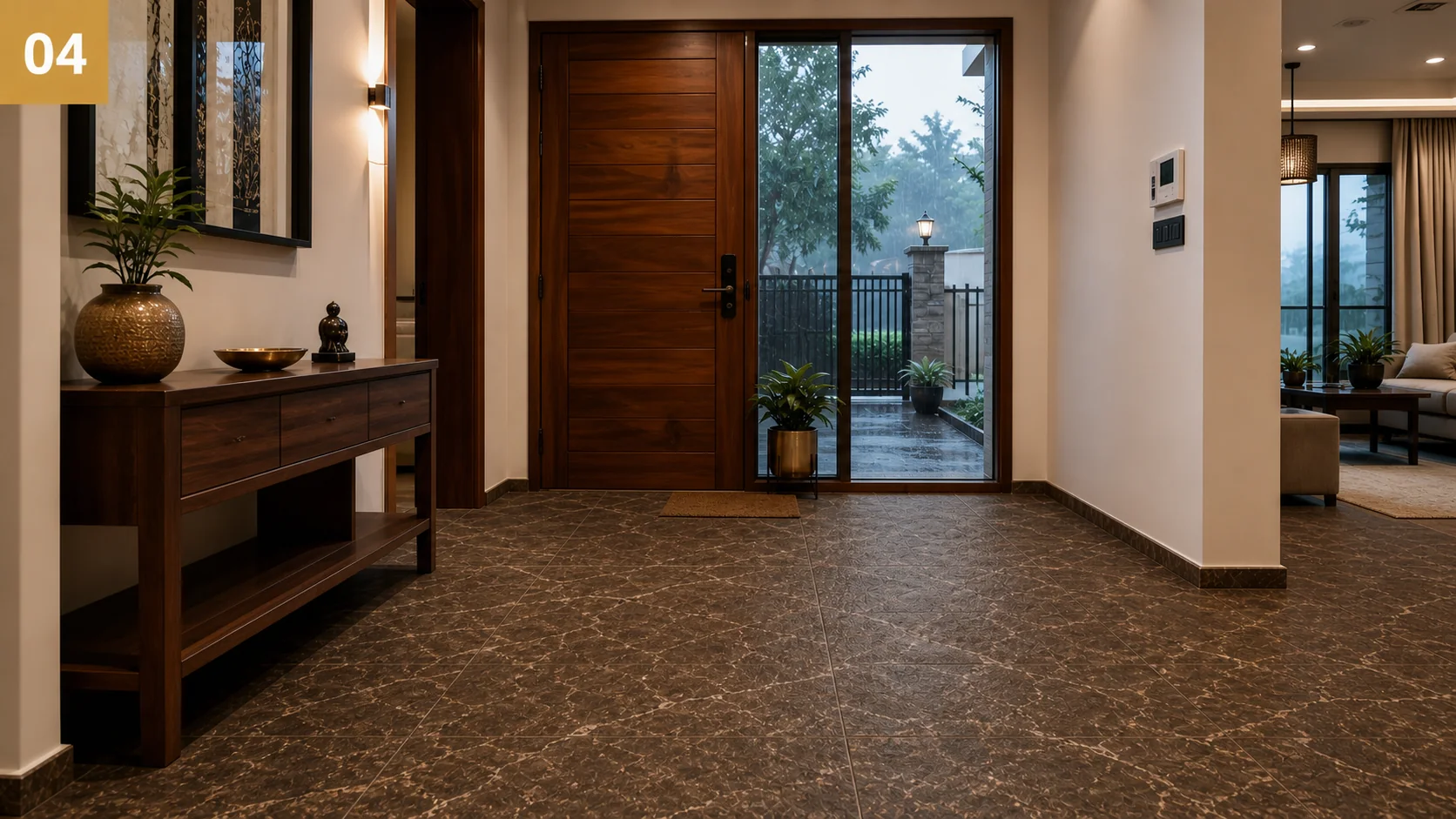
Deep brown marble look that hides monsoon slush and footmarks, with the strong wet grip of a GHR surface. Priced around Rs. 75 to Rs. 130 per sq.ft. Needs a bright entry light so the space does not feel closed in.
5. Onyx-Look Matte in Large Format
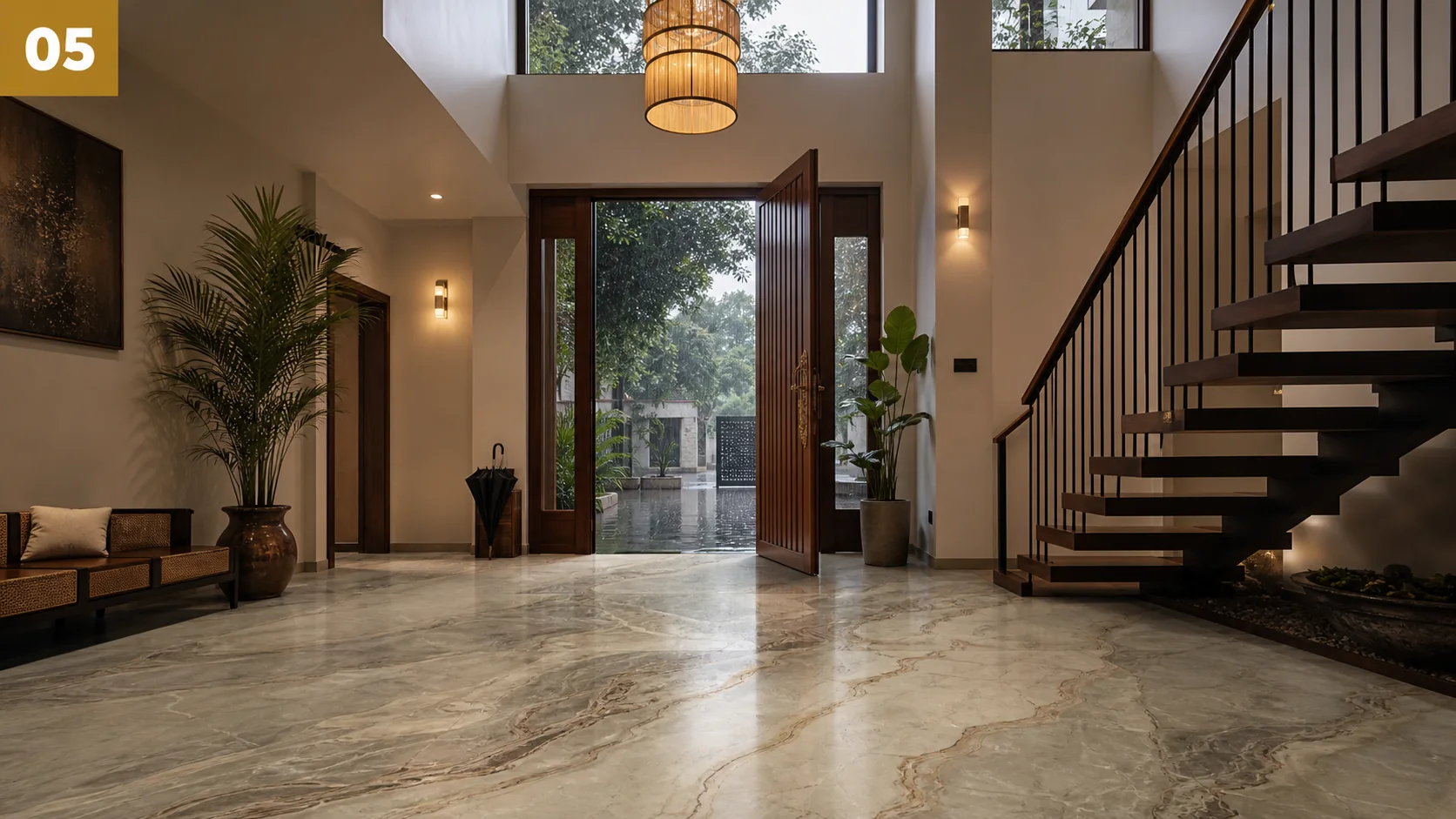
A dramatic veined onyx pattern in 32x64 inch (800x1600 mm) that cuts grout lines for a slab-like floor in double-height foyers. Around Rs. 90 to Rs. 160 per sq.ft, best paired with plain walls so the veining stays the hero.
6. Grey Marble Texture Slab
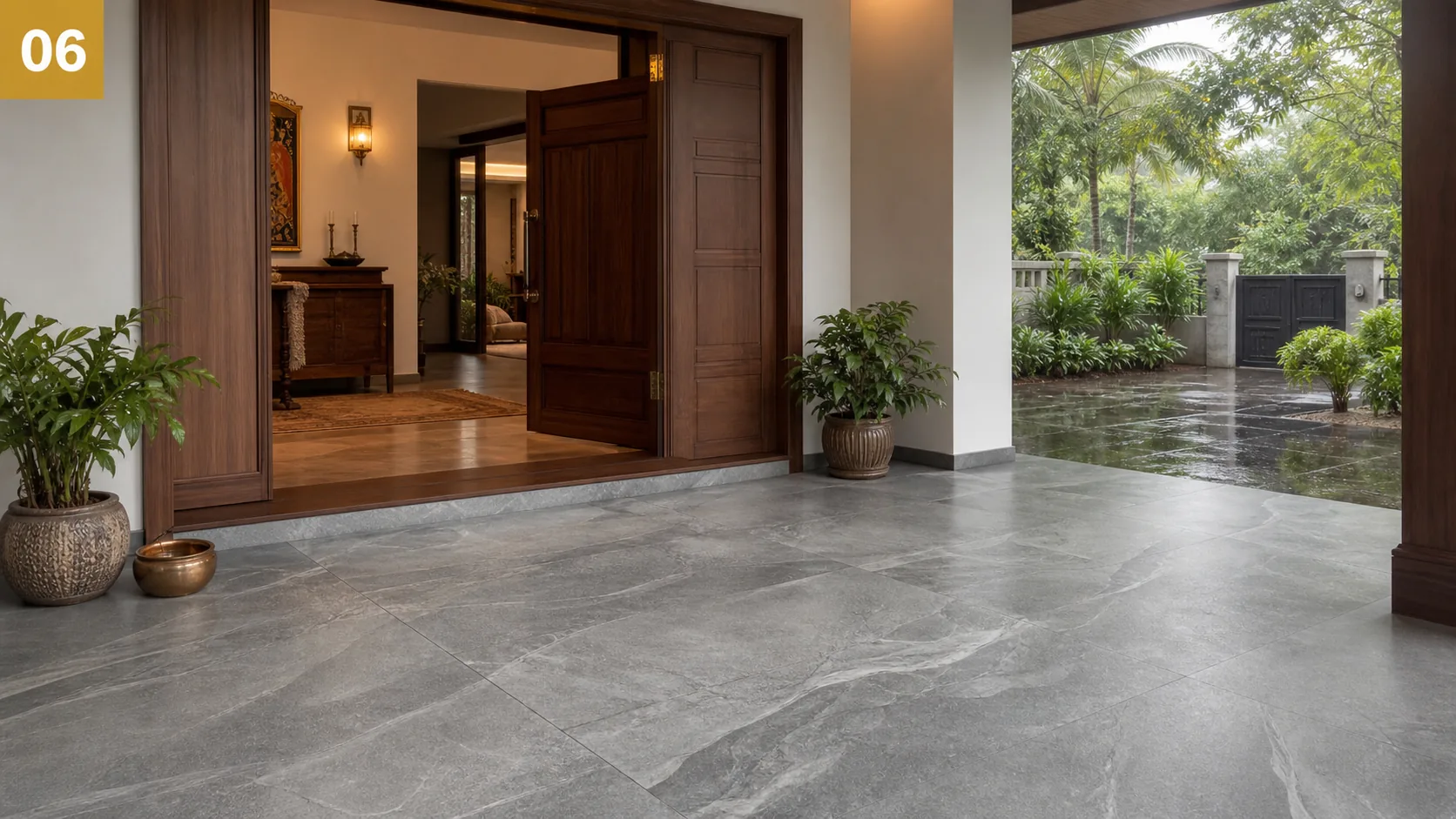
A wide grey marble look in 1200x1800 mm (about 4x6 feet), suited to bungalow entrances that want a single-slab feel. Full body vitrified in this size costs around Rs. 120 to Rs. 240 per sq.ft.
7. Ivory Travertine-Look Matte
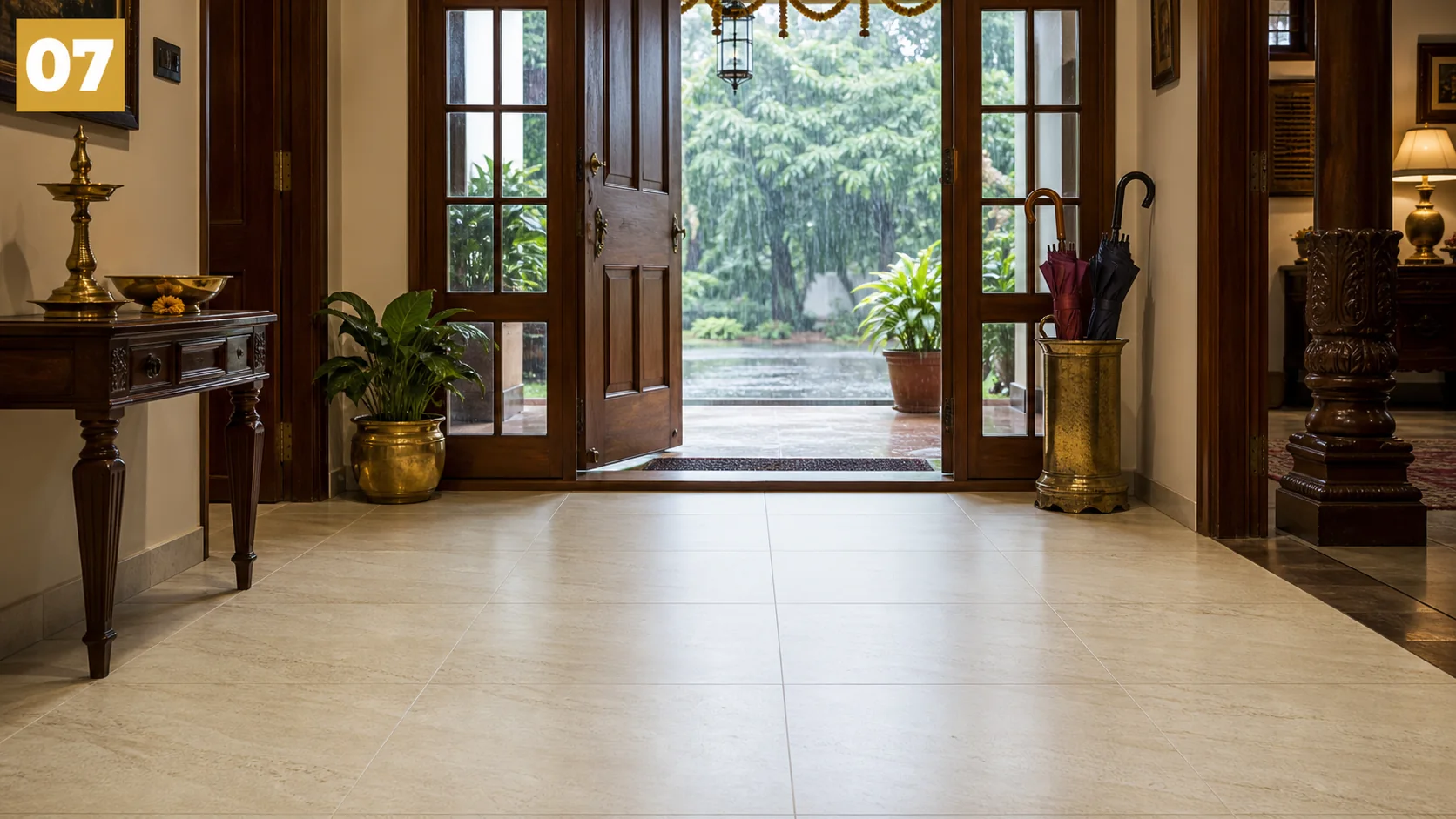
A soft ivory stone look tile with subtle movement that suits traditional and Indian classic interiors. In a 24x24 inch (600x600 mm), it costs about Rs. 65 to Rs. 120 per sq.ft and hides light dust between cleans.
8. Charcoal Marble Matte Carving
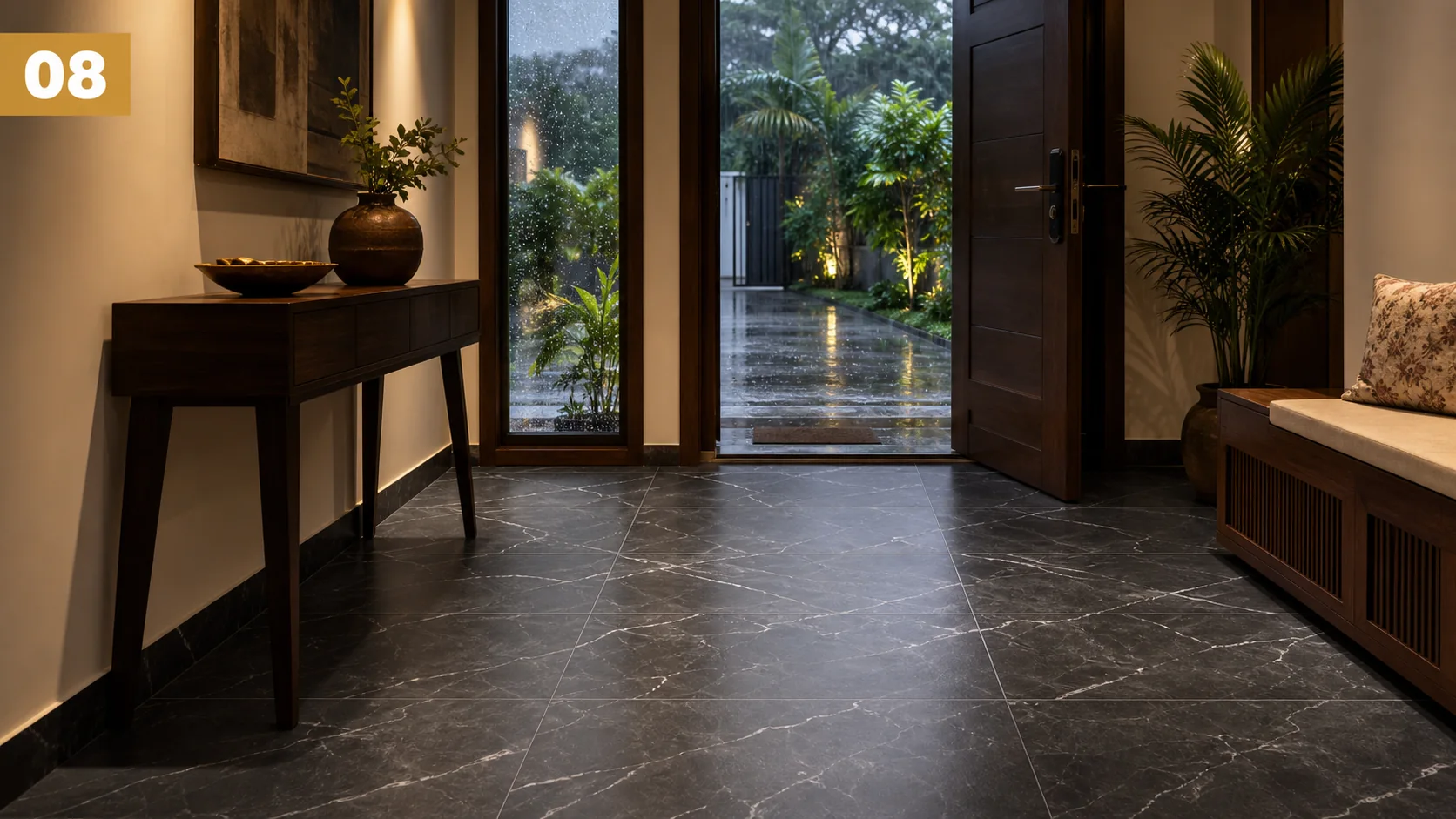
A near-black marble look with white veining for a bold entrance statement, the carved surface giving grip and hiding wet footmarks. Around Rs. 85 to Rs. 150 per sq.ft in 24x48 inch (600x1200 mm).
Choosing the Right Marble-Look Colour for Your Foyer
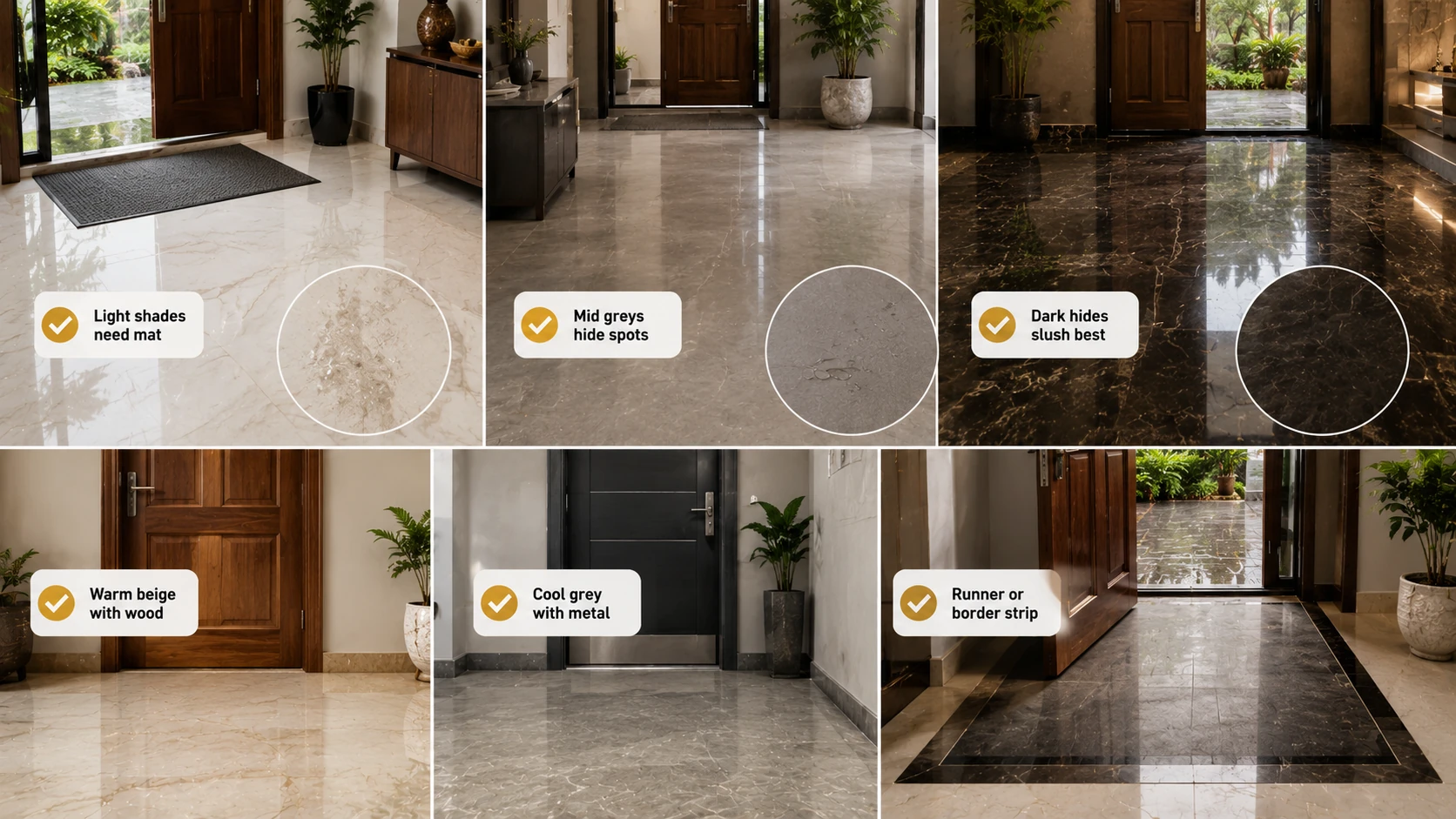
Colour decides how the entrance feels and how often you reach for the mop during the rains.
- Light shades like white, ivory, and beige make a small or dim foyer feel larger and brighter, but they show monsoon slush, so pair them with a wide entry mat.
- Mid greys are the easy middle ground. They hide dust and water spots and sit well under both warm and cool lighting.
- Dark emperador and charcoal hide slush and footmarks best, so they suit busy family entrances, but they need good entry lighting to avoid a boxed-in feel.
- Match the tile undertone to your main door and skirting. Warm beige with wooden doors, cool grey with metal or laminate doors.
Pro tip: Lay a runner of the same tile or a dark border strip in the first two feet inside the door. It takes the worst of the wet footfall and keeps the main field of the foyer cleaner.
Looking for more entrance styling inspiration beyond marble-look finishes? Explore our Foyer Tile Design Ideas to discover 20+ modern Indian entrance designs, colour combinations, border layouts, and décor-friendly flooring ideas for every home style.
Matching Tile Size to Your Foyer
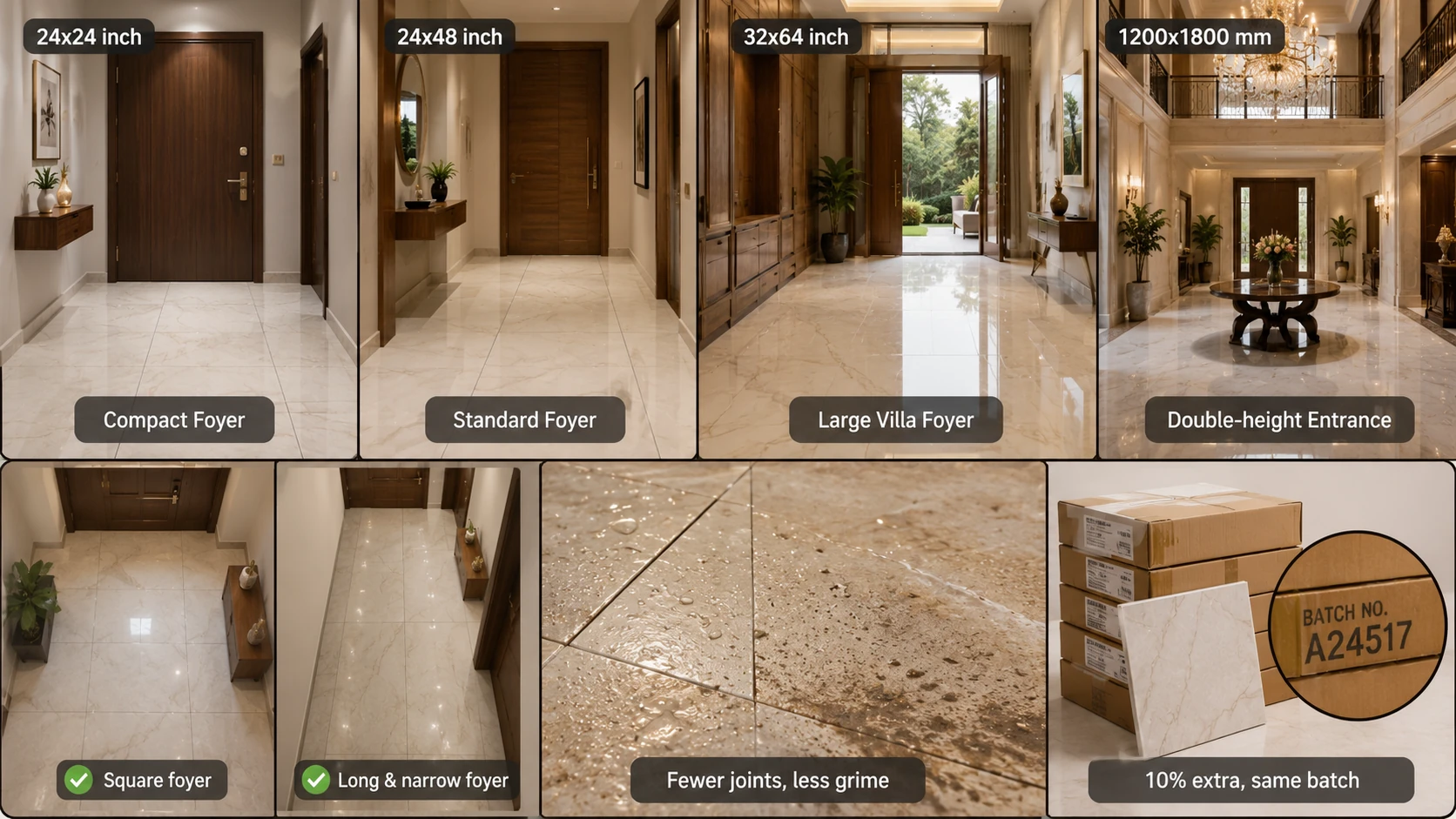
Foyer size decides which format looks balanced and how many grout lines you end up cleaning. Fewer joints mean fewer places for monsoon grime to settle.
| Foyer type | Suggested size | Why it works |
| Compact flat entrance (under 40 sq.ft) | 24x24 inch (600x600 mm) | Keeps proportions right, simple layout |
| Standard 2BHK or 3BHK foyer (40 to 90 sq.ft) | 24x48 inch (600x1200 mm) | Fewer joints, cleaner look |
| Large villa foyer (above 90 sq.ft) | 32x64 inch (800x1600 mm) | Slab effect, minimal grout |
| Double-height bungalow entrance | 1200x1800 mm (about 4x6 feet) | Grand single-slab feel |
Larger formats do work in small foyers when the room is fairly square, since fewer grout lines can make a compact space read bigger. In a long, narrow entrance, run the longer side of the tile along the length to stretch the space.
Pro tip: Order 10 per cent extra tiles from the same batch number. Shade shifts between batches, and a foyer is too visible to patch with a mismatched box later.
Tile dimensions and laying patterns can completely change how an entrance feels. Our Foyer Tile Size & Pattern Guide explains which tile sizes, layouts, and grout patterns work best for compact apartment entrances, standard foyers, and spacious villa entryways.
Laying and Sub-Floor Prep for a Wet Entrance
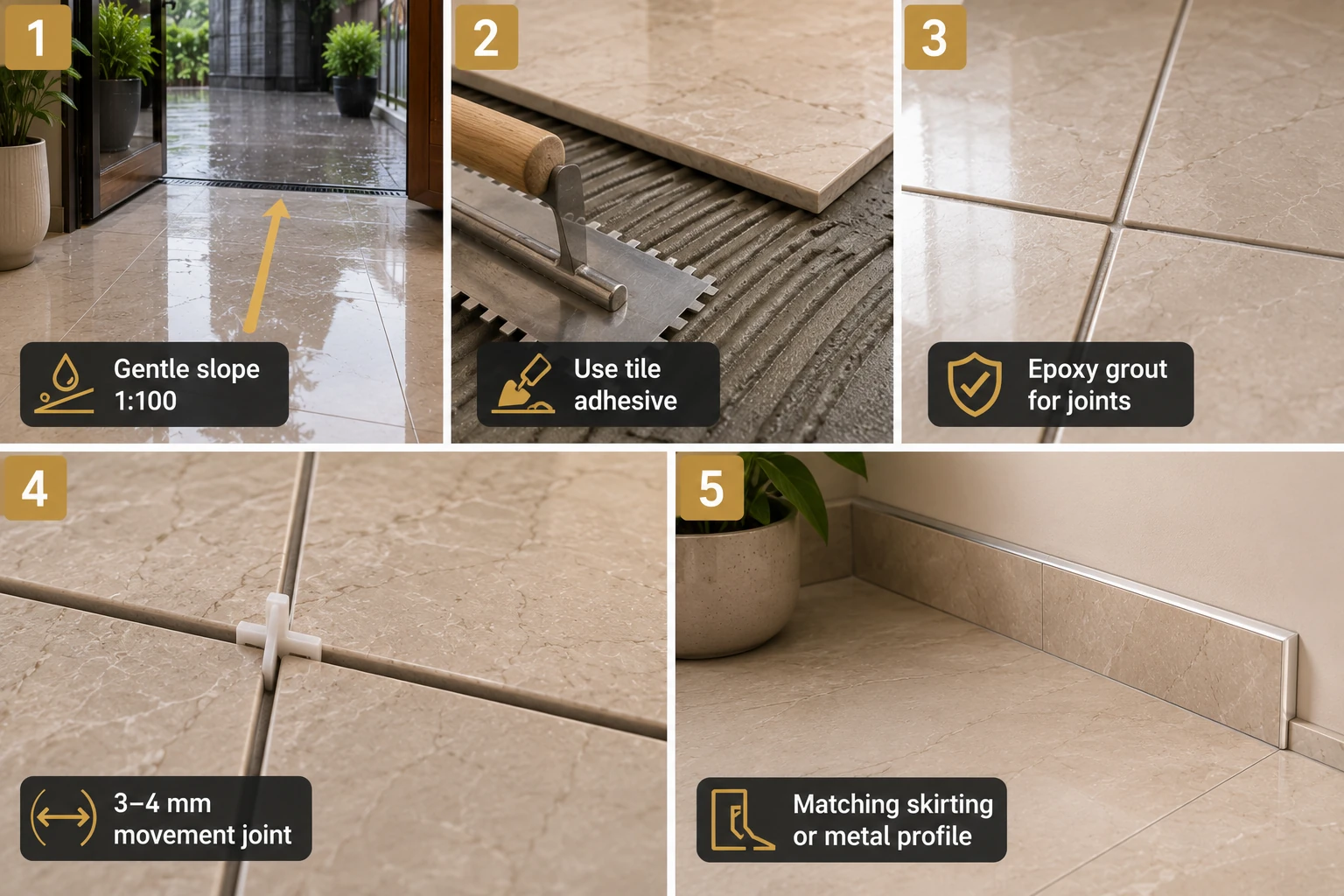
A monsoon-safe foyer is as much about the fitting as the tile. A few steps at the laying stage stop water from pooling and stop tiles from lifting later.
- Give the floor a gentle 1:100 slope away from the door towards a drain point or the outer edge, so rainwater runs off instead of standing.
- Use tile adhesive rather than the old sand-cement dab method for large formats, which stops hollow spots and cracks under heavy tiles.
- Fill the joints with epoxy grout, not cement grout. Epoxy stays sealed, resists staining, and does not soak up damp near the door.
- Keep a 3 mm to 4 mm joint on large slabs to allow for movement, and match the grout shade to the tile so the floor reads as one surface.
- Run a matching skirting or a slim metal profile at the wall so mop water and monsoon splash do not creep behind the plaster.
Keeping a Marble-Look Foyer Clean Through the Monsoon
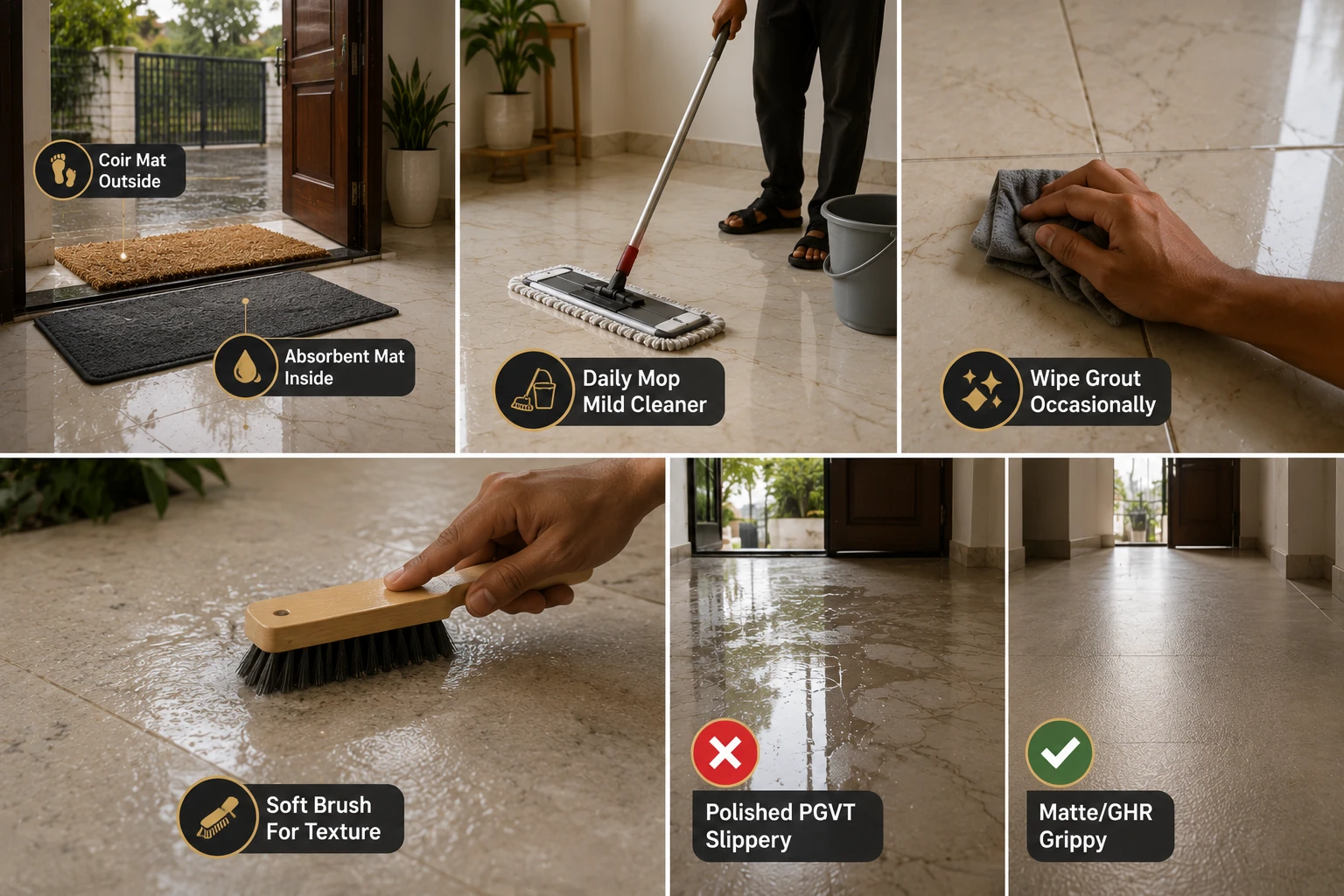
Matte and carved surfaces hide water spots better than gloss, but a wet entrance still needs a simple routine during the rains.
- Place an absorbent entry mat inside the door and a coir mat outside to catch most of the water and grit before it hits the tile.
- Mop daily in peak monsoon with a mild floor cleaner. Skip strong acids and harsh chemicals, which are not needed on vitrified tiles.
- Wipe the epoxy grout lines with a damp cloth now and then so grime does not settle in the joints.
- For sugar and textured finishes, use a soft brush occasionally to lift dust out of the fine texture.
Note: A polished PGVT floor near the door would need constant wiping to stay safe in the monsoon. A matte or GHR marble-look floor stays grippy even when you cannot dry it immediately, which is the real day-to-day advantage.
Cost Breakdown for a Marble-Look Foyer Floor
The tile is only part of the bill. Here is an indicative Gujarat and western India range, so you can budget the full job, not just the box price.
| Item | Indicative rate | Notes |
| Marble-look GVT tiles (2x2 to 2x4) | Rs. 55 to 160/sq.ft | Lower direct from Morbi manufacturers |
| Large-format or full-body slabs | Rs. 90 to 240/sq.ft | For villa and double-height foyers |
| Skilled tile laying (labour) | Rs. 25 to 45/sq.ft | Higher for large slabs and patterns |
| Epoxy grout (material and work) | Rs. 15 to 35/sq.ft | Worth it near a wet entrance |
| Wastage allowance | Add 10 per cent | Cuts, breakage, future patch stock |
For a typical 60 sq. ft. foyer with a mid-range matte marble-look tile, the tile plus laying plus epoxy grout usually lands somewhere around Rs. 110 to Rs. 200 per sq ft, all in, before you count skirting and the entry mat.
Common Mistakes Buyers Make
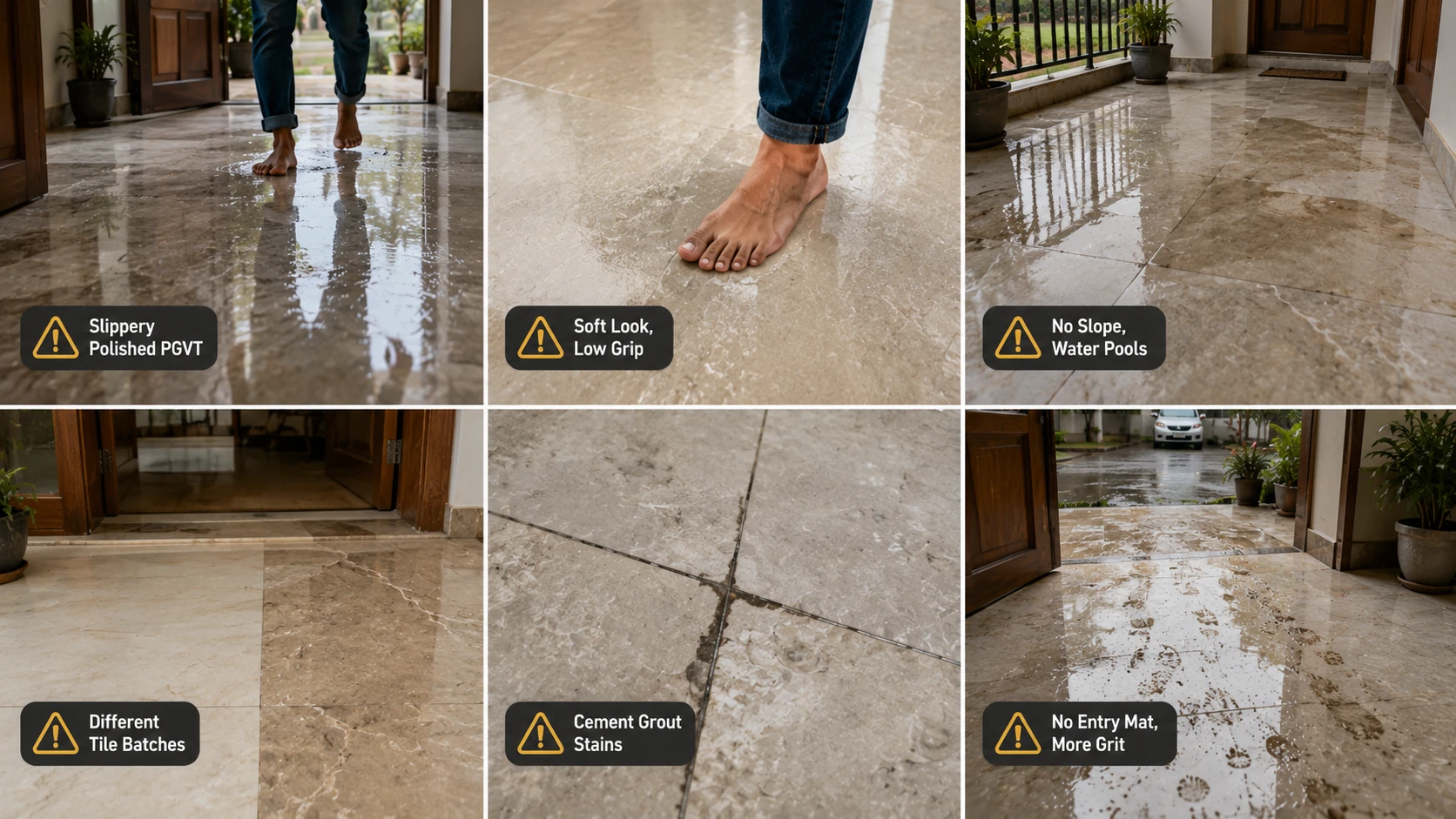
A few checks at the buying stage save trouble after the first heavy rain.
- Picking a PGVT marble tile for the floor because it looked best in the showroom, then facing a slippery entrance.
- Choosing satin matte or semi-polished and assuming the soft look means grip.
- Laying a sugar-finish tile dead flat with no slope, so water pools instead of draining.
- Buying tiles from two different batches and getting a visible shade line right at the door.
- Using cement grout at the entrance, which stains dark and soaks up damp within one monsoon.
- Skipping the entry mat, so grit scratches the surface and slush spreads across the whole floor.
Why a Morbi-Made Vitrified Foyer Lasts
Almost every marble-look vitrified tile you see in India is fired in Morbi, Gujarat, where the big plants run the glaze, carving, and GHR lines that create these anti-skid finishes. Being vitrified, the body absorbs close to 0.05 per cent water, which is why a Morbi-made foyer floor shrugs off the monsoon damp that would swell natural stone or a high-absorption ceramic.
Made to IS 15622:2006, a matte or GHR marble-look floor in the 24x24 inch (600x600 mm) to 24x48 inch (600x1200 mm) range lands between Rs. 55 and Rs. 160 per sq.ft from Gujarat suppliers. Add laying and epoxy grout, and you still have a safe, good-looking entrance for a fraction of what natural marble costs to buy, fit, seal, and polish year after year.
Planning a Monsoon-Ready Foyer
Shortlist two or three matte or GHR marble-look shades that match your door and wall colour, confirm the R-rating and wet DCOF with the dealer, and pick a size that keeps grout lines low for your foyer dimensions. You can compare marble-look tiles by finish, size, slip rating, and price across verified Morbi manufacturers on TilesFinders, and line up a slip-safe foyer floor before the next monsoon sets in.
FAQs
No. A matte, matte carving, or GHR marble-look tile keeps its grip even with rainwater on top. Only glossy, polished, satin matte, and semi-polished marble-look tiles turn slippery when wet, so those stay off a monsoon-exposed foyer floor.
Matte GVT and GHR are the safest finishes for a foyer floor. Both hold traction under monsoon water and come in wide marble-look ranges. Matte carving is a strong third choice, since its light surface relief adds extra grip.
Look for R10 or higher for a foyer that catches rain near the door. An R10 or R11 matte or GHR surface with a wet DCOF of 0.42 or more gives enough grip for a safe entrance. Ask the dealer to confirm both.
The 600x600 mm size fits most compact flat entrances. Standard 2BHK and 3BHK foyers look cleaner in 600x1200 mm, while large villa entrances suit 800x1600 mm for fewer grout lines.
Matte marble-look GVT tiles run about Rs. 55 to Rs. 130 per sq.ft in the 600x600 mm size. With laying and epoxy grout, a finished foyer floor usually costs around Rs. 110 to Rs. 200 per sq.ft, lower direct from Morbi.
No. PGVT marble-look tiles are polished and meant for walls or dry feature panels only. On a foyer floor that catches monsoon water, they turn slippery, so use a matte or GHR marble-look tile on the floor instead.
Marble-look vitrified tiles are the safer pick for a wet entrance. They absorb near 0.05 per cent water, need no sealing, and cost far less. Natural marble stains, etches, and needs regular sealing and polishing to survive the monsoon.
No. Matte marble-look tiles wipe clean with a regular mop and actually hide water spots and footmarks better than glossy tiles. A daily mop with mild floor cleaner keeps a foyer looking fresh through the monsoon.
Yes. Epoxy grout is strongly recommended for a foyer that sees monsoon water. It stays sealed, resists staining, and does not soak up damp the way cement grout does, so the joints near your entrance stay clean longer.
Mid grey and dark emperador hide slush, dust, and footmarks best for a busy monsoon entrance. White and ivory look brighter but show dirt faster, so pair light shades with a wide entry mat inside the door.
Yes. Larger formats work in small square foyers because fewer grout lines make the space read bigger. Use tile adhesive rather than the dab method for large slabs, and keep a 3 mm to 4 mm joint for movement.

See our tile guides first
Set TilesFinders as a preferred source and our buying guides surface ahead of the rest for you.
Add as preferred sourceTakes one tap. Nothing to install.
What Readers Say
I was about to redo my parking area with the wrong tile size until I read this. The layout comparisons saved me from a costly mistake.
We reference TilesFinders guides while briefing clients on material selection. The size and pattern breakdowns are accurate and easy to explain visually.
On site, I get asked about grout spacing all the time. This article gave me a solid reference I now share with my team before every job.
Finally a guide that doesn't just push generic advice. The oil stain removal steps actually worked on our clubhouse driveway tiles.
I run a small construction firm and now send this link to clients directly when they ask about entrance tile sizing. Saves me an hour of explaining.
Good practical detail, though I wish there were more examples for compact apartment entrances specifically, not just villas.
My mother-in-law wanted marble, I wanted vitrified. This blog gave us the neutral comparison we needed to actually decide together.
Detailed without being overwhelming. I appreciated that it covered both cost and maintenance, not just the aesthetics.
Used the algae and hard water removal tips on our terrace tiles after the monsoon. Worked better than what our regular cleaner was doing.
As someone who sources tiles for multiple builder projects, I find these comparisons genuinely useful for vendor conversations, not just consumer content.
Recommended this to a client who kept second-guessing the entrance design. The small vs large layout section settled the debate instantly.
Straightforward and honest, no unnecessary jargon. Would like to see a similar breakdown for outdoor pool-deck tiles next.
We've bookmarked several TilesFinders guides for our design handbook. Reliable source when clients want data, not just opinions.
Two paths, one marketplace.
Get free quotes from verified suppliers.
Share your room, budget, and style. Suppliers in Morbi respond within hours.
Get Free QuotesList your business, reach real buyers.
Put your showroom in front of homeowners searching for tiles right now.
List Your Business