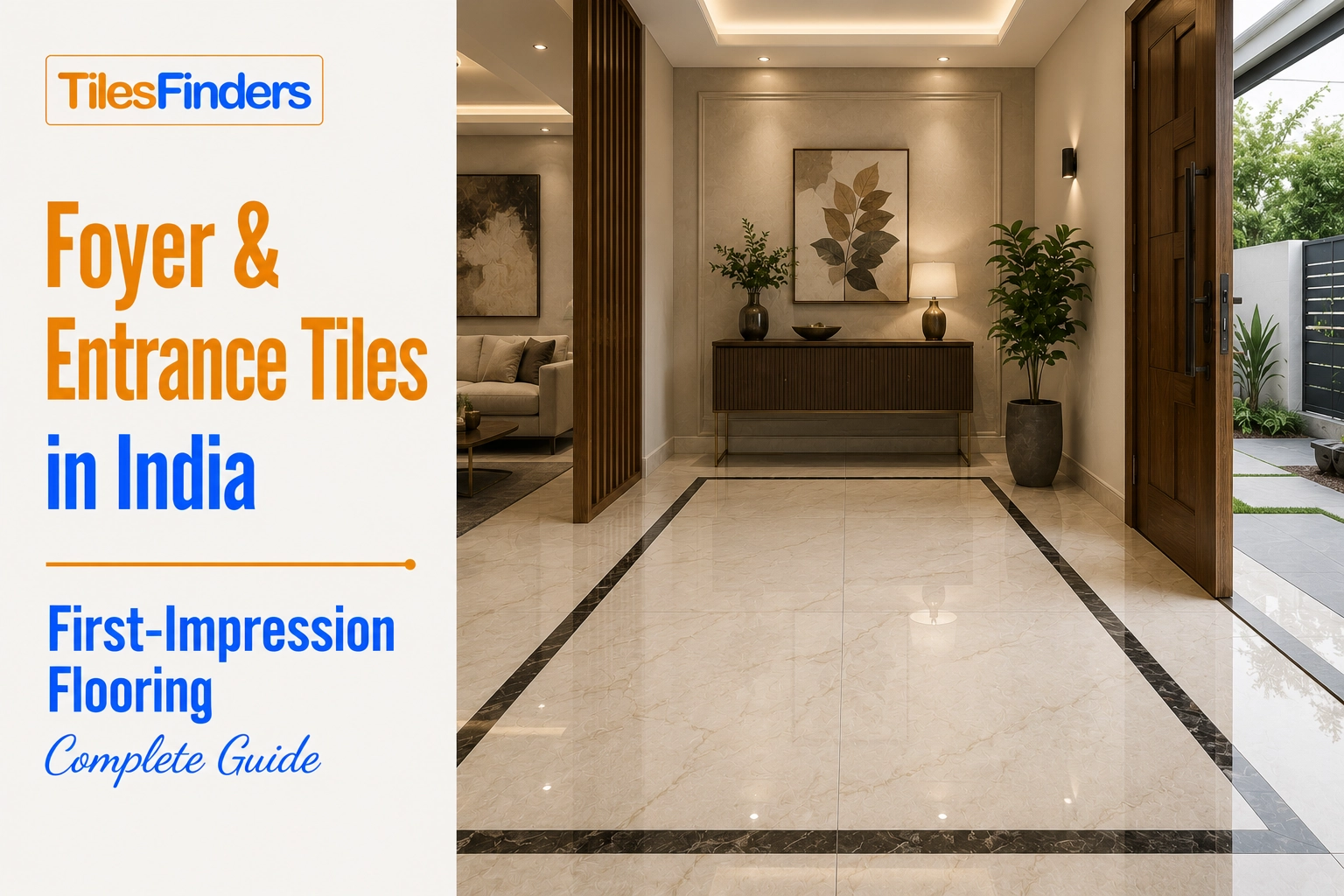
Foyer and Entrance Tiles in India: First-Impression Flooring Complete Guide
Choose the best foyer and entrance tiles for Indian homes with expert advice on anti-skid safety, Vastu, tile sizes, materials, design ideas, and buying tips for a lasting first impression.
- Why Foyer Floors Have Different Requirements Than Interior Rooms
- Vastu Significance of the Entrance Foyer
- Size Guide for Foyer and Entrance Tiles
- Material Comparison for Foyer Floors
- Foyer and Entrance Tile Design Ideas
- Buying Guide for Foyer and Entrance Tiles
- Foyer and Entrance Tiles in India: Manufacturing Context 2026
- Browse Foyer and Entrance Tiles on TilesFinders
Your foyer creates the home's first impression while handling wet footwear, heavy foot traffic, and daily wear. Choose anti-skid GVT or double charge tiles in the right size and finish for a safe, stylish, and durable entrance.
The entrance foyer is the only room in an Indian home that every single visitor experiences without exception, and it is judged in the first three seconds before anyone has said a word. It also happens to be the room with the most inconsistent floor demands: wet footwear during monsoon, direct sun exposure at open entrances, high foot traffic concentrated into a small area, and the design pressure of creating the right first impression.
This guide covers everything specific to foyer and entrance tiles in Indian homes: the safety considerations that differ from interior rooms, Vastu significance, size and material selection, design ideas, and the buying specifications that matter for this specific, high-consequence room.
Why Foyer Floors Have Different Requirements Than Interior Rooms
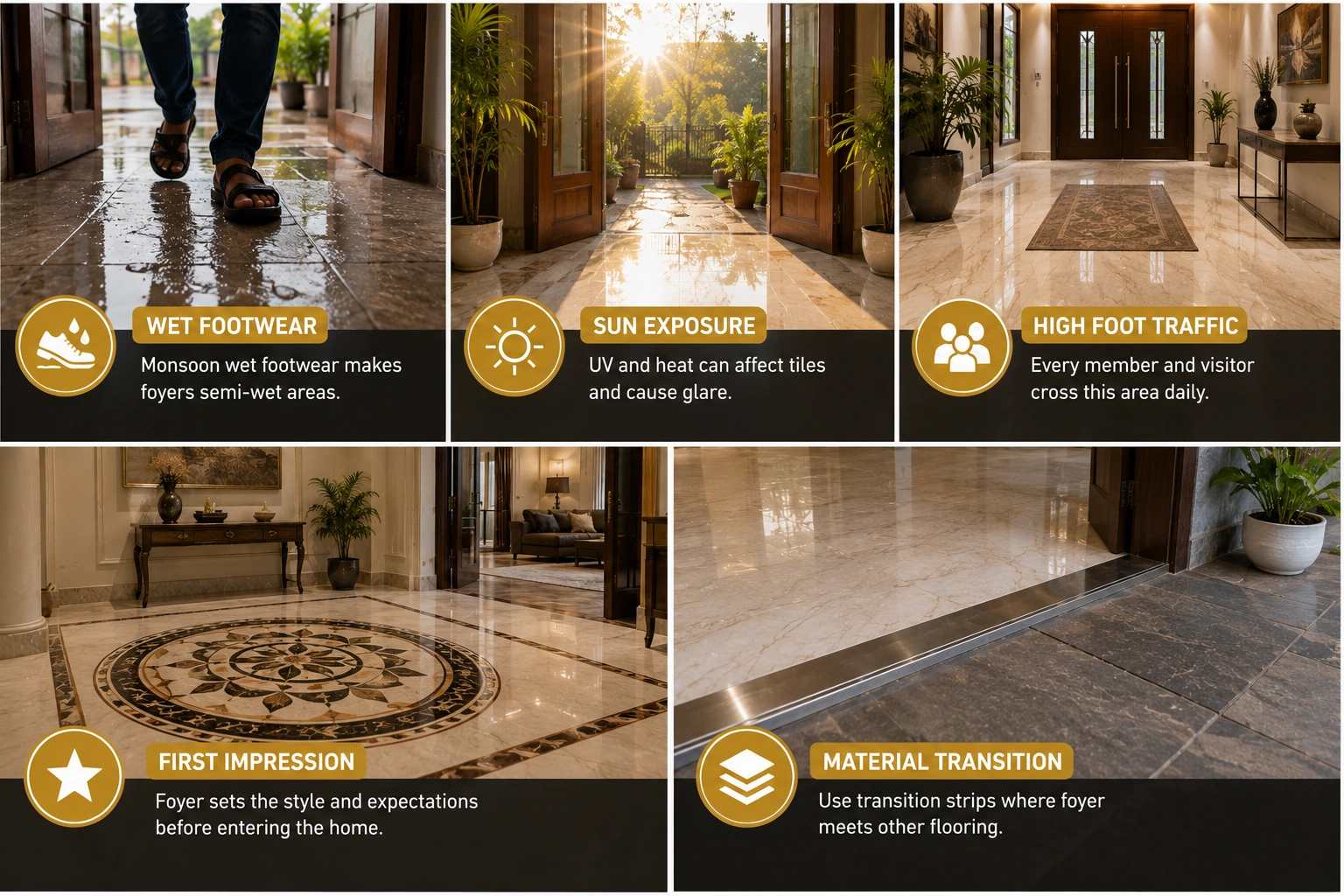
A foyer sits at the boundary between outside and inside, and this position creates a set of practical demands that do not apply to a living room or bedroom deeper in the home.
| Foyer Condition | Practical Implication | Tile Requirement |
| Monsoon wet footwear contact | Water tracked in from rain creates a genuinely wet floor condition, unlike a typical dry-area interior room. | Anti-skid rating recommended for any foyer, even one that appears dry most of the year. Confirm COF 0.4 wet minimum. |
| Direct or partial sun exposure at open entrances | UV exposure and heat can affect colour stability in some materials over the ears, and direct sun on a reflective floor can create glare at the entrance. | GVT at 0.05% water absorption is UV-stable. Avoid very high gloss finishes at entrances with direct sun exposure. |
| Concentrated high foot traffic | Every household member and every visitor crosses this specific floor area multiple times daily, concentrating wear more than any single interior room. | PEI 4 minimum. Consider double charge or full body construction for very high-traffic entrances. |
| First-impression design pressure | The foyer sets visual expectations for the rest of the home before a visitor sees any other room. | Design-forward material choices (marble-look, patterned inlay, statement borders) are more justified here than in lower-visibility interior rooms. |
| Transition zone between materials | The foyer often meets an outdoor porch or a different interior floor material at its boundaries. | Plan transition strips or threshold details at material junctions during the design phase, not as an afterthought during installation. |
Important distinction: Many buyers treat the entrance foyer as a dry-area room since it is technically inside the home, but a covered entrance receiving monsoon wet footwear traffic functions more like a semi-wet area than a true dry room, such as a bedroom. Confirm anti-skid COF specifically for any foyer, even one that looks completely dry in a showroom context. This single decision prevents the most common foyer-related slip incident in Indian homes.
Vastu Significance of the Entrance Foyer
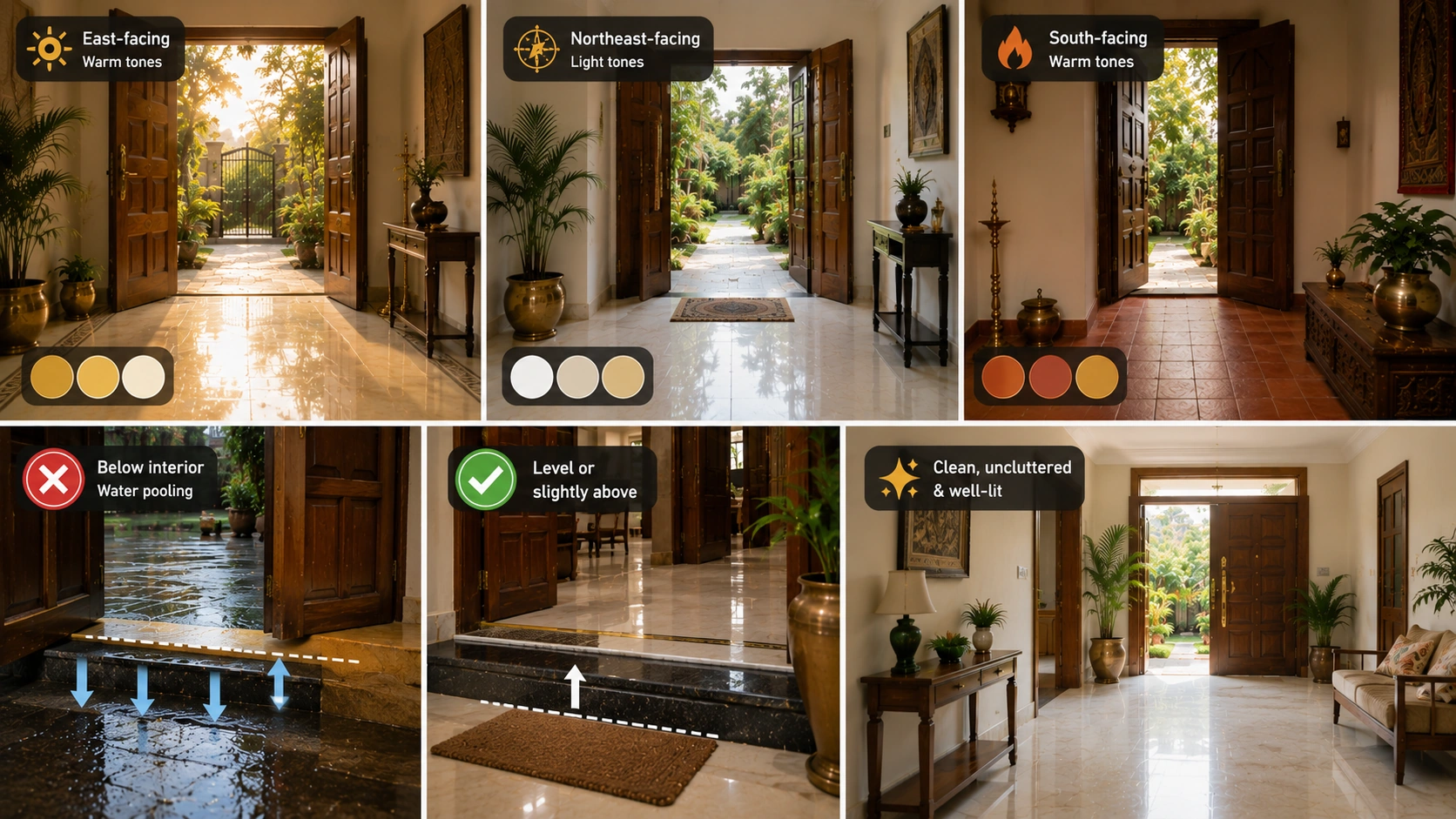
In Vastu Shastra, the main entrance is considered one of the most important zones in a home, governing the flow of energy into the household. This cultural and design significance is part of why Indian homeowners invest disproportionate design attention into a room that is often under 60 sq.ft.
- East-facing entrances are considered the most auspicious orientation in Vastu, associated with the rising sun and new beginnings. A golden, warm yellow, or ivory floor tone is commonly recommended to amplify this association.
- Northeast-facing entrances are linked to wisdom and clarity. White, ivory, and light tones are the traditional Vastu recommendation for this direction.
- South-facing entrances are associated with the fire element. Warm terracotta, red, or deep golden tones are considered harmonious here.
- Avoid a foyer floor level below the interior room level. Vastu principles generally recommend that the entrance floor be level with or slightly above the interior floor level, not below it, which is also a practical consideration for preventing water pooling at the threshold during the monsoon.
- A clean, uncluttered, well-lit foyer is considered important in Vastu regardless of specific colour or direction guidance, reinforcing the practical design principle that a foyer should read as open and welcoming rather than crowded with pattern or furniture.
Size Guide for Foyer and Entrance Tiles
| Size | Best Foyer Type | Design Effect |
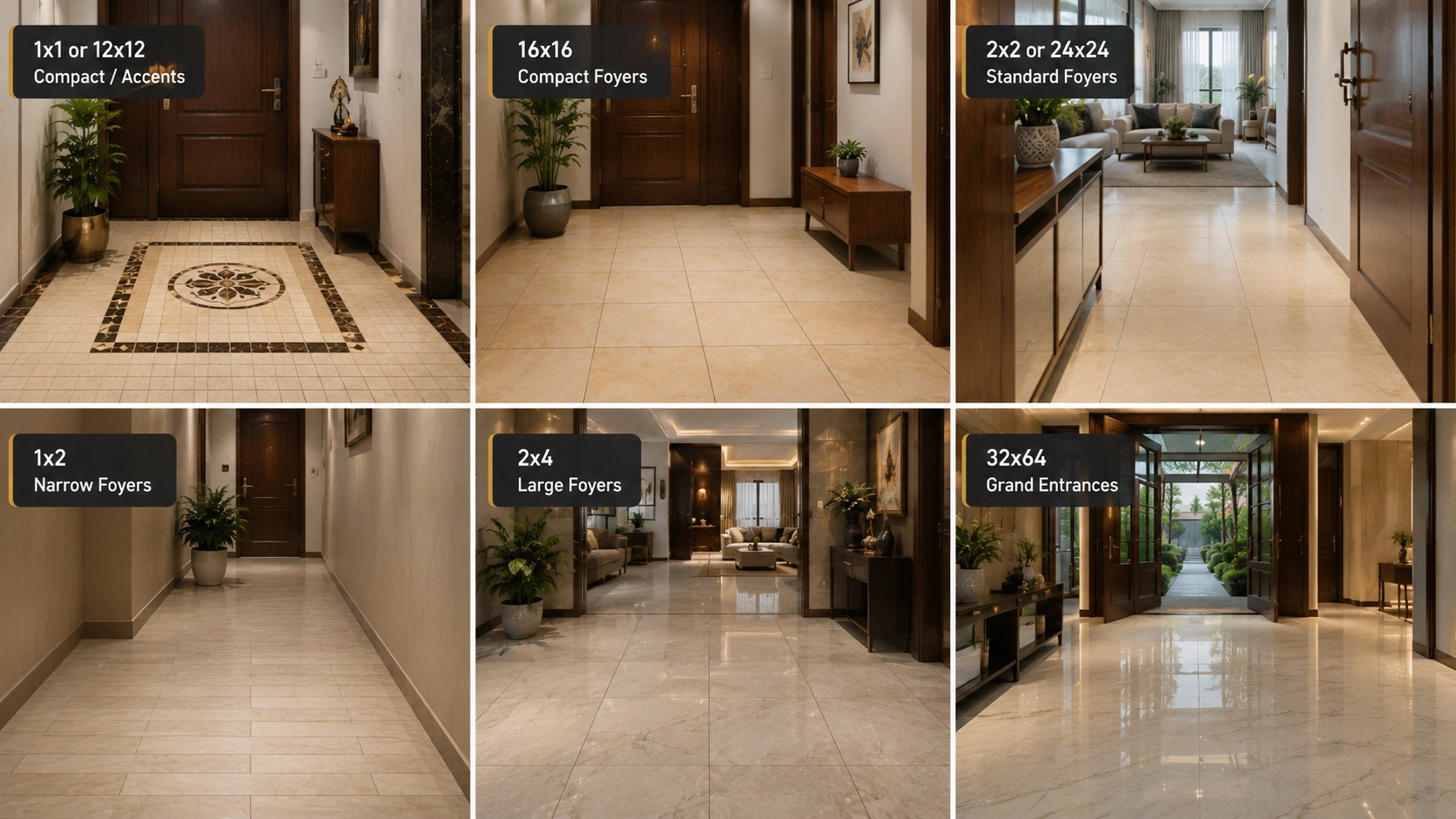
| 1x1 or 12x12 (300x300 mm) | Very compact foyers under 30 sq. ft., or as border and inlay accent pieces | Allows detailed pattern and medallion work at a small scale |
| 16x16 (400x400 mm) | Compact foyers, 30 to 45 sq.ft | Balanced grid, moderate grout line count |
| 2x2 or 24x24 (600x600 mm) | Standard Indian apartment foyers, 30 to 60 sq.ft | The most common foyer format is clean and proportionate |
| 1x2 (300x600 mm) | Narrow or corridor-style foyers | Directional format that can visually elongate a narrow entrance |
| 2x4 (600x1200 mm) | Larger foyers above 60 sq. ft., open-plan entrances | Fewer grout lines read as more continuous and formal |
| 32x64 (800x1600 mm) | Grand entrances in independent homes and villas | Near-seamless slab-like read, the most premium foyer specification |
Note: The 2x2 or 24x24 (600x600 mm) format is the practical default for the overwhelming majority of Indian apartment foyers, which typically range from 25 to 60 sq.ft. Larger formats like 2x4 tiles (600x1200 mm) and above are reserved for independent homes and villas with a genuinely larger entrance footprint, since a large-format tile in a very compact foyer produces excessive and awkward edge cuts.
Material Comparison for Foyer Floors
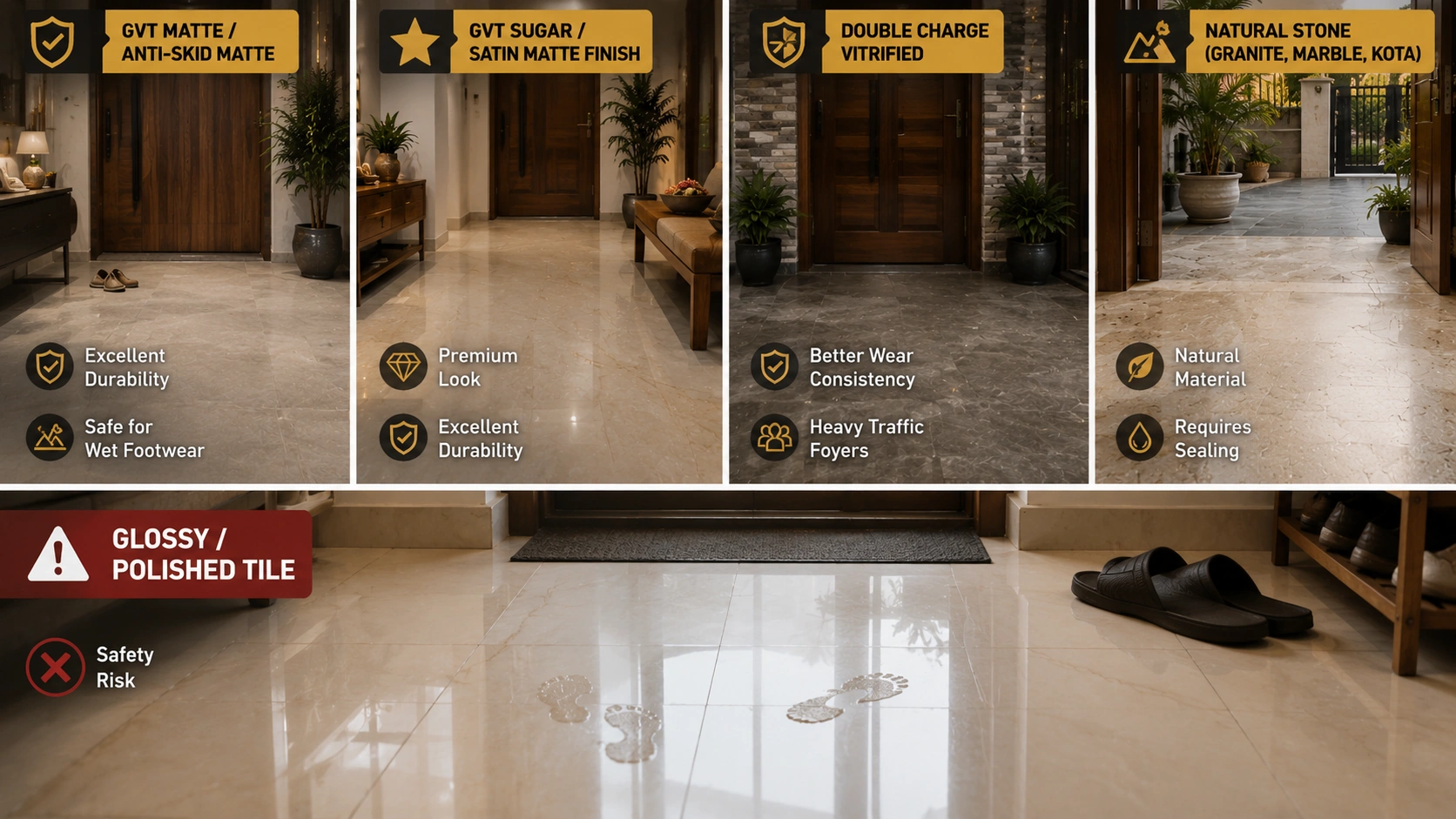
| Material | Durability for High Foot Traffic | Design Range | Price Range | Best For |
| GVT, matte or anti-skid matte | Excellent. PEI 4 handles concentrated foyer traffic well. The anti-skid variant manages monsoon wet footwear safely. | Widest design range, including marble-look, stone-look, and plain colours | Rs. 70 to Rs. 160/sq.ft | The default recommendation for most Indian apartment and independent home foyers |
| GVT, sugar or satin matte finish | Excellent. Same durability as standard matte with added refinement. | Wide range in marble-look and warm neutral designs | Rs. 85 to Rs. 220/sq.ft | Premium foyers where the finish itself is part of the design statement, provided anti-skid COF is separately confirmed if wet contact is expected |
| Double charge vitrified | Excellent, with better long-term wear consistency than standard GVT at high-contact points near the door. | Moderate range, primarily stone-look and marble-look | Rs. 90 to Rs. 165/sq.ft | Foyers with very heavy daily traffic, large households, or frequent visitors |
| Natural stone (granite, marble, Kota) | Good to excellent depending on stone type, but requires sealing and periodic maintenance. | Authentic natural variation, premium material character | Rs. 90 to Rs. 250/sq.ft | Independent homes and villas where natural material authenticity is the specific brief and sealing maintenance is accepted |
| Glossy or polished tile | Not recommended for foyer floors. | N/A | N/A | Not suitable. The combination of monsoon wet footwear and low wet COF makes glossy and polished tile a genuine safety risk at any entrance. |
Foyer and Entrance Tile Design Ideas
Idea 1: Ivory Marble-Look Anti-Skid Foyer
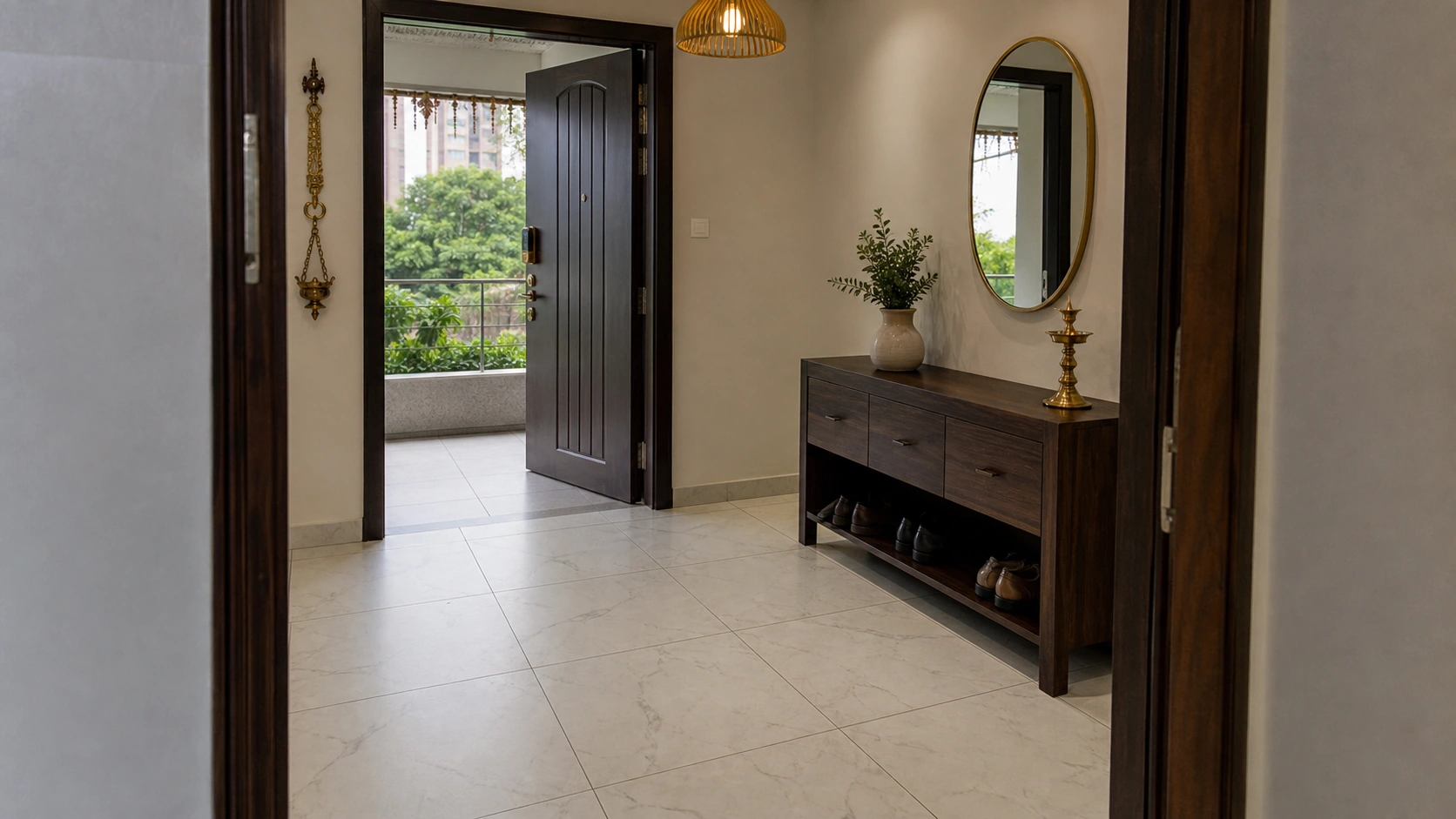
Ivory marble-look GVT | 2x2 or 24x24 (600x600 mm) | Anti-skid matte | Rs. 90 to Rs. 150/sq.ft
An ivory marble-look anti-skid GVT tile in the foyer creates a formal, welcoming arrival moment while safely managing monsoon wet footwear traffic. Under a statement pendant light, the marble print reads clearly at the compact foyer scale of 25 to 60 sq.ft. This is the most widely specified foyer combination in Indian apartment renovations, balancing design ambition with genuine floor safety.
Idea 2: Black and White Checkerboard Foyer
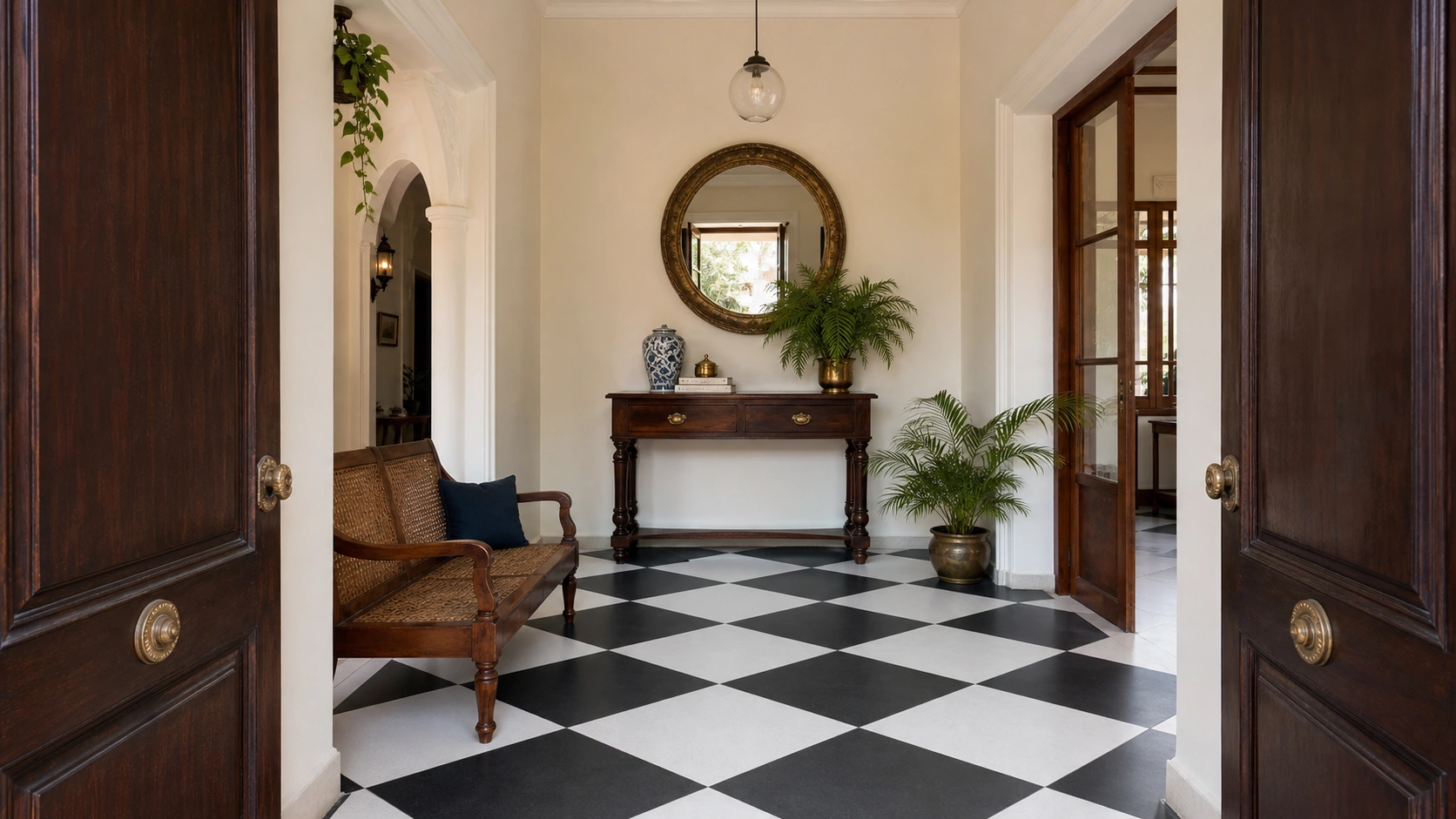
White anti-skid GVT + black anti-skid GVT | 2x2 or 24x24 (600x600 mm) | Anti-skid matte | Rs. 85 to Rs. 145/sq.ft combined
A black and white checkerboard laid on a 45-degree diagonal is one of the most classically formal entrance patterns, referencing both colonial bungalow entrance halls and contemporary heritage design. The diagonal orientation makes a compact foyer read as larger, and using anti-skid matte in both colours ensures the graphic pattern does not compromise the floor's monsoon safety.
Idea 3: Golden Yellow Vastu-Aligned Entrance
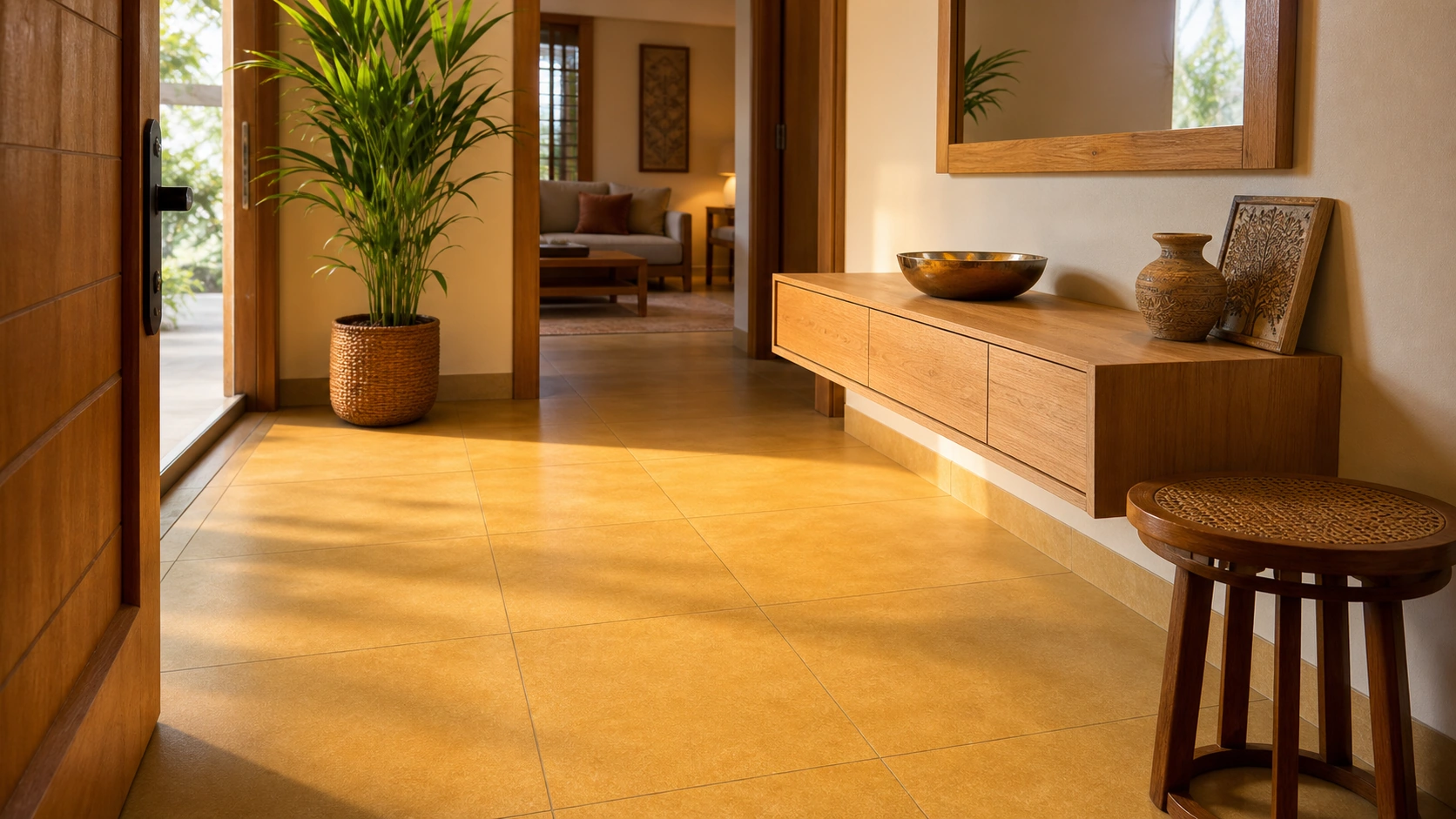
Golden yellow or warm ochre anti-skid GVT | 2x2 or 24x24 (600x600 mm) | Anti-skid matte | Rs. 65 to Rs. 130/sq.ft
A golden yellow or warm ochre floor at an east-facing entrance aligns with Vastu guidance for this orientation while delivering a warm, welcoming visual quality. The anti-skid specification manages the wet footwear risk that a true dry-area interior room does not need to consider, making this the correct combination of cultural alignment and practical safety.
Idea 4: Terracotta Border on Cream Field Foyer
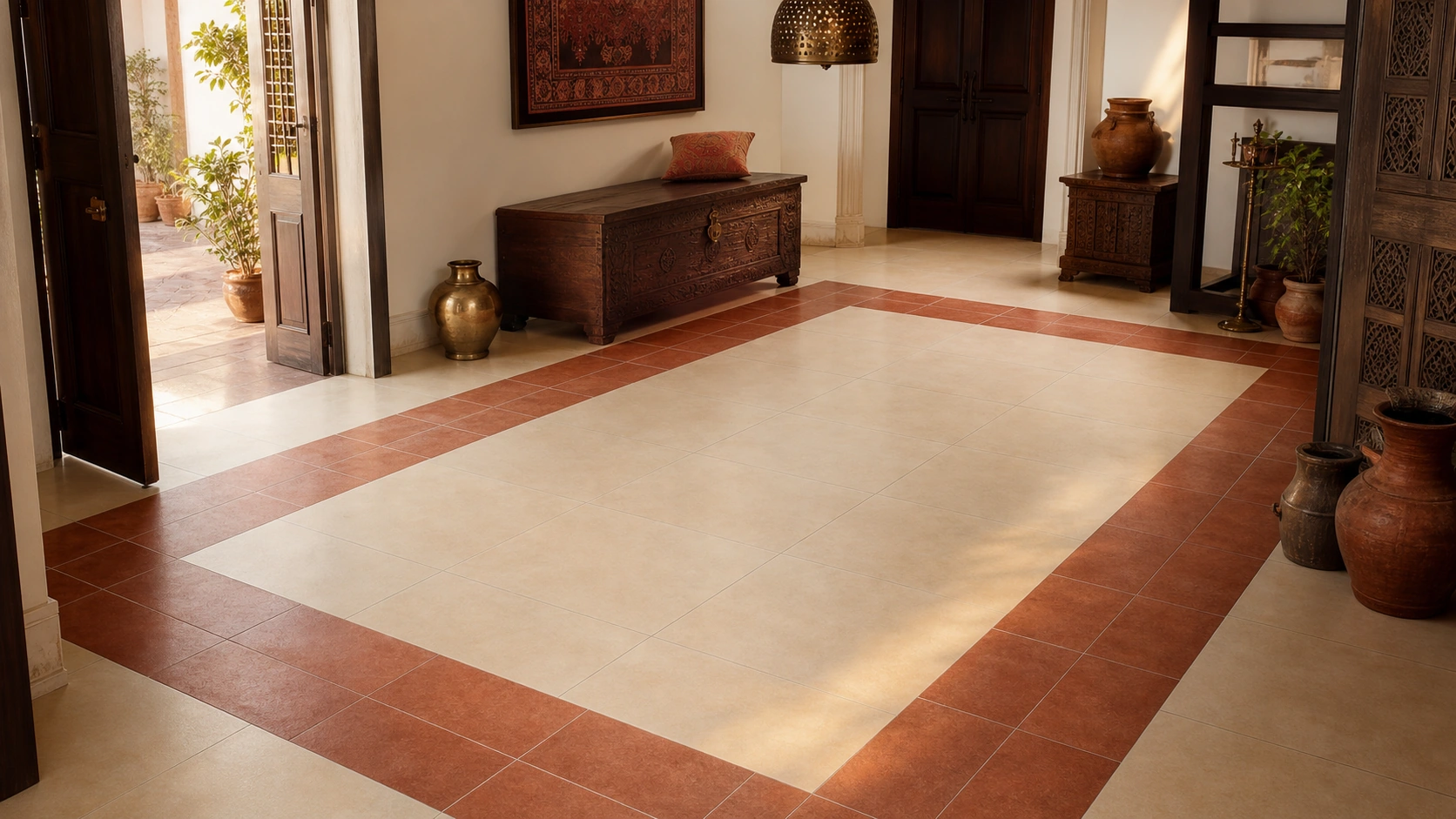
Cream anti-skid GVT field + terracotta border tiles | 2x2 or 24x24 (600x600 mm) field, 1x2 (300x600 mm) border | Anti-skid matte | Rs. 75 to Rs. 140/sq.ft combined
A cream field floor with a terracotta-tone border running two tiles deep at the room perimeter references the traditional Indian framed entrance floor, common in havelis and bungalow entrance halls. The border concentrates colour at the room's edge, framing the space without covering the full floor in a strong tone.
Idea 5: Large-Format Slab Foyer for Independent Homes
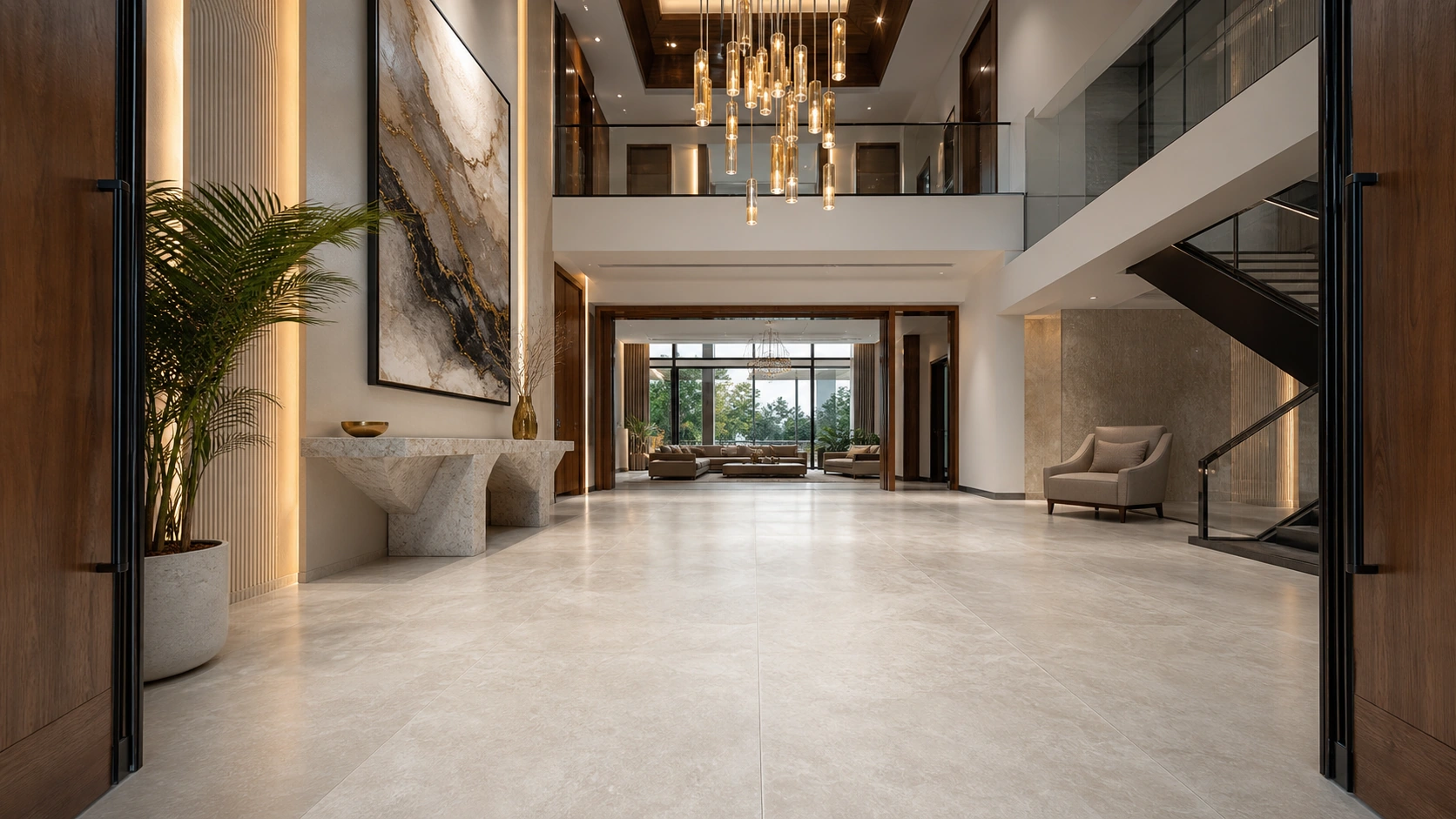
Ivory or grey marble-look GVT | 32x64 (800x1600 mm) | Anti-skid matte or confirmed anti-skid satin | Rs. 150 to Rs. 220/sq.ft
A large-format slab tile in a grand entrance foyer of an independent home or villa creates a near-seamless, luxury arrival surface with minimal grout lines. This format suits entrances above 80 sq. ft. where the scale of the space supports large-format tile proportions without excessive edge cutting. Confirm anti-skid COF specifically, since large-format premium finishes do not automatically carry this rating.
Idea 6: Gold Geometric Inlay Foyer Medallion
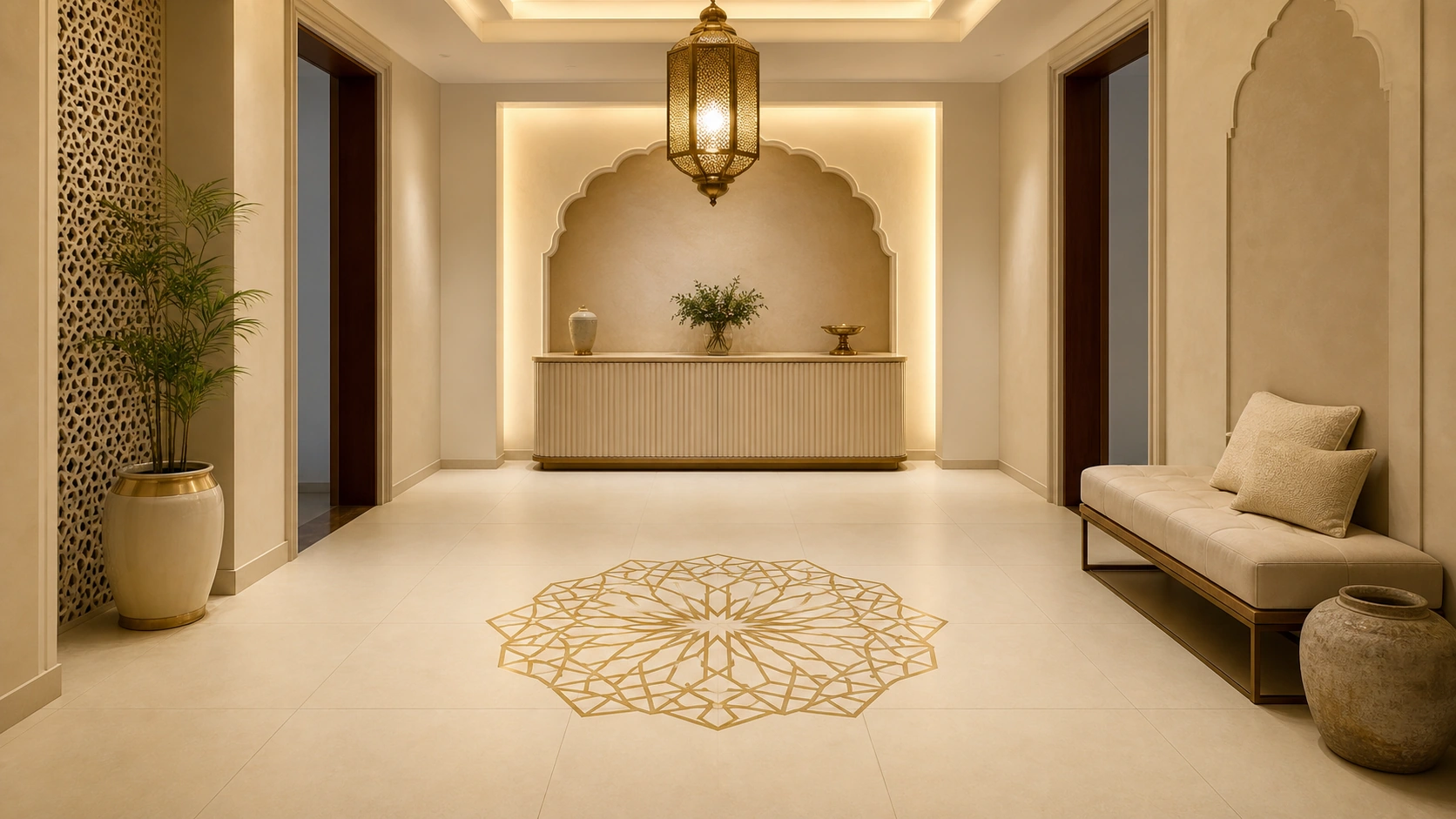
Ivory or cream GVT field + gold-tone cut inlay pieces | 2x2 or 24x24 (600x600 mm) field | Anti-skid matte | Rs. 90 to Rs. 155/sq.ft combined
A central geometric medallion assembled from gold-tone cut GVT pieces set into a plain ivory or cream field creates the most decoratively ambitious foyer floor available at a moderate budget. This design references Mughal architectural inlay work and reads as a considered, high-intention arrival design the moment a visitor enters.
Buying Guide for Foyer and Entrance Tiles
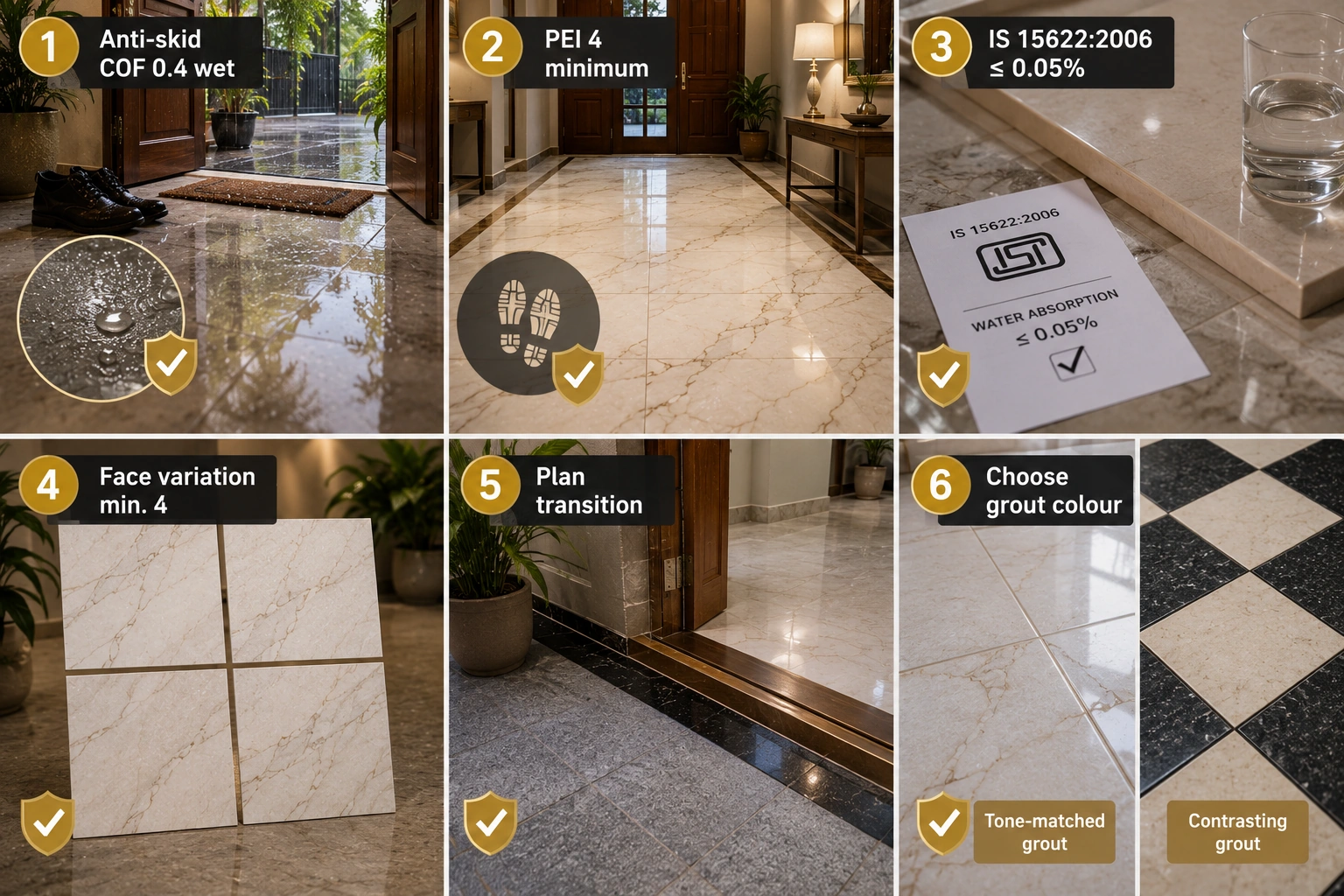
- Confirm anti-skid COF for the specific foyer, even if it appears dry. Any entrance exposed to monsoon wet footwear should carry a confirmed COF of 0.4 wet minimum, regardless of how the tile is marketed or displayed in a showroom.
- Confirm PEI 4 minimum for concentrated foot traffic. For very high-traffic entrances in large households or frequently visited homes, consider double charge construction for better long-term wear consistency.
- Confirm IS 15622:2006 compliance and water absorption at 0.05% or below for GVT.
- Confirm face variation count for marble-look and patterned designs. Minimum 4 for foyers above 40 sq. ft., since a repeating pattern is more noticeable in a small, frequently viewed space than in a large room.
- Plan the threshold and transition detail before ordering. Confirm how the foyer tile meets any adjoining porch, outdoor step, or interior floor material, and specify an appropriate transition strip or level detail at the design stage.
- Choose the grout colour to match the design intention. A tone-matched grout for a formal marble-look foyer; a contrasting grout for a graphic pattern like a checkerboard. Decide this before ordering, not during installation.
Foyer and Entrance Tiles in India: Manufacturing Context 2026
Foyer and entrance tiles across the material range covered in this guide are predominantly manufactured in Morbi, Gujarat, which produces over 70% of India's vitrified tile supply, in accordance with IS 15622:2006, with a water absorption rate of 0.05% or below for GVT products. The 2x2 or 24x24 (600x600 mm) anti-skid matte format is the highest-volume foyer specification from Morbi manufacturers, reflecting its status as the practical default for the majority of Indian apartment entrance sizes. Natural stone foyer materials, such as Kota stone and Indian granite, are sourced from Rajasthan and southern Indian quarries, respectively. Both require sealing and maintenance considerations that GVT does not.
In coastal Indian cities with monsoon humidity of 85 to 95% from June to September, GVT foyer tiles at 0.05% absorption perform without staining or maintenance overhead, while natural stone foyer materials in the same climate require more frequent resealing than in drier inland regions to maintain their anti-slip surface treatment and prevent water absorption at the entrance threshold.
Browse Foyer and Entrance Tiles on TilesFinders
Anti-skid marble-look, stone-look, and plain GVT for entrance foyers, from budget to premium slab formats, are available on TilesFinders from verified Morbi manufacturers. Confirm anti-skid COF for any foyer with monsoon wet footwear exposure before ordering.
FAQs
2x2 or 24x24 (600x600 mm) is the practical default for most Indian apartment foyers, which typically range from 25 to 60 sq. t. Larger formats like 2x4 (600x1200 mm) or 32x64 (800x1600 mm) suit larger entrance areas in independent homes and villas above 60 to 80 sq.ft.
Yes, for any foyer exposed to monsoon wet footwear traffic, which is the majority of Indian entrances. Confirm a wet COF of 0.4 minimum from the tile's technical data sheet. Treating the foyer as a fully dry interior room is a common mistake that overlooks the genuine wet-contact risk this transitional space carries.
Golden yellow or warm ochre for east-facing entrances, white or ivory for northeast-facing entrances, and warm terracotta or red tones for south-facing entrances are the traditional Vastu recommendations. A clean, uncluttered, well-lit foyer is considered important regardless of specific colour choice.
Not recommended. The combination of monsoon wet footwear contact and the low wet coefficient of friction in glossy and polished tiles creates a genuine slip risk at the entrance, which is one of the highest foot-traffic zones in any Indian home. Anti-skid matte, sugar finish, or satin matte with confirmed anti-skid COF are the safer specifications.
Anti-skid matte GVT for foyers ranges from Rs. 70 to Rs. 160 per sq.ft, depending on design. Sugar or satin matte finish ranges from Rs. 85 to Rs. 220 per sq.ft. Double charge vitrified ranges from Rs. 90 to Rs. 165 per sq.ft. Natural stone ranges from Rs. 90 to Rs. 250 per sq.ft, depending on stone type and finish.
Minimum 4 face variations for a foyer above 40 sq.ft. Since a foyer is viewed frequently and at close range every time someone enters or exits the home, a repeating pattern is often more noticeable here than in a larger, less frequently scrutinised room.

See our tile guides first
Set TilesFinders as a preferred source and our buying guides surface ahead of the rest for you.
Add as preferred sourceTakes one tap. Nothing to install.
What Readers Say
I was about to redo my parking area with the wrong tile size until I read this. The layout comparisons saved me from a costly mistake.
We reference TilesFinders guides while briefing clients on material selection. The size and pattern breakdowns are accurate and easy to explain visually.
On site, I get asked about grout spacing all the time. This article gave me a solid reference I now share with my team before every job.
Finally a guide that doesn't just push generic advice. The oil stain removal steps actually worked on our clubhouse driveway tiles.
I run a small construction firm and now send this link to clients directly when they ask about entrance tile sizing. Saves me an hour of explaining.
Good practical detail, though I wish there were more examples for compact apartment entrances specifically, not just villas.
My mother-in-law wanted marble, I wanted vitrified. This blog gave us the neutral comparison we needed to actually decide together.
Detailed without being overwhelming. I appreciated that it covered both cost and maintenance, not just the aesthetics.
Used the algae and hard water removal tips on our terrace tiles after the monsoon. Worked better than what our regular cleaner was doing.
As someone who sources tiles for multiple builder projects, I find these comparisons genuinely useful for vendor conversations, not just consumer content.
Recommended this to a client who kept second-guessing the entrance design. The small vs large layout section settled the debate instantly.
Straightforward and honest, no unnecessary jargon. Would like to see a similar breakdown for outdoor pool-deck tiles next.
We've bookmarked several TilesFinders guides for our design handbook. Reliable source when clients want data, not just opinions.
Two paths, one marketplace.
Get free quotes from verified suppliers.
Share your room, budget, and style. Suppliers in Morbi respond within hours.
Get Free QuotesList your business, reach real buyers.
Put your showroom in front of homeowners searching for tiles right now.
List Your Business