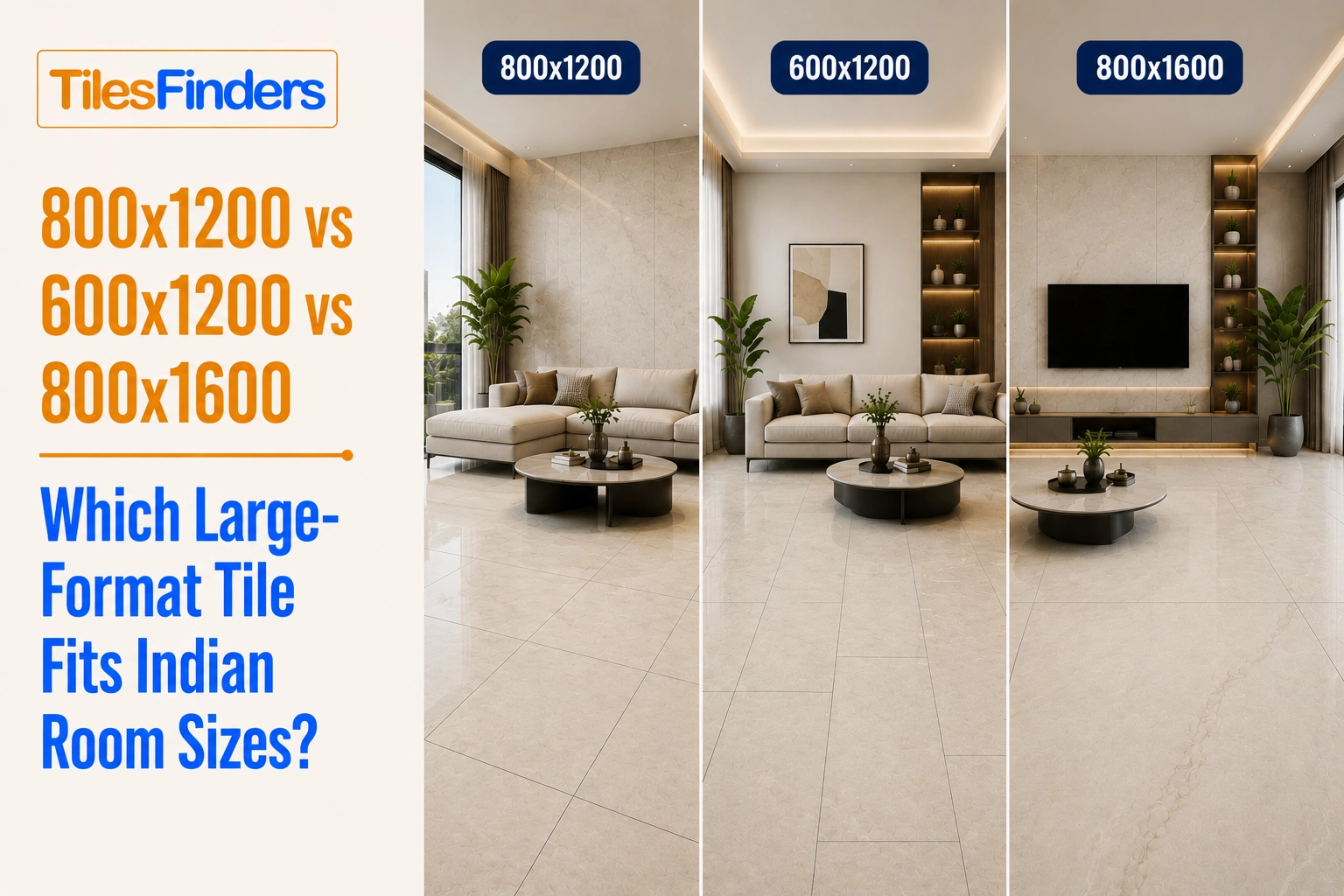
800x1200 vs 600x1200 vs 800x1600: Which Large-Format Tile Fits Indian Room Sizes
A direct three-way comparison of 600x1200 mm, 800x1200 mm, and 800x1600 mm tiles for Indian homes. Covers which size fits which room dimension, weight and installation differences, structural load, and price across all three.
- The Three Sizes at a Glance
- Room-by-Room: Which Size Fits Which Indian Room
- 800x1200 vs 600x1200: Head to Head
- 800x1200 vs 800x1600: Head to Head
- 600x1200 vs 800x1600: The Extremes Compared
- Slab Flatness and Structural Load Across All Three Sizes
- Price Comparison: All Three Sizes Side by Side
- Common Mistakes When Choosing Between These Sizes
- Find All Three Sizes With Confirmed Stock
800x1200 mm fits most Indian living rooms (180-250 sq.ft), 600x1200 mm suits budget bedrooms, and 800x1600 mm is best for open-plan spaces above 250 sq.ft with a flat slab.
Three large-format tile sizes dominate the upper end of the Indian residential tile market: 600x1200 mm, 800x1200 mm, and 800x1600 mm tiles. Each carries genuine trade-offs in weight, price, installation demand, and how it reads on the floor of an actual Indian room rather than a showroom display.
Most comparison content online treats this as a two-way choice, usually 600x1200 mm against 800x1200 mm, and stops there. The reality is that most Indian buyers are choosing between three live options, and the right answer changes depending on room dimensions, slab condition, and budget, not personal taste alone.
This guide puts all three sizes side by side directly, room type by room type, so the comparison maps to an actual floor plan rather than a generic size chart.
The Three Sizes at a Glance
Before getting into room-specific recommendations, the baseline numbers for each size need to sit next to each other. These three figures, coverage per tile, weight per tile, and price premium, drive almost every other decision in this comparison.
Coverage, Weight, and Tile Count Per Size
| Size | Coverage per Tile | Weight per Tile | Tiles for 200 sq.ft (before wastage) | Installers Needed |
|---|---|---|---|---|
| 600x1200 mm | 0.72 sq.ft | 14 to 17 kg | 278 tiles | 2 |
| 800x1200 mm | 0.96 sq.ft | 18 to 24 kg | 209 tiles | 2 |
| 800x1600 mm | 1.28 sq.ft | 22 to 28 kg | 157 tiles | 3 to 4 |
The tile count column matters more than buyers usually expect. Fewer tiles means fewer grout lines, but it also means each tile failure (a crack, a chip, a colour mismatch) covers a larger share of the visible floor. A cracked 600x1200 mm tile affects 0.72 sq.ft of the room. A cracked 800x1600 mm tile affects 1.28 sq. ft., nearly double the visual impact of a single defect.
Why These Three Sizes Specifically Compete With Each Other
600x1200 mm, 800x1200 mm, and 800x1600 mm all share design DNA. Each is a rectangular format (not square), each is produced in the same matte finish, glossy, stone, and marble-look finishes by the same Morbi and Gujarat manufacturers, and each targets the same buyer: someone who has decided against 600x600 mm tiles and wants a more continuous, premium-reading floor.
1200x1800 mm tiles and larger sizes pull out of this competition entirely. At 40 to 55 kg per tile, that category requires mechanical handling and a different class of structural assessment, putting it out of reach for the large majority of Indian residential projects, regardless of budget.
Room-by-Room: Which Size Fits Which Indian Room
Room dimensions, not personal preference, should be the first filter in this decision. The table below maps Indian room categories to the sizes that work without excessive cutting, waste, or proportion mismatch.
Small Bedrooms (Under 120 sq.ft)
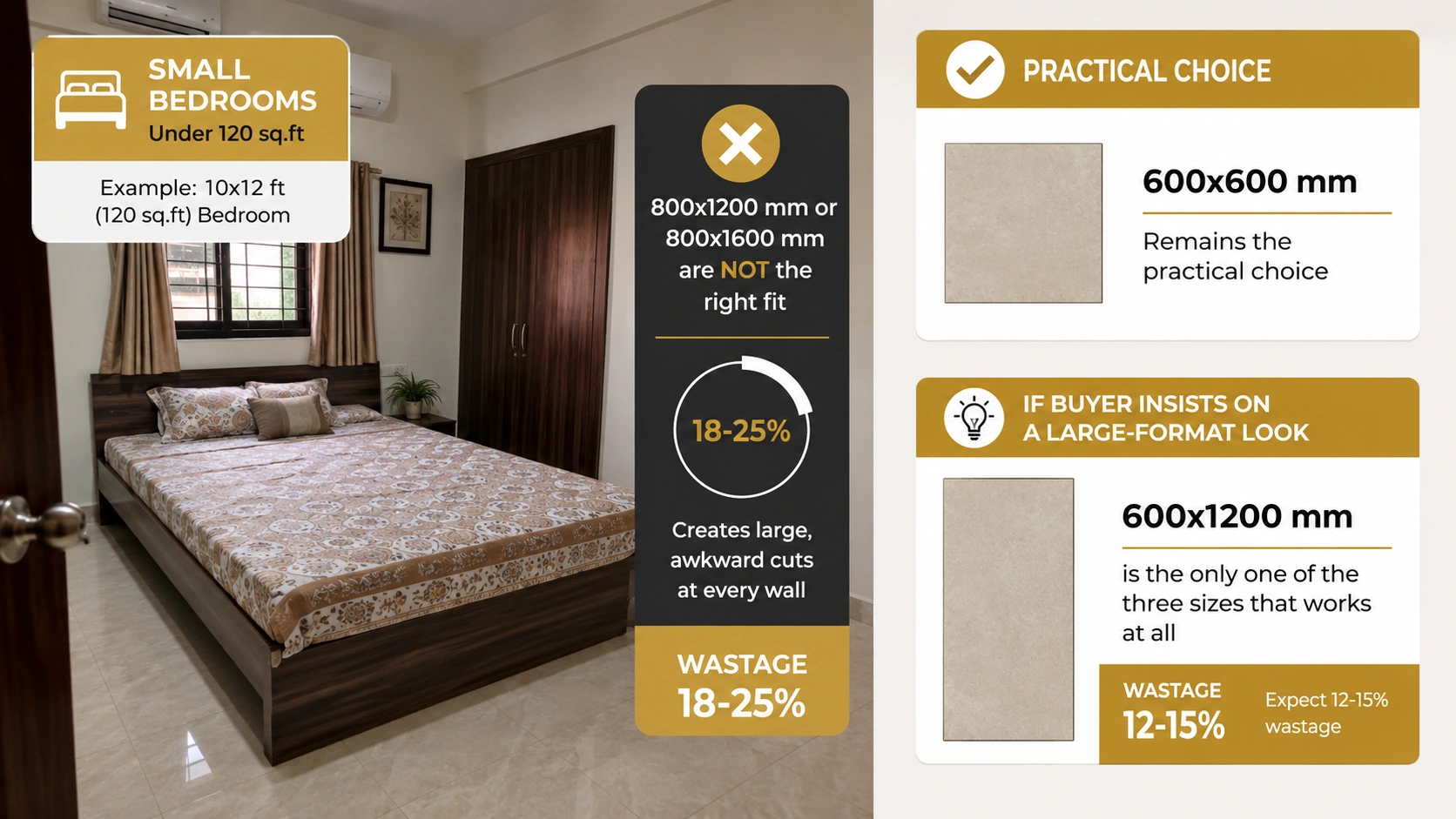
None of these three sizes is the right fit here. A 10x12 ft (120 sq.ft) bedroom with 800x1200 mm or 800x1600 mm tiles creates large, awkward cuts at every wall, often wasting 18 to 25% of tile material. 600x600 mm remains the practical choice for rooms this size.
If a buyer insists on a large-format look in a small bedroom, 600x1200 mm is the only one of the three sizes that works at all, and even then, expect 12 to 15% wastage rather than the 8 to 10% typical in a properly sized room.
Medium Bedrooms and Box Rooms (120 to 180 sq.ft)
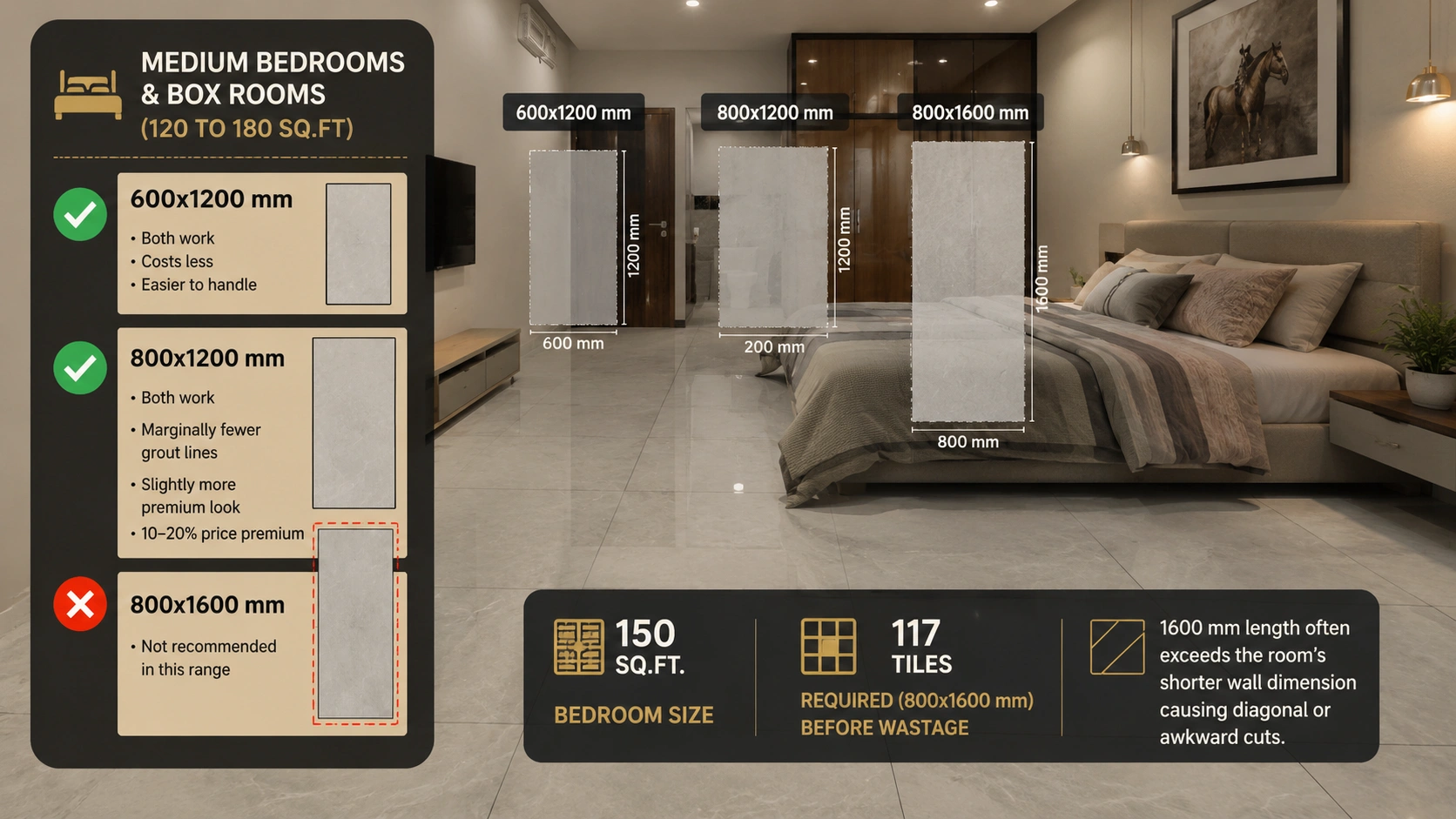
This is where 600x1200 mm and 800x1200 mm genuinely compete. Both work. 600x1200 mm costs less and is easier to handle. 800x1200 mm gives marginally fewer grout lines and a slightly more premium look, at a 10 to 20% price premium.
800x1600 mm is not recommended in this range. A 150 sq. ft. bedroom needs around 117 tiles in 800x1600 mm before wastage, but the format's 1600 mm length often exceeds the room's shorter wall dimension, forcing diagonal or awkward cuts that defeat the purpose of choosing a large format in the first place.
Standard Living Rooms (180 to 250 sq.ft)
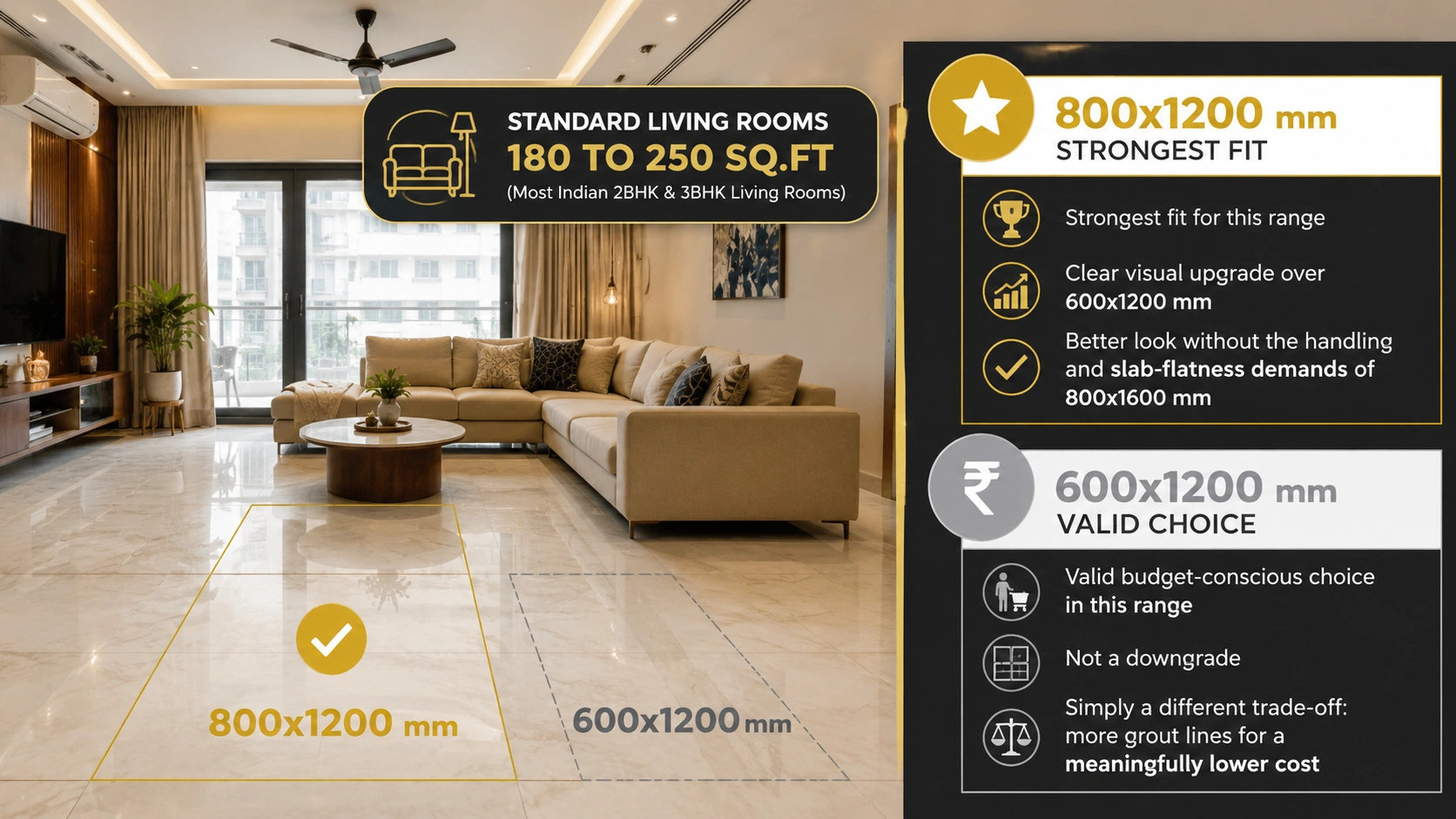
800x1200 mm is the strongest fit for this range, which covers the majority of Indian 2BHK and 3BHK living room requirements. The format delivers a clear visual upgrade over 600x1200 mm without the handling and slab-flatness demands of 800x1600 mm.
600x1200 mm remains a valid budget-conscious choice in this range and is not a downgrade, simply a different trade-off: more grout lines for a meaningfully lower cost.
Large Living Rooms and Open-Plan Areas (Above 250 sq.ft)
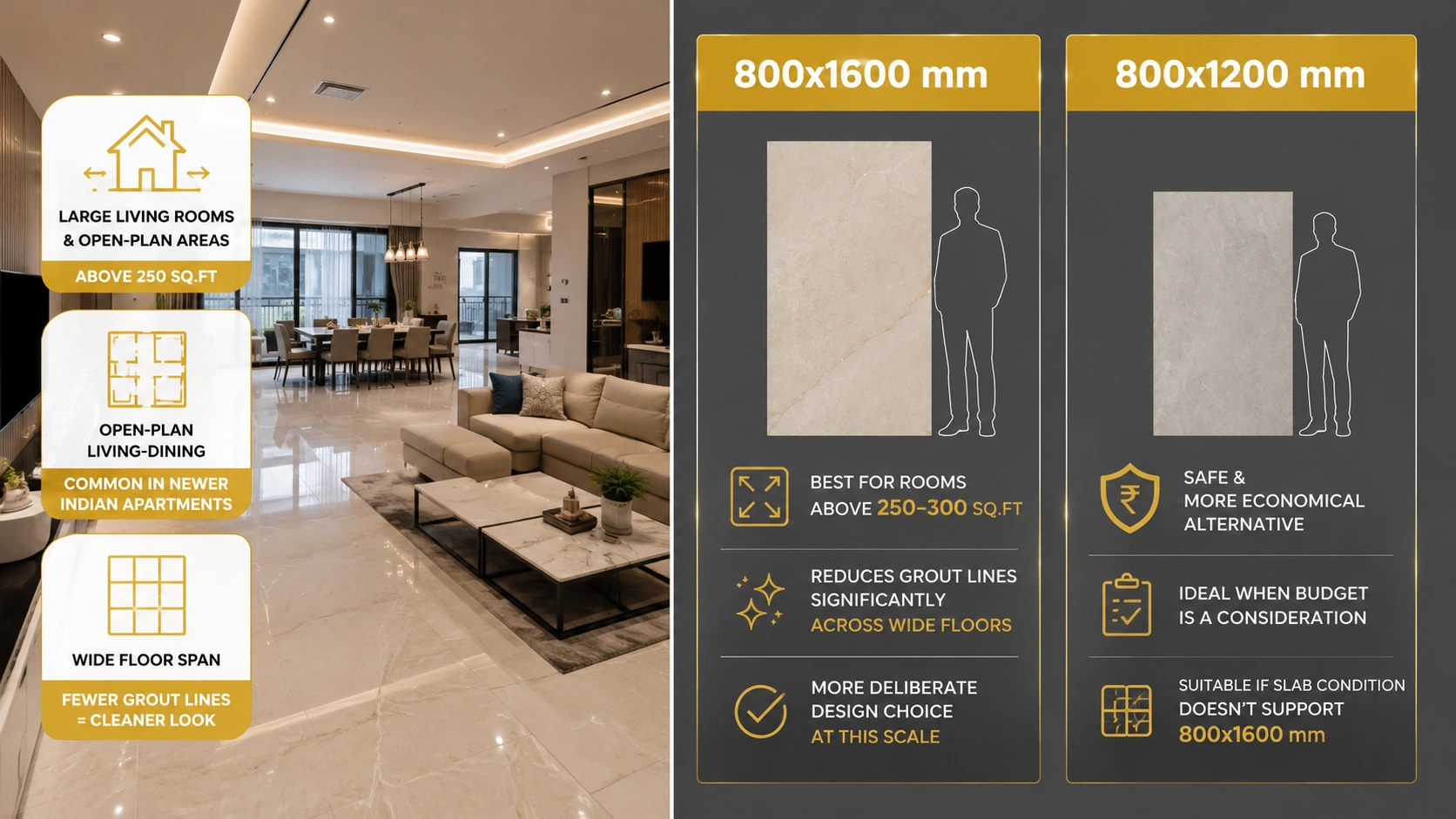
800x1600 mm starts to make sense once the room crosses 250 to 300 sq.ft, particularly in open-plan living-dining layouts common in newer Indian apartment construction. The larger format reduces the total grout line count significantly across a wide floor and reads as a more deliberate design choice at this scale.
800x1200 mm remains a safe, slightly more economical alternative in the same room size range, especially where the project budget or the slab condition does not comfortably support 800x1600 mm's tighter flatness requirement.
Corridors and Narrow Spaces
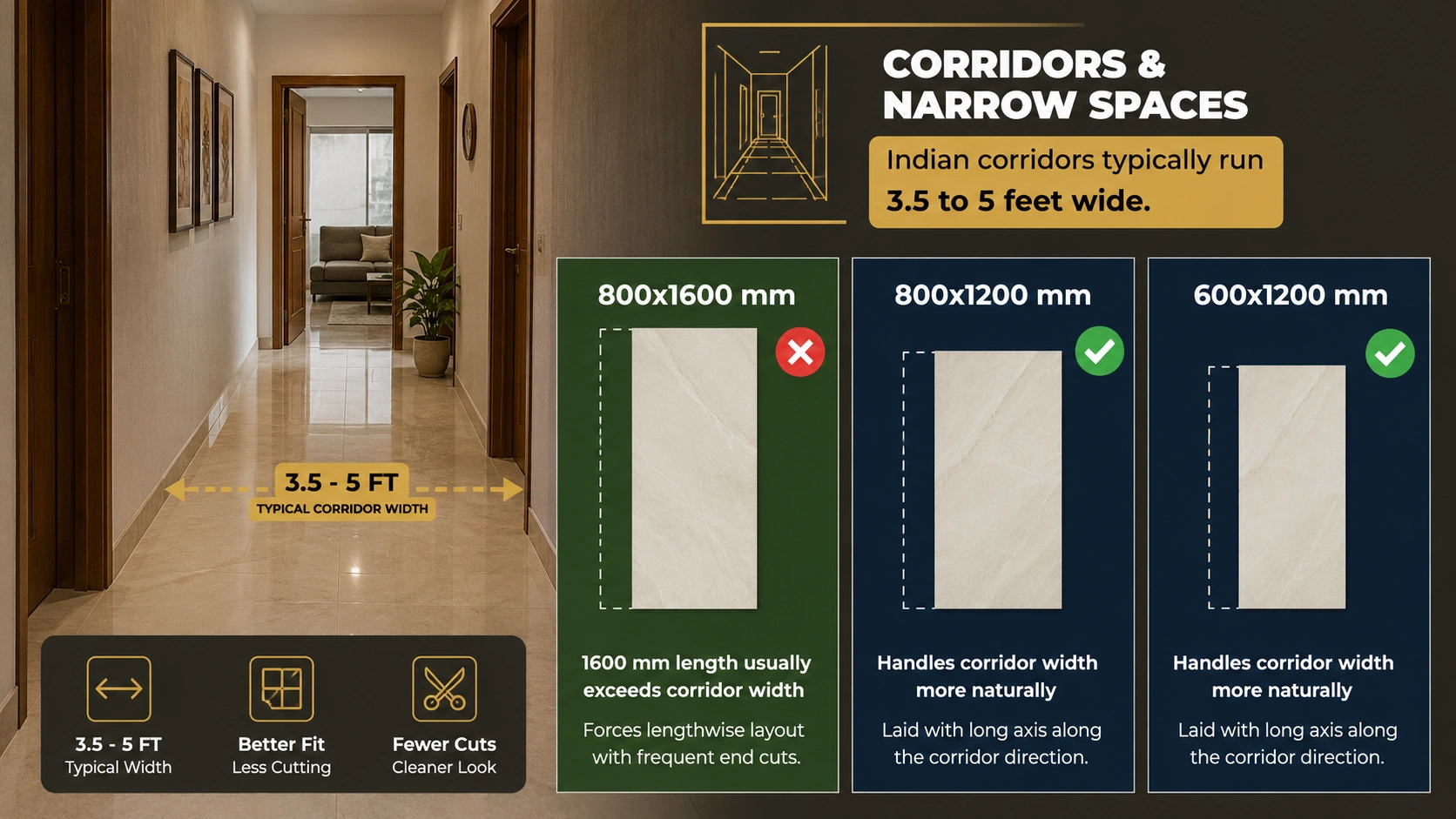
Indian corridors typically run 3.5 to 5 feet wide. 800x1600 mm, with its 1600 mm length, usually exceeds a reasonable corridor width when laid across the corridor, forcing the tile to run lengthwise with frequent end cuts. 800x1200 mm and 600x1200 mm both handle corridor widths more naturally, laid with the long axis along the corridor direction.
800x1200 vs 600x1200: Head to Head
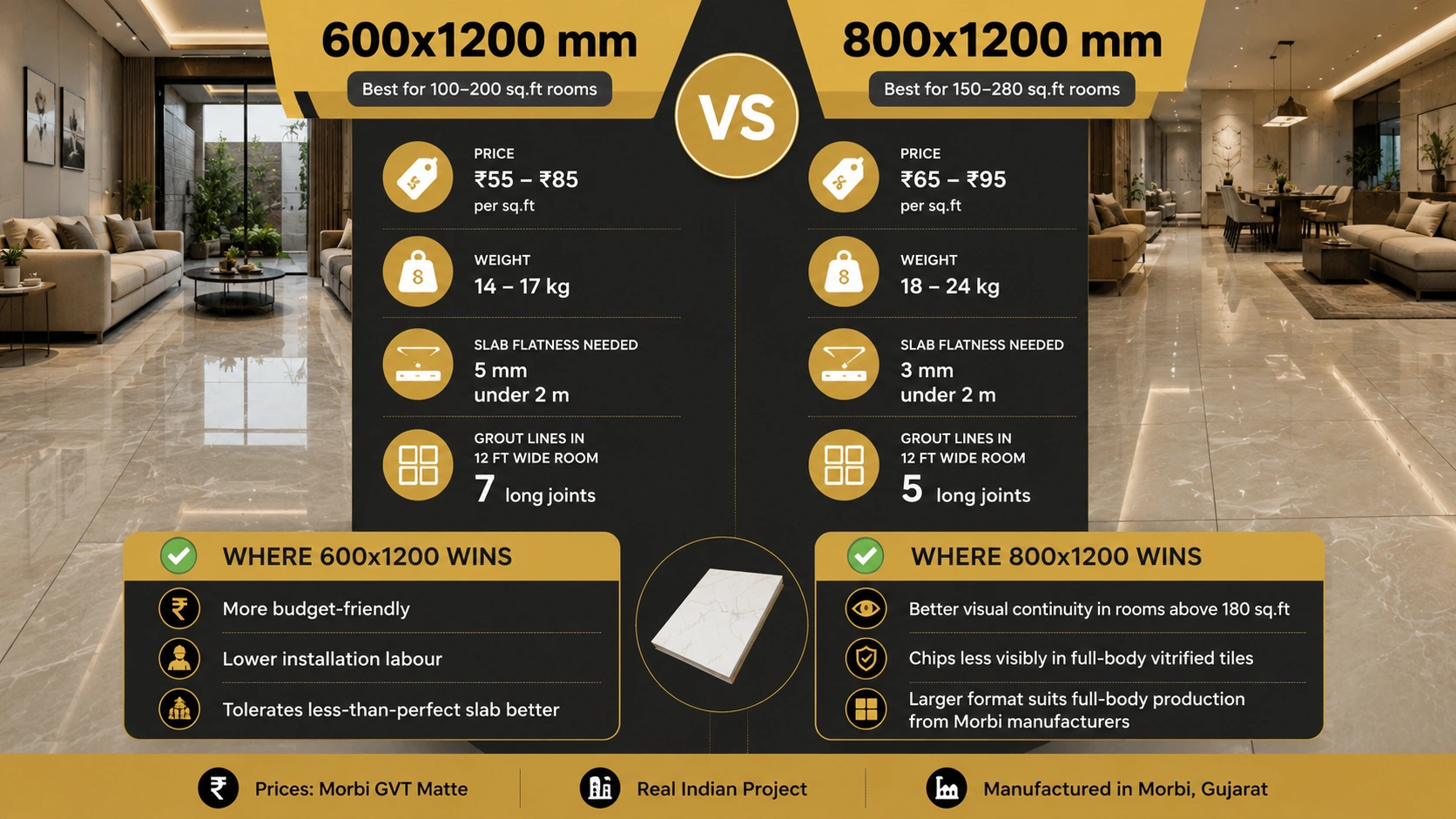
This is the most common real-world comparison Indian buyers face, since both sizes suit a near-identical range of room dimensions.
| Factor | 600x1200 mm | 800x1200 mm |
|---|---|---|
| Price (same finish, Morbi GVT matte) | Rs. 55 to Rs. 85 per sq.ft | Rs. 65 to Rs. 95 per sq.ft |
| Weight | 14 to 17 kg | 18 to 24 kg |
| Slab flatness needed | 5 mm under 2 m | 3 mm under 2 m |
| Grout lines in a 12 ft wide room | 7 long joints | 5 long joints |
| Best room range | 100 to 200 sq.ft | 150 to 280 sq.ft |
Where 600x1200 Wins
Budget is the clearest win for 600x1200 mm. For a 200 sq.ft room, the price difference between the two sizes typically adds Rs. 2,000 to Rs. 4,000 to the total tile cost, before accounting for the higher installation labour that 800x1200 mm also demands. 600x1200 mm also tolerates a less-than-perfect slab better, which matters in older Indian buildings where re-screeding the floor is not always in the budget.
Where 800x1200 Wins
800x1200 mm wins on visual continuity in rooms above 180 sq. ft., where the additional 200 mm of width per tile noticeably reduces the grid-like appearance that 600x1200 mm can carry at scale. It also chips less visibly when specified in full-body vitrified tiles rather than GVT, since the larger format better suits full-body production at this size from Morbi manufacturers.
Still wondering if 800×1200 mm is the right balance between size, cost, and installation? Our 800×1200 Tiles Guide explains everything from ideal room sizes and slab requirements to finishes, pricing, installation tips, and buying considerations, helping you decide whether this mid-large format is the best fit for your home.
800x1200 vs 800x1600: Head to Head
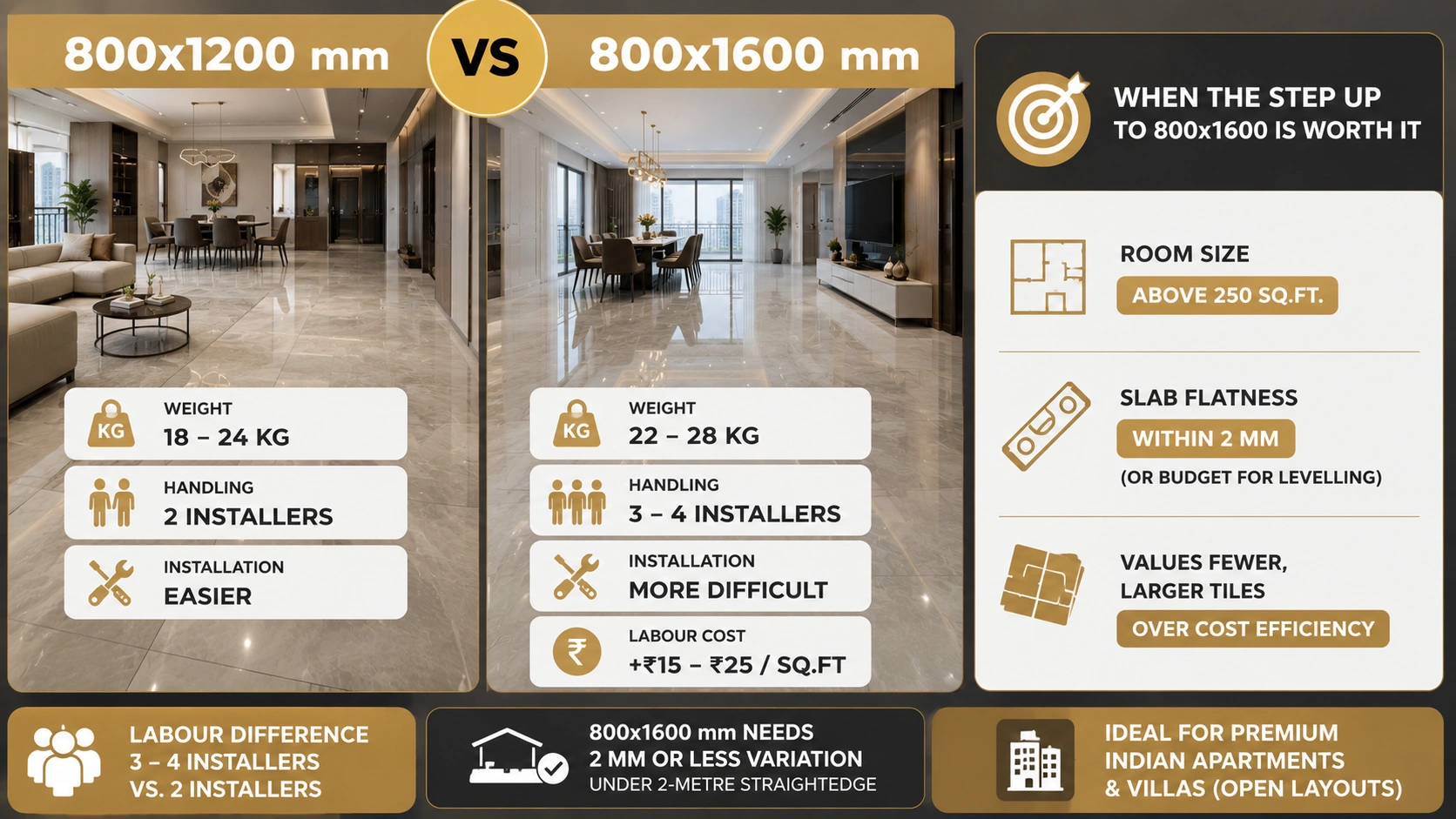
This comparison is less about cost and more about whether the installation conditions can support the larger size at all.
Weight, Handling, and Installation Difficulty
800x1600 mm tiles at 22 to 28 kg require three to four installers working in coordination to avoid cracking the tile during placement. 800x1200 mm at 18 to 24 kg is manageable for two experienced installers without additional equipment. This labour difference adds Rs. 15 to Rs. 25 per sq.ft to the installation cost for 800x1600 mm over 800x1200 mm in most Indian cities.
Slab flatness tolerance also tightens. 800x1600 mm needs 2 mm or less variation under a 2-metre straightedge. Most Indian RCC slabs built before 2018 do not meet this without a self-levelling screed, which adds further cost and project time before the first tile is even placed.
When the Step Up to 800x1600 Is Worth It
The step up makes sense when three conditions align: the room is above 250 sq. ft., the slab has been confirmed flat to within 2 mm (or the budget allows for levelling), and the project values the visual statement of fewer, larger tiles over cost efficiency. In open-plan living-dining layouts in premium Indian apartments and villas, this combination is increasingly common.
Once you've decided that 800×1200 mm is the right format, explore our Top 800×1200 Tile Designs featuring 20 stylish options for living rooms, bedrooms, and bathrooms. Compare marble, concrete, wood, terrazzo, stone, and modern designer finishes to find the perfect look for your space.
600x1200 vs 800x1600: The Extremes Compared
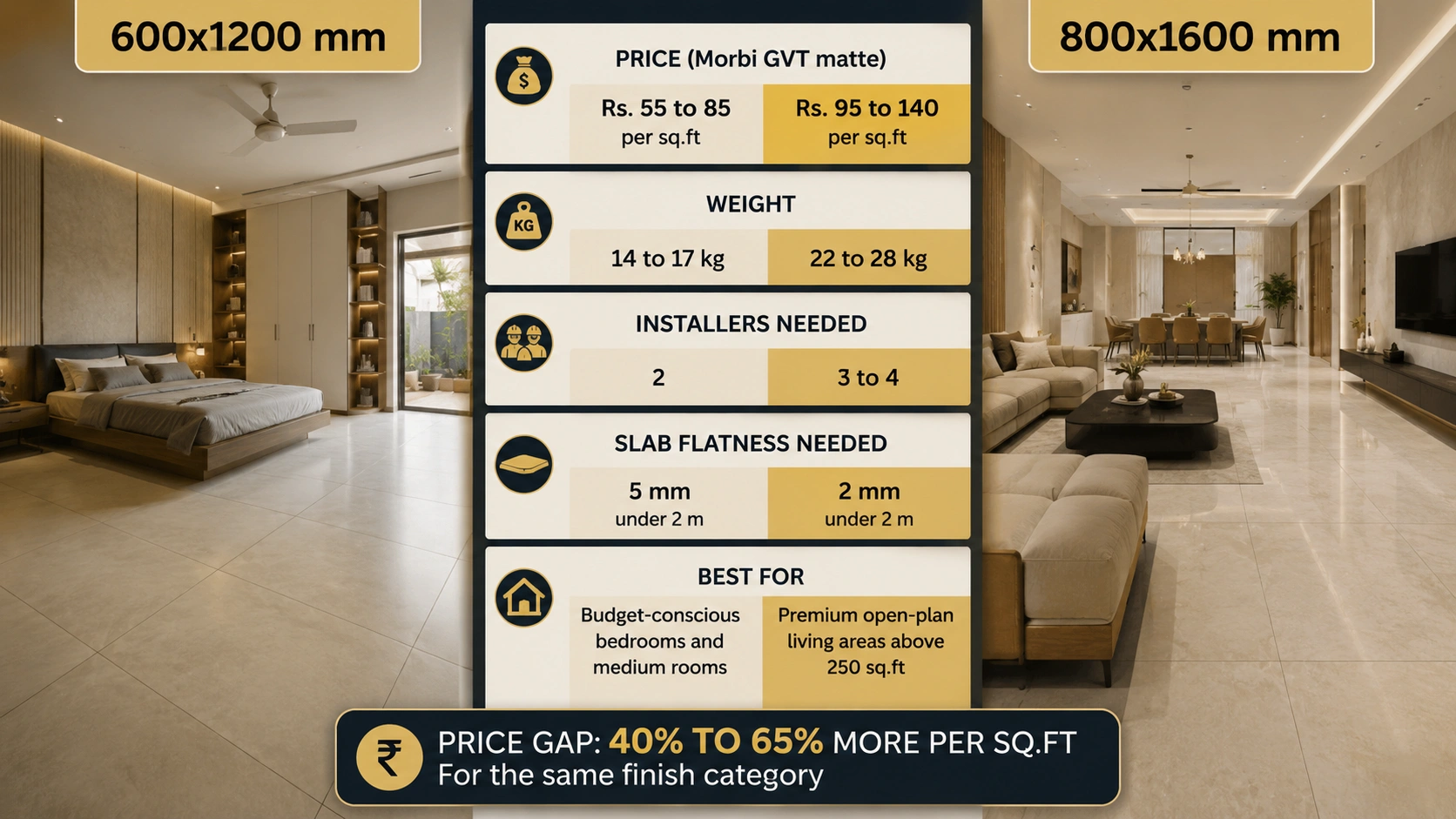
These two sizes rarely compete directly because they suit opposite priorities, but laying them side by side clarifies the full spread of the large-format category.
Budget and Practicality vs Visual Impact
| Factor | 600x1200 mm | 800x1600 mm |
|---|---|---|
| Price (Morbi GVT matte) | Rs. 55 to Rs. 85 per sq.ft | Rs. 95 to Rs. 140 per sq.ft |
| Weight | 14 to 17 kg | 22 to 28 kg |
| Installers needed | 2 | 3 to 4 |
| Slab flatness needed | 5 mm under 2 m | 2 mm under 2 m |
| Best for | Budget-conscious bedrooms and medium rooms | Premium open-plan living areas above 250 sq.ft |
The price gap between these two extremes runs 40 to 65% per sq. ft. for the same finish category. For most Indian residential budgets, this gap alone settles the decision before room size or design preference even enters the conversation.
Slab Flatness and Structural Load Across All Three Sizes
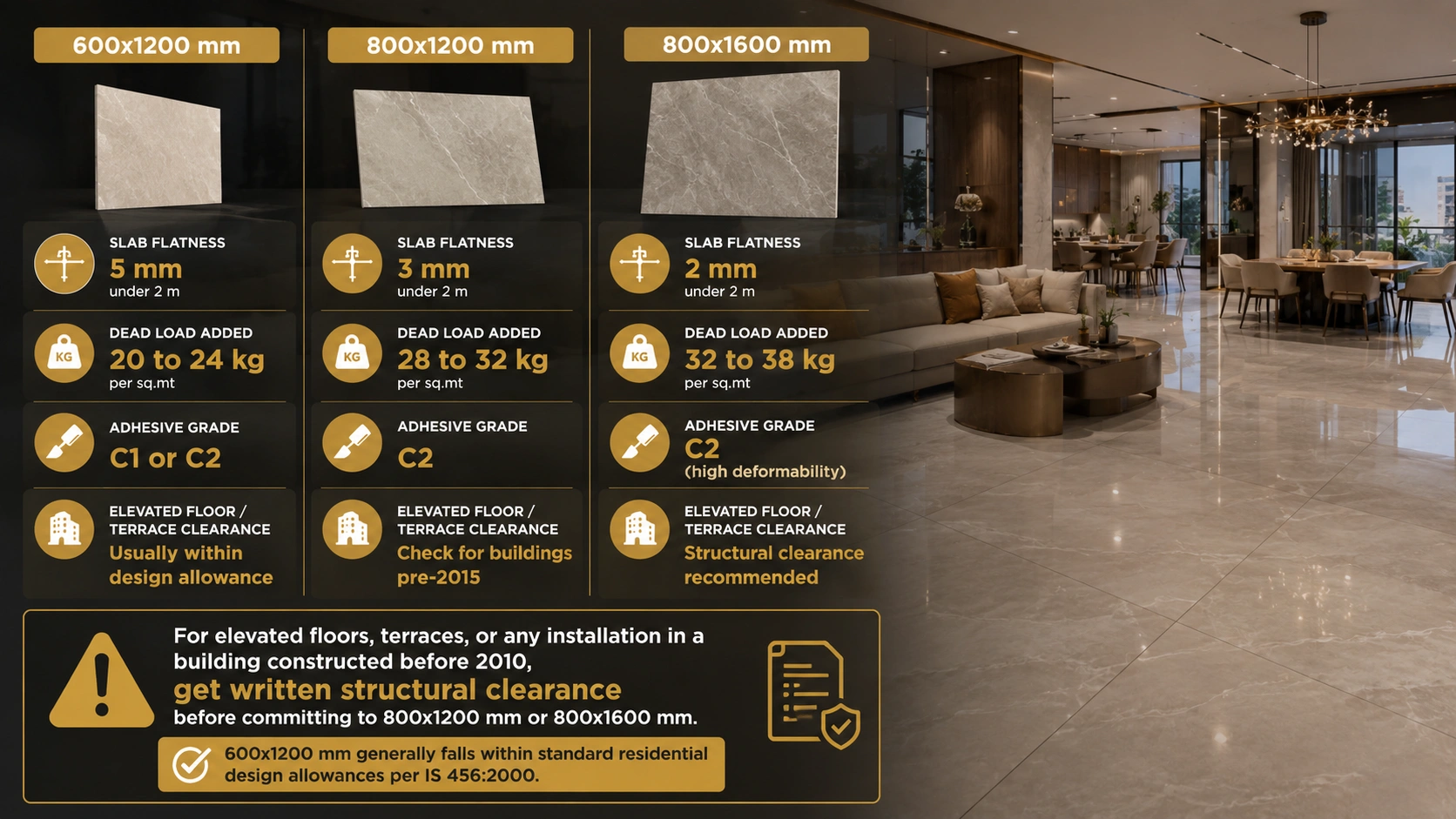
Structural and slab readiness is the part of this comparison most buyers skip until the installer raises it on-site, by which point the tile has often already been purchased.
| Factor | 600x1200 mm | 800x1200 mm | 800x1600 mm |
|---|---|---|---|
| Slab flatness tolerance | 5 mm under 2 m | 3 mm under 2 m | 2 mm under 2 m |
| Dead load added (tile + adhesive + grout, per sq.mt) | 20 to 24 kg | 28 to 32 kg | 32 to 38 kg |
| Adhesive grade required | C1 or C2 | C2 | C2 (high deformability) |
| Elevated terrace/balcony clearance needed | Usually, within design allowance | Check for buildings pre-2015 | Structural clearance recommended |
For elevated floors, terraces, or any installation in a building constructed before 2010, get written structural clearance before committing to 800x1200 mm or 800x1600 mm. 600x1200 mm generally falls within standard residential design allowances per IS 456:2000, but this should still be confirmed for any non-ground-floor application in older construction.
Price Comparison: All Three Sizes Side by Side
| Tile Type | 600x1200 mm | 800x1200 mm | 800x1600 mm |
|---|---|---|---|
| GVT matte | Rs. 55 to Rs. 85/sq.ft | Rs. 65 to Rs. 95/sq.ft | Rs. 85 to Rs. 120/sq.ft |
| GVT stone finish | Rs. 60 to Rs. 90/sq.ft | Rs. 75 to Rs. 110/sq.ft | Rs. 90 to Rs. 130/sq.ft |
| Full body vitrified matte | Rs. 75 to Rs. 105/sq.ft | Rs. 90 to Rs. 130/sq.ft | Rs. 110 to Rs. 150/sq.ft |
| Installation cost (per sq.ft) | Rs. 45 to Rs. 65 | Rs. 60 to Rs. 90 | Rs. 75 to Rs. 110 |
For a 200 sq.ft living room in full body vitrified matte, total tile-plus-installation cost runs approximately Rs. 24,000 to Rs. 34,000 in 600x1200 mm, Rs. 30,000 to Rs. 44,000 in 800x1200 mm, and Rs. 37,000 to Rs. 52,000 in 800x1600 mm, before accounting for any slab levelling that the larger formats may require.
Common Mistakes When Choosing Between These Sizes
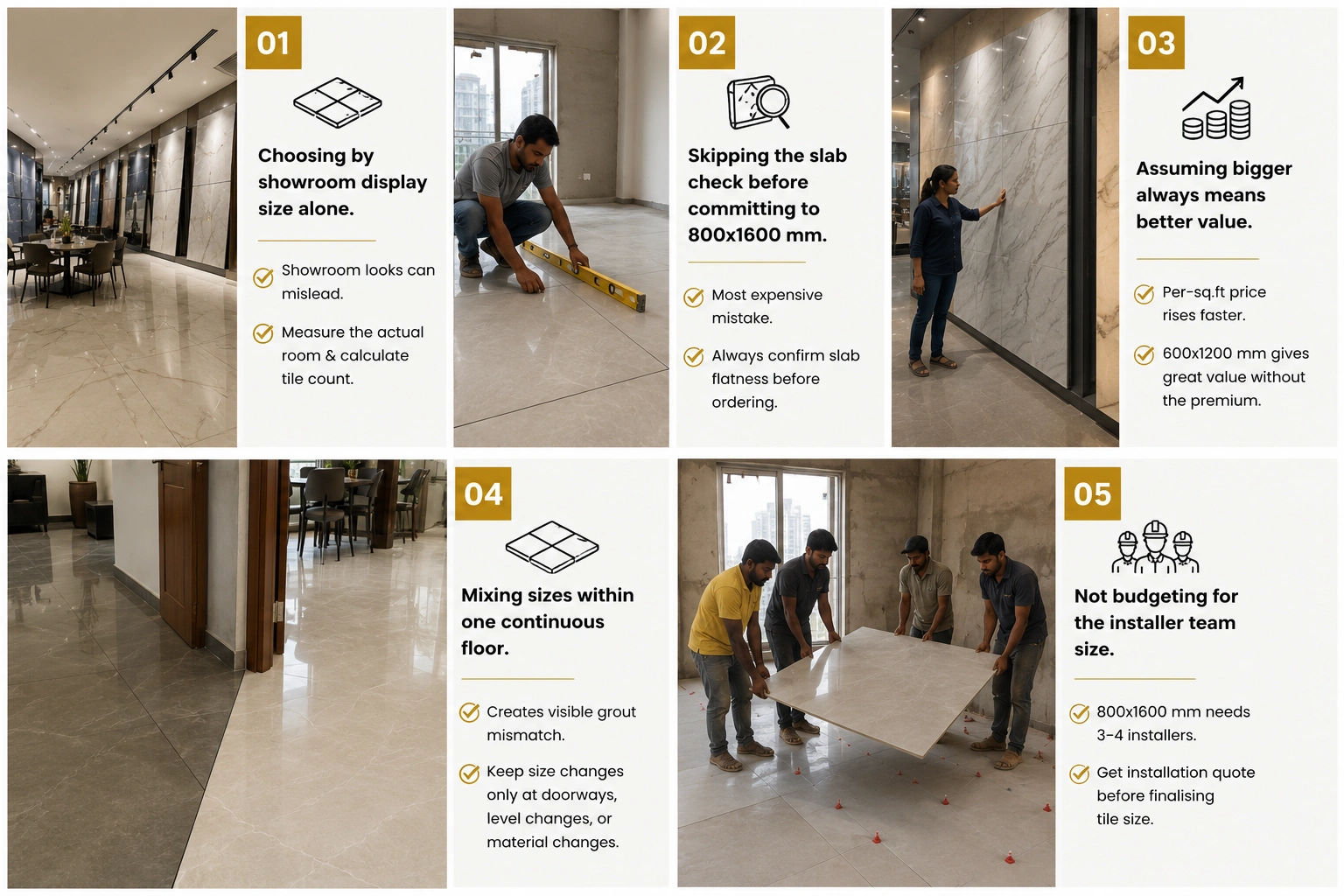
- Choosing by showroom display size alone. Showroom floors are large, open, and well-lit. The same 800x1600 mm tile that looks proportionate across a 1,000 sq. ft. showroom can dominate and overwhelm a 200 sq. ft. Indian living room. Always measure the actual room and calculate tile count before deciding on the look alone.
- Skipping the slab check before committing to 800x1600 mm. This is the single most expensive mistake in this comparison. Ordering 800x1600 mm tiles without confirming slab flatness often results in either a costly mid-project levelling addition or visible lippage across the finished floor.
- Assuming bigger always means better value. Per-sq.ft price rises faster than the reduction in grout lines justifies for many budgets. 600x1200 mm at a lower price point still delivers a clear visual upgrade over 600x600 mm without the premium that 800x1600 mm commands.
- Mixing sizes within one continuous floor. Using 800x1200 mm in the living room and 600x1200 mm in the adjoining dining area without a clear physical break creates a visible mismatch in grout rhythm at the transition point. Keep size changes at doorways, level changes, or material changes only.
- Not budgeting for the installer team size. 800x1600 mm needing three to four installers instead of two is a labour cost most first-time large-format buyers do not anticipate. Get the installation quote before finalising the tile size, not after.
Find All Three Sizes With Confirmed Stock
Comparing tile sizes on paper only goes so far. The actual decision depends on your room's exact dimensions, your slab's current condition, and which manufacturers currently have your preferred finish in stock in each size.
Every listing across 600x1200 mm, 800x1200 mm, and 800x1600 mm tiles on Tilesfinders shows stock confirmed as available by the manufacturer, so you can filter by size, finish, or room type to compare real options side by side before placing an order with a verified Morbi or Gujarat supplier.

FAQs
800x1600 mm tiles are bigger. They cover 1.28 sq.ft per tile compared to 0.96 sq.ft for 800x1200 mm, a 33% increase in coverage. 800x1600 mm tiles also weigh more, at 22 to 28 kg per piece versus 18 to 24 kg for 800x1200 mm.
Yes, for most bedrooms. 800x1600 mm suits rooms above 220 sq.ft, which is larger than a typical 2BHK or even most 3BHK bedrooms in India. For bedrooms between 120 and 220 sq.ft, 800x1200 mm or 600x1200 mm is more practical and creates less wastage at the edges.
600x1200 mm gives the best value for money for most Indian homes. It costs 10 to 30% less per sq.ft than 800x1200 mm and 20 to 45% less than 800x1600 mm, while still delivering a large-format look with fewer grout lines than 600x600 mm tiles.
800x1600 mm tiles need three to four trained installers due to their 22 to 28 kg weight per piece and large surface area, which makes a single person handling impossible without risking tile breakage or back injury. 800x1200 mm tiles need two installers, and 600x1200 mm tiles can be handled by two installers as well, though more comfortably.
800x1200 mm tiles cost 10 to 20% more per sq ft than 600x1200 mm tiles for the same finish and body type from Morbi manufacturers. For example, GVT matte tiles in 600x1200 mm run Rs. 55 to Rs. 85 per sq.ft, while the same finish in 800x1200 mm runs Rs. 65 to Rs. 95 per sq.ft.
Yes. 800x1600 mm tiles require a flatter mortar bed, typically within 2 mm under a 2-metre straightedge, compared to 3 mm for 800x1200 mm. Both sizes need C2 grade tile adhesive with full back-buttering coverage, but 800x1600 mm is less forgiving of minor slab irregularities due to its larger surface area.
It is not recommended. Mixing two different tile sizes in one continuous floor area creates inconsistent grout line patterns and complicates the layout at room transitions. If a project needs different sizes, use a clear physical break such as a threshold, change in level, or a different room to separate the two sizes.
800x1200 mm is generally the best balance for open-plan living-dining areas in India, covering the 250 to 400 sq.ft range common in such layouts without the handling difficulty of 800x1600 mm. For areas above 400 sq.ft with a flat, well-prepared slab, 800x1600 mm delivers a more dramatic, seamless look.

See our tile guides first
Set TilesFinders as a preferred source and our buying guides surface ahead of the rest for you.
Add as preferred sourceTakes one tap. Nothing to install.
What Readers Say
I was about to redo my parking area with the wrong tile size until I read this. The layout comparisons saved me from a costly mistake.
We reference TilesFinders guides while briefing clients on material selection. The size and pattern breakdowns are accurate and easy to explain visually.
On site, I get asked about grout spacing all the time. This article gave me a solid reference I now share with my team before every job.
Finally a guide that doesn't just push generic advice. The oil stain removal steps actually worked on our clubhouse driveway tiles.
I run a small construction firm and now send this link to clients directly when they ask about entrance tile sizing. Saves me an hour of explaining.
Good practical detail, though I wish there were more examples for compact apartment entrances specifically, not just villas.
My mother-in-law wanted marble, I wanted vitrified. This blog gave us the neutral comparison we needed to actually decide together.
Detailed without being overwhelming. I appreciated that it covered both cost and maintenance, not just the aesthetics.
Used the algae and hard water removal tips on our terrace tiles after the monsoon. Worked better than what our regular cleaner was doing.
As someone who sources tiles for multiple builder projects, I find these comparisons genuinely useful for vendor conversations, not just consumer content.
Recommended this to a client who kept second-guessing the entrance design. The small vs large layout section settled the debate instantly.
Straightforward and honest, no unnecessary jargon. Would like to see a similar breakdown for outdoor pool-deck tiles next.
We've bookmarked several TilesFinders guides for our design handbook. Reliable source when clients want data, not just opinions.
Two paths, one marketplace.
Get free quotes from verified suppliers.
Share your room, budget, and style. Suppliers in Morbi respond within hours.
Get Free QuotesList your business, reach real buyers.
Put your showroom in front of homeowners searching for tiles right now.
List Your Business