800x1200 Tiles: Complete Guide to This Mid-Large Format for Indian Homes
This guide covers 800x1200 mm tiles for Indian homes, including which rooms suit this format, how it compares to 600x1200 mm and 800x800 mm, finish options, installation requirements, and price by body type from Morbi manufacturers.
- What Are 800x1200 Tiles and Where Do They Fit in the Indian Tile Market
- Which Rooms in Indian Homes Suit 800x1200 Tiles
- 800x1200 vs Other Large Format Sizes: Which to Choose
- Finishes Available in 800x1200 Tiles and Which to Pick
- Installation Considerations for 800x1200 Tiles in Indian Homes
- Price Guide: 800x1200 Tiles in India
- Common Mistakes With 800x1200 Tile Projects
- Find Confirmed Stock in 800x1200 Tile Sizes
800x1200 mm tiles suit Indian living rooms above 180 sq.ft and master bedrooms above 150 sq.ft, costing Rs. 65 to Rs. 140 per sq.ft depending on finish and body type.
The 800x1200 mm tile sits at a useful midpoint in the Indian large-format market. It is large enough to make living rooms and open corridors feel spacious, but small enough to remain manageable on standard Indian residential slabs without requiring structural modifications.
Buyers often land on this size after finding 600x600 mm too ordinary and 1200x1800 mm too demanding. The 800x1200 mm format delivers the fewer-grout-lines benefit of large format without the weight, lippage risk, and installation complexity that comes with the largest sizes available from Morbi manufacturers.
This guide covers which rooms in Indian homes suit 800x1200 tiles, which finishes and body types to choose, how the size compares to its nearest alternatives, and what installation considerations matter before the first tile goes down.
What Are 800x1200 Tiles and Where Do They Fit in the Indian Tile Market
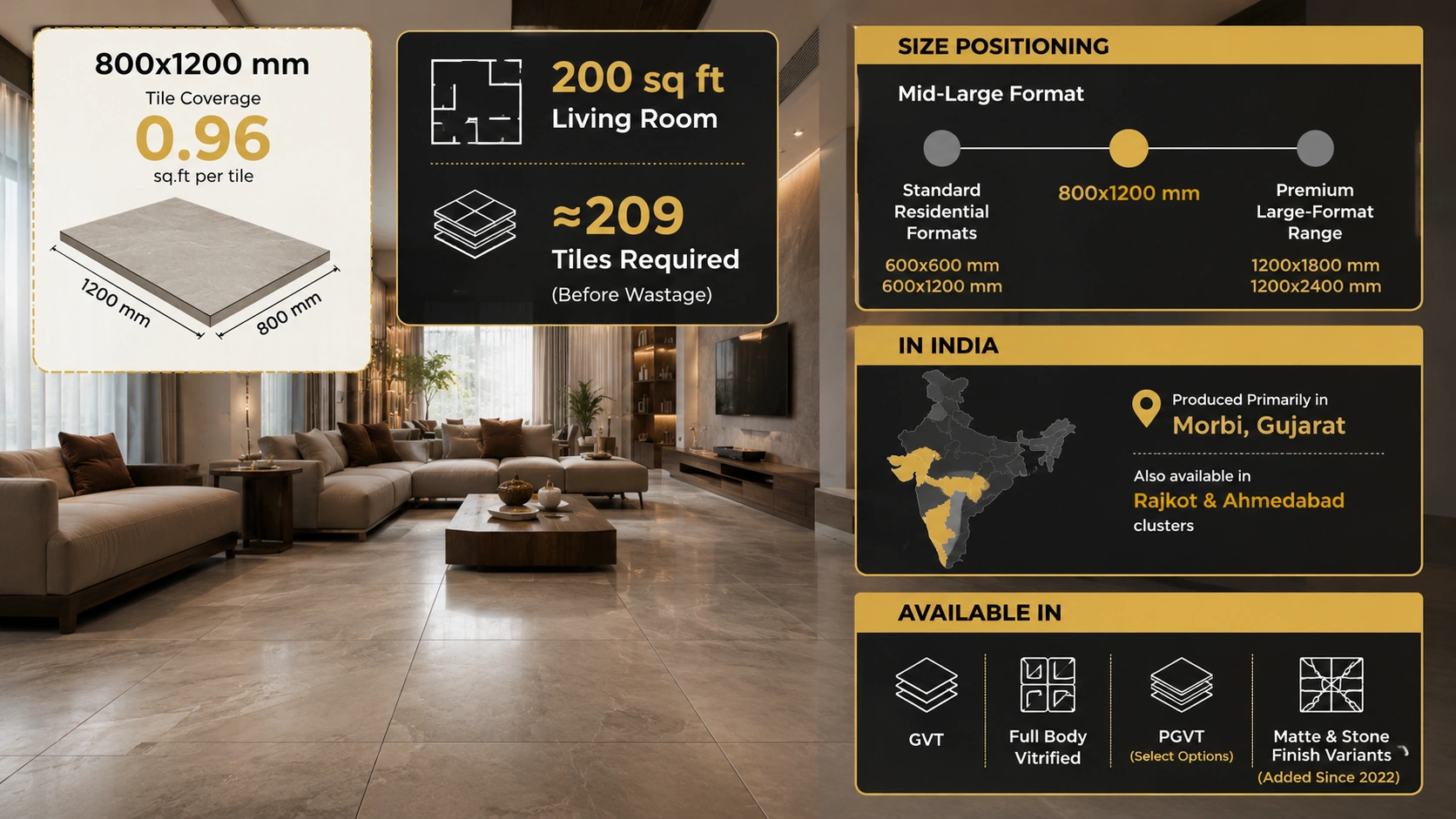
800x1200 mm tiles cover 0.96 sq.ft per tile, which means a 200 sq ft living room needs around 209 tiles before accounting for wastage. The size falls in the mid-large format category, above the standard residential formats (600x600 mm, 600x1200 mm) and below the premium large-format range (1200x1800 mm, 1200x2400 mm).
In India, 800x1200 mm tiles are produced primarily by vitrified tile manufacturers in Morbi, Gujarat, though Rajkot and Ahmedabad clusters also carry this size. The format is available in GVT, full body vitrified, and select PGVT options, with a growing range of matte and stone finish variants added since 2022.
How 800x1200 Compares to Other Popular Tile Sizes in India
| Size | Coverage per Tile | Category | Typical Weight | Common Use |
|---|---|---|---|---|
| 600x600 mm | 0.36 sq.ft | Standard residential | 7 to 9 kg | Bedrooms, kitchens, and small rooms |
| 600x1200 mm | 0.72 sq.ft | Mid format | 14 to 17 kg | Bedrooms, medium living rooms |
| 800x800 mm | 0.64 sq.ft | Mid-large square | 12 to 15 kg | Living rooms, dining areas |
| 800x1200 mm | 0.96 sq.ft | Mid-large rectangle | 18 to 24 kg | Living rooms, corridors, open-plan |
| 800x1600 mm | 1.28 sq.ft | Large format | 22 to 28 kg | Large living rooms, open-plan |
| 1200x1800 mm | 2.16 sq.ft | Premium large format | 40 to 55 kg | Showrooms, premium villas, lobbies |
The weight column above matters more than most buyers realise before installation day. An 800x1200 mm tile at 18 to 24 kg per piece is manageable for two experienced tile setters. A 1200x1800 mm tile at 40 to 55 kg per piece requires three to four people and mechanical handling equipment to install safely.
Which Tile Bodies Come in 800x1200 mm
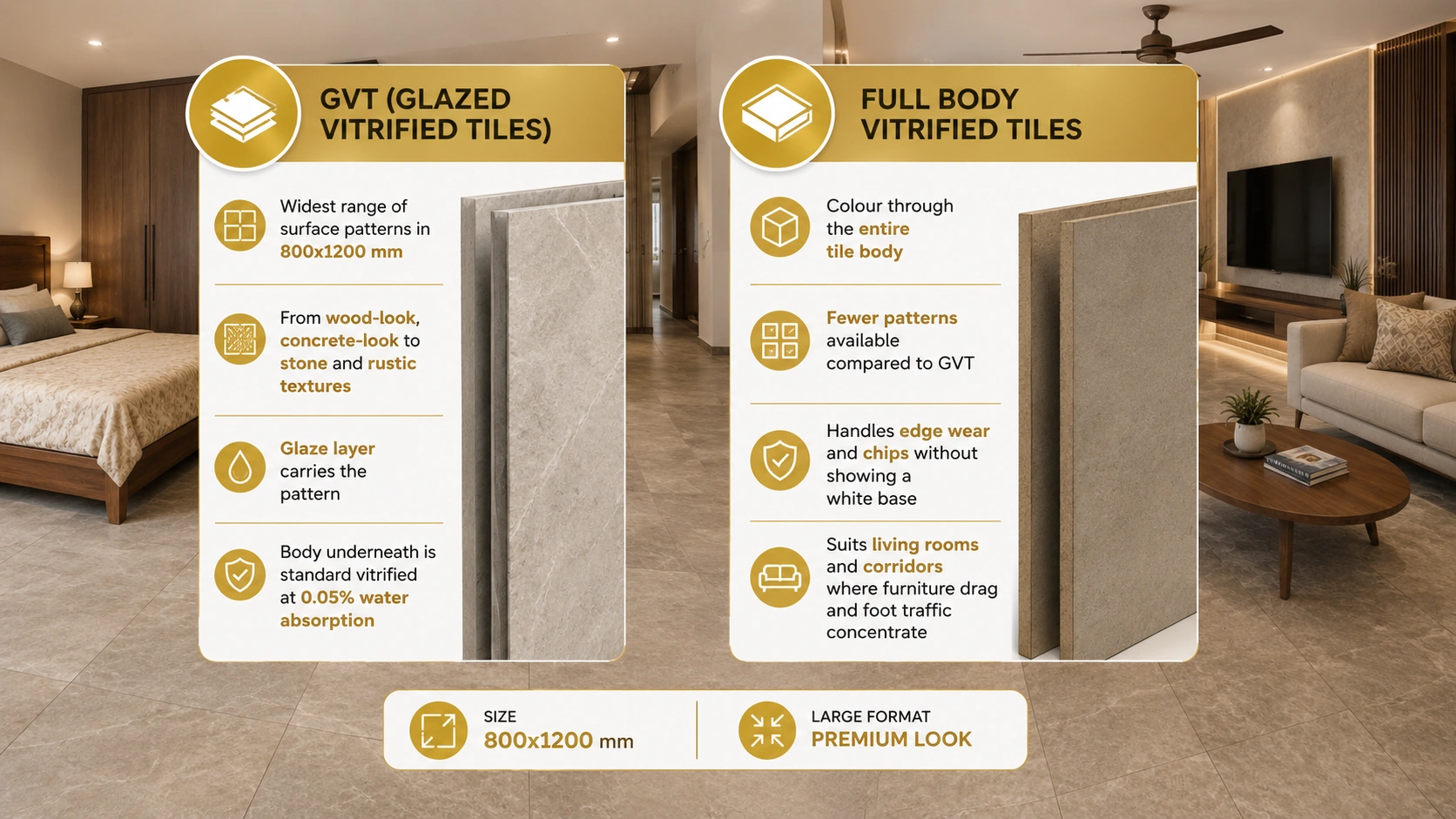
GVT (Glazed Vitrified Tiles) cover the widest range of surface patterns in 800x1200 mm, from wood-look and concrete-look to stone and rustic textures. The glaze layer carries the pattern, and the body underneath is standard vitrified at 0.05% water absorption.
Full body vitrified tiles in 800x1200 mm carry colour through the entire tile body. Fewer patterns are available compared to GVT, but the tile handles edge wear and chips without showing a white base. These tiles suit living rooms and corridors where furniture drag and foot traffic concentrate.
Which Rooms in Indian Homes Suit 800x1200 Tiles
Living Rooms and Open-Plan Spaces
800x1200 mm tiles work best in living rooms above 180 sq.ft. In a running bond layout, the long axis of the tile runs perpendicular to the main entrance, which draws the eye into the room and makes the space feel longer than it is. This effect is strongest when the grout colour is close to the tile colour.
For open-plan living and dining areas between 250 and 450 sq. ft. ft.t, 800x1200 mm tiles cover the full area with a consistent look that does not require a threshold or transition strip between zones. The fewer grout lines compared to 600x600 mm or even 600x1200 mm give the floor a more continuous visual plane.
Bedrooms: When 800x1200 Works and When It Does Not
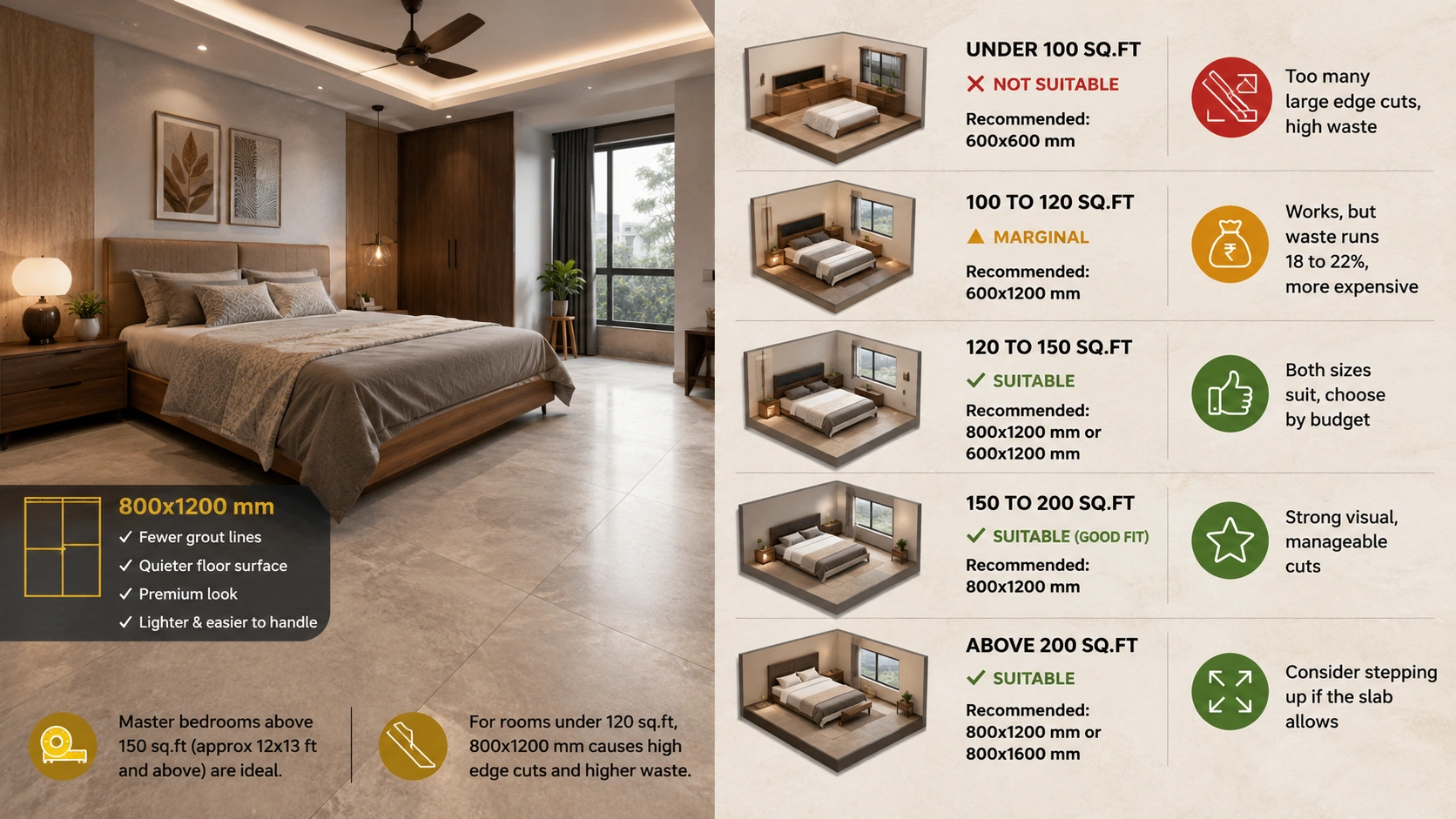
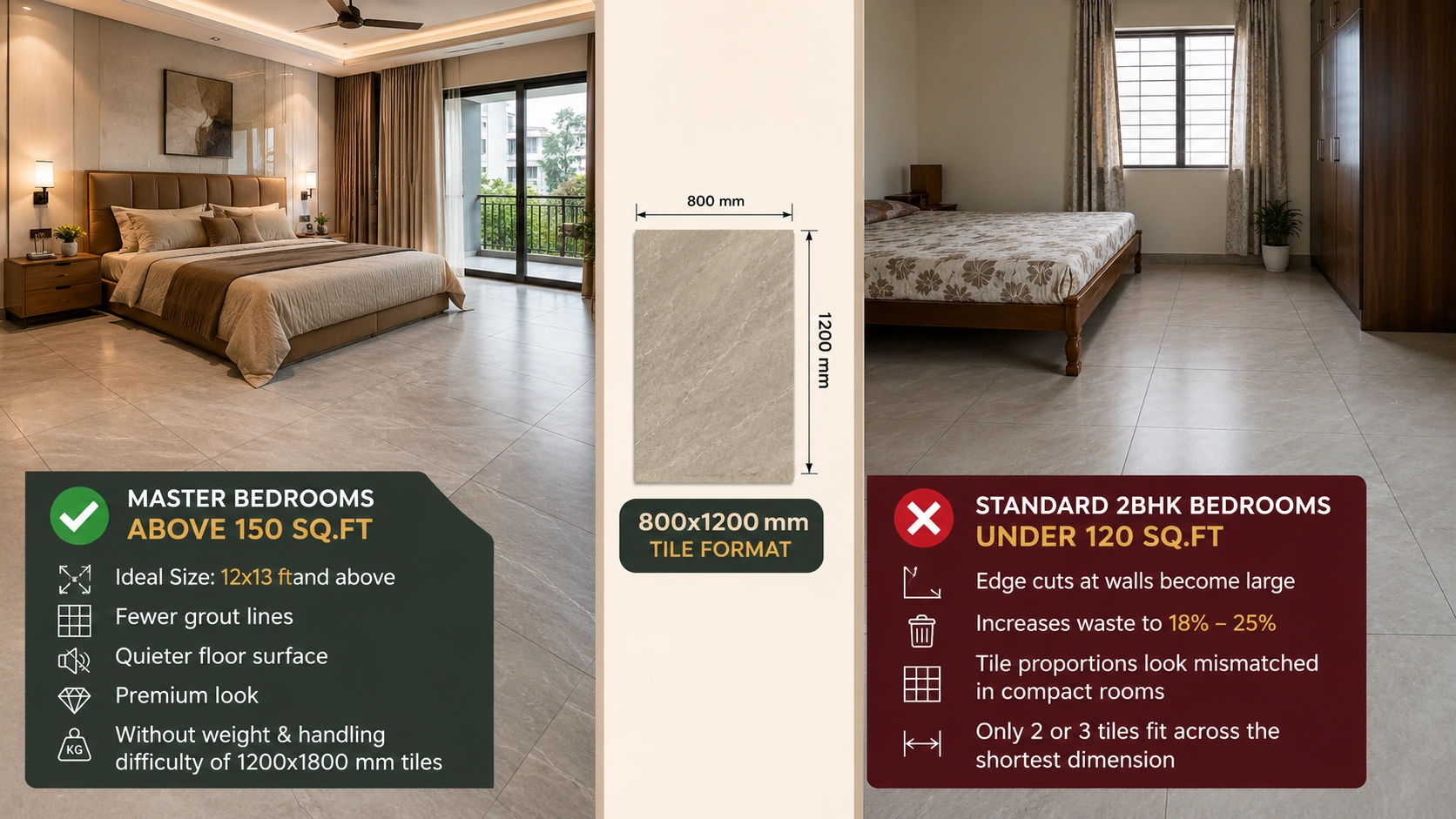
800x1200 mm tiles suit master bedrooms above 150 sq.ft (roughly 12x13 ft and above). In rooms this size, the format delivers fewer grout lines, a quieter floor surface, and a premium look without the weight and handling difficulty of 1200x1800 mm tiles.
For standard 2BHK bedrooms under 120 sq. ft. ft t, the 800x1200 mm format creates problems. Edge cuts at walls become large, which increases waste to 18 to 25%. The tile proportions can also look mismatched in a compact room where only two or three tiles fit across the shortest dimension.
| Bedroom Size | 800x1200 mm Suitable? | Recommended Alternative | Reason |
|---|---|---|---|
| Under 100 sq.ft | No | 600x600 mm | Too many large edge cuts, high waste |
| 100 to 120 sq.ft | Marginal | 600x1200 mm | Work,s but waste runs 18 to 22%, more expensive |
| 120 to 150 sq.ft | Yes | 800x1200 mm or 600x1200 mm | Both sizes suit, choose by budget |
| 150 to 200 sq.ft | Yes (good fit) | 800x1200 mm | Strong visual, manageable cuts |
| Above 200 sq.ft | Yes | 800x1200 mm or 800x1600 mm | Consider stepping up if the slab allows |
Dining Areas and Corridors
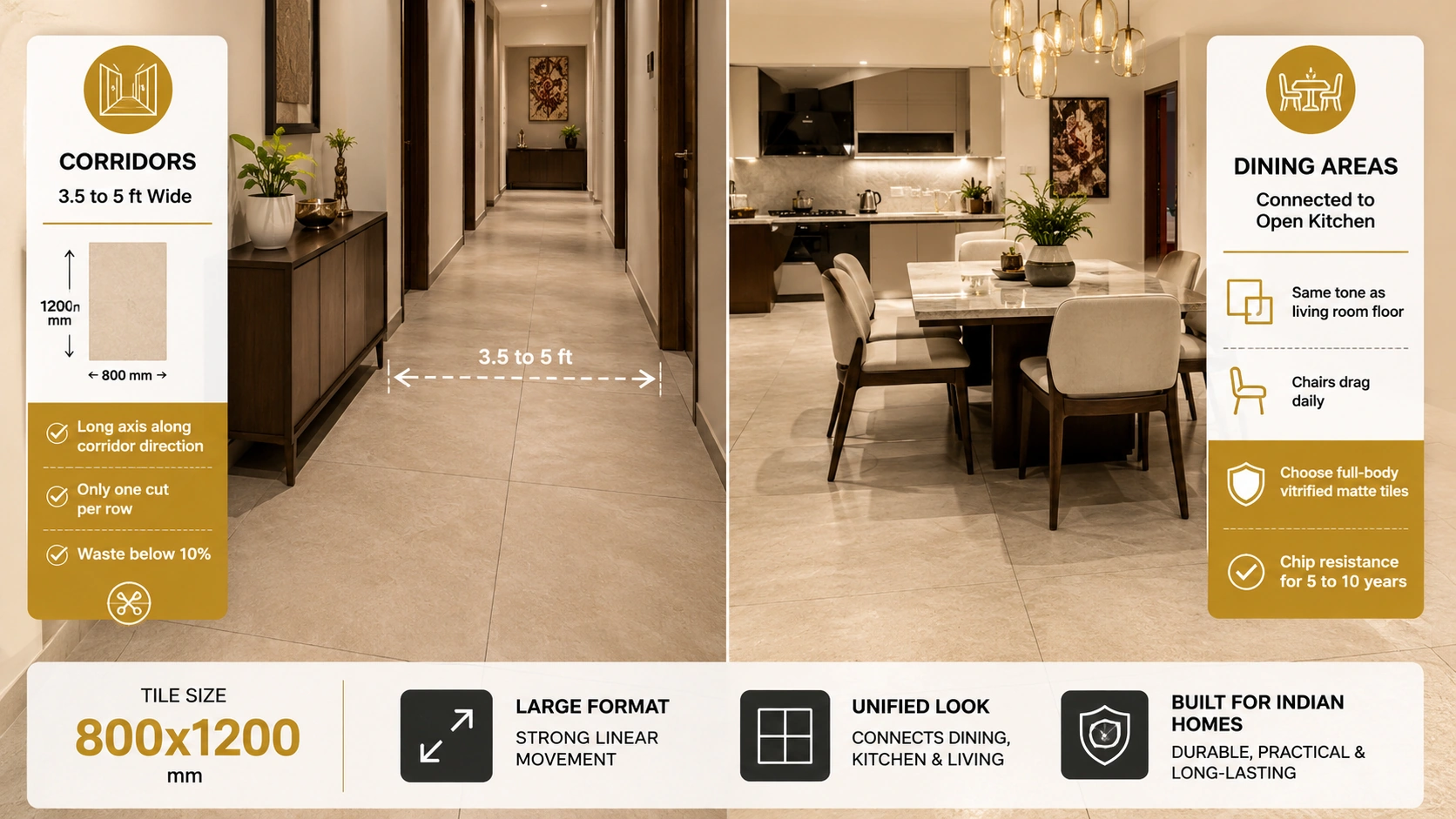
Corridors in Indian homes typically run 3.5 to 5 feet wide. An 800x1200 mm tile laid with the long axis along the corridor direction needs only one cut per row across the 3.5 to 5 ft width, which keeps waste below 10% and gives the corridor a strong linear movement.
For dining areas connected to an open kitchen, 800x1200 mm tiles in the same tone as the living room floor unify the space. Dining chairs drag across tile surfaces daily, so choose full-body vitrified matte tiles in this format for dining areas where chip resistance over five to ten years matters.
Walls: Using 800x1200 Tiles Vertically
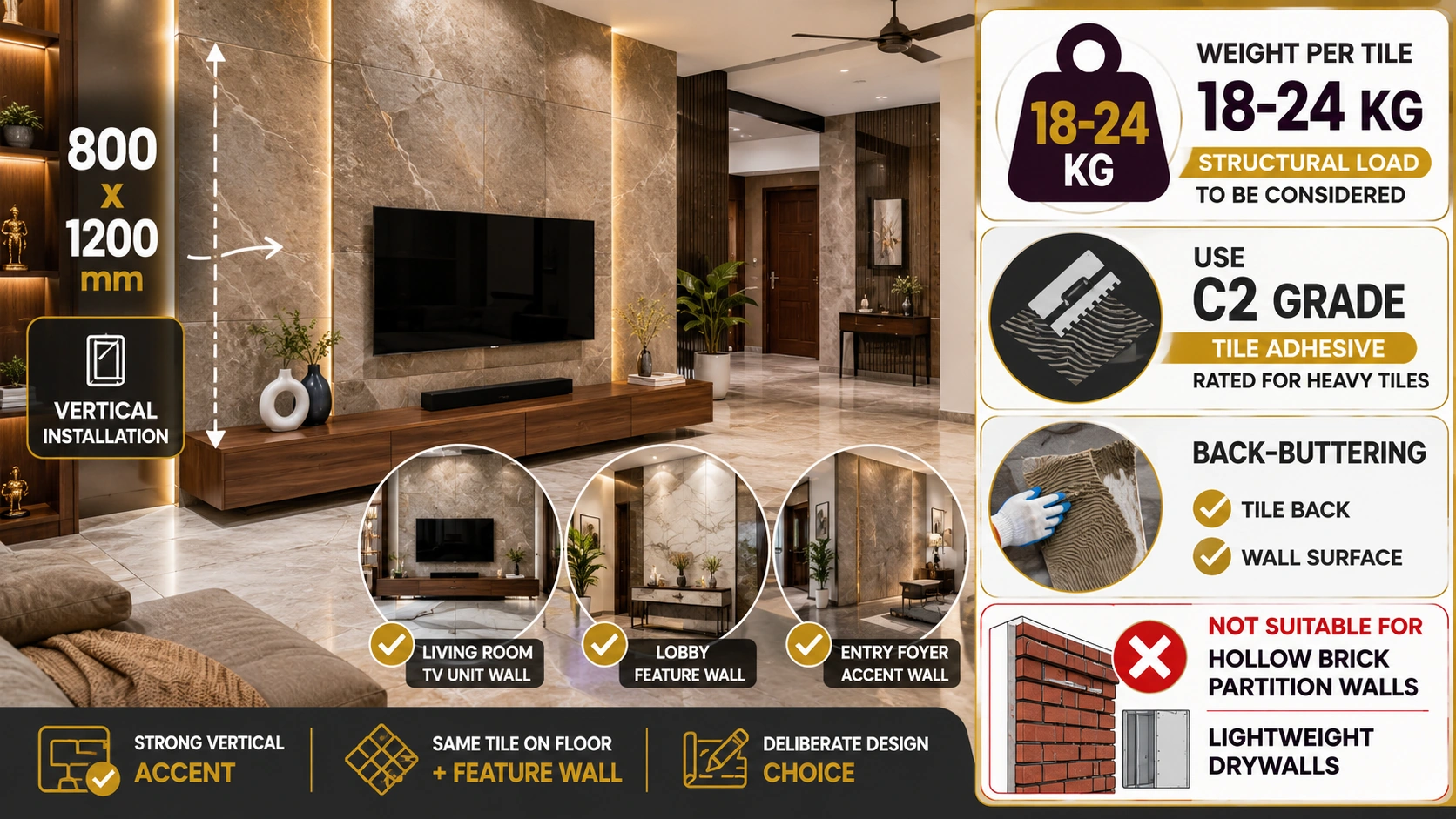
800x1200 mm tiles on walls create a strong vertical accent in living rooms, behind TV units, and on feature walls in lobbies and entry foyers. The same tile is used on the floor, and one feature wall reads as a deliberate design choice rather than a budget cut.
Wall installation of 800x1200 mm tiles requires C2 grade tile adhesive rated for heavy tiles, back-buttering of both the tile and the wall surface, and a structural wall capable of carrying 18 to 24 kg per tile piece. Hollow brick partition walls and lightweight drywalls do not carry this weight safely.
800x1200 vs Other Large Format Sizes: Which to Choose
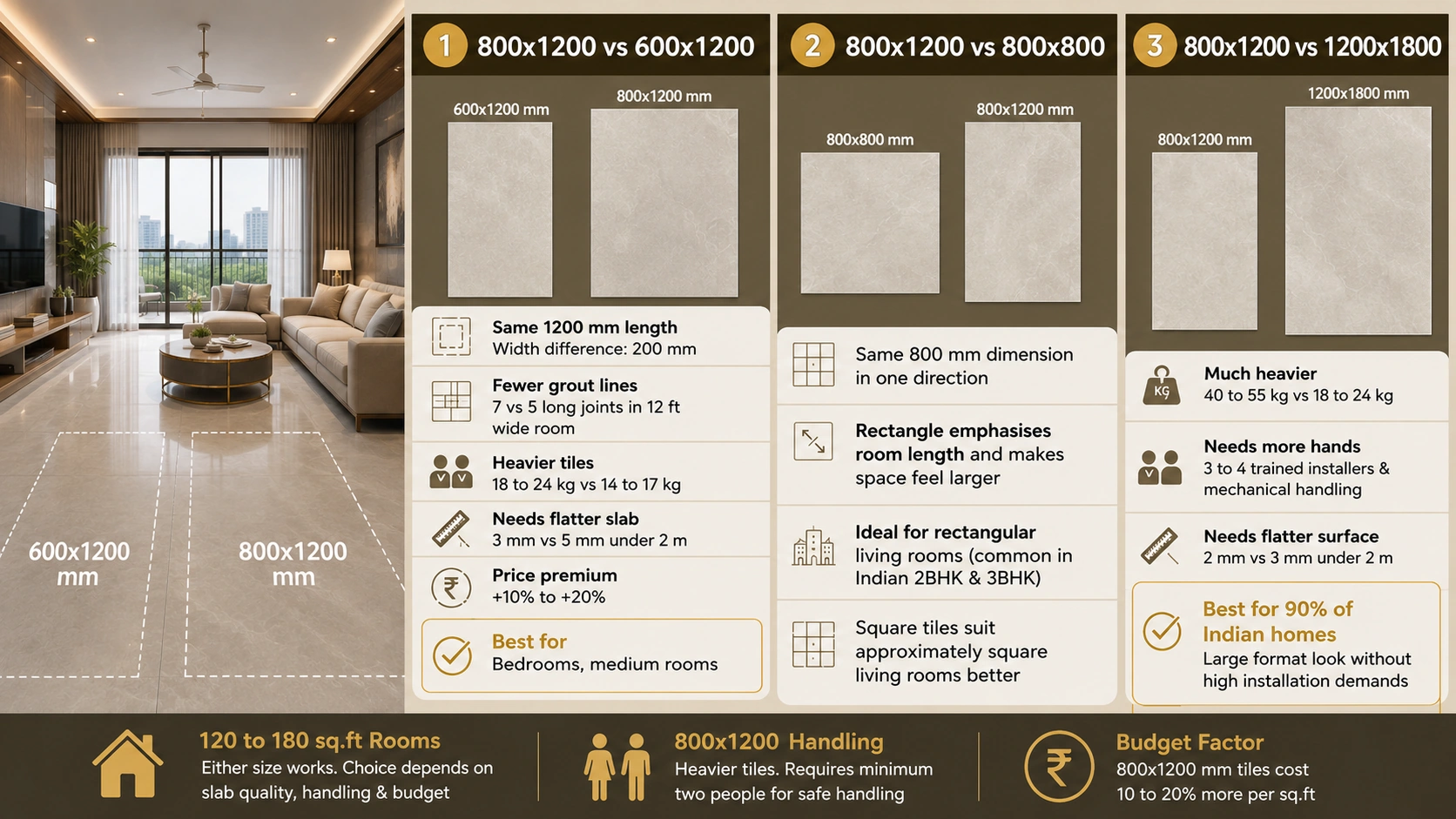
800x1200 vs 600x1200: The Most Common Comparison
The 600x1200 mm and 800x1200 mm tiles share the same 1200 mm length. The width difference, 200 mm, changes how many tiles fit across a standard Indian room and how the proportion reads on the floor.
| Factor | 600x1200 mm | 800x1200 mm |
|---|---|---|
| Coverage per tile | 0.72 sq.ft | 0.96 sq.ft |
| Tiles per 200 sq.ft (before wastage) | 278 tiles | 209 tiles |
| Grout lines in a 12 ft wide room | 7 long joints | 5 long joints |
| Weight per tile | 14 to 17 kg | 18 to 24 kg |
| Slab flatness requirement | 5 mm under 2 m | 3 mm under 2 m |
| Price premium (approx) | Baseline | +10 to +20% |
| Best for | Bedrooms, medium rooms | Living rooms, corridors, open-plan |
For rooms between 120 and 180 sq. ft., either size works. The choice comes down to three things: slab quality (800x1200 needs a flatter surface), tile handling (800x1200 is heavier and requires two people at minimum), and budget (800x1200 mm tiles cost 10 to 20% more per sq ft from the same manufacturer).
800x1200 vs 800x800: When the Rectangle Beats the Square
800x800 mm and 800x1200 mm tiles carry the same 800 mm dimension in one direction. In a square room, 800x800 mm tiles in a grid pattern look balanced. In a rectangular room, 800x1200 mm tiles with the long axis along the longer room dimension emphasise the room length and make the space feel larger.
For living rooms with a clear long axis (common in Indian 2BHK and 3BHK apartments where the living room is rectangular rather than square), 800x1200 mm in a running bond direction along the length outperforms 800x800 mm visually. For approximately square living rooms, 800x800 mm tiles in a grid cause fewer cut issues.
800x1200 vs 1200x1800: When to Step Up or Pull Back
1200x1800 mm tiles weigh 40 to 55 kg per piece and require mechanical handling equipment, three to four trained installers, and a mortar bed flat to within 2 mm under a 2-metre straightedge. Most Indian residential slabs are not prepared to this tolerance without additional levelling compound.
800x1200 mm tiles at 18 to 24 kg are manageable for two tile setters without mechanical aids and require only 3 mm flatness tolerance. For 90% of Indian residential projects, 800x1200 mm delivers the large-format look without the installation demands and structural concerns of 1200x1800 mm.
Finishes Available in 800x1200 Tiles and Which to Pick
Matte and Stone Finish: Best for Bedrooms and Dry Living Areas
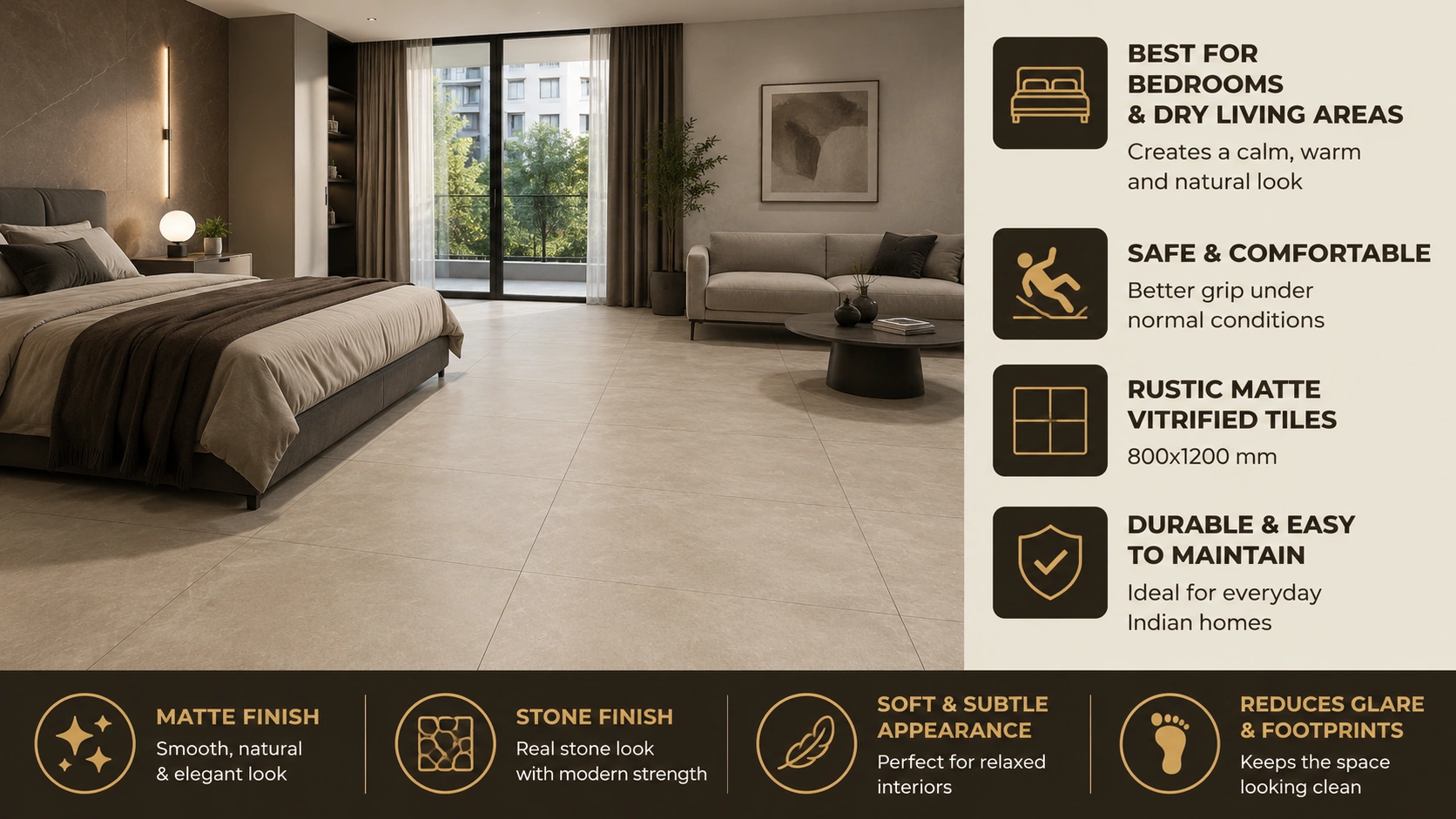
Matte finish 800x1200 mm tiles are the safest all-round choice for Indian living rooms and bedrooms. The larger tile face amplifies whatever the surface does. On a polished tile, every footprint shows at scale. On a matte tile, the non-reflective surface hides daily marks at the same scale.
Stone finish in 800x1200 mm is growing in demand in Indian metros and Tier 1 cities. The deep surface relief on a stone finish tile in this format creates a near-natural stone appearance at a fraction of natural stone cost and weight. Stone finish 800x1200 mm tiles from Morbi manufacturers cost Rs. 80 to Rs. 125 per sq.ft.
GHR and Glossy: Where They Work in 800x1200 Format
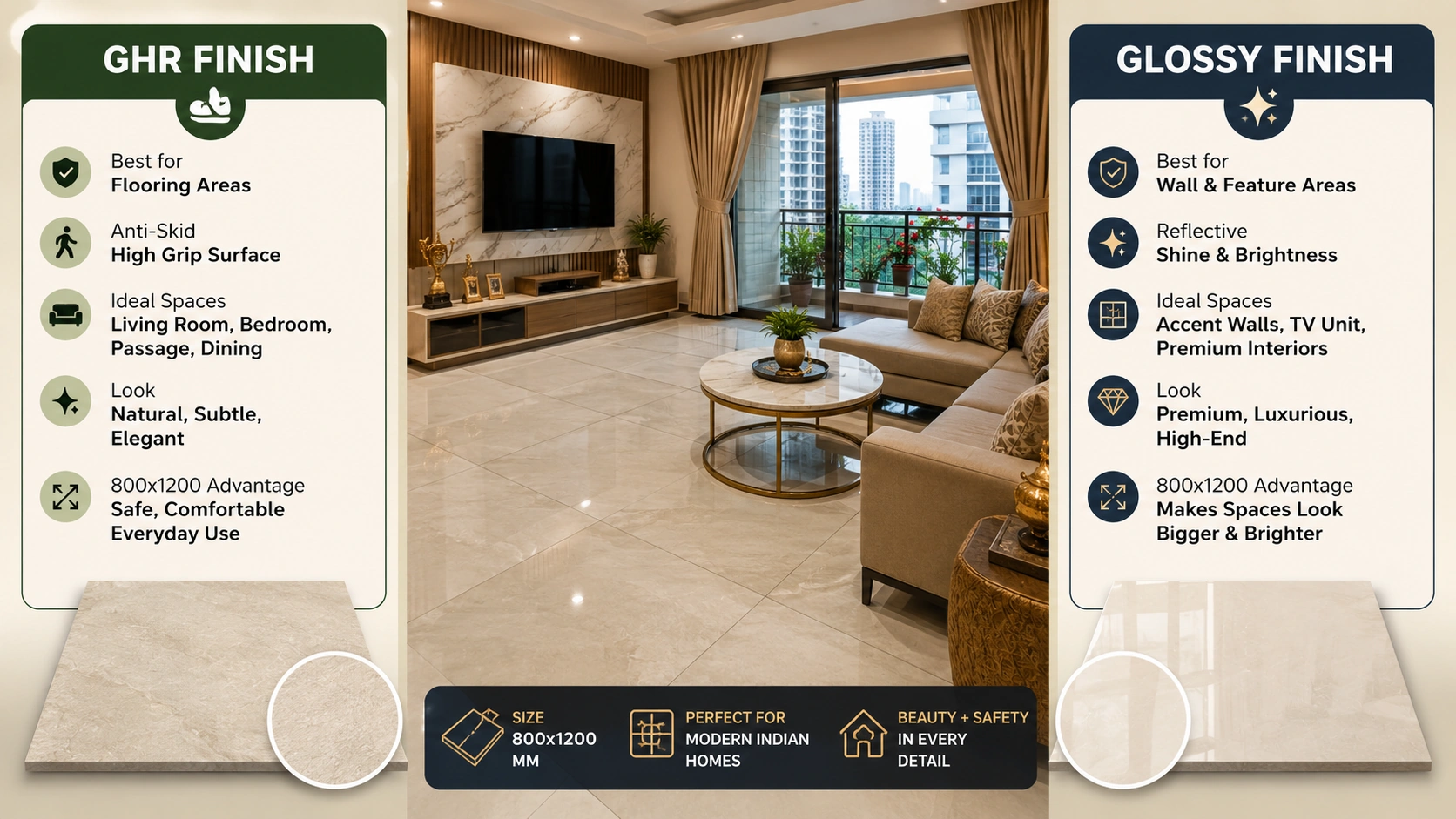
GHR (Glazed High Resistance) in 800x1200 mm works on feature walls and vertical accent surfaces in living rooms and lobbies. The raised relief pattern across the large tile face creates a strong textural statement. On floors, GHR in this size is limited to covered, dry indoor areas away from water sources.
Glossy finish 800x1200 mm GVT tiles suit formal dining rooms and drawing rooms with predominantly dry foot traffic and regular maintenance. Indian homes where daily mopping leaves water streaks on the floor are not suited to glossy large-format tiles, as the water marks are far more visible on an 800x1200 mm glossy face than on a 600x600 mm one.
Finishes That Must Not Be Used on 800x1200 Floor Tiles
| Finish | Floor Use | Wall Use | Wet Area | Notes |
|---|---|---|---|---|
| Matte (indoor rated) | Yes | Yes | No (indoor only) | Best all-round choice for 800x1200 floors |
| Stone finish | Yes | Yes | No (indoor only) | Strong visual, suits living rooms and corridors |
| GHR (Glossy High Relief) | Covered dry areas only | Yes | No | Good for feature walls, limited floor use |
| Glossy GVT | Dry indoor only | Yes | No | Shows footprints at scale on a large format |
| PGVT (Polished) | Dry indoor only | No | Never | Slippery when wet, never use in wet areas |
| Satin matte | Never | Yes | No | Wall finish only, no floor use in any size |
Installation Considerations for 800x1200 Tiles in Indian Homes
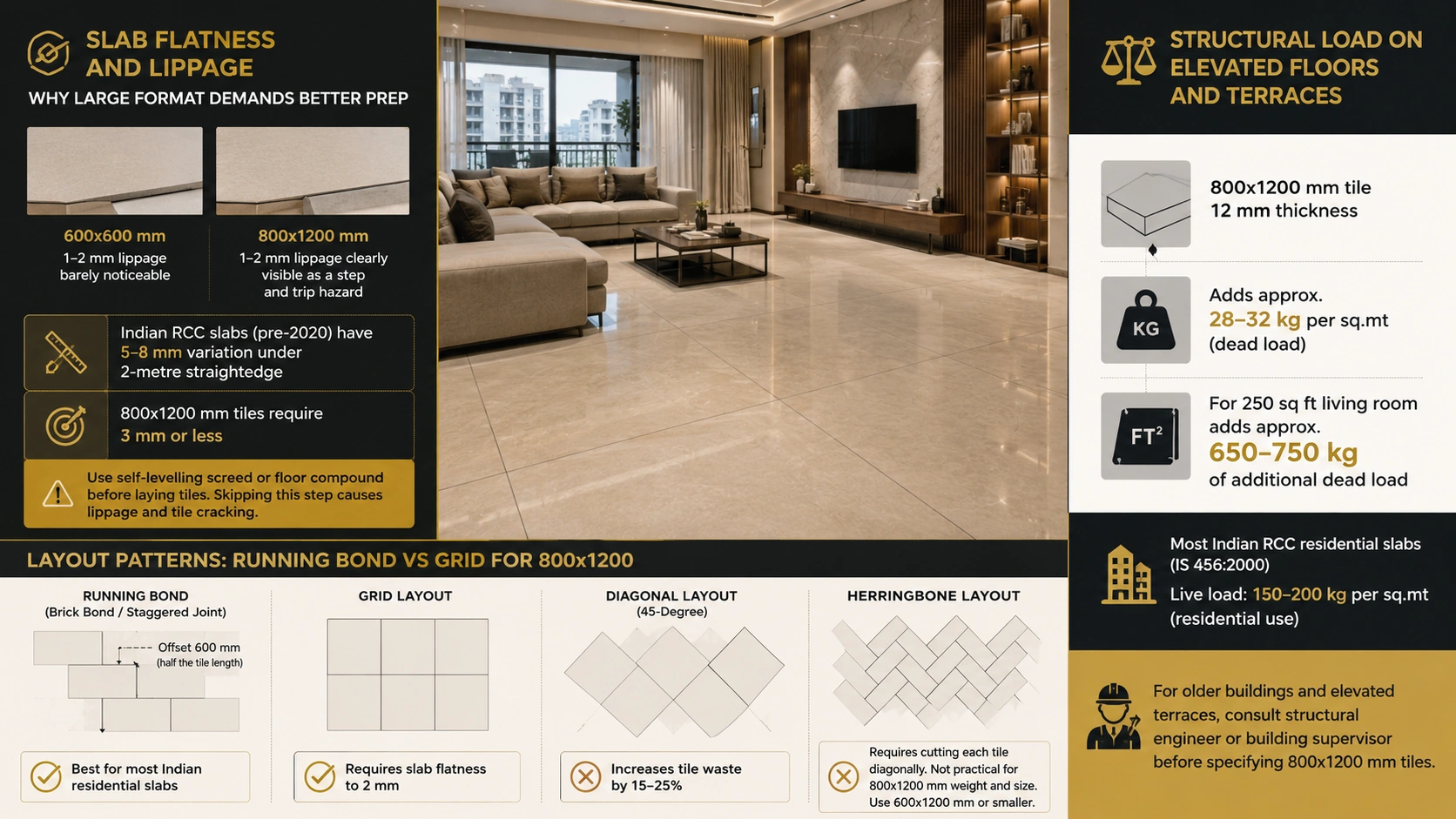
Slab Flatness and Lippage: Why Large Format Demands Better Prep
Lippage is the height difference between the edges of two adjacent tiles. On 600x600 mm tiles, 1 to 2 mm lippage is barely noticeable. On 800x1200 mm tiles, the same 1 to 2 mm lippage across a 1200 mm joint is clearly visible as a step and creates a trip hazard underfoot.
Indian RCC slabs, particularly in apartment buildings completed before 2020, typically have surface variations of 5 to 8 mm under a 2-metre straightedge. 800x1200 mm tiles require 3 mm or less. This gap must be addressed with a self-levelling screed or floor compound before laying tiles. Skipping this step is the leading cause of visible lippage and tile cracking in large-format residential projects.
Layout Patterns: Running Bond vs Grid for 800x1200
Running bond (also called brick bond or staggered joint) is the standard layout for 800x1200 mm tiles. Each tile is offset by half its 1200 mm length from the row above and below, which staggers the joint and reduces the visual prominence of grout lines. This pattern is more forgiving of minor slab irregularities than a straight grid.
Grid layout places tiles directly above and below each other with continuous straight joints in both directions. On a perfectly flat slab, this pattern reads as sharp and contemporary. On a slab with minor variations, the continuous long joints make any lippage far more visible. Specify grid layout only when the slab has been confirmed flat to within 2 mm under a 2-metre straightedge.
- Running bond: offset 600 mm (half the tile length). Best for most Indian residential slabs.
- Grid: requires slab flatness to 2 mm. Suit post-screeded or new construction slabs.
- Diagonal: 45-degree layout. Increases tile waste by 15 to 25%. Not recommended for 800x1200 mm due to the large diagonal cut pieces.
- Herringbone: requires cutting each tile diagonally. Not practical for 800x1200 mm weight and size. Use 600x1200 mm or smaller for herringbone.
Structural Load on Elevated Floors and Terraces
A full floor of 800x1200 mm tiles at 12 mm thickness adds approximately 28 to 32 kg per sq.mt of dead load (tiles plus adhesive plus grout). For a 250 sq ft living room, this is around 650 to 750 kg of additional dead load on the structural slab.
Most Indian RCC residential slabs designed to IS 456:2000 carry a live load capacity of 150 to 200 kg per sq.mt for residential use, with dead load already factored for floor finishes. In newer construction above 2015, large-format tiles typically fall within the design allowance. In older buildings and any elevated terrace application, consult the structural engineer or building supervisor before specifying 800x1200 mm tiles.
Price Guide: 800x1200 Tiles in India
| Tile Type | Finish | Price Range (Rs./sq.ft) | Source | Notes |
|---|---|---|---|---|
| GVT matte | Matte, V3 variation | Rs. 65 to Rs. 95 | Morbi, Gujarat | Widest pattern range, best value |
| GVT stone finish | Stone texture, V4 | Rs. 75 to Rs. 110 | Morbi, Rajkot | Strong texture, growing demand |
| GVT glossy | Glossy | Rs. 70 to Rs. 100 | Morbi, Gujarat | Formal rooms only, shows marks at scale |
| PGVT polished | Polished | Rs. 80 to Rs. 115 | Morbi, Gujarat | Dry indoor only, never wet areas |
| Full body vitrified matte | Matte, V3-V4 | Rs. 90 to Rs. 130 | Morbi, Gujarat | Best for living rooms, chip-resistant |
| Full body vitrified stone | Stone finish, V4 | Rs. 95 to Rs. 140 | Morbi, Rajkot | Premium option, high wear resistance |
Installation cost for 800x1200 mm tiles in India runs Rs. 60 to Rs. 90 per sq.ft, compared to Rs. 40 to Rs. 60 per sq. ft for 600x600 mm tiles. The premium covers the additional labour for two-person tile handling, back-buttering both tile and bed, and the slower pace of setting large tiles to avoid lippage.
If the slab requires self-levelling compound before laying, add Rs. 15 to Rs. 25 per sq.ft to the installation cost. For a 250sq. ftt living room requiring both levelling and large-format installation, the total floor cost including tile, adhesive, grout, levelling, and labour ranges from Rs. 200 to Rs. 320per squaree foot s. ft,t depending on tile grade and city.
Common Mistakes With 800x1200 Tile Projects
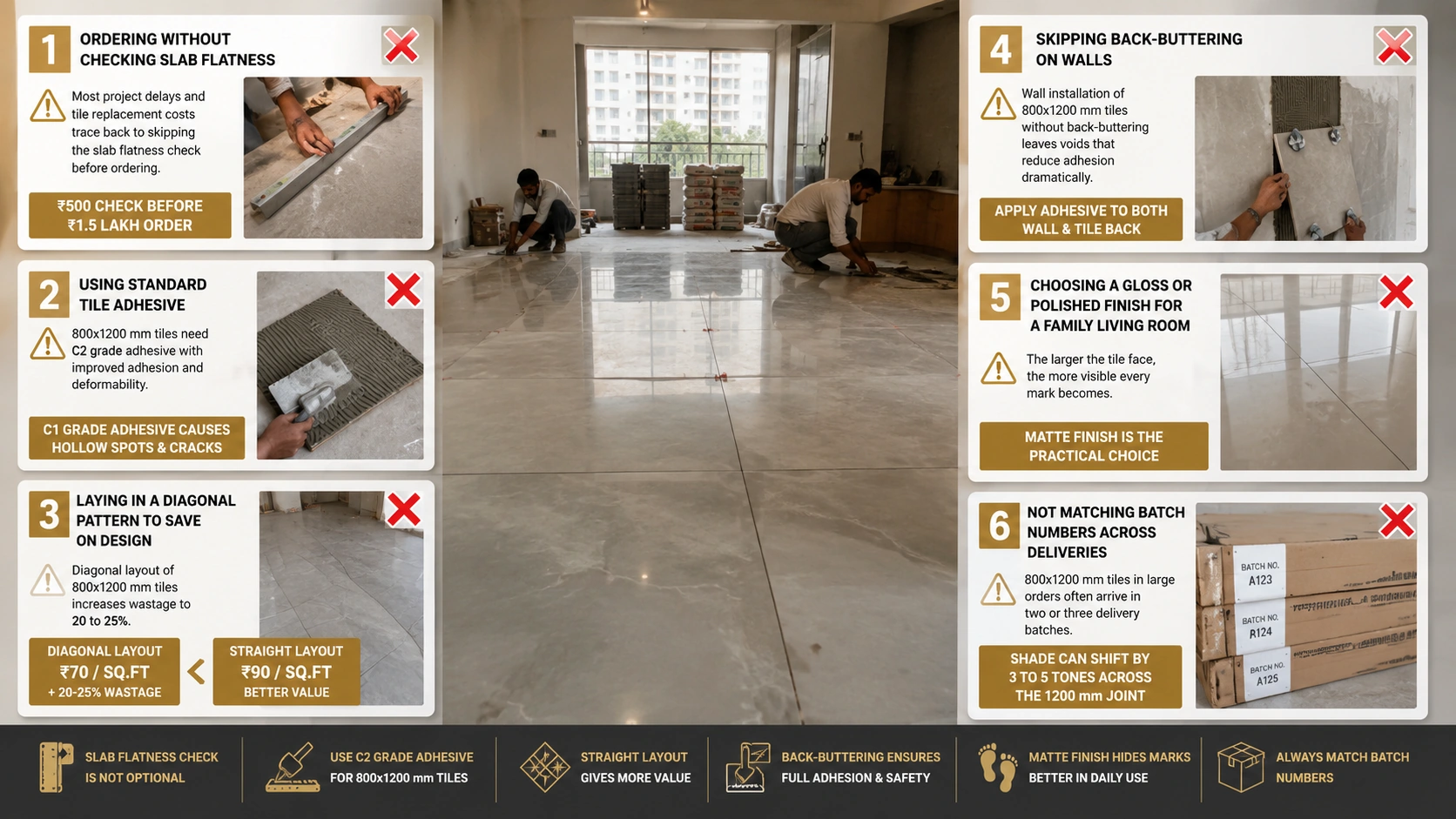
- Ordering without checking slab flatness. Most project delays and tile replacement costs in large-format projects trace back to skipping the slab flatness check before ordering. A Rs. 500 straightedge check before placing a Rs. 1.5 lakh tile order is not optional.
- Using standard tile adhesive. 800x1200 mm tiles need C2 grade adhesive with improved adhesion and deformability. Standard grey cement adhesive (C1 grade) does not bond well to the back of large-format tiles and leads to hollow spots that crack under point loads from furniture legs.
- Laying in a diagonal pattern to save on design. Diagonal layout of 800x1200 mm tiles increases wastage to 20 to 25%, which typically costs more per sq ft in tile material than the upgrade to the next tile grade. A straight running bond layout at Rs. 90 per sq ft tile cost delivers more value than a diagonal at Rs. 70 per sq ft with 25% extra wastage.
- Skipping back-buttering on walls. Wall installation of 800x1200 mm tiles without back-buttering leaves voids between tile and wall that reduce adhesion dramatically. Large-format tiles on walls without full coverage adhesion are a safety risk. Apply adhesive to both the wall and the tile back before fixing.
- Choosing a gloss or polished finish for a family living room. The larger the tile face, the more visible every mark becomes. Footprints, furniture drag, and cleaning streaks that are barely noticeable on a 600x600 mm polished tile are clearly visible on an 800x1200 mm polished tile. Matte finish is the practical choice for any living room with daily use.
- Not matching batch numbers across deliveries. 800x1200 mm tiles in large orders often arrive in two or three delivery batches. If the batch numbers differ, the shade can shift by three to five tones across the 1200 mm joint, creating a stripe effect across the finished floor.
Find Confirmed Stock in 800x1200 Tile Sizes
800x1200 mm tiles sell fast from popular patterns and batches. A tile you select from a catalogue photograph may already be discontinued or out of stock by the time your contractor places the order.
On TilesFinders, every 800x1200 mm tile listing shows stock that manufacturers have confirmed as currently available. Filter by finish, body type, or tone to find options that match your room dimensions and finish requirements, then contact the verified manufacturer directly without going through a middleman.
FAQs
No, not for most bedrooms. 800x1200 mm tiles suit bedrooms of 120 sq.ft and above. For smaller bedrooms under 120 sq.ft (10x12 ft), the format creates more edge cuts and higher wastage, making 600x600 mm or 600x1200 mm a more practical choice.
GVT matte 800x1200 mm tiles cost Rs. 65 to Rs. 100 per sq.ft from Morbi manufacturers. Full body vitrified 800x1200 mm tiles range from Rs. 90 to Rs. 140 per sq.ft. Polished GVT in this size runs Rs. 75 to Rs. 110 per sq.ft depending on surface finish and pattern.
Yes, but with weight and adhesive limitations. 800x1200 mm tiles weigh 18 to 24 kg per piece. Wall installation requires C2 grade tile adhesive, stainless steel back-buttering, and structural wall assessment. Do not fix 800x1200 mm tiles to hollow partition walls or lightweight drywalls.
800x1200 mm tiles are typically 9 to 12 mm thick. Floor tiles in this format run 10 to 12 mm. Wall tiles in the same size may be 9 mm. Always confirm the thickness on the technical data sheet, as thicker tiles require deeper mortar beds and raise the finished floor level by 2 to 3 mm.
Running bond (brick bond) is the standard pattern for 800x1200 mm tiles. Each tile is offset by half its length from the row below, which breaks the continuous long joint and reduces lippage visibility. Grid (stacked) layout creates a stronger vertical and horizontal line that suits contemporary interiors but demands higher slab flatness.
Each 800x1200 mm tile covers 0.96 sq.ft, so a 200 sq.ft room needs approximately 209 tiles before wastage. Add 10 to 12% for cuts and breakage, bringing the total order to around 230 to 235 tiles. For rooms with columns or alcoves, calculate each regular zone separately.
Yes. 800x1200 mm tiles require a flatter mortar bed with less than 3 mm variation under a 2-metre straightedge. Standard 600x600 mm installations allow up to 5 mm variation. Large format tiles also need back-buttering of the tile and the bed, a stronger C2 adhesive, and mechanical anchors for wall applications.
An 800x1200 mm tile weighs 18 to 24 kg depending on thickness and body type. Full body vitrified tiles at 12 mm are at the heavier end. For an elevated terrace or first-floor room, calculate the total tile dead load (tiles plus adhesive plus grout) as part of the structural assessment before ordering.
Matte or stone finish is best for most Indian living rooms in 800x1200 mm size. Matte surfaces hide footprints and furniture drag marks that become very visible on the larger tile face. Polished and glossy finishes amplify every scratch and footprint on a large format, making maintenance impractical in a daily-use family space.

See our tile guides first
Set TilesFinders as a preferred source and our buying guides surface ahead of the rest for you.
Add as preferred sourceTakes one tap. Nothing to install.
What Readers Say
I was about to redo my parking area with the wrong tile size until I read this. The layout comparisons saved me from a costly mistake.
We reference TilesFinders guides while briefing clients on material selection. The size and pattern breakdowns are accurate and easy to explain visually.
On site, I get asked about grout spacing all the time. This article gave me a solid reference I now share with my team before every job.
Finally a guide that doesn't just push generic advice. The oil stain removal steps actually worked on our clubhouse driveway tiles.
I run a small construction firm and now send this link to clients directly when they ask about entrance tile sizing. Saves me an hour of explaining.
Good practical detail, though I wish there were more examples for compact apartment entrances specifically, not just villas.
My mother-in-law wanted marble, I wanted vitrified. This blog gave us the neutral comparison we needed to actually decide together.
Detailed without being overwhelming. I appreciated that it covered both cost and maintenance, not just the aesthetics.
Used the algae and hard water removal tips on our terrace tiles after the monsoon. Worked better than what our regular cleaner was doing.
As someone who sources tiles for multiple builder projects, I find these comparisons genuinely useful for vendor conversations, not just consumer content.
Recommended this to a client who kept second-guessing the entrance design. The small vs large layout section settled the debate instantly.
Straightforward and honest, no unnecessary jargon. Would like to see a similar breakdown for outdoor pool-deck tiles next.
We've bookmarked several TilesFinders guides for our design handbook. Reliable source when clients want data, not just opinions.
Two paths, one marketplace.
Get free quotes from verified suppliers.
Share your room, budget, and style. Suppliers in Morbi respond within hours.
Get Free QuotesList your business, reach real buyers.
Put your showroom in front of homeowners searching for tiles right now.
List Your Business