What Architects Look for in a Tile Supplier: A Practical Checklist
Evaluate tile suppliers across 5 key project stages! A practical checklist for architects covering BIM assets, IS compliance, batch guarantees, and post-occupancy support.

- Why Architects Evaluate Suppliers Differently Than Builders Do
- Stage 1: Concept and Design
- Stage 2; Specification Writing
- Stage 3: Procurement and Site Delivery
- Stage 4: Installation Support
- Stage 5: Post-Occupancy
- A Practical Supplier Evaluation Checklist
- Red Flags That Predict a Difficult Supplier Relationship
- Where to Start Vetting Suppliers
- Testing the Whole Relationship, Not Just the Sale
Architects evaluate tile suppliers across five distinct project stages, concept, specification, procurement, installation, and post-occupancy, not on price and design alone. This checklist covers what to verify at each stage, from BIM assets and IS compliance documentation to long-term batch availability for future repairs.
A tile supplier rarely fails an architect at the point of sale. The showroom visit goes well, the samples look right, the quote is competitive. Where the relationship actually breaks down is later, at a stage the initial meeting never tested: a discontinued batch eighteen months into a phased project, a technical certificate that turns out not to exist, a site query that goes unanswered for a week during a critical installation window.
Evaluating a supplier properly means testing them against every stage of a project, not just the first one. This checklist is organised that way, from concept through post-occupancy, because that is genuinely where different suppliers separate from each other.
Why Architects Evaluate Suppliers Differently Than Builders Do
A contractor or builder typically evaluates a supplier on a single transaction, price, delivery date, and product quality for one order. An architect's relationship with a tile supplier usually spans the life of a project and, often, the years after handover when a client calls about a cracked tile or a planned extension.
This longer, more accountable relationship is why architects tend to weight documentation, consistency, and long-term availability more heavily than price alone, factors a single-transaction buyer might reasonably deprioritise.
Stage 1: Concept and Design
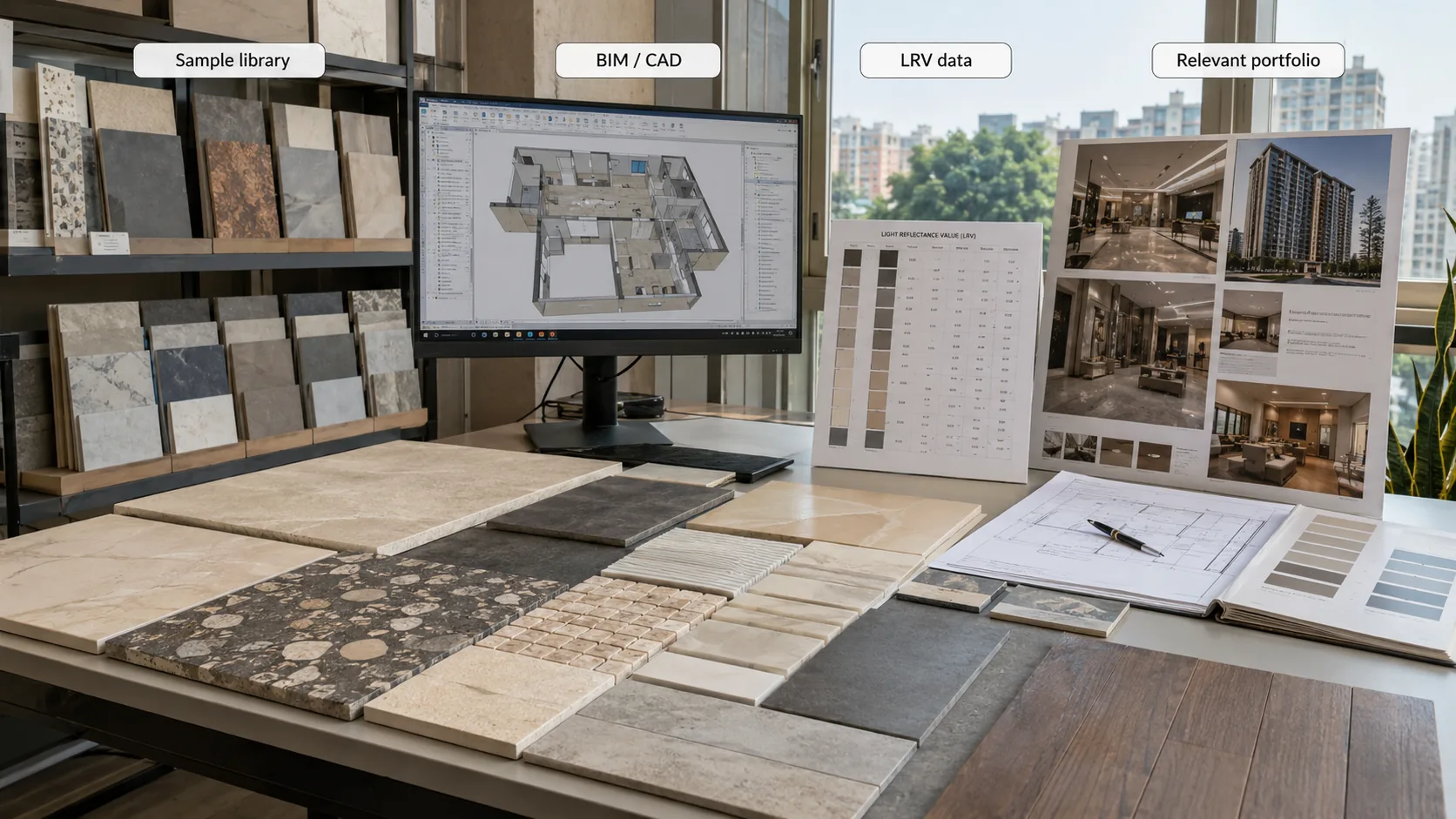
Before a single tile gets specified, a supplier needs to support the exploratory, comparative part of design work.
- A genuine physical sample library, not just a digital catalogue, since colour and texture judgments made from a screen consistently differ from how a tile reads in person under actual site lighting.
- BIM or CAD assets for larger, technically driven projects, increasingly expected on commercial and institutional work where the tile needs to sit accurately within a broader digital model.
- Light Reflectance Value (LRV) data alongside colour samples, useful for any project where lighting design and finish selection need to be coordinated rather than chosen independently.
- A credible project portfolio in a comparable typology, residential, hospitality, or commercial, since a supplier's experience in one sector does not automatically transfer to another's technical demands.
Stage 2; Specification Writing
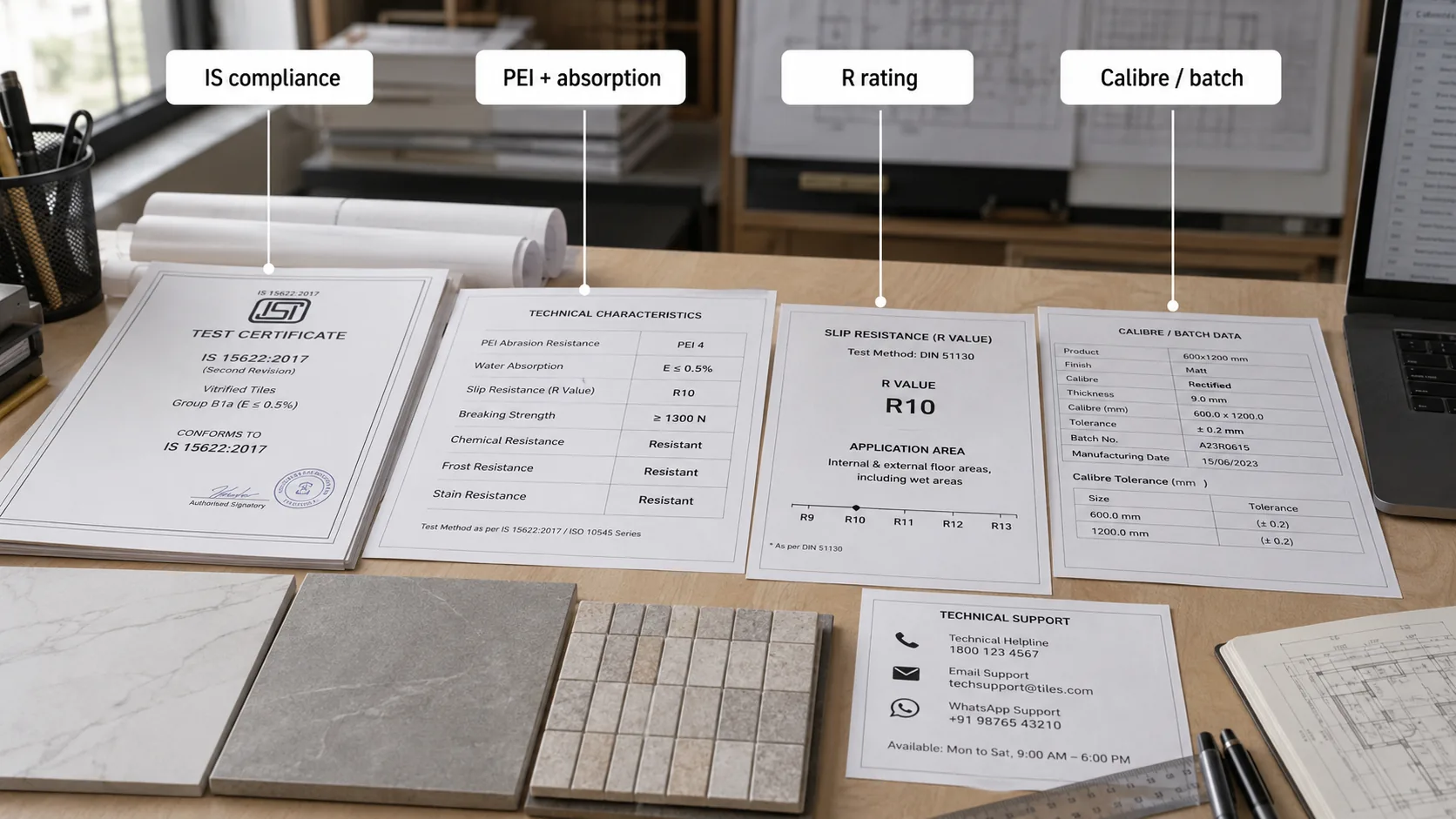
Once a tile is chosen, it needs to survive translation into a defensible written specification, and a good supplier makes this considerably easier.
- IS 15622 (vitrified) or IS 13753 (ceramic) compliance certificates available on request, not buried in generic marketing material or unavailable entirely.
- PEI abrasion rating, water absorption percentage, and slip resistance data (R rating or equivalent) provided as standard technical documentation, not only when specifically pushed for.
- Calibre and batch consistency data for large-format or rectified tile, particularly relevant above 60x120cm where even small dimensional tolerance becomes visually significant across a large installation.
- A technical contact who can actually answer a specification question, not just a sales contact repeating catalogue copy back.
Stage 3: Procurement and Site Delivery
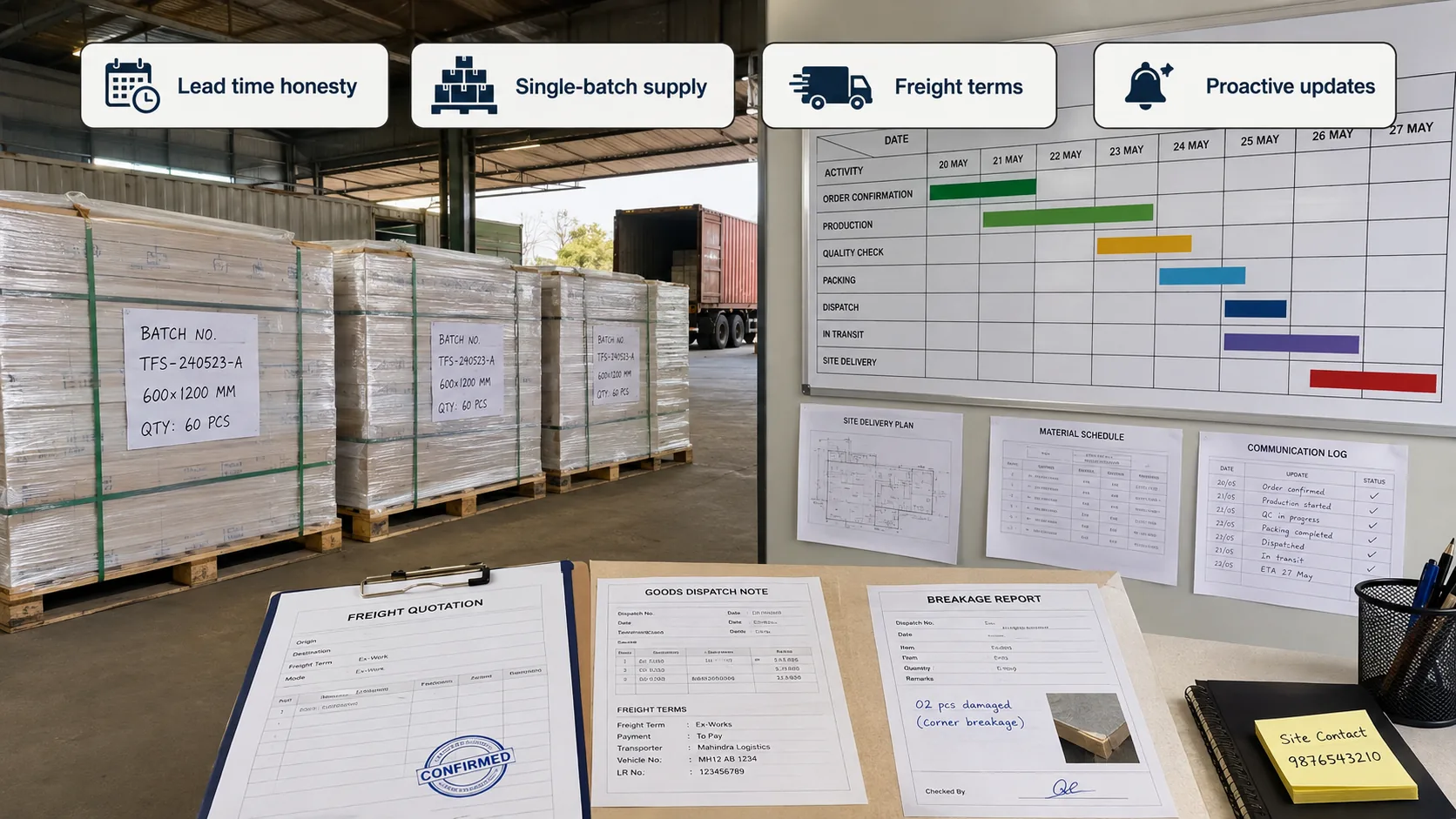
This is where many otherwise promising supplier relationships go wrong, and it is worth testing for reliability here specifically, not just assuming it.
- Honest lead time communication, including a clear answer on whether a specific order ships from existing stock or requires a fresh production run, and what that actually means for the project timeline.
- A written single-batch guarantee for continuous areas, with a clear explanation of what happens if the order needs to be split across two batches.
- Transparent freight and breakage liability terms agreed before dispatch, not negotiated after a damaged shipment arrives.
- A track record of proactive communication when a delay is likely, rather than the project team discovering a problem only when the delivery date has already passed.
From The Marketplace
Popular tiles right now









Stage 4: Installation Support
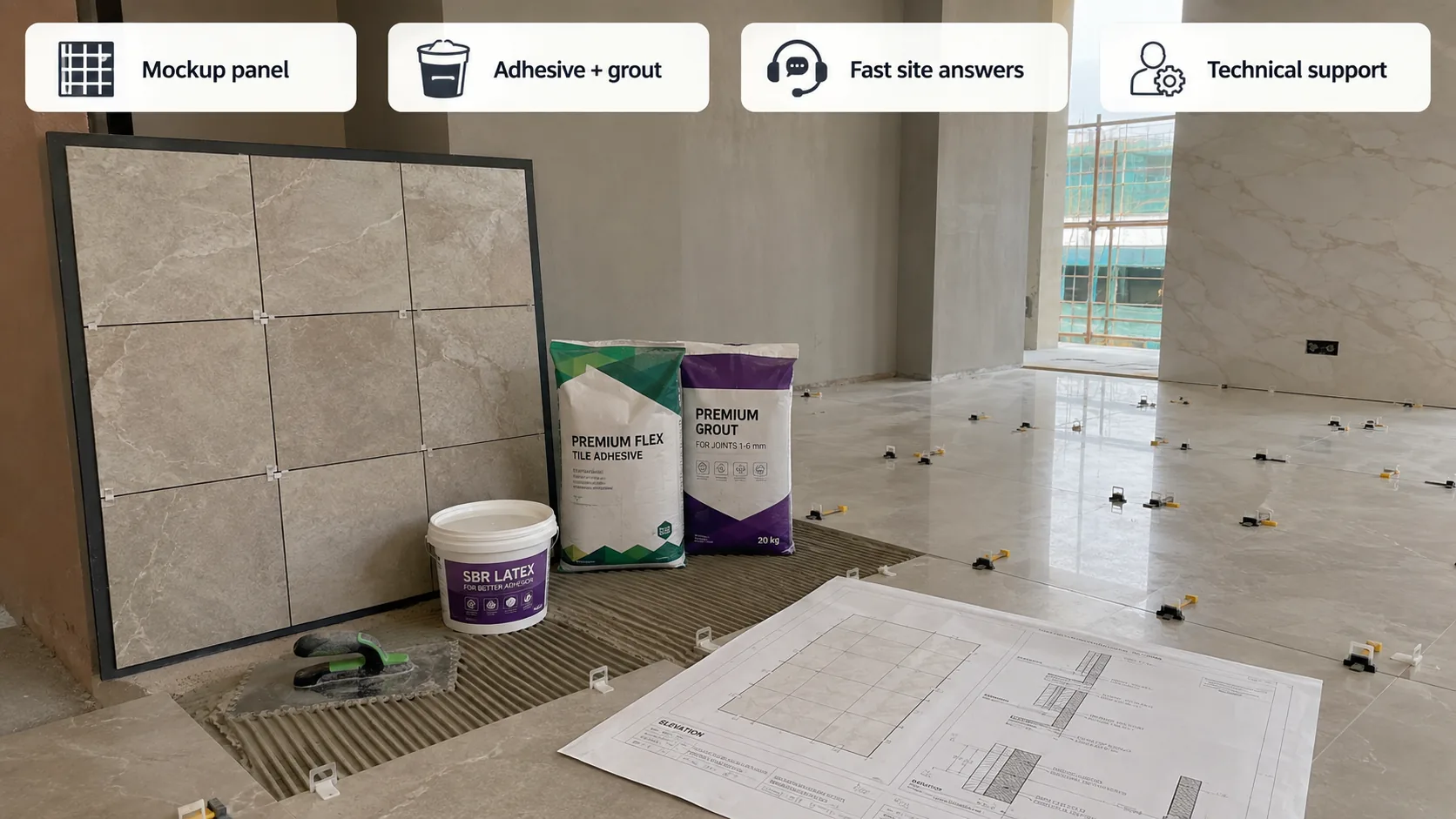
A supplier's job is not finished once the tile reaches the site, and the good ones understand this.
- Willingness to provide or review a mockup or test panel for large or technically demanding installations, particularly relevant for large-format tile, complex patterns, or unusual substrates.
- Access to technical guidance on adhesive and grout selection matched to the specific tile and substrate, rather than leaving this entirely to the installation contractor's general practice.
- A responsive channel for site queries during installation, since problems discovered mid-installation need same-day or next-day answers, not a week-long email chain.
- Willingness to visit site for a technically complex installation, particularly on larger commercial or hospitality projects where the cost of a specification error multiplies quickly across a large area.
Stage 5: Post-Occupancy
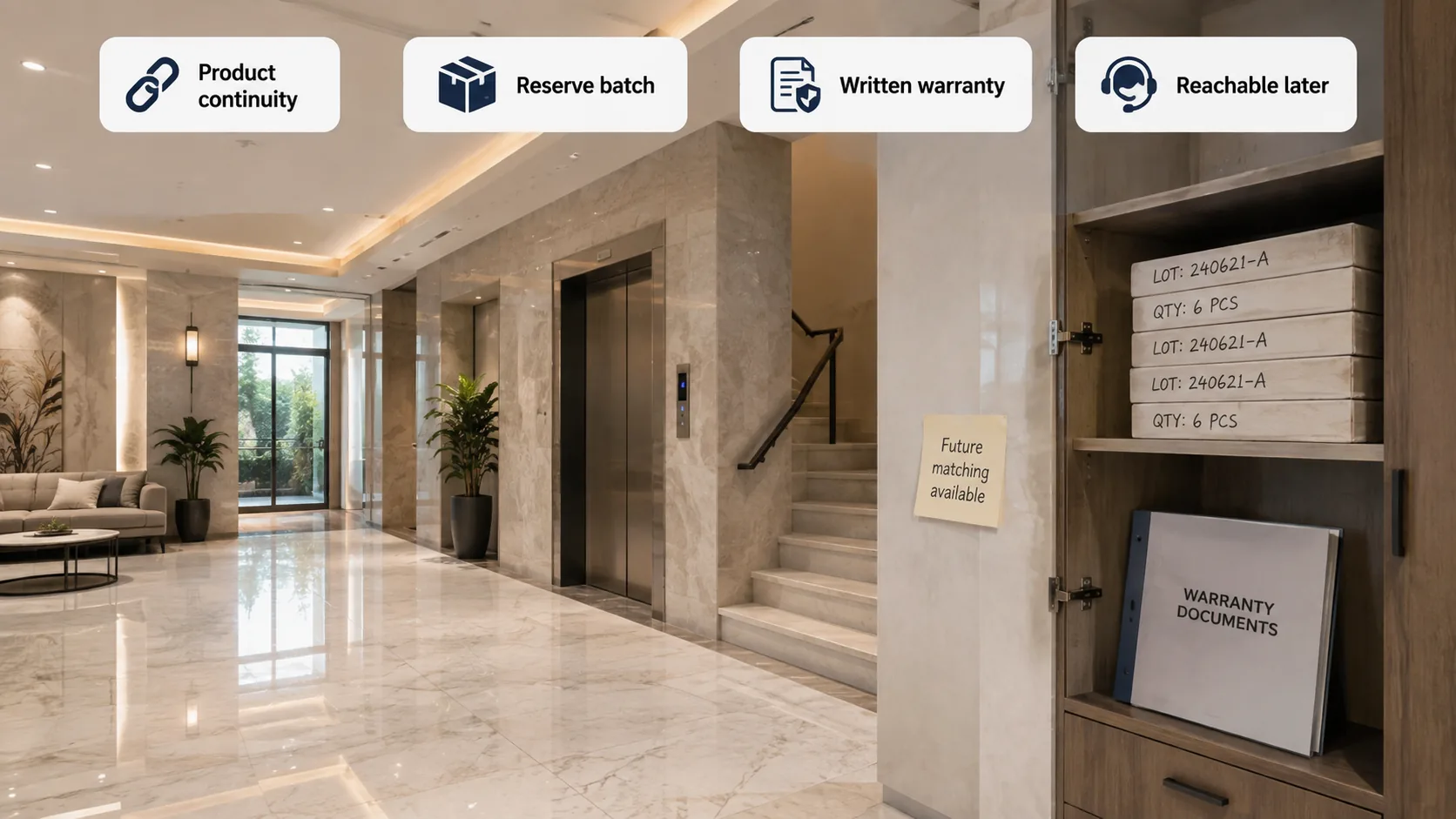
This is the stage most suppliers are never tested on before being selected, and it is often the one that most affects an architect's long-term reputation with a client.
- A clear answer on how long a given product line is expected to remain in production, particularly relevant for phased projects or clients likely to need matching material for a future extension.
- Willingness to hold or help source a small reserve batch for future repairs, a service some suppliers offer proactively and others never mention unless asked.
- Clear warranty terms in writing, covering what is and is not included, rather than a verbal assurance that becomes difficult to enforce later.
- A record of actually being reachable a year or more after project handover, when a client repair query inevitably routes back through the architect first.
A Practical Supplier Evaluation Checklist
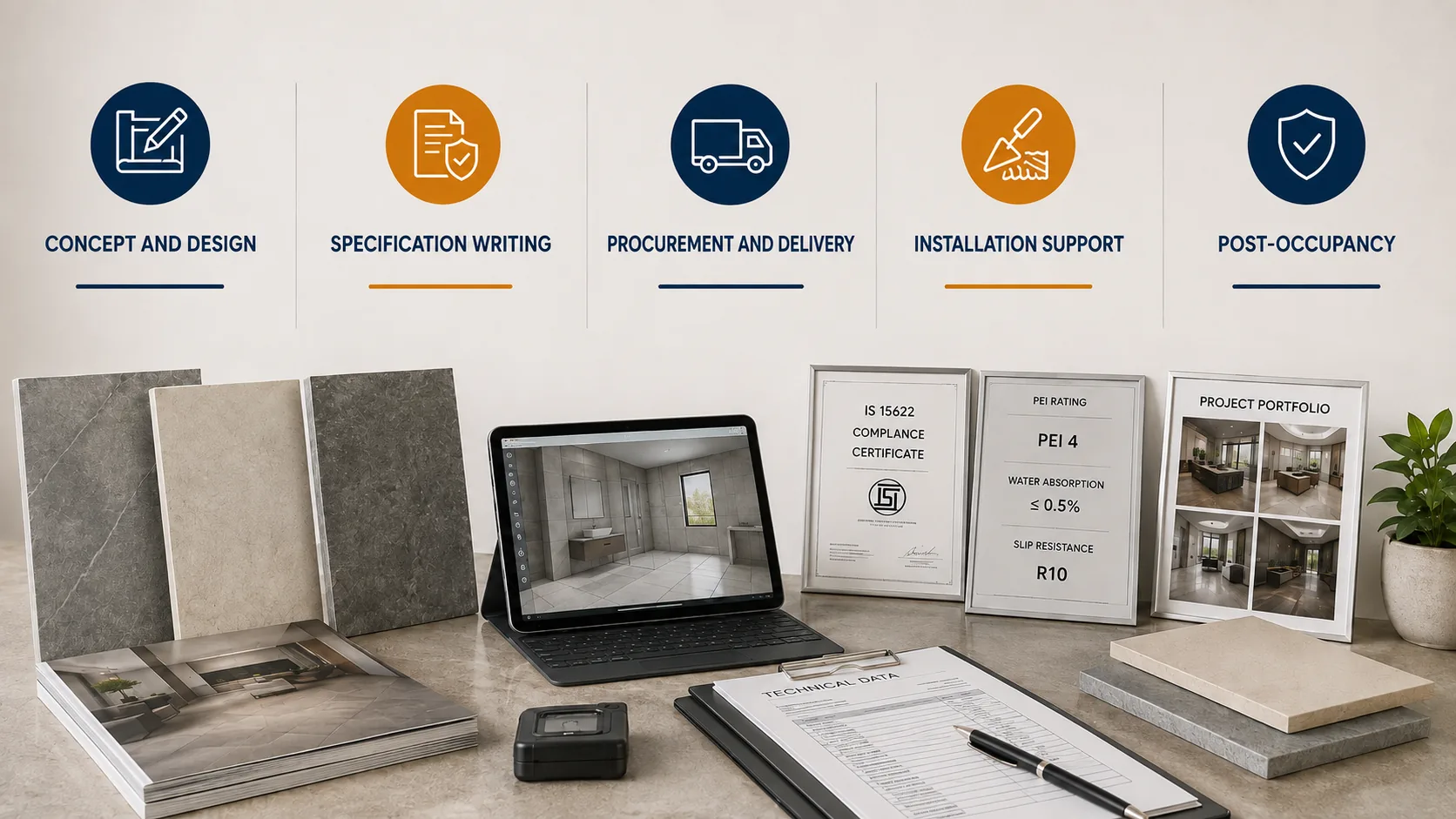
| Project Stage | What to Verify | Why It Matters |
| Concept and design | Physical samples, BIM/CAD assets, LRV data, relevant portfolio | Design decisions need accurate, in-person reference material |
| Specification writing | IS compliance certs, PEI/absorption/slip data, technical contact | A defensible BOQ entry needs real documentation, not marketing copy |
| Procurement and delivery | Honest lead times, single-batch guarantee, freight terms in writing | Most supplier failures happen here, not at the point of sale |
| Installation support | Mockup willingness, adhesive/grout guidance, responsive site contact | Problems found mid-installation need fast, expert answers |
| Post-occupancy | Production lifespan estimate, reserve batch option, written warranty | This determines whether a future repair is simple or a redesign |
Red Flags That Predict a Difficult Supplier Relationship
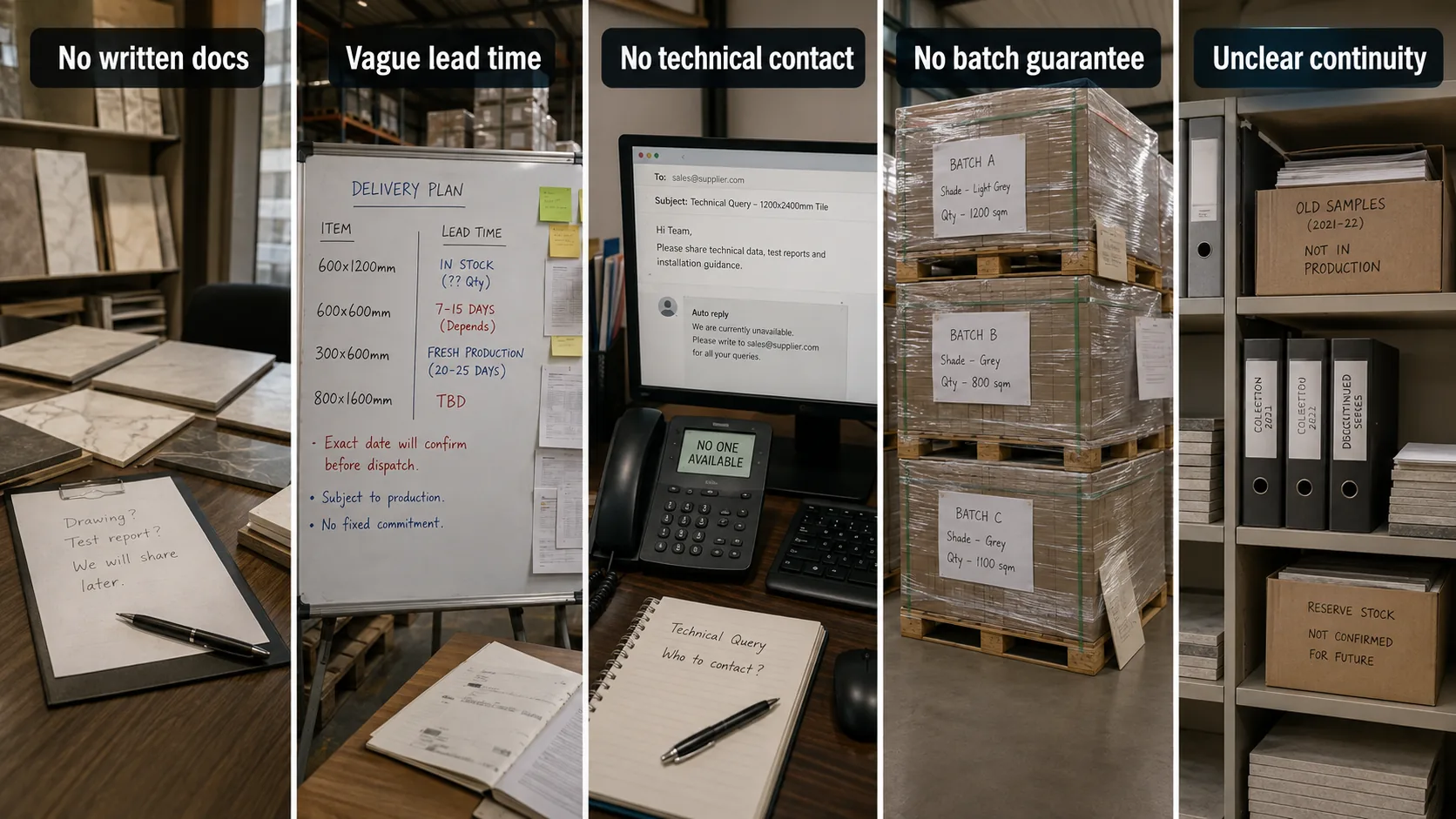
- Reluctance to provide written technical documentation, offering only verbal assurances about compliance or performance data.
- Vague or shifting answers about lead time, particularly an inability to say clearly whether a product is in stock or requires fresh production.
- No clear point of contact for technical questions once the sales conversation is complete.
- An unwillingness to commit to single-batch supply in writing for a large continuous area.
- No meaningful answer when asked how long a specific product line is expected to remain available.
Where to Start Vetting Suppliers
Building this kind of evaluation into the supplier selection process from the start, rather than only after a problem surfaces mid-project, is what separates architects who repeatedly work with reliable partners from those who discover a supplier's weaknesses the hard way.
TilesFinders connects architects and design teams with verified tile dealers and suppliers who can be evaluated against documentation, batch consistency, and long-term availability on TilesFinders, rather than relying on a single showroom conversation to make that judgment.
Testing the Whole Relationship, Not Just the Sale
A tile supplier worth building a long-term working relationship with can answer questions from all five project stages confidently and in writing, not just the ones that come up during the initial showroom visit. Architects who evaluate suppliers this way, before a problem forces the issue, consistently end up with fewer mid-project surprises and cleaner client conversations later.
If you are evaluating tile suppliers for a project, TilesFinders helps connect architects and design teams with verified dealers on TilesFinders who can be assessed against this full checklist.

FAQs
At minimum, request IS compliance certificates, PEI and water absorption data, confirmation of single-batch availability for the required quantity, and a clear answer on expected production lifespan for the specific product line.
A visible shade mismatch across a large specified area, common when a project draws from two different production batches, reflects directly on the architect's design credibility with the client, not just the contractor's installation work.
This is a genuine risk on any multi-phase or long-duration project, which is why confirming a supplier's expected production timeline and willingness to hold a reserve batch matters at the specification stage, before the risk becomes a live problem.
No, this varies significantly by manufacturer and is more commonly available for larger commercial and institutional-focused product lines than for standard residential ranges, so it is worth confirming directly rather than assuming availability.
Very, for any large-format, complex pattern, or technically unusual installation, since a mockup surfaces problems, lippage, shade variation, adhesive compatibility, before they appear across an entire finished floor.
Rarely on its own. A marginally cheaper supplier who cannot guarantee batch consistency, documentation, or post-occupancy support often costs more in the long run through rework, client disputes, or an unrepairable mismatch years later.


See our tile guides first
Set TilesFinders as a preferred source and our buying guides surface ahead of the rest for you.
Add as preferred sourceTakes one tap. Nothing to install.
What Readers Say
I was about to redo my parking area with the wrong tile size until I read this. The layout comparisons saved me from a costly mistake.
We reference TilesFinders guides while briefing clients on material selection. The size and pattern breakdowns are accurate and easy to explain visually.
On site, I get asked about grout spacing all the time. This article gave me a solid reference I now share with my team before every job.
Finally a guide that doesn't just push generic advice. The oil stain removal steps actually worked on our clubhouse driveway tiles.
I run a small construction firm and now send this link to clients directly when they ask about entrance tile sizing. Saves me an hour of explaining.
Good practical detail, though I wish there were more examples for compact apartment entrances specifically, not just villas.
My mother-in-law wanted marble, I wanted vitrified. This blog gave us the neutral comparison we needed to actually decide together.
Detailed without being overwhelming. I appreciated that it covered both cost and maintenance, not just the aesthetics.
Used the algae and hard water removal tips on our terrace tiles after the monsoon. Worked better than what our regular cleaner was doing.
As someone who sources tiles for multiple builder projects, I find these comparisons genuinely useful for vendor conversations, not just consumer content.
Recommended this to a client who kept second-guessing the entrance design. The small vs large layout section settled the debate instantly.
Straightforward and honest, no unnecessary jargon. Would like to see a similar breakdown for outdoor pool-deck tiles next.
We've bookmarked several TilesFinders guides for our design handbook. Reliable source when clients want data, not just opinions.
Two paths, one marketplace.
Get free quotes from verified suppliers.
Share your room, budget, and style. Suppliers in Morbi respond within hours.
Get Free QuotesList your business, reach real buyers.
Put your showroom in front of homeowners searching for tiles right now.
List Your Business