Terracotta Tiles in India: Traditional Roots, Modern Applications, and Buying Guide
Explore terracotta tiles in India across GVT, ceramic, vitrified, and natural stone. Compare colours, Vastu significance, room-wise applications, prices, maintenance, and expert buying tips.
- What the Terracotta Colour Range Covers
- Traditional Roots of the Terracotta Colour in Indian Architecture
- Tiles in the Terracotta Colour Range: All Materials Compared
- Terracotta Colour Tiles: Room-by-Room Applications
- Terracotta Colour and Vastu Shastra
- Buying Terracotta Colour Tiles in India: What to Check
- Common Mistakes When Choosing Terracotta Colour Tiles
- Terracotta Colour GVT from Morbi, Gujarat: Available Range 2026
- Browse Terracotta Colour Tiles on TilesFinders
Terracotta is a colour family, not a single material, and is available in GVT, ceramic, vitrified, and natural stone tiles. Choose the right material based on durability, maintenance, room use, and Vastu preferences for long-lasting performance.
Terracotta is a colour, not a material. The warm red-orange to burnt sienna tone that Indian design calls terracotta is achievable in vitrified GVT, full-body porcelain, ceramic, and natural stone tiles. What unites them is the colour: a baked-earth warmth that sits between orange and red with a brown pull, the tone of Rajasthani sandstone, sun-dried Indian clay, and the soil of the Deccan plateau.
This guide covers tiles in the terracotta colour range available in India in 2026 across all material categories, with their individual properties, applications, price points, and the design traditions they draw from. Whether you want a maintenance-free GVT floor, a ceramic accent wall, or a natural stone courtyard, the terracotta colour family covers all of them.
What the Terracotta Colour Range Covers
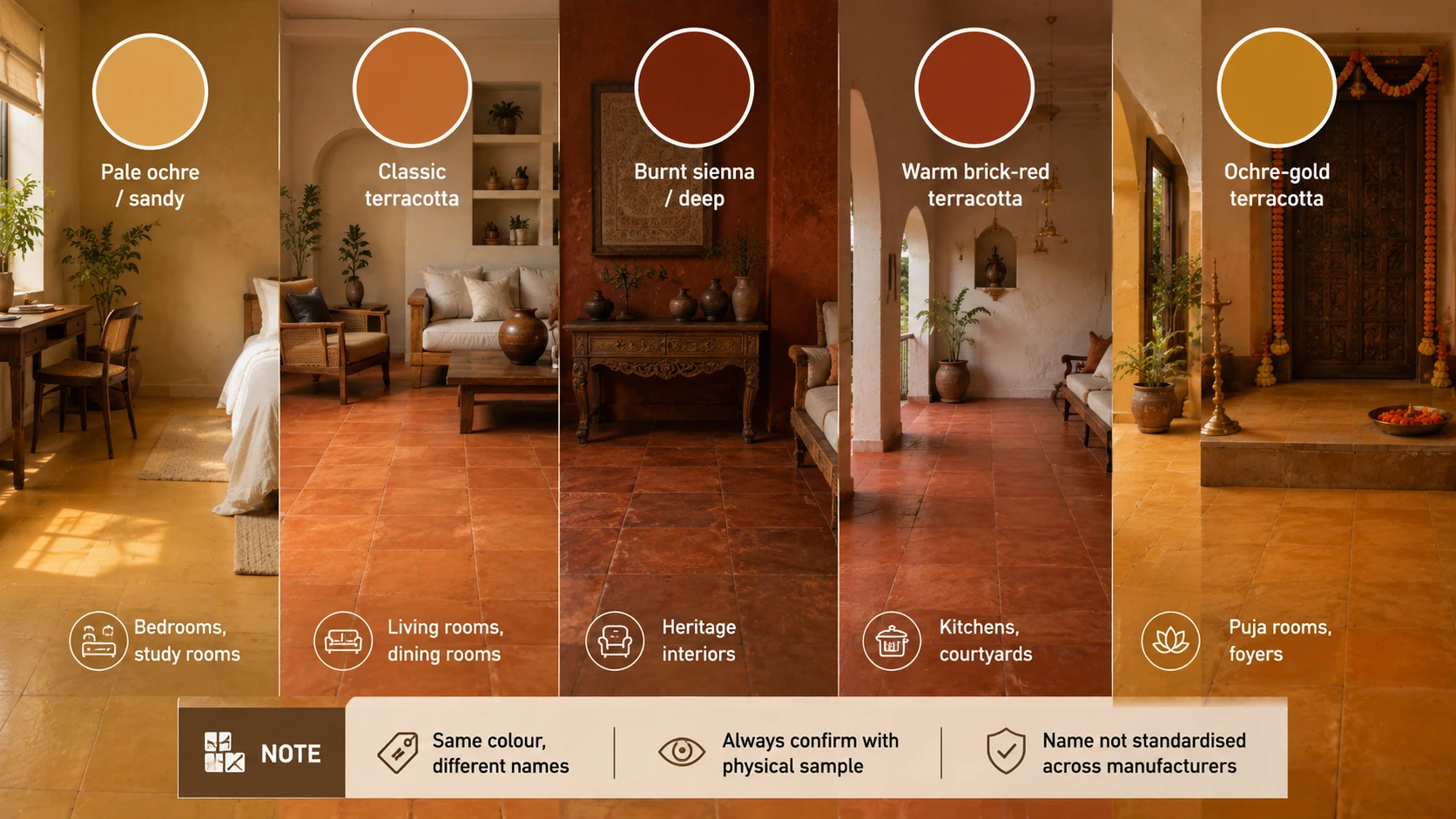
The terracotta colour family is broader than most buyers initially assume. It spans at least five distinct sub-tones, each with a different design application and cultural reference in India.
| Terracotta Sub-Tone | Colour Description | Indian Cultural Reference | Best Design Application |
| Pale ochre / sandy terracotta | Light warm yellow-orange. The palest end of the terracotta range. Close to beige but with a clear warm orange pull. | Jaisalmer yellow sandstone, raw, unbleached Indian cotton, dried grass. | Bedrooms, study rooms, meditation spaces. Rooms where a warm tone is wanted without strong colour saturation. |
| Classic terracotta | Medium warm red-orange. The most widely recognised terracotta tone. Neither too yellow nor too red. | Rajasthani kiln-fired clay, the tone of a new clay pot before it darkens with use. | Living rooms, dining rooms, covered courtyards, and entrance foyers. |
| Burnt sienna / deep terracotta | Rich, deeper red-brown. More red saturation than classic terracotta. Closer to the colour of aged or fire-darkened clay. | Aged terracotta after years of use and outdoor exposure, the colour of Rajasthan laterite. | Heritage interiors, accent walls, statement living room floors with dark furniture. |
| Warm brick-red terracotta | Deep red-orange with strong red pull. Sits at the border between terracotta and red tile families. | Red Agra brick, Mangalore roof tiles, Indian red sandstone. | Rajasthani-reference interiors, kitchens with a vernacular building reference, and covered courtyards. |
| Ochre-gold terracotta | Warm golden-orange. The warmest and most yellow-toned end of the terracotta range. Closer to mustard or ochre than to red. | Turmeric yellow, Indian saffron, and Rajasthani mustard harvest fields. | Puja rooms, entrance foyers, Vastu-aligned spaces where the Agni or earth element is the colour intention. |
Note: In Indian tile showrooms and online catalogs, the same tile colour is sometimes labelled as terracotta, ochre, rust, brick-red, or burnt orange by different suppliers. When specifying a terracotta colour tile, always confirm with a physical sample rather than relying on the product name alone. The colour name is not standardised across Indian manufacturers.
Traditional Roots of the Terracotta Colour in Indian Architecture
The terracotta colour's deep presence in Indian design comes not from any single tile tradition but from the colour of India's building landscape itself. The warm red-orange and ochre tones of Indian stone, earth, and fired brick are the dominant colours of traditional built environments across most of India.
Rajasthan: Stone, Earth, and the Desert Palette
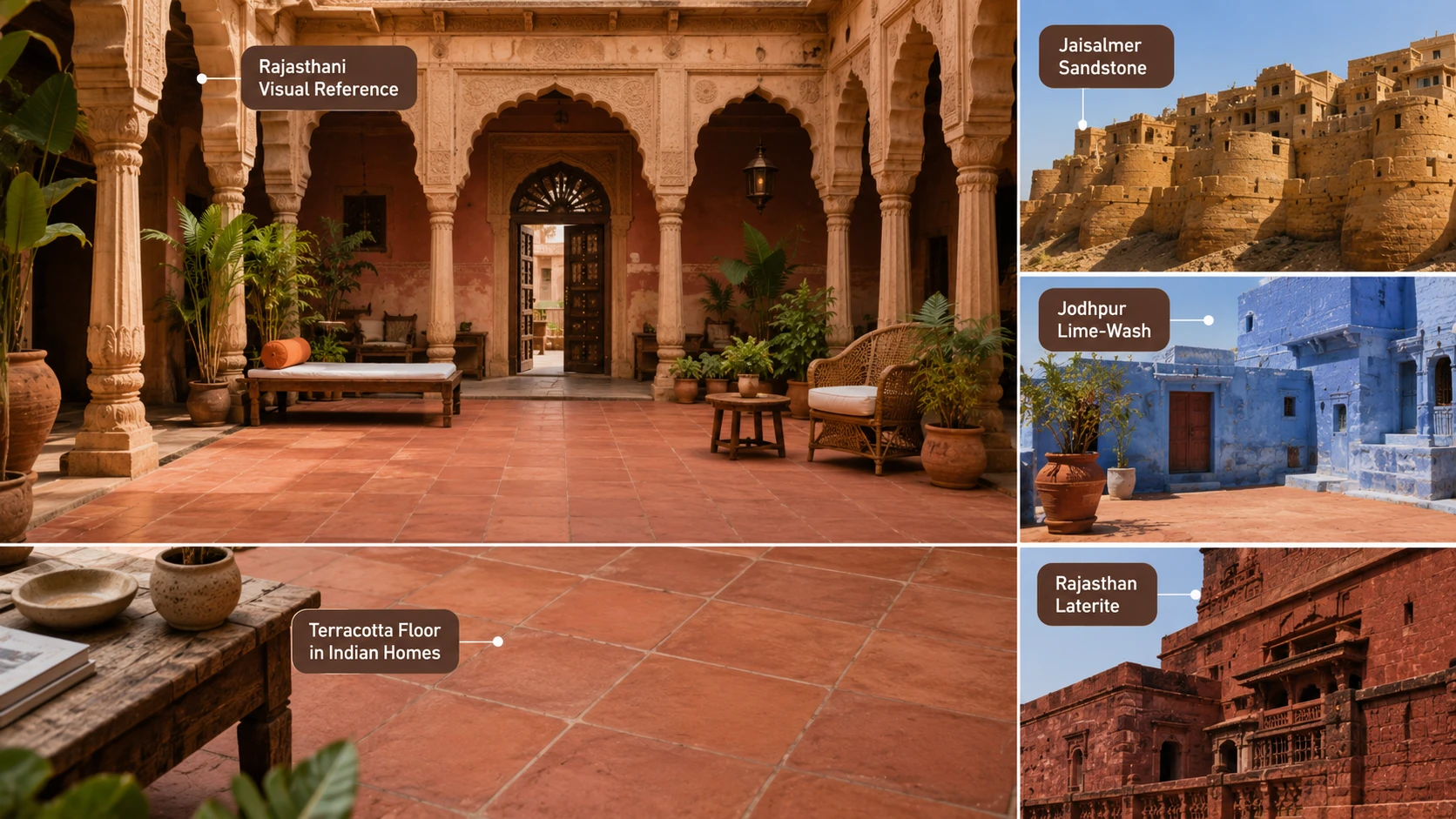
Rajasthan's built environment is the most recognisable source of the terracotta colour family in Indian architecture. Jaisalmer's yellow sandstone reads as pale ochre-terracotta. Jodhpur's traditional lime-wash buildings use terracotta and burnt sienna as base tones. The laterite buildings of Rajasthan's southern districts use a deep brick-red terracotta that is the most saturated version of the colour. The Rajasthani association with terracotta colour persists in contemporary Indian interior design: when a designer specifies a terracotta floor for an Indian home, the Rajasthani haveli or fort is almost always part of the visual reference.
South India: Red Oxide and Laterite Traditions
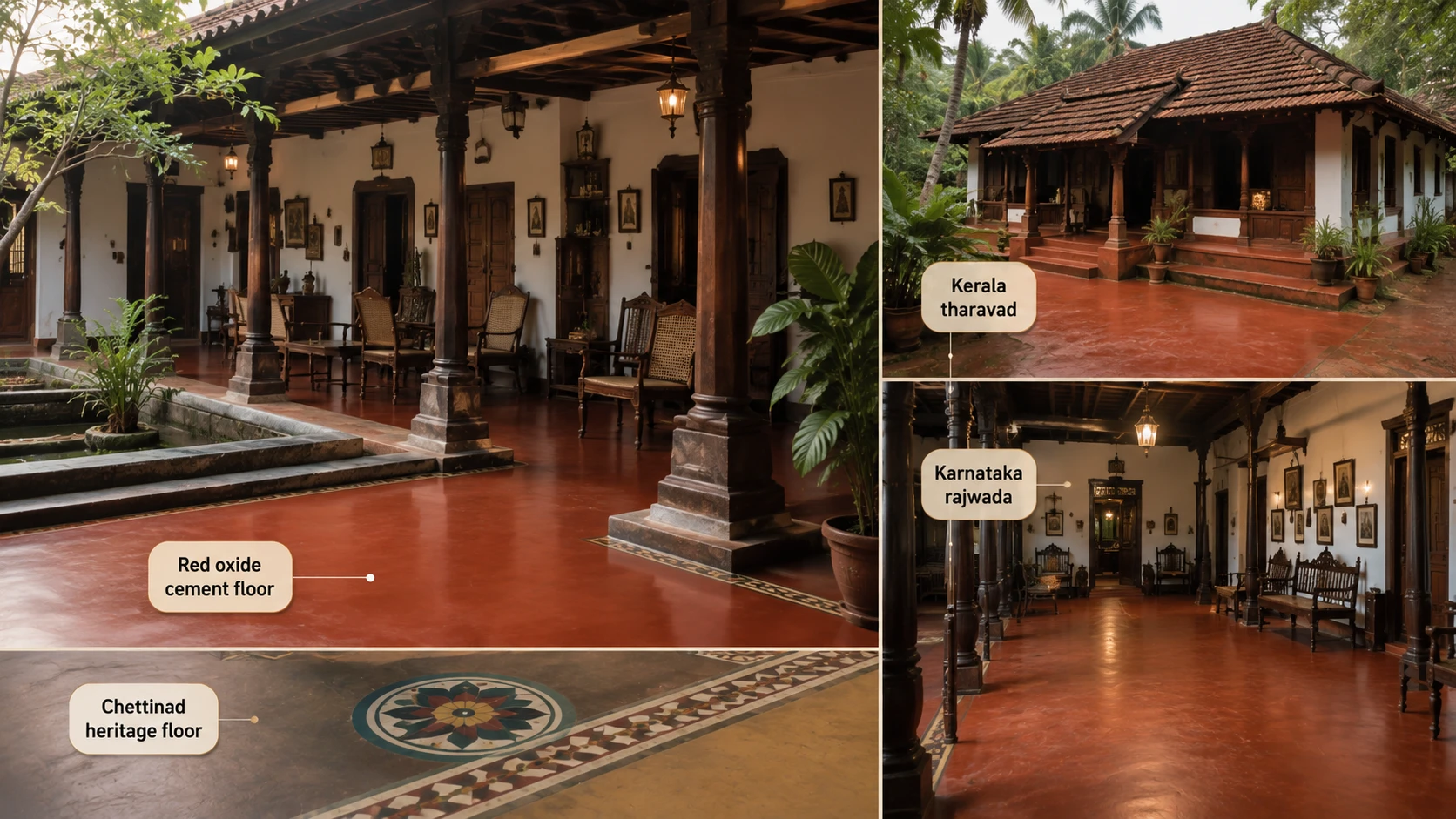
South Indian traditional homes in Kerala, Karnataka, and Tamil Nadu use a deep red-ochre floor finish called red oxide cement, which is a poured and polished cement floor in a warm red-brown tone. The floor colour of a traditional Kerala tharavad or a Karnataka rajwada is in the deep terracotta and brick-red range, achieved with iron oxide pigment in cement rather than with tile. In Tamil Nadu, the Chettinad heritage homes used a cement and pigment floor in warm earth tones. Understanding this helps a South Indian buyer specify the right sub-tone of terracotta: deeper and more red-saturated than the pale ochre of Rajasthan.
Gujarat: The Pol House and Stepped-Well Colour
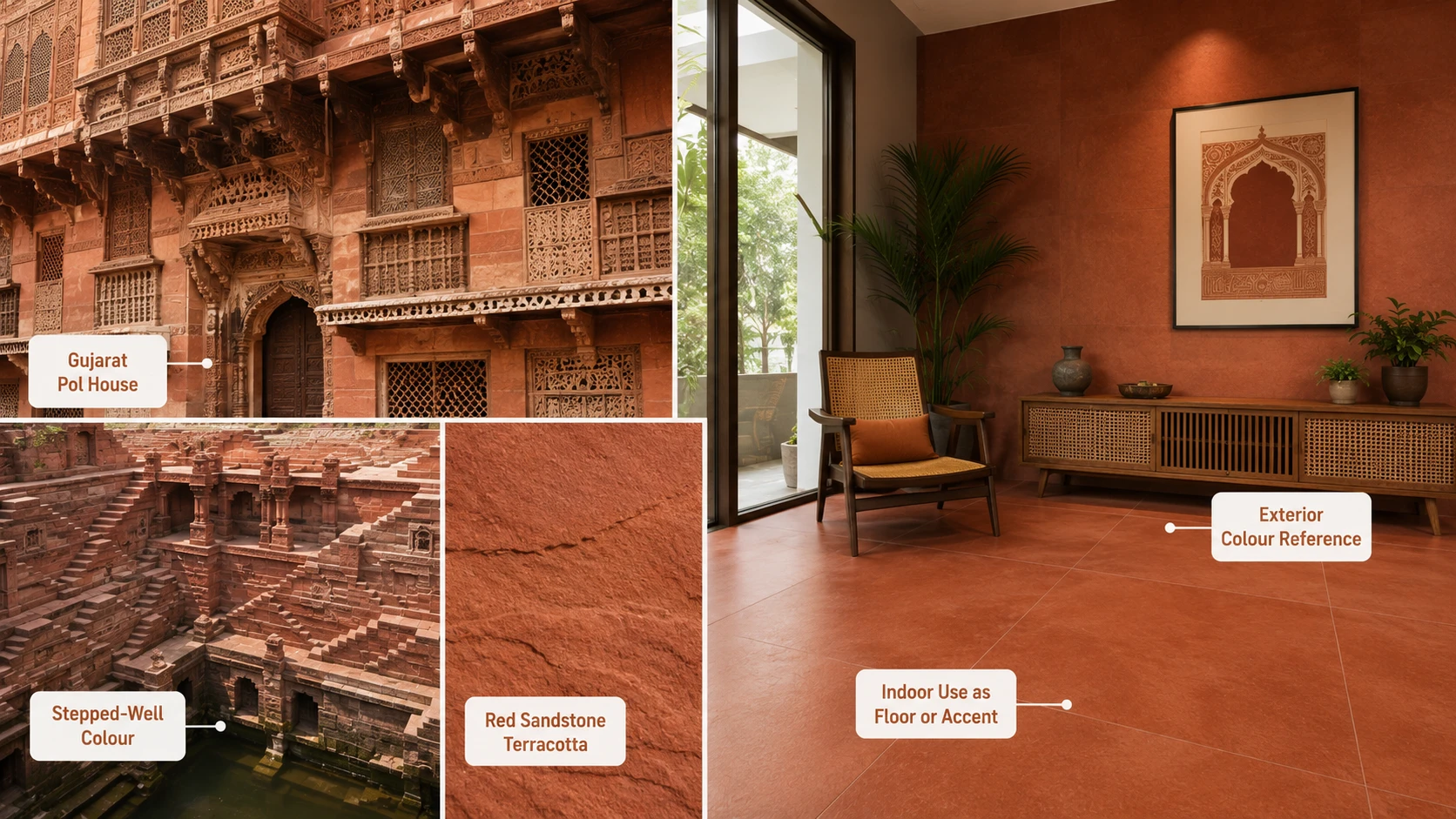
Ahmedabad's pol house architecture uses carved stone and brick in warm red-brown tones that sit in the deep terracotta family. Gujarat's step-wells (vav) use the local red sandstone whose colour is a warm brick-terracotta. The Gujarati terracotta colour reference is architectural rather than flooring: the colour of carved stone facades and stepped sandstone rather than of a specific floor tradition. In contemporary Indian design, Gujarat architectural terracotta most often appears as an exterior colour reference, brought indoors as a floor or accent wall tone.
Tiles in the Terracotta Colour Range: All Materials Compared
Since terracotta is a colour, it is available across multiple tile material categories in India. Each material delivers the terracotta colour through a different mechanism and with distinct technical properties.
| Material | How the Terracotta Colour Is Achieved | Water Absorption | Floor Safety | Price Range | Maintenance |
| GVT (Glazed Vitrified Tile) | Digital print on a vitrified body. The colour is in the glaze layer applied to the high-density tile body. | 0.05% or below (IS 15622:2006) | PEI 4. Anti-skid variant for wet areas. Safe for all Indian floor applications. | Rs. 55 to Rs. 160/sq.ft from Morbi, Gujarat | Weekly mop. No sealing. No specialist treatment. |
| Full Body Vitrified Tile | The terracotta colour runs through the full tile body rather than just the surface glaze. Edge chips show the same colour. | 0.5% or below | PEI 4. Safe for all floor applications. | Rs. 70 to Rs. 180/sq.ft | Weekly mop. No sealing required. |
| Ceramic tile (floor-rated) | Glaze on a ceramic body. The terracotta colour is in the glaze layer. The body below the glaze is typically grey or buff. | 3 to 6% for floor-rated ceramic. Confirm PEI 3 or PEI 4. | PEI 3 to PEI 4 for floor-rated ceramic. Check TDS. | Rs. 40 to Rs. 100/sq.ft | Mop regularly. Seal grout in wet areas. The tile glaze itself does not require sealing. |
| Ceramic tile (wall-rated) | Terracotta-tone glaze on ceramic body for wall applications. May be glossy, matte, or textured. | 6 to 10% (wall tile, not floor-rated) | Wall use only. Not suitable for floors. | Rs. 35 to Rs. 90/sq.ft | Wipe clean. No sealing for glazed ceramic walls. |
| Natural stone (Kota, sandstone, laterite) | The terracotta colour comes from the stone's natural mineralogy: iron oxide content creates warm red-brown tones. Colour is the actual stone colour, not applied. | 1 to 8%, depending on stone type. Porous. | Requires anti-skid surface treatment for wet floor use. Sealing mandatory. | Rs. 60 to Rs. 200/sq.ft for Indian stone | Annual sealing. No acidic cleaners. Patina develops over time. |
| Cement and oxide floor finish (non-tile) | Iron oxide pigment mixed into Portland cement screed. Not a tile product. Applied as a poured floor finish. | 5 to 12% without topcoat sealer | Safe as a floor surface when properly sealed. Not a tile and not in the tile buying guide, but often specified as an alternative. | Rs. 80 to Rs. 200/sq.ft for red oxide floor | Sealing required. Re-seal every 12 months. Patina develops. |
Key takeaway: GVT and full-body vitrified tiles in the terracotta colour range offer the best combination of design range, surface safety, and maintenance-free performance for Indian homes. Ceramic floor-rated tiles in terracotta tones work well in bedrooms and low-traffic rooms. Natural stone in warm red-brown tones is appropriate for covered courtyards and verandahs, where the material's authenticity and patina development justify the sealing maintenance. The terracotta colour is available across all these materials; the material choice depends on the room's performance requirements.
Terracotta Colour Tiles: Room-by-Room Applications
Idea 1: Classic Terracotta GVT Living Room Floor
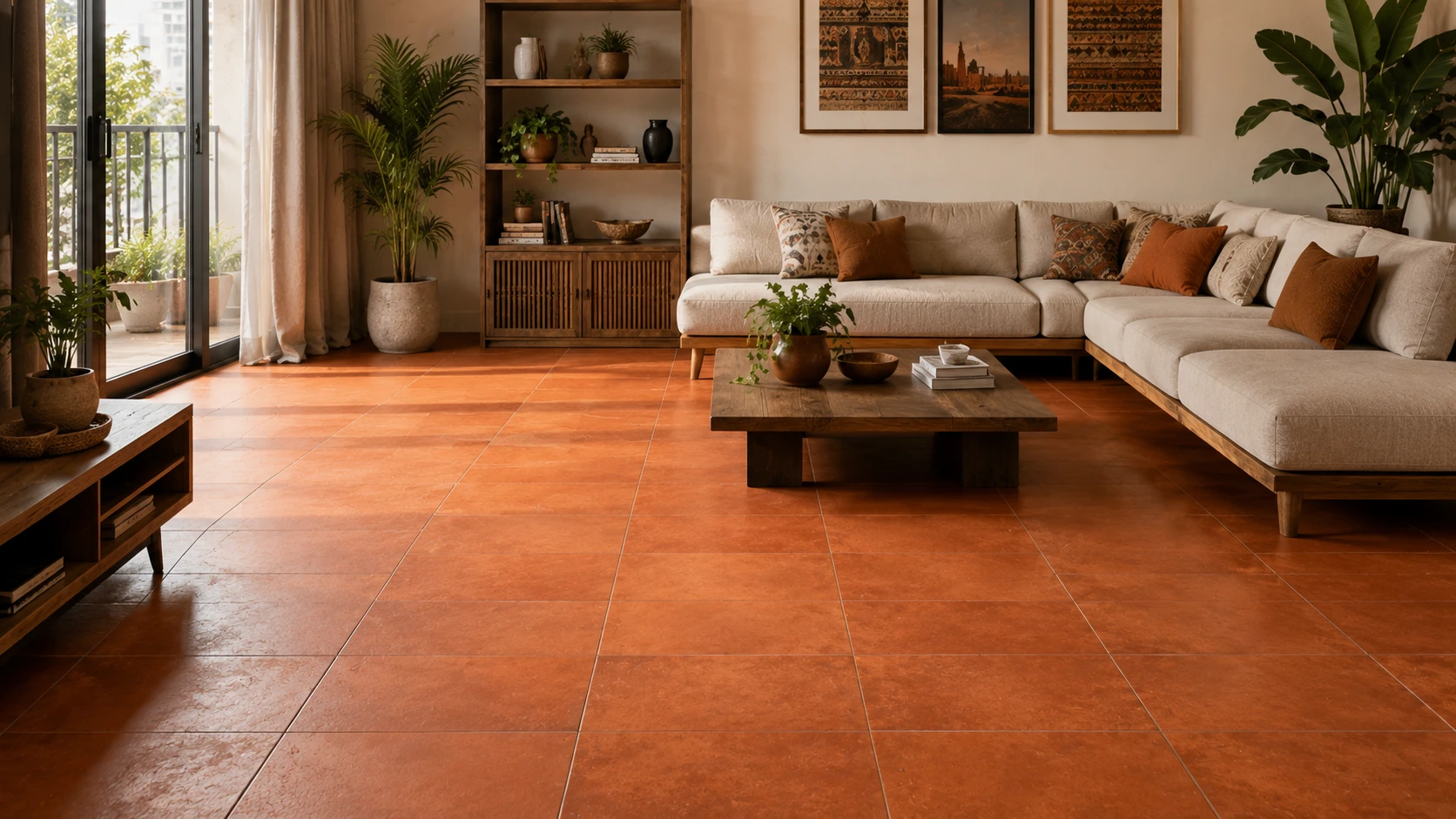
GVT, 600x600 mm or 600x1200 mm | Textured matte | Rs. 70 to Rs. 130/sq.ft
Classic terracotta GVT at 600x600 mm or 600x1200 mm in textured matte is the most widely specified terracotta colour floor for Indian living rooms. The warm red-orange tone grounds the space and reads as organic against white or lime-wash walls. At 600x1200 mm in the mid-budget range with 4 to 6 face variations, the tonal variation across tile faces reads as natural material at room scale. Under warm-white lighting at 2700K, classic terracotta GVT deepens to a rich clay-orange that creates the most flattering warm ambient quality available in a tile floor.
Idea 2: Pale Ochre GVT Master Bedroom Floor
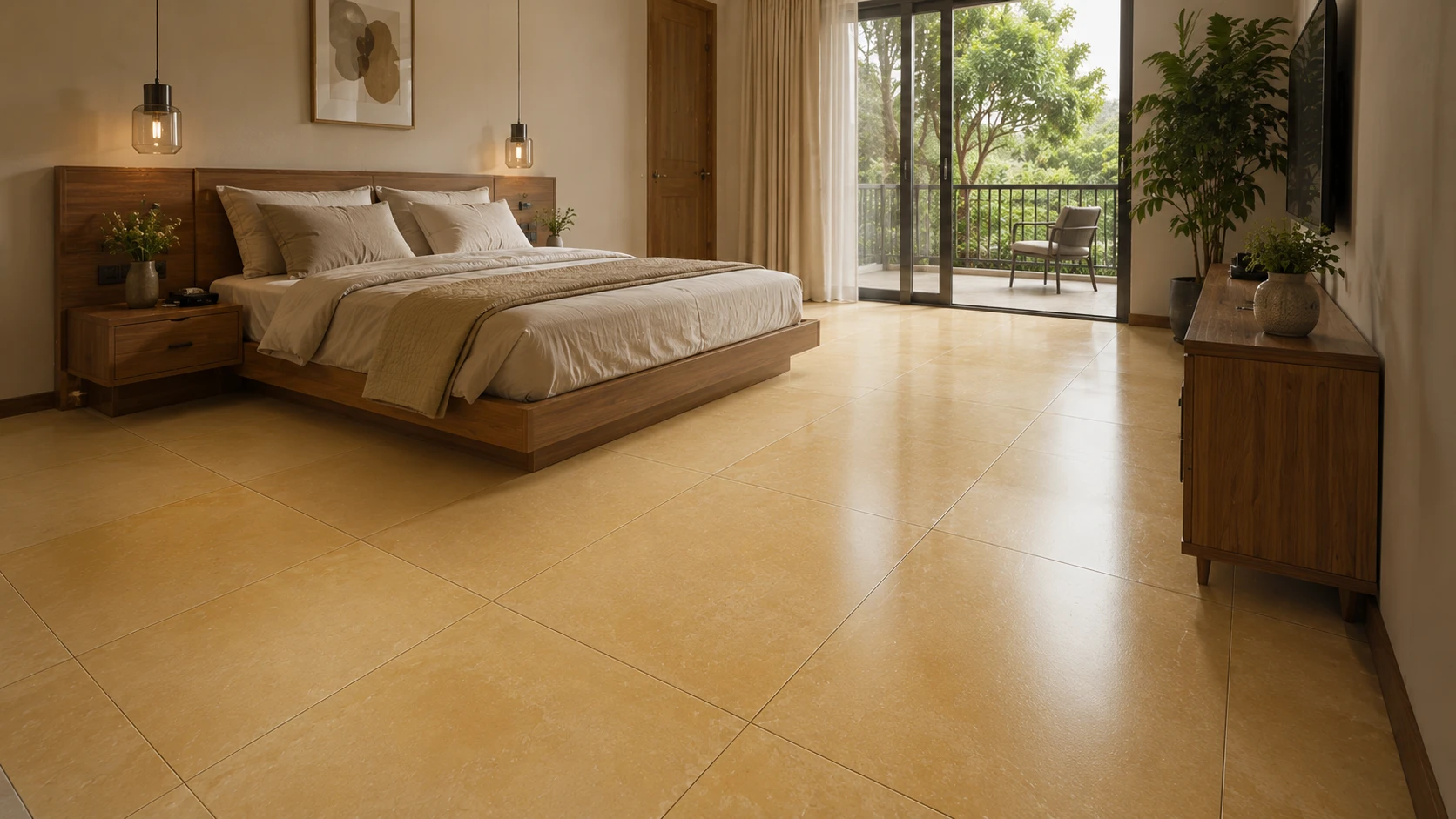
GVT, 600x600 mm or 800x800 mm | Sugar finish or matte | Rs. 75 to Rs. 130/sq.ft
The pale ochre sub-tone of the terracotta range, a warm sandy yellow-orange at low saturation, is the right bedroom floor specification for the terracotta colour family. It reads as warm and grounded without the strong colour statement of classic terracotta, and it is the most restful sub-tone in the range for a sleeping space. At 600x600 mm or 800x800 mm in sugar finish, pale ochre GVT creates a bedroom floor that reads as warm natural stone or aged linen underfoot. Pairs with white or cream walls and neutral or pale blue textiles.
Idea 3: Warm Brick-Red GVT Kitchen Floor
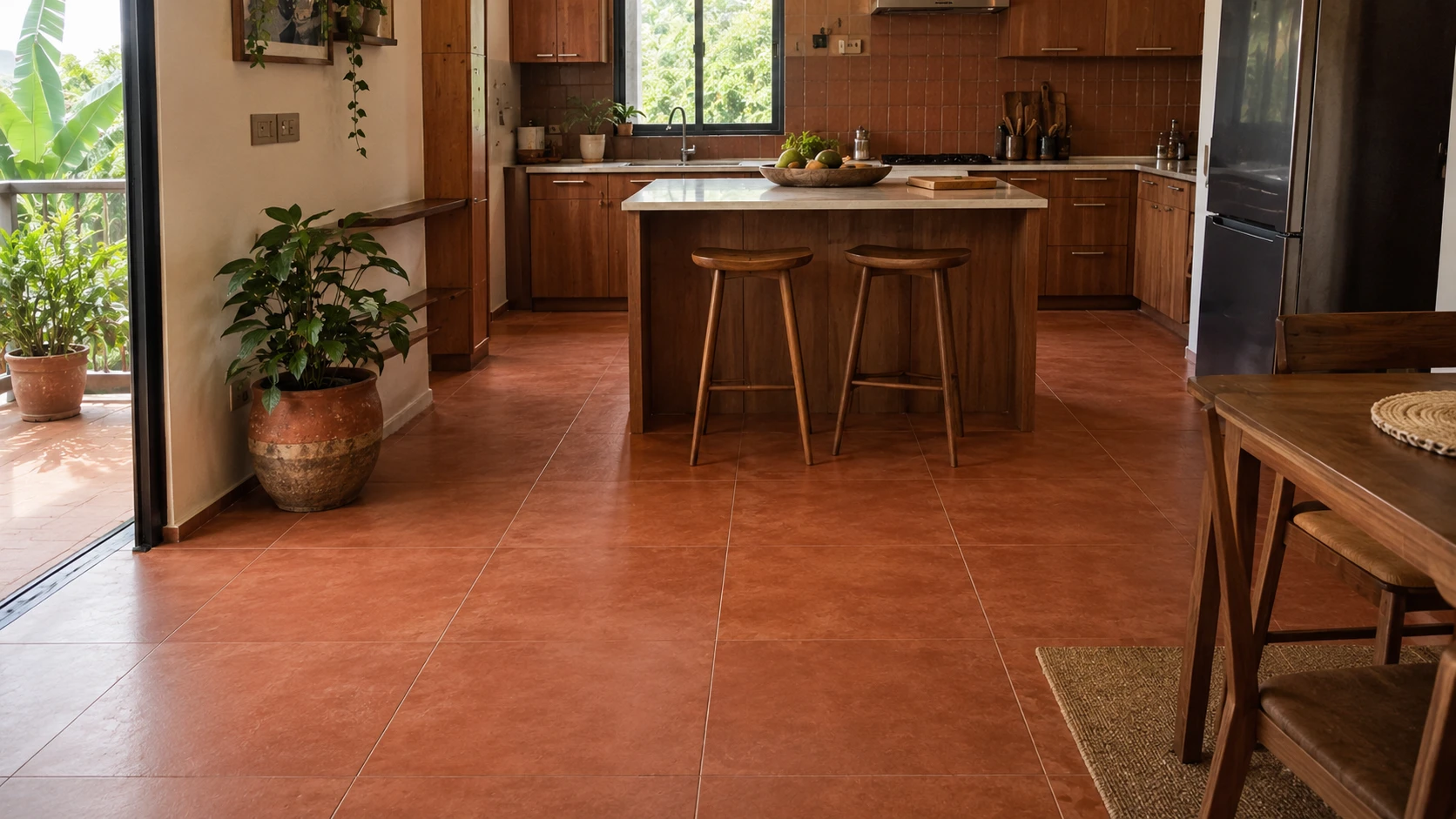
GVT anti-skid, 300x600 mm or 600x600 mm | Anti-skid matte | Rs. 65 to Rs. 115/sq.ft
A warm brick-red terracotta GVT in anti-skid matte finish at 300x600 mm references the traditional Indian vernacular kitchen floor: the red brick and laterite floor that appears in historic Indian homes across the country, from coastal Kerala to Rajasthani farmhouses. At 0.05% water absorption and PEI 4 with an anti-skid rating, this tile handles the daily demands of Indian cooking without staining or requiring sealing. The deeper brick-red sub-tone of the terracotta range hides cooking residue more effectively than pale ochre, making it the most practical terracotta colour specification for an Indian kitchen floor.
Idea 4: Ochre-Gold Ceramic Wall Tile Pooja Room
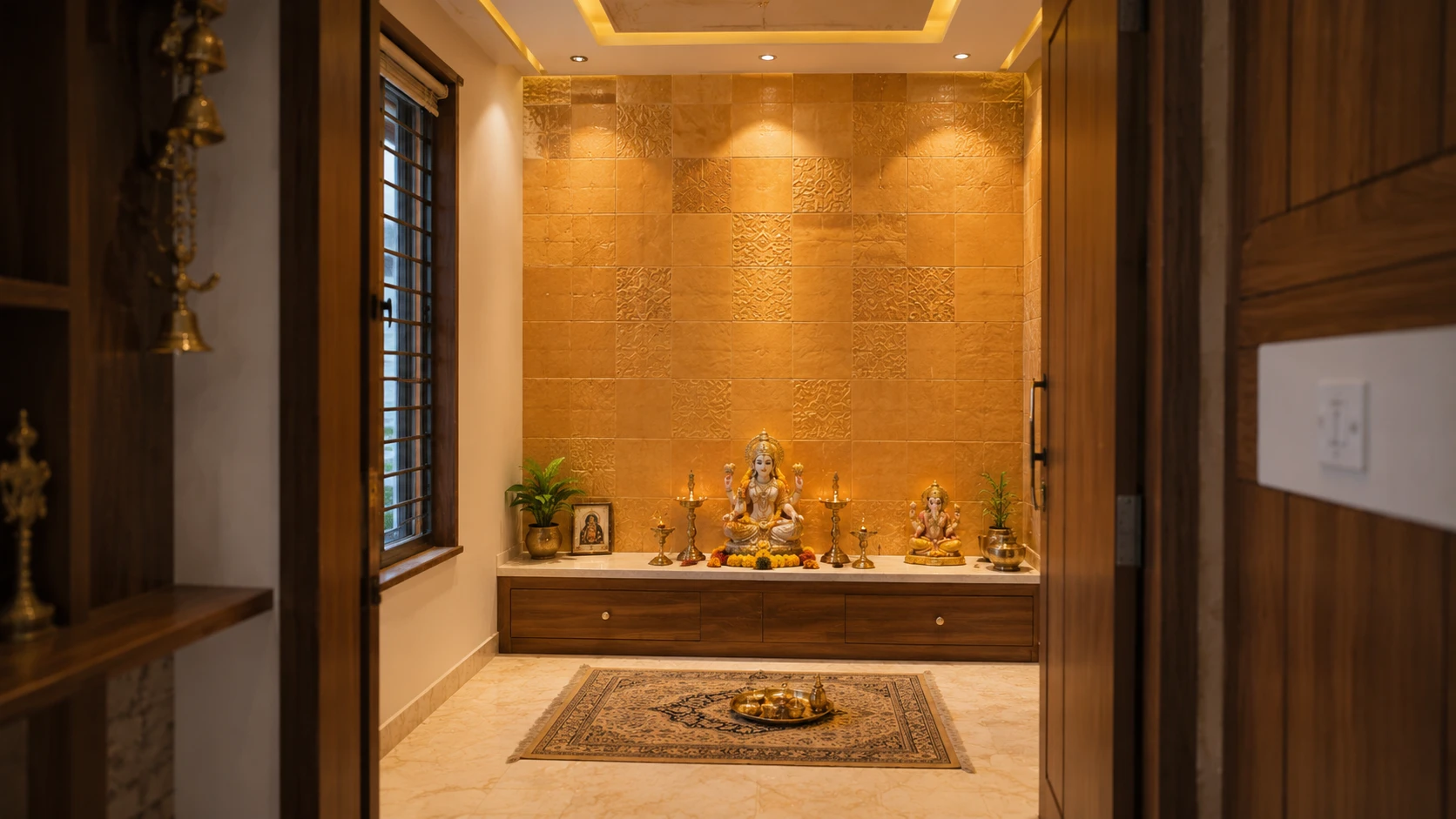
Ceramic wall tile, 300x300 mm | Matte or semi-matte | Rs. 45 to Rs. 80/sq.ft
A puja room wall in ochre-gold ceramic wall tile at 300x300 mm in matte finish delivers the most Vastu-aligned terracotta colour application in an Indian home. The warm golden-orange of the ochre-gold sub-tone is auspicious in Hindu, Jain, and Buddhist design traditions and reads as the colour of saffron, turmeric, and divine warmth. Ceramic wall tile is appropriate here as the puja room walls have no water or cleaning chemical contact. The matte finish prevents the reflective quality of a glossy tile that can be distracting in a meditative space.
Idea 5: Burnt Sienna GVT Feature Wall in Living Room
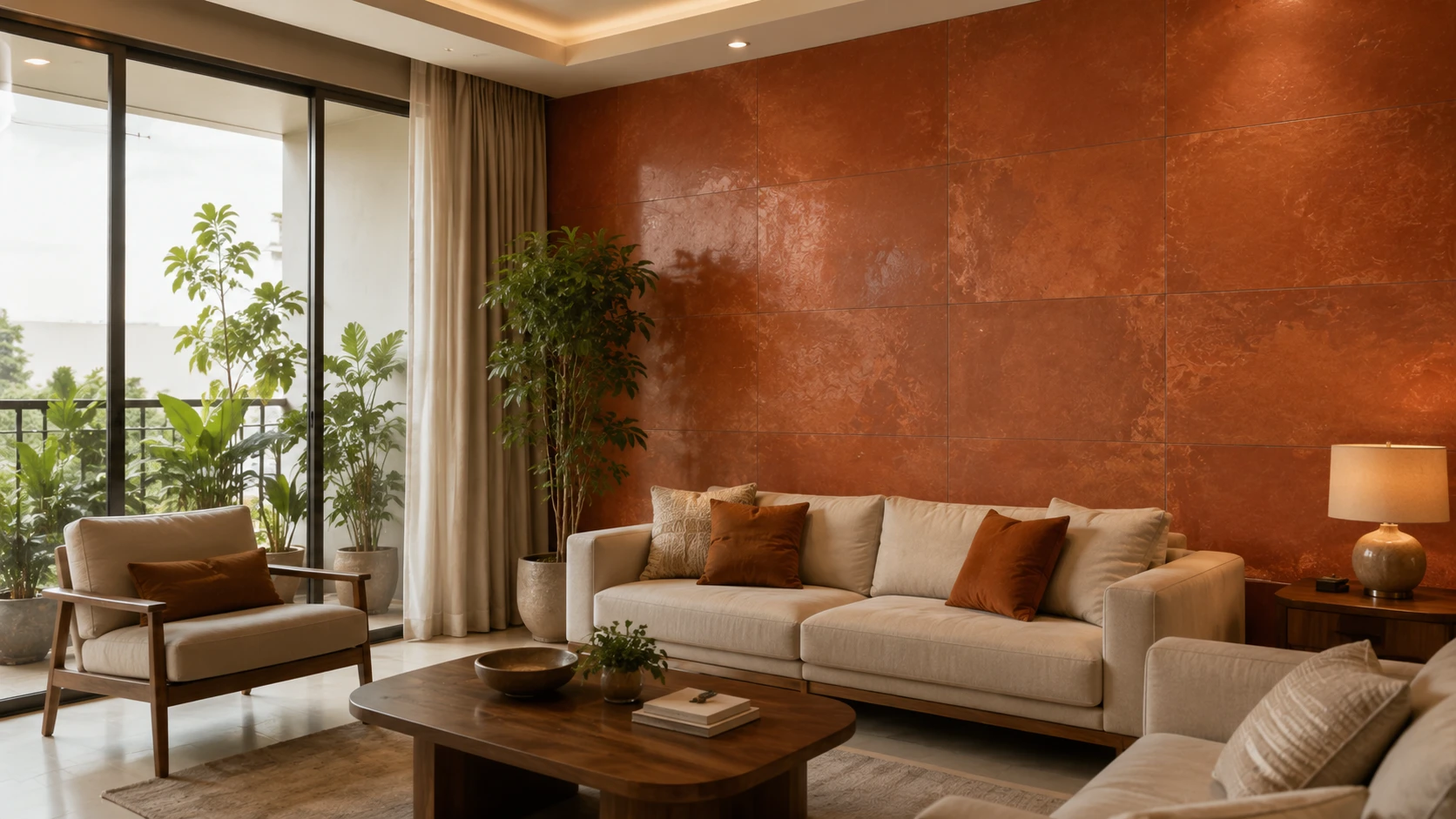
GVT, 600x1200 mm | Matte or GHR | Rs. 80 to Rs. 145/sq.ft
A burnt sienna terracotta GVT at 600x1200 mm on the living room feature wall or TV wall creates a warm, deep accent that reads as architectural earthwork. Burnt sienna is the richest and most design-forward of the terracotta sub-tones and is best used on a single feature wall rather than on the full floor, where its saturation can become heavy in a compact room. At 600x1200 mm in vertical orientation, a standard 10 ft x 12 ft feature wall uses approximately 19 sq ft of tile. Under warm-white recessed lighting, burnt sienna GVT glows with a depth that no painted wall can replicate.
Idea 6: Classic Terracotta Bathroom Floor
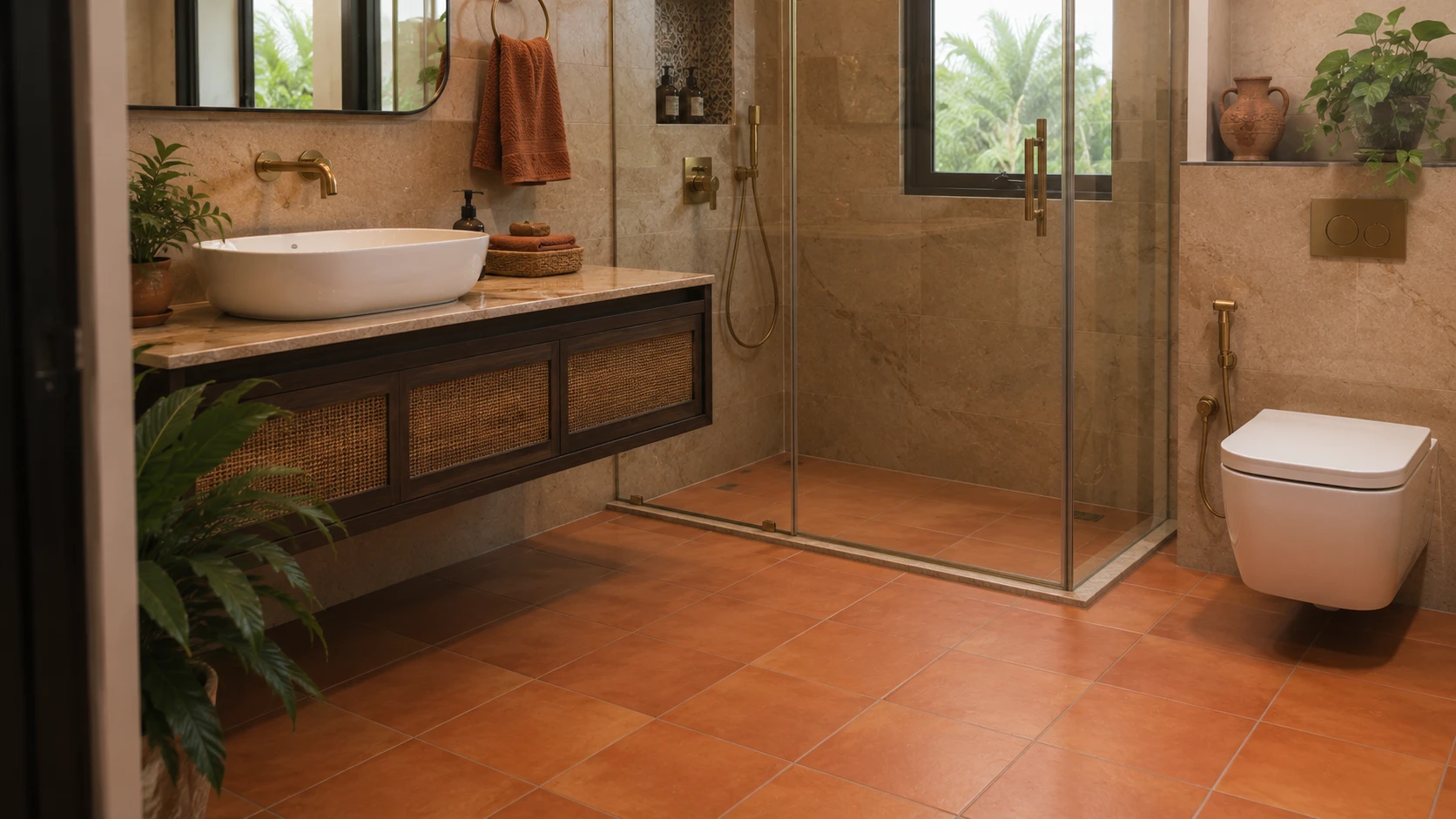
GVT anti-skid, 300x300 mm | Anti-skid matte, R10 to R11 | Rs. 55 to Rs. 90/sq.ft
An Indian bathroom in the terracotta colour family uses classic terracotta anti-skid GVT at 300x300 mm for the floor and pairs it with white or cream matte ceramic wall tiles. The warm red-orange floor against the cool white wall creates a cave-like warmth that makes the bathroom read as a space of retreat rather than clinical hygiene. The anti-skid matte specification is mandatory: the terracotta colour does not change the surface friction of a tile, and a standard matte tile in any colour without an anti-skid rating is not safe for Indian bathroom floors.
Idea 7: Full Body Vitrified Terracotta Floor for Heavy Use
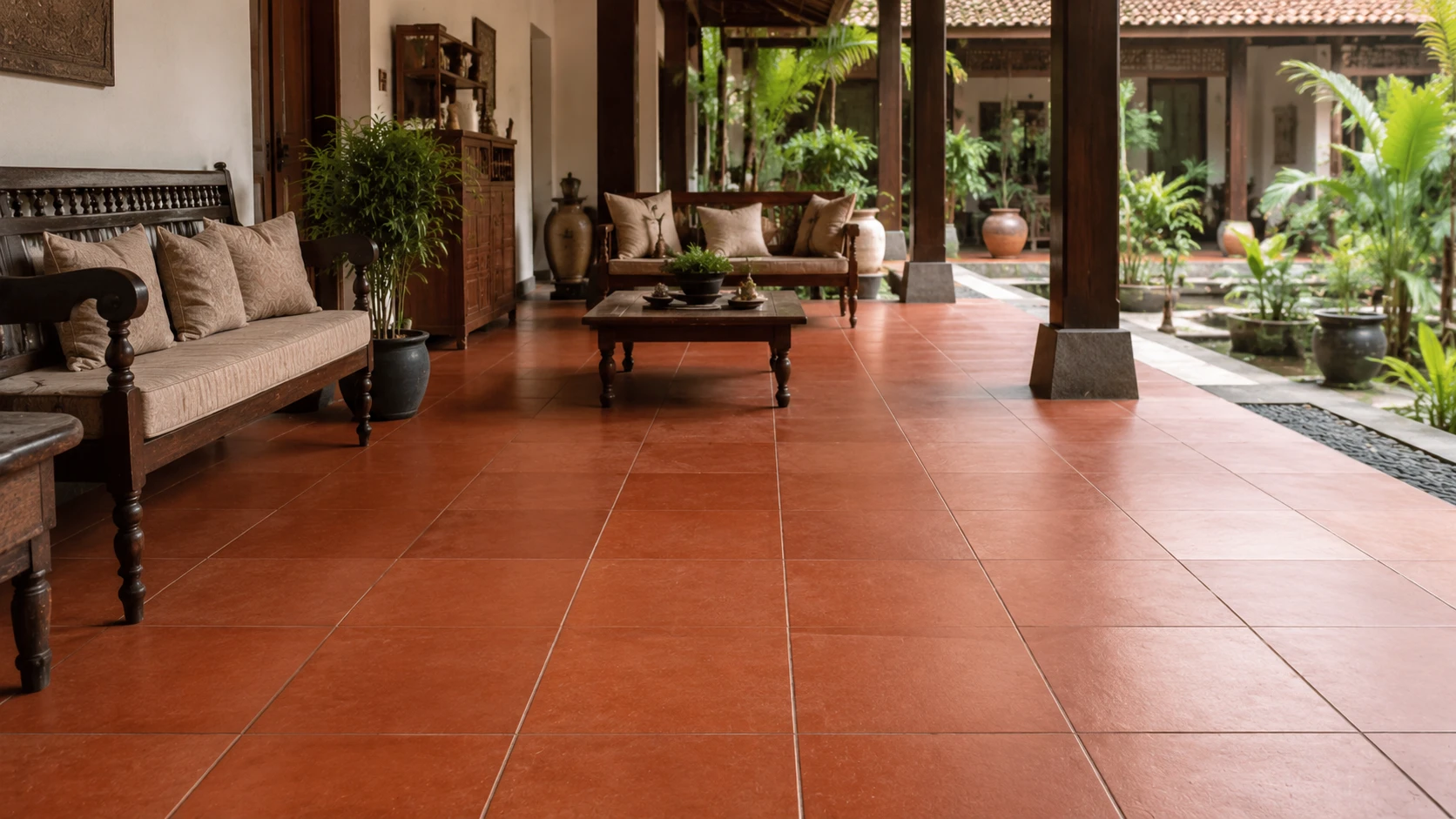
Full body vitrified, 600x600 mm | Matte | Rs. 80 to Rs. 180/sq.ft
Full-body vitrified tiles in the terracotta colour range are specified for floors where impact resistance and edge durability matter: commercial spaces, high-traffic lobbies, heavily used family rooms, and any floor where the colour running through the full tile body prevents visible wear at chip edges. Unlike GVT, where a surface chip can expose a different-coloured body underneath, full-body vitrified tiles in terracotta colour show the same warm tone at the chip. This is particularly relevant for hospitality and commercial installations where the floor sees trolley wheels, furniture movement, and sustained heavy foot traffic.
Idea 8: Kota Stone or Indian Sandstone Courtyard
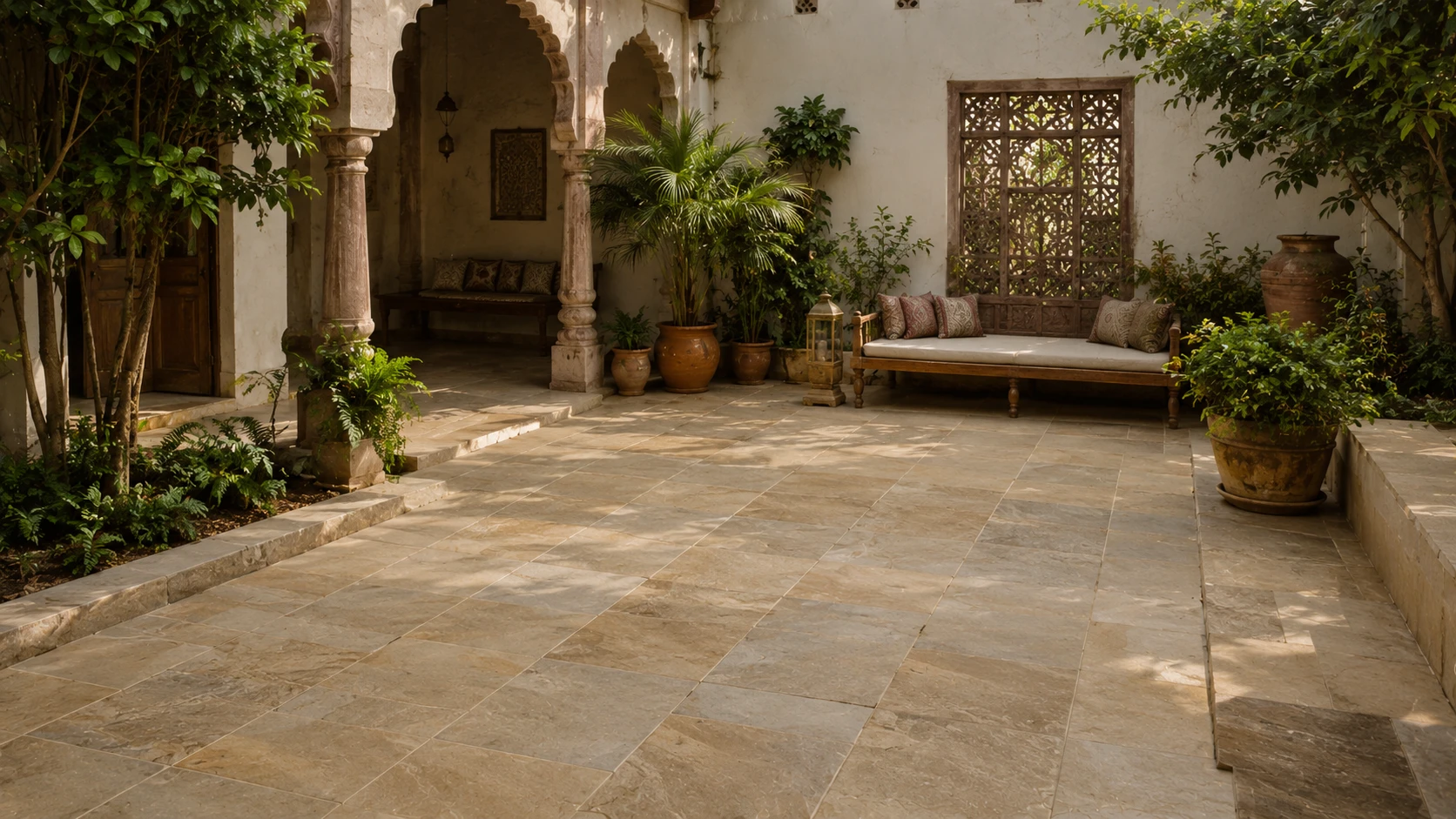
Natural stone in warm red-brown (Kota, Mandana, Dholpur) | Natural cleft or honed | Rs. 60 to Rs. 200/sq.ft
A covered courtyard in an independent home, farmhouse, or heritage property that uses natural Indian stone in the terracotta colour range delivers the most authentic version of the traditional Indian warm-tone floor. Kota stone in its red-green variant, Mandana red quartzite from Rajasthan, and Dholpur pink sandstone all sit within the terracotta colour family. The stone surface develops a natural patina over the years of use that gives the courtyard floor the worn, lived-in quality that no tile can replicate. Natural stone is appropriate here because the courtyard application justifies the sealing maintenance, and the patina is a design asset, not a liability.
Terracotta Colour and Vastu Shastra
The terracotta colour family has strong Vastu alignment as an earth element and fire element colour, depending on the specific sub-tone.
| Terracotta Sub-Tone | Vastu Element Association | Recommended Zone | Best Room Application |
| Pale ochre / sandy terracotta | Earth element (Prithvi). Softest earth tone in the range. | South and southwest zones. Also, northeast for warm wisdom energy. | Bedroom, study room, meditation room, northeast-facing entrance. |
| Classic terracotta | Earth element with fire overtone. The primary terracotta Vastu colour. | South, southwest, and south-facing rooms. Centre of the home (Brahmasthana) in single-storey homes. | Living room, dining room, puja room, and entrance foyer. |
| Burnt sienna / deep terracotta | Fire element (Agni). The red saturation brings the fire association. | South zone, specifically. Kitchens facing south. Strong and assertive spaces. | Kitchen, south-facing living room, fireplace surrounds, heritage reception rooms. |
| Warm brick-red terracotta | Fire element (Agni). The most fire-associated sub-tone of the terracotta range. | South and southeast (Agni) zones. The kitchen is the primary Vastu application. | South-facing kitchens, southeast-facing rooms. |
| Ochre-gold terracotta | Earth element with sun energy. The warmest, most divine-associated sub-tone. | Northeast (Ishanya), east-facing entrance, puja room in any zone. | Puja room, east-facing entrance foyer, northeast study room. |
Design principle: The terracotta colour range connects to the Indian landscape at a depth that no other tile colour achieves. The warm red-orange is the colour of the soil, the unglazed pot, the brick kiln, and the sandstone cliff that has been part of the Indian visual landscape for millennia. When a buyer chooses a terracotta tile for their home, they are drawing on a colour memory that is older and deeper than any designed aesthetic. This is why terracotta floors in Indian homes read as immediately comfortable rather than as a designed choice: the colour is already familiar before the design decision is made.
Buying Terracotta Colour Tiles in India: What to Check
For GVT in Terracotta Colours
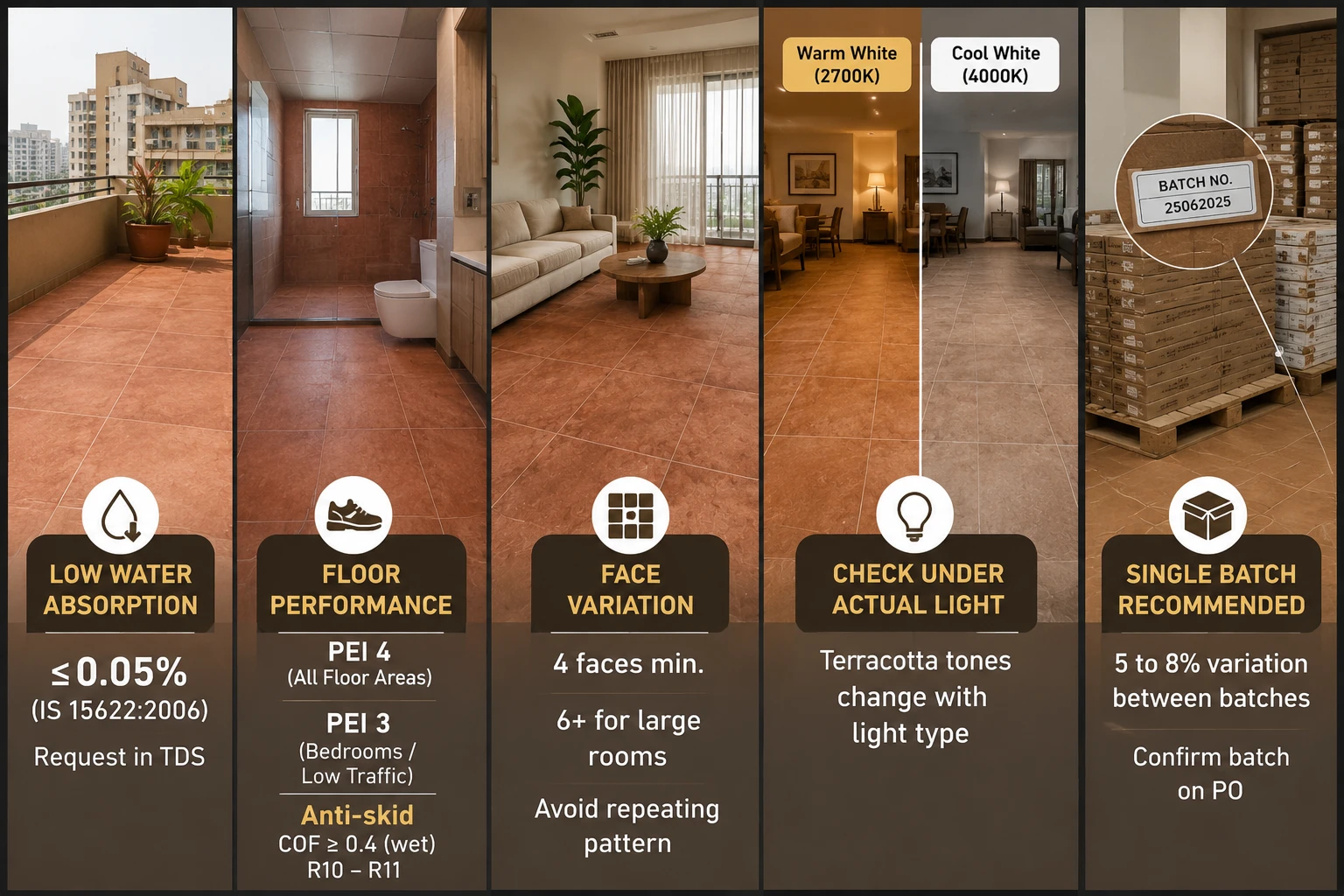
- Water absorption 0.05% or below per IS 15622:2006. The fundamental vitrified tile quality requirement. Request this figure in the TDS. Any tile above 0.05% labelled as GVT is misclassified.
- PEI 4 for all floor applications. PEI 3 for bedrooms and low-traffic rooms. Anti-skid rating (COF 0.4 wet minimum, R10 to R11) for bathroom, kitchen, and balcony floors.
- Face variation count. Terracotta colour GVT with 2 face variations produces a visibly repeating pattern in rooms above 150 sq.ft. Request 4 face variations minimum. For living rooms above 300 sq. ft., request 6 or more.
- View the colour under the room's actual light type. Terracotta sub-tones shift significantly between warm-white (2700K) and cool-white (4000K) artificial light. Pale ochre reads as muted golden under warm light and as dusty sand under cool light. Classic terracotta reads as rich clay under warm light and as flat orange-grey under cool light.
- Order from a single batch. Terracotta colour variation between batches can be 5 to 8%, even from the same factory, which is visible when tiles from two batches are mixed in the same floor. Confirm the batch number on the purchase order.
For Ceramic Terracotta Colour Tiles
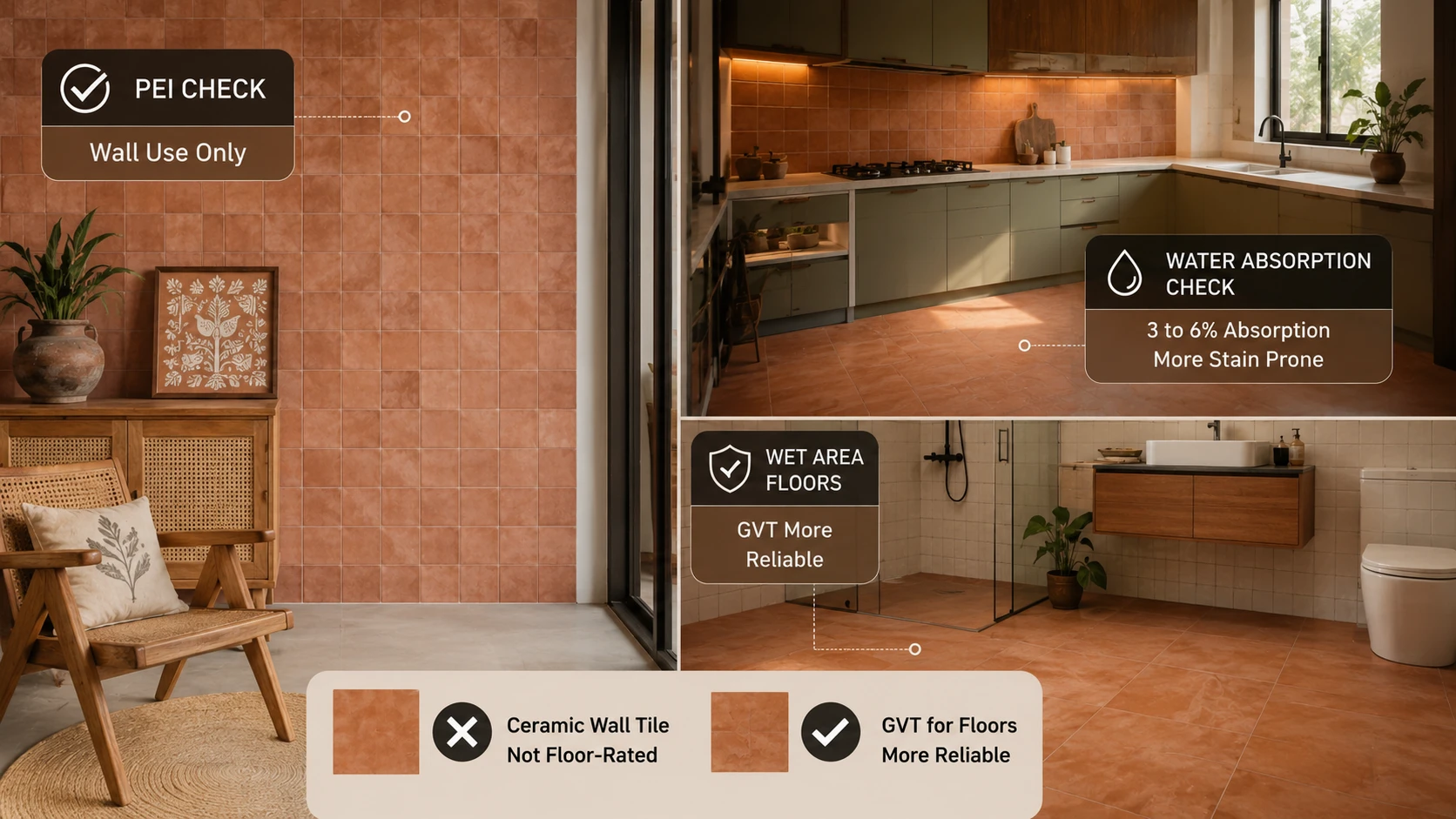
- Check PEI for floor use. Ceramic wall tiles in terracotta colours are not floor-rated. A terracotta ceramic tile without a PEI floor rating must be used on walls only.
- Check water absorption for wet areas. For kitchen and bathroom floors, ceramic tiles with 3 to 6% absorption are more prone to staining from cooking oil and turmeric than GVT at 0.05%. For wet-area floors, GVT is the more reliable specification in the terracotta colour.
For Natural Stone in Terracotta Colours
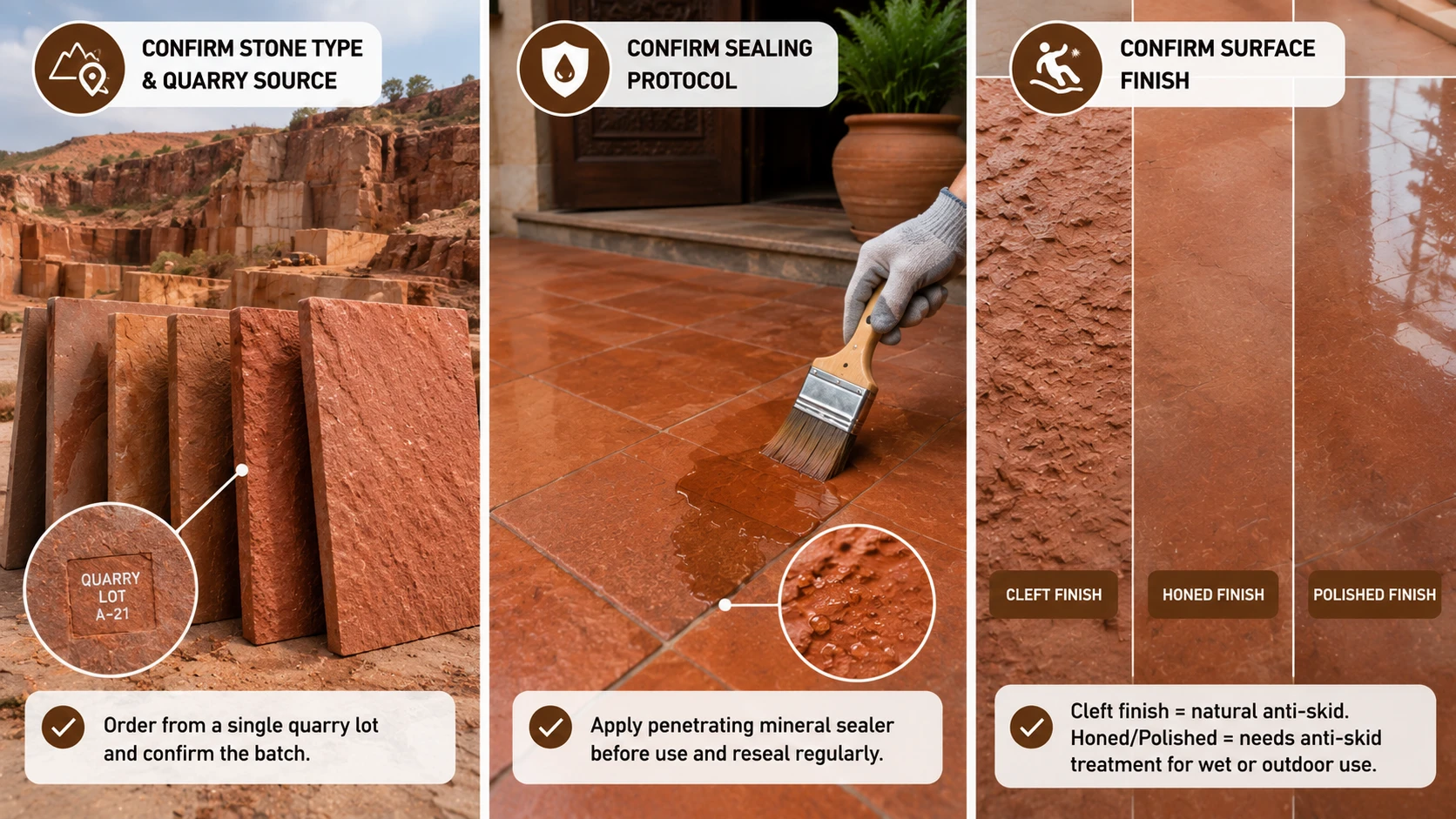
- Confirm the stone type and quarry source. Colour consistency in Indian natural stone varies by quarry and even by quarry level. Order from a single quarry lot and confirm the batch before approving.
- Confirm the sealing protocol. Indian natural stone in terracotta tones (Kota, Mandana, sandstone) requires penetrating mineral sealer before use and resealing every 12 to 24 months, depending on the climate zone.
- Confirm surface finish. Natural cleft finish on sandstone and laterite provides natural anti-skid properties. Honed or polished natural stone in a warm red-brown tone requires anti-skid treatment for any wet or outdoor floor application.
Spec to confirm: For any terracotta colour GVT from Morbi, request these five in writing: (1) IS 15622:2006 TDS with water absorption figure, (2) PEI rating, (3) COF wet rating for any floor tile, (4) face variation count, (5) batch number. For natural stone, replace items 1 and 2 with quarry source and sealing protocol recommendations from the supplier.
Common Mistakes When Choosing Terracotta Colour Tiles
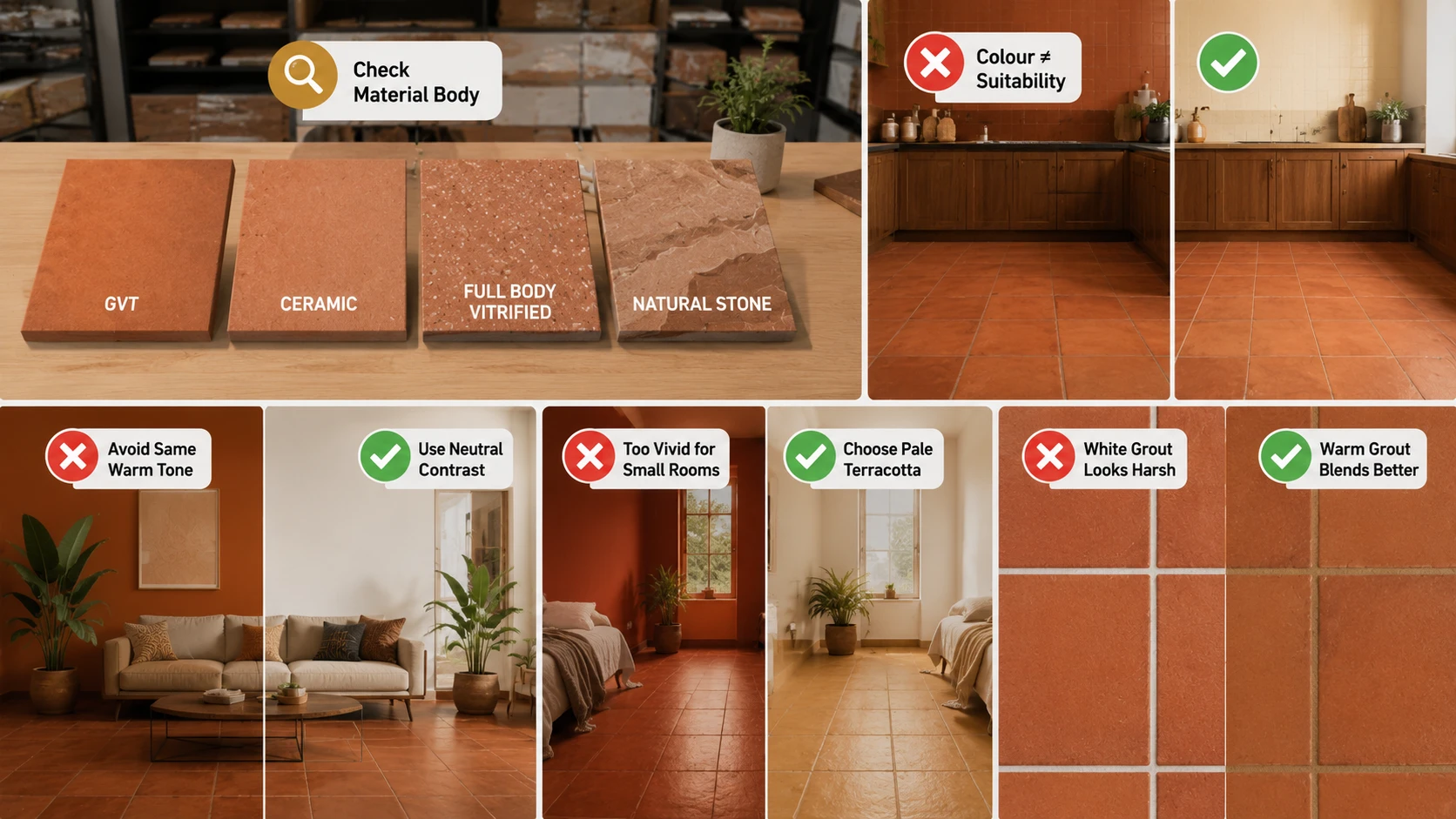
- Assuming all terracotta colour tiles are the same material. Terracotta is a colour family, not a material. The tile labelled terracotta might be GVT, ceramic, full body vitrified, or natural stone. Each has different water absorption, PEI rating, and maintenance requirements. Always confirm the material body.
- Using the colour name to judge the tile's technical suitability. A terracotta ceramic wall tile at 8% water absorption is not suitable for a kitchen floor, regardless of how good the colour looks. The material specification, not the colour, determines whether the tile is appropriate for a given surface.
- Pairing terracotta colour floors with warm-orange walls. A terracotta floor with warm-orange or warm-red walls creates a single-temperature room that reads as enclosed and heavy. Terracotta colour floors need a neutral or complementary contrast wall: white, off-white, lime wash, or indigo blue.
- Specifying a vivid terracotta sub-tone in a compact room. Classic terracotta and burnt sienna are appropriate in rooms above 200 sq. ft. with good light. In a compact room under 120 sq. ft., a vivid terracotta floor can read as overwhelming. Specify pale ochre or sandy terracotta in small rooms.
- Not checking the grout colour before installation. White grout on a terracotta tile creates a clinical grid. Warm cream, tan, or sand grout that blends with the tile is the correct specification. Decide the grout colour at the same time as the tile, not during installation.
Terracotta Colour GVT from Morbi, Gujarat: Available Range 2026
| Sub-Tone | Design Category | Format | Price Range | IS Standard | Availability |
| Pale ochre / sandy terracotta | Plain ochre GVT, warm beige stone-look GVT | 300x300 mm to 800x800 mm | Rs. 55 to Rs. 115/sq.ft | IS 15622:2006, 0.05% absorption, PEI 4 | Wide. High-volume stock item in Morbi. |
| Classic terracotta | Stone-look textured GVT, aged clay-look GVT, brick-look GVT | 300x300 mm to 600x1200 mm | Rs. 65 to Rs. 145/sq.ft | IS 15622:2006, 0.05% absorption, PEI 4 | Widest availability. Most stocked terracotta tone in Morbi. |
| Burnt sienna / deep terracotta | Deep stone-look GVT, aged laterite-look GVT | 600x600 mm, 600x1200 mm | Rs. 80 to Rs. 150/sq.ft | IS 15622:2006, 0.05% absorption, PEI 4 | Good availability at mid and premium tiers. |
| Warm brick-red terracotta | Brick-look GVT, deep red stone-look GVT | 300x300 mm to 600x600 mm | Rs. 65 to Rs. 125/sq.ft | IS 15622:2006, 0.05% absorption, PEI 4 | Good. Brick-look format widely stocked in Morbi. |
| Ochre-gold terracotta | Plain warm ochre-gold GVT, warm yellow-orange stone-look | 300x300 mm to 600x600 mm | Rs. 55 to Rs. 110/sq.ft | IS 15622:2006, 0.05% absorption, PEI 4 | Good. Overlaps with the golden tile category. Widely available. |
Note: In coastal Indian cities (Mumbai, Kochi, Chennai, Goa) with monsoon humidity of 85 to 95%, all GVT in the terracotta colour range at 0.05% absorption requires no sealing and maintains its colour and surface finish without treatment across all seasons. Natural stone in warm terracotta tones (Kota, sandstone, Mandana) in these same cities requires sealing every 6 to 12 months and is vulnerable to mineral staining in sustained high humidity.
Browse Terracotta Colour Tiles on TilesFinders
The full terracotta colour range across GVT, full body vitrified, ceramic, and natural stone is available on Tilesfinders from verified Morbi and Indian manufacturers. Filter by material type, sub-tone, finish, and room to find the right terracotta colour tile for your project.
FAQs
Terracotta is a colour family in Indian tiles, not a single material. The terracotta colour range covers warm red-orange to burnt sienna tones that replicate the colour of baked earth, Indian sandstone, and traditional clay. This colour is achievable in GVT, full-body vitrified tiles, ceramic tiles, and natural stone. Each material has different technical properties and maintenance requirements.
GVT in terracotta tones from Morbi, Gujarat, ranges from Rs. 55 to Rs. 160 per sq.ft, depending on the sub-tone, format, and quality tier. Ceramic tiles in terracotta colours range from Rs. 35 to Rs. 100 per sq.ft. Natural Indian stone in warm red-brown tones (Kota, sandstone, Mandana) ranges from Rs. 60 to Rs. 200 per sq.ft.
Yes, with the correct material specification. Terracotta colour GVT in anti-skid matte finish with COF 0.4 wet minimum, and PEI 4 is safe for Indian bathroom floors. Terracotta colour ceramic wall tiles are appropriate for bathroom walls. Natural stone in terracotta tones requires sealing for bathroom floors and is not the first-choice specification in Indian bathrooms with daily moisture exposure.
Classic terracotta GVT at 600x600 mm or 600x1200 mm in textured matte is the most versatile sub-tone for an Indian living room. It reads as warm and grounded without being too vivid or too pale. Burnt sienna is the right sub-tone for a heritage or maximalist brief where a stronger colour statement is wanted. Pale ochre is the right sub-tone for a calm, contemporary brief where warmth is wanted without strong colour.
Yes. The terracotta colour family aligns with the earth element (Prithvi) and fire element (Agni) in Vastu Shastra, depending on the specific sub-tone. Pale ochre and classic terracotta are earth element tones, recommended for south and southwest rooms and puja rooms. Burnt sienna and brick-red are fire element tones, aligned with the south and southeast zones and kitchen applications.
No. GVT tiles at 0.05% water absorption are non-porous and require no sealing regardless of their colour. This includes all terracotta colour GVT from Morbi manufacturers. Natural stone tiles in terracotta colour tones (Kota stone, sandstone, Mandana) do require sealing before use and periodic resealing.
Terracotta colour GVT has a digital print replicating the terracotta tone at 0.05% water absorption with no sealing required. Natural stone in terracotta tones is actual stone with the colour inherent in its mineralogy, at 1 to 8% absorption depending on stone type, requiring sealing and developing natural patina over time. GVT gives a maintenance-free result; natural stone gives an authentic material result with a maintenance commitment.
Match the sub-tone to the room's light and the design brief. Pale ochre for bedrooms and calm spaces. Classic terracotta for living rooms and entrance foyers in any orientation. Burnt sienna and brick-red for heritage references, south-facing rooms with strong light, and spaces where a strong colour statement is the brief. Ochre-gold for puja rooms and northeast-facing spaces. Always view a physical tile sample under the room's actual lighting type before ordering.

See our tile guides first
Set TilesFinders as a preferred source and our buying guides surface ahead of the rest for you.
Add as preferred sourceTakes one tap. Nothing to install.
What Readers Say
I was about to redo my parking area with the wrong tile size until I read this. The layout comparisons saved me from a costly mistake.
We reference TilesFinders guides while briefing clients on material selection. The size and pattern breakdowns are accurate and easy to explain visually.
On site, I get asked about grout spacing all the time. This article gave me a solid reference I now share with my team before every job.
Finally a guide that doesn't just push generic advice. The oil stain removal steps actually worked on our clubhouse driveway tiles.
I run a small construction firm and now send this link to clients directly when they ask about entrance tile sizing. Saves me an hour of explaining.
Good practical detail, though I wish there were more examples for compact apartment entrances specifically, not just villas.
My mother-in-law wanted marble, I wanted vitrified. This blog gave us the neutral comparison we needed to actually decide together.
Detailed without being overwhelming. I appreciated that it covered both cost and maintenance, not just the aesthetics.
Used the algae and hard water removal tips on our terrace tiles after the monsoon. Worked better than what our regular cleaner was doing.
As someone who sources tiles for multiple builder projects, I find these comparisons genuinely useful for vendor conversations, not just consumer content.
Recommended this to a client who kept second-guessing the entrance design. The small vs large layout section settled the debate instantly.
Straightforward and honest, no unnecessary jargon. Would like to see a similar breakdown for outdoor pool-deck tiles next.
We've bookmarked several TilesFinders guides for our design handbook. Reliable source when clients want data, not just opinions.
Two paths, one marketplace.
Get free quotes from verified suppliers.
Share your room, budget, and style. Suppliers in Morbi respond within hours.
Get Free QuotesList your business, reach real buyers.
Put your showroom in front of homeowners searching for tiles right now.
List Your Business