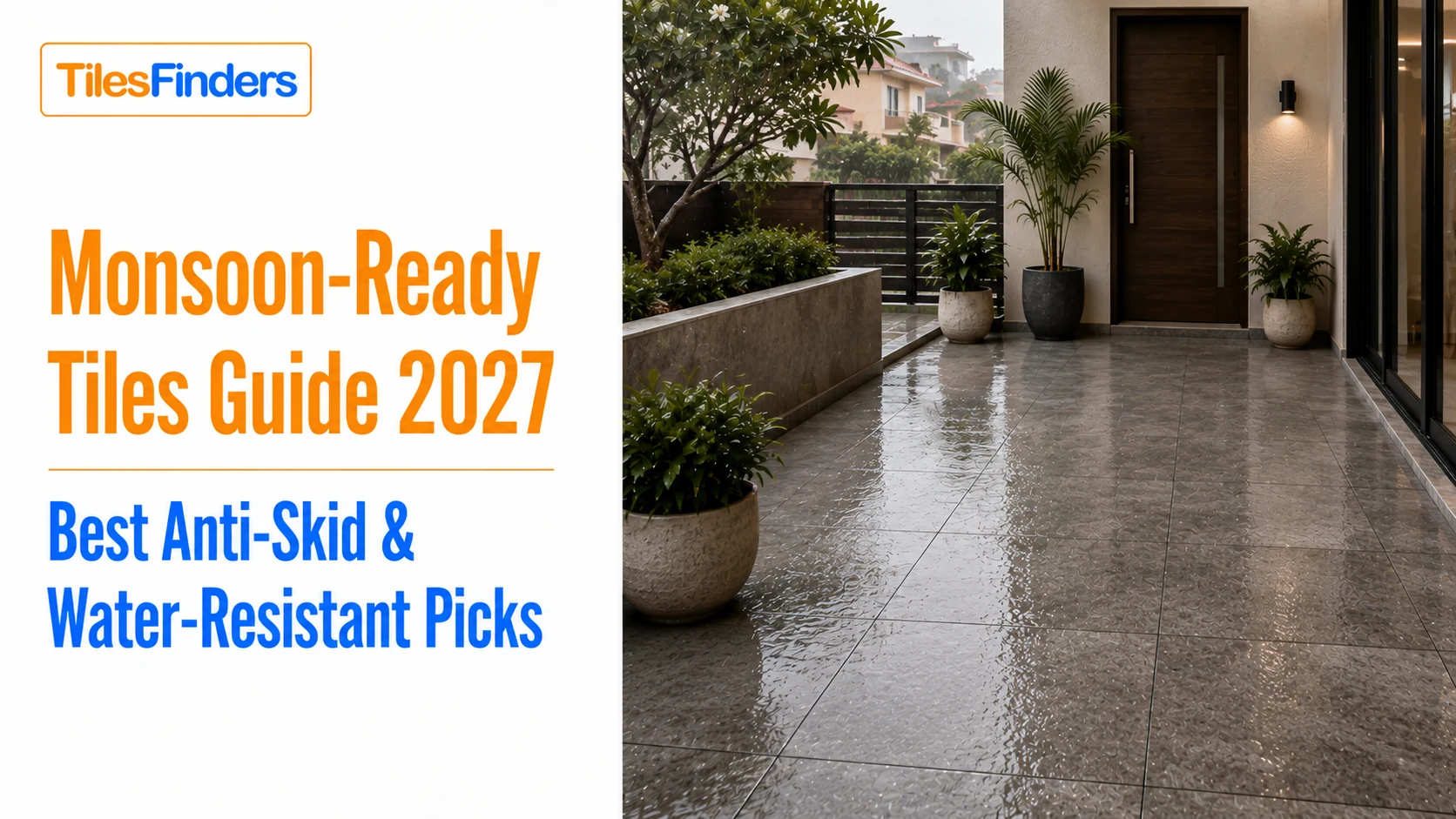
Monsoon-Ready Tiles Guide 2027: Best Anti-Skid & Water-Resistant Picks
2027 guide to monsoon-ready tiles: compare R-ratings vs pendulum tests, match anti-skid picks to high-risk home zones, and explore prices from ₹30 to ₹250/sq.ft.
- Where Monsoon Actually Attacks a Home
- Matching Zone to Risk Level
- Two Tests, Two Numbers: Making Sense of Anti-Skid Ratings
- Best Anti-Skid and Water-Resistant Tile Picks by Budget
- Grout, Sealing, and the Parts of Monsoon-Proofing That Aren't Tile
- A Monsoon Prep Timeline: Before, During, After
- Where to Buy Monsoon-Ready Tiles
- Getting Ahead of the Next Monsoon
Monsoon-ready flooring depends on matching each zone of a home, entrance, balcony, staircase, parking, and bathroom, to the right anti-skid rating and water absorption level. This guide compares R rating and pendulum slip test data, and covers grout, sealing, and tile picks by budget for 2027.
Every year, the same handful of spots in Indian homes turn from ordinary to hazardous the moment the first heavy monsoon spell hits. It is rarely the whole house. It is the entrance step, the balcony edge, the staircase near a window, and the parking floor closest to the gate, the specific points where water actually reaches the tile in meaningful quantity.
A genuinely monsoon-ready home is not one with a single anti-skid tile used everywhere. It is one where each of these known risk points has been matched to a tile that has actually been tested for how it behaves wet, not just labelled anti-skid on a box. This guide maps where the risk really sits, explains how anti-skid ratings are tested and where they can mislead, and gives realistic tile picks and budgets for 2027.
Where Monsoon Actually Attacks a Home
Water does not distribute itself evenly through a home during heavy rain. It concentrates at specific points, and those points are where flooring risk needs the most attention.
1. Entrance and foyer: the single highest-risk spot in most homes, since it takes tracked-in rainwater and wet footwear dozens of times a day during a monsoon spell.
2. Balcony and open terrace: direct rain exposure combined with any furniture or planter obstruction to natural drainage.
3. Staircases, particularly near an open window or external flight: water blown in by wind-driven rain is often underestimated compared to direct exposure.
4. Parking and driveway: standing water plus tyre-tracked mud and oil residue compounds the slip risk beyond what plain water alone would cause.
5. Bathrooms: less about monsoon specifically, but the same anti-skid logic applies, and monsoon humidity extends how long a bathroom floor stays damp after use.
6. Ground floor and basement units: in low-lying areas, water ingress from outside during heavy spells means water resistance matters even where standing water was never part of the original design brief.
Matching Zone to Risk Level
| Zone | Risk Level | Minimum R Rating | Water Absorption |
| Entrance and foyer | Very high, constant wet footfall | R11 | Below 0.5% |
| Balcony and terrace | High, direct rain exposure | R11 to R12 | Below 0.5% |
| Staircase (exposed) | High, safety critical | R11 | Below 3% |
| Parking and driveway | High, water plus oil residue | R11 to R12 | Below 0.5% |
| Bathroom | Moderate to high, prolonged damp | R10 | Below 0.5% |
| Ground floor living areas | Low to moderate, situational | R9 to R10 | Below 3% |
These are practical starting points, not universal rules. A ground floor flat in a low-lying, flood-prone locality should treat its living area closer to the entrance category than a similar flat on a higher floor with no history of water ingress.
Two Tests, Two Numbers: Making Sense of Anti-Skid Ratings
Most tile marketing uses the word anti-skid loosely, but there are two genuinely different laboratory tests behind the numbers that actually matter, and they do not always agree with each other.
The R rating (DIN 51130 ramp test): a person in cleated boots walks on an oiled tile sample as the ramp tilts, and the angle at which grip fails sets the rating from R9 to R13. This test is widely used and printed on most Indian tile packaging, but it was designed around industrial and commercial safety footwear, and international slip safety researchers have noted that a single R rating can still cover a fairly wide range of real-world slipperiness.
The pendulum test (measured as PTV or BPN): a swinging arm with a rubber slider strikes the wet tile surface, and the distance it travels afterwards gives a pendulum test value. This method is considered a closer real-world proxy for how a bare or socked foot actually slips, and a PTV of 36 or higher is generally treated as a low-risk threshold for wet barefoot areas internationally.
For an Indian home, the practical takeaway is straightforward: treat the R rating on a tile's packaging as a useful starting filter, R10 or higher for any zone that gets wet, but where possible, ask the dealer or manufacturer for pendulum or DCOF data as well, particularly for a bathroom or entrance floor that will be walked on barefoot. Where only one number is available, the R rating remains a reasonable practical guide for monsoon planning in a residential setting.
Best Anti-Skid and Water-Resistant Tile Picks by Budget
Realistic 2027 pricing across budget tiers, focused specifically on tiles suited to monsoon-exposed zones.
| Budget Tier | Tile Type | Price Range (Rs. per sq.ft.) | Best For |
| Economy | Anti-skid ceramic, R9 to R10 | Rs. 30 to Rs. 65 | Covered balconies, low-exposure entrances |
| Mid-range | GVT with GHR or matte finish, R10 to R11 | Rs. 60 to Rs. 150 | Open balconies, staircases, most entrances |
| Premium | Full body vitrified, R11 to R12 | Rs. 90 to Rs. 220 | Driveways, high-exposure entrances, heavy footfall zones |
| Specialist | Textured anti-skid stone or granite, R12+ | Rs. 90 to Rs. 250 | Flood-prone ground floors, exposed staircases |
Installation labour for anti-skid tiling typically runs Rs. 30 to Rs. 60 per sq.ft., with textured or heavily patterned anti-skid finishes at the higher end due to more careful cutting and alignment work.
Grout, Sealing, and the Parts of Monsoon-Proofing That Aren't Tile
- Epoxy grout resists the algae and mould growth that standard cement grout develops quickly in a monsoon-exposed zone, and is worth the extra cost in every high-risk area identified above.
- A waterproofing membrane beneath the tile, not just a water-resistant tile on top, is what actually stops water ingress into the slab below, particularly for balconies and any ground floor area with a flood history.
- Correct slope toward a drain outlet matters as much as tile choice itself. A perfectly rated anti-skid tile still pools water on a flat surface with no fall toward drainage.
- Natural stone surfaces, including granite, need periodic sealing before monsoon season specifically, since an unsealed or under-sealed stone surface absorbs more water and loses grip faster than a properly maintained one.
- Door mats and boot-scrapers at entrances reduce the volume of water and grit that reaches interior flooring in the first place, a low-cost addition that meaningfully reduces wear on interior tiles over a full monsoon season.
A Monsoon Prep Timeline: Before, During, After
Before the Monsoon (April to May)
This is the window to address any known risk zone identified from the previous year, replace a tile that showed visible wear or repeated slip incidents, reseal natural stone surfaces, and clear balcony and terrace drains of debris that accumulated over the dry season.
During the Monsoon (June to September)
Focus shifts to maintenance rather than replacement. Keep entrance mats and boot-scrapers in active use, wipe down glossy or semi-glossy floors more frequently than usual, and monitor any area that historically pools water for early signs of drainage blockage.
After the Monsoon (October onward)
This is the right time for a proper inspection: check grout lines for early mould or discolouration, look for any tile that has developed a hollow sound when tapped, indicating adhesive failure from prolonged moisture exposure, and plan replacements or upgrades for the following year's monsoon rather than waiting until the next season is already underway.
Where to Buy Monsoon-Ready Tiles
Anti-skid and water-resistant tile ranges are widely available across Indian tile dealers, though not every showroom stocks the higher R-rated ranges suited to driveways and exposed entrances, since these see less demand than standard indoor flooring.
TilesFinders is a tile discovery and dealer directory that helps buyers across India compare anti-skid tile designs, check indicative pricing across ceramic, GVT, and full body vitrified tile categories, and connect with verified dealers on a quote basis. For monsoon-specific purchases, it is worth asking any shortlisted dealer directly for the R rating and, where available, pendulum test data, rather than relying on the word "anti-skid" alone.
Getting Ahead of the Next Monsoon
Monsoon-ready flooring is less about finding one perfect tile and more about treating each known risk zone in a home with the attention it specifically needs, the right anti-skid rating, a genuine water absorption check, and the grout and waterproofing details that a tile alone cannot cover.
If you are planning anti-skid or water-resistant tiling ahead of the next monsoon, you can compare designs, indicative pricing, and verified dealer options on TilesFinders to match each zone of your home to the right specification.

See our tile guides first
Set TilesFinders as a preferred source and our buying guides surface ahead of the rest for you.
Add as preferred sourceTakes one tap. Nothing to install.
What Readers Say
I was about to redo my parking area with the wrong tile size until I read this. The layout comparisons saved me from a costly mistake.
We reference TilesFinders guides while briefing clients on material selection. The size and pattern breakdowns are accurate and easy to explain visually.
On site, I get asked about grout spacing all the time. This article gave me a solid reference I now share with my team before every job.
Finally a guide that doesn't just push generic advice. The oil stain removal steps actually worked on our clubhouse driveway tiles.
I run a small construction firm and now send this link to clients directly when they ask about entrance tile sizing. Saves me an hour of explaining.
Good practical detail, though I wish there were more examples for compact apartment entrances specifically, not just villas.
My mother-in-law wanted marble, I wanted vitrified. This blog gave us the neutral comparison we needed to actually decide together.
Detailed without being overwhelming. I appreciated that it covered both cost and maintenance, not just the aesthetics.
Used the algae and hard water removal tips on our terrace tiles after the monsoon. Worked better than what our regular cleaner was doing.
As someone who sources tiles for multiple builder projects, I find these comparisons genuinely useful for vendor conversations, not just consumer content.
Recommended this to a client who kept second-guessing the entrance design. The small vs large layout section settled the debate instantly.
Straightforward and honest, no unnecessary jargon. Would like to see a similar breakdown for outdoor pool-deck tiles next.
We've bookmarked several TilesFinders guides for our design handbook. Reliable source when clients want data, not just opinions.
Two paths, one marketplace.
Get free quotes from verified suppliers.
Share your room, budget, and style. Suppliers in Morbi respond within hours.
Get Free QuotesList your business, reach real buyers.
Put your showroom in front of homeowners searching for tiles right now.
List Your Business