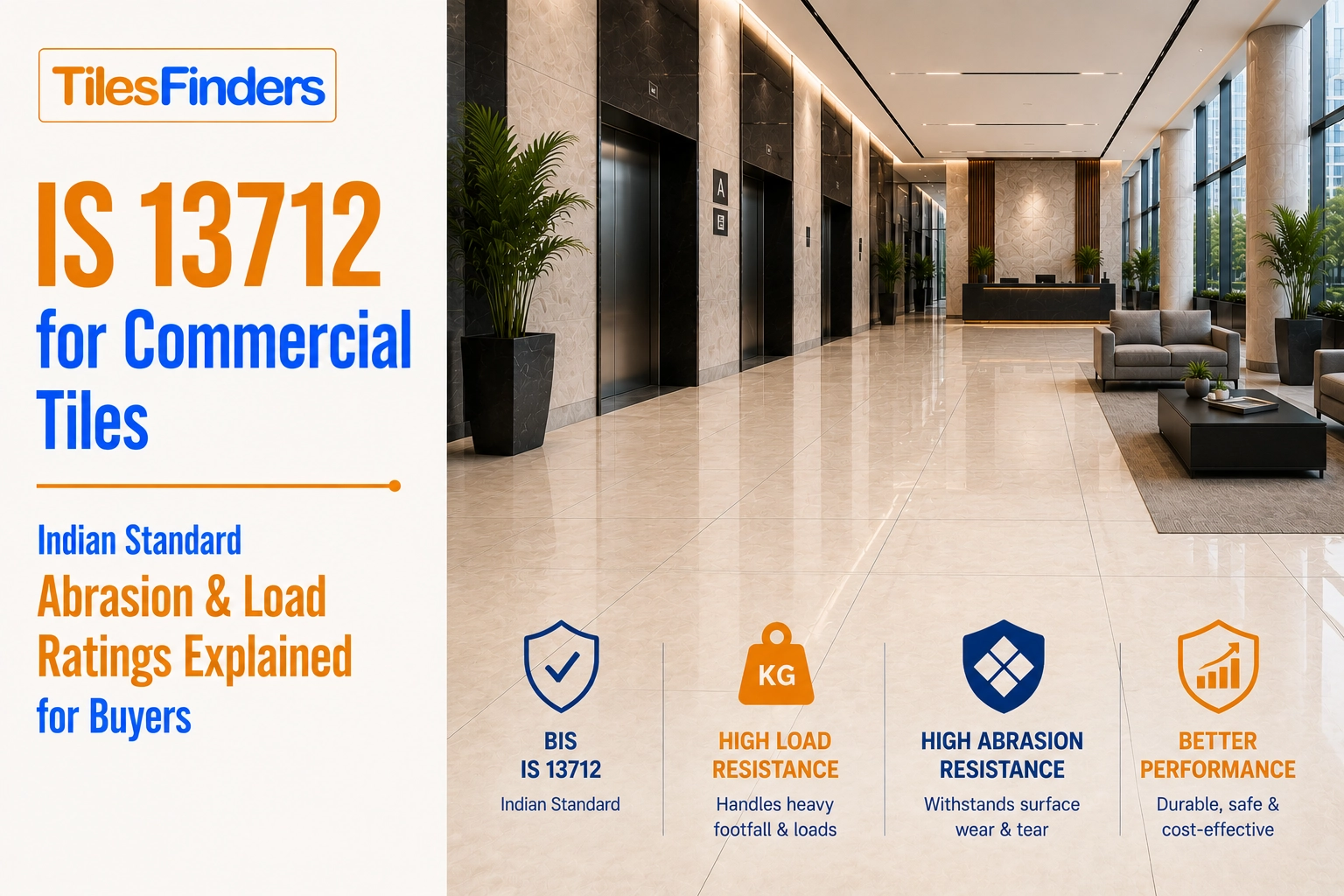
IS 13712 for Commercial Tiles: Indian Standard Abrasion and Load Ratings Explained for Buyers
Learn what IS 13712 means for commercial tile buyers. Understand abrasion testing, load ratings, PEI verification, mechanical strength, and the documents you should request before bulk procurement.
- Why This Matters More for Commercial Buyers Than Residential Buyers
- What Abrasion Resistance Testing Covers
- What Load and Mechanical Strength Testing Covers
- How This Interacts with the Standards You Already See on a TDS
- A Practical Checklist for Commercial Procurement
- Standards Compliance in Indian Commercial Tile Manufacturing: 2026 Context
- Source Documented Commercial Tiles on TilesFinders
IS 13712 helps commercial buyers verify abrasion resistance, mechanical strength, and durability claims instead of relying only on PEI ratings or supplier assurances. Always request the actual test certificates, confirm they match the supplied batch, and keep the documentation for future maintenance, warranty, and procurement records.
Most commercial tile buyers in India rely on PEI rating and a supplier's word that a tile is commercial-grade, without ever seeing the underlying test documentation that the rating is supposed to come from. IS 13712 is the Indian ceramic tile standard covering the test methods for properties, including abrasion resistance and mechanical load-bearing performance, the technical basis that PEI and durability claims should be traceable back to. This guide explains what these test categories mean in practical terms and what a commercial buyer should actually ask a supplier for.
Why This Matters More for Commercial Buyers Than Residential Buyers
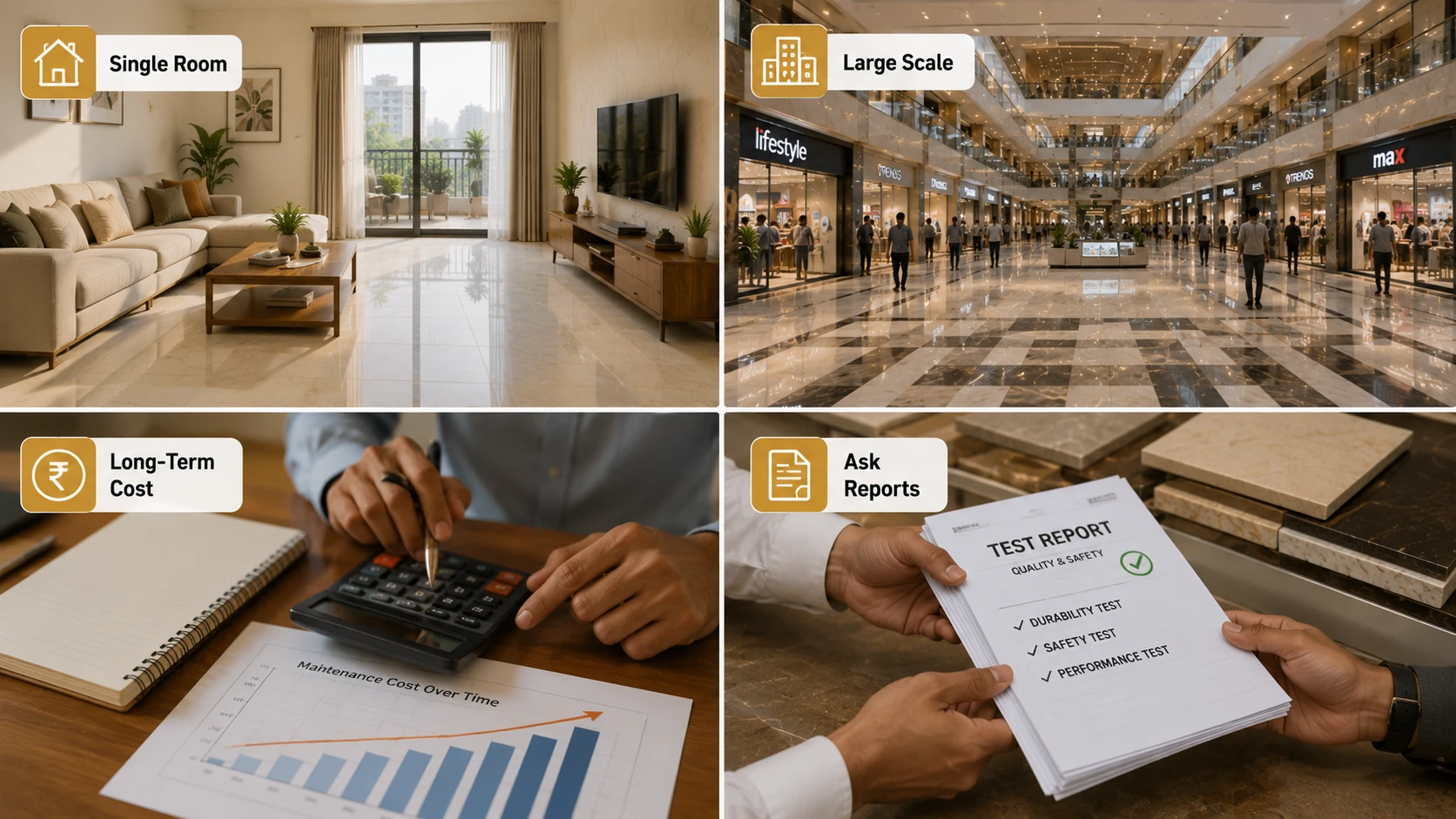
A residential buyer choosing a tile for one living room can rely reasonably safely on a general PEI number and a showroom sample, since the consequence of a specification error is limited to one room. A commercial buyer specifying tens of thousands of square feet for a mall, hospital, or office building is making a decision that determines maintenance cost, replacement frequency, and liability exposure across the building's entire operating life. At this scale, requesting the actual test documentation behind a supplier's durability and safety claims, rather than accepting a verbal or catalog-level assurance, is standard commercial procurement practice, not an unusual level of scrutiny.
What Abrasion Resistance Testing Covers
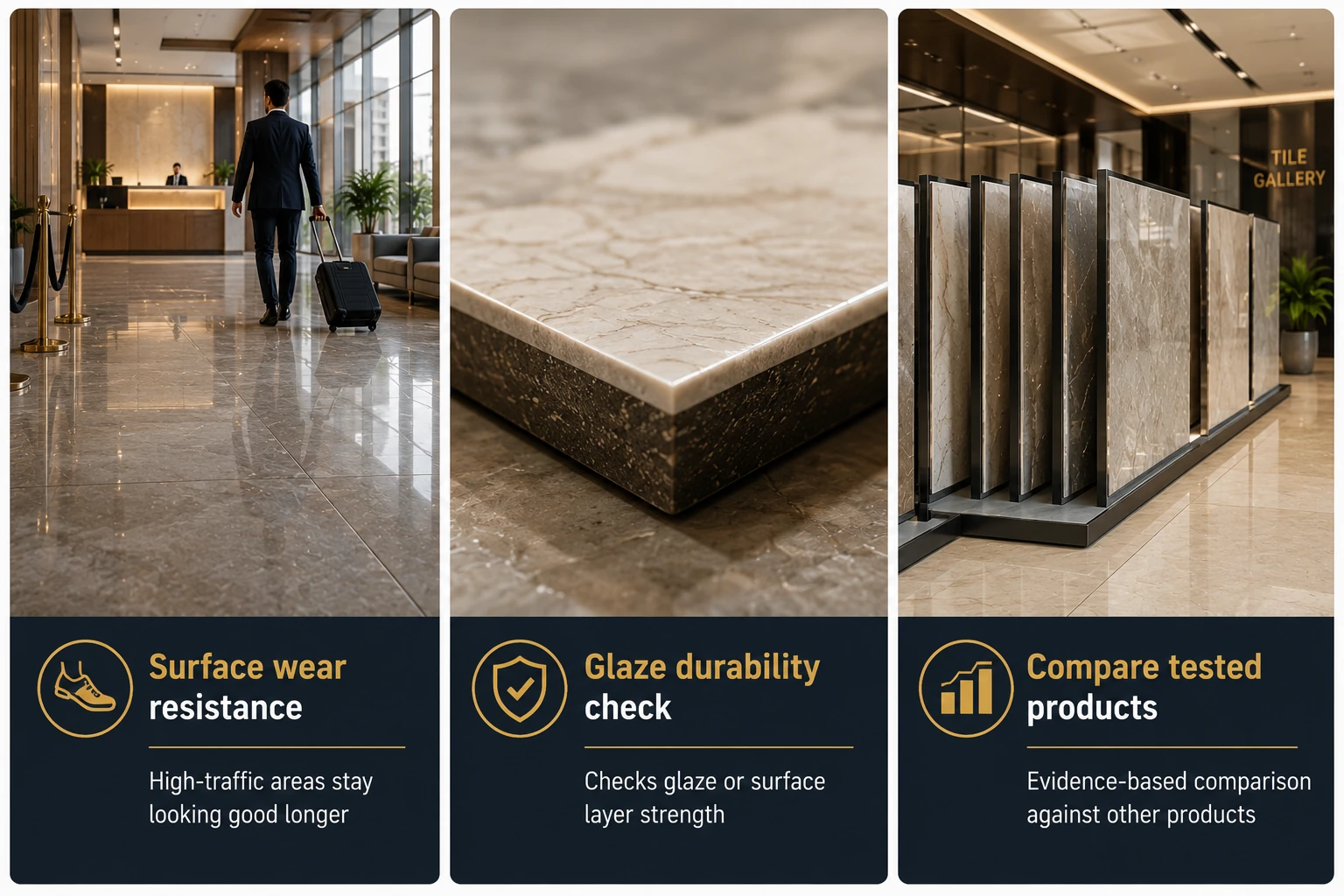
Abrasion resistance testing measures how a tile's glazed or unglazed surface withstands the repeated mechanical wear of foot traffic over time, the same underlying physical property that PEI classification is built on. For a commercial buyer, the practical value of this testing is a comparative, evidence-based answer to a specific question: will this floor's surface still look and perform correctly after years of the traffic volume this particular space will see?
| What Abrasion Testing Assesses | Why It Matters Commercially |
| Surface wear resistance under repeated mechanical contact | Determines how visibly a floor degrades at high-traffic pinch points such as entrances, elevator lobbies, and main corridors over years of continuous use |
| Glaze or surface layer durability specifically | Relevant to whether a standard GVT surface print will show wear before the underlying double charge or the full body alternative would |
| Comparative classification against other tested products | Gives a buyer an evidence-based basis to compare competing supplier claims rather than relying on marketing language like 'commercial grade' |
What Load and Mechanical Strength Testing Covers
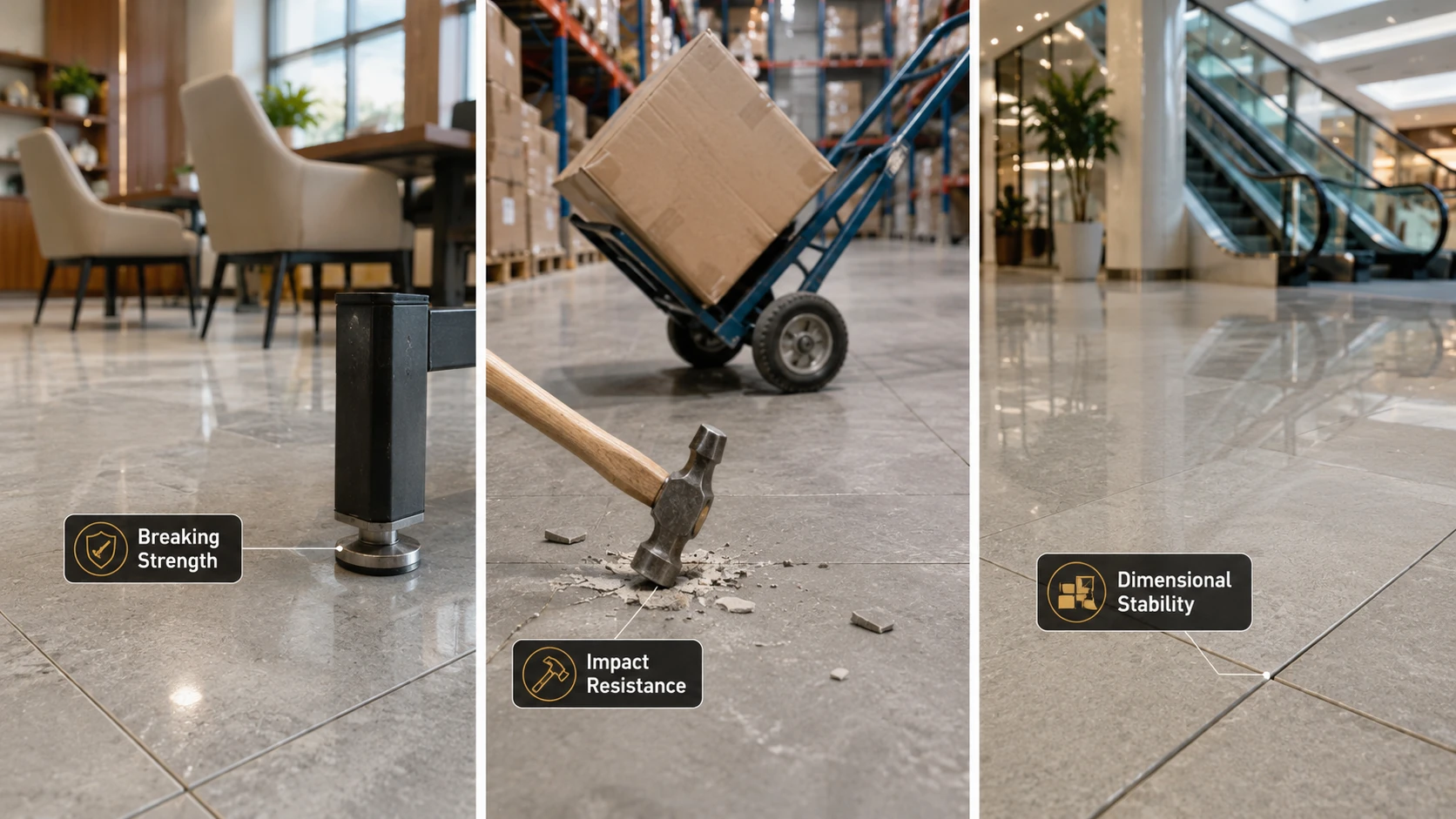
Beyond surface wear, a commercial floor also needs to withstand mechanical load: point loads from furniture and fixtures, distributed loads from foot and equipment traffic, and in some applications, wheeled loads from trolleys, service carts, or light material-handling equipment. Mechanical strength testing evaluates a tile's structural performance under these loads, distinct from its surface wear resistance.
- Breaking strength and modulus of rupture assess how much force a tile can withstand before structural failure, relevant to any application with concentrated point loads, such as furniture legs or equipment placement.
- Impact resistance is relevant to any commercial zone where dropped tools, equipment, or heavy goods handling is a routine occurrence, such as loading docks and service corridors.
- Dimensional stability under load and thermal cycling matters for large continuous commercial floor areas where any tile movement over time could compromise the overall surface flatness and grout joint integrity.
How This Interacts with the Standards You Already See on a TDS
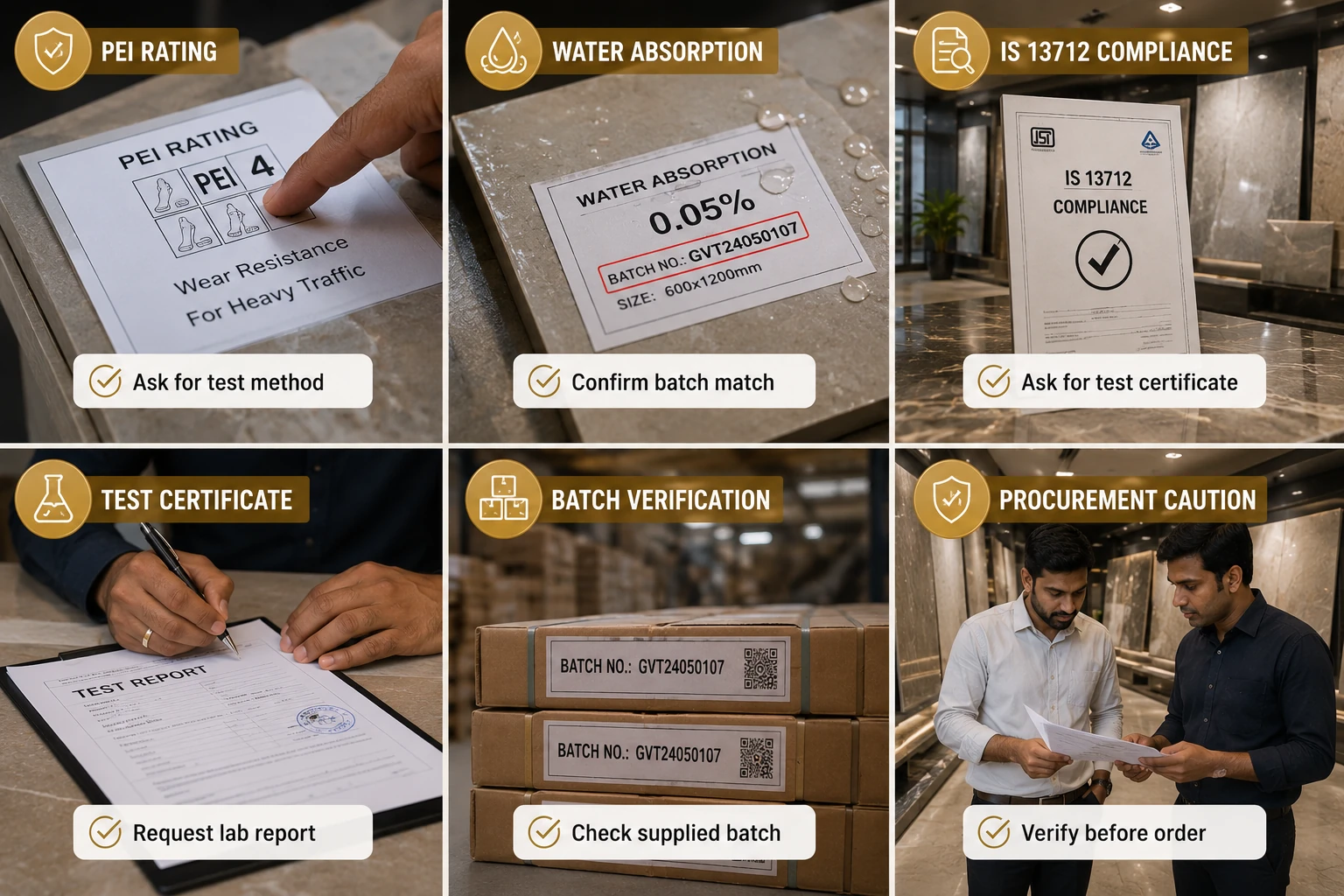
| Specification You See | What It Tells You | What to Also Ask For |
| PEI rating (3, 4, or 5) | A classification for expected wear resistance under a defined traffic category | The abrasion test result and methodology behind the PEI classification, not just the final number |
| Water absorption percentage (IS 15622:2006 for GVT) | Porosity classification, relevant to staining and moisture resistance | Confirm this figure is from the specific batch being supplied, not a generic product-line figure |
| General ceramic tile compliance (IS 13712) | Confirms the product has been tested against the Indian standard framework covering abrasion, mechanical strength, and related physical properties | Request the specific test certificate or lab report referenced, not just a statement of compliance |
Procurement caution: A supplier stating that a product 'meets IS 13712' without providing the underlying test certificate or lab report is making an unverifiable claim. For any commercial order above a few thousand square feet, request the actual documentation, not a summary statement, and confirm the tested batch corresponds to the batch being supplied for your specific project.
A Practical Checklist for Commercial Procurement
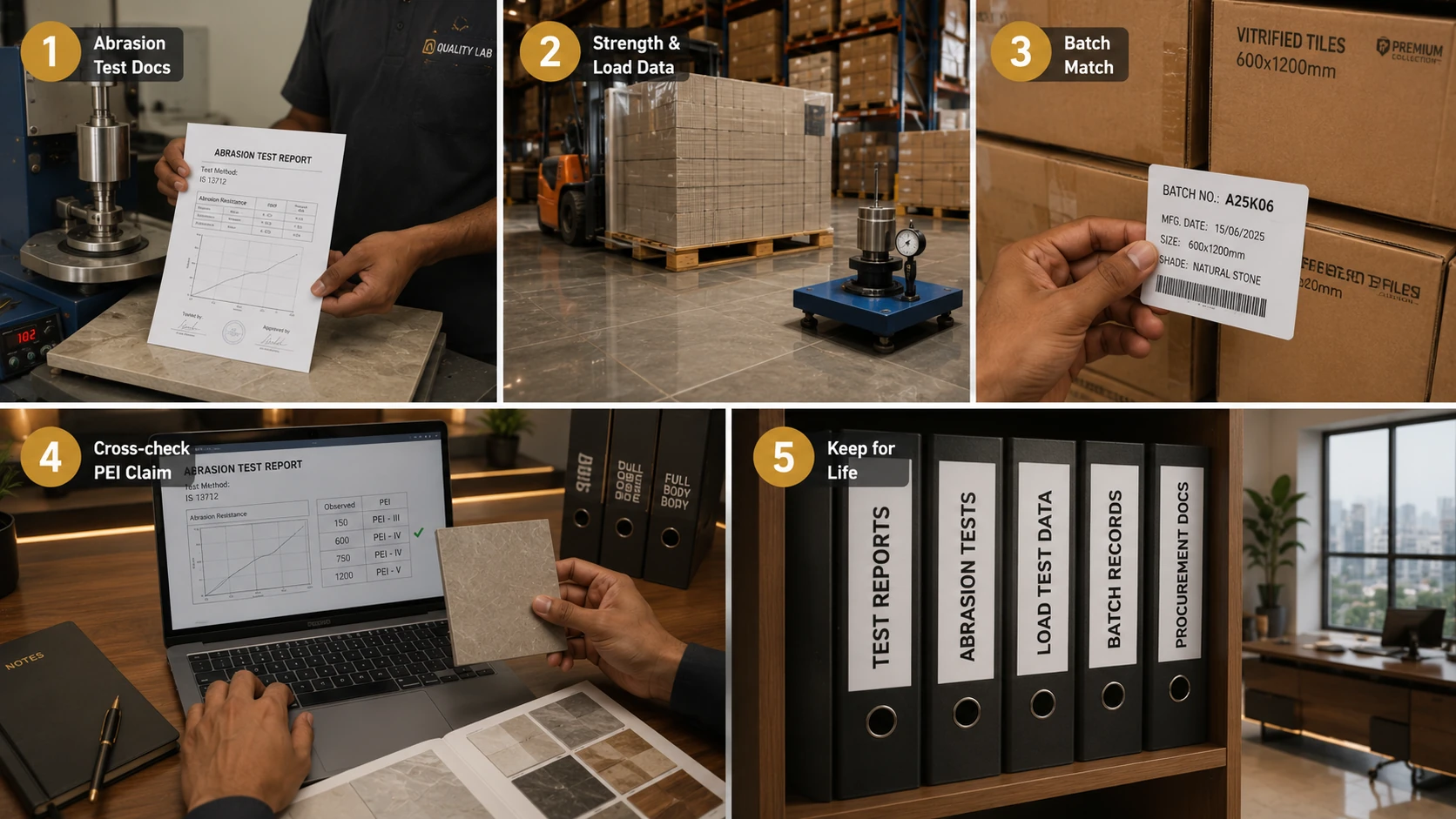
- Request the abrasion test documentation, not just the resulting PEI number, for any large commercial order.
- Request mechanical strength and breaking load data specifically for any application with concentrated point loads or wheeled traffic, such as loading docks, retail display zones, or equipment-heavy commercial kitchens.
- Confirm the test documentation corresponds to the actual batch being supplied, not a generic product-line certificate that may predate manufacturing changes.
- Cross-check the supplier's PEI claim against the abrasion data rather than accepting the PEI number alone, particularly for orders where the wear classification materially affects the specification decision between standard GVT, double charge, and full body vitrified.
- Retain all test documentation with the project's procurement records for the life of the building, since it may be relevant to future maintenance planning, warranty claims, or renovation specifications.
Understanding IS 13712 testing is only one part of selecting the right commercial flooring. Our Commercial Tiles Guide explains how PEI ratings, tile construction, slip resistance, procurement planning, and long-term durability work together to create reliable specifications for commercial projects.
Standards Compliance in Indian Commercial Tile Manufacturing: 2026 Context
Morbi, Gujarat manufacturers producing commercial-grade GVT, double charge, and full-body vitrified tiles maintain testing documentation against the relevant Indian standards as standard practice for institutional and large-volume commercial buyers, though the depth of documentation readily provided varies by manufacturer and order scale. For any commercial project procurement above a few thousand square feet, build a documentation request into the initial supplier qualification process rather than requesting it after a purchase order has already been placed, since this gives the project team leverage to select an alternative supplier if the requested documentation is not available.
After verifying technical documentation, the next step is choosing a flooring design suited to your project. Browse our Commercial Floor Tile Designs for sector-specific recommendations covering malls, hospitals, offices, hotels, and other high-traffic commercial environments.
Source Documented Commercial Tiles on TilesFinders
Full body, double charge, and standard GVT tiles from verified Morbi manufacturers are available on TilesFinders, with supporting technical documentation available on request for commercial procurement. Request abrasion and load test documentation as part of your supplier qualification process before finalising a large-volume order.
FAQs
IS 13712 is part of the Indian standard framework covering ceramic tile testing, including properties such as abrasion resistance and mechanical strength characteristics. For a commercial buyer, it represents the technical testing basis that durability claims like PEI classification and load suitability should be traceable back to.
PEI rating is a classification derived from abrasion testing, expressed as a simple number for general specification purposes. The underlying abrasion test documentation provides the detailed test data and methodology behind that classification. For large commercial orders, requesting the underlying documentation, not just the final PEI number, gives a more verifiable basis for comparing supplier claims.
Surface abrasion resistance and structural load-bearing capacity are distinct properties. A tile can have excellent surface wear resistance and still be inappropriate for an application with concentrated point loads, wheeled traffic, or impact risk, such as a loading dock or equipment-heavy commercial kitchen. Requesting both data sets separately ensures the tile is correctly matched to the full range of mechanical demands the specific application will place on it.
Not without supporting documentation. For any commercial order of meaningful scale, request the actual test certificate or lab report, and confirm it corresponds to the specific batch being supplied for your project rather than a generic product-line certificate that may not reflect current manufacturing.
GVT (vitrified) tiles are primarily governed by IS 15622:2006, which covers water absorption and related vitrified-specific properties. IS 13712 sits within the broader ceramic tile testing framework relevant to abrasion and mechanical strength testing methodology that applies across ceramic and vitrified product categories. Confirm with your supplier which specific standard documentation applies to the exact product category you are procuring.
Any commercial order in the range of a few thousand square feet or more justifies requesting formal documentation, since the cost of a specification error multiplies significantly at that scale compared to a single residential room. For very large institutional projects such as hospitals, malls, or multi-floor office buildings, this documentation should be a standard part of the supplier qualification process from the outset.
Not meaningfully if built into the supplier qualification process early, before purchase orders are finalised. Reputable Morbi manufacturers working with institutional and commercial buyers generally maintain this documentation as part of standard practice. Requesting it as an afterthought after a purchase order has already been placed is more likely to cause delay than requesting it upfront during supplier selection.
Treat this as a meaningful signal in supplier selection for any large commercial order. A supplier unable or unwilling to provide underlying test documentation for durability and load claims on a significant procurement is a weaker choice than one who can, independent of price, particularly for applications like hospitals and malls, where the consequences of a wear or safety specification error are highest.

See our tile guides first
Set TilesFinders as a preferred source and our buying guides surface ahead of the rest for you.
Add as preferred sourceTakes one tap. Nothing to install.
What Readers Say
I was about to redo my parking area with the wrong tile size until I read this. The layout comparisons saved me from a costly mistake.
We reference TilesFinders guides while briefing clients on material selection. The size and pattern breakdowns are accurate and easy to explain visually.
On site, I get asked about grout spacing all the time. This article gave me a solid reference I now share with my team before every job.
Finally a guide that doesn't just push generic advice. The oil stain removal steps actually worked on our clubhouse driveway tiles.
I run a small construction firm and now send this link to clients directly when they ask about entrance tile sizing. Saves me an hour of explaining.
Good practical detail, though I wish there were more examples for compact apartment entrances specifically, not just villas.
My mother-in-law wanted marble, I wanted vitrified. This blog gave us the neutral comparison we needed to actually decide together.
Detailed without being overwhelming. I appreciated that it covered both cost and maintenance, not just the aesthetics.
Used the algae and hard water removal tips on our terrace tiles after the monsoon. Worked better than what our regular cleaner was doing.
As someone who sources tiles for multiple builder projects, I find these comparisons genuinely useful for vendor conversations, not just consumer content.
Recommended this to a client who kept second-guessing the entrance design. The small vs large layout section settled the debate instantly.
Straightforward and honest, no unnecessary jargon. Would like to see a similar breakdown for outdoor pool-deck tiles next.
We've bookmarked several TilesFinders guides for our design handbook. Reliable source when clients want data, not just opinions.
Two paths, one marketplace.
Get free quotes from verified suppliers.
Share your room, budget, and style. Suppliers in Morbi respond within hours.
Get Free QuotesList your business, reach real buyers.
Put your showroom in front of homeowners searching for tiles right now.
List Your Business