High Glossy Tiles: Complete Guide for Indian Homes - Where to Use and What to Avoid
A practical reference for selecting high glossy tiles with real-world usage advice, safety considerations, upkeep expectations, and room-wise recommendations for Indian homes.
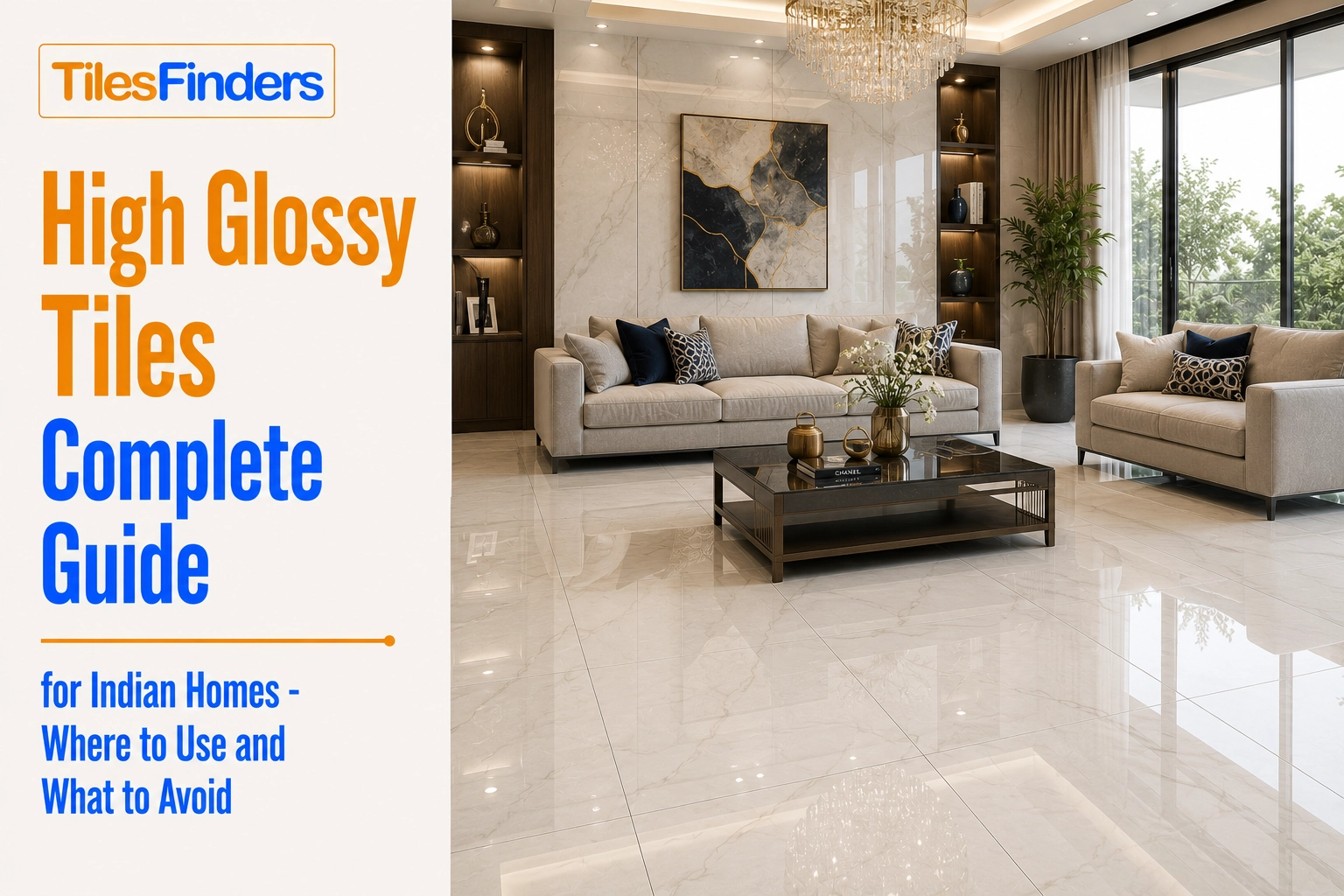
- What High Gloss Tiles Are: Types and Technical Properties
- Where High Gloss Tiles Work in Indian Homes
- Where High Gloss Tiles Should Not Be Used in Indian Homes
- The Maintenance Reality of Glossy Floors in Indian Conditions
- Glossy Tile Slip Safety: COF Reference for Indian Applications
- Buying Glossy Tiles in India: What to Confirm
- Colour Guide for Glossy Tiles in Indian Rooms
- Glossy Tiles in India: Market Context 2026
- Find the Right Tile Finish for Your Indian Home on TilesFinders
High glossy tiles look luxurious and brighten interiors but are best suited for walls and dry indoor floors with regular maintenance. Avoid using them on bathrooms, kitchens, balconies, and staircases where anti-skid tiles are the safer choice.
High gloss tiles are the most misunderstood surface in Indian interior design. In a showroom under controlled display lighting, a glossy tile floor looks spectacular: reflective, light-amplifying, and premium. In an Indian home under natural light, the same floor shows every footprint, every dust particle, and every monsoon-season wet footwear mark within the first week. Understanding where glossy tiles deliver on their promise and where they fail is the difference between a floor you are proud of and one that requires mopping three times a day.
This guide covers what high gloss tile finishes are, where they genuinely work in Indian homes, where they categorically do not work, the slip safety rules that apply regardless of design intent, and the buying specifications to confirm before ordering any glossy tile.
What High Gloss Tiles Are: Types and Technical Properties
-3a17bb8c-2fd5-485f-8af7-915c61654f6a.webp)
High gloss is a surface finish, not a material category. It is available across three distinct tile material types in India, and the properties differ significantly between them.
| Type | Material Body | Water Absorption | PEI Rating | Gloss Level | Primary Application |
| Glazed ceramic (glossy) | Ceramic body. Clay-based, fired at medium temperature. | 6 to 10% for wall-rated. 3 to 5% for floor-rated ceramic. | PEI 1 to PEI 2 for glossy wall ceramic. PEI 3 for some floor-rated glossy ceramic. | High: 60 to 90 GU (gloss units) | Bathroom walls, kitchen walls, and backsplash. The wall is used only for PEI 1 to PEI 2 rated products. |
| Polished GVT (vitrified glossy) | Vitrified body, 0.05% or below water absorption. The same body as matte GVT, with a post-firing mechanical polish on the surface. | 0.05% or below (IS 15622:2006) | PEI 3 to PEI 4, but the polished surface significantly reduces wet friction. Floor use with major caveats. | Very high: 80 to 110 GU | Dry-area residential floors (with full understanding of maintenance demands). Not recommended for wet-area floors. |
| Double charge vitrified (DC) | Full-body vitrified tile with two layers of pigment pressed together, then surface-polished. The colour runs deeper into the body than standard GVT. | 0.05% or below | PEI 4, but same wet-slip issue as polished GVT. | High: 70 to 100 GU | Dry-area living room floors. The most durable glossy floor tile available in India. Still not safe in wet areas. |
| PGVT (polished glazed vitrified) | GVT body with a glaze layer that is then polished. The gloss is on the glaze, not the vitrified body. | 0.05% or below | PEI 3 to PEI 4. Surface durability is lower than DC because the polished glaze layer is thinner than the DC double-pressed body. | Very high: 90 to 120 GU | Dry-area living room and bedroom floors. The most reflective Indian floor tile. Very high maintenance. |
Note: In Indian tile showrooms, the terms glossy, polished, high-gloss, mirror finish, and full polished are used to describe different products that behave differently in installation. The most important question to ask for any glossy tile is: What is the wet COF (coefficient of friction)? A tile that cannot provide a wet COF figure from its TDS is not a tile you can specify with confidence for any floor in an Indian home.
Where High Gloss Tiles Work in Indian Homes
The applications where glossy tiles genuinely perform as intended are narrower than most showroom displays suggest. These are the situations where the reflective quality of gloss adds value rather than problems.
Idea 1: Bathroom Walls
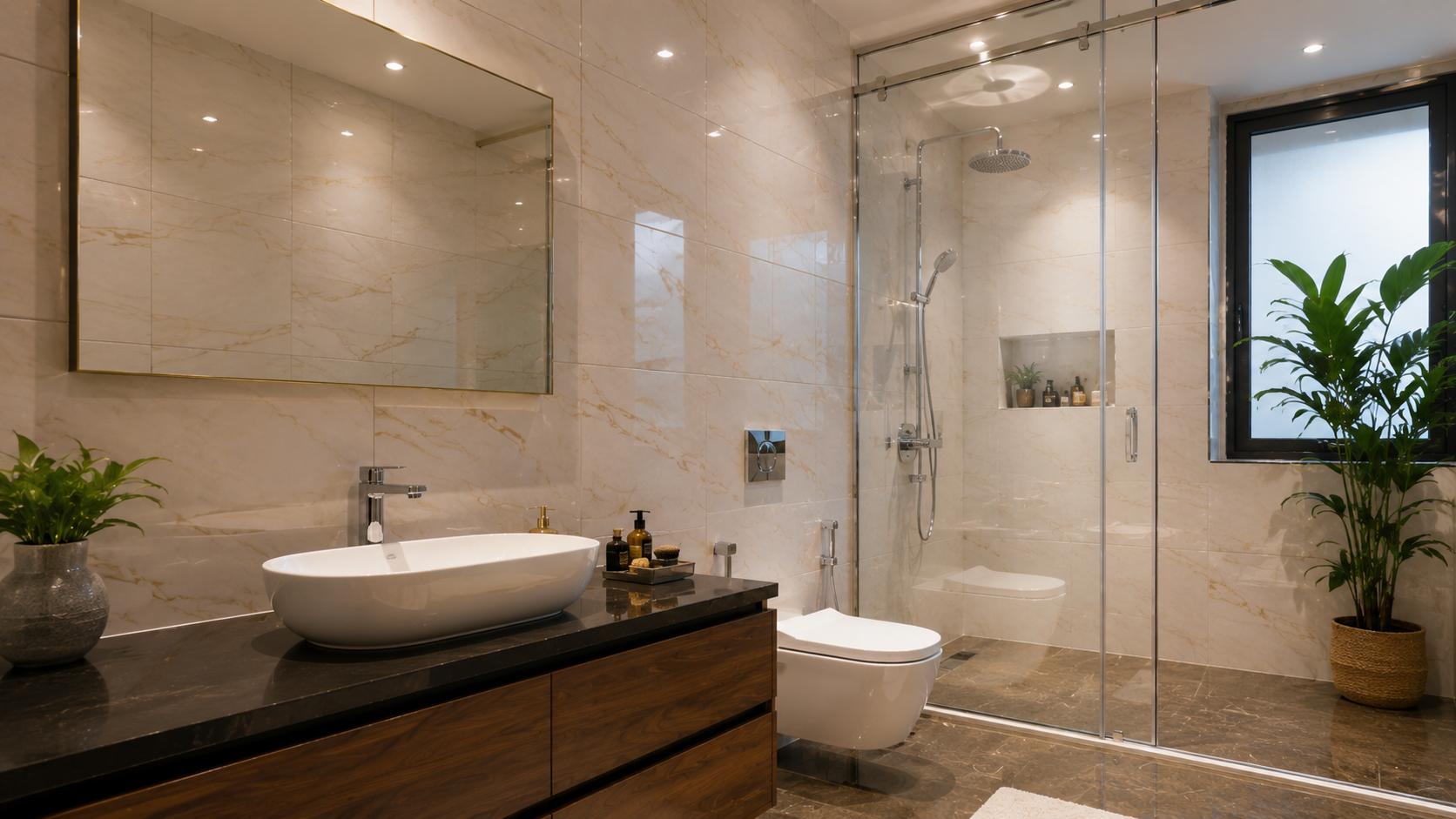
Glossy ceramic wall tile | 300x450 mm to 600x1200 mm | Any colour | PEI 1 to PEI 3 (wall use) | Rs. 40 to Rs. 200/sq.ft
Glossy tiles on bathroom walls are the safest and most effective application in an Indian home. On a vertical surface, there is no slip risk. The high reflective surface amplifies light in compact Indian bathrooms with small windows, making the room read as larger and brighter. Cleaning is straightforward: a weekly wipe with a damp cloth removes soap scum, toothpaste, and water marks from a glazed ceramic wall tile surface. White, ivory, and warm neutral glossy wall tiles in Indian bathrooms reflect the warm-white vanity lighting at 2700K to 3000K and create the spa-adjacent aesthetic that is one of the most consistently desired bathroom looks in Indian homes in 2026.
Idea 2: Kitchen Backsplash and Walls
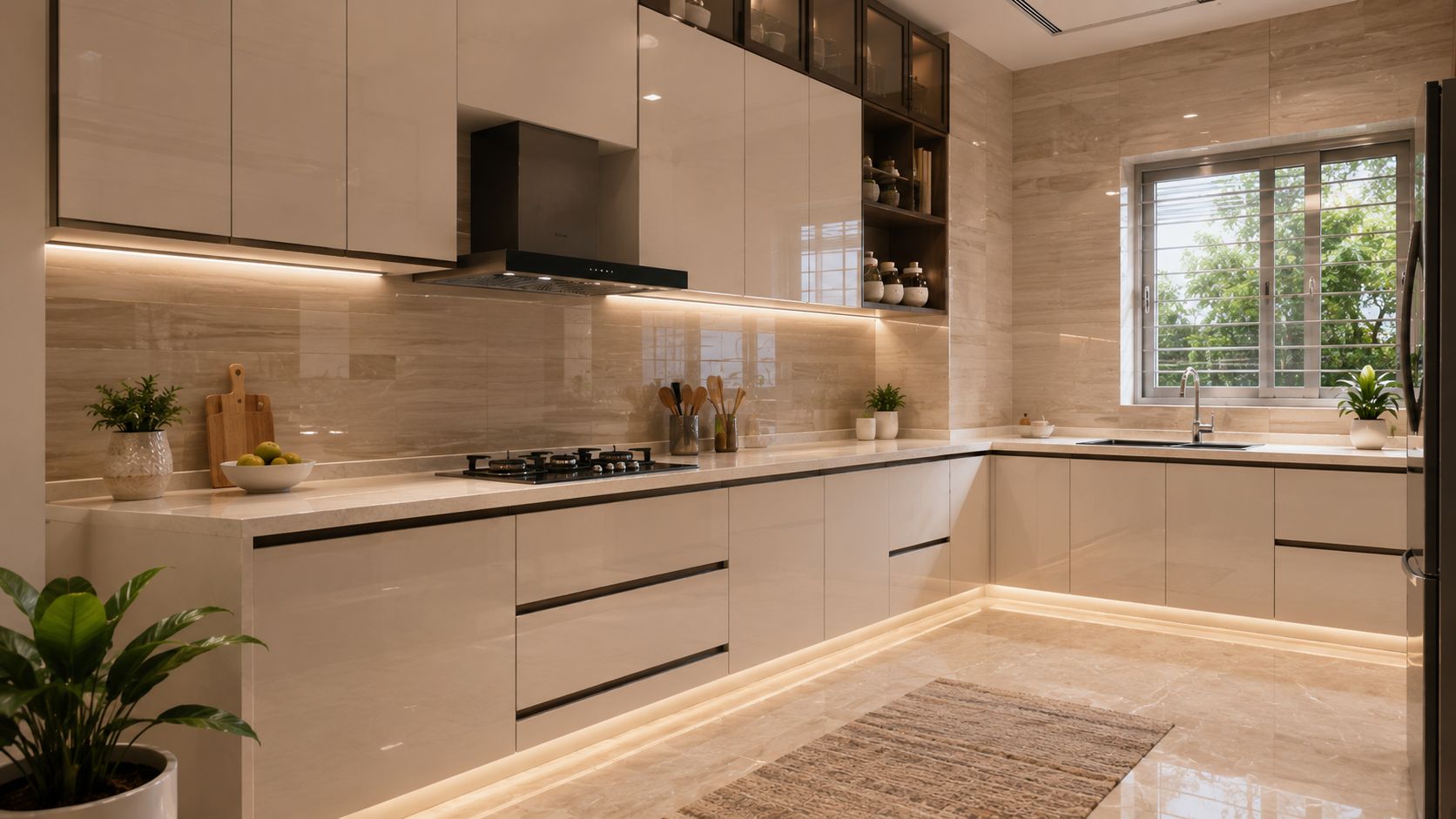
Glossy ceramic wall tile or glossy GVT | 75x300 mm subway to 600x1200 mm | Any colour | Wall use | Rs. 45 to Rs. 180/sq.ft
Kitchen walls and backsplashes are the second most popular application for glossy tiles in Indian homes. The reflective surface amplifies cooking-zone under-cabinet lighting and is the easiest surface to wipe clean from turmeric, cooking oil, and masala splatter. A damp cloth removes most Indian kitchen wall soiling from a glossy ceramic surface in a single pass. Glossy kitchen backsplash tiles in white, ivory, or warm yellow subway format are the most widely specified kitchen wall tile in Indian modular kitchens. The colour and design range at the glossy ceramic wall tile price tier is the widest of any tile category from Indian manufacturers.
Idea 3: Feature Wall in Living Room or Bedroom (Vertical Surface Only)
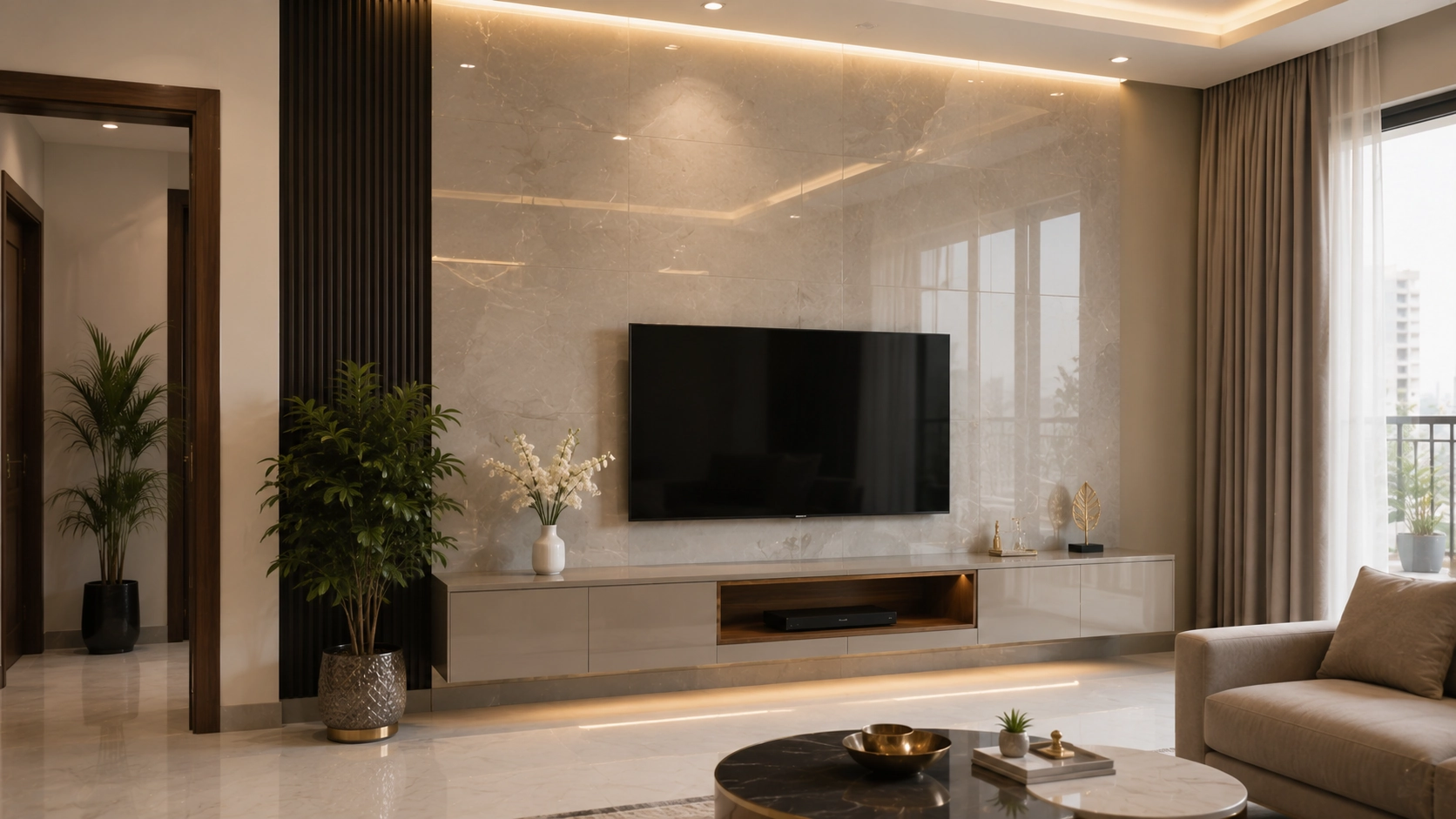
High-gloss ceramic or PGVT | 600x1200 mm | Glossy or mirror finish | Rs. 120 to Rs. 280/sq.ft
A high-gloss or mirror-finish tile used as a feature wall in a living room or bedroom, behind the sofa or the headboard, creates a dramatic light-reflecting accent that reads very differently from a painted or matte-tiled wall. On a vertical surface, the reflective quality of the glossy tile amplifies the light from accent fixtures and creates a sense of visual depth behind the main furniture element. The mirror-finish tile reads as an architectural element rather than a tile, particularly in a living room with a dark furniture palette where the reflective wall provides the room's primary light source. This application is wall-only and has no slip risk.
Idea 4: Dry-Area Living Room Floor with Full Maintenance Acceptance
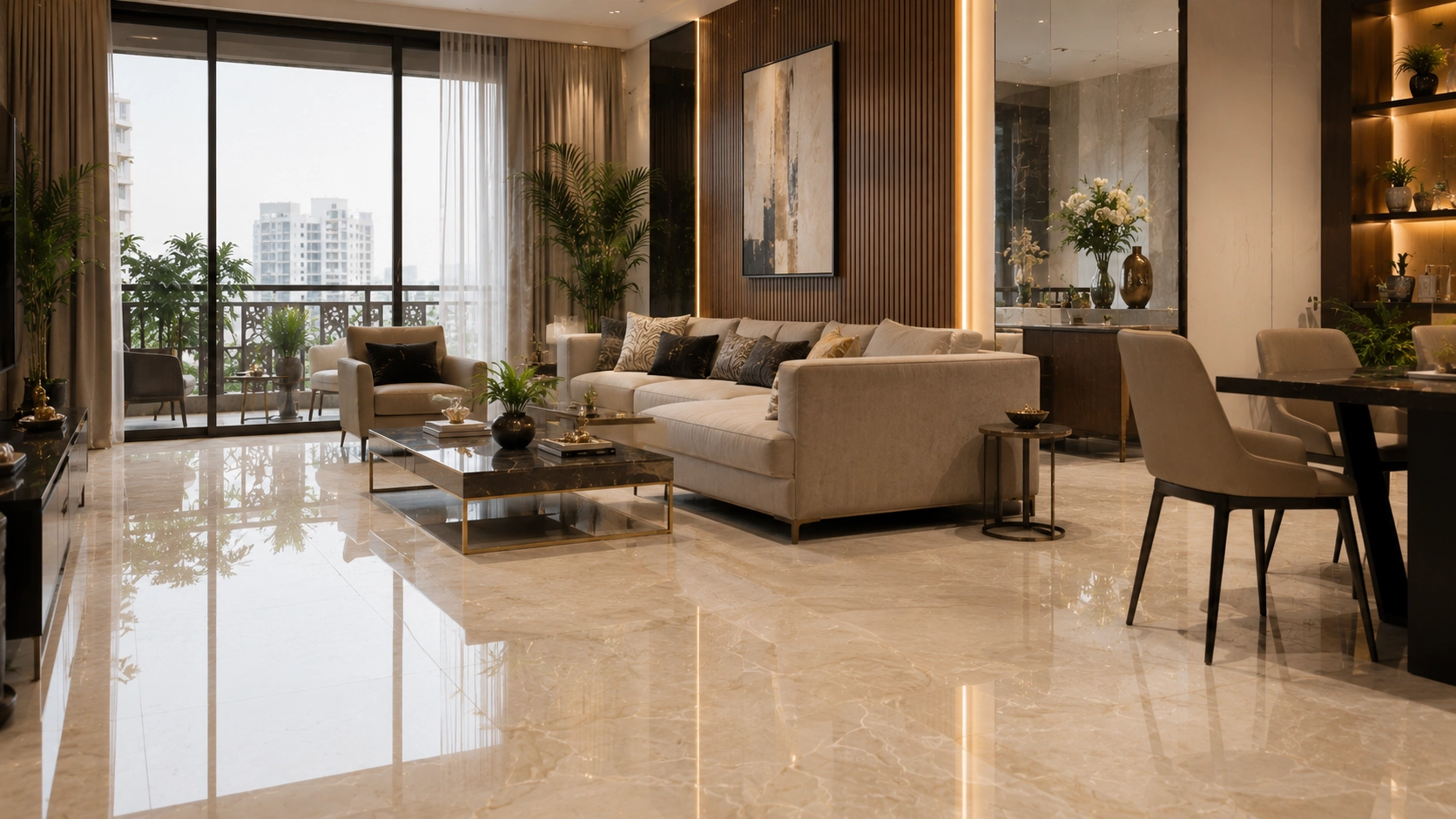
Polished GVT or PGVT | 600x600 mm or 800x800 mm | Polished | PEI 4 | Rs. 100 to Rs. 220/sq.ft
A polished GVT or PGVT floor in a living room is the application where glossy tiles on floors are most commonly specified in India, and the application that produces the most buyer regret. The glossy living room floor looks exceptional immediately after mopping and disappointing within an hour of the first person walking across it. In an Indian home with daily foot traffic, a white or light grey polished GVT living room floor requires mopping at a minimum twice daily to maintain its showroom appearance. If a buyer fully understands this maintenance requirement, accepts it, and plans their cleaning routine around it, a polished GVT living room floor at PEI 4 is technically appropriate for a dry-area floor. It is the most honest statement of the trade-off this finish requires.
Idea 5: Covered Entrance Area or Porch (Dry, No Rain Contact)
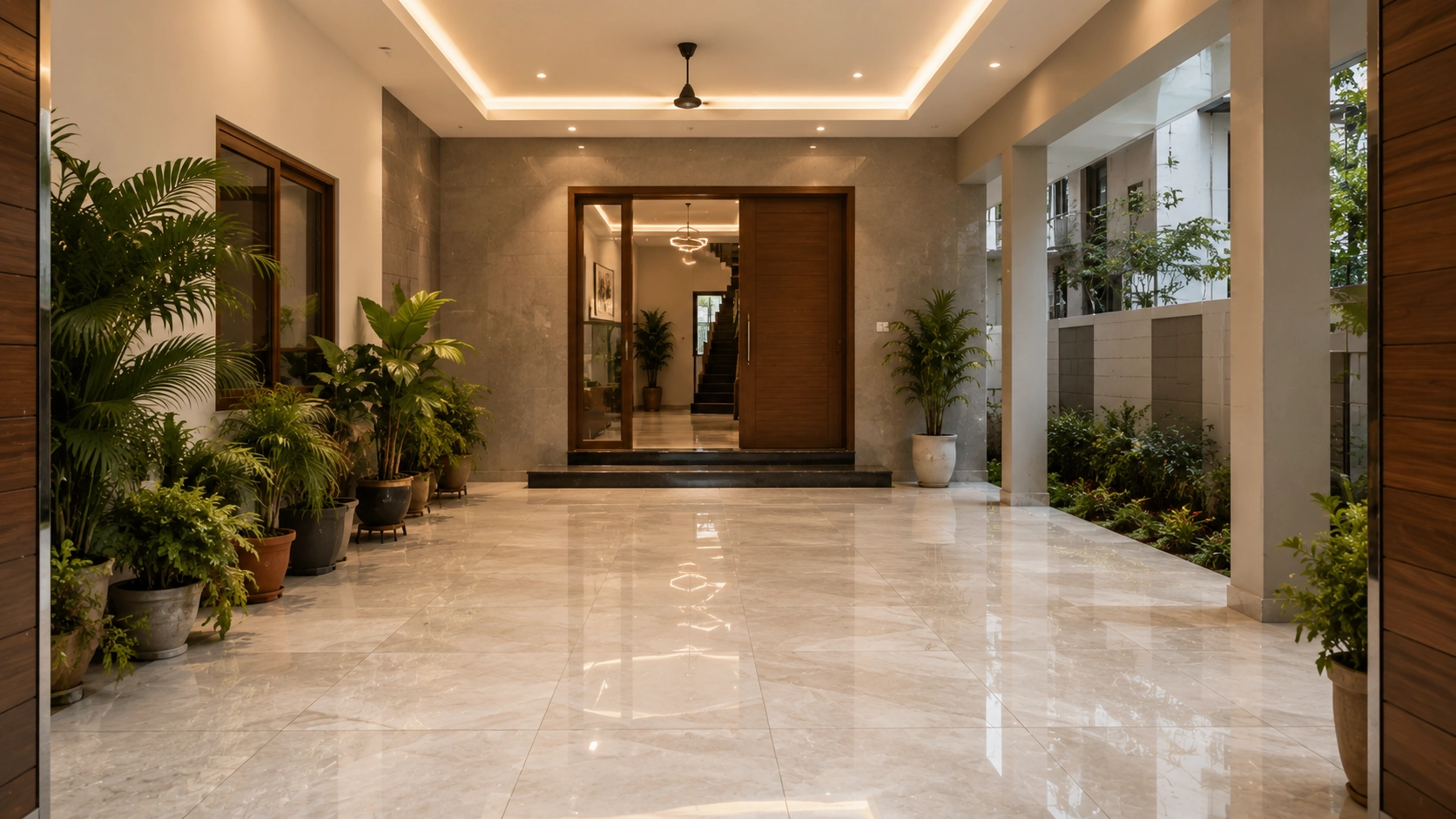
Polished GVT or double charge | 600x600 mm | Polished | PEI 4 | Rs. 100 to Rs. 180/sq.ft
A covered entrance or porch area in a private home, fully sheltered from rainfall and away from wet monsoon footwear, is a marginal floor application for polished GVT. The glossy floor in an entrance under focused pendant lighting reads as premium. The risk is that any moisture from footwear, an umbrella, or floor washing creates a serious slip hazard on the polished surface. If the entrance area is a covered lobby in a private independent home where access is controlled and the floor is monitored, polished GVT can work. In a common corridor or building entrance that receives public foot traffic, polished GVT is not appropriate.
Where High Gloss Tiles Should Not Be Used in Indian Homes
These are not design preferences. These are safety and practicality limits that apply regardless of how the tile looks in a showroom, how expensive it is, or what the interior designer has specified.
Bathroom Floors
-3875fc86-e32a-4b54-8e53-507329e18bd2.webp)
Glossy tiles on bathroom floors in Indian homes are the single most common cause of slip injuries in domestic settings. A polished or glossy GVT bathroom floor has a wet COF of 0.2 to 0.3, which is well below the 0.4 wet COF minimum required for safe bathroom floor use. During the Indian monsoon, when visitors arrive in homes with wet footwear, even a covered bathroom floor with the door open to the corridor becomes a wet-footwear risk zone. A glossy bathroom floor is dangerous. Anti-skid matte GVT with COF 0.4 wet and R10 to R11 rating is the correct specification for any Indian bathroom floor.
Kitchen Floors
-06e86162-f692-4714-a3d1-8a6e56871e42.webp)
Cooking oil on a glossy kitchen floor is a slip liability equivalent to a wet bathroom floor. In Indian kitchens with high daily cooking volume involving oil, masala, and water, the kitchen floor receives wet and oily contact many times per day. A polished or glossy tile on a kitchen floor is not a maintenance problem: it is a safety problem. Anti-skid matte GVT with COF 0.4 wet minimum and PEI 4 is the correct specification for any Indian kitchen floor.
Any Outdoor or Semi-Outdoor Floor
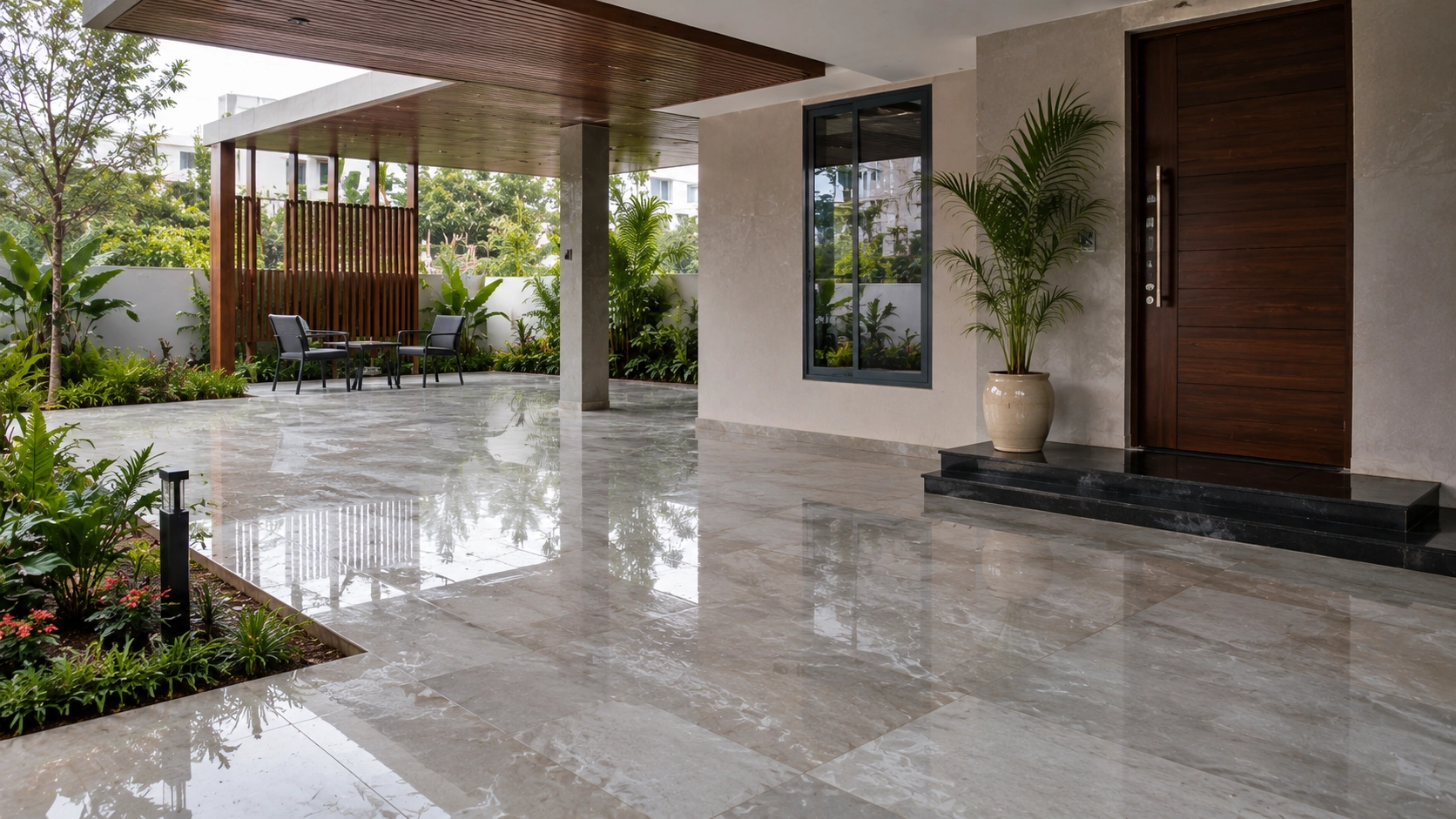
Balconies, terraces, uncovered car porches, garden paths, and any surface exposed to Indian monsoon rain must not be specified in glossy tile. Rain on a glossy tile surface creates a near-zero friction condition. Anti-skid matte GVT rated R11 with COF 0.5 wet is the minimum safe specification for any outdoor or rain-exposed floor in India.
Staircase Treads
-bb24ed70-06df-4a46-8fed-18dafe2d0e99.webp)
Staircase treads in a glossy tile are a life-safety matter, not a design preference. A polished or glossy tile on a staircase tread is dangerous for all users and represents a liability. Anti-skid tile with a nose (anti-slip edge) or a separate anti-slip nosing strip is the correct specification for staircase treads.
Any Floor Where Elderly or Young Children Are Present
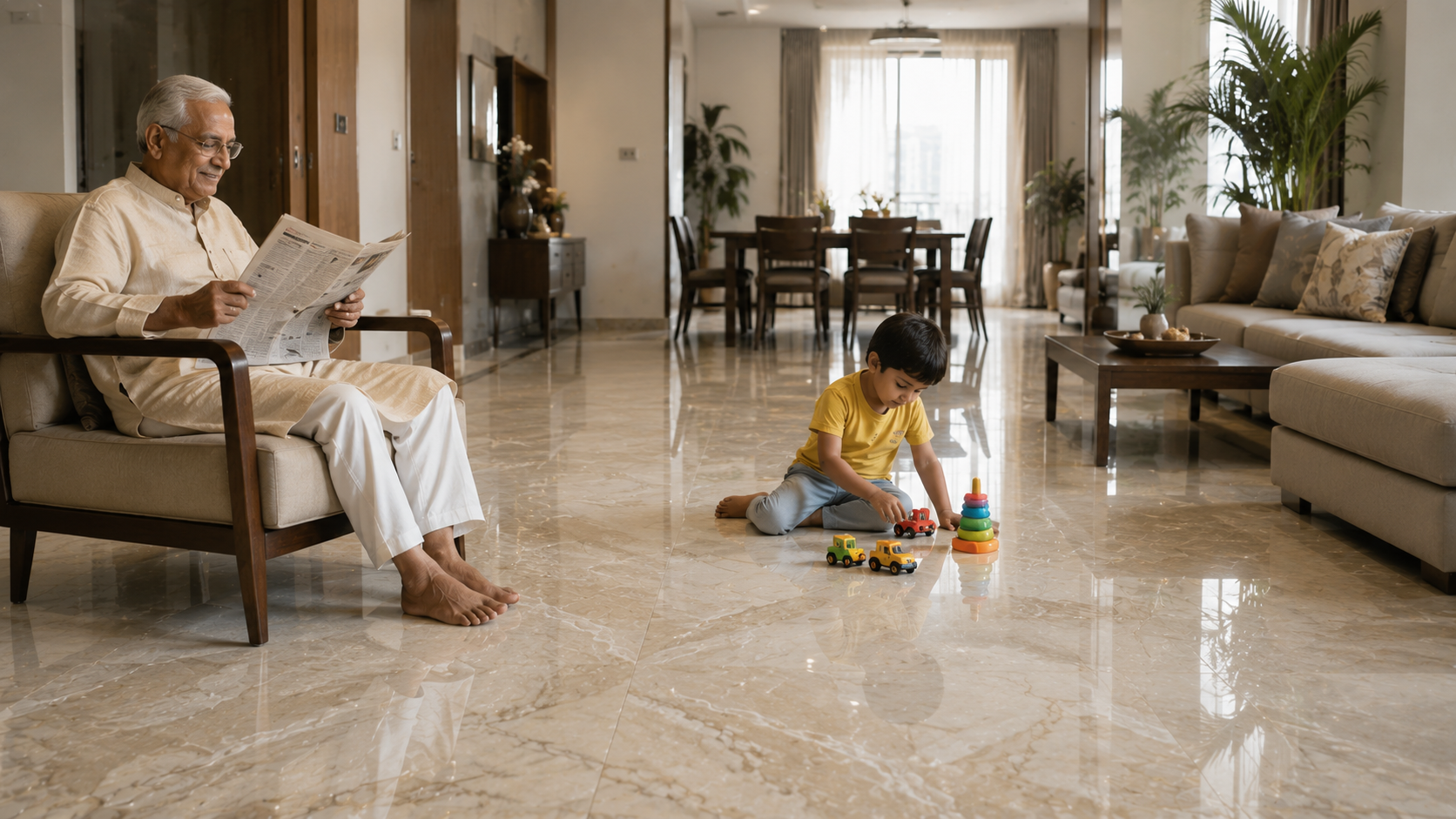
Even on a technically 'acceptable' dry-area application, such as a living room floor, a polished GVT or PGVT floor significantly increases fall risk for elderly users and young children who run. The wet footwear risk from monsoon-season entry, the oil risk from kitchen proximity, and the age-related stability differences make glossy floors a higher-risk specification in any Indian home with elderly residents or children under 8.
Critical caution: A PEI 4 rating on a polished or glossy GVT tile does not make it safe for wet-area floors. PEI measures abrasion resistance (how well the surface resists scratching from foot traffic) and has no relationship to slip resistance. A polished GVT at PEI 4 has excellent abrasion resistance and extremely low wet COF. It will not scratch under foot traffic, and it will be dangerously slippery when wet. These are two separate properties. Always request and check the wet COF from the tile TDS for any floor tile, regardless of PEI rating.
The Maintenance Reality of Glossy Floors in Indian Conditions
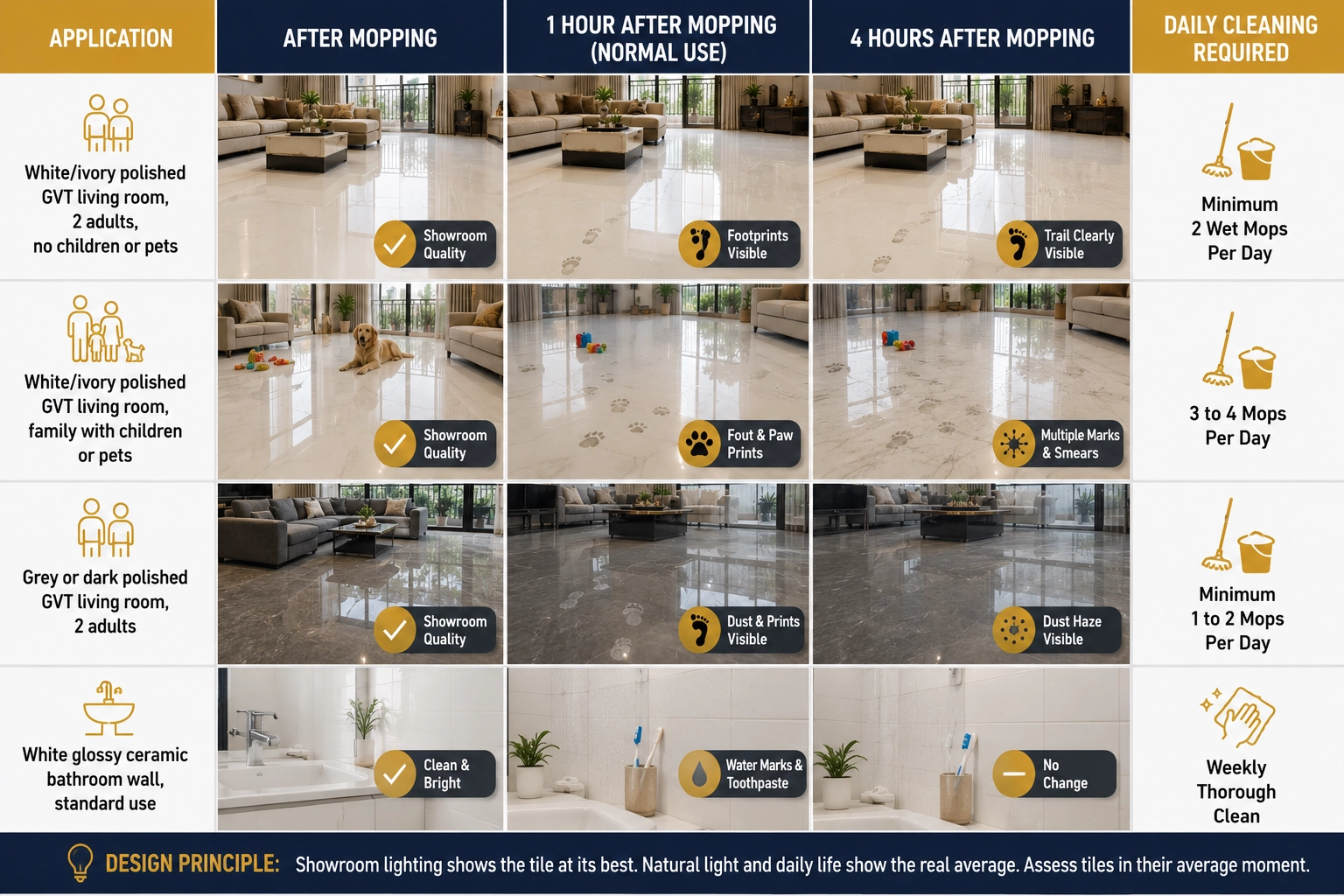
Indian interior designers and tile salespeople frequently understate the maintenance demand of glossy floors. The table below states it accurately.
| Application | After Mopping Appearance | 1 Hour After Mopping (Normal Use) | 4 Hours After Mopping | Daily Cleaning Required |
| White/ivory polished GVT living room, 2 adults, no children or pets | Showroom-quality reflective. Spectacular. | First footprints visible from across the room under the window light. | Footprint trail is clearly visible from any occupied chair or sofa. | Minimum 2 wet mops per day to maintain showroom appearance. |
| White/ivory polished GVT living room, family with children or pets | Showroom-quality immediately after mopping. | 15 to 20 minutes: multiple footprints, pet paw prints, possibly a spill. | Multiple trails, marks, and possible smears from any contact. | 3 to 4 mops per day. Most families find this unsustainable within the first month. |
| Grey or dark polished GVT living room, 2 adults | Showroom-quality after mopping. Dark greys hide prints slightly better than white. | Dust and footprints are visible but less severely than white. | Dust accumulation is visible as a lighter grey haze on the dark polished surface. | Minimum 1 to 2 mops per day. Slightly less demanding than white polished floors. |
| White glossy ceramic bathroom wall, standard use | Clean and bright after a weekly wipe. | Water marks and toothpaste at vanity height. Normal and expected. | Same. No change. | Weekly thorough clean sufficient. Most practical application. |
Design principle: The glossy floor in an Indian showroom under controlled display lighting represents the tile at its very best moment: freshly polished, no foot traffic, no natural light at raking angles, no monsoon humidity. The same tile in an Indian home under natural light with daily life represents the tile at its average moment. Every tile should be evaluated in its average moment, not its best. For glossy floor tiles, the gap between the best moment and average moment is larger than for any other tile surface.
Glossy Tile Slip Safety: COF Reference for Indian Applications
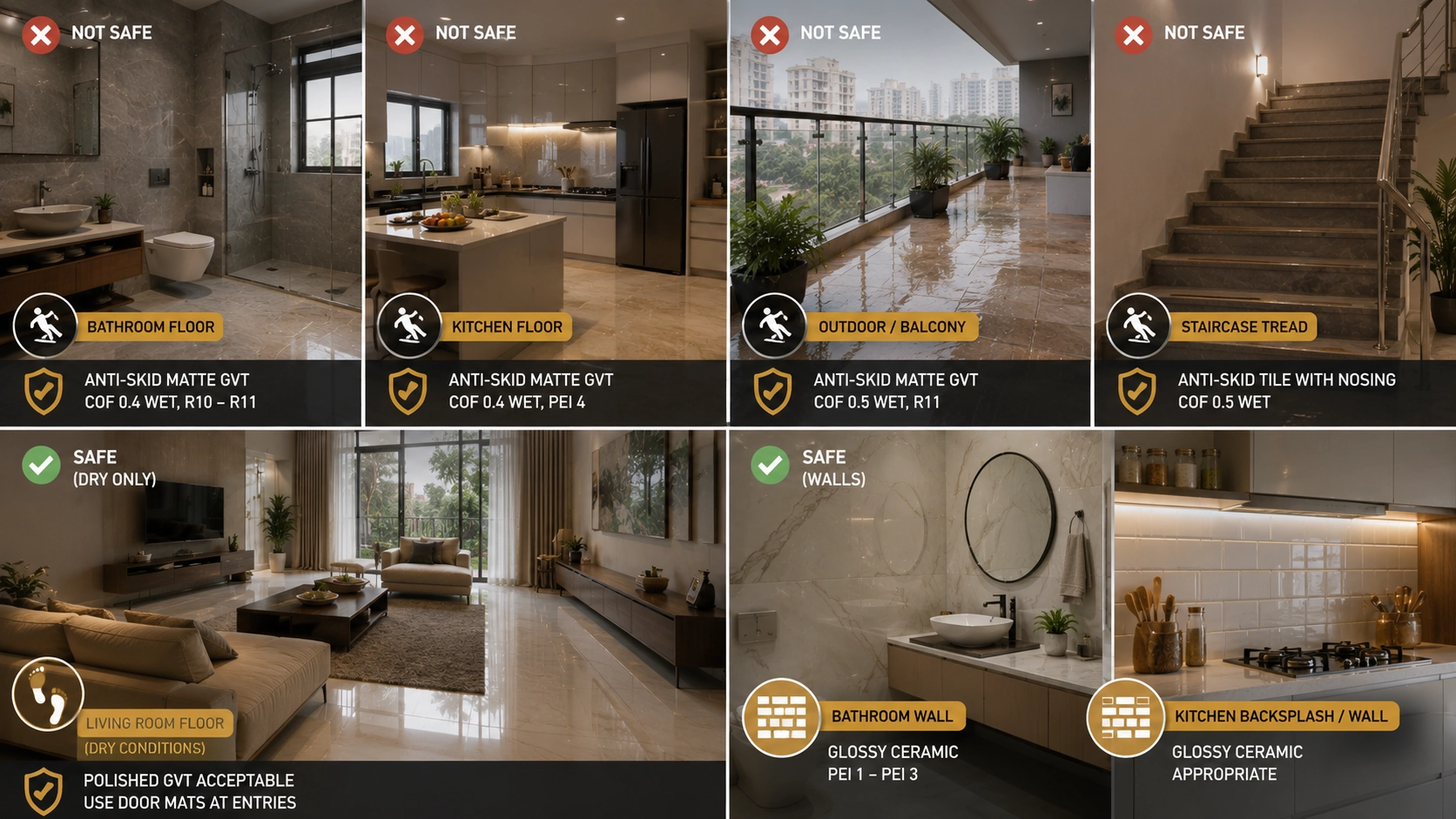
| Application | Required Wet COF | Typical Polished GVT Wet COF | Safe? | Correct Specification |
| Bathroom floor | 0.4 wet minimum (R10 to R11) | 0.2 to 0.3 wet | Not safe. | Anti-skid matte GVT, COF 0.4 wet, R10 to R11 rating. |
| Kitchen floor | 0.4 wet minimum | 0.2 to 0.3 wet | Not safe. | Anti-skid matte GVT, COF 0.4 wet, PEI 4. |
| Outdoor / balcony | 0.5 wet minimum (R11) | 0.2 to 0.3 wet | Not safe. | Anti-skid matte GVT, COF 0.5 wet, R11. |
| Staircase tread | 0.5 wet minimum with anti-slip nosing | 0.2 to 0.3 wet | Not safe. | Anti-skid tile with nosing, COF 0.5 wet. |
| Dry living room floor (no wet contact) | 0.35 dry acceptable | 0.45 to 0.55 dry | Technically safe in fully dry conditions. Becomes unsafe immediately on any wet contact. | Polished GVT is acceptable only with a full understanding of wet-contact risk. Add door mats at all entries. |
| Bathroom wall | No COF requirement for walls. | N/A (vertical surface) | Safe. No slip risk on walls. | Glossy ceramic PEI 1 to PEI 3 is fully appropriate. |
| Kitchen backsplash/wall | No COF requirement for walls. | N/A (vertical surface) | Safe. | Glossy ceramic is appropriate for all kitchen wall applications. |
Buying Glossy Tiles in India: What to Confirm
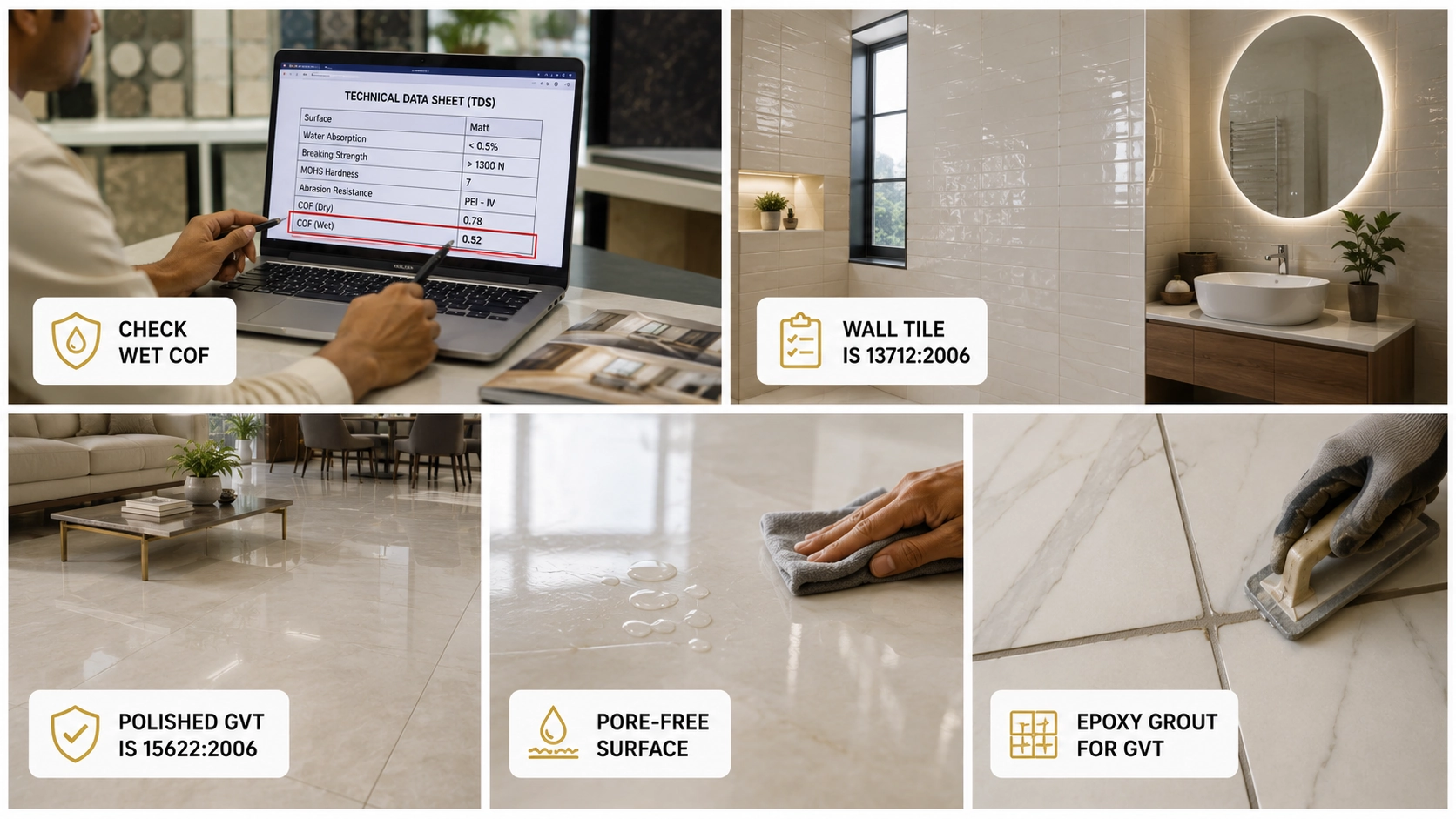
- For floor applications: request the wet COF figure from the TDS. Not the dry COF. The wet COF is the safety-relevant figure for Indian conditions where monsoon-season wet footwear, bathroom moisture, and kitchen water are daily realities. A tile supplier who cannot provide a wet COF from the TDS should not be trusted to specify a safe floor tile.
- For glossy ceramic wall tiles: confirm IS 13712:2006 compliance. Water absorption at 6 to 10% for wall-rated ceramic. PEI 1 to PEI 3 for wall use. This is the correct specification for bathroom and kitchen wall tiles. Do not use a wall-rated ceramic on any floor.
- For polished GVT and PGVT: confirm IS 15622:2006 compliance. Water absorption at 0.05% or below. PEI 3 to PEI 4. This confirms the tile body is a vitrified class. It does not confirm the tile is safe for wet-area floors: that requires the wet COF confirmation in item 1.
- Confirm pore-free surface for polished GVT. Polished GVT tiles that have not been properly sealed at the surface develop micro-pores that absorb staining from cleaning chemicals and cooking oil over time. A polished GVT floor that has not been sealed (or specified as pore-free from the manufacturer) will develop dark marks at grout joints and tile centres within 2 to 3 years of use.
- For glossy ceramic: confirm shade consistency within the batch. Glossy ceramic tiles amplify colour variation between shades (shade numbers) more visibly than matte tiles. A batch of glossy white ceramic tiles with two shade numbers will show a visible tonal seam in the installed bathroom wall. Order all tiles for a single wall from the same shade number.
- Confirm the grout type for polished GVT floors. Standard sanded cement grout on a polished GVT living room floor becomes a visible maintenance problem within 12 months as the polished tile surface attracts mopping water that settles in the grout line. Specify epoxy grout for polished GVT floors to prevent grout-line staining and darkening.
Colour Guide for Glossy Tiles in Indian Rooms
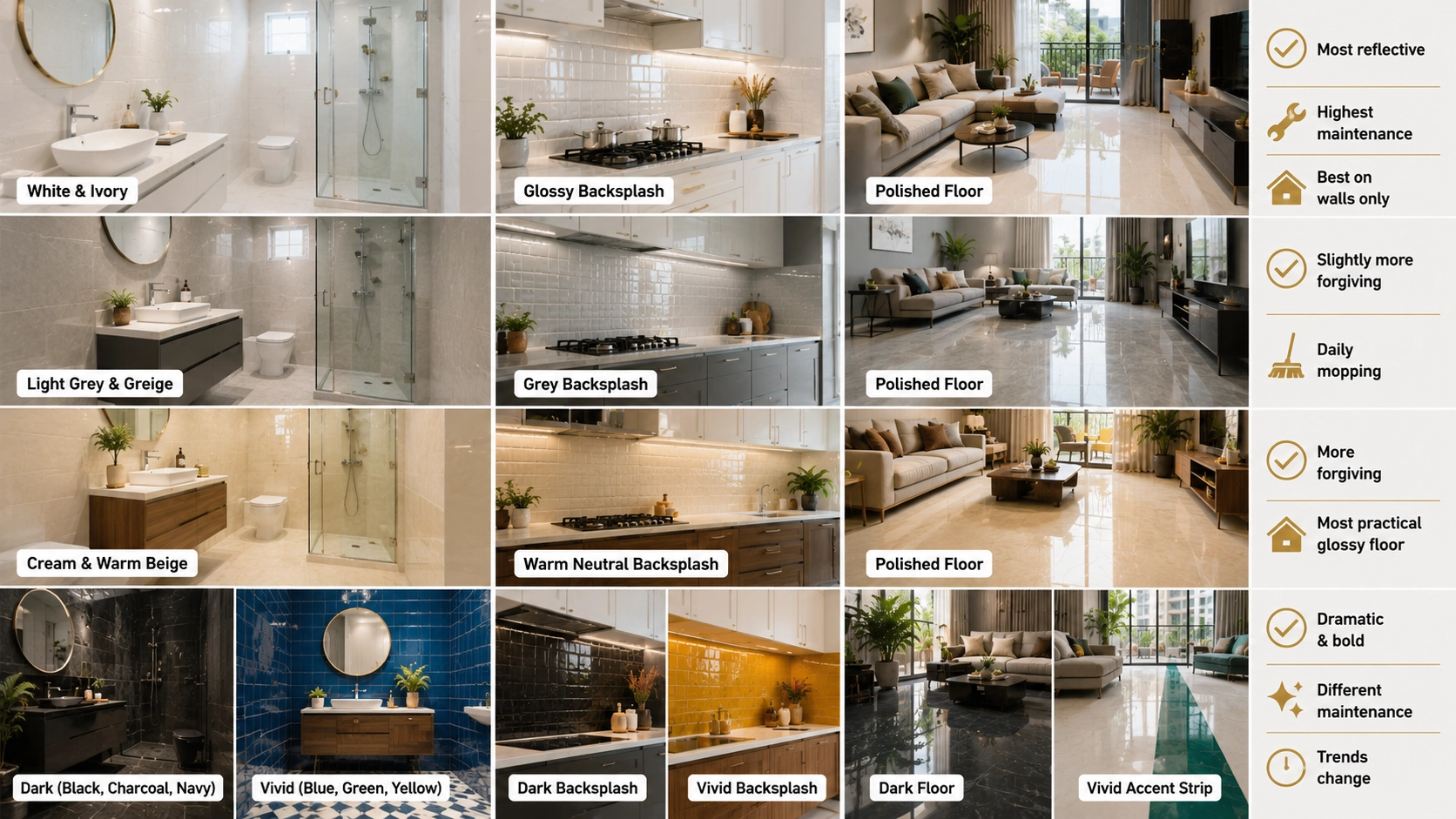
| Colour | Glossy Bathroom Wall | Glossy Kitchen Backsplash | Polished GVT Living Room Floor | Notes |
| White and ivory | Excellent. Most reflective, most light-amplifying. Widest available range. | Excellent. The most practical glossy backsplash: oil wipes clean visually against white. | Highest maintenance demand. Every footprint is visible within minutes of mopping. Not recommended for families with children or pets. | White glossy is best restricted to walls in Indian homes with practical maintenance expectations. |
| Light grey and greige | Very good. Slightly less clinical than white, with the same light amplification. | Good. Grey backsplash with white or dark cabinets. | Slightly more forgiving than white for footprint visibility. Still requires daily mopping. | Grey polished GVT hides footprints marginally better than white. Still a high-maintenance floor. |
| Cream and warm beige | Very good. Adds warmth to bathroom walls without sacrificing reflective quality. | Good. Warm neutral backsplash suitable for kitchens with wood-tone cabinets. | More forgiving than white for soiling. The warm tone absorbs minor soiling better than cool neutrals. | Warm neutral polished GVT is the most practical glossy floor colour if a glossy floor is insisted upon. |
| Dark colours (black, charcoal, navy) | Good as accent walls. Very dramatic. Full dark glossy bathroom walls suit a specific bold brief. | Good as an accent backsplash. Dark glossy backsplash with white cabinets is a confident design choice. | Shows watermarks and dust as lighter marks on the dark surface. A different but equally frequent maintenance demand as white. | Dark glossy floors hide food soiling but show limescale and dust. The maintenance problem changes, not disappears. |
| Vivid colours (blue, green, yellow) | Good as accent strips or feature panels. Full, vivid-colour glossy walls suit a very specific brief. | Gold or mustard glossy backsplash: distinctive and warm. Full vivid kitchen walls: bold and high-commitment. | Not commonly specified for full floor use. Vivid colour polished GVT as a single accent strip or inlay: appropriate. | Vivid, glossy colours age less gracefully than neutrals as design trends shift. |
Glossy Tiles in India: Market Context 2026
Glossy ceramic wall tiles in white, ivory, and warm neutral tones are the most widely produced tile category in India by volume, manufactured across Gujarat, Rajasthan, Andhra Pradesh, and Tamil Nadu under IS 13712:2006. At Rs. 40 to Rs. 90 per sq.ft for standard 300x450 mm and 300x600 mm glossy white and ivory ceramic from Indian manufacturers, this category serves the full Indian residential and light commercial market for bathroom and kitchen walls. Polished GVT and PGVT in 600x600 mm and 800x800 mm formats are manufactured in Morbi, Gujarat, under IS 15622:2006 at water absorption 0.05% or below, priced at Rs. 100 to Rs. 220 per sq ft, depending on design and format.
The Indian tile market in 2026 is shifting away from polished GVT living room floors as a default specification in mid and premium residential projects, with sugar finish and matte GVT capturing an increasing share of the premium living room floor segment. This shift reflects accumulated buyer experience with the maintenance demands of polished floors in Indian household conditions, particularly in cities with high dust, monsoon humidity, and active family lifestyles. In the hospitality and commercial segment, polished GVT and double charge vitrified tiles remain a primary specification for hotel lobbies, showrooms, and commercial floors where cleaning staff manage the maintenance cycle professionally.
Find the Right Tile Finish for Your Indian Home on TilesFinders
Glossy ceramic wall tiles for bathroom and kitchen walls, polished GVT for dry-area living room floors, and anti-skid matte GVT for bathroom and kitchen floors are all available on TilesFinders from verified Indian manufacturers. Filter by finish, application, and safety rating to find the specification that is right for both your design brief and your home's actual use conditions.

FAQs
Glossy and polished tiles can be used on dry-area floors (living rooms, bedrooms, formal dining rooms) with a PEI 4 rating and with a full understanding of the daily maintenance demand. They cannot safely be used on bathroom floors, kitchen floors, outdoor floors, or staircases due to dangerously low wet COF (0.2 to 0.3 wet versus the 0.4 wet minimum required for safe Indian wet-area floors).
A typical polished GVT or PGVT tile has a wet COF of 0.2 to 0.3. The minimum safe wet COF for a bathroom or kitchen floor in India is 0.4. This means polished GVT is below the safe threshold for wet-area floor use by 25 to 50%. The PEI 4 rating does not compensate for low wet COF: these are two separate tile properties measuring two different things.
A highly polished tile surface reflects light specularly, like a mirror. When a foot contacts the tile, the oils and moisture create a thin film that disrupts the specular reflection. Under natural or raking artificial light, this disruption reads as a darker mark against the surrounding reflected light. Standard matte tiles reflect light diffusely in all directions, so a similar mark is diffused across the surface and less visible from any angle.
For floor use, polished GVT at 0.05% water absorption is significantly more durable than glossy ceramic at 3 to 6% absorption. For wall use, glossy ceramic is the practical and cost-effective standard. For wet-area floors, neither polished GVT nor glossy ceramic is safe without an anti-skid specification. For dry-area floors, polished GVT (PEI 4) is the correct specification over glossy ceramic (PEI 2 to PEI 3).
Polished GVT requires daily wet mopping with a pH-neutral cleaner and a microfibre mop. Do not use vinegar, acidic, or abrasive cleaners as they dull the surface permanently over time. Use a dry microfibre mop pass before the wet mop to pick up dry dust and grit that acts as a micro-abrasive. Apply a topcoat floor sealer or polish every 3 to 6 months to maintain the glossy surface character.
Anti-skid matte GVT at 300x300 mm with COF 0.4 wet minimum and R10 to R11 anti-skid rating, confirmed in the written TDS. The anti-skid matte surface is the safe specification for Indian bathroom floors across all colours and designs. Sugar finish GVT at the same format provides a slightly more refined surface than standard anti-skid matte, but must also carry a confirmed COF 0.4 wet designation to be specified for a bathroom floor.
Double charge (DC) tiles are more durable than PGVT for living room floors because the colour runs deeper into the tile body, making the tile more resistant to visible wear at the surface over time. Both DC and PGVT have the same wet slip characteristics and footprint visibility issue. DC tiles maintain their appearance better over a 10 to 15-year floor lifecycle, while PGVT may show surface dulling at high-traffic points within 5 to 8 years.
Epoxy grout is the correct specification for polished GVT living room floors. Standard cement sanded grout becomes a maintenance problem within 12 to 18 months as mopping water settles in the grout joint and creates darkening stains that the polished tile surface highlights by contrast. Epoxy grout is non-porous, does not absorb water or cleaning agents, and maintains a consistent colour alongside the polished tile surface.

See our tile guides first
Set TilesFinders as a preferred source and our buying guides surface ahead of the rest for you.
Add as preferred sourceTakes one tap. Nothing to install.
What Readers Say
I was about to redo my parking area with the wrong tile size until I read this. The layout comparisons saved me from a costly mistake.
We reference TilesFinders guides while briefing clients on material selection. The size and pattern breakdowns are accurate and easy to explain visually.
On site, I get asked about grout spacing all the time. This article gave me a solid reference I now share with my team before every job.
Finally a guide that doesn't just push generic advice. The oil stain removal steps actually worked on our clubhouse driveway tiles.
I run a small construction firm and now send this link to clients directly when they ask about entrance tile sizing. Saves me an hour of explaining.
Good practical detail, though I wish there were more examples for compact apartment entrances specifically, not just villas.
My mother-in-law wanted marble, I wanted vitrified. This blog gave us the neutral comparison we needed to actually decide together.
Detailed without being overwhelming. I appreciated that it covered both cost and maintenance, not just the aesthetics.
Used the algae and hard water removal tips on our terrace tiles after the monsoon. Worked better than what our regular cleaner was doing.
As someone who sources tiles for multiple builder projects, I find these comparisons genuinely useful for vendor conversations, not just consumer content.
Recommended this to a client who kept second-guessing the entrance design. The small vs large layout section settled the debate instantly.
Straightforward and honest, no unnecessary jargon. Would like to see a similar breakdown for outdoor pool-deck tiles next.
We've bookmarked several TilesFinders guides for our design handbook. Reliable source when clients want data, not just opinions.
Two paths, one marketplace.
Get free quotes from verified suppliers.
Share your room, budget, and style. Suppliers in Morbi respond within hours.
Get Free QuotesList your business, reach real buyers.
Put your showroom in front of homeowners searching for tiles right now.
List Your Business