Top 10 GVT & PGVT Tiles Manufacturers in India
Confused between GVT and PGVT? Discover 2026's top 10 Indian tile manufacturers, understand the real difference in finishes, and choose the perfect, slip-safe tiles for your build.
- What Are GVT and PGVT Tiles?
- GVT vs PGVT: Side-by-Side Comparison
- Why the Manufacturer Choice Matters for GVT and PGVT
- Top 10 GVT and PGVT Tiles Manufacturers in India
- Quick Reference: GVT and PGVT Manufacturer Comparison 2026
- GVT and PGVT Tile Sizes: What Works Where
- What to Check Before Choosing a GVT or PGVT Manufacturer
- Common Mistakes When Buying GVT and PGVT Tiles
- Finding the Right GVT or PGVT Tile for Your Project
Walk into any tile showroom in Ahmedabad, Pune, or Chennai and you will hear the terms GVT and PGVT thrown around constantly. Dealers use them interchangeably. Buyers nod along without fully understanding what sets these two tile types apart and how that difference affects their project over the next decade.
The wrong tile choice rarely fails immediately. It shows up six months later as scratches on a polished floor, slippery surfaces in a wet bathroom, or shade patches where a top-up batch did not match the original. Choosing the right GVT tiles manufacturer in India matters as much as choosing the right tile type itself.
This guide covers what GVT and PGVT tiles actually are, how they differ from each other, and which Indian manufacturers produce them well across different price points and project types.
What Are GVT and PGVT Tiles?
GVT stands for Glazed Vitrified Tiles. These are vitrified tiles with a digital-printed glaze layer applied to the surface before firing. This glaze layer is what makes GVT tiles so design-flexible. The inkjet printing technology used by Indian manufacturers today can replicate marble veining, wood grain, concrete texture, and geometric patterns with high accuracy on the tile surface.
PGVT stands for Polished Glazed Vitrified Tiles. A PGVT tile starts as a GVT tile and goes through one additional step: mechanical polishing. The polishing process removes the micro-rough texture of the glaze and produces the mirror-like, high-gloss finish that PGVT is known for. That shine is the main reason buyers choose PGVT for living room floors and bedroom feature walls.
Both tile types share the same vitrified body with water absorption below 0.05%, which is what makes them suitable for wet areas and heavy-traffic floors. The difference is entirely in the surface treatment and what that surface does in real use.
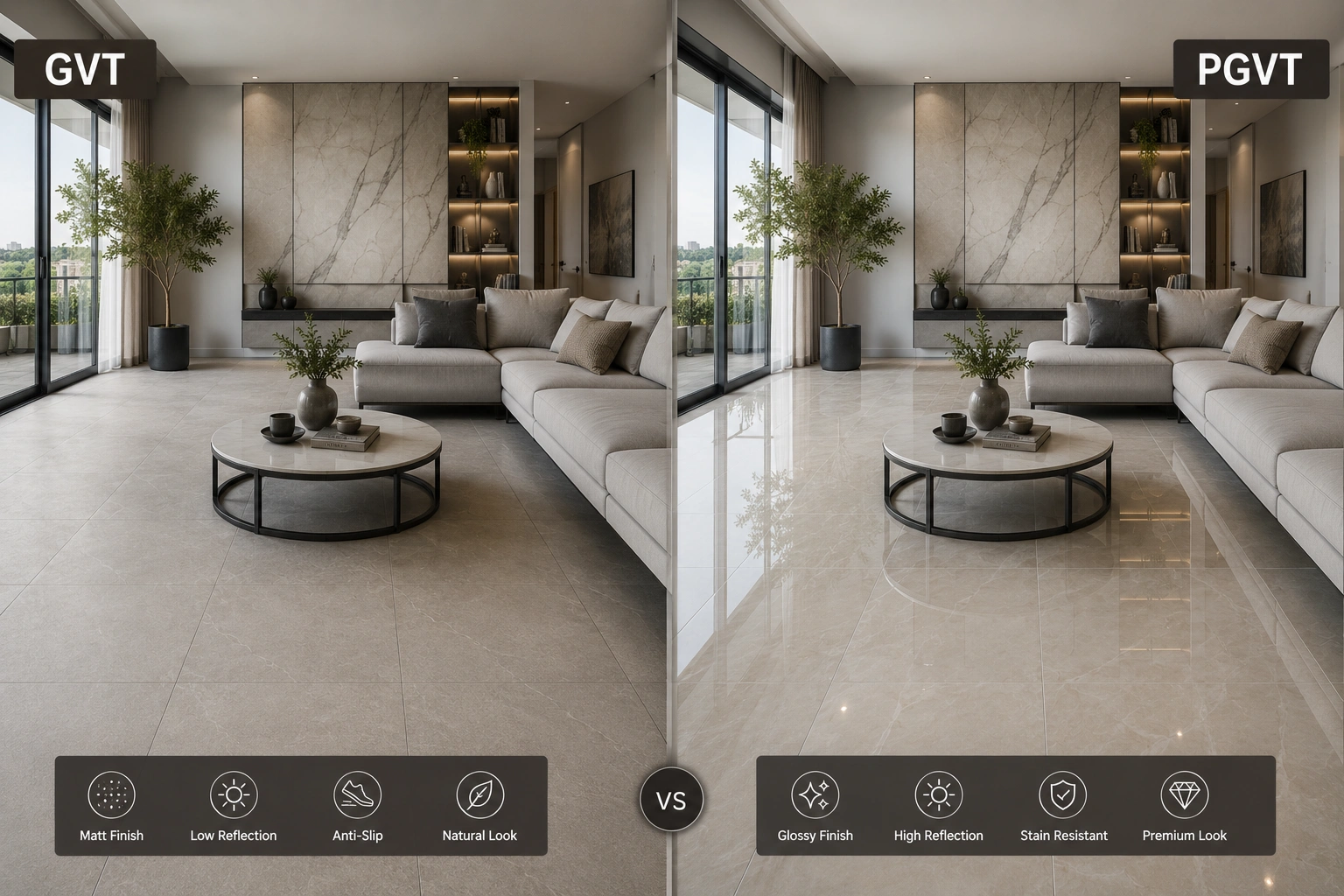
GVT vs PGVT: Side-by-Side Comparison
| Feature | GVT (Glazed Vitrified Tiles) | PGVT (Polished Glazed Vitrified Tiles) |
| Surface finish | Matte, sugar, satin, rustic, carving | Polished high-gloss only |
| Slip resistance | Good (suitable for wet areas) | Low (not for wet floors) |
| Light reflection | Low to medium | High, mirror-like |
| Scratch visibility | Low (texture hides minor scratches) | Higher (scratches show on gloss) |
| Design flexibility | Wide range of finishes and patterns | Limited to gloss finish |
| Maintenance | Easy, hides dust marks | Frequent wiping to maintain shine |
| Best use | Kitchens, bathrooms, outdoor, commercial | Living rooms, bedrooms, feature walls |
| Available sizes | 400x400 to 800x3000 mm | 600x600 to 1200x2400 mm |
| Price range (approx.) | Rs 60 to Rs 180 per sq. ft. | Rs 70 to Rs 200 per sq. ft. |
Why the Manufacturer Choice Matters for GVT and PGVT
Morbi in Gujarat produces roughly 70% of India's vitrified tile output. Hundreds of factories there make GVT and PGVT tiles using similar raw materials. The quality gap between a Rs 65 tile and a Rs 130 tile from the same district comes down to three things: press tonnage, kiln temperature control, and surface calibration after polishing.
Shade consistency is the biggest practical concern for project buyers. A housing society ordering tiles for 50 flats cannot afford a batch difference visible to the naked eye between floor 2 and floor 8. Only manufacturers with strict batch-coding and controlled production runs can guarantee this. Reputed brands invest in this. Many Morbi mid-tier factories do not.
Rectified edges are the other factor buyers often overlook. A rectified GVT tile is mechanically cut after firing to precise dimensions. This allows thin grout joints of 1.5 to 2 mm and a cleaner finished floor. Non-rectified tiles need 3 to 4 mm grout lines. Ask your dealer specifically which you are getting.
Top 10 GVT and PGVT Tiles Manufacturers in India
1. Kajaria Ceramics
Kajaria is India's largest tile manufacturer by production volume, with over 90 million sq. metres of annual output across nine plants. Their GVT and PGVT catalogue covers more than 2,100 designs, from large-format marble-look slabs to wood-finish planks. Kajaria's investment in automated production means shade consistency is tighter than most Morbi-only manufacturers.
Best for: Large residential projects, housing societies, buyers who need pan-India replacement stock.
GVT/PGVT price range: Rs 65 to Rs 300 per sq. ft.
2. Somany Ceramics
Founded in 1969, Somany exports to over 60 countries, meaning their tile body strength and glaze quality meet international specifications. Their VC Shield technology adds an additional scratch and stain-resistant layer on top of their GVT surface, which is useful in homes with pets and children. Somany's glazed vitrified range in 2x4 and 2x2 sizes covers most residential flooring requirements.
Best for: Urban homeowners, buyers who want scratch-protection on GVT floors, healthcare projects.
GVT/PGVT price range: Rs 60 to Rs 280 per sq. ft.
3. Simpolo Ceramics
Simpolo, based in Morbi, has built strong recognition among architects and interior designers for their PGVT slabs and high-detail digital printing. Their Posh and Stucco finish GVT tiles have become popular in minimalist apartment interiors across Ahmedabad and Bangalore. Their rectified-edge tiles in 32x48 and 32x64 sizes are regularly specified for hotel lobbies and premium 4BHK apartments.
Best for: High-end residential, hospitality, interior designers, large-format PGVT flooring.
GVT/PGVT price range: Rs 80 to Rs 220 per sq. ft.
4. Asian Granito India (AGL)
AGL is one of the fastest-growing tile companies in India, positioning strongly in large-format glazed vitrified tiles and full-body slabs. Their export footprint signals tight production controls. For architects working on luxury projects, AGL's marble-look full-body tiles give a clean cut edge even when the tile is trimmed, because the colour and pattern run through the body, not just the glaze layer.
Best for: Luxury residential, commercial spaces, architects, export-quality sourcing.
GVT/PGVT price range: Rs 75 to Rs 200 per sq. ft.
5. Orient Bell
Orient Bell was among the first Indian tile manufacturers to invest in digital tile printing, and their mid-market GVT range shows that experience. Their catalogue covers a wide band from Rs 55 to Rs 180 per sq. ft., which suits renovation projects in 2BHK and 3BHK apartments. Their tile visualiser tool lets homeowners preview patterns in their actual room dimensions before ordering.
Best for: Mid-market renovation, tier-2 city buyers, buyers who want design preview tools.
GVT/PGVT price range: Rs 55 to Rs 180 per sq. ft.
6. Varmora Granito
Varmora, headquartered in Morbi, is known for marble-look and stone-look GVT tiles at prices that work for mid-market Indian homes and builder projects. With over 700 dealers across the country, they are easy to source in Gujarat, Rajasthan, and Madhya Pradesh. Their glazed vitrified range in 2x2 and 2x4 sizes is the default choice for many housing developers in these regions.
Best for: Builder projects, budget-conscious buyers, tier-2 and tier-3 city markets.
GVT/PGVT price range: Rs 44 to Rs 200 per sq. ft.
7. H&R Johnson (Johnson Tiles)
Johnson has operated in India since 1958 and remains the go-to brand for institutional and heavy-traffic projects. Their GVT range is reliable for commercial floor applications. For residential buyers, Johnson's tiles may not carry the widest design palette, but their batch consistency and after-sales support have earned them long-term loyalty among project contractors and facility managers.
Best for: Commercial flooring, institutions, bulk project contractors, heavy-traffic applications.
GVT/PGVT price range: Rs 60 to Rs 200 per sq. ft.
8. Nitco Tiles
NITCO has operated since 1956 and carries a distinctly design-focused identity. They introduced terrazzo-look tiles to the Indian market and have maintained a premium showroom network in Mumbai, Delhi, and Hyderabad. Their PGVT range in large format targets design-conscious buyers who want a tile that stands apart from the standard marble-pattern options flooding the mid-market.
Best for: Design-forward buyers in metros, premium residential, buyers looking for unique PGVT patterns.
GVT/PGVT price range: Rs 90 to Rs 300 per sq. ft.
9. RAK Ceramics India
RAK is a UAE-headquartered global ceramics manufacturer with a strong India operation. Their rectified GVT and PGVT tiles are specified regularly in 5-star hotel projects and luxury gated communities in Mumbai and Bangalore. RAK's production quality meets international grading standards, which means tighter dimensional tolerances and surface flatness than most domestic Morbi manufacturers.
Best for: Luxury hospitality, premium residential projects, architects specifying international-grade tile.
GVT/PGVT price range: Rs 120 to Rs 400+ per sq. ft.
10. Marbonite (Saint-Gobain)
Marbonite, part of the Saint-Gobain group, produces vitrified tiles with a strong focus on tile body strength and surface durability. Their GVT range is positioned in the upper-mid segment, and the backing of a multinational group gives buyers confidence on after-sales support and product consistency. Marbonite is a solid option for corporate offices and premium housing projects in metros.
Best for: Corporate offices, premium housing, buyers who want multinational-backed product consistency.
GVT/PGVT price range: Rs 80 to Rs 200 per sq. ft.
Quick Reference: GVT and PGVT Manufacturer Comparison 2026
| Brand | Base City | GVT Range | PGVT Range | Approx. Price (sq. ft.) |
| Kajaria Ceramics | Delhi NCR | Yes | Yes | Rs 65 to Rs 300 |
| Somany Ceramics | Kolkata / Delhi | Yes | Yes | Rs 60 to Rs 280 |
| Simpolo Ceramics | Morbi | Yes | Yes | Rs 80 to Rs 220 |
| Asian Granito (AGL) | Ahmedabad | Yes | Yes | Rs 75 to Rs 200 |
| Orient Bell | New Delhi | Yes | Yes | Rs 55 to Rs 180 |
| Varmora Granito | Morbi | Yes | Yes | Rs 44 to Rs 200 |
| H&R Johnson | Mumbai | Yes | Yes | Rs 60 to Rs 200 |
| Nitco Tiles | Mumbai | Yes | Yes | Rs 90 to Rs 300 |
| RAK Ceramics India | Multiple | Yes | Yes | Rs 120 to Rs 400+ |
| Marbonite (Saint-Gobain) | Multiple | Yes | Yes | Rs 80 to Rs 200 |
Prices are approximate 2026 market rates and vary by size, finish, dealer location, and order volume.
GVT and PGVT Tile Sizes: What Works Where
Choosing the right tile size for your space is as important as choosing the right finish. A 2x2 tile in a 12x12 bathroom floor creates a busy look with more grout lines. A 2x4 tile in the same space opens the room visually and makes cleaning easier.
| Size (mm) | Common Name | GVT OK? | PGVT OK? | Best Application |
| 600x600 | 2x2 / 24x24 | Yes | Yes | Bedrooms, dining areas, feature walls |
| 600x1200 | 2x4 | Yes | Yes | Living rooms, large kitchens, commercial floors |
| 800x1200 | 32x48 | Yes | Yes | Hotel lobbies, large format flooring |
| 800x1600 | 32x64 | Yes | Yes | Premium residential floors, showrooms |
| 1200x1800 | 6x4 slab | Yes | Yes | Feature walls, countertops, premium projects |
| 1200x2400 | 8x4 slab | Yes | Yes | Commercial wall cladding, large floors |
| 200x1200 | 8x48 plank | Yes | No | Wood-look floor planks, balconies |
What to Check Before Choosing a GVT or PGVT Manufacturer
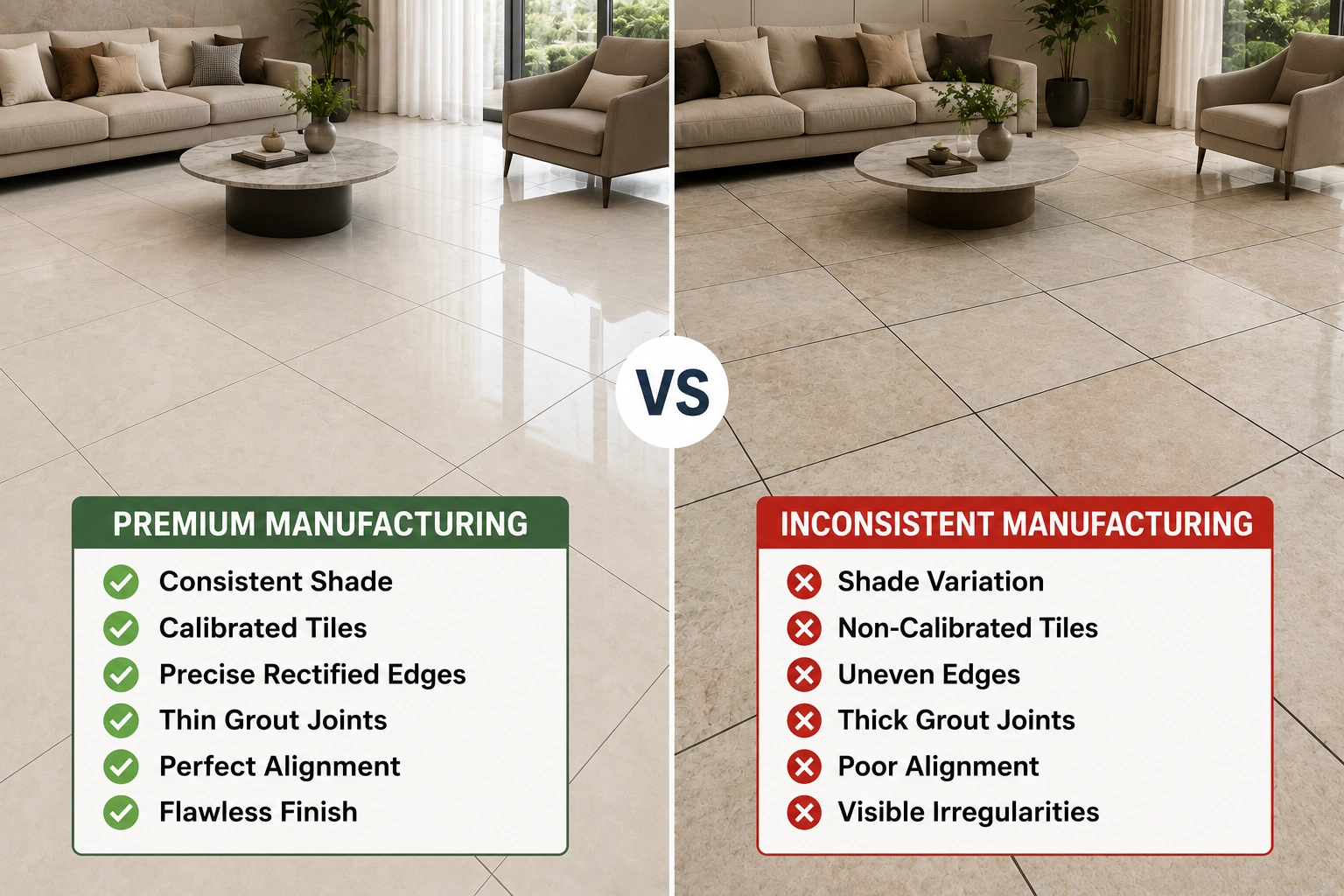
1. Batch code on the box: Always note the batch number printed on each carton. If you reorder later, matching batch codes is the only way to avoid visible shade differences between sections of the same floor.
2. Rectified vs non-rectified edges: Rectified tiles allow thin grout joints of 1.5 to 2 mm and a cleaner floor. Non-rectified tiles need 3 to 4 mm grout. Confirm this before ordering.
3. Finish suitability for the space: PGVT polished finish is not suitable for wet bathroom floors, outdoor areas, or high-traffic commercial spaces. Use matte or Rain Drops finish GVT for those applications.
4. PEI rating for floor tiles: PEI 3 for residential floors, PEI 4 for commercial, PEI 5 for heavy-traffic public spaces like airports and malls.
5. Water absorption certificate: GVT and PGVT tiles should show water absorption below 0.05%. Ask for the BIS test certificate, especially for outdoor and wet area applications.
6. Order 10% buffer: Always buy 10% more than your measured area. Cutting waste, breakage during laying, and future replacements all draw from this buffer.
Common Mistakes When Buying GVT and PGVT Tiles
Using PGVT on bathroom floors: The polished gloss surface becomes slippery when wet and stays that way. Use matte-finish GVT or Rain Drops finish tiles on bathroom floors. PGVT works well on bathroom walls.
Confusing GVT with porcelain: GVT and PGVT tiles have a vitrified body, not a porcelain body. Porcelain has 2 to 5% water absorption, while vitrified GVT is below 0.05%. These are different categories. Do not let dealers use the terms interchangeably.
Skipping the technical data sheet: Every credible manufacturer provides a data sheet with water absorption rate, breaking strength, PEI rating, and slip rating. If a brand cannot produce one, that is a warning sign.
Judging tiles only in showroom lighting: Showroom spotlights make glossy tiles look spectacular. Take a sample home and check it under tubelight and daylight before confirming the order.
Not confirming lead time before ordering: Peak construction season (October to February) sees extended lead times from Morbi manufacturers. Confirm dispatch schedules before placing large orders.
Finding the Right GVT or PGVT Tile for Your Project
The right tile brand depends on your project size, the room application, your finish preference, and whether you need pan-India dealer support for replacements. Kajaria and Somany cover most residential needs with wide design ranges and strong distribution. Simpolo and AGL are strong picks for large-format PGVT and premium project requirements. Varmora and Orient Bell offer solid glazed vitrified tiles at prices that work for mid-market homes and builder projects.
Before placing any order, take a tile sample home, check it under your actual lighting, confirm the batch code, and ask for the technical data sheet. A few hours of checking upfront saves a lot of cost and frustration after installation.
You can compare GVT and PGVT tile designs, sizes, and finishes from Indian manufacturers on TilesFinders, where dealers list verified products with full specifications. It is a practical starting point for homeowners, contractors, and B2B buyers who want to shortlist options before visiting a showroom.

FAQs
GVT stands for Glazed Vitrified Tiles. PGVT stands for Polished Glazed Vitrified Tiles. Both have a vitrified body with water absorption below 0.05%. PGVT goes through an additional mechanical polishing step after glazing, which produces its high-gloss, mirror-like surface.
It depends on the room and how much maintenance you are willing to do. GVT is better for kitchens, bathrooms, balconies, and high-traffic areas because it offers better slip resistance and hides dust and minor scratches. PGVT is better for living rooms and bedrooms where the glossy finish adds visual brightness and the floor does not face heavy water exposure.
Yes, GVT tiles in matte, GHR (Glaze High Resistance), or Rain Drops finishes are suitable for outdoor applications, balconies, and terrace flooring. PGVT tiles should not be used outdoors because the polished surface is slippery when wet and the high-gloss finish fades under direct sunlight.
GVT tiles from branded manufacturers range from approximately Rs 60 to Rs 300 per sq. ft. depending on the brand, size, and finish. PGVT tiles start around Rs 70 and go up to Rs 200 or higher for large-format slab sizes. Morbi-sourced tiles from mid-tier manufacturers start lower, around Rs 40 to Rs 50 per sq. ft. All prices are approximate and vary by city and order volume.
GVT tiles are available in a wide size range: 400x400 mm (16x16), 500x500 mm (20x20), 600x600 mm (2x2), 600x1200 mm (2x4), 800x1200 mm (32x48), 800x1600 mm (32x64), 1200x1800 mm (6x4), 1200x2400 mm (8x4), and 200x1200 mm wood-plank format. PGVT tiles are available from 600x600 mm up to 1200x2400 mm.
Check the batch code printed on the side of each carton. Tiles from the same batch code will match. When placing a large order, ask the dealer to pull stock from the same production run. If you need to top up after installation, always share the batch code when reordering, not just the tile name or size.

See our tile guides first
Set TilesFinders as a preferred source and our buying guides surface ahead of the rest for you.
Add as preferred sourceTakes one tap. Nothing to install.
What Readers Say
I was about to redo my parking area with the wrong tile size until I read this. The layout comparisons saved me from a costly mistake.
We reference TilesFinders guides while briefing clients on material selection. The size and pattern breakdowns are accurate and easy to explain visually.
On site, I get asked about grout spacing all the time. This article gave me a solid reference I now share with my team before every job.
Finally a guide that doesn't just push generic advice. The oil stain removal steps actually worked on our clubhouse driveway tiles.
I run a small construction firm and now send this link to clients directly when they ask about entrance tile sizing. Saves me an hour of explaining.
Good practical detail, though I wish there were more examples for compact apartment entrances specifically, not just villas.
My mother-in-law wanted marble, I wanted vitrified. This blog gave us the neutral comparison we needed to actually decide together.
Detailed without being overwhelming. I appreciated that it covered both cost and maintenance, not just the aesthetics.
Used the algae and hard water removal tips on our terrace tiles after the monsoon. Worked better than what our regular cleaner was doing.
As someone who sources tiles for multiple builder projects, I find these comparisons genuinely useful for vendor conversations, not just consumer content.
Recommended this to a client who kept second-guessing the entrance design. The small vs large layout section settled the debate instantly.
Straightforward and honest, no unnecessary jargon. Would like to see a similar breakdown for outdoor pool-deck tiles next.
We've bookmarked several TilesFinders guides for our design handbook. Reliable source when clients want data, not just opinions.
Two paths, one marketplace.
Get free quotes from verified suppliers.
Share your room, budget, and style. Suppliers in Morbi respond within hours.
Get Free QuotesList your business, reach real buyers.
Put your showroom in front of homeowners searching for tiles right now.
List Your Business