Glossy Carving vs Matte Carving vs Punch Tiles: Which 3D-Texture Finish Suits Indian Feature Walls
Compare glossy carving, matte carving and punch tiles by texture, relief, price and safety to find the right 3D surface for Indian feature walls and selected floor applications.
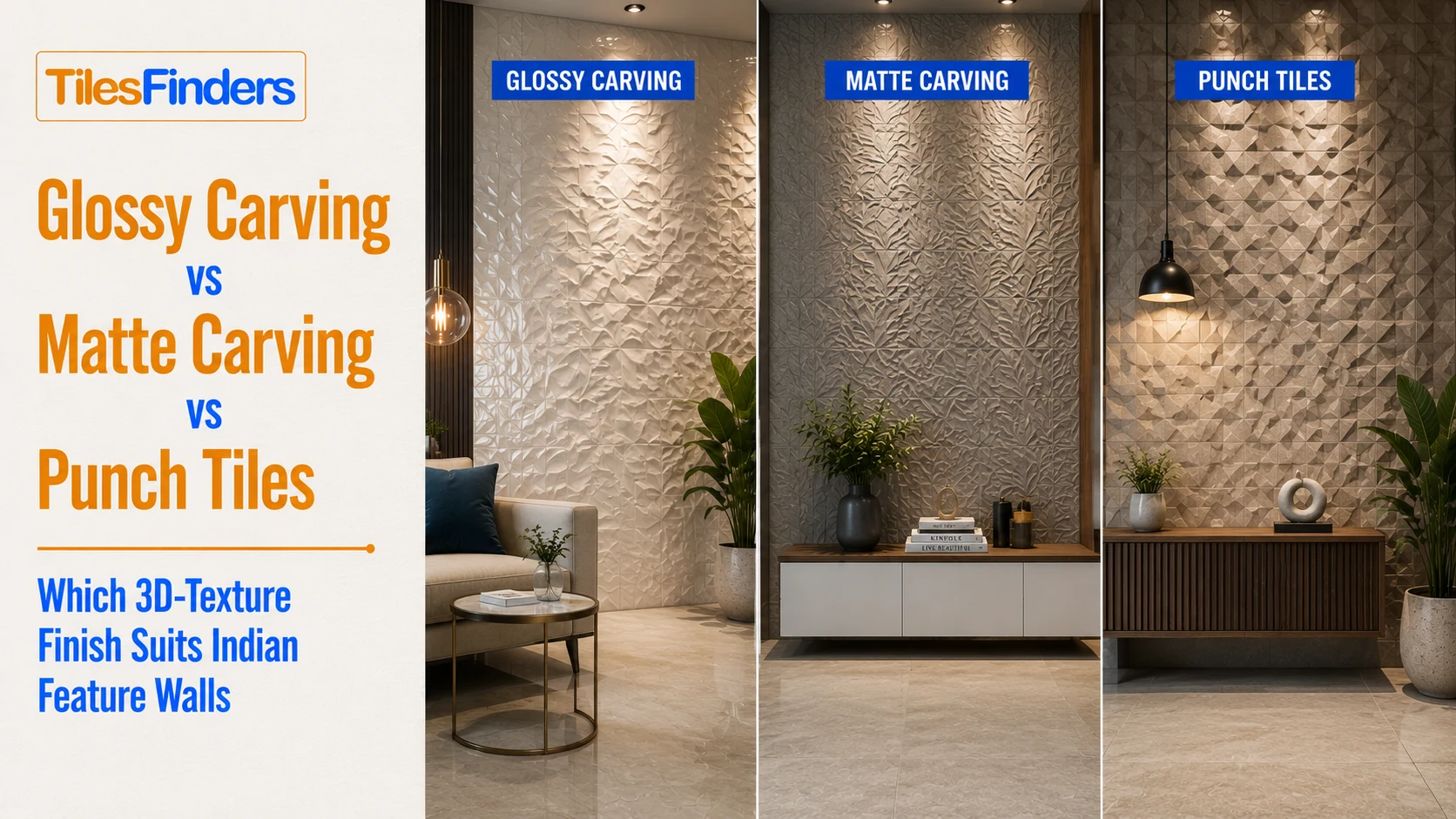
Matte carving delivers deeper sculptural relief, glossy carving adds reflection for maximum drama, while punch tiles offer consistent texture at a more accessible price. For walls, choose based on visual depth and lighting; for floors, verify anti-skid performance and never use glossy carving.
Three genuinely different production methods create three distinct dimensional wall tiles in India: carved cutting, punched stamping, and the glaze finish applied to either. This guide compares glossy carving tiles, matte carving tiles, and punch tiles directly, since the production method behind each creates a meaningfully different visual and tactile character, and a meaningfully different price and floor-safety profile.
The one-line answer: Matte carving tiles for the deepest, most varied relief at moderate maintenance. Glossy carving tiles for maximum shadow-plus-reflection drama on a wall or niche only, never a floor. Punch tiles for a regular, budget-friendly repeating texture that is also the most likely of the three to be usable on a confirmed anti-skid floor.
How Each 3D Texture Tile Is Produced
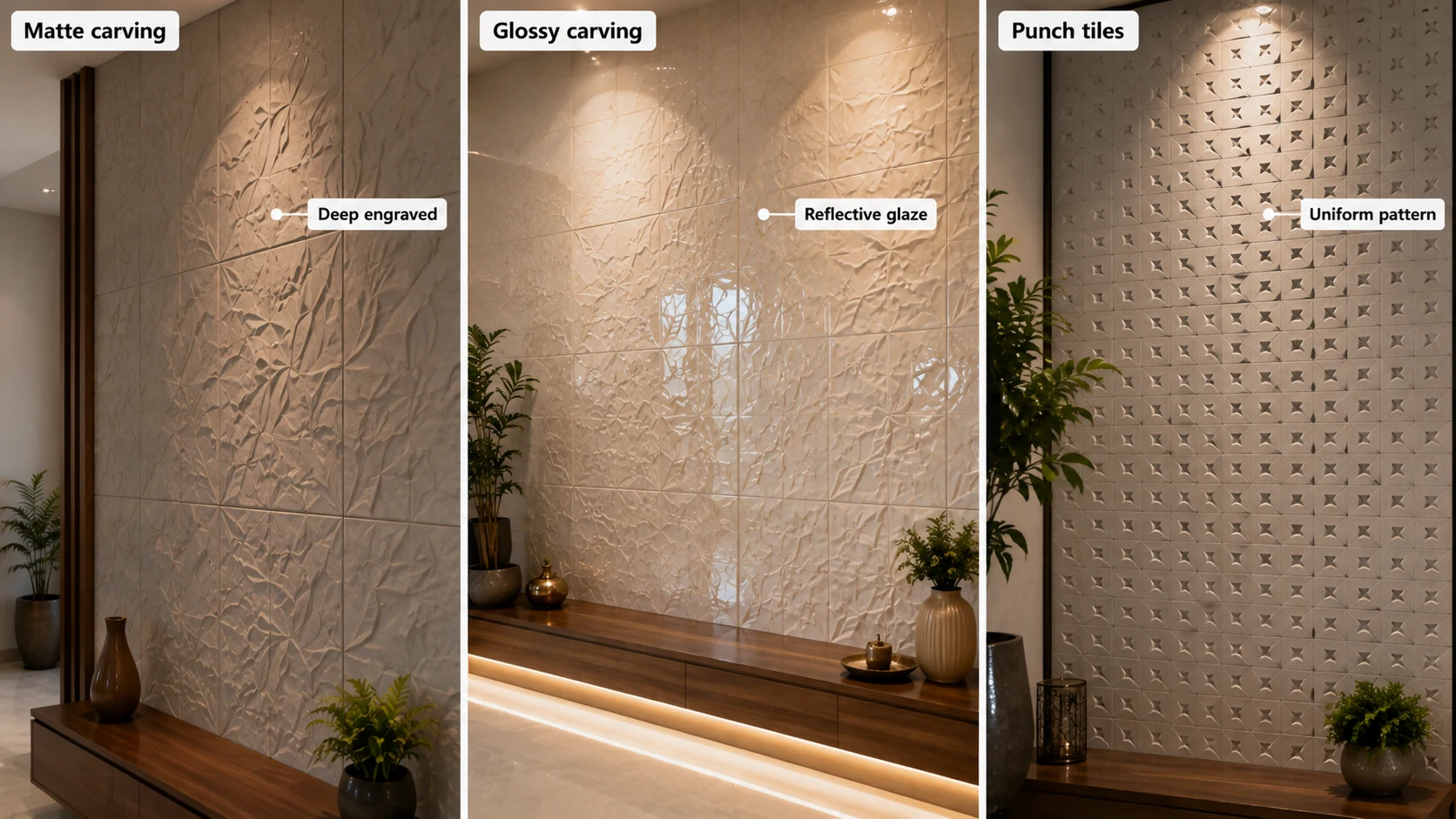
| Category | Production Method | Texture Character |
| Matte carving | Deep engraved or carved cutting into the tile surface, matte finished | Organic or geometric relief with genuine varied depth, absorbing light for shadow definition |
| Glossy carving | The same carved cutting process, finished with a reflective glaze | The same genuine relief, plus light reflection on raised and flat surfaces |
| Punch tiles | A mechanical punch or stamping die creates a uniform, repeating indent or perforation-style pattern. | More mechanical and consistent than carving, typically shallower and more evenly repeated across the surface. |
Carving Tiles vs Punch Tiles: Full Comparison
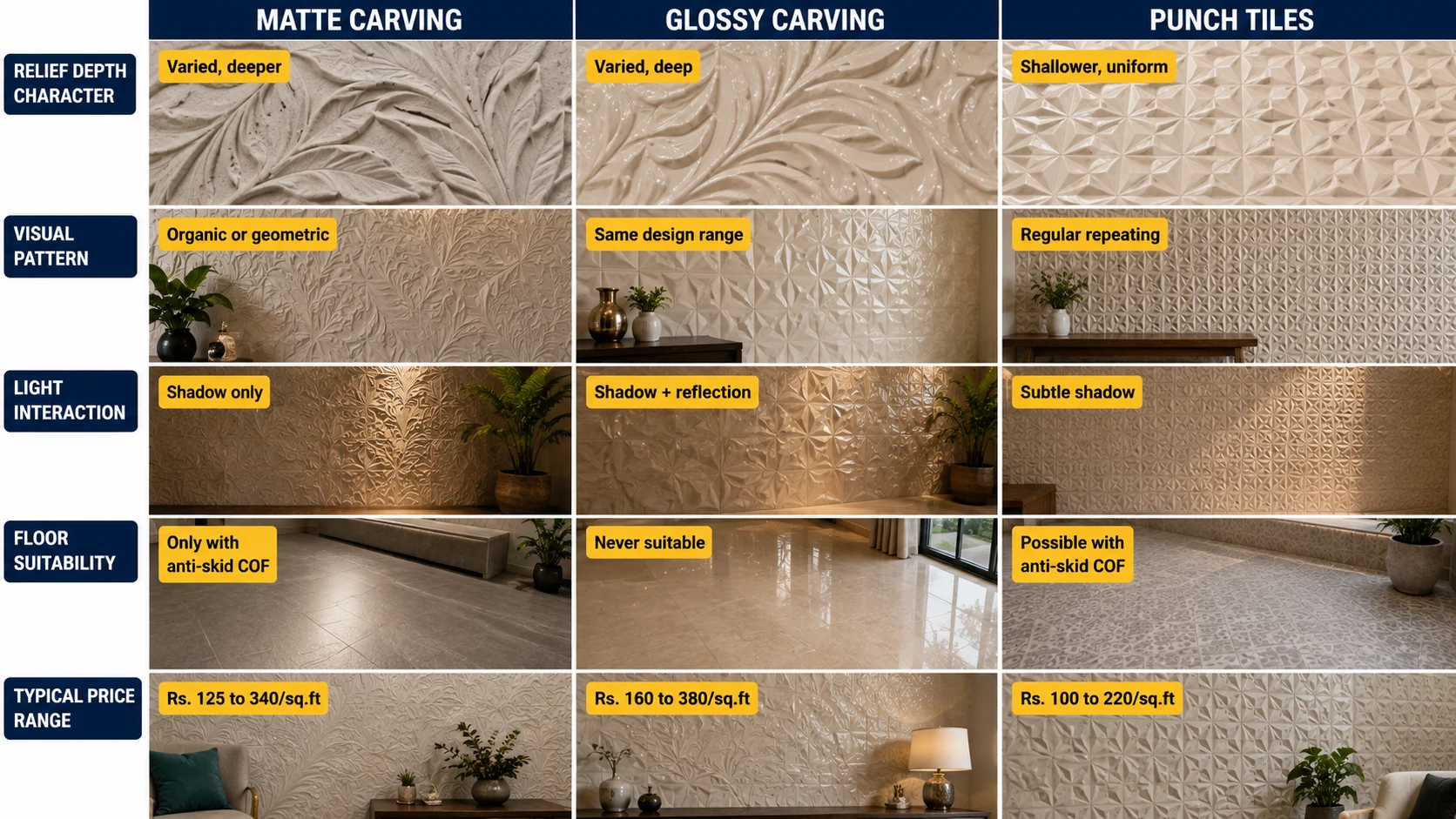
| Factor | Matte Carving | Glossy Carving | Punch Tiles |
| Relief depth character | Varied, often deeper and more organic | Same as matte carving tiles, varied and deep | Typically shallower, uniform, and mechanically consistent |
| Visual pattern | Can be organic or geometric design tiles, often non-repeating | Same design range as matte carving tiles | Almost always a regular, evenly repeating geometric pattern given the stamping process |
| Light interaction | Shadow only | Shadow plus reflection | Shadow only, generally more subtle given shallower relief |
| Floor suitability | Only with confirmed anti-skid COF | Never suitable for floor tiles | Possible with confirmed anti-skid COF; shallower relief may offer more predictable grip than deep carving tiles |
| Typical price range | Rs. 125 to Rs. 340/sq.ft | Rs. 160 to Rs. 380/sq.ft | Rs. 100 to Rs. 220/sq.ft, generally more accessible given the more standardised production process |
Which 3D Wall Tile Design Suits Your Brief
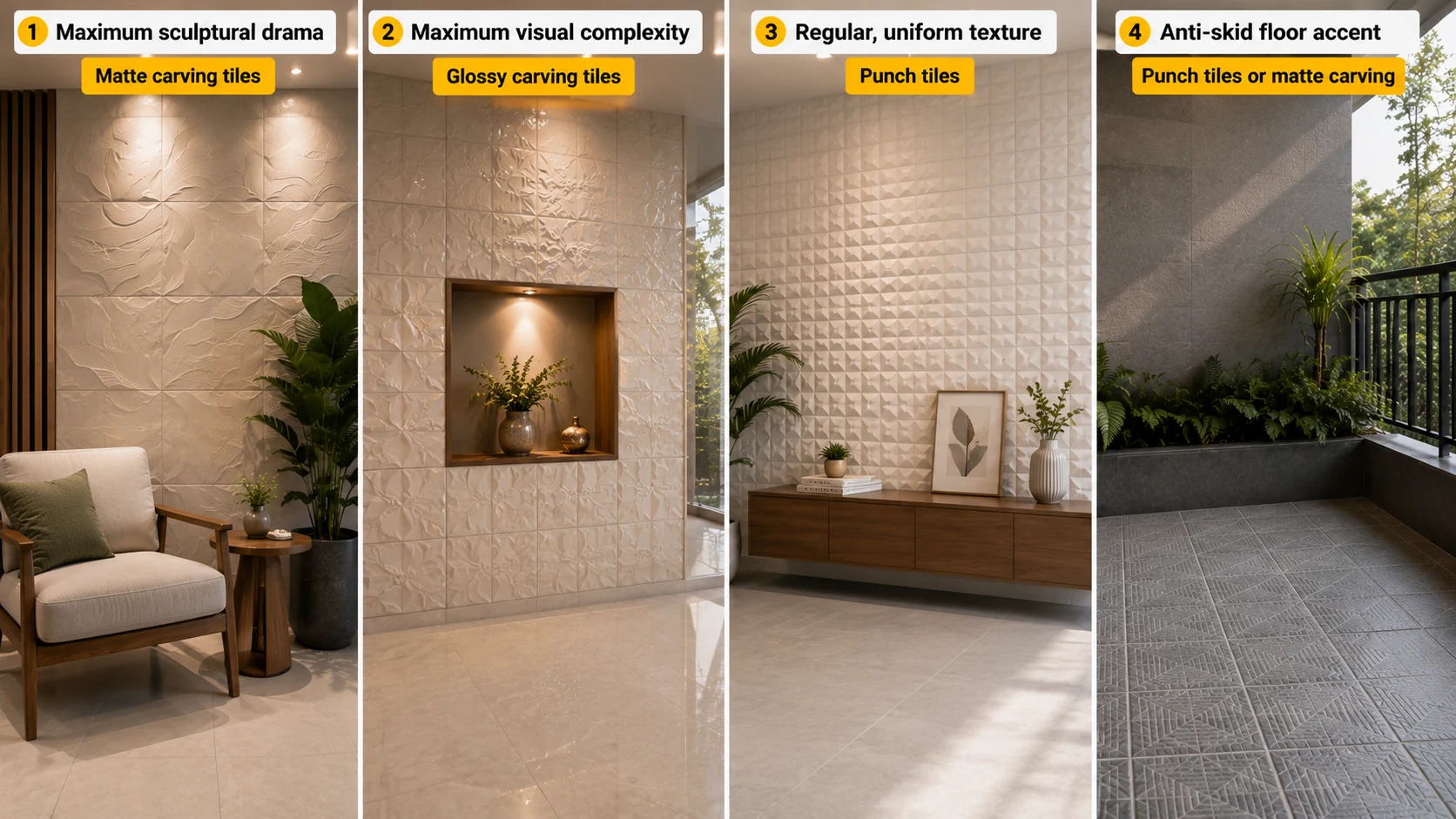
- Maximum organic or bold geometric sculptural drama: matte carving tiles, delivering the deepest and most varied relief available among the three, with lower maintenance demand than glossy.
- Maximum visual complexity, shadow and reflection together: glossy carving tiles, appropriate for a wall or niche wanting the most layered visual statement available in this category.
- A regular, uniform repeating texture at accessible cost: punch tiles, suited to a contemporary brief wanting consistent, predictable pattern rather than organic variation.
- Confirmed anti-skid floor accent: punch tiles or matte carving tiles, both potentially viable with specific product confirmation; never glossy carving tiles under any circumstances.
If you are leaning toward glossy carving, it helps to understand the finish itself before choosing a pattern. Explore Glossy Carving Tiles in India for details on its relief, reflective glaze, pricing, suitable applications, and wall-only use.
Feature Wall Tile Buying Checklist
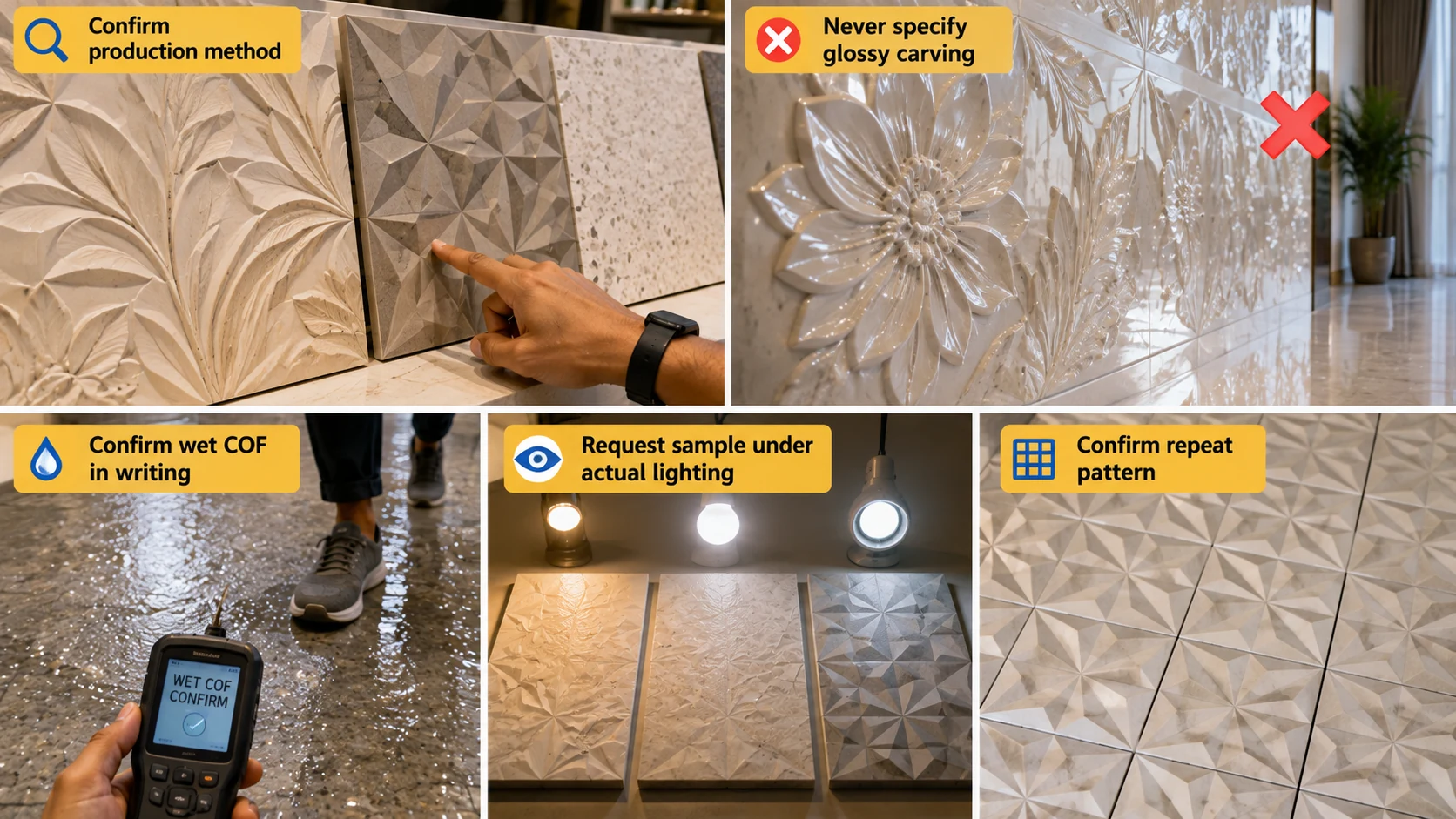
- Confirm which production method a specific product actually uses, since carving tiles and punch tiles create genuinely different textures despite sometimes similar marketing language.
- Never specify glossy carving tiles for any floor, regardless of framing.
- For matte carving tiles or punch tiles intended for floor use, confirm wet COF in writing rather than assuming texture provides safety.
- Request a physical sample under your actual planned lighting for any of the three types, since all perform differently depending on light source and angle.
- Confirm panel or tile repeat pattern before ordering, particularly for punch tiles given their inherently regular, repeating structure.
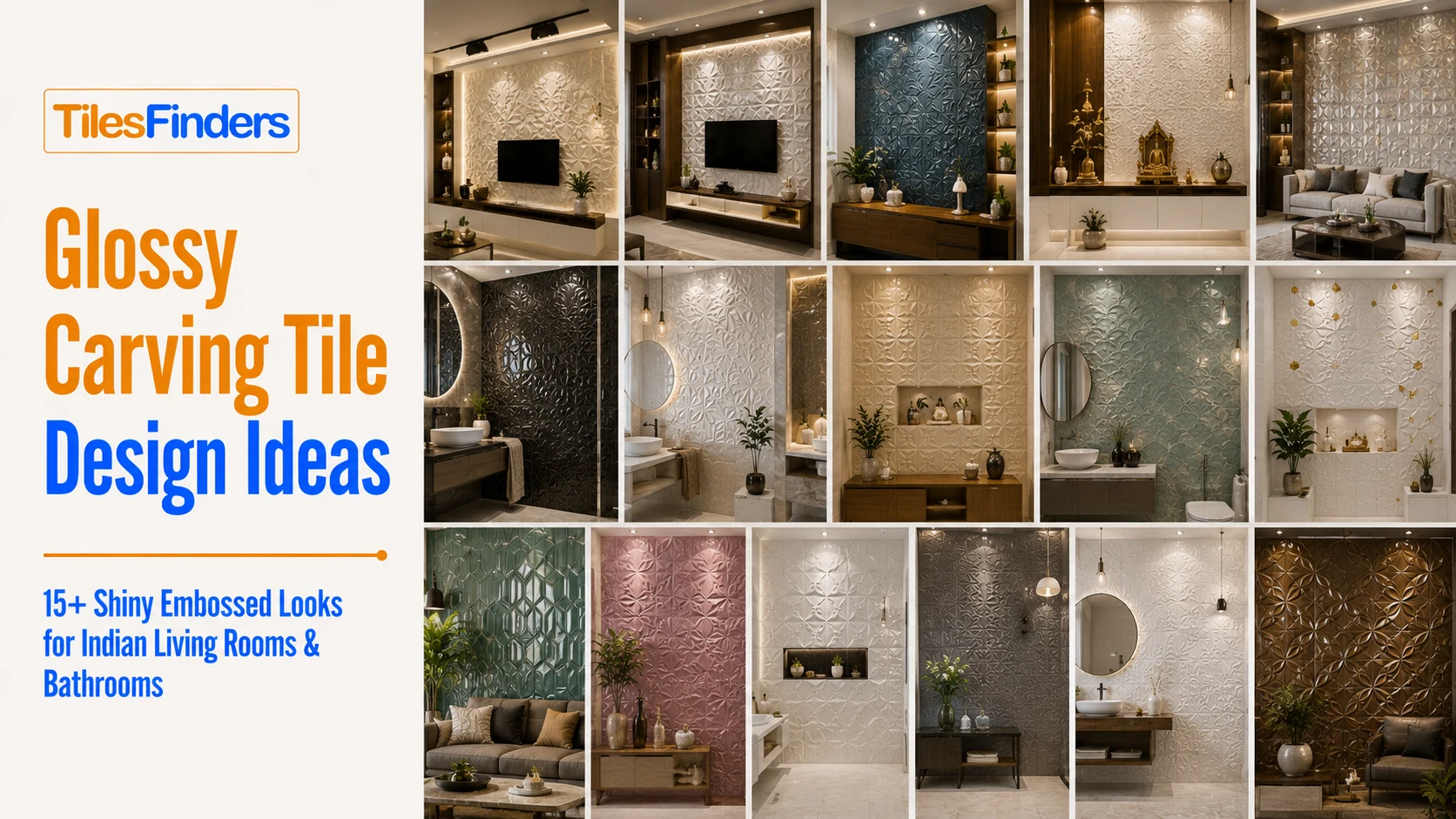
Once you have shortlisted glossy carving, the next step is choosing the right visual direction. Browse Glossy Carving Tile Design Ideas for 15+ geometric, organic, metallic and stone-inspired looks for Indian living rooms and bathrooms.
Textured and Dimensional Wall Tiles in India: 2026 Context
Matte carving tiles and punch tiles both have an established production base across Indian ceramic tile manufacturers, including Morbi, Gujarat, with punch tiles generally more widely available given their more standardised, mechanical production process closer to conventional tile press manufacturing.
Glossy carving tiles remain the most specialist of the three, combining two demanding production steps in a single product with a correspondingly narrower manufacturing base. Buyers comparing all three should independently verify the PEI wear rating and water absorption figure for the specific product line, rather than assuming these properties carry over identically across a manufacturer's full texture range.
Compare All Three Textures on TilesFinders
Matte carving, glossy carving, and punch tiles can be compared by relief character, finish, and price on TilesFinders, with physical samples available to confirm which category best suits your wall or floor project.
FAQs
Carving tiles use a deep engraving or cutting process, creating varied, often organic relief, while punch tiles use a mechanical punch or stamping die, creating a uniform, evenly repeating indent pattern, generally shallower and more geometrically consistent than carving.
Possible with confirmed anti-skid COF for the specific product. Punch tiles' typically shallower, more uniform relief may offer more predictable grip characteristics than deep carving tiles, but this must still be confirmed in writing rather than assumed.
No, never, regardless of relief depth or pattern. Glossy carving tiles carry the same wet-floor slip risk as any glossy tile given the glaze component.
Punch tiles are generally the most accessible, Rs. 100 to Rs. 220 per sq.ft, given their more standardised mechanical production process compared to the more labour- and equipment-intensive carving tile methods.
Matte carving tiles and glossy carving tiles, both offering varied, often deeper relief than punch tiles' typically shallower, more uniform stamped pattern.
Yes, almost always, given the stamping process inherently produces a regular, evenly repeating geometric design tile pattern, distinct from carving's more varied, often non-repeating character.
Punch tiles, whose regular, uniform repeating texture suits a brief wanting a consistent, predictable pattern rather than the more organic or bold variation carving tiles deliver.
Yes, using punch tiles for a larger, more accessible-cost area and reserving carving tiles, matte or glossy, for a smaller, more dramatic accent zone is a practical way to balance budget and visual impact.


See our tile guides first
Set TilesFinders as a preferred source and our buying guides surface ahead of the rest for you.
Add as preferred sourceTakes one tap. Nothing to install.
What Readers Say
I was about to redo my parking area with the wrong tile size until I read this. The layout comparisons saved me from a costly mistake.
We reference TilesFinders guides while briefing clients on material selection. The size and pattern breakdowns are accurate and easy to explain visually.
On site, I get asked about grout spacing all the time. This article gave me a solid reference I now share with my team before every job.
Finally a guide that doesn't just push generic advice. The oil stain removal steps actually worked on our clubhouse driveway tiles.
I run a small construction firm and now send this link to clients directly when they ask about entrance tile sizing. Saves me an hour of explaining.
Good practical detail, though I wish there were more examples for compact apartment entrances specifically, not just villas.
My mother-in-law wanted marble, I wanted vitrified. This blog gave us the neutral comparison we needed to actually decide together.
Detailed without being overwhelming. I appreciated that it covered both cost and maintenance, not just the aesthetics.
Used the algae and hard water removal tips on our terrace tiles after the monsoon. Worked better than what our regular cleaner was doing.
As someone who sources tiles for multiple builder projects, I find these comparisons genuinely useful for vendor conversations, not just consumer content.
Recommended this to a client who kept second-guessing the entrance design. The small vs large layout section settled the debate instantly.
Straightforward and honest, no unnecessary jargon. Would like to see a similar breakdown for outdoor pool-deck tiles next.
We've bookmarked several TilesFinders guides for our design handbook. Reliable source when clients want data, not just opinions.
Two paths, one marketplace.
Get free quotes from verified suppliers.
Share your room, budget, and style. Suppliers in Morbi respond within hours.
Get Free QuotesList your business, reach real buyers.
Put your showroom in front of homeowners searching for tiles right now.
List Your Business