Ceramic vs Porcelain vs Vitrified vs Natural Stone Tiles: The Complete Comparison
Stop confusing international specs with Indian reality! Learn why porcelain sits below vitrified tiles in India, map real water absorption stats, and pick the right layout material.
- The Correct Hierarchy in the Indian Market
- Why Porcelain Means Something Different in India
- Quick Definitions
- The Complete Comparison Table
- Which Wins Where: A Use-Case Breakdown
- A Word on PGVT and Wet Floors
- Cost, Maintenance, and Lifespan Compared
- Common Misconceptions Worth Correcting
- Comparing the Right Sub-Type, Not Just the Category
In the Indian market, ceramic has the highest water absorption (12-16%), porcelain sits in the middle (2-6%), and vitrified, covering PGVT, GVT, Double Charge, Full Body, and Nano, is the densest at around 0.05% under IS 15622. Natural stone varies by stone type and needs periodic sealing the other three do not.
Search "vitrified vs porcelain tiles", and you'll find plenty of confident-sounding claims that porcelain is the denser, lower-absorption option, based on how the word is used internationally. In the Indian market specifically, that's backwards. Here, porcelain is a distinct semi-vitrified category with 2% to 6% water absorption, sitting between ceramic and vitrified, while vitrified tiles, PGVT, GVT, Double Charge, Full Body, and Nano, are the ones that hit the near-zero absorption most people associate with premium porcelain elsewhere in the world.
This guide lays out the correct Indian-market hierarchy first, explains why the international and Indian definitions diverge, and then works through a complete practical comparison of all four tile materials, so you can specify with confidence rather than a guess informed by a generic international article.
The Correct Hierarchy in the Indian Market
-743b585f-36de-46ca-a298-3931ff53f710.webp)
This is the table to bookmark. It reflects how the Indian tile industry, and the standards it manufactures against, actually classifies these four materials.
| Category | Water Absorption | Density | Indian Standard |
| Ceramic | 12% to 16% | Lowest, most porous | IS 13630 |
| Porcelain (Indian market) | 2% to 6% | Medium, semi-vitrified | No single dedicated BIS code; treated as a commercial mid-tier category |
| Vitrified (PGVT/GVT/Double Charge/Full Body/Nano) | Around 0.05% | Highest, near-zero porosity | IS 15622 |
| Natural stone | 0.2% to 1%, varies by stone | Varies widely by stone type | Not applicable, quarried material |
Why Porcelain Means Something Different in India
Internationally, porcelain is frequently used as the broad, catch-all term for any fully vitrified, low-absorption tile; there often isn't a separate international category called "vitrified" the way India uses the term. The Indian tile industry drew the line differently: it created vitrified as the name for the densest tiles, PGVT, GVT, Double Charge, Full Body, and Nano, all manufactured to hit roughly 0.05% water absorption under IS 15622, and kept porcelain as a distinct, less dense, semi-vitrified category with 2% to 6% absorption instead.
Neither convention is wrong on its own terms, but comparing an article written for an international audience against Indian retail listings, without knowing this split exists, is exactly how the confusion spreads. The practical fix: when shopping in India, treat vitrified as the premium, lowest-absorption tier, and porcelain as a genuinely useful but distinctly mid-tier option, not a synonym for vitrified and not automatically superior to it.
Quick Definitions
Ceramic Tiles
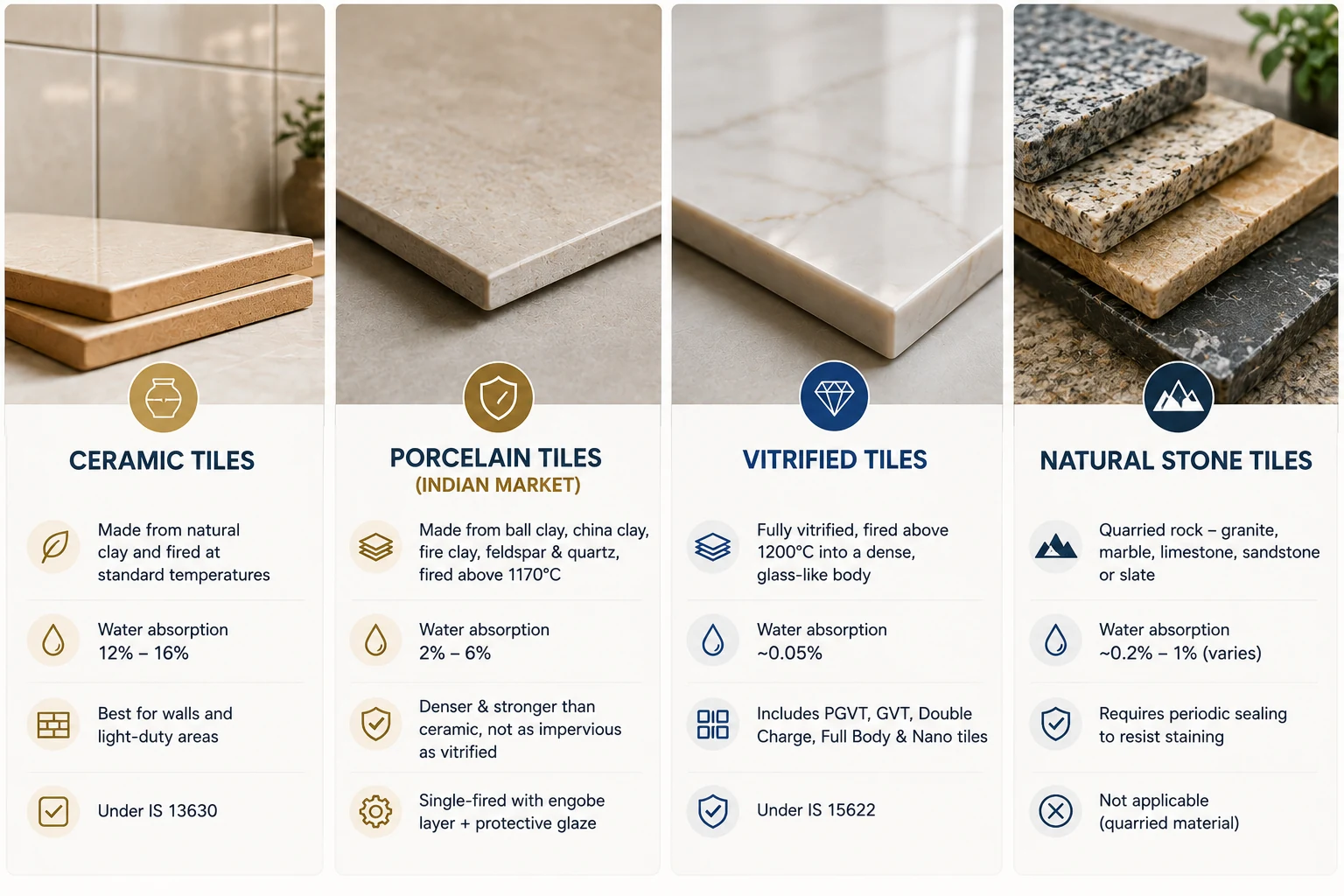
Made from natural clay and fired at standard kiln temperatures, almost always with a glazed surface. Water absorption runs 12% to 16% under IS 13630, which is why ceramic tile is the standard choice for walls and light-duty areas rather than heavy-traffic or wet flooring.
Porcelain Tiles (Indian Market)
Made from a blend of ball clay, china clay, fire clay, feldspar, and quartz, fired above 1170°C into a semi-vitrified body. Water absorption sits at 2% to 6%, denser and stronger than ceramic but not as impervious as vitrified. Indian porcelain tiles are typically single-fired, with body and glaze bonded in one high-temperature cycle, and rely on an engobe layer plus a protective glaze coat for their moisture resistance.
Vitrified Tiles
India's category for tiles that have undergone full vitrification, fired above 1200°C using clay, silica, quartz, and feldspar until the body fuses into a dense, glass-like, near-zero-porosity structure, with roughly 0.05% water absorption under IS 15622. This category covers several sub-types: PGVT tiles (polished, glossy, glazed before firing then polished after), GVT tiles (glazed but not polished, more slip-resistant), Double Charge tiles (colour pressed 3- 4 mm deep for high scratch resistance), Full Body tiles (colour runs through the entire tile), and Nano tiles(budget soluble-salt tiles in ivory and beige tones).
Natural Stone Tiles
Quarried rock, granite, marble, limestone, sandstone, or slate, cut into tile-format pieces rather than manufactured. Water absorption varies enormously by stone type, roughly 0.2% to 1%, and most varieties need periodic sealing to resist staining, an upkeep requirement none of the three manufactured categories shares.
The Complete Comparison Table
| Property | Ceramic | Porcelain (Indian market) | Vitrified | Natural Stone |
| Water absorption | 12% to 16% | 2% to 6% | Around 0.05% | 0.2% to 1%, varies |
| Raw material | Natural clay, glazed | Ball clay, china clay, fire clay, feldspar, quartz | Clay, silica, quartz, feldspar | Quarried rock, no manufacturing |
| Firing temperature | Lower, standard kiln firing | Above 1170°C | Above 1200°C | None, natural formation |
| Typical construction | Glazed surface on clay body | Semi-vitrified body, engobe plus glaze layers | Full vitrification, glass-like body | N/A, natural stone slab or tile-cut piece |
| Best for | Walls, light-traffic areas | Bathrooms, balconies, kitchens, moderate-traffic floors | General flooring, wet areas, most Indian homes | Premium flooring, elevation, accents |
| Price band (per sq ft) | Rs. 15 to Rs. 60 | Rs. 35 to Rs. 90 (market estimate) | Rs. 25 to Rs. 250 | Rs. 80 to Rs. 500+ |
| Maintenance | Low to moderate | Low | Low, easy wipe-clean | Moderate to high, periodic sealing |
Porcelain pricing is a general market estimate; TilesFinders' own product pages do not publish a fixed price band for this category the way they do for vitrified. Always confirm current pricing and technical data with the specific supplier.
Which Wins Where: A Use-Case Breakdown
The "best" material genuinely depends on the application, and within vitrified specifically, the right sub-type (PGVT, GVT, Double Charge, Full Body) matters as much as the broad category.
| Application | Best Choice | Why |
| Bathroom floor | Vitrified (GVT matte, Full Body, or GHR finish) | Near-zero water absorption plus anti-skid finish options; PGVT polished is not recommended here |
| Bathroom walls | Porcelain or PGVT vitrified | Both perform well; porcelain's moderate porosity is fine for walls, PGVT adds a glossy, spacious look |
| Kitchen backsplash | Ceramic or porcelain | Ceramic for budget, porcelain for better stain and heat resistance near the hob |
| Kitchen floor | Vitrified, matte or GHR finish | Matte finishes resist cooking-oil spills better than polished options |
| Living room floor | Vitrified (Double Charge or GVT) | Handles daily foot traffic and cleans easily; large formats reduce grout lines |
| Balcony/outdoor | GVT vitrified with anti-skid finish, or porcelain with textured finish | Both are rated for monsoon and sun exposure when the right finish is chosen; avoid PGVT polished outdoors |
| Heritage/luxury elevation | Natural stone (granite, marble) | Unique veining and texture no manufactured tile fully replicates |
| Commercial high-traffic floor | Double Charge or Full Body vitrified | Highest scratch resistance and lowest absorption for sustained heavy footfall |
A Word on PGVT and Wet Floors
One constraint worth calling out on its own: PGVT (Polished Glazed Vitrified Tiles), despite being part of the low-absorption vitrified category, should not be used on wet-area floors or outdoor flooring. The polished, high-gloss surface that makes PGVT desirable for dry living room floors and bathroom walls becomes genuinely slippery when wet. For bathroom and balcony floors, GVT matte, Full Body, or GHR-finish vitrified tiles are the safer choice, with low absorption without the slip risk.
Cost, Maintenance, and Lifespan Compared
Cost
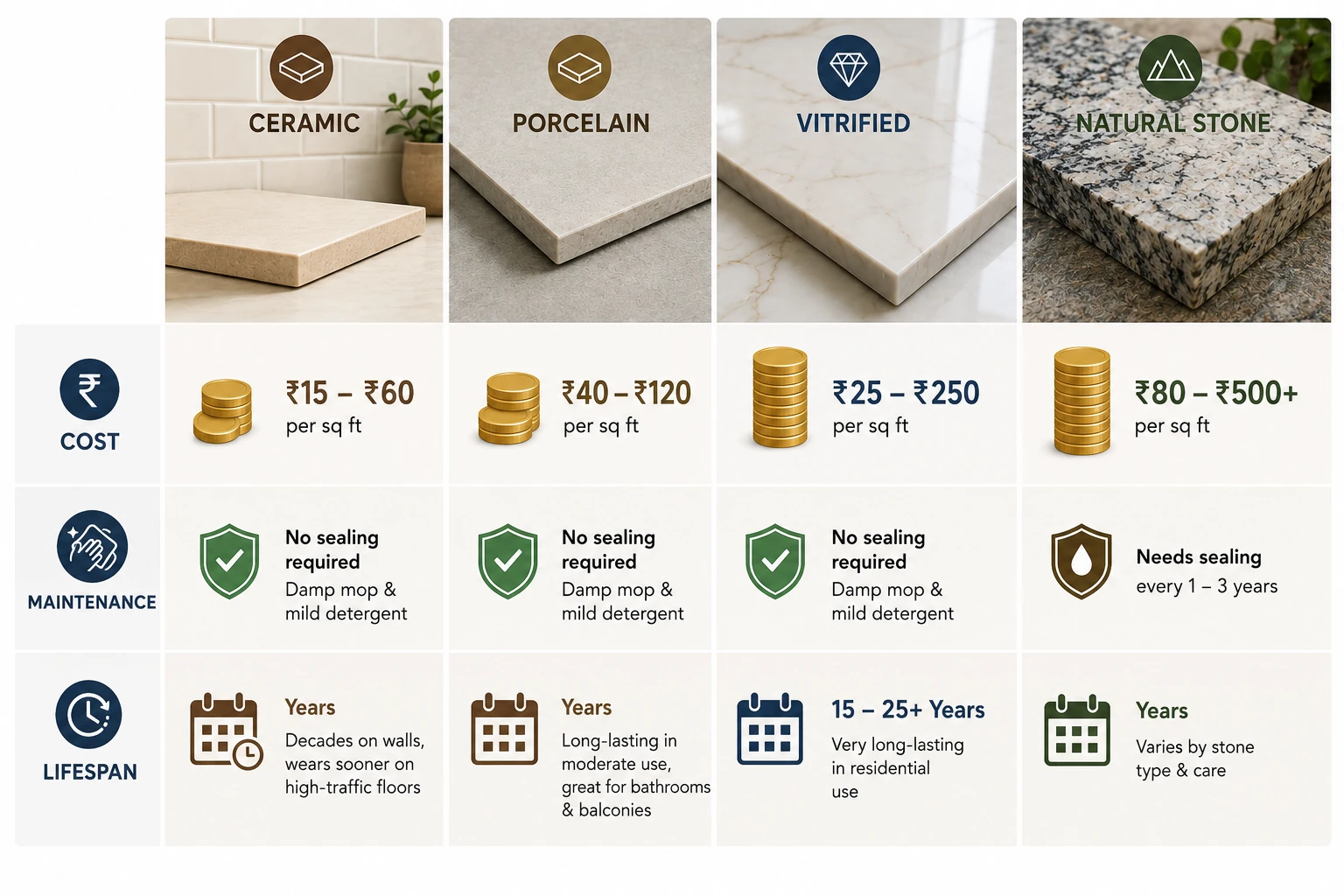
Ceramic sits at the most accessible end, roughly Rs. 15 to Rs. 60 per square foot, making it the natural choice for budget-conscious wall projects. Vitrified spans the widest range of all, Rs. 25 to Rs. 250 per square foot, since it covers everything from budget Nano tiles to premium large-format PGVT slabs. Porcelain generally falls in a middle band. Natural stone has the widest ceiling, from common local stone up to Rs. 500 or more per square foot for imported marble and granite varieties.
Maintenance
Ceramic, porcelain, and vitrified all share a genuine advantage over natural stone: none of them requires sealing. A damp mop and mild detergent keep all three looking fresh. Natural stone is the outlier; most varieties need sealing every one to three years to maintain stain and moisture resistance.
Lifespan
Well-installed vitrified tiles commonly last 15 to 25 years or longer in residential use. Porcelain, being a genuine step up from ceramic in density and strength, also holds up well over years of moderate use, particularly in bathrooms and balconies. Ceramic's lifespan depends heavily on application; ceramic walls can last decades, but ceramic used on a demanding floor will show wear considerably sooner than porcelain or vitrified in the same spot.
Common Misconceptions Worth Correcting
"Porcelain is the premium option above vitrified"
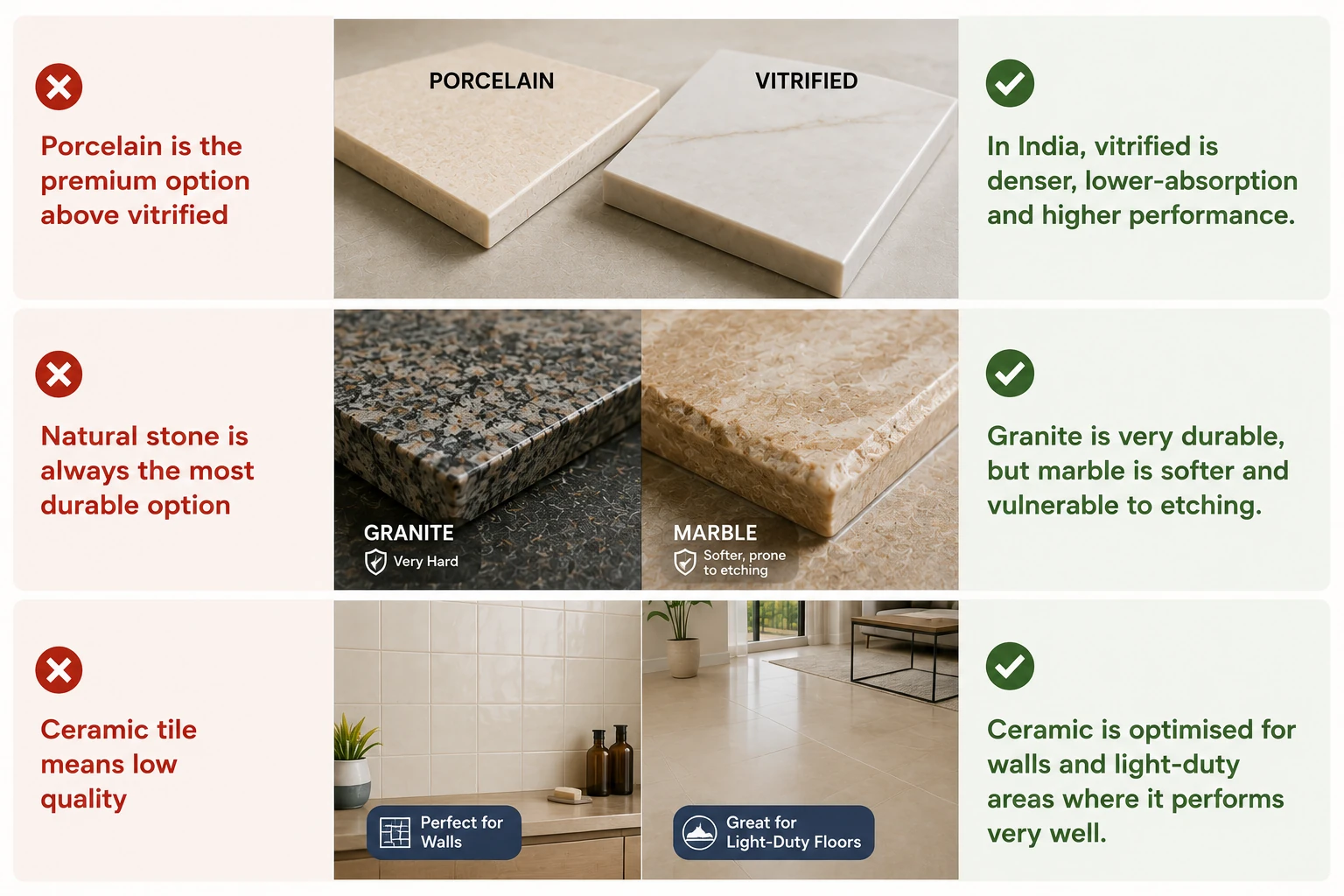
Not in the Indian market. This is the single most common mix-up, borrowed from international usage where porcelain is the umbrella term for low-absorption tiles. In India, vitrified, not porcelain, is the denser, lower-absorption, generally higher-performance category.
"Natural stone is always the most durable option"
Only for certain stones. Granite genuinely outperforms most manufactured tiles on hardness, but marble, despite its premium price and appearance, is notably softer and vulnerable to acid etching, a weakness vitrified and porcelain tiles do not share.
"Ceramic tile means low quality"
Ceramic is simply optimised for a different job, wall applications and light-duty floors, where its higher water absorption is irrelevant, and its lower cost is a genuine advantage rather than a compromise.
Comparing the Right Sub-Type, Not Just the Category
Once you've settled on vitrified for a floor or porcelain for a bathroom wall, the next decision, PGVT versus GVT, or which finish suits a wet area, matters just as much as the category itself. TilesFinders lists verified suppliers across India by tile category, finish, and size, useful for comparing the exact sub-type your project needs rather than relying on a single showroom's word.
FAQs
No, and this is the single most important thing to get right. In the Indian market, porcelain tiles are a semi-vitrified category with 2% to 6% water absorption, denser than ceramic but less dense than vitrified tiles. Vitrified tiles, PGVT, GVT, Double Charge, Full Body, and Nano are all significantly denser, with water absorption around 0.05% under IS 15622. Porcelain sits in the middle of the ceramic-to-vitrified spectrum in India, not above vitrified.
Internationally, porcelain is often used as the umbrella term for all low-absorption, fully vitrified tiles, meaning there is no separate international category called vitrified the way India uses the word. In Indian retail and manufacturing, the industry split the market differently: vitrified became the name for the densest, near-zero-absorption tiles (PGVT, GVT, Double Charge, Full Body, Nano), while porcelain was kept as a distinct, less dense, semi-vitrified mid-tier category. Neither usage is wrong; they're just two different regional conventions, but mixing them up when comparing products leads to real confusion.
Vitrified tiles are denser and have significantly lower water absorption (around 0.05% versus porcelain's 2-6%), which generally makes them more durable for high-traffic and wet-area use in the Indian market context. Porcelain tiles are still a meaningful step up from ceramic and perform well in bathrooms, balconies, and moderate-traffic areas, just not quite at the level of vitrified tiles.
No, ceramic is not inherently lower quality; it is built for a different job. Ceramic's higher water absorption (12-16%) makes it unsuitable for demanding wet or high-traffic floors, but for walls, where structural load and constant moisture are not concerns, ceramic performs perfectly well at a meaningfully lower price than porcelain or vitrified.
Generally yes. Most natural stone is porous to some degree and needs periodic sealing, typically every one to three years depending on the stone and traffic, to resist staining and moisture damage. Ceramic, porcelain, and vitrified tiles need no equivalent sealing.
Yes, and this is one of the more significant shifts in the tile industry over the past decade. Digital printing technology now reproduces marble, granite, and travertine veining closely enough on both porcelain and vitrified bodies that many buyers choose the manufactured version specifically to get the stone look without the sealing upkeep or cost of quarried stone.
Vitrified tiles, particularly GVT with an anti-skid rating, or glass mosaic for waterline detailing, are the standard recommendation for pool surrounds, since near-zero water absorption is essential for a surface in constant water contact. Porcelain's higher absorption range makes it a less ideal choice for this specific application.
Generally yes, though ranges overlap. Ceramic wall tiles typically start lowest, around Rs. 15 to Rs. 60 per square foot. Porcelain sits in a middle band. Vitrified spans the widest range, roughly Rs. 25 to Rs. 250 per square foot, since it covers everything from budget Nano tiles to premium large-format PGVT slabs.

See our tile guides first
Set TilesFinders as a preferred source and our buying guides surface ahead of the rest for you.
Add as preferred sourceTakes one tap. Nothing to install.
What Readers Say
I was about to redo my parking area with the wrong tile size until I read this. The layout comparisons saved me from a costly mistake.
We reference TilesFinders guides while briefing clients on material selection. The size and pattern breakdowns are accurate and easy to explain visually.
On site, I get asked about grout spacing all the time. This article gave me a solid reference I now share with my team before every job.
Finally a guide that doesn't just push generic advice. The oil stain removal steps actually worked on our clubhouse driveway tiles.
I run a small construction firm and now send this link to clients directly when they ask about entrance tile sizing. Saves me an hour of explaining.
Good practical detail, though I wish there were more examples for compact apartment entrances specifically, not just villas.
My mother-in-law wanted marble, I wanted vitrified. This blog gave us the neutral comparison we needed to actually decide together.
Detailed without being overwhelming. I appreciated that it covered both cost and maintenance, not just the aesthetics.
Used the algae and hard water removal tips on our terrace tiles after the monsoon. Worked better than what our regular cleaner was doing.
As someone who sources tiles for multiple builder projects, I find these comparisons genuinely useful for vendor conversations, not just consumer content.
Recommended this to a client who kept second-guessing the entrance design. The small vs large layout section settled the debate instantly.
Straightforward and honest, no unnecessary jargon. Would like to see a similar breakdown for outdoor pool-deck tiles next.
We've bookmarked several TilesFinders guides for our design handbook. Reliable source when clients want data, not just opinions.
Two paths, one marketplace.
Get free quotes from verified suppliers.
Share your room, budget, and style. Suppliers in Morbi respond within hours.
Get Free QuotesList your business, reach real buyers.
Put your showroom in front of homeowners searching for tiles right now.
List Your Business