Cement Look Tiles vs Real Cement Screed: Cost, Maintenance & Durability Compared
Compare cement look tiles and real cement screed on cost, maintenance, durability, installation, and climate suitability to choose the best flooring option for Indian projects.
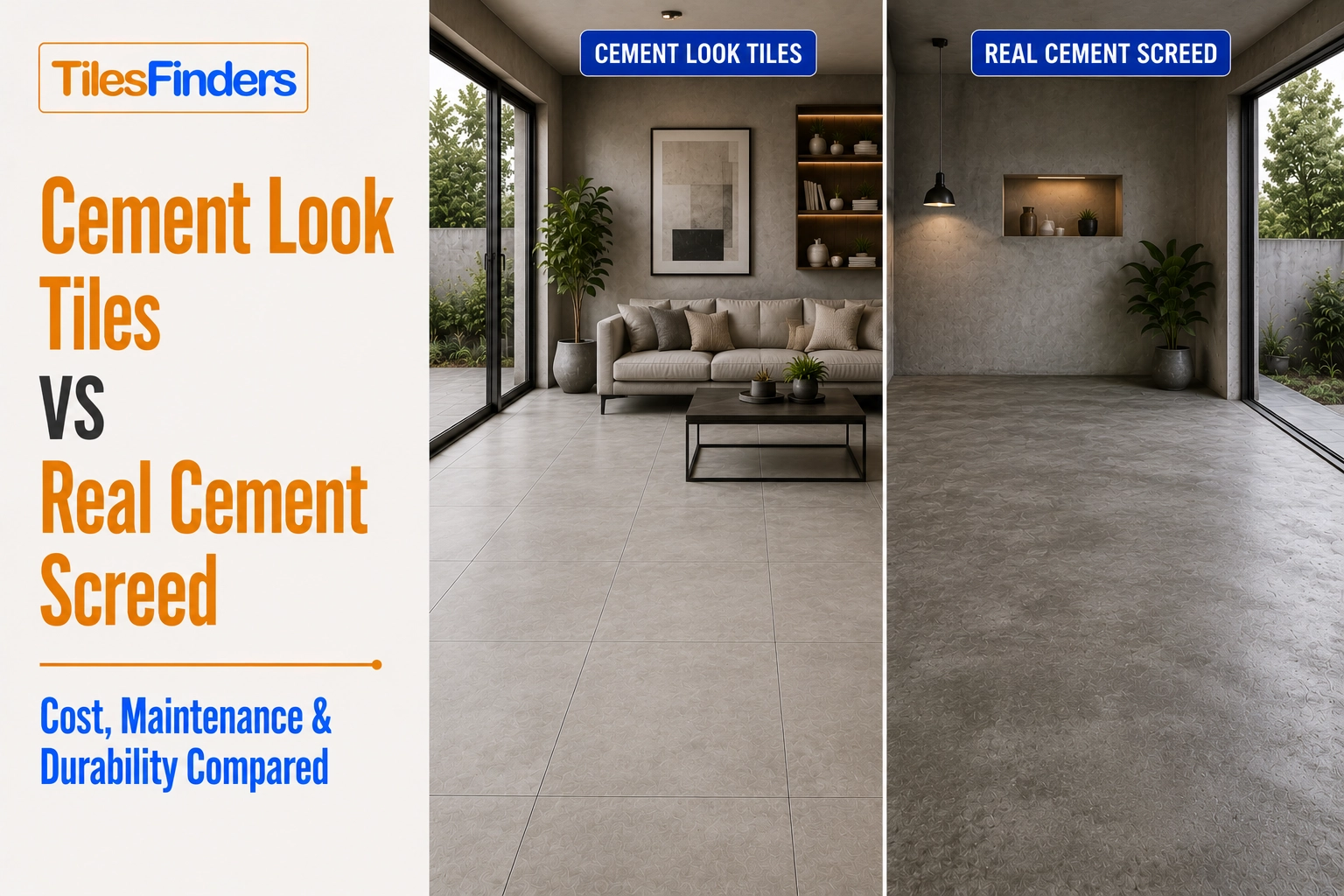
- What Cement Look Tiles and Real Cement Screed Actually Are
- Round 1: Installation Cost Comparison
- Round 2: Maintenance Cost Over Five Years
- Round 3: Durability and Lifespan
- Round 4: Installation Complexity and Site Conditions
- Round 5: Visual Authenticity and Design Range
- Round 6: Structural Load, Acoustic Properties, and Indian Climate Fit
- Round 7: Repairability and Long-Term Floor Management
- Decision Guide: Which Specification Is Right for Your Project
- Summary Scorecard: Cement Look GVT vs Real Cement Screed
- Cement Look Tiles and Indian Market Context
- Browse Cement Look Tiles From Morbi Manufacturers
Cement look GVT tiles offer the industrial concrete aesthetic with lower maintenance, better moisture resistance, and easier installation than real cement screed. While screed provides a seamless, authentic finish, GVT is the more practical choice for most Indian homes and commercial spaces.
Cement look tiles (GVT with a digital cement-look print) cost Rs. 55 to Rs. 150 per sq.ft installed and need a weekly mop. Real cement screed costs Rs. 180 to Rs. 380 per sq.ft installed and needs sealing every 6 to 12 months, polishing every 3 to 5 years, and careful management of cracks that appear from thermal movement and subfloor settlement.
For most Indian homes and mid-range commercial projects, cement tiles are the correct specification. Real cement screed is the right choice only when the design brief requires an authentic material that cannot be replicated digitally, the budget allows for ongoing maintenance, and the project team includes a skilled screed applicator. This guide breaks down every comparison point so you can make the right call for your project.
What Cement Look Tiles and Real Cement Screed Actually Are
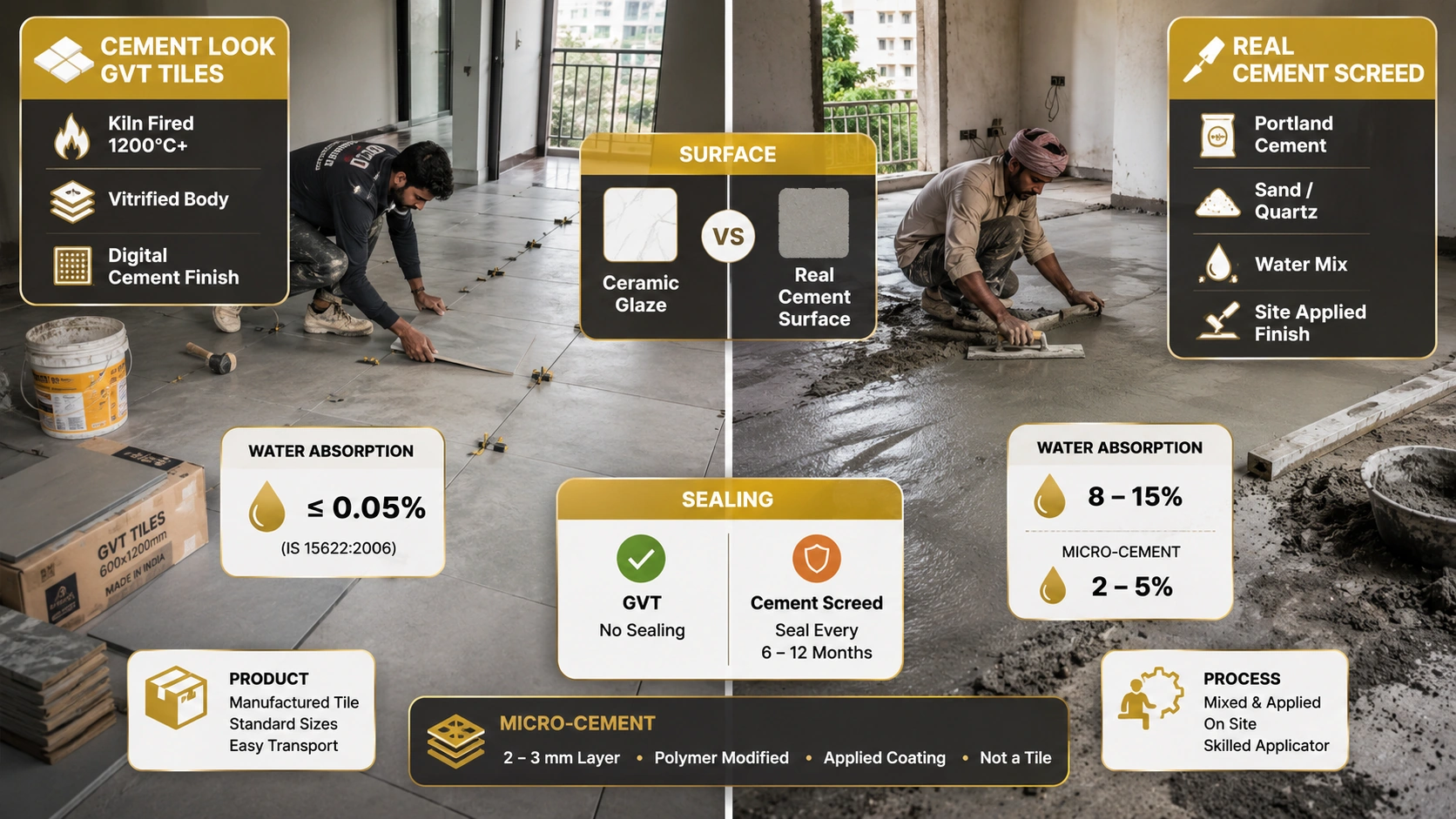
Before comparing the two, it helps to be clear on what each material is at the product level.
| Property | Cement Look GVT Tiles | Real Cement Screed |
| Material composition | Vitrified clay and mineral body, kiln-fired at 1,200°C+. The glaze layer carries a digital cement-look print. | Portland cement, fine aggregate (sand or quartz), and water, mixed and poured as a semi-dry or liquid compound over the floor substrate. |
| Product category | Manufactured tile. Comes in standard sizes. Can be sourced, stored, and transported as a product. | Applied finish. Mixed and poured on-site by a skilled applicator. Not a product; it is a process. |
| What is the surface? | A ceramic glaze that replicates the appearance of cement. The look is a print; the body is vitrified tile. | Actual cement. The grey colour, texture, tonal variation, and any cracks or patina are properties of the material itself. |
| Water absorption | 0.05% or lower under IS 15622:2006 for vitrified tiles. | 8 to 15% for standard cement screed. 2 to 5% for micro-cement or polymer-modified screed. Always porous without sealing. |
| Requires sealing | No. Non-porous glaze surface needs no sealing. | Yes. Cement screed must be sealed to prevent staining, water penetration, and dust. Standard screed: seal every 6 to 12 months. |
Note: Micro-cement is a subcategory of cement screed, not a tile product. It is a thin (2 to 3 mm) polymer-modified cement compound applied over existing floors or walls by a specialist applicator. It is not the same as cement-look GVT. When a designer specifies 'micro-cement flooring', they mean an applied cement coating, not a tile. The comparison in this guide covers standard cement screed and micro-cement as the 'real cement' side of the comparison.
Round 1: Installation Cost Comparison
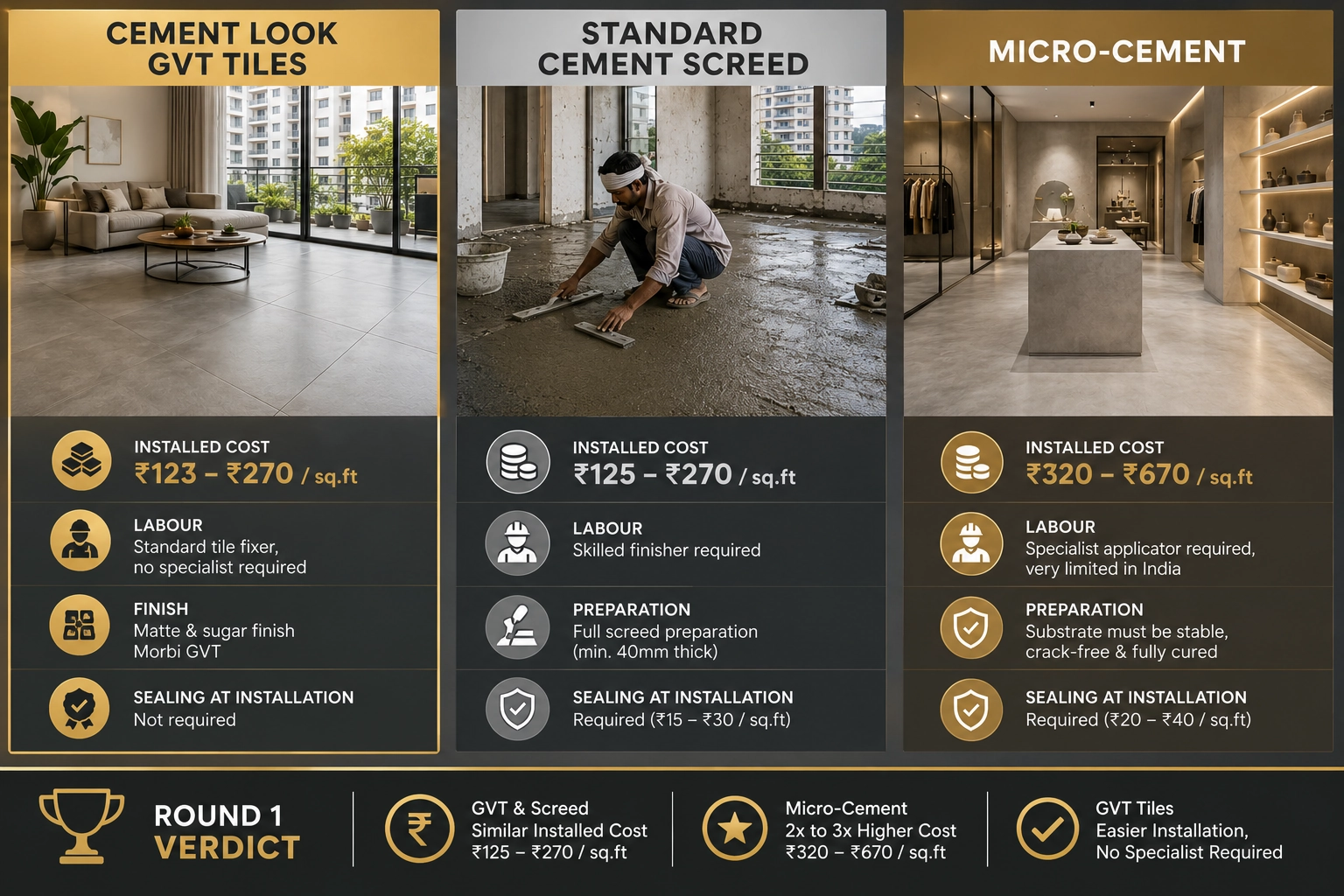
Installation cost is where cement look GVT tiles have the clearest advantage over real cement screed in the Indian market. The cost difference comes from three sources: material cost, skilled labour, and preparation requirements.
| Cost Element | Cement Look GVT Tiles | Standard Cement Screed | Micro-Cement |
| Material cost | Rs. 55 to Rs. 150/sq.ft (Morbi GVT, matte and sugar finish) | Rs. 30 to Rs. 60/sq.ft for raw materials (cement, sand, additive) | Rs. 120 to Rs. 250/sq.ft for micro-cement compound (imported brands Rs. 200 to Rs. 400/sq.ft) |
| Skilled labour | Rs. 40 to Rs. 65/sq.ft for tile setting. Standard tile fixer, no specialist required. | Rs. 60 to Rs. 120/sq.ft for screed levelling, finishing, and grinding. Skilled finisher required. | Rs. 150 to Rs. 280/sq.ft for micro-cement specialist applicator. Very limited availability in India. |
| Substrate preparation | Standard floor levelling. Rs. 20 to Rs. 40/sq.ft if a topping coat is needed. | Full screed preparation over the concrete slab. Minimum 40 mm thick pour. Time-intensive. | Substrate must be stable, crack-free, and fully cured. Any movement cracks the micro-cement. Preparation adds Rs. 30 to Rs. 60/sq.ft. |
| Grouting | Rs. 8 to Rs. 15/sq.ft for epoxy or polymer grout. | No grouting. Screed is a continuous surface. | No grouting. Micro-cement is applied seamlessly. |
| Sealing at installation | Not required. | Rs. 15 to Rs. 30/sq.ft for first-time penetrating sealer application. | Rs. 20 to Rs. 40/sq.ft for hardener and topcoat sealer application. |
| Total installed cost | Rs. 123 to Rs. 270/sq.ft | Rs. 125 to Rs. 270/sq.ft for standard screed | Rs. 320 to Rs. 670/sq.ft for micro-cement |
Round 1 verdict: Standard cement screed and cement look GVT tile arrive at a similar total installation cost in the Rs. 125 to Rs. 270 per sq.ft range. Micro-cement is 2 to 3 times the cost of tile at Rs. 320 to Rs. 670 per sq.ft installed. The GVT tile advantage becomes clear in the next category: ongoing maintenance cost over five years.
Round 2: Maintenance Cost Over Five Years
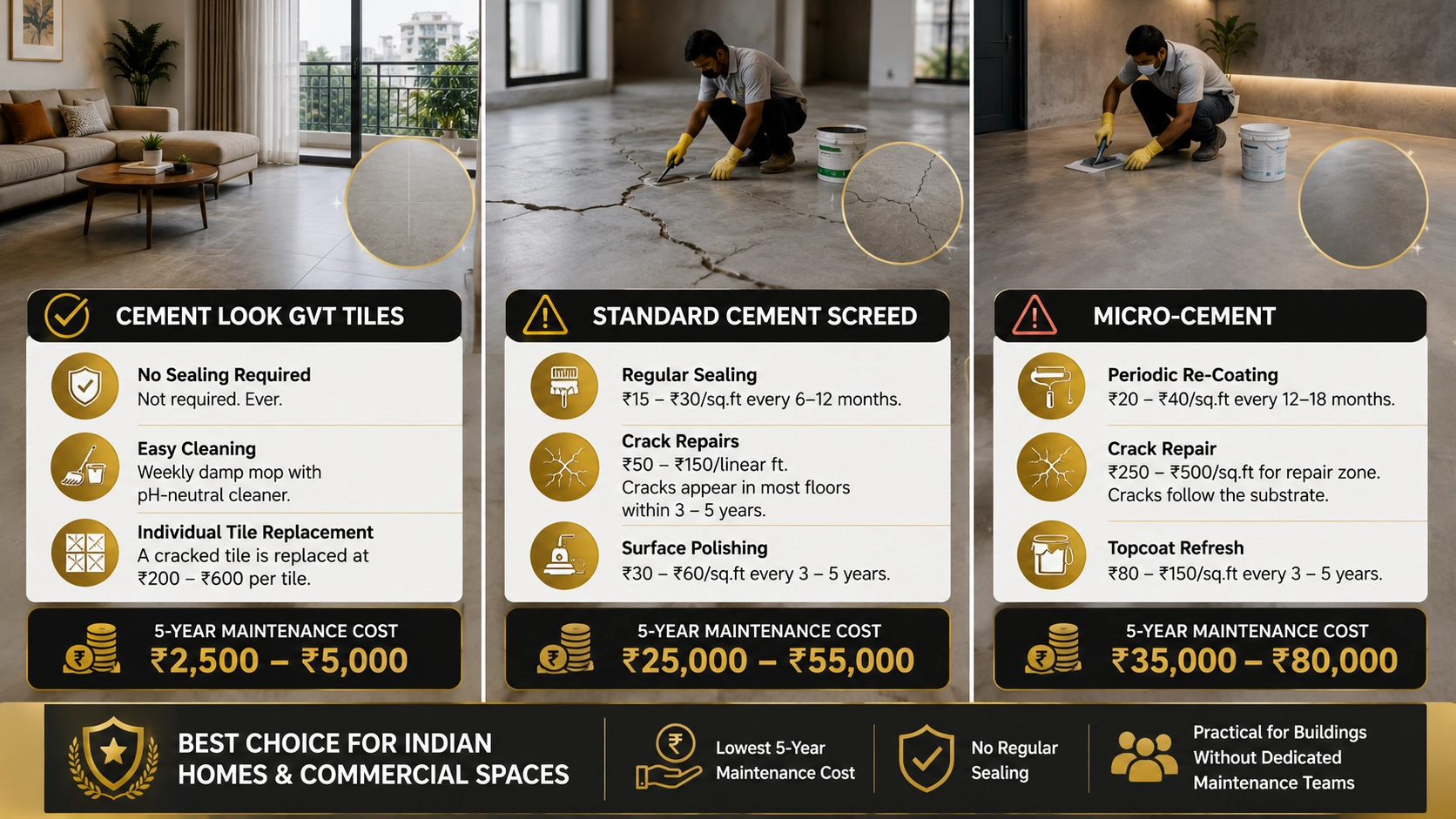
Maintenance is where the real cost difference between cement look tiles and real cement screed becomes significant in Indian conditions. The combination of monsoon humidity, temperature cycling, and variable cleaning standards accelerates the maintenance cycle for cement screed in Indian buildings.
| Maintenance Task | Cement Look GVT Tiles | Standard Cement Screed | Micro-Cement |
| Sealing | Not required. Ever. | Rs. 15 to Rs. 30/sq.ft every 6 to 12 months. A 200 sq ft living room: Rs. 3,000 to Rs. 6,000 per year. | Rs. 20 to Rs. 40/sq.ft every 12 to 18 months. More stable than standard screed but still needs re-coating. |
| Crack repair | Not applicable. Individual tiles can crack, but do not propagate cracks. A cracked tile is replaced at Rs. 200 to Rs. 600 per tile. | Cracks from thermal movement, subfloor settlement, or shrinkage appear in most screed floors within 3 to 5 years. Crack repair: Rs. 50 to Rs. 150/linear ft. A 2 m crack costs Rs. 300 to Rs. 900 to repair. | Micro-cement cracks when the substrate moves. Any crack in the screed below propagates to the surface. Repair requires re-application of the affected area: Rs. 250 to Rs. 500/sq.ft for the repair zone. |
| Polishing/grinding | Not applicable. | Surface polishing every 3 to 5 years to restore sheen: Rs. 30 to Rs. 60/sq.ft. | Topcoat refresh every 3 to 5 years: Rs. 80 to Rs. 150/sq.ft. |
| Stain removal | Non-porous surface. Standard mop removes all common stains. No specialist treatment. | Unsealed or under-sealed screed absorbs coffee, turmeric, oil, and cleaning chemicals. Deep stains require grinding and re-sealing: Rs. 60 to Rs. 120/sq.ft for the stained area. | Similar to standard screed. Staining between seal cycles requires topcoat re-application. |
| Daily/weekly cleaning | Weekly damp mop with pH-neutral cleaner. Rs. 500 to Rs. 1,000/year in cleaning materials. | Same cleaning routine, but must avoid acidic cleaners (vinegar, citrus-based) that etch cement. pH-neutral only. | Same. More sensitive to harsh chemicals than standard screed. |
| Five-year total maintenance cost (200 sq.ft floor) | Rs. 2,500 to Rs. 5,000 | Rs. 25,000 to Rs. 55,000 (sealing + polishing + crack repair) | Rs. 35,000 to Rs. 80,000 (topcoat cycles + crack repair) |
Round 2 verdict: Cement looks like GVT tiles win the maintenance comparison decisively. Five-year maintenance cost on a 200 sq.ft floor: Rs. 2,500 to Rs. 5,000 for GVT versus Rs. 25,000 to Rs. 55,000 for standard cement screed. The maintenance cost advantage of GVT over micro-cement is even larger. For Indian homes and commercial spaces without a dedicated maintenance team, cement look GVT is the only practical specification.
Round 3: Durability and Lifespan
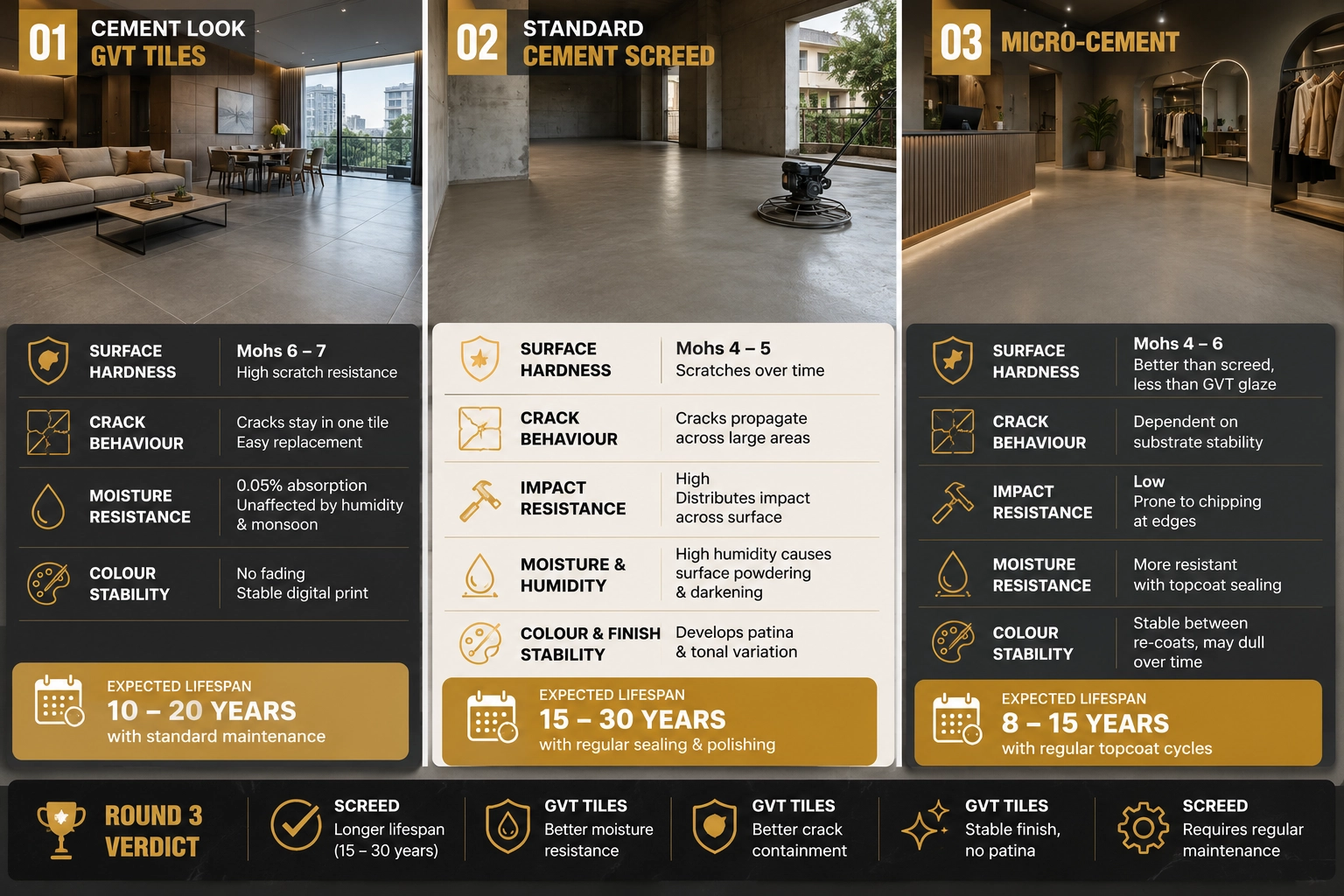
Durability means different things for a tile and a screed. A tile has surface wear resistance (PEI rating) and body strength (MOR). A screed has compressive strength, crack resistance, and surface hardness. These properties behave differently under the same floor use conditions.
| Durability Factor | Cement Look GVT Tiles | Standard Cement Screed | Micro-Cement |
| Surface hardness | Glaze surface: Mohs 6 to 7. Resistant to scratching from furniture legs, grit, and footwear. | Hardened cement: Mohs 4 to 5. Scratches from grit underfoot and furniture drag over time. | Micro-cement topcoat: Mohs 4 to 6, depending on hardener. More scratch-resistant than standard screed but less than GVT glaze. |
| Crack behaviour | Individual tile cracks do not propagate to adjacent tiles. One cracked tile was replaced without disturbing the rest of the floor. | Screed cracks propagate across the surface. A single subfloor movement point can produce visible cracks across a 3 to 5 sq. ft. area. | Same as standard screed. Micro-cement is thin (2 to 3 mm) and fully dependent on the substrate stability below it. |
| Impact resistance | PEI 4 GVT withstands standard residential and light commercial impact. Heavy point impact (dropped tool, heavy object) can crack the tile. | Screed is continuous and distributes impact across a larger area. Less likely to show localised impact damage than tile. | Low. Micro-cement at 2 to 3 mm is vulnerable to impact chipping at edges and transitions. |
| Moisture and humidity | 0.05% water absorption. Unaffected by high humidity, standing water, or monsoon conditions. | High ambient humidity accelerates carbonation of the cement screed surface, causing surface powdering. Monsoon humidity of 85 to 95% in Indian coastal cities is the primary accelerator. | Polymer-modified: more moisture-resistant than standard screed but still requires a sealed surface. Humidity cycling causes micro-delamination over time. |
| Colour and finish stability | Digital glaze print is stable for the tile's life. No fading, no patina development, no tonal change. | Cement screed develops patina, tonal variation, and surface darkening over time. This is a design feature for some, a defect for others. | Topcoat colour is stable between re-coats. Between re-coating cycles, the surface may dull and lose its original depth. |
| Expected lifespan (Indian residential) | 10 to 20 years for PEI 4 GVT with standard daily maintenance. | 15 to 30 years for well-maintained cement screed with regular sealing and polishing. Poorly maintained screed degrades in 5 to 8 years. | 8 to 15 years for micro-cement with regular topcoat cycles. Shorter lifespan than standard screed or GVT in high-humidity Indian conditions. |
Round 3 verdict: Well-maintained standard cement screed outlasts GVT tile in lifespan (15 to 30 years vs 10 to 20 years) and distributes impact better. GVT wins on crack containment, moisture resistance, and surface stability. The screed lifespan advantage is real, but it requires consistent maintenance discipline that most Indian residential and commercial projects do not sustain.
Round 4: Installation Complexity and Site Conditions
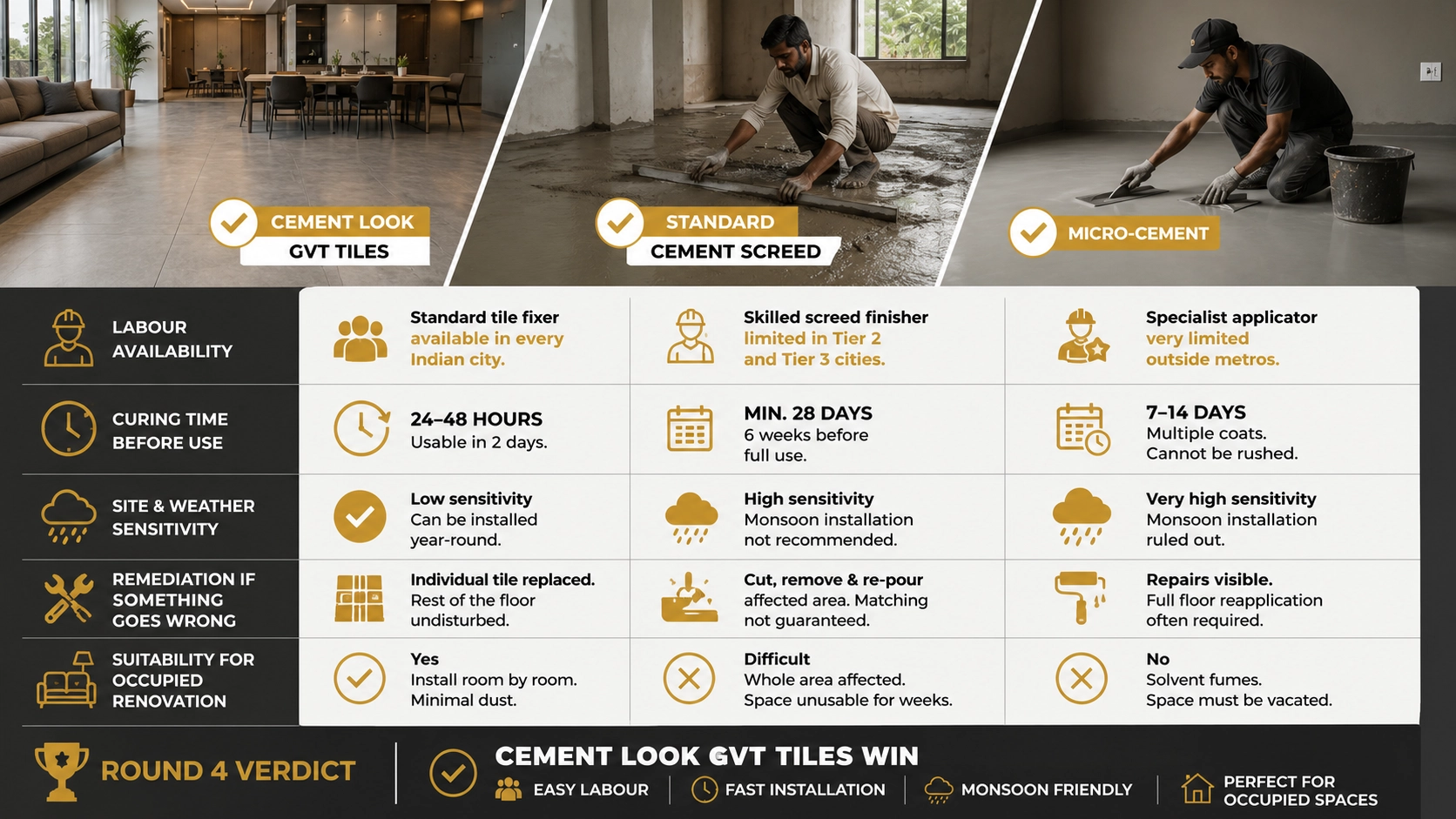
Installation complexity matters in Indian construction because labour availability, project timelines, and site conditions vary significantly across cities and project types.
| Installation Factor | Cement Look GVT Tiles | Standard Cement Screed | Micro-Cement |
| Labour availability | Standard tile fixer available in every Indian city and town. No specialist required. | Skilled screed finisher required. Available in metros; limited availability in Tier 2 and Tier 3 cities. | Specialist micro-cement applicator required. Very limited availability in India outside Mumbai, Delhi, Bengaluru, and Pune. |
| Curing time before use | 24 to 48 hours after installation (adhesive cure). Floor usable in 2 days. | Minimum 28 days curing before sealing. Minimum 6 weeks before full use. Project timelines affected. | Minimum 72 hours per coat. Multiple coats needed. Total process: 7 to 14 days. Cannot be rushed. |
| Substrate requirement | Standard levelled concrete floor. Minor undulations corrected with self-levelling compound. | The structural floor slab must be stable, dry, and free of upward moisture movement. Damp slabs cause screed failure. | Most demanding substrate requirement. Substrate must be completely stable, crack-free, and dry. Failed substrate = failed micro-cement. |
| Temperature and humidity sensitivity | Low. Tiles can be installed year-round in Indian conditions, including the monsoon season. | High. Cement screed poured in high humidity (above 70%) is at risk of slow curing and surface dusting. Monsoon-season installation is not recommended. | Very high. Micro-cement application above 80% humidity causes adhesion failure. Monsoon season installation is ruled out for most Indian locations. |
| Remediation if something goes wrong | Individual tile replaced. The rest of the floor is undisturbed. | Localised screed failure requires cutting, removing, and re-pouring the affected area. Colour and texture matching the original pour is not guaranteed. | Partial micro-cement repair is visible at the repair boundary. Full floor reapplication is often required for a seamless result. |
| Suitability for occupied renovation | Yes. Tiles can be installed room by room. Minimal dust and no curing fumes. | Difficult. Screed pour affects the whole floor area. Curing time means the space is unusable for weeks. | No. Micro-cement application produces solvent fumes during topcoat application. Space must be vacated. |
Round 4 verdict: Cement looks GVT tiles win on every installation factor relevant to the Indian context: labour availability across all city tiers, short curing time, tolerance of monsoon-season installation, and suitability for occupied renovation. Micro-cement is the most demanding and least available specification in the Indian market.
Round 5: Visual Authenticity and Design Range
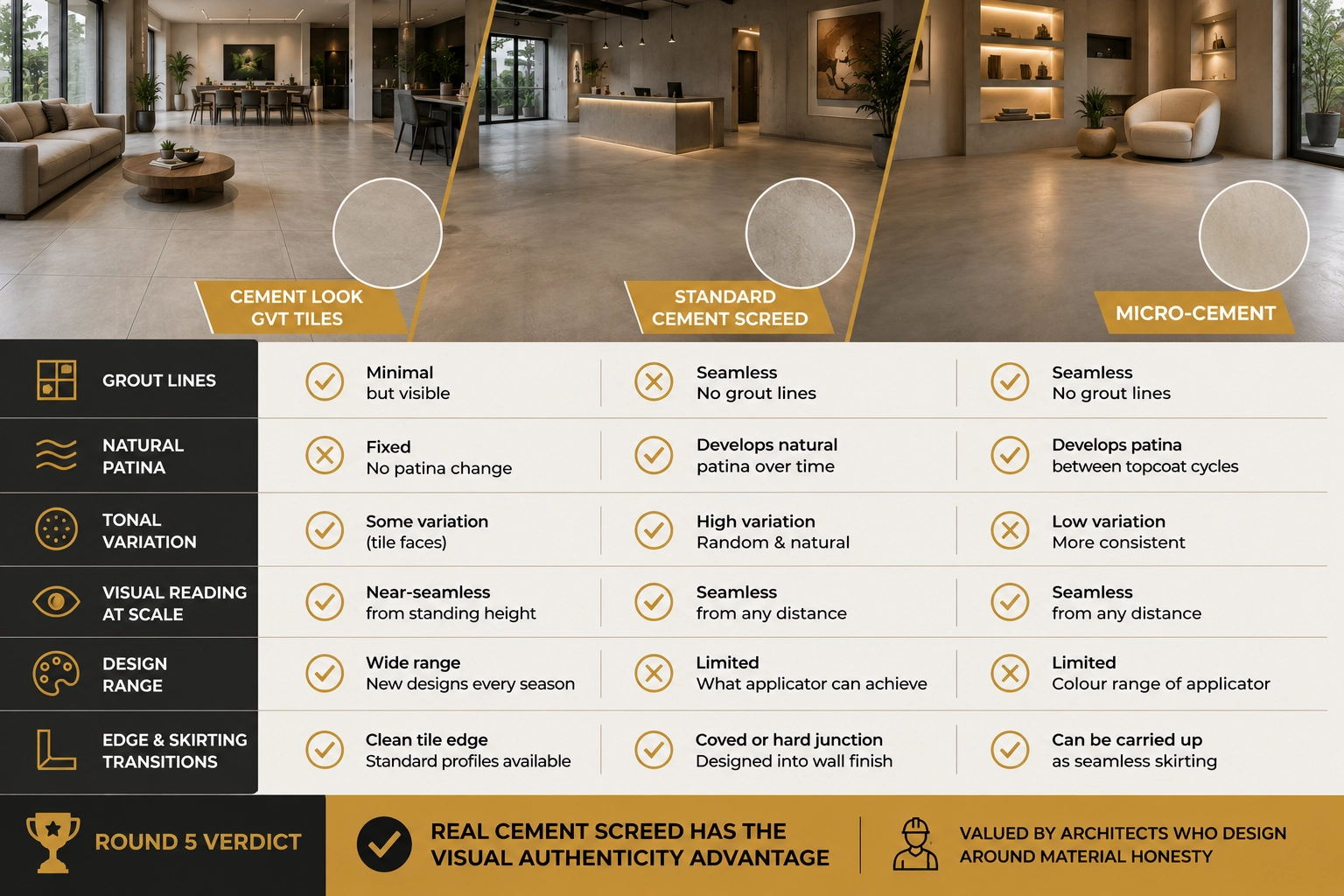
This is the category where real cement screed has an advantage that cement look GVT cannot fully close. The question is how much that advantage matters in practice.
| Visual Factor | Cement Look GVT Tiles | Standard Cement Screed | Micro-Cement |
| Grout lines | Grout lines are present. At 800x1600 mm with 1.5 mm joint width, grout lines are minimal but visible on close inspection. | Seamless. No grout lines. The continuous surface is the primary visual advantage of screed over tile. | Seamless. Micro-cement's seamless surface is the reason it commands 3x the price of cement-look tile. |
| Natural patina over time | Digital print is fixed. No natural patina development. The tile looks the same in year 10 as in year 1. | Cement screed develops a natural patina: tonal darkening in high-traffic zones, subtle surface texture evolution. Some designers consider this the defining character of the material. | Develops patina between topcoat cycles. Less pronounced than standard screed but more natural than GVT. |
| Tonal variation across the floor | Face variation across tiles (4 to 8 faces per batch) creates some variation but is less random than natural cement. | Tonal variation is inherent and random. No two screed floors look identical. | Less tonal variation than standard screed. Micro-cement is mixed to a consistent colour. |
| Visual reading at architectural scale | At 800x1600 mm with matched grout, it reads as near-seamless from standing height. Visible as a tile on close inspection. | Seamless from any distance. An architect can design around the visual continuity of screed in a way that tile cannot fully replicate. | Seamless from any distance. Same architectural quality as standard screed. |
| Design range | Wide. Digital print covers raw concrete, aged screed, micro-cement, polished concrete, exposed aggregate, and geometric cement looks. New designs every season from Morbi. | Limited to what the applicator can achieve with cement pigment and finish technique. | Limited to the applicator's colour range and finish technique. Custom colours require specialist mixing. |
| Edge and skirting transitions | Clean tile-to-skirting edge. Standard transition profile available. | Screed meets wall at a coved skirting or a hard floor-wall junction. Can be designed seamlessly into the wall finish. | Micro-cement can be carried up the wall as a seamless skirting. This is a design feature not achievable with tile. |
Design principle: The visual authenticity advantage of real cement screed is real and appreciated by architects who design around material honesty. A cement screed floor in a gallery, a restaurant, or a private home is not pretending to be cement; it is cement, and its evolution over time is part of the design intention. Cement looks like GVT is an excellent practical replica, but it is a replica. Whether that distinction matters depends entirely on who is living or working in the space and what design values the project carries.
Round 6: Structural Load, Acoustic Properties, and Indian Climate Fit
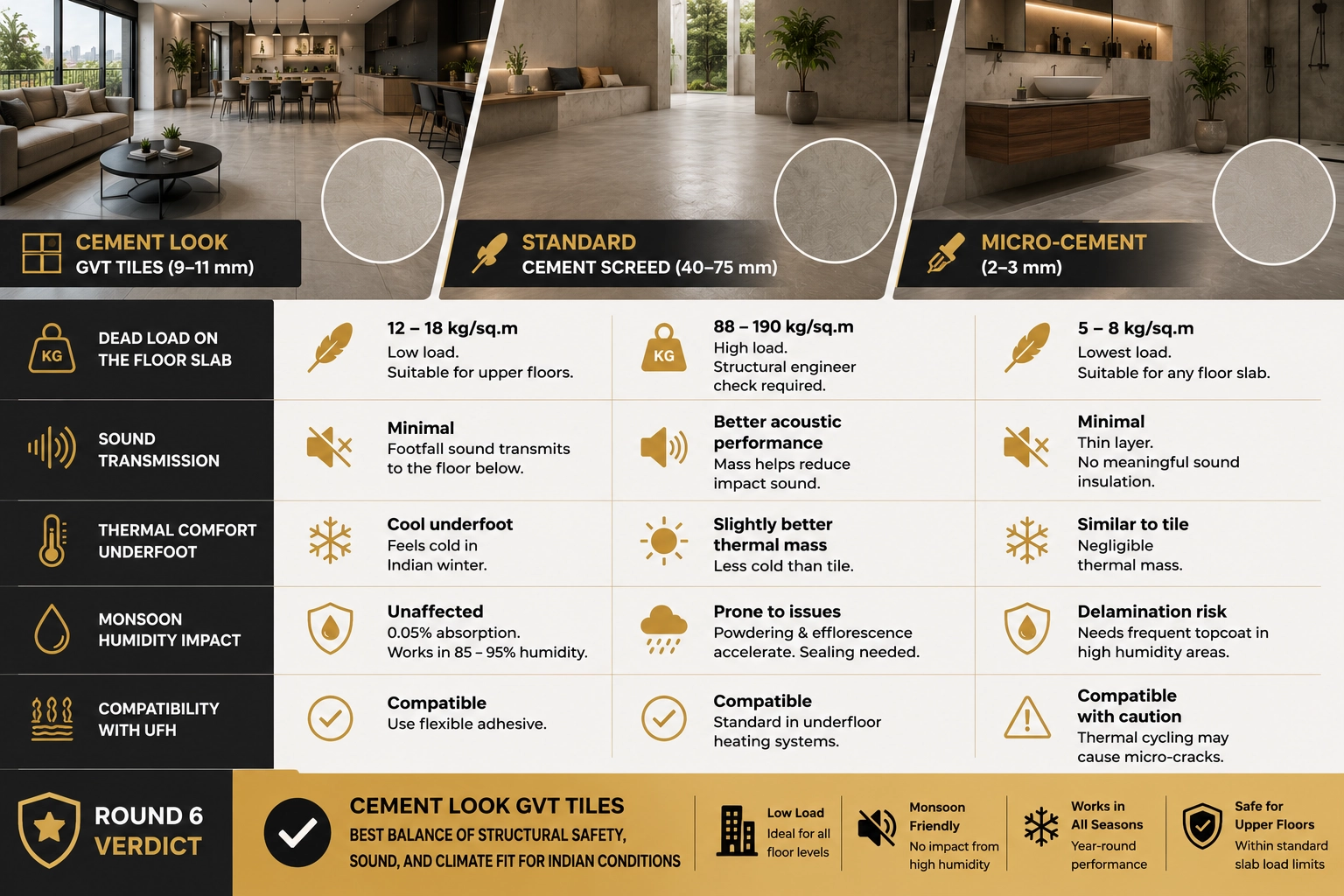
| Factor | Cement Look GVT Tiles (9 to 11 mm) | Standard Cement Screed (40 to 75 mm) | Micro-Cement (2 to 3 mm) |
| Dead load on the floor slab | Approx. 12 to 18 kg/sq.m. Low. Suitable for upper-floor slabs in apartments. | Approx. 88 to 190 kg/sq.m depending on thickness. Significant structural load. Requires structural engineer confirmation for upper floors. | Approx. 5 to 8 kg/sq.m. Lowest load of all three options. Suitable for any floor slab. |
| Sound transmission | Standard GVT tile with adhesive provides minimal sound insulation. Footfall sound transmits to the floor below. | Screed mass provides some impact sound attenuation. Floating screed with acoustic underlay is a recognised acoustic floor system. | Minimal acoustic benefit. The TA thin layer has no meaningful sound insulation property. |
| Thermal comfort underfoot | Tile is cool underfoot. In Indian winter (December to February in North India), bare tile floors feel cold. | Screed has slightly better thermal mass but is similarly cool underfoot. Less cold than tile in practice. | Similar to tile. The thin layer has negligible thermal mass. |
| Monsoon humidity impact | None. GVT at 0.05% absorption is unaffected by 85 to 95% ambient humidity. | Surface powdering, efflorescence, and carbonation accelerate in monsoon humidity. Annual sealing is non-negotiable in coastal Indian cities. | Topcoat delamination risk in sustained high humidity. Micro-cement in Goa, Kochi, or Mumbai requires more frequent topcoat cycles than in Delhi or Pune. |
| Compatibility with underfloor heating | Compatible. Use flexible adhesive to allow tile movement. | Compatible. Screed is commonly used as the heat-conducting layer in underfloor heating systems. Standard specification in European flooring. | Compatible. But thermal cycling increases the micro-crack risk in micro-cement. Use with caution. |
Note: Standard cement screed at 40 to 75 mm thickness adds 88 to 190 kg per sq.m to the floor slab dead load. On an upper-floor apartment slab in an Indian multi-storey building, this is a significant addition that must be checked against the structural engineer's slab load specification before cement screed is confirmed as the floor finish. Cement look GVT at 12 to 18 kg per sq.m is well within the standard slab load allowance for any floor level.
Round 7: Repairability and Long-Term Floor Management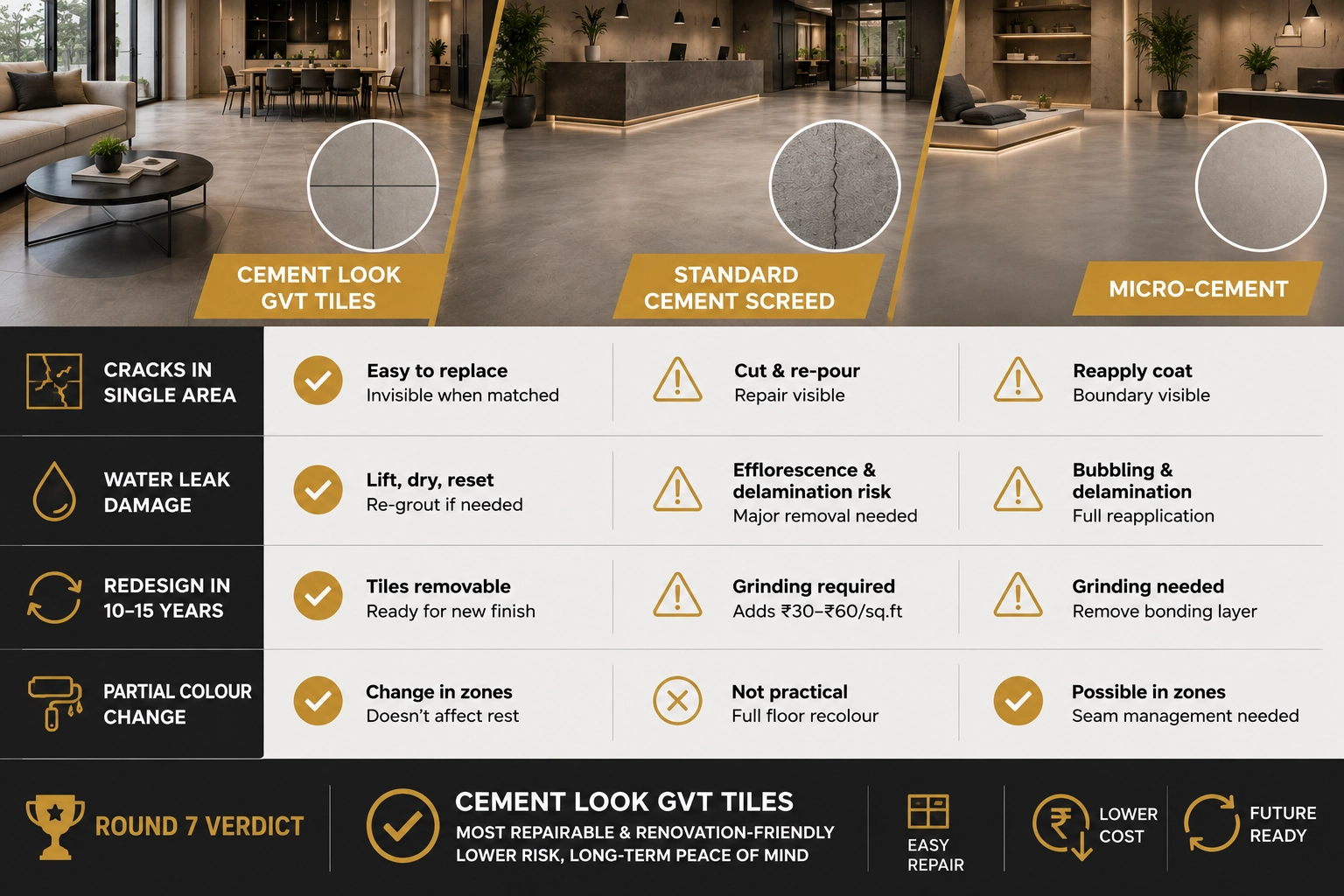
| Scenario | Cement Look GVT Tiles | Standard Cement Screed | Micro-Cement |
| Single tile or area cracks | Replace affected tiles. Colour and texture match is possible if tiles from the same batch are available. Repair is invisible when matched correctly. | Cut and re-pour the affected zone. Colour match with the aged original screed is difficult. The repair zone may be visible as a lighter patch. | Reapply micro-cement to the repair area. The boundary between the old and new coats is visible unless the entire floor is re-coated. |
| Water leak damage from the floor above | Tiles lifted, substrate dried, tiles re-set. If the adhesive bond failed, re-adhesive and re-grout. | Water ingress into screed causes salt deposits (efflorescence) and can cause screed-to-slab delamination. Repair requires full screed removal in the affected area. | Water under micro-cement causes topcoat bubbling and delamination. Requires complete reapplication. |
| Redesign or renovation in 10 to 15 years | Tiles can be removed. Substrate is ready for new tile or screed installation without major grinding. | Screed removal requires grinding or scarifying. Labour-intensive and dusty. Adds Rs. 30 to Rs. 60/sq.ft to renovation cost. | Micro-cement removal is easier than screed (thin layer), but still requires grinding the bonding layer off the substrate. |
| Partial colour change | Tiles can be changed in zones (e.g. one room) without affecting the rest of the floor. The new tile batch must match or complement the existing. | Partial screed recolouring is not practical. Full floor re-pigmentation required. | Partial recolouring is possible with micro-cement. A skilled applicator can re-coat one zone, though the boundary seam requires careful management. |
Round 7 verdict: Cement looks GVT is the most repairable and renovation-friendly floor finish of the three. Individual tile replacement is clean, low-cost, and reversible. Cement screed and micro-cement repairs are partial-solution fixes that are often visible and sometimes require full floor reapplication. For long-term floor management in Indian residential and commercial projects, GVT tile is the lower-risk specification.
Decision Guide: Which Specification Is Right for Your Project
Choose Cement Look GVT Tiles if:
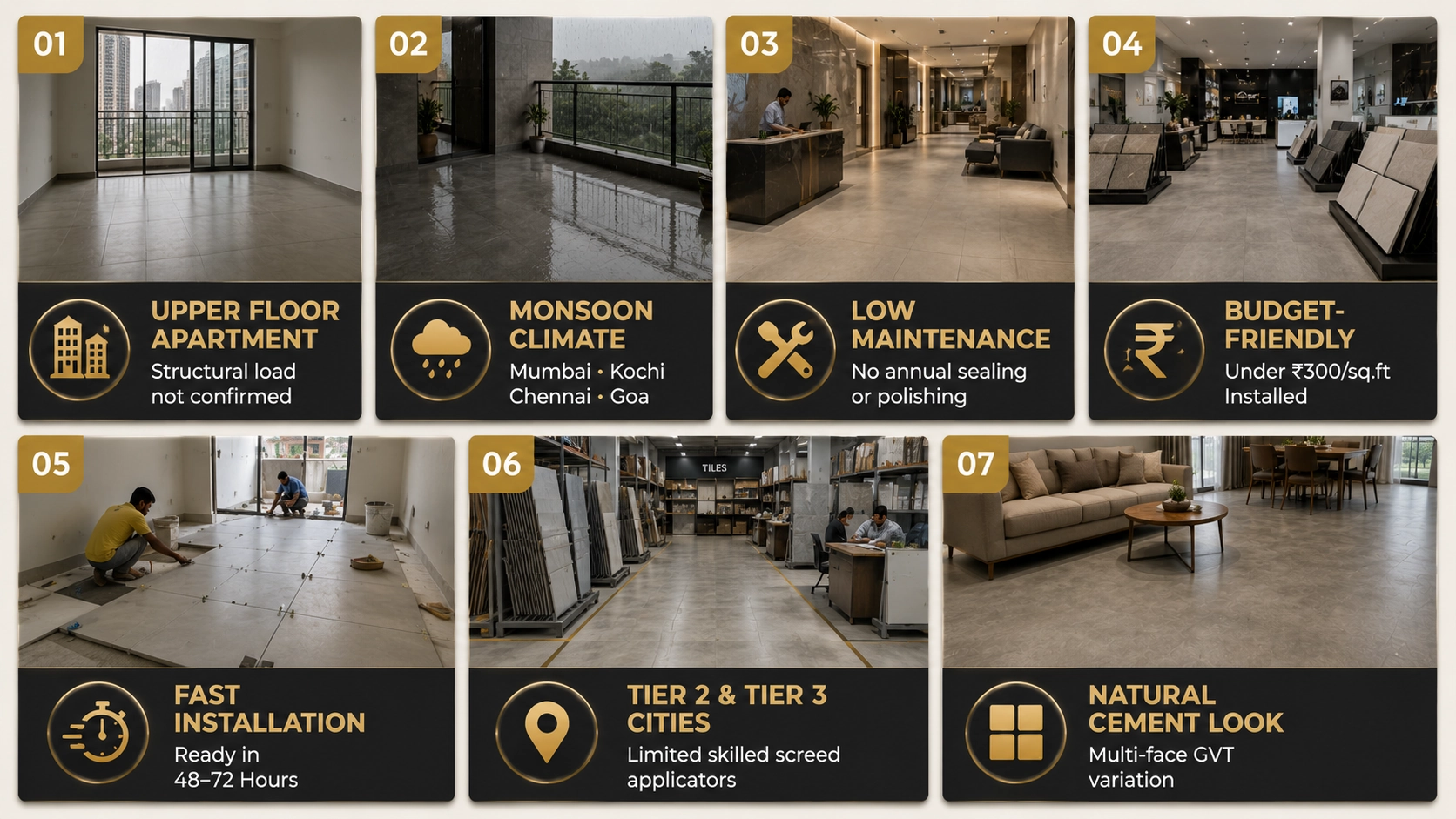
- The project is a residential apartment on an upper floor where the structural load from 40 to 75 mm of screed is not confirmed by the structural engineer.
- The building is in a monsoon-heavy Indian city (Mumbai, Kochi, Chennai, Goa), and the floor will see high ambient humidity for 4 to 6 months per year.
- The facility does not have a dedicated maintenance team that can manage annual sealing, polishing cycles, and crack monitoring.
- The project budget for the floor is under Rs. 300 per sq ft installed all-in, or the five-year total cost of ownership is a decision factor.
- The installation timeline requires the floor to be usable within 48 to 72 hours of tile-setting completion.
- The project is in a Tier 2 or Tier 3 Indian city where skilled screed finishers and micro-cement applicators are not available.
- The design brief calls for a cement look with some visual variation across the floor, achieved through multi-face GVT tile selection, but not the complete visual seamlessness of actual screed.
Choose Standard Cement Screed if:
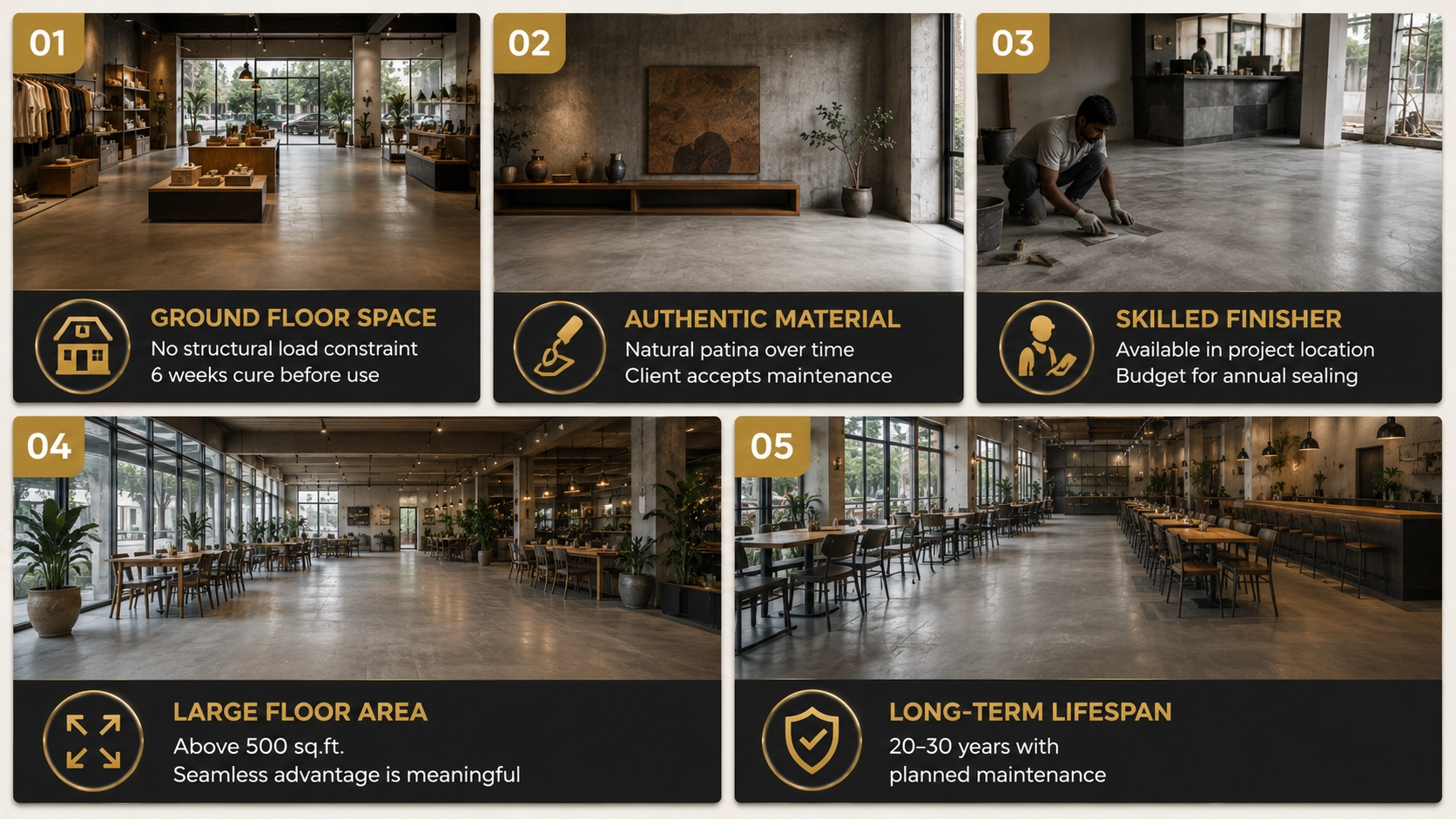
- The project is a ground-floor space (retail, restaurant, gallery, studio) where structural load is not a constraint, and the floor can cure for 6 weeks before occupation.
- The design brief explicitly calls for an authentic material with natural patina development over time, and the client understands and accepts the maintenance cycle.
- A skilled screed finisher is available for the project, and the project location, and the client has a maintenance budget that allows for annual sealing.
- The floor area is large enough (above 500 sq. ft.) that the seamless advantage of screed over grout-jointed tile is architecturally meaningful.
- The project has a lifespan brief of 20 to 30 years with planned maintenance, not a 10-year renovation cycle.
Choose Micro-Cement if:
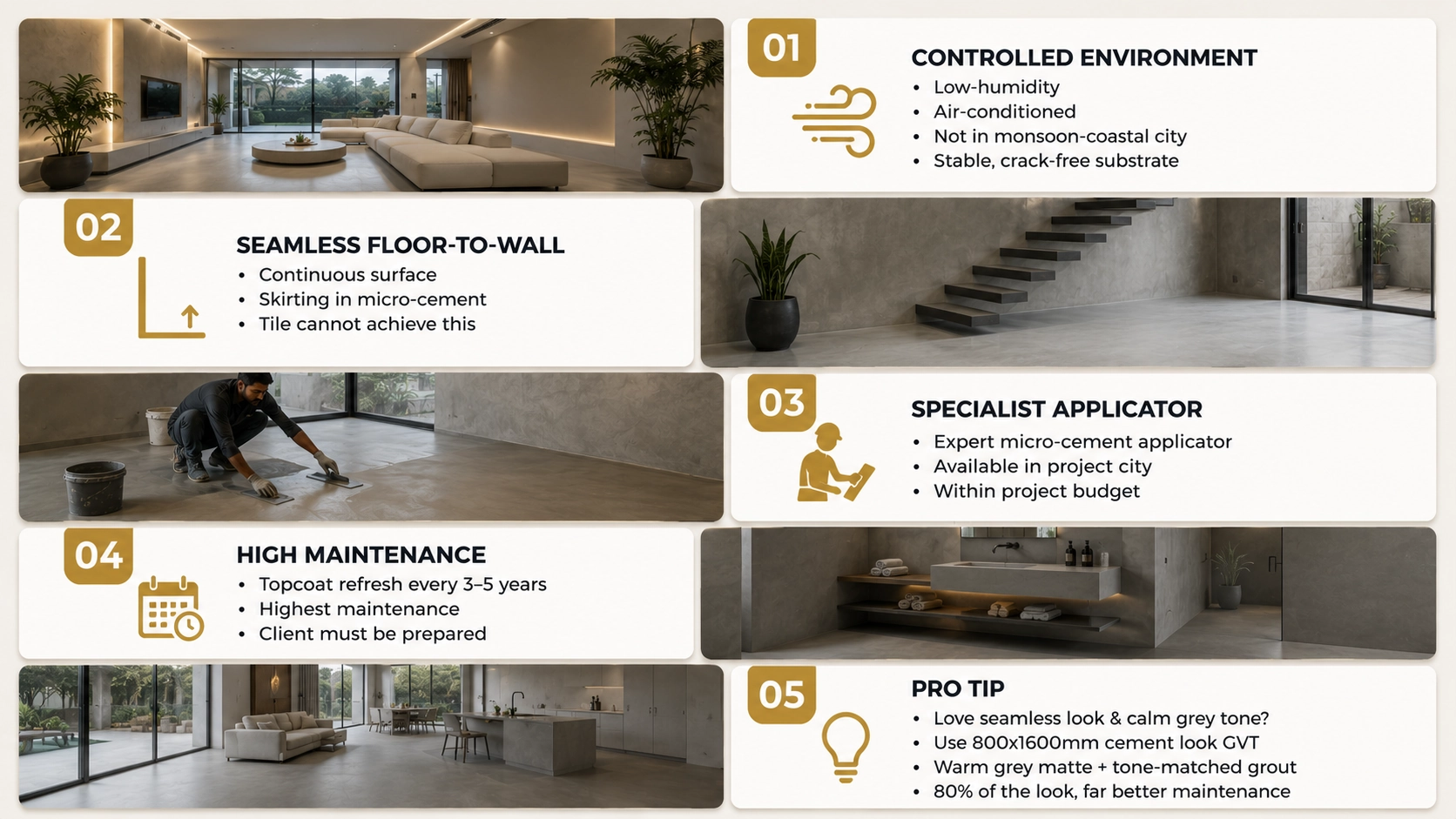
- The project is in a controlled, low-humidity environment (air-conditioned throughout, not in a monsoon-coastal city) where the substrate is confirmed stable and crack-free.
- The design brief requires a seamless floor-to-wall continuation (skirting carried in micro-cement up the wall) that tile cannot achieve.
- A specialist micro-cement applicator is available in the project city and within the project budget.
- The client is prepared for topcoat refresh cycles every 3 to 5 years and understands that micro-cement is the highest-maintenance specification of the three options.
Pro tip: If the client presents a design inspiration image from a European or Scandinavian interior with a seamless micro-cement floor and the project location is coastal India (Mumbai, Goa, Kochi, Chennai), the right conversation is about what the client loves in the image, which is likely the seamless, no-grout-line read and the calm grey tone, and then delivering that through a 800x1600 mm cement look GVT in warm grey matte with a tone-matched grout. The visual outcome covers 80% of the inspiration image. The maintenance outcome is incomparably better.
Summary Scorecard: Cement Look GVT vs Real Cement Screed
| Category | Cement Look GVT | Standard Cement Screed | Micro-Cement |
| Installation cost (similar range) | Rs. 123 to Rs. 270/sq.ft | Rs. 125 to Rs. 270/sq.ft | Rs. 320 to Rs. 670/sq.ft |
| 5-year maintenance cost (200 sq.ft) | Rs. 2,500 to Rs. 5,000 | Rs. 25,000 to Rs. 55,000 | Rs. 35,000 to Rs. 80,000 |
| Lifespan (maintained) | 10 to 20 years | 15 to 30 years | 8 to 15 years |
| Monsoon climate suitability | Excellent | Needs careful management | Poor in coastal Indian cities |
| Labour availability in India | Any city or town | Metro and large cities only | 4 to 6 major metros only |
| Seamless surface | No (grout joints present) | Yes | Yes |
| Natural patina | No | Yes | Partial |
| Repairability | Excellent | Moderate | Poor |
| Structural load (upper floors) | Low (12 to 18 kg/sq.m) | High (88 to 190 kg/sq.m) | Very low (5 to 8 kg/sq.m) |
| Overall: best for Indian projects | Most residential and commercial | Ground-floor, curated projects | Specialist, controlled environments |
Cement Look Tiles and Indian Market Context
Cement look GVT for Indian homes and commercial projects is manufactured in Morbi, Gujarat, which produces over 70% of India's vitrified tile supply. Under IS 15622:2006, cement look GVT for residential floor use must achieve water absorption at 0.05% or below, with PEI 4 rating for living room and bedroom use. The 32x32 (800x800 mm) cement look matte finish GVT is a standard stock item at Rs. 80 to Rs. 130 per sq.ft from Morbi manufacturers, and the 24x48 (600x1200 mm) format at Rs. 70 to Rs. 120 per sq.ft is the primary specification for larger living rooms and commercial reception areas. Both formats are available from stock with standard 7 to 14 day delivery for orders up to 2,000 sq.ft.
India's climate range, from coastal monsoon humidity of 85 to 95% in Mumbai, Kochi, and Chennai through the 42 to 48 degree Celsius summer heat of Rajasthan and Gujarat, makes cement look GVT the more climate-compatible specification over real cement screed for the majority of Indian project locations. The annual sealing and polishing that standard cement screed requires in a coastal Indian city adds Rs. 15,000 to Rs. 30,000 per year to the maintenance cost of a 500 sq. ft. floor. Gujarat-manufactured cement looks GVT at 32x64 (800x1600 mm) matte finish, priced at Rs. 110 to Rs. 175 per sq.ft, delivers the same visual read as fresh cement screed without any of the maintenance overhead or the structural load that 40 to 75 mm of screed would add to an upper-floor slab.
Browse Cement Look Tiles From Morbi Manufacturers
Cement look GVT in matte and sugar finish, from 600x600 mm kitchen floors to 800x1600 mm living room formats, is available across a wide price and design range on TilesFinders. Compare sizes, finishes, and face variation counts from Gujarat manufacturers before specifying for your project.

FAQs
Cement look tiles are vitrified GVT tiles with a digital cement-look print and 0.05% water absorption. Real cement screed is a Portland cement compound poured and finished on-site with 8 to 15% water absorption. GVT tiles need no sealing. Cement screed requires sealing every 6 to 12 months and polishing every 3 to 5 years.
Standard cement screed and cement look GVT tile have a similar total installation cost of Rs. 123 to Rs. 270 per sq.ft. The cost difference appears in maintenance: five-year maintenance on a 200 sq.ft floor costs Rs. 2,500 to Rs. 5,000 for GVT versus Rs. 25,000 to Rs. 55,000 for cement screed. Micro-cement is the most expensive option at Rs. 320 to Rs. 670 per sq.ft installed.
Standard cement screed needs careful management in monsoon conditions. Monsoon humidity of 85 to 95% in coastal Indian cities accelerates surface carbonation, causing powdering and staining if the floor is not sealed annually. GVT cement look tiles at 0.05% water absorption are unaffected by monsoon humidity. For coastal Indian cities, cement look GVT is the more practical specification.
Well-maintained cement screed has a longer lifespan of 15 to 30 years versus 10 to 20 years for GVT. However, screed durability depends on consistent sealing and polishing. Cement looks GVT is more forgiving of inconsistent maintenance and contains cracks within individual tiles rather than propagating them across the floor.
Yes, for most Indian projects. Cement look GVT at 800x1600 mm with a tone-matched grout delivers 80 to 85% of the visual impact of micro-cement at one-third to one-fifth of the installed cost. The only thing GVT cannot replicate is the seamless, grout-line-free surface. If the grout joint is acceptable, GVT is the right specification for Indian conditions over micro-cement.
Yes. Matte and sugar finish cement look GVT at 0.05% water absorption, and PEI 4 rating is safe for bathroom and kitchen floors in Indian homes. Anti-skid matte finish is the specification for bathroom floors. Real cement screed requires very careful sealing in bathrooms and is not a practical kitchen floor material in Indian households due to the risk of oil and turmeric staining.
Cement screed cracks from three sources: thermal movement from India's temperature cycling between seasons, subfloor settlement from construction shrinkage, and shrinkage in the screed itself as it cures. In Indian multi-storey apartment buildings, slab deflection from live loads above also contributes. GVT tile on the same slab contains the crack within a single tile, which can be replaced, rather than propagating it across the floor.
Matte and sugar finish cement look GVT are the two correct finishes for a living room floor in India. Sugar finish gives a slightly warmer, more textured read that suits the micro-cement look. Matte gives a flatter, raw concrete read. Both are available from Morbi manufacturers in 800x800 mm and 600x1200 mm formats at Rs. 70 to Rs. 130 per sq.ft.

See our tile guides first
Set TilesFinders as a preferred source and our buying guides surface ahead of the rest for you.
Add as preferred sourceTakes one tap. Nothing to install.
What Readers Say
I was about to redo my parking area with the wrong tile size until I read this. The layout comparisons saved me from a costly mistake.
We reference TilesFinders guides while briefing clients on material selection. The size and pattern breakdowns are accurate and easy to explain visually.
On site, I get asked about grout spacing all the time. This article gave me a solid reference I now share with my team before every job.
Finally a guide that doesn't just push generic advice. The oil stain removal steps actually worked on our clubhouse driveway tiles.
I run a small construction firm and now send this link to clients directly when they ask about entrance tile sizing. Saves me an hour of explaining.
Good practical detail, though I wish there were more examples for compact apartment entrances specifically, not just villas.
My mother-in-law wanted marble, I wanted vitrified. This blog gave us the neutral comparison we needed to actually decide together.
Detailed without being overwhelming. I appreciated that it covered both cost and maintenance, not just the aesthetics.
Used the algae and hard water removal tips on our terrace tiles after the monsoon. Worked better than what our regular cleaner was doing.
As someone who sources tiles for multiple builder projects, I find these comparisons genuinely useful for vendor conversations, not just consumer content.
Recommended this to a client who kept second-guessing the entrance design. The small vs large layout section settled the debate instantly.
Straightforward and honest, no unnecessary jargon. Would like to see a similar breakdown for outdoor pool-deck tiles next.
We've bookmarked several TilesFinders guides for our design handbook. Reliable source when clients want data, not just opinions.
Two paths, one marketplace.
Get free quotes from verified suppliers.
Share your room, budget, and style. Suppliers in Morbi respond within hours.
Get Free QuotesList your business, reach real buyers.
Put your showroom in front of homeowners searching for tiles right now.
List Your Business