Cement Look Tiles in India: Complete Guide to Industrial-Chic Flooring
Discover cement look tiles in India with industrial-chic designs, matte finishes, sizes, prices, and expert tips for durable, low-maintenance residential and commercial flooring.
- Types of Cement Look Tiles Available in India
- Finish Options for Cement Look Tiles
- Cement Look Tile Sizes: Which Format for Which Space
- Where Cement Look Tiles Work in Indian Commercial and Residential Buildings
- Cement Look Tiles vs Real Concrete Flooring: What Builders in India Should Know
- Common Mistakes When Using Cement Look Tiles
- Manufacturing and Pricing in the Indian Market
- Find Cement Look Tiles Across Every Format and Budget
Cement look tiles deliver the raw concrete aesthetic with the durability and low maintenance of vitrified tiles. They're ideal for Indian homes, offices, restaurants, and commercial spaces seeking an industrial-modern look.
Cement-look tiles replicate the flat, matte, slightly textured surface of poured concrete or cement screed without any of the structural requirements, sealing needs, or colour consistency issues that real concrete flooring entails. In a commercial context, they are manufactured as glazed vitrified tiles (GVT) with a printed concrete texture on the face and a water absorption rate of 0.05% or below.
The design category has grown significantly in Indian commercial interiors since 2020. Co-working spaces, creative agency offices, restaurant groups, retail flagships, and technology company receptions now specify cement look GVT as a primary floor choice. The aesthetic is deliberate, unconventional, and low-maintenance: three properties that align with how these businesses want their spaces to read.
This guide covers cement look tile types, the right finish for commercial and residential use, size options, common applications, and what they cost from Indian manufacturers.
Types of Cement Look Tiles Available in India
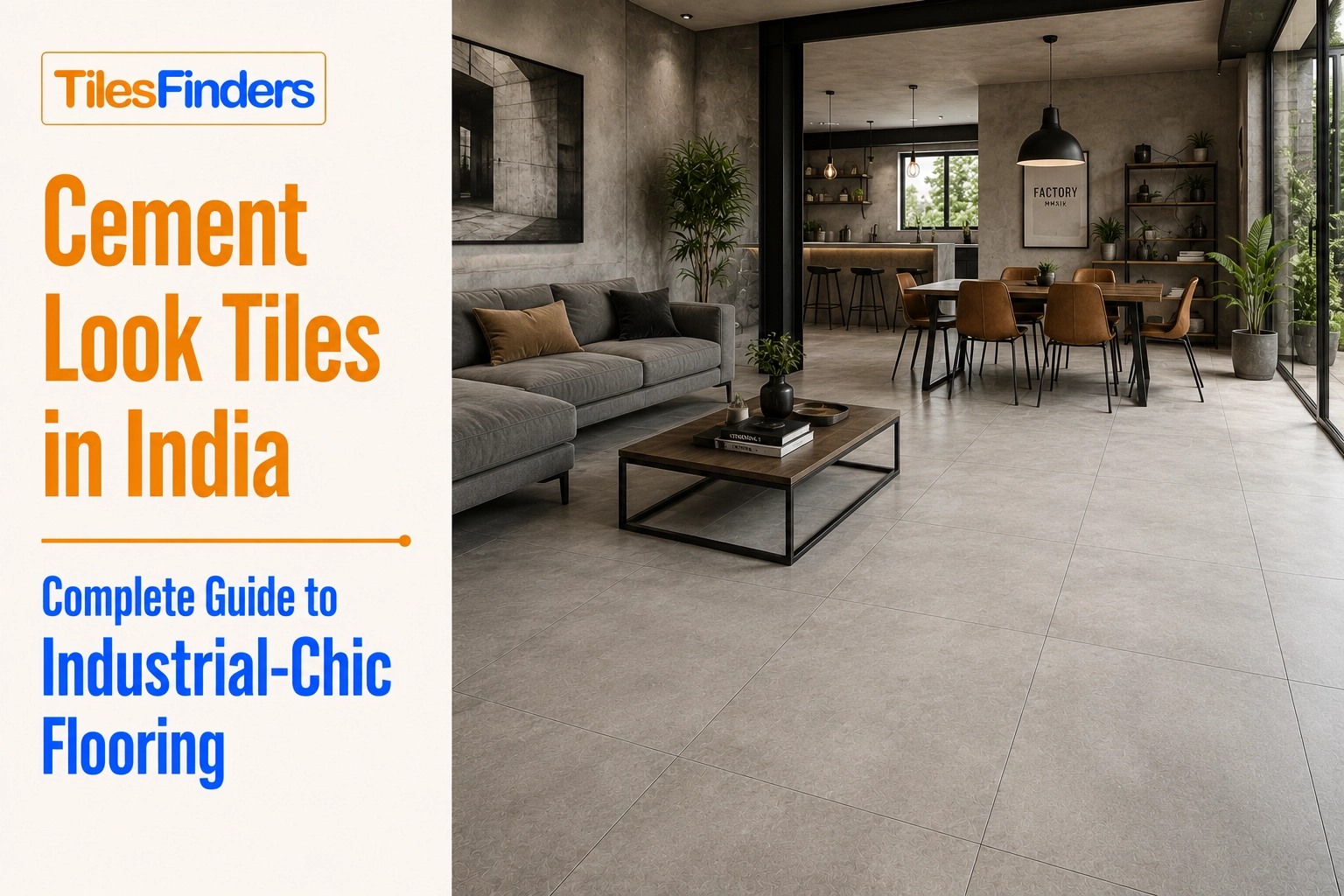
Cool Grey Cement Look
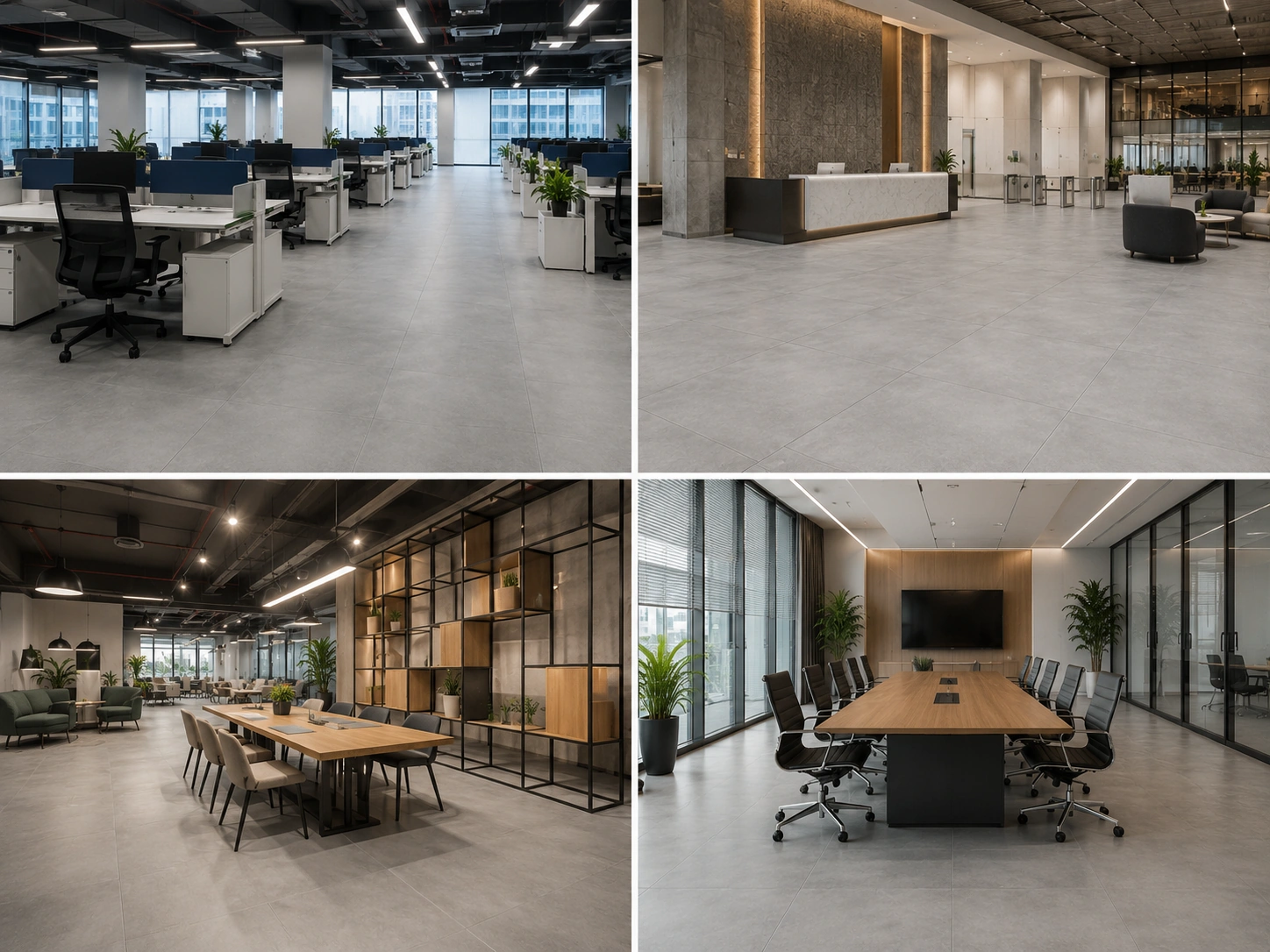
A neutral cool grey with a flat, even surface that reads as fresh industrial concrete. The most-used cement look in corporate offices, IT park lobbies, and co-working receptions. Available in 600x600 mm, 600x1200 mm, and 800x1600 mm from Morbi, Gujarat manufacturers.
Warm Ash Cement Look
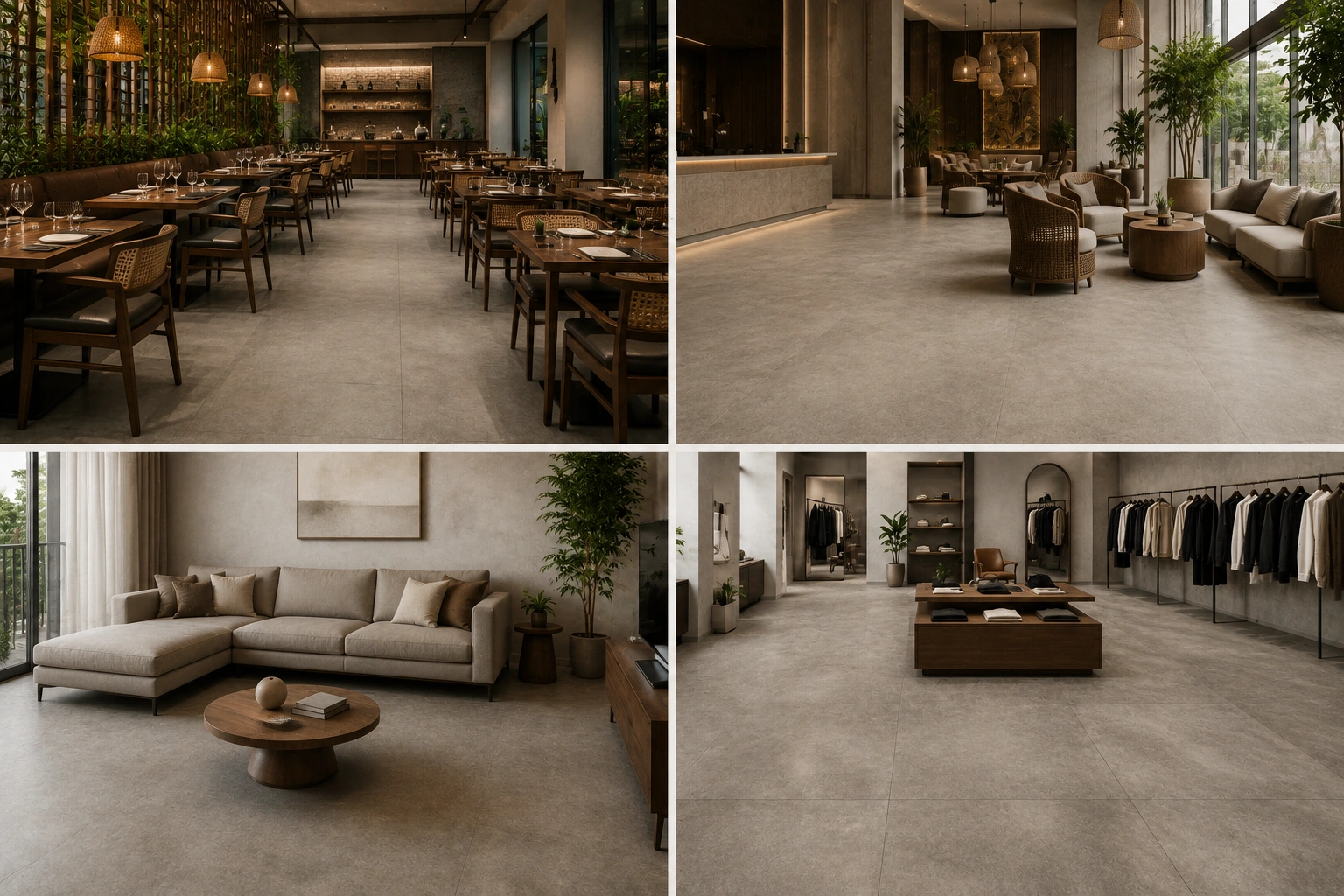
A slightly warm grey with brown undertones. Reads as aged concrete or industrial floor screed. Works well in restaurant interiors, boutique hotel common areas, and residential living rooms where the purely cool grey reads as too corporate.
White Cement Look
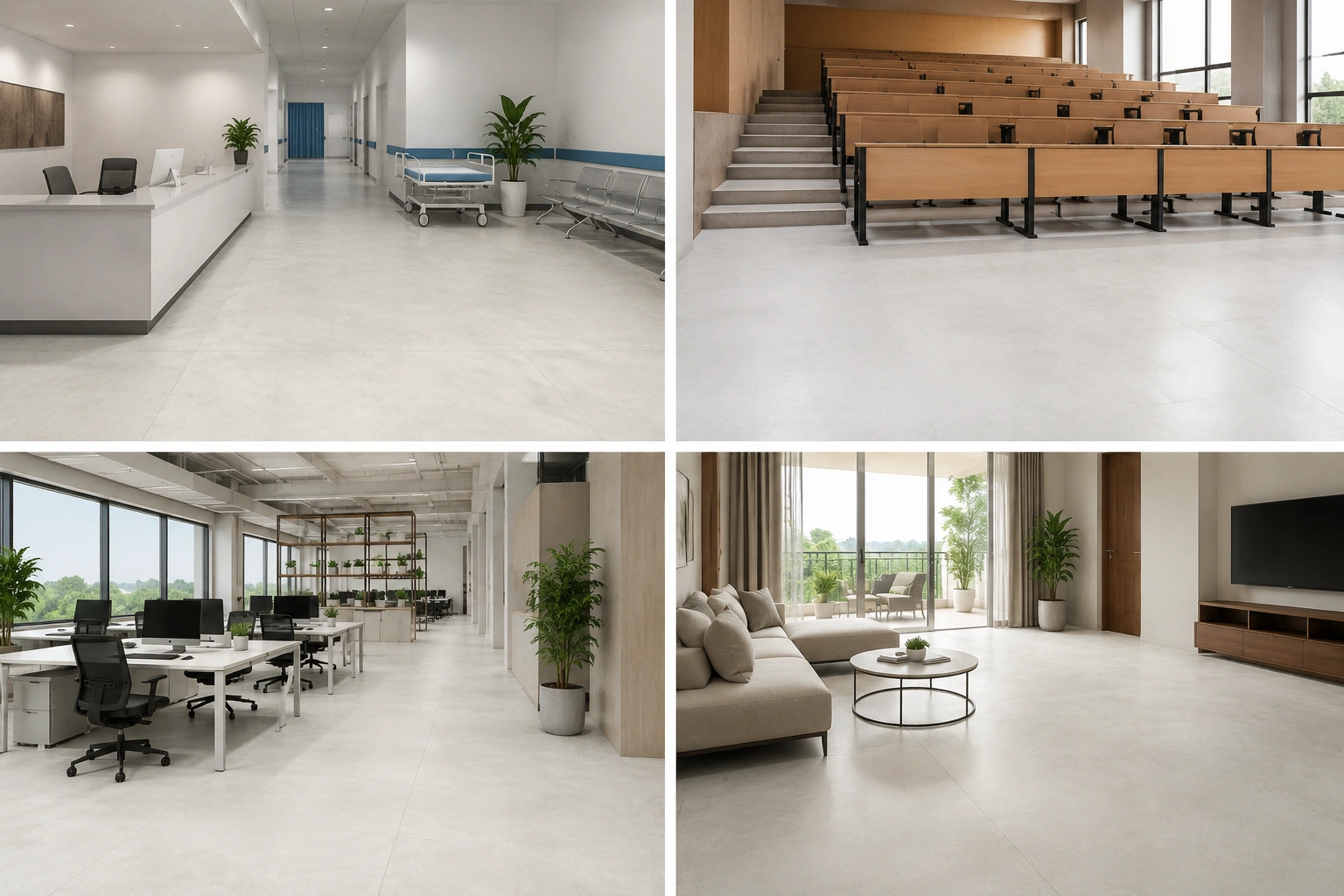
Light grey-white surface texture replicating freshly poured white cement. A softer version of the industrial palette that works in healthcare reception areas, education institutions, and open-plan offices, where a pure white tile would read as clinical rather than considered.
Charcoal and Dark Cement Look
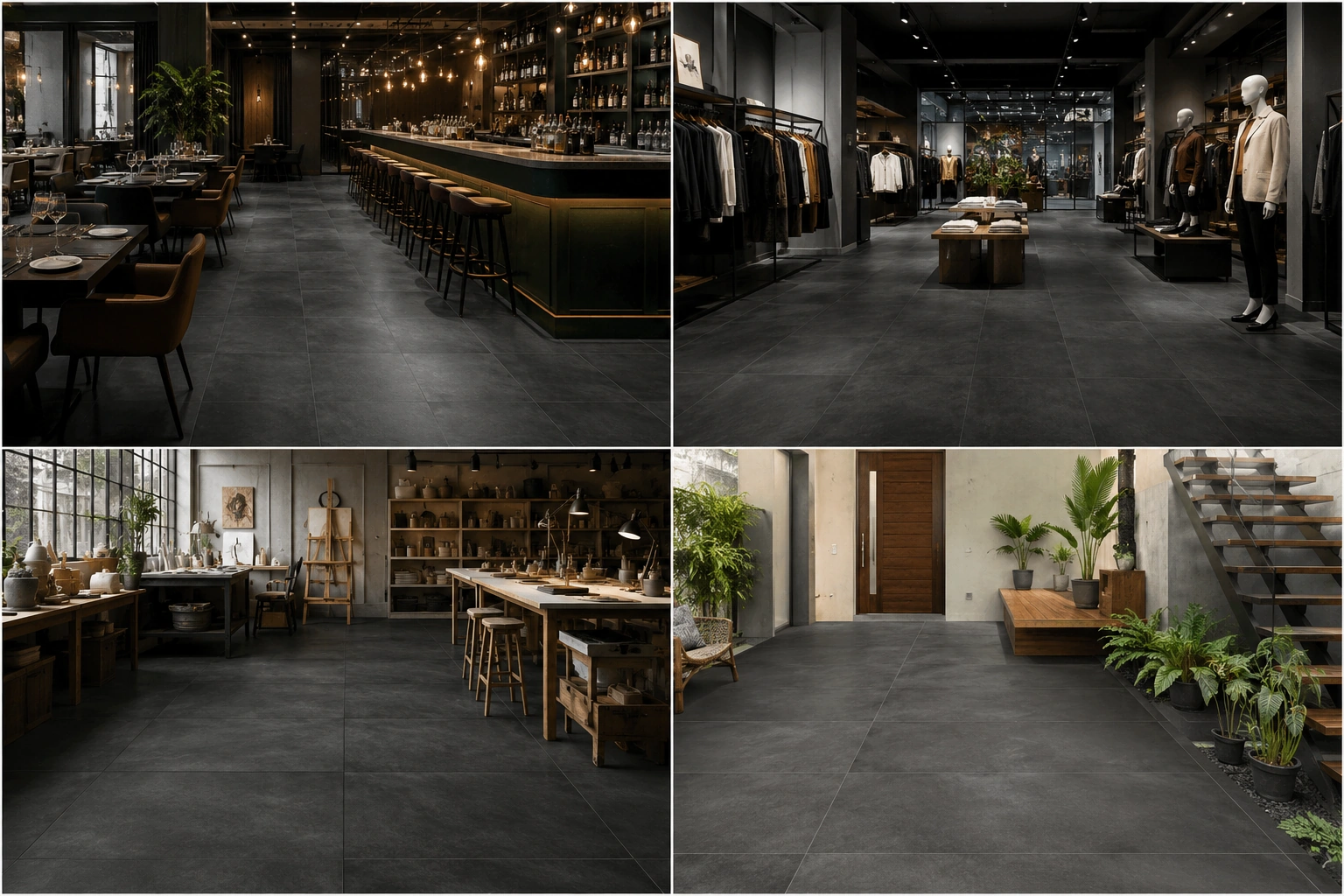
Dark grey to near-black cement look. Used in high-contrast interiors and spaces where a darker floor creates a deliberate visual anchor. Restaurant bars, retail flagships, and creative studio spaces use dark cement look GVT to create a ground-plane that recedes visually and makes objects and people above it stand out.
Patterned Cement Look (Cement Tile Effect)
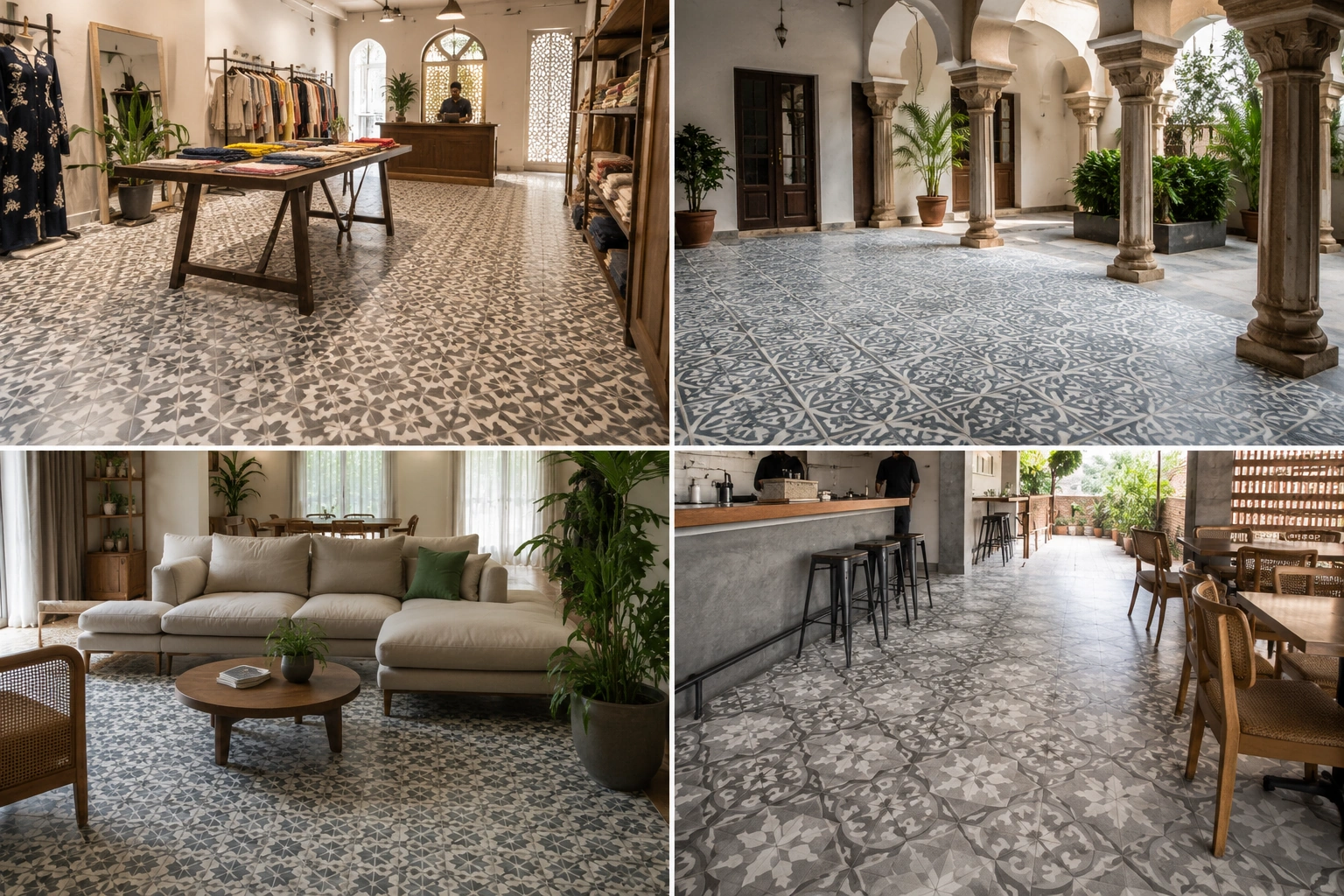
A GVT version of traditional patterned cement tiles.. These carry a geometric or Moorish pattern printed in the concrete look finish. Used in boutique hospitality, heritage restoration projects, and residential feature areas where the encaustic aesthetic is required without the fragility and maintenance of handmade cement tiles.
Finish Options for Cement Look Tiles
| Finish | Appearance | Slip Safety | Commercial Floor Use | Best Application |
| Matte | Completely flat, stone-dry surface texture. Most authentic concrete read. | Safe - low reflectance | Yes - all floor types | Office floors, reception areas, hospitals, restaurants |
| Sugar (Satin) | Very fine texture, controlled micro-sheen. Slightly warmer than matte. | Safe | Yes | Boutique hotel floors, premium retail, residential |
| GHR (Half Polish) | Controlled gloss on the cement-look surface. Changes the industrial read. | Use with caution in wet zones | Dry interior zones only | Accent walls, dry interior commercial zones |
| Polished | Mirror surface. Contradicts the cement aesthetic entirely. | Not safe wet | Not for floors | Wall cladding only - rarely specified in cement look |
Design principle: The cement aesthetic is built on the contradiction between a natural industrial material and a refined, intentional space. The matte finish is the only finish that preserves this contradiction. A polished cement-look tile looks neither like concrete nor like polished stone - it falls between both and loses the design intent entirely.
Cement Look Tile Sizes: Which Format for Which Space
600x600 mm (24x24 inches - versatile square format)
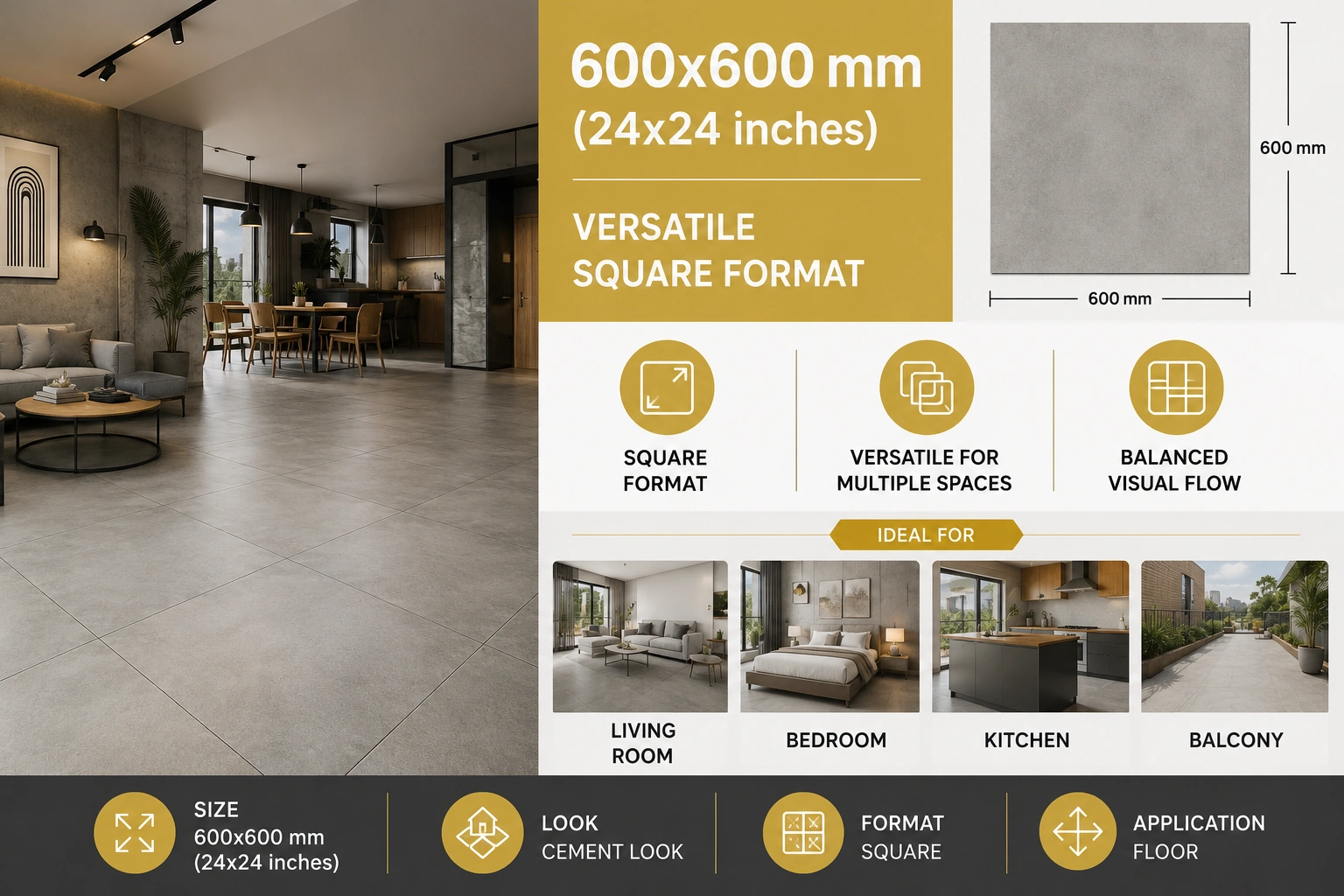
Weight approx.: Widest design availability; most manufacturers produce cement look in this size
The standard format for residential cement look floors and commercial applications below 500 sq.ft. A 600x600 mm cement look tile in a running bond or stack bond lay with matching grout creates a floor that reads as continuous concrete screed in compact spaces.
Use when: Budget is a priority, the floor area is below 500 sq. ft., or the design intent is a traditional encaustic-style grid with visible joints as part of the aesthetic.
600x1200 mm (24x48 inches - rectangular large format)
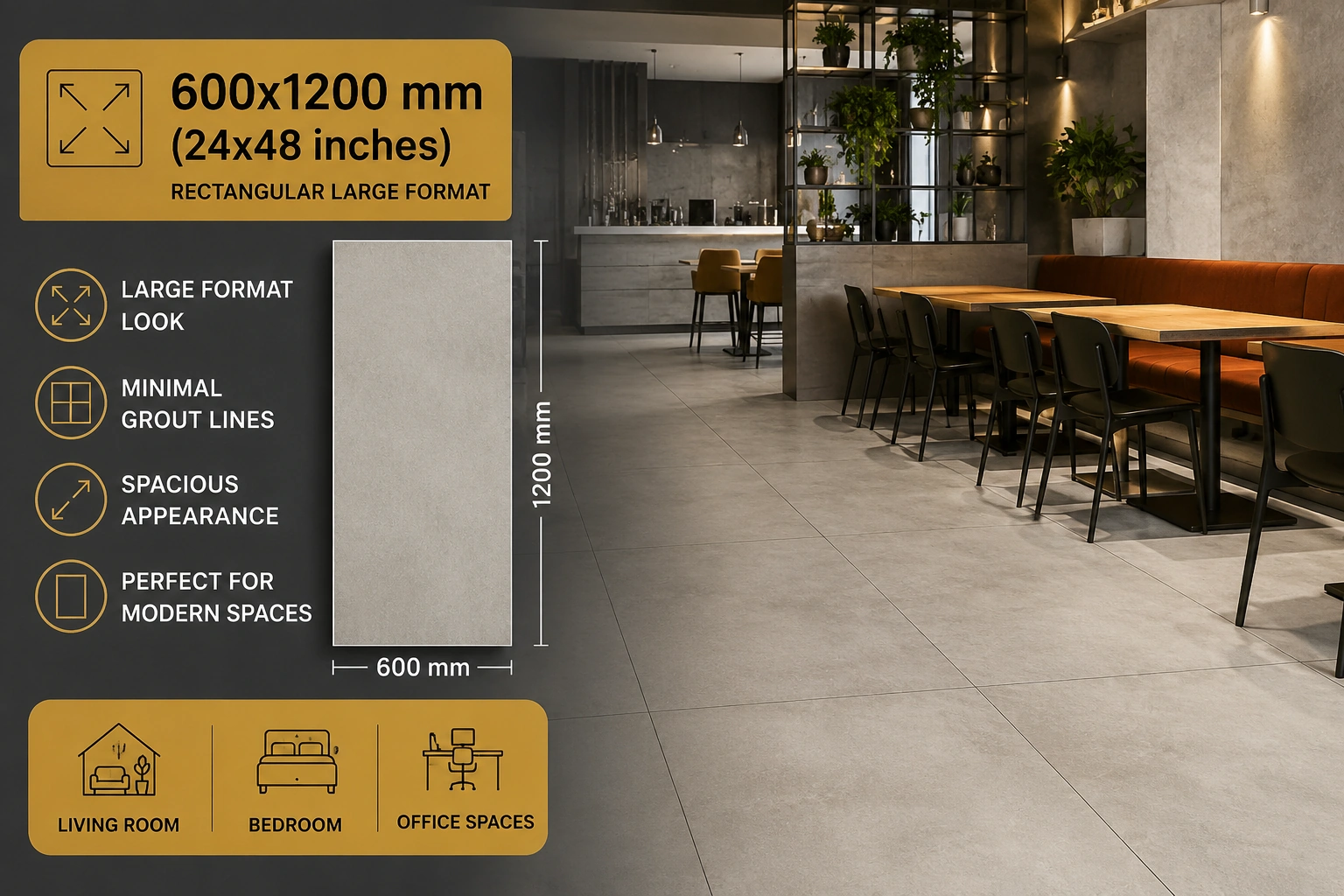
Weight approx.: Cement look designs available from most Morbi manufacturers in grey, ash, and white tones
The correct format for commercial cement is found in office receptions, restaurant dining areas, and co-working entry zones. The 600x1200 mm format reduces grout intersections and creates a more continuous surface reading than 600x600 mm. Running bond lay in this size replicates the poured concrete panel aesthetic that architectural concrete flooring uses.
Use when: Commercial floor between 200 and 1,000 sq. ft., budget-conscious large-format specification, or a co-working and office application where the 800x1600 mm handling cost is not justified.
800x1600 mm (32x64 inches - premium large format)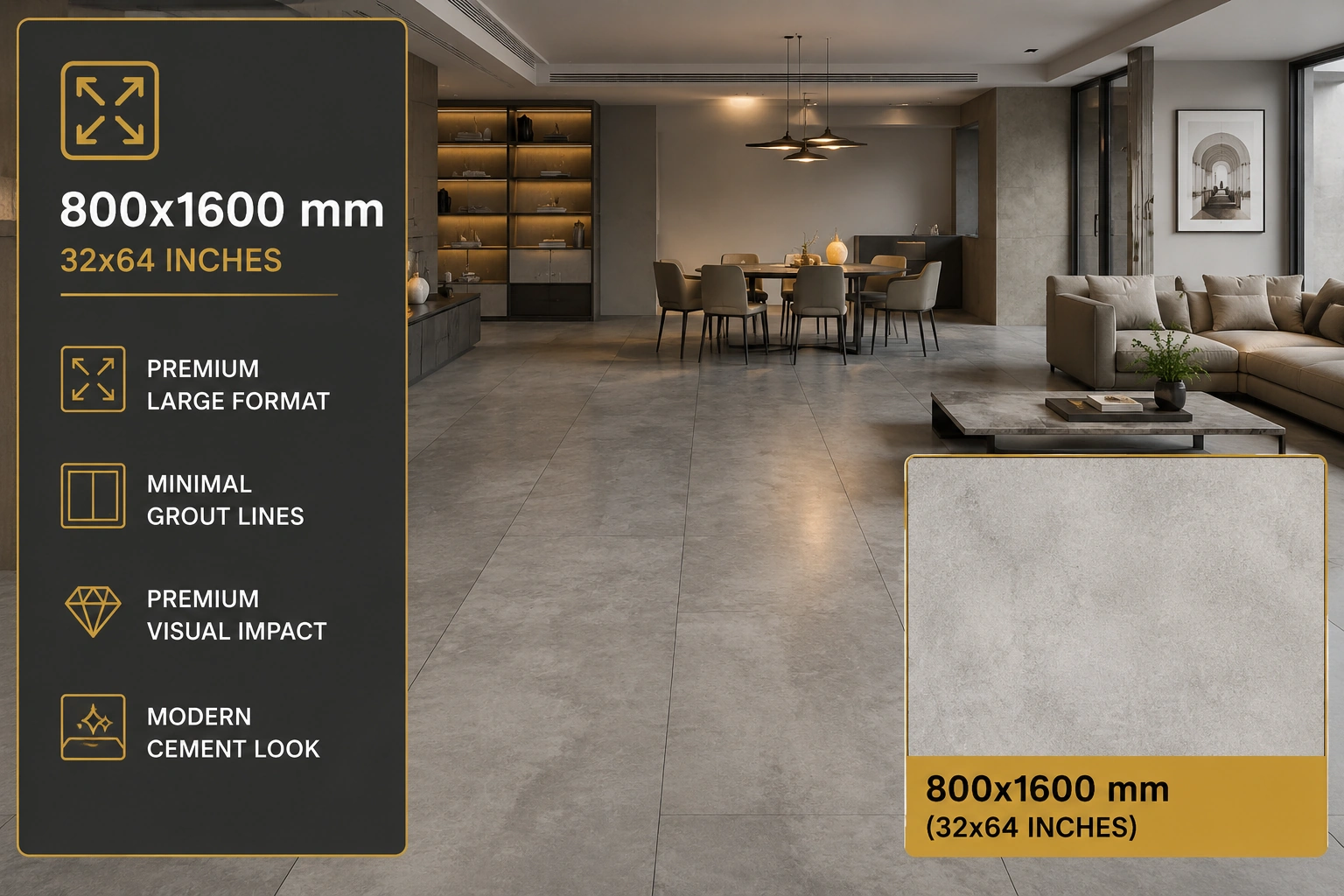
Weight approx.: Cement looks available in cool grey, warm ash, and charcoal from mid-to-large Morbi manufacturers
The specification for premium cement looks good for applications in large commercial receptions, co-working main floors, and restaurant group interiors. At 800x1600 mm, the concrete look reads as an architectural slab rather than a tiled surface. Grout intersections drop below 60 per 1,000 sq. ft., and the floor's industrial character is achieved with a precision that smaller formats cannot match.
Use when: Large commercial floor above 500 sq. ft., design intent is architectural industrial (concrete panels, not tile grid), or the project budget supports the higher installation cost.
Where Cement Look Tiles Work in Indian Commercial and Residential Buildings
| Application | Recommended Size | Finish | Design Note |
| Co-working reception and lobby | 800x1600 mm or 600x1200 mm | Matte | Cool grey or warm ash. Large format reads as architectural. |
| Restaurant dining area | 600x1200 mm | Matte or Sugar | Warm ash or patterned cement look. Grout in a matching tone. |
| Office open floor (post-2022) | 600x1200 mm or 800x1600 mm | Matte | Cool grey. Stack bond lay for a clean, corporate grid. |
| Retail flagship (creative brands) | 800x1600 mm | Matte | Charcoal or cool grey. Background for product display. |
| Residential living room | 600x600 mm or 600x1200 mm | Matte or Sugar | Warm ash or white cement look. Pairs with natural wood furniture. |
| Kitchen floor | 600x600 mm | Matte | Avoid GHR or sugar in the kitchen - matte is safer and easier to clean. |
| Bathroom floor | 300x600 mm or 300x300 mm | Matte (minimum R10) | White or light grey cement look. Confirm R10 slip rating. |
| Outdoor terrace | 600x600 mm outdoor-rated | Matte (R11 minimum) | Confirm the tile is rated for exterior use and frost-resistance if needed. |
Pro tip: Cement look tiles work best when the grout colour is chosen to match or blend with the tile rather than contrast with it. A cool grey cement look tile with charcoal grout creates a continuous surface reading. The same tile with white grout creates a visible grid that contradicts the concrete aesthetic. Ask your tile supplier for grout samples in the same grey family as the tile before finalising the grout specification.
Cement Look Tiles vs Real Concrete Flooring: What Builders in India Should Know
| Factor | Cement Look GVT | Real Polished Concrete | Real Cement Screed |
| Installation | Standard tile contractor | Specialist concrete polisher | Specialist screed contractor |
| Sealing required | No | Yes - annual | Yes - every 2-3 years |
| Maintenance | Mop with commercial detergent | Specialist buffing, annual seal | Periodic sealing and patching |
| Colour consistency | High - digital print is consistent | Variable - concrete has inherent variation | Variable - batch mixing affects tone |
| Repair the damage | Replace individual tiles | Patch and re-polish - visible repair | Patch visible, colour variation likely |
| Water resistance | Excellent - 0.05% absorption | Good when sealed | Poor when unsealed |
| Price (installed) | Rs. 120 to Rs. 300/sq.ft total | Rs. 250 to Rs. 500/sq.ft | Rs. 150 to Rs. 350/sq.ft |
| Lead time | Immediate from Morbi stock | 2 to 4 weeks for large areas | 3 to 6 weeks |
Verdict: For commercial projects in India where the concrete aesthetic is the brief, cement look GVT is the practical standard. Real polished concrete is a viable choice for flagship projects with the budget for specialist installation and an annual maintenance contract. Cement screed is appropriate for specific architectural applications but requires ongoing sealing that most commercial building management teams are not set up to maintain.
Common Mistakes When Using Cement Look Tiles
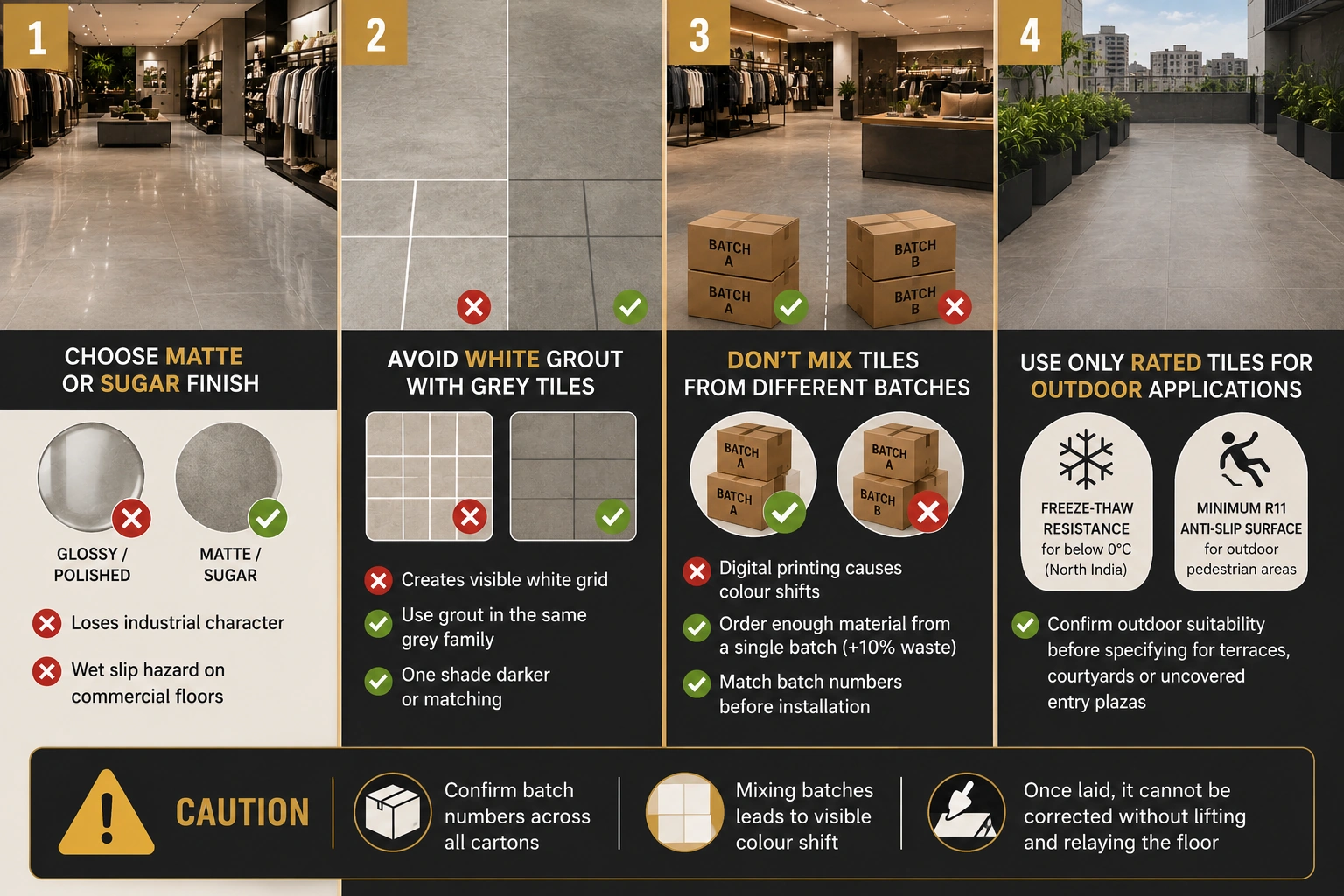
Mistake 1: Choosing a Glossy or Polished Finish
Polished or GHR cement look tiles lose the industrial character that makes the design work. More importantly, any finish above matte or sugar is a wet slip hazard on a commercial floor. Matte or sugar finish, every time.
Mistake 2: White Grout with Grey Cement Look Tiles
White or off-white grout with a grey cement look tile creates a visible white grid that makes the floor read as tiled rather than as continuous concrete. Choose a grout in the same grey family as the tile, one shade darker or matching.
Mistake 3: Mixing Cement Look Tiles from Different Batches
Digital printing means that GVT cement look tiles from different production batches can have slight colour shifts. In a uniform grey surface, a colour shift between batches is more visible than in a marble-look or patterned tile. Order enough material from a single batch to complete the floor, adding 10% for wastage. Always match the batch number before installation.
Caution: Confirm batch numbers across all cartons before tiling begins. Once half the floor is laid in one batch,h and the remainder is from a second batch, the colour shift becomes visible and cannot be corrected without lifting and relaying the entire floor.
Mistake 4: Using a Non-Rated Tile for Outdoor Cement Look Applications
Not all GVT cement look tiles are rated for outdoor use. Outdoor tiles must have a freeze-thaw resistance rating for locations that see temperatures below 0°C (applicable to parts of North India), and a minimum R11 anti-slip surface for outdoor pedestrian areas. Confirm the tile's outdoor suitability with the supplier before specifying for terraces, courtyards, or uncovered entry plazas.
Manufacturing and Pricing in the Indian Market
Cement look GVT is manufactured in Morbi, Gujarat, under IS 15622:2006, with water absorption at 0.05% or below. The 24x24 (600x600 mm) format costs Rs. 75 to Rs. 140 per sq.ft from Morbi factories in cool grey, warm ash, white, and charcoal cement look designs in matte finish. The 24x48 (600x1200 mm) format at Rs. 90 to Rs. 160 per sq.ft is available from most Morbi manufacturers and covers the commercial office and reception applications where a large-format cement look floor is the specification. Total installed cost, including adhesive, labour, and substrate preparation,n runs Rs. 130 to Rs. 250 per sq ft for 600x1200 mm on a flat commercial floor slab.
India's monsoon humidity and the seasonal temperature variation between air-conditioned commercial interiors and exterior ambient conditions make sealing a recurring cost burden for any flooring material that requires it. Cement look GVT produced in Morbi and Gujarat requires no sealing because the 0.05% water absorption rate of the vitrified body prevents moisture from penetrating the tile surface. The 32x64 (800x1600 mm) format at Rs. 130 to Rs. 220 per sq.ft from Gujarat's mid-to-large Morbi manufacturers gives commercial specifiers the option to deliver an architectural cement look floor without the substrate and maintenance demands of real polished concrete, even in India's most challenging monsoon conditions.
Find Cement Look Tiles Across Every Format and Budget
The concrete and industrial aesthetic in Indian commercial interiors has moved from a niche specification to a mainstream floor choice for offices, co-working spaces, restaurants, and creative brands. Browse TilesFinders to compare cement look GVT in 600x600 mm, 600x1200 mm, and 800x1600 mm formats, in cool grey, warm ash, charcoal, white, and patterned designs, with matte and sugar finish options and material pricing direct from Morbi, Gujarat manufacturers.
FAQs
Cement look tiles in India are manufactured as glazed vitrified tiles (GVT). The tile body is vitrified clay fired at 1,200 degrees Celsius, and the concrete texture and colour are applied as a digital print on the tile face. The result is a tile with water absorption of 0.05%, far lower than real cement or concrete.
Yes. Matte finish cement look GVT with PEI 4 or 5 rating is suitable for any commercial office or reception floor. The matte surface provides adequate slip resistance for dry and wet conditions, and the 0.05% water absorption rate means no sealing is required.
Cement looks GVT costs Rs. 75 to Rs. 140 per sq. ft in 600x600 mm and Rs. 90 to Rs. 160 per sq ft in 600x1200 mm from Morbi, Gujarat manufacturers. 800x1600 mm cement look GVT costs Rs. 130 to Rs. 220 per sq.ft. Installed cost, including adhesive and labour,r adds Rs. 50 to Rs. 80 per sq.ft.
No. Cement look GVT has a water absorption rate of 0.05%, which means moisture cannot penetrate the tile body. No sealing is required at installation or during the tile's service life. This is a major advantage over real polished concrete or cement screed floors in Indian conditions.
Use a mid-grey or charcoal epoxy grout that matches the tone of the tile. White grout with grey cement look tiles creates a visible white grid that undermines the continuous concrete appearance. Epoxy grout also prevents staining in high-footfall areas and does not require sealing.
Yes, in 300x600 mm or 300x300 mm matte finish with a minimum R10 slip resistance rating. Confirm the tile's slip rating before specifying for bathroom floors. Larger formats like 600x600 mm can be used in a dry bathroom zone, but are not recommended for the wet shower area without a confirmed R11 slip rating.
Handmade cement tiles (encaustic tiles) are porous, require sealing every 1 to 2 years, chip at edges, and are limited to indoor dry applications. Cement looks GVT absorbs 0.05% water, requires no sealing, is dimensionally consistent, and is suitable for commercial floors. The aesthetic is similar; the performance and maintenance are very different.
Yes. 600x1200 mm and 800x1600 mm cement look GVT is available from Morbi, Gujarat manufacturers in cool grey, warm ash, and charcoal designs. The 800x1600 mm format at Rs. 130 to Rs. 220 per sq.ft is available from mid-to-large Morbi factories with a 2 to 4 week lead time for commercial orders.

See our tile guides first
Set TilesFinders as a preferred source and our buying guides surface ahead of the rest for you.
Add as preferred sourceTakes one tap. Nothing to install.
What Readers Say
I was about to redo my parking area with the wrong tile size until I read this. The layout comparisons saved me from a costly mistake.
We reference TilesFinders guides while briefing clients on material selection. The size and pattern breakdowns are accurate and easy to explain visually.
On site, I get asked about grout spacing all the time. This article gave me a solid reference I now share with my team before every job.
Finally a guide that doesn't just push generic advice. The oil stain removal steps actually worked on our clubhouse driveway tiles.
I run a small construction firm and now send this link to clients directly when they ask about entrance tile sizing. Saves me an hour of explaining.
Good practical detail, though I wish there were more examples for compact apartment entrances specifically, not just villas.
My mother-in-law wanted marble, I wanted vitrified. This blog gave us the neutral comparison we needed to actually decide together.
Detailed without being overwhelming. I appreciated that it covered both cost and maintenance, not just the aesthetics.
Used the algae and hard water removal tips on our terrace tiles after the monsoon. Worked better than what our regular cleaner was doing.
As someone who sources tiles for multiple builder projects, I find these comparisons genuinely useful for vendor conversations, not just consumer content.
Recommended this to a client who kept second-guessing the entrance design. The small vs large layout section settled the debate instantly.
Straightforward and honest, no unnecessary jargon. Would like to see a similar breakdown for outdoor pool-deck tiles next.
We've bookmarked several TilesFinders guides for our design handbook. Reliable source when clients want data, not just opinions.
Two paths, one marketplace.
Get free quotes from verified suppliers.
Share your room, budget, and style. Suppliers in Morbi respond within hours.
Get Free QuotesList your business, reach real buyers.
Put your showroom in front of homeowners searching for tiles right now.
List Your Business