Best Marble Tiles Design for Living Room: Luxury Picks
Explore marble tiles design ideas for living rooms and halls. Compare marble types, tile sizes, finishes, pricing, and luxury floor and wall combinations for Indian homes.

- Why the Living Room and Hall Are the Right Places for Marble Tiles
- Marble vs Other Living Room Tiles: Where It Stands
- 22 Marble Tiles Design Ideas for Living Rooms and Halls in 2026
- Best Marble Tile Sizes for Indian Living Rooms and Halls
- Finish Options for Living Room and Hall Tiles: Polished, Matte and High Gloss
- Marble Tiles vs Vitrified Tiles for Living Room: Which Is Better?
- Marble Tiles Design for Small Living Rooms and Compact Halls
- Living Room Wall and Floor Tile Combination Ideas
- Hall Tiles Design: Specific Considerations for Indian Homes
- Living Room Tiles Price and Hall Tiles Price in India 2026
- Buying Tips Before You Choose Living Room and Hall Tiles
- Common Mistakes When Choosing Living Room Tiles and Hall Tiles
- Finding the Right Marble Design for Your Living Room and Hall
The living room is where most families in India spend the most time, host guests, and make the strongest impression on anyone who visits the home. The floor carries every conversation, every festival gathering, and every ordinary morning. Most things in the living room change over the years. The tiles for the living room floor usually do not.
That is why marble tiles for the living room remain the first choice in Indian homes across budget categories, from a standard 2BHK apartment in Pune to a 5,000 sq. ft. bungalow in Ahmedabad. When Indian homeowners think about hall tiles or living room tiles, marble comes up first, and for good reason. Marble floors reflect light, stay cool in Indian summers, and look substantially better in year ten than most other flooring materials do.
This guide covers the best marble tile design options for Indian living rooms and halls in 2026, the marble types that suit each design direction, size and finish guidance, how to approach a small living room versus a large hall, a clear comparison of natural marble versus marble-look vitrified tiles, and a full living room tile price reference to plan your project budget.
Why the Living Room and Hall Are the Right Places for Marble Tiles
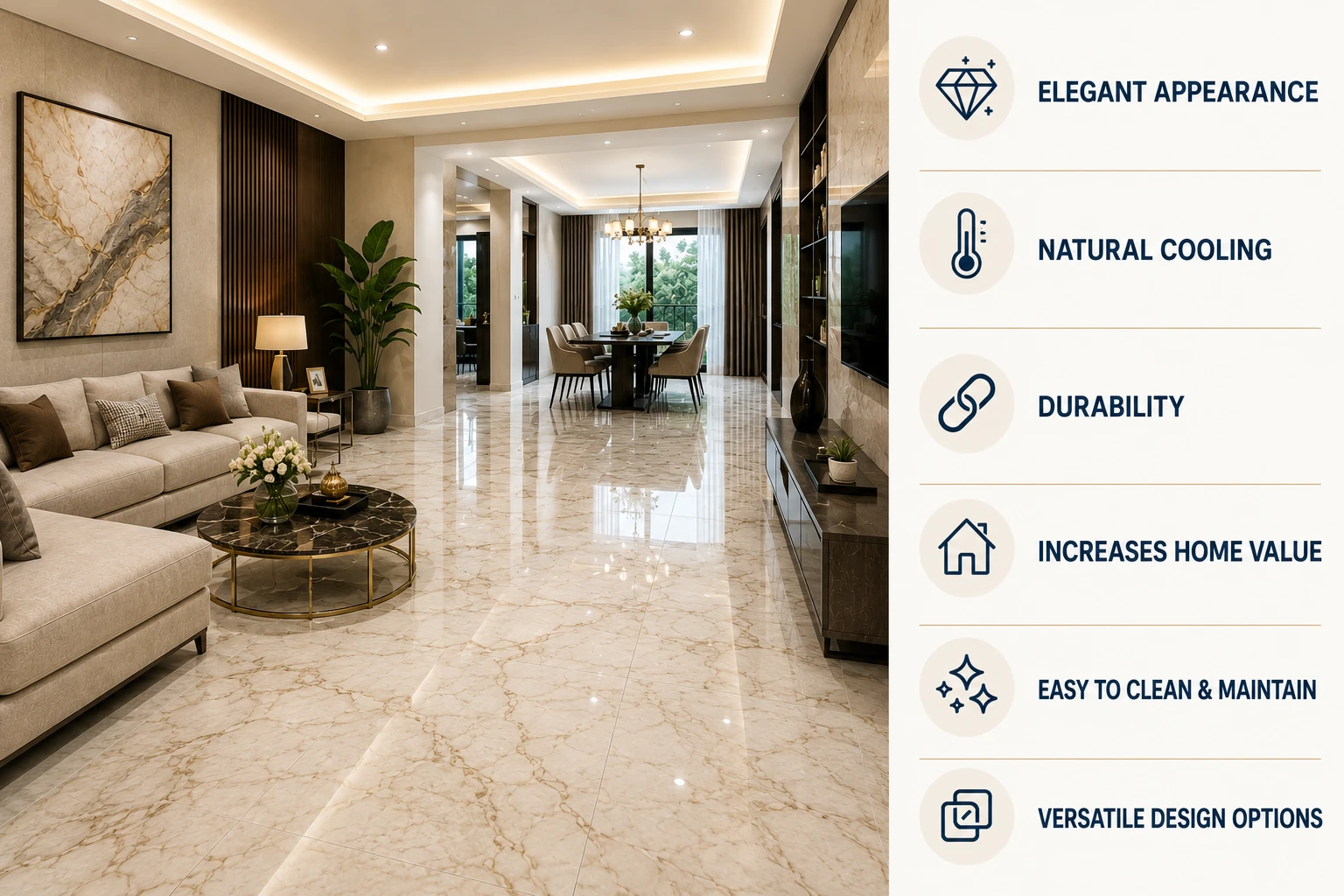
The living room and hall have the best conditions for marble flooring in any Indian home. These spaces see foot traffic but not the chemical spills and constant moisture of a kitchen or bathroom. They are the most visited spaces by guests, which means the marble's visual impact is maximised. And the controlled indoor environment means marble holds its finish longer with basic maintenance.
Choosing the right living room tiles is one of the most impactful decisions in any home renovation. The floor tiles for the living room set the tone for the entire interior. They define the space before the furniture, the walls, or any decor element does. In a hall, which functions as the transition zone between the entry and the rest of the home, hall tiles carry both an aesthetic and a functional role: they must look good and handle daily foot traffic from footwear, guests, and family alike.
Marble reflects both natural and artificial light. In Indian living rooms with standard 9 to 10 ft ceilings, a large-format polished marble floor visually opens up the room. The reflective flooring surface bounces ambient light upward, making the space feel taller and larger without any structural change.
Marble also stays cooler than most other flooring materials. In Indian summers , where temperatures inside apartments can reach 30 to 36 degrees Celsius even with fans running, a cool marble floor is a genuine comfort benefit, not just an aesthetic one. This is one reason marble flooring has stayed relevant in Indian homes for generations, despite the higher upfront cost compared to standard vitrified tiles for the living room.
The hall and living room are also where marble's visual character gets the most attention. The veining patterns, the depth of the stone, the way a bookmatched wall design mirrors across a feature wall behind the sofa, these are details that get noticed in a living space in ways they simply would not in a bedroom or utility area.
Marble vs Other Living Room Tiles: Where It Stands
Not every homeowner is ready to commit fully to natural marble for their living room or hall. Understanding how marble tiles compare to the other main categories of living room tiles helps clarify where marble belongs in a flooring decision.
| Factor | Marble Tiles | Vitrified Tiles for Living Room | Marble Effect Vitrified (PGVT) | Porcelain Tiles |
| Visual appeal | Highes,; unique natural depth | Good range of designs; consistent | Very close to marble at a distance | Good; mostly matte look |
| Durability for hall use | Indian marble is very strong; Italian softer | Very good; suited for high-traffic hall floors | Good; harder than natural marble on the surface | Moderate; 2 to 5% water absorption |
| Maintenance | Sealing required; pH neutral only | Low; wipe clean; no sealing | Very low; no sealing; mild cleaner | Low; matte hides marks well |
| Living room tile price in India | Rs. 40 to Rs. 4,000+ per sq. ft. | Rs. 60 to Rs. 150 per sq. ft. | Rs. 60 to Rs. 250 per sq. ft. | Rs. 90 to Rs. 220 per sq. ft. |
| Best for hall tiles application | Indian marble; strong for daily hall foot traffic | GVT matte or GHR finish; high traffic hall | Marble look for hall; polished PGVT suits dry entry zones | Light-use residential halls; not heavy commercial |
For most Indian living rooms and halls, vitrified tiles (GVT or PGVT) in a marble finish give the best balance of appearance, durability, and daily ease. Natural marble in the living room makes the most sense for showcasing drawing rooms and formal spaces where the stone's depth and prestige matter most.
22 Marble Tiles Design Ideas for Living Rooms and Halls in 2026
The way marble tiles are selected, laid, and combined determines how the living room and hall read as a whole. The same white marble can produce a minimal modern interior or a classic Indian drawing room, depending on size, layout, finish, and what accompanies it.
White and Grey Marble Designs for Living Rooms
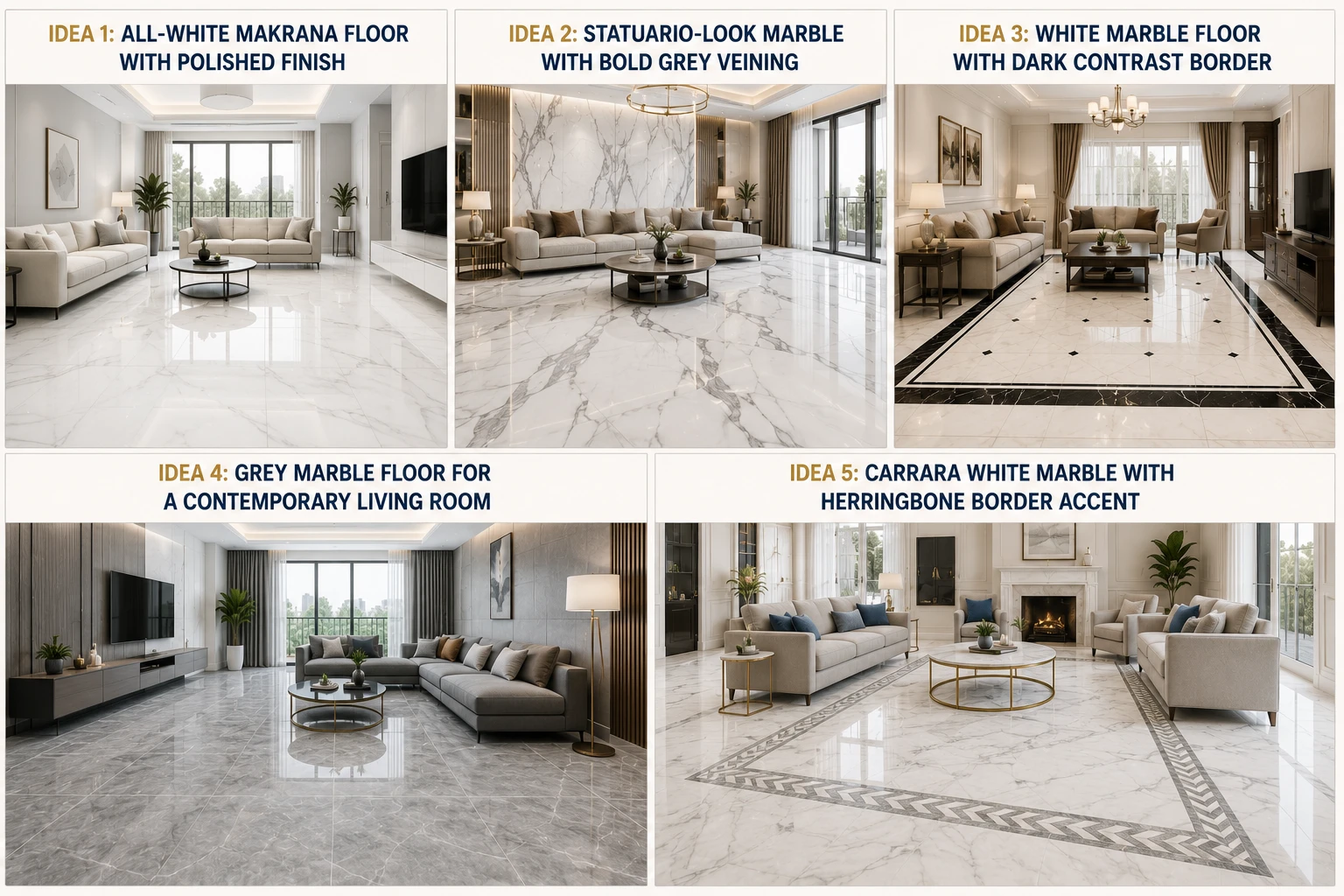
Idea 1: All-white Makrana floor with polished finish: A full Makrana white marble floor in 600x1200 mm (2x4) tiles with a polished finish and 2 mm rectified grout lines. The reflective flooring surface catches the morning light in east-facing Indian living rooms and makes the space feel at least a third larger than its actual dimensions. This tile design for the living room pairs well with light grey walls and minimalist furniture for a contemporary minimalist marble flooring effect.
Idea 2: Statuario-look marble with bold grey veining: A PGVT tile in a Statuario finish in 800x1600 mm (32x64) gives the look of Italian marble at a fraction of natural stone cost. The bold grey veining on a bright white base creates a modern luxury living room feel without the sealing commitment of real Italian stone. This is the most popular marble-effect vitrified tile design in Indian living rooms and halls in 2026.
Idea 3: White marble floor with a dark contrast border: A white or cream marble floor in 600x600 mm (2x2) with a 3 to 4-inch border in Nero Marquina or dark grey marble along the room perimeter. The border visually defines the living room or hall floor and gives a finished, framed quality that plain marble floors lack.
Idea 4: Grey marble floor for a contemporary living room: Grey marble tiles in 600x1200 mm with subtle white veining give a calmer, contemporary feel than stark white. Grey is one of the most popular hall tile colours in urban Indian apartments because it suits both dark wood and light Scandinavian-influenced furniture and hides everyday dust better than white.
Idea 5: Carrara white marble with herringbone border accent: A straight-laid Carrara or Carrara-look marble floor with a herringbone-pattern marble inlay strip in a contrasting tone as a border within the room, not just at the perimeter. This creates a classic Italian-inspired interiors feel, popular in modern hall flooring ideas for bungalows and premium apartments.
Beige and Warm Tone Marble Designs
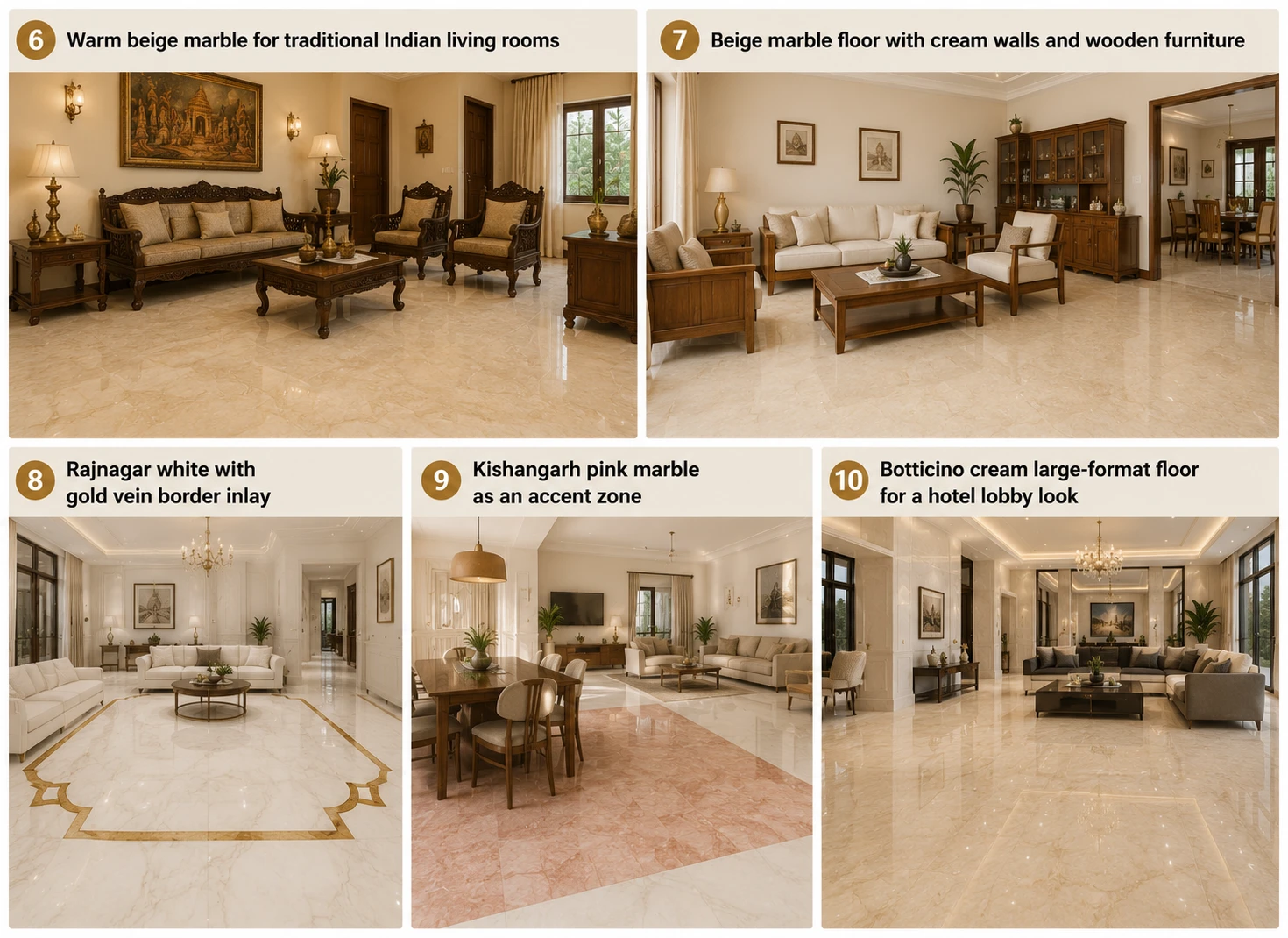
Idea 6: Warm beige marble for traditional Indian living rooms: Katni beige or Botticino marble in 600x600 mm or 600x1200 mm with a polished finish suits warm, wood-heavy interiors typical of traditional Indian drawing rooms. Beige is a consistently popular hall tile colour in North and South Indian homes because it absorbs warm light from brass lamps and yellow LEDs beautifully.
Idea 7: Beige marble floor with cream walls and wooden furniture: A monochromatic warm scheme using beige marble tiles, cream or off-white walls, and teak or walnut furniture produces a rich, layered interior without any bold colour. This timeless living room flooring idea is popular in South Indian and Gujarati homes, where natural materials dominate.
Idea 8: Rajnagar white with gold vein border inlay: A Rajnagar white marble floor with a hand-cut gold or yellow marble inlay strip near the centre of the hall or living room creates a focal point. This traditional marble floor border design is common in architect-designed Indian bungalows and is seeing a modern revival in premium apartment renovations.
Idea 9: Kishangarh pink marble as an accent zone: In open-plan Indian living and dining areas, using Kishangarh pink marble tiles to define the dining zone while keeping white marble in the seating area creates a visual separation without any wall. The warm tones in natural light are subtle and elegant.
Idea 10: Botticino cream large-format floor for a hotel lobby look: Botticino marble in 800x1600 mm laid in a straight grid with minimal grout lines gives the living room of a large Indian bungalow the look and feel of a premium hotel lobby. This is a well-established hall tiles design for India's larger standalone homes and villas.
Dark Marble and Contrast Designs
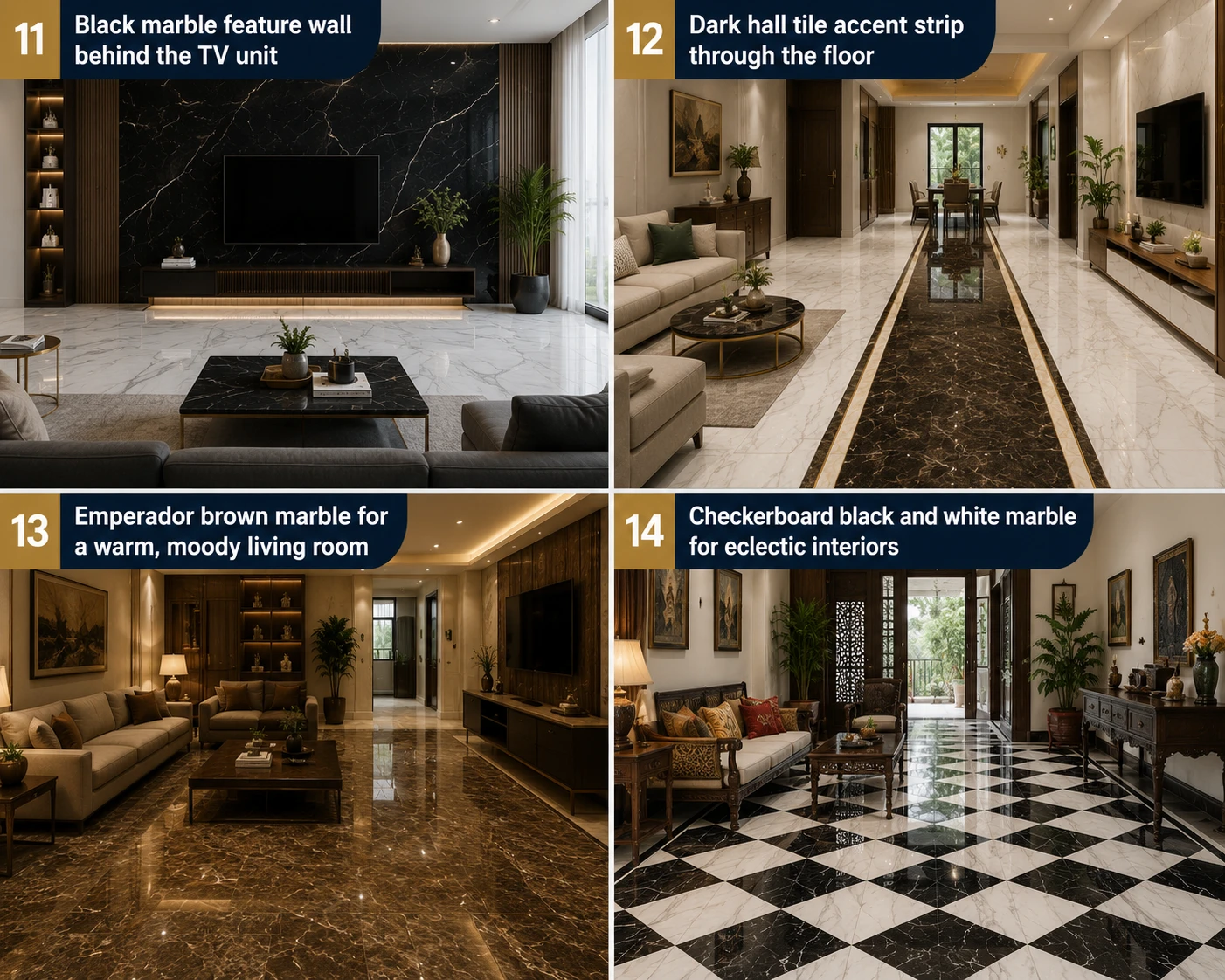
Idea 11: Black marble feature wall behind the TV unit: A floor-to-ceiling Nero Marquina or black marble wall behind the TV unit, with white marble on the floor, is one of the strongest living room tile combinations in contemporary Indian interiors. This dark hall feature wall works in rooms with a minimum width of 14 ft to avoid the wall feeling oppressive.
Idea 12: Dark hall tile accent strip through the floor: A 2 to 3-tile-wide strip of dark marble tiles running lengthwise through the centre of a living room or hall floor, flanked by white or beige marble on both sides. This creates a strong visual axis that suits long, rectangular halls and draws the eye toward the main seating area.
Idea 13: Emperador brown marble for a warm, moody living room: Emperador brown Italian marble on the floor of a living room paired with cream walls and amber-toned lighting creates a warm, intimate atmosphere. This combination suits a media room or a second living room in a 4BHK or 5BHK home.
Idea 14: Checkerboard black and white marble for eclectic interiors: A classic checkerboard floor using 600x600 mm white and black marble tiles laid diagonally. This hall tile design idea has a heritage quality that suits traditional Indian furniture, vintage collectables, and eclectic styling in large, high-ceilinged rooms.
Marble Floor Border and Pattern Designs
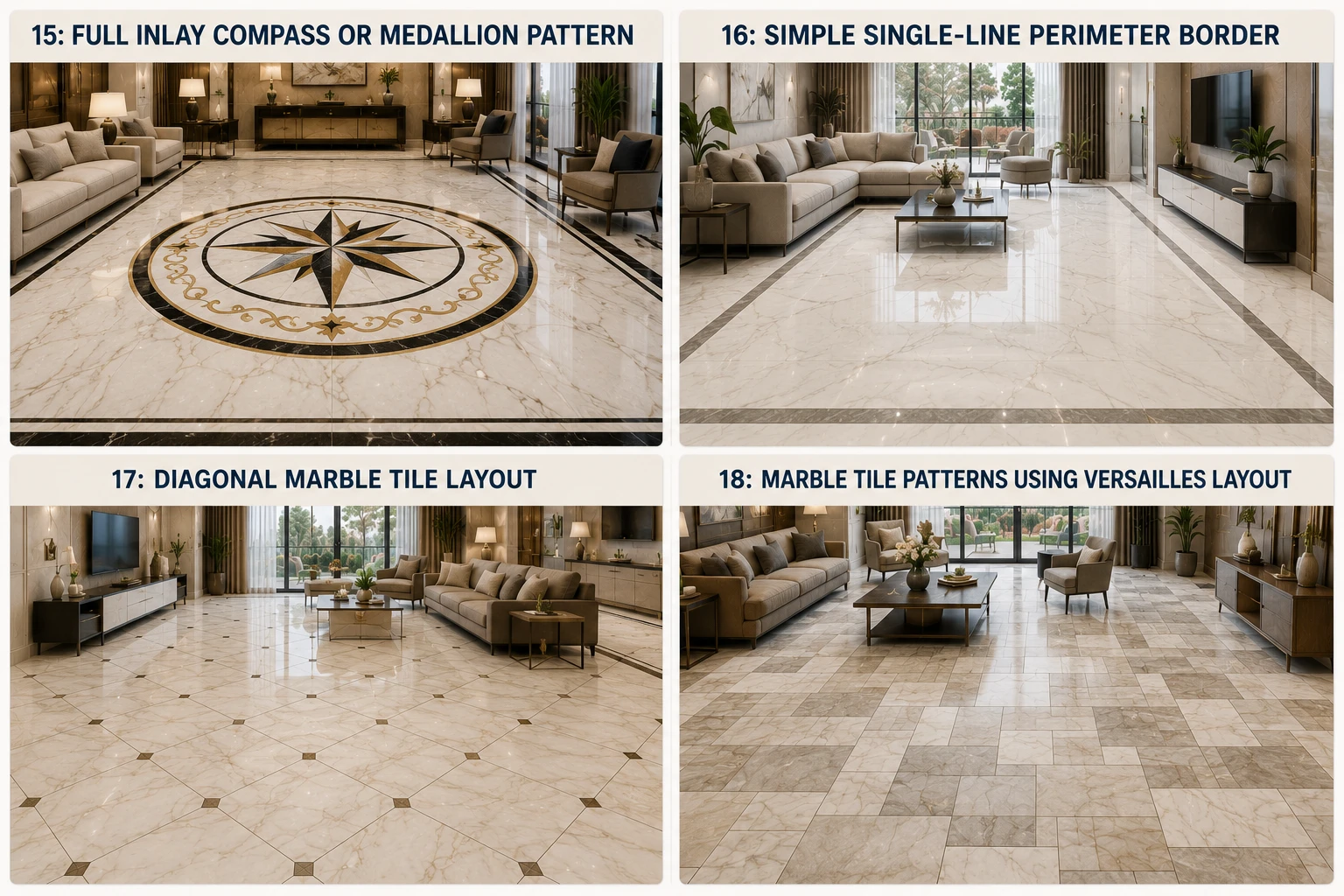
Idea 15: Full inlay compass or medallion pattern: A hand-cut marble medallion at the centre of the living room floor using contrasting marble types. Typically 4 to 6 ft in diameter, using white, beige, black, and gold marble pieces. This is the most premium floor tile design for hall and large living rooms, almost exclusively used in standalone bungalows.
Idea 16: Simple single-line perimeter border in contrasting marble: A single row of contrasting marble tiles around the room perimeter (typically 6 to 8 inches wide) gives the floor a finished, intentional look. A white marble floor with a grey or beige border works in most Indian living rooms and hall sizes from 150 sq. ft. upward.
Idea 17: Diagonal marble tile layout for a wider room feel: Standard 600x600 mm marble tiles laid at a 45-degree diagonal angle. The diagonal creates a wider visual effect in rectangular halls, especially those that are longer than they are wide. Common in Indian apartments where the hall is 12 to 14 ft wide.
Idea 18: Marble tile patterns using Versailles mixed-size layout: A mix of 600x600 mm, 600x1200 mm, and 300x600 mm marble tiles arranged in a random Versailles pattern. This gives the floor an organic, natural look that resembles traditional Indian haveli flooring and works well as a hall tile design in bungalows and heritage homes.
Marble Wall Tiles for Living Rooms and Halls
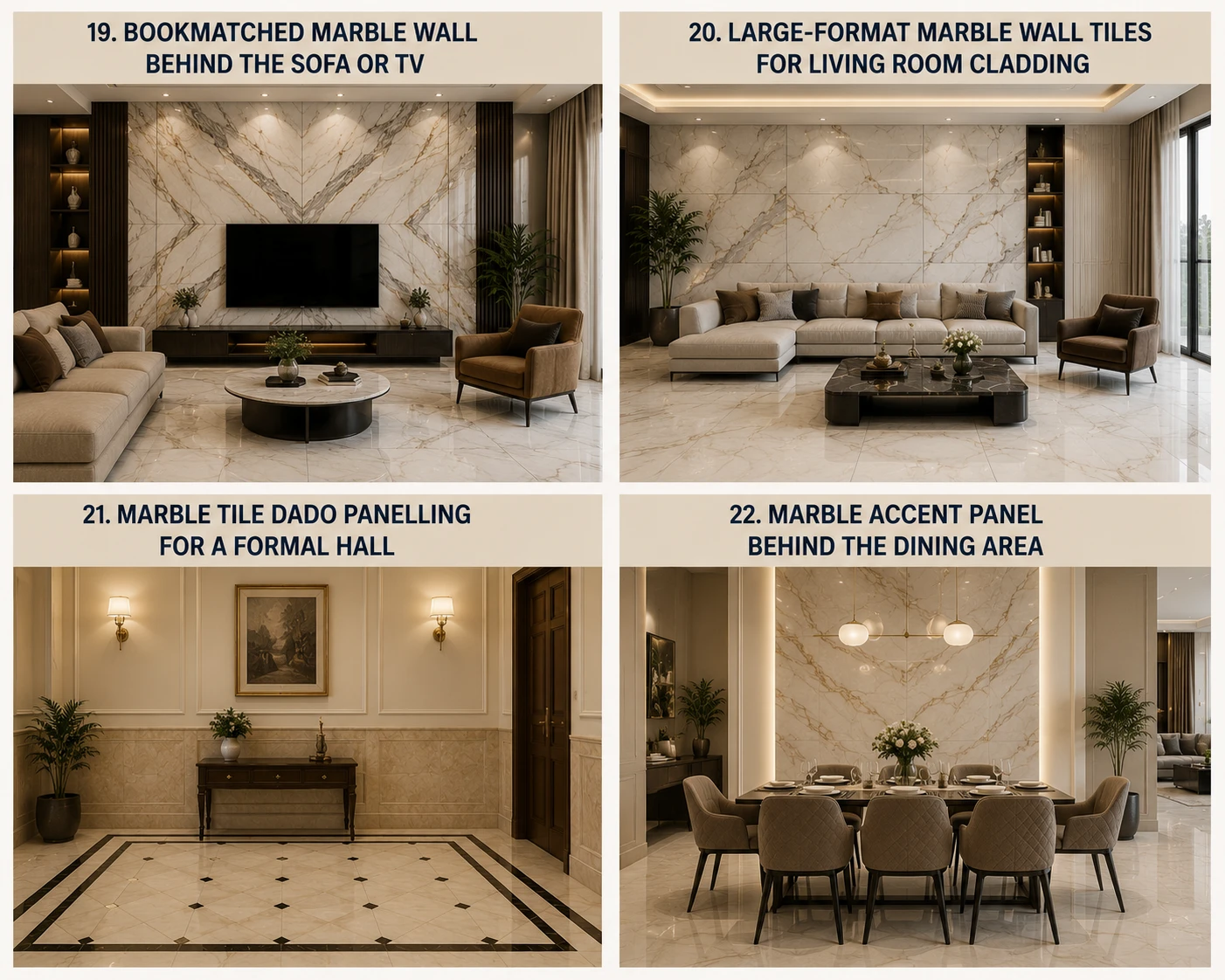
Idea 19: Bookmatched marble wall behind the sofa or TV: A bookmatch marble tiles wall design where two or four matching marble slabs are placed side by side to create a mirror-image vein pattern. This is the most architecturally striking application of marble wall tiles for the living room. Best done with Italian marble in 800x1600 mm (32x64) or 1200x1800 mm (6x4) format.
Idea 20: Large-format marble wall tiles for living room cladding: Full wall cladding using 600x1200 mm (2x4) or 800x1600 mm (32x64) marble wall tiles on the main feature wall. Fewer tiles mean fewer grout lines, and the wall reads as a single surface. This living room wall and floor tile combination using matching or complementary marble creates a high-end interior look that is hard to achieve with any painted surface.
Idea 21: Marble tile dado panelling for a formal hall: A marble dado (the lower wall portion, typically 3 to 4 ft high) using 300x600 mm marble tiles as wall cladding, with painted plaster above. This is a traditional Indian interior detail that gives formal halls and drawing rooms a rich, layered character. White or beige marble is most common for this hall tile design.
Idea 22: Marble accent panel behind the dining area: In open-plan Indian homes where living and dining share a room, a marble wall panel behind the dining table anchors the dining zone. This wall tile for the ,living room application uses a single large slab or a set of 600x1200 mm tiles that complement the hall flooring tiles below.
Best Marble Tile Sizes for Indian Living Rooms and Halls
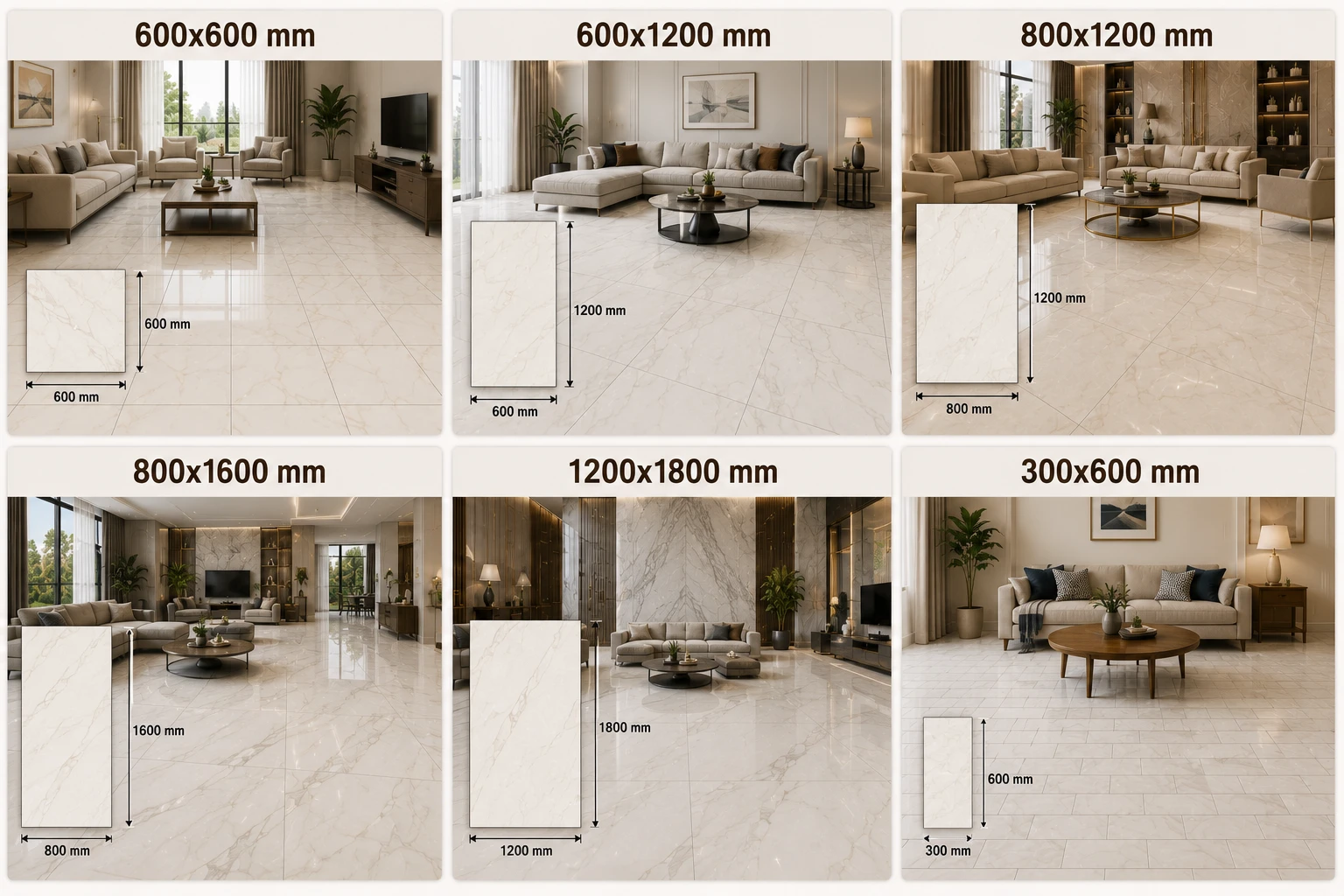
Size is one of the most impactful decisions in living room tiles design and hall floor tiles selection. Larger tiles mean fewer grout lines and a more seamless appearance. But the right size also depends on the room's actual dimensions.
| Tile Size (mm) | Size Name | Best Living Room / Hall Tiles Application |
| 600x600 mm | 2x2 | Standard living rooms up to 200 sq. ft.; works for border tiles alongside larger formats; suitable for diagonal pattern floor tiles design for the hall |
| 600x1200 mm | 2x4 | Most popular size for living room floor tiles and hall floor tiles in India 2026; suits rooms from 150 to 400 sq. ft.; reduces grout lines significantly versus 2x2 |
| 800x1200 mm | 32x48 | Larger living rooms from 250 sq. ft. upward; fewer tiles needed; more seamless look; good for modern hall flooring ideas in open-plan layouts |
| 800x1600 mm | 32x64 | Premium and large living rooms above 300 sq. ft.; also used for feature walls in bookmatched applications; requires skilled laying |
| 1200x1800 mm | 6x4 | Grand living rooms in villas and large bungalows above 450 sq. ft.; most impactful slab-like appearance for hall tiles; specialist installation required |
| 300x600 mm | 12x24 | Wall cladding only: marble dado panels, wall tiles for the living room feature wall, hall accent wall; never on floors |
For most Indian 2BHK and 3BHK living rooms (150 to 280 sq. ft.), the 600x1200 mm (2x4) marble tile in a straight grid layout gives the best balance of practicality and visual impact. For larger living rooms and halls in 4BHK apartments and bungalows, moving to 800x1600 mm or 800x1200 mm increases the room's perceived scale significantly.
Finish Options for Living Room and Hall Tiles: Polished, Matte and High Gloss
The finish affects how the living room and hall look in different lighting conditions and how the floor performs in daily use. Three main finishes suit marble applications in Indian living rooms.
Polished marble finish: Polished living room floor tiles have a mirror-like reflective surface that captures both natural daylight and evening LED lighting. This finish is the most popular for both hall tiles and living room tiles in India because it maximises the light-reflecting quality of marble. Polished marble suits dry living room and hall floors,. but should not be used in wet areas.
High gloss marble tiles: High gloss PGVT tiles with a marble finish take the polished look to a more intense level. These are popular in premium living rooms where a very high-end appearance is the goal. The high gloss finish is scratch-sensitive; use furniture protector pads under all furniture legs and dust mop the hall floor daily to prevent micro-abrasion.
Matte marble tiles: Matte finish marble tiles have a honed, non-reflective surface. The matte finish is more forgiving of light marks and fingerprints and suits minimalist and contemporary interiors. For living rooms and halls where the design direction is calm and understated, matte marble gives a more appropriate result than polished finishes. Matte also works better in north-facing Indian living rooms where direct sunlight is limited and a polished finish adds little benefit.
Note: Semi-polished and satin matte finishes available in vitrified marble-finish tiles are not recommended for floors due to slipperiness. In living rooms that are generally dry, the slip risk is lower than in bathrooms, but these finishes remain technically unsuited to flooring per product specifications.
Marble Tiles vs Vitrified Tiles for Living Room: Which Is Better?
For many Indian homeowners, the decision is not between types of natural marble but between real marble and marble-look vitrified tiles. Both are valid choices for living room tiles and hall tiles; the right one depends on budget, household activity level, and how much ongoing maintenance the family can manage.
| Factor | Natural Marble Living Room Tiles | Marble Effect Vitrified (PGVT) for Living Room |
| Visual appearance | Unique natural veining, depth, and translucency that manufactured tiles cannot fully replicate | Digitally printed marble pattern; very close to natural stone at room distance; consistent pattern across tiles |
| Durability for hall use | Indian marble is harder than vitrified; Italian marble is softer than vitrified; both handle standard hall foot traffic | Vitrified body (Mohs 6 to 7) is harder than most natural marble; scratch-resistant surface; well-suited for high-traffic hall tiles. |
| Maintenance | Requires sealing, pH-neutral cleaning, no acidic products; Italian needs more frequent care than Indian. | Wipe clean with mild cleaner; no sealing; much lower daily care commitment for living room floor tiles |
| Water absorption | Natural marble is porous; it absorbs liquids without sealing | PGVT water absorption 0.05%; near-zero; does not absorb spills into the tile body |
| Living room tile price in India | Rs. 40 to Rs. 4,000+ per sq. ft., depending on type and origin | Rs. 60 to Rs. 250 per sq. ft. for marble effect vitrified tiles |
| Prestige value | Natural stone carries a genuine material prestige that tile buyers, visitors, and resale buyers recognise | Widely used; known to tile dealers and interior designers as a manufactured product |
| Best for | Showcase living rooms, formal drawing rooms, foyers, and signature hall tiles in low-traffic areas | Active family living rooms, apartment renovations, homes with children, high-traffic halls |
For Indian homeowners who want Italian marble aesthetics in a high-traffic living room or hall used by a full family with children, PGVT marble effect tiles are the more practical choice. For showcase drawing rooms or formal living areas with lower daily traffic, real marble gives an unmatched result.
Marble Tiles Design for Small Living Rooms and Compact Halls
In Indian cities like Mumbai, Bengaluru, and Hyderabad, many 2BHK apartments have living rooms between 120 and 180 sq. ft. and compact halls. The right living room tile design can make these spaces feel significantly larger.
Use a larger tile, not a smaller one: Counter-intuitively, larger floor tiles for living room spaces look bigger in small rooms. A 600x1200 mm (2x4) tile creates fewer grout lines and a more continuous visual surface than a 600x600 mm (2x2 tile. For small hall tiles, the same logic applies: fewer, larger tiles read as a more spacious floor.
Choose light hall tile colours: White or light grey marble tiles for the living room reflect light and keep the room. feeling open. The lightest hall tile colour options (white marble, light beige) work best in compact halls that benefit from every bit of light reflection. Darker hall floor tiles absorb light and reduce perceived space.
Keep the pattern simple: In a small living room or compact hall, a simple straight grid is better than a diagonal or herringbone. Diagonal and patterned tile designs for the living room can feel busy in smaller spaces. A straight laid 2x4 or 2x2 marble tile with minimal grout lines is the cleanest small-room approach.
Extend the same tile to the balcony or entry passage: If the living room tiles continue into the balcony or entry passage without a threshold change, the eye follows the floor continuously and reads the combined space as larger. This living room flooring idea is commonly used in metro apartment renovations.
For small living rooms and compact hall tile design, the combination of a large format tile (2x4), a light marble tone (white or beige), a straight grid with rectified edges, and 1 to 2 mm grout lines gives the maximum sense of space.
Living Room Wall and Floor Tile Combination Ideas
The most impactful living room interior tile decisions often involve the combination of floor and wall tiles rather than either in isolation. The right living room wall and floor tile combination creates a cohesive interior that feels intentional and complete.
White marble floor with a marble feature wall in the same stone: Using the same marble tile on both the floor and the main feature wall of the living room creates a seamless, spa-like effect. The floor is typically polished for maximum reflection; the wall can be polished or slightly honed for a subtle contrast. This combination works best with Makrana or Statuario-look tiles, where the clean white-grey veining reads well on both surfaces.
Beige marble floor with a textured wall tile in warm grey: A warm beige marble floor tiles design paired with a textured grey or warm tone wall tile on the feature wall gives depth and contrast without a stark colour difference. This combination is a popular living room tiles design choice in Indian homes, aiming for a contemporary yet warm aesthetic.
Grey marble floor with white wall tiles for a light, modern hall: Grey hall floor tiles paired with simple white or off-white wall tiles create a clean, contemporary interior that feels spacious and well-lit. This tile for hall flooring and wall combination is widely used in urban Indian apartments for its practicality and visual balance.
Polished marble floor with a matte marble wall panel: Mixing a polished marble floor tile with a matte-finish marble panel on the feature wall creates textural contrast within the same material family. The polished floor reflects light while the matte wall absorbs it, giving the room a layered, designed quality without mixing different tile categories.
Hall Tiles Design: Specific Considerations for Indian Homes
The hall in an Indian home serves a distinct purpose from the living room. It is the transition zone between the entrance and the rest of the house, sees footwear traffic, and needs to create a strong first impression while handling daily wear. Hall tiles need to balance all of these requirements.
Hall tiles' durability: Hall floor tiles get the hardest use in the home. Footwear from outside, guests who do not remove shoes, monsoon water carried in on rainy days, and daily traffic from all family members concentrate in the hall more than anywhere else. For hall tiles in Indiafull-bodydy vitrified tiles or dense Indian marble (Makrana, Rajnagar, Katni) handle this better than Italian marble or porcelain.
Hall tiles colour selection: Dark hall tile colours hide dirt between cleans better than white or very light tones. Grey marble, beige marble, and darker vitrified tiles in matte or GHR finish stay looking clean in actively used Indian halls between mop cycles. White hall tiles look good immediately after cleaning, but show marks quickly in daily use.
Hall tiles size: For halls above 10 ft in length, 600x1200 mm (2x4) is the minimum recommended size. For longer halls in bungalows and independent houses above 15 ft, 800x1600 mm creates a more dramatic and spacious appearance. Small 600x600 mm tiles in a long, narrow hall create a choppy visual rhythm.
Hall tiles and transition to living room: Wherever possible, continue the same tile from the hall into the living room without a threshold break. This removes the visual stop that separate tiles create and makes the combined space read as larger and more fluid. Choose the hall tiles design with this continuation in mind.
Living Room Tiles Price and Hall Tiles Price in India 2026
The total cost of marble flooring in a living room or hall includes tile material, installation labour, sealing for natural marble, and, for very large tiles, specialist laying. Below are approximate 2026 ranges for common choices.
| Tile Option | Material Cost (per sq. ft.) | Notes |
| Indian marble (Katni, Rajnagar, basic grade) | Rs. 40 to Rs. 150 | Most accessible living room tiles; strong for daily hall use; widely available |
| Indian marble (Makrana, Ambaji, premium grade) | Rs. 150 to Rs. 350 | Export-quality grades; best Indian marble for living rooms and halls with high visual expectations |
| Italian marble (Botticino, Carrara, standard) | Rs. 350 to Rs. 900 | Imported; price varies with freight and USD exchange rate; mid-prestige Italian range for living rooms. |
| Italian marble (Statuario, Calacatta, premium) | Rs. 900 to Rs. 4,000+ | Top Italian marble for living room feature walls and luxury hall flooring tiles; selective use recommended |
| PGVT marble effect vitrified tiles (living room) | Rs. 60 to Rs. 250 | Marble look tiles for living room and hall; lowest maintenance; widest range of design options |
| GVT matte / GHR finish (vitrified tiles for hall) | Rs. 60 to Rs. 150 | Best vitrified tiles for high-traffic hall flooring; matte hides marks; GHR gives grip; anti-skid suitable |
| Installation (labour; varies by city and tile type) | Rs. 35 to Rs. 80 per sq. ft. | Indian marble and standard vitrified tiles can be laid by most experienced masons; large-format Italian marble needs specialist labour at higher cost |
For a 200 sq. ft. Indian living room with standard 2BHK dimensions, total marble flooring cost (material plus installation) ranges from approximately Rs. 15,000 to Rs. 85,000 for Indian marble options and Rs. 80,000 to Rs. 10 lakh or more for premium Italian marble selections. Add 10% buffer for wastage in all cases. GST on tiles is currently 18% on most categories; confirm with your dealer before finalising your floor tiles for the living room budget.
Buying Tips Before You Choose Living Room and Hall Tiles
1. Decide the traffic level before choosing the marble type: A formal drawing room sees different traffic from a combined living-dining hall used by a family with children daily. Italian marble on the floor of a busy Indian hall is a maintenance burden. For active daily-use halls, Indian marble or PGVT marble effect tiles handle the usage better.
2. Visit the stone yard and choose slabs in person for natural marble: Marble varies between slabs even within the same quarry batch. For natural marble living room tiles or hall tiles, visit a Kishangarh or local marble dealer and choose slabs in person. The variation in veining and tone that looks fine in a catalogue can be jarring when tiles from different slabs meet on the same hall floor.
3. Check the tile for rectified edges before buying large formats: For 600x1200 mm and larger living room tiles, rectified edges allow the 1 to 2 mm grout lines that create a seamless flooring look. Non-rectified tiles need wider grout lines, and the hall floor reads as more patterned. Always confirm rectified edges for large-format floor tiles for the hall or the living room.
4. Match the marble tone to your wall colour before committing: Take a sample tile home. Place it on the floor of the actual room and observe it in morning light, afternoon sun, and evening LED light. Marble looks very different in each condition. A tile that appears warm cream in the showroom can turn pale and cold in south-facing apartments with indirect light.
5. Plan the grout colour as part of the tile design for the living room: White grout with white marble shows marks quickly. A light grey grout with white marble stays cleaner looking between washes. For beige marble, a matching beige grout creates a seamless effect. Grout colour is a small decision with a large visual outcome in hall tiles and living room tiles alike.
6. Confirm the subbase quality with your contractor: Marble tiles, especially large-format ones, crack when laid on an uneven or weak base. A proper cement bed, adequate curing time, and expansion joints at regular intervals in large rooms are not optional steps. Cracked hall floor tiles within a year of installation are almost always a subbase issue, not a tile quality issue.
7. Order at least 10% extra from the same batch: Marble production batches vary. Getting a matching replacement tile for a cracked hall tile a year later is very difficult without buffer stock. For PGVT marble tiles, designs get discontinued. Order 10% extra and store it safely.
Common Mistakes When Choosing Living Room Tiles and Hall Tiles
Choosing Italian marble for the full hall floor in a busy family home: Italian marble is designed for low-traffic showcase spaces. An active Indian hall with daily footwear traffic, monsoon water, and frequent family use is not the right application for soft, porous Italian stone. Use Italian marble for the feature wall and Indian marble or PGVT tiles for hall flooring.
Using polished PGVT tiles in wet entry zones adjacent to the hall: PGVT tiles are indoor dry-room tiles. If the hall adjoins an open porch or a wet entry area, do not extend polished PGVT tiles into those zones. The polished surface becomes slippery when wet. Use a matte or GHR finish tile for any wet transition zone.
Ignoring the lighting when selecting living room tile colour: North-facing Indian living rooms receive little direct sunlight. The very white hall tiles colour in these rooms look grey and cold. South-facing rooms get afternoon sun that can wash out very white marble. Test tiles in the actual room light before deciding on your living room tiles design.
Choosing a small tile size for a large hall to reduce cost: Using 600x600 mm (2x2) tiles in a 350 sq. ft. hall to save cost creates a busy, patterned floor that makes the space feel smaller. In large halls, investing in 600x1200 mm or 800x1600 mm hall floor tiles gives a significantly better visual result.
Mixing marble types with different sheen levels in the same hall: Combining polished natural marble floor tiles with a PGVT marble wall tile that has a different reflectivity level creates a visible inconsistency at the junction. Match the finish level between the floor and wall living room tiles wherever both are visible in the same sightline.
Not planning hall tile borders at the design stage: Many homeowners lay the main hall floor and then decide to add a border. Adding borders as an afterthought requires breaking existing tiles. Marble tile patterns and border designs for both the hall and the living room should be planned before any laying begins.
Finding the Right Marble Design for Your Living Room and Hall
The best marble tile design for a living room , and the right hall tiles are not the most expensive marble or the most dramatic pattern. They are the tile type and design that fit how the space is actually used, hold up to the household's daily life, and look right in the room's actual lighting conditions.
Before finalising any order, take sample tiles home, observe them at different times of day, and test them against your wall colour and furniture tone. Living room floor tiles and hall floor tiles are a 15 to 20-year decision. Getting the type, size, finish, and design right at the start makes everything easier afterwards.
You can explore living room tiles and hall tiles across Indian and Italian marble types, PGVT marble effect vitrified options, sizes from 2x2 to large-format slabs, and finish categories through TilesFinders. The platform lets you compare living room flooring ideas from verified Indian suppliers and connect with dealers without visiting multiple showrooms.

FAQs
For daily-use family living rooms, Makrana white or Rajnagar Indian marble in 600x1200 mm with a polished finish is the most reliable choice. These tiles handle foot traffic, chair movement, and daily cleaning without the maintenance demands of Italian marble. For showcase or formal drawing rooms with lower traffic, Italian Statuario or Calacatta marble on the feature wall creates the strongest luxury living room flooring statement. PGVT marble effect vitrified tiles are the best living room tiles option for active family households where low maintenance is a priority.
For hall tiles in India, Makrana white marble and Rajnagar white marble are the two most trusted natural stone choices. Both handle the foot traffic a main hall receives, and both are available in the large slab formats that suit hall-scale flooring. Katni beige marble is the preferred choice for traditional interiors, where warm hall tile colours suit the furniture and wall colour better than cool white. For a modern and minimal hall, grey marble or a PGVT tile in a grey marble effect gives a contemporary result with lower maintenance than natural stone.
Yes. The living room is the best room in the house for marble flooring. It has controlled conditions, the highest visual impact value of any room, and marble's light-reflecting quality adds genuine daily comfort by keeping the space brighter and cooler. The key is choosing the right marble type for the household's actual usage pattern: Indian marble for active family rooms, Italian marble for lower-traffic showcase spaces.
Both work well as living room tiles; the right choice depends on the household. Natural marble gives a visual depth and prestige that vitrified tiles cannot fully replicate, but it requires sealing, careful cleaning with pH-neutral products, and more attentive spill management. PGVT marble-effect vitrified tiles have near-zero water absorption, need no sealing, and can be cleaned with standard mild cleaners. For busy Indian families with children, PGVT marble look tiles for the living room are the more practical choice. For showcase or heritage-style drawing rooms, natural marble adds a genuine stone quality worth the care commitment.
White and light grey marble are the most popular living room tile colours and hall tile colours in India because they reflect light and make rooms feel larger. White marble with grey veining (Makrana, Rajnagar, Carrara-look) suits contemporary, modern, and transitional interiors. Warm beige marble (Katni, Botticino) suits traditional Indian and South Asian interiors with warm wood tones and darker furniture. For bold, modern interiors in larger living rooms, grey or dark-accent marble creates a contrast that reads as designed and intentional.
Start with the room size. For rooms below 180 sq. ft., choose 600x1200 mm tiles in a light tone with minimal grout. For larger rooms, move to 800x1600 mm or 1200x1800 mm. Then decide on marble type based on traffic level: Indian marble for daily family use, Italian marble for showcase rooms. Choose a polished finish for maximum light reflection. Test sample tiles in the room at different times of day before ordering. Add 10% buffer stock to the order. Confirm the subbase preparation and grout colour choice with your contractor before work begins.
The leading hall tiles design trends in India in 2026 are large-format tiles in 600x1200 mm and 800x1600 mm with polished marble finishes, grey and veined white marble replacing older all-white preferences, seamless floor-to-wall continuation using the same tile from the hall into the living room, and the growth of PGVT marble effect tiles in Statuario and Calacatta-inspired prints as the hall floor tile of choice for active family homes. Minimal grout lines using rectified tiles are also a consistent trend in premium Indian apartment renovations.
Yes, counter-intuitively. Larger living room tiles in a small room create fewer grout lines, which makes the floor read as a single continuous surface rather than a patterned grid. A 600x1200 mm (2x4) tile in a 150 sq. ft. living room looks significantly less busy and more spacious than a 600x600 mm (2x2) tile in the same space. Pair the larger tile with a light marble tone and keep walls and furniture neutral to get the maximum room-expanding effect in both the living room and the hall.
Dust mop daily to remove grit that causes micro-scratches on the polished surface. Damp mop weekly with a pH-neutral stone cleaner diluted as directed. Wipe spills immediately. Never use vinegar, lemon juice, baking soda, or standard multi-surface disinfectants on marble. Reseal on schedule: every 3 to 5 years for Indian marble in dry living rooms, every 12 to 18 months for Italian marble. Have the floor machine-polished every 3 to 5 years for Indian marble and every 1 to 2 years for Italian marble by a professional stone care service.

See our tile guides first
Set TilesFinders as a preferred source and our buying guides surface ahead of the rest for you.
Add as preferred sourceTakes one tap. Nothing to install.
What Readers Say
I was about to redo my parking area with the wrong tile size until I read this. The layout comparisons saved me from a costly mistake.
We reference TilesFinders guides while briefing clients on material selection. The size and pattern breakdowns are accurate and easy to explain visually.
On site, I get asked about grout spacing all the time. This article gave me a solid reference I now share with my team before every job.
Finally a guide that doesn't just push generic advice. The oil stain removal steps actually worked on our clubhouse driveway tiles.
I run a small construction firm and now send this link to clients directly when they ask about entrance tile sizing. Saves me an hour of explaining.
Good practical detail, though I wish there were more examples for compact apartment entrances specifically, not just villas.
My mother-in-law wanted marble, I wanted vitrified. This blog gave us the neutral comparison we needed to actually decide together.
Detailed without being overwhelming. I appreciated that it covered both cost and maintenance, not just the aesthetics.
Used the algae and hard water removal tips on our terrace tiles after the monsoon. Worked better than what our regular cleaner was doing.
As someone who sources tiles for multiple builder projects, I find these comparisons genuinely useful for vendor conversations, not just consumer content.
Recommended this to a client who kept second-guessing the entrance design. The small vs large layout section settled the debate instantly.
Straightforward and honest, no unnecessary jargon. Would like to see a similar breakdown for outdoor pool-deck tiles next.
We've bookmarked several TilesFinders guides for our design handbook. Reliable source when clients want data, not just opinions.
Two paths, one marketplace.
Get free quotes from verified suppliers.
Share your room, budget, and style. Suppliers in Morbi respond within hours.
Get Free QuotesList your business, reach real buyers.
Put your showroom in front of homeowners searching for tiles right now.
List Your Business