500x500 Tiles in India: The Mid-Size Classic for Bathrooms, Kitchens and Outdoor Spaces
Discover whether 500x500 tiles suit your Indian bathroom, kitchen, balcony or outdoor space, with room-size calculations, edge-cut guidance, coverage, pricing and practical installation tips.
- The Numbers You Need
- The Division Problem Nobody Warns You About
- The Arithmetic for Real Indian Room Sizes
- The One Adjustment That Fixes Almost Every Bad Result
- How Many Tiles to Order
- Where 500x500 Genuinely Earns Its Place
- What to Confirm Before Ordering
- Do the Arithmetic Before You Shortlist on TilesFinders
500x500 tiles are a practical mid-size choice for bathrooms, kitchens, balconies and awkward spaces, but room dimensions can create problematic edge slivers. Set out from the centre, target cuts of 150–250+ mm, and order 5–12% overage based on room complexity.
Choosing a tile size is arithmetic before it is aesthetics. A 500x500 mm tile either divides into your room leaving sensible cuts at the edges, or it leaves a thin sliver that no installer can make look intentional. This guide does that arithmetic for the room sizes Indian homes actually have, shows the single adjustment that fixes almost every bad result, and covers where this format genuinely earns its place.
The Numbers You Need
| Measure | Figure |
| Tile face area | 0.25 sq.m, or 2.69 sq.ft per tile |
| Tiles per square metre | 4 |
| Tiles per 100 sq.ft | 37.2, so 38 tiles before overage |
| Typical box | 4 tiles, covering 1 sq.m or 10.76 sq.ft |
| Boxes per 100 sq.ft | 10 boxes including a small margin |
| Tile width in feet | 1.64 ft, which is why it rarely divides neatly into foot-based rooms |
| Typical price range | Rs. 55 to Rs. 130 per sq.ft depending on body and finish |
The Division Problem Nobody Warns You About
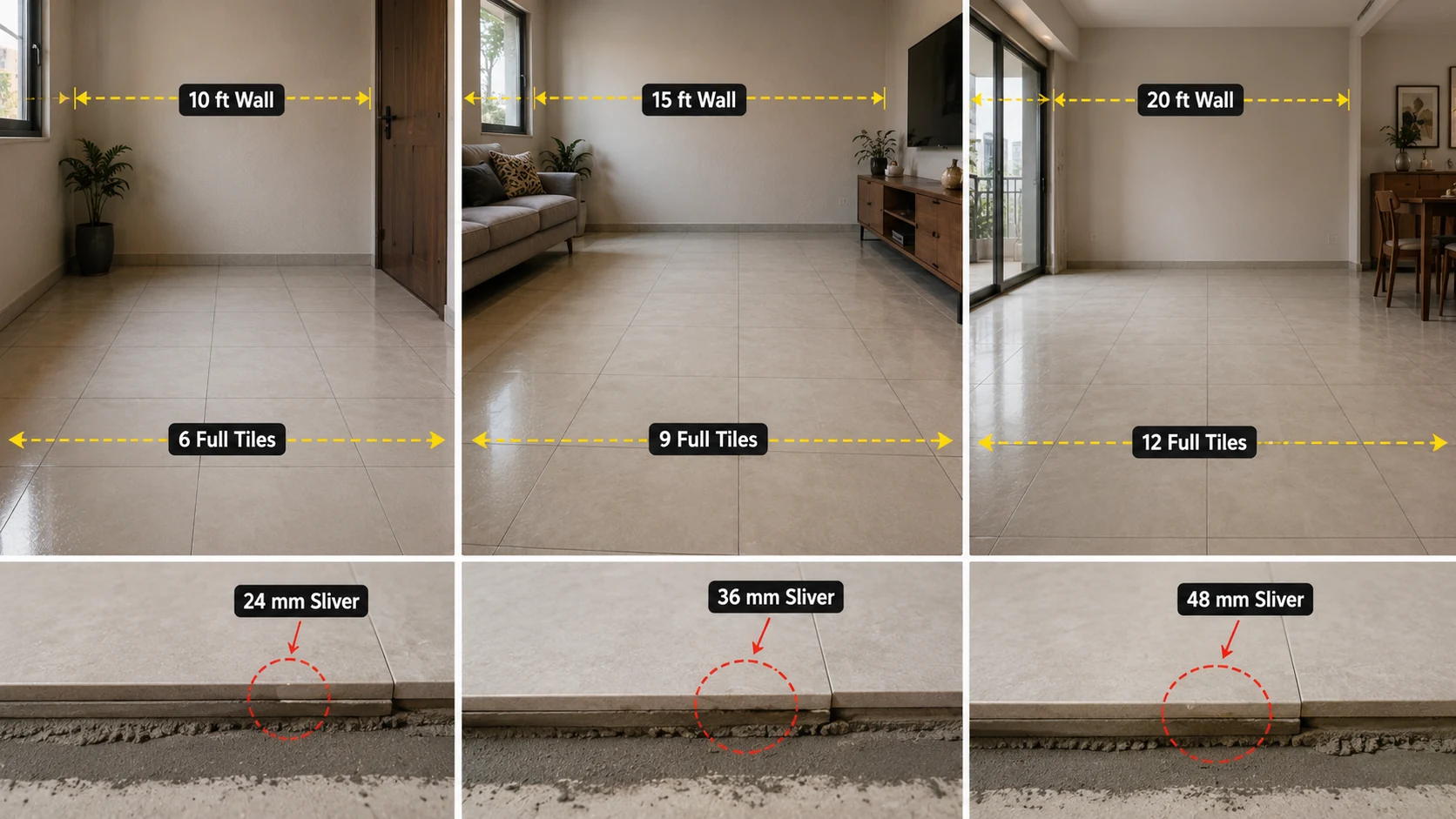
Why the roundest room dimensions produce the worst cuts: Indian rooms are built in feet, and 500 mm is 1.64 feet. Those two systems do not align, so the remainder left at the edge of a room is essentially arbitrary. What makes it worse is that the neatest-sounding dimensions are the worst offenders. A 10 ft wall takes six full tiles and leaves 48 mm. A 15 ft wall takes nine and leaves 72 mm. A 20 ft wall takes twelve and leaves 96 mm. Split symmetrically at both ends, those become slivers of 24 mm, 36 mm and 48 mm, which are difficult to cut cleanly, difficult to bed properly, prone to breaking during installation, and unmistakably visible in the finished wall tiles. The rooms most likely to look wrong are the ones with the tidiest measurements. |
From The Marketplace
Popular tiles right now


The Arithmetic for Real Indian Room Sizes
Each row assumes symmetrical setting out from the room's centre line, which splits the leftover between both edges rather than dumping it all at one wall. Figures ignore grout joints, which add a few millimetres across a run.
| Room Dimension | Full Tiles | Edge Cut Each Side | Verdict |
| 8 ft (2438 mm) | 4 | 219 mm | Good, a substantial cut that reads as deliberate |
| 9 ft (2743 mm) | 5 | 122 mm | Marginal, under a quarter tile |
| 10 ft (3048 mm) | 6 | 24 mm | Poor, a sliver that will look like an error |
| 11 ft (3353 mm) | 6 | 176 mm | Acceptable |
| 12 ft (3658 mm) | 7 | 79 mm | Poor, too thin to lay well |
| 13 ft (3962 mm) | 7 | 231 mm | Good |
| 14 ft (4267 mm) | 8 | 134 mm | Marginal |
| 15 ft (4572 mm) | 9 | 36 mm | Poor, a sliver |
| 16 ft (4877 mm) | 9 | 188 mm | Acceptable |
| 18 ft (5486 mm) | 10 | 243 mm | Good, close to half a tile |
| 20 ft (6096 mm) | 12 | 48 mm | Poor, a sliver |
The One Adjustment That Fixes Almost Every Bad Result
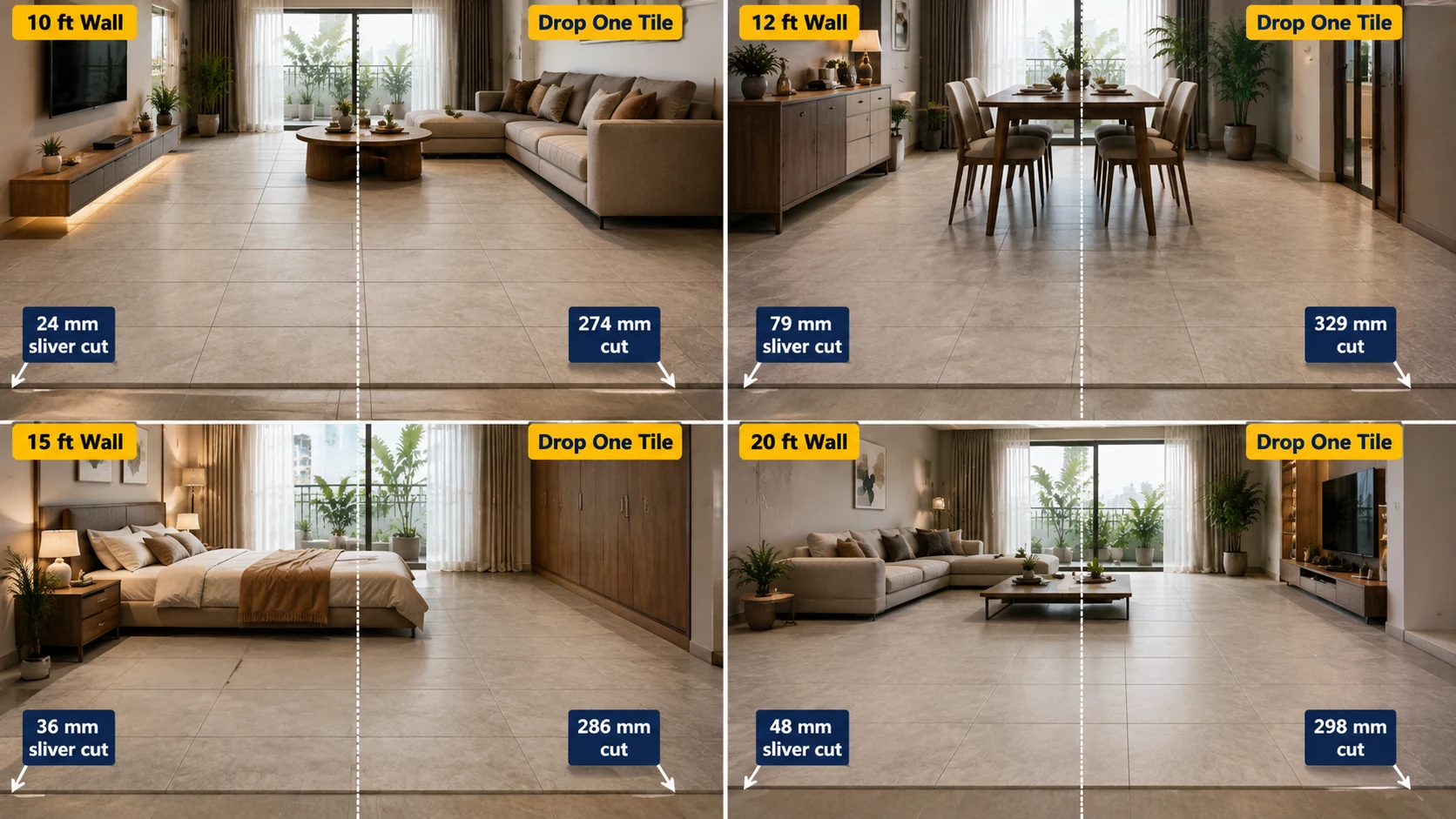
Drop one full tile from the run, and split the larger remainder instead: If the arithmetic leaves you a sliver, remove one full tile from the count and recalculate. The leftover becomes a full tile larger, and split between two edges it produces a substantial, deliberate-looking cut. The 10 ft wall that gave 24 mm slivers gives 274 mm cuts at five full tiles. The 12 ft wall that gave 79 mm gives 329 mm at six. The 15 ft wall that gave 36 mm gives 286 mm at eight. The 20 ft wall that gave 48 mm gives 298 mm at eleven. You lose one tile of full coverage and gain a floor that looks planned rather than squeezed. |
| Room Dimension | Naive Result | After Dropping One Tile | Improvement |
| 10 ft | 6 full, 24 mm slivers | 5 full, 274 mm cuts | From unusable to better than half a tile |
| 12 ft | 7 full, 79 mm slivers | 6 full, 329 mm cuts | From poor to comfortably substantial |
| 15 ft | 9 full, 36 mm slivers | 8 full, 286 mm cuts | From unusable to good |
| 20 ft | 12 full, 48 mm slivers | 11 full, 298 mm cuts | From poor to good |
The working rule to carry into the conversation with your installer: Aim for an edge cut of at least 150 mm, and ideally above 250 mm, which is half a tile. Anything under 100 mm should be treated as a problem to be designed out rather than accepted. Ask how the floor tiles will be set out before laying begins, because after the first row is bedded the arithmetic is fixed. |
How Many Tiles to Order
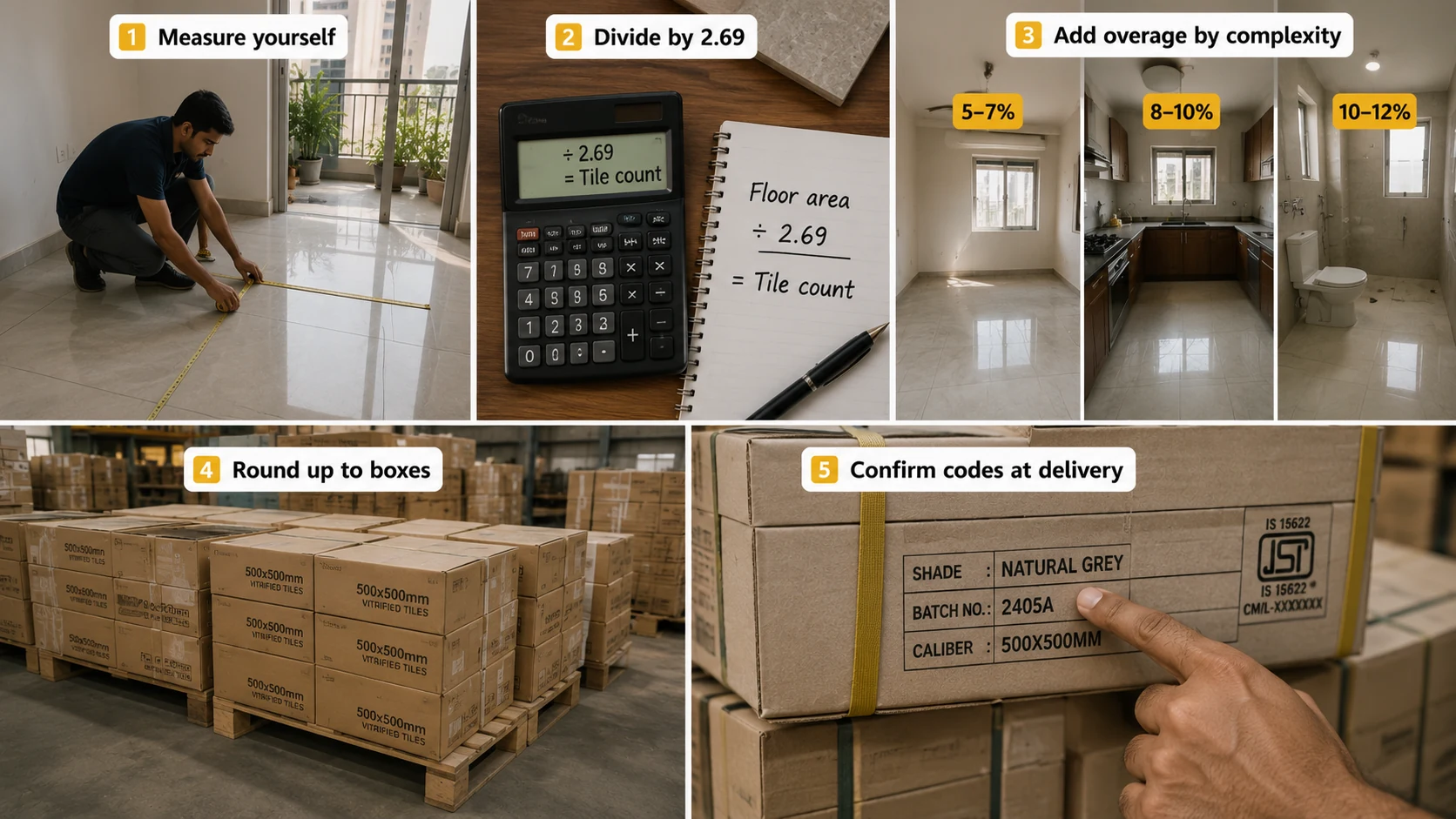
- Measure the actual floor area in square feet, and measure it yourself rather than working from a plan, since built dimensions and drawn dimensions frequently differ.
- Divide by 2.69 to get the tile count, which is the coverage of a single 500x500 mm tile.
- Add overage by room complexity: 5 to 7% for a simple rectangular room, 8 to 10% for a room with several fixtures or angles, and 10 to 12% for a heavily cut bathroom or utility area.
- Round up to complete boxes, since suppliers sell by the box and a part box is not usually available.
- Confirm single batch, shade code and calibre for the full quantity including overage, and check the codes physically at delivery rather than on the invoice alone.
| Floor Area | Tiles Needed | With 8% Overage | Boxes of 4 |
| 100 sq.ft | 38 | 41 | 11 |
| 150 sq.ft | 56 | 61 | 16 |
| 200 sq.ft | 75 | 81 | 21 |
| 300 sq.ft | 112 | 121 | 31 |
| 500 sq.ft | 186 | 201 | 51 |
Where 500x500 Genuinely Earns Its Place
This format sits between the small tiles that suit tight, fixture-heavy spaces and the large formats that suit open floors. That middle position is a real advantage in specific rooms and a compromise in others.
| Space | Verdict | Reasoning |
| Standard bathroom floor | Strong fit | Large enough to reduce joint count, small enough to cut economically around fixtures and drains |
| Kitchen floor | Strong fit | Handles cabinet runs and appliance recesses with less waste than a large format would produce |
| Balcony and terrace | Strong fit | Manageable cutting around railings and drainage falls, with anti-skid variants readily available |
| Utility and wash areas | Strong fit | Economical in small, awkward rooms where large tiles generate heavy offcut waste |
| Outdoor pathways | Good | Practical to lay and replace individually if one tile is damaged |
| Large open living room | Compromise | A larger format reduces the joint grid more effectively across an unbroken floor |
| Very small bathroom under 30 sq.ft | Compromise | A smaller format cuts more economically in a genuinely tight footprint |
What to Confirm Before Ordering
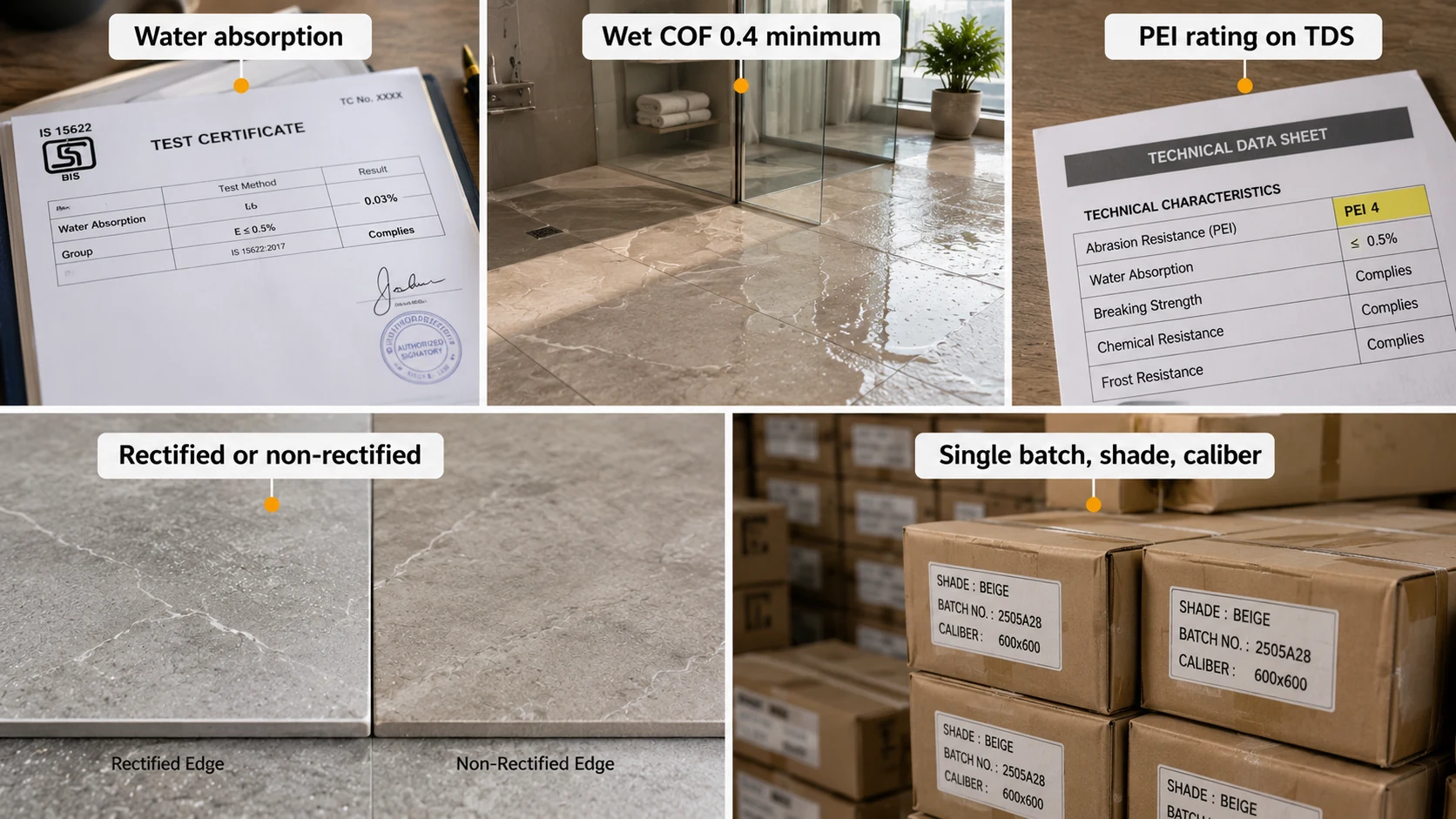
- Water absorption of 0.05% or below for vitrified tile, the benchmark set by the Bureau of Indian Standards under IS 15622, with the test certificate requested rather than assumed.
- Wet coefficient of friction of 0.4 minimum for any floor that gets wet, covering bathrooms, kitchens, balconies, wash areas and outdoor surfaces.
- PEI abrasion rating on the technical data sheet, PEI 4 minimum for normal residential floors and PEI 5 for heavy traffic or vehicle load.
- Rectified or non-rectified edges, since rectified permits a narrower joint and slightly changes the arithmetic across a long run.
- Single batch, shade code and calibre across the full quantity, since a calibre mismatch produces visibly uneven joints even when the colour matches.
Do the Arithmetic Before You Shortlist on TilesFinders
500x500 mm ranges can be browsed on TilesFinders across matte, anti-skid and textured finishes in GVT, porcelain and ceramic bodies, so once the room arithmetic points to this format you can filter straight to the rating your specific room needs.
FAQs
Four, since each tile covers 0.25 square metres. One box of four therefore covers 1 square metre, or 10.76 square feet, which makes box arithmetic straightforward once you know the floor area.
Thirty-eight tiles before overage, since each tile covers 2.69 square feet. With 8% overage, that becomes 41 tiles, or 11 boxes of four.
Because 500 mm is 1.64 feet, it does not divide evenly into foot-based dimensions. A 10 ft wall takes six full tiles and leaves only 48 mm, which splits into 24 mm slivers at each edge. Dropping to five full tiles gives 274 mm cuts instead, which looks deliberate.
Aim for at least 150 mm, and ideally above 250 mm, which is half a tile. Anything under 100 mm is difficult to cut cleanly, difficult to bed, prone to breaking during installation, and clearly visible in the finished floor.
From the centre line, which splits the leftover between both edges rather than leaving it all at one wall. This matters more in Indian homes because rooms are frequently not perfectly square, and centre-line setting out halves the visible error.
Yes, one of its strongest applications. It is large enough to reduce the joint count meaningfully but small enough to cut economically around fixtures, drains and falls, which is where large formats generate heavy offcut waste.
5 to 7% for a simple rectangular room, 8 to 10% where there are several fixtures or angles, and 10 to 12% for a heavily cut bathroom or utility area. Round up to complete boxes, since part boxes are not usually sold.
It works, but it is a compromise there. A larger format such as 600x600 mm or 800x800 mm suppresses the joint grid more effectively across a big unbroken floor, which is the main reason to go large in an open room.
Slightly. A 2 mm joint across six tiles adds around 10 mm to the run, which can turn a marginal cut into an acceptable one or vice versa. Confirm the intended joint width with your installer before the setting out is finalised.


See our tile guides first
Set TilesFinders as a preferred source and our buying guides surface ahead of the rest for you.
Add as preferred sourceTakes one tap. Nothing to install.
What Readers Say
I was about to redo my parking area with the wrong tile size until I read this. The layout comparisons saved me from a costly mistake.
We reference TilesFinders guides while briefing clients on material selection. The size and pattern breakdowns are accurate and easy to explain visually.
On site, I get asked about grout spacing all the time. This article gave me a solid reference I now share with my team before every job.
Finally a guide that doesn't just push generic advice. The oil stain removal steps actually worked on our clubhouse driveway tiles.
I run a small construction firm and now send this link to clients directly when they ask about entrance tile sizing. Saves me an hour of explaining.
Good practical detail, though I wish there were more examples for compact apartment entrances specifically, not just villas.
My mother-in-law wanted marble, I wanted vitrified. This blog gave us the neutral comparison we needed to actually decide together.
Detailed without being overwhelming. I appreciated that it covered both cost and maintenance, not just the aesthetics.
Used the algae and hard water removal tips on our terrace tiles after the monsoon. Worked better than what our regular cleaner was doing.
As someone who sources tiles for multiple builder projects, I find these comparisons genuinely useful for vendor conversations, not just consumer content.
Recommended this to a client who kept second-guessing the entrance design. The small vs large layout section settled the debate instantly.
Straightforward and honest, no unnecessary jargon. Would like to see a similar breakdown for outdoor pool-deck tiles next.
We've bookmarked several TilesFinders guides for our design handbook. Reliable source when clients want data, not just opinions.
Two paths, one marketplace.
Get free quotes from verified suppliers.
Share your room, budget, and style. Suppliers in Morbi respond within hours.
Get Free QuotesList your business, reach real buyers.
Put your showroom in front of homeowners searching for tiles right now.
List Your Business