Types of Bathroom Tiles: Ceramic, Vitrified, Marble and Porcelain Compared
Compare ceramic, vitrified, porcelain & marble-look bathroom tiles for Indian homes. Explore anti-skid options, sizes, prices & best tiles in 2026.
- Why Bathroom Tile Choices Matter More Than They Seem
- Types of Bathroom Tiles: What Each Material Actually Does
- Anti-Skid Bathroom Tiles: What to Look for and What to Avoid
- Bathroom Tiles Design Ideas for Indian Homes in 2026
- Small Bathroom Tiles Ideas for Indian Apartments
- Recommended Tile Sizes for Indian Bathrooms
- Ceramic vs Vitrified vs Porcelain: A Direct Comparison
- Expert Tips Before Buying Bathroom Tiles
- Common Mistakes People Make When Choosing Bathroom Tiles
- Final Tips Before Buying Bathroom Tiles for Your Home
Most Indian homeowners pick bathroom tiles the same way. They walk into a showroom, point to whichever tile looks bright and clean under the display lights, and place an order. Six months later, the floor feels slippery every morning. The grout turns dark. The once-bright walls look dull under the bathroom's own lighting.
The problem is rarely the tile brand. It is the type of tile, the finish, and the size, chosen without knowing what each one does in a wet, high-use space.
This guide covers every major bathroom tile type used in Indian homes, what each one handles well, where each one fails, anti-skid options that actually work, size guidance for small Indian bathrooms, and design ideas. By the end, you will know exactly which tiles belong on your bathroom floor, which belong on the walls, and what to avoid altogether.
Why Bathroom Tile Choices Matter More Than They Seem
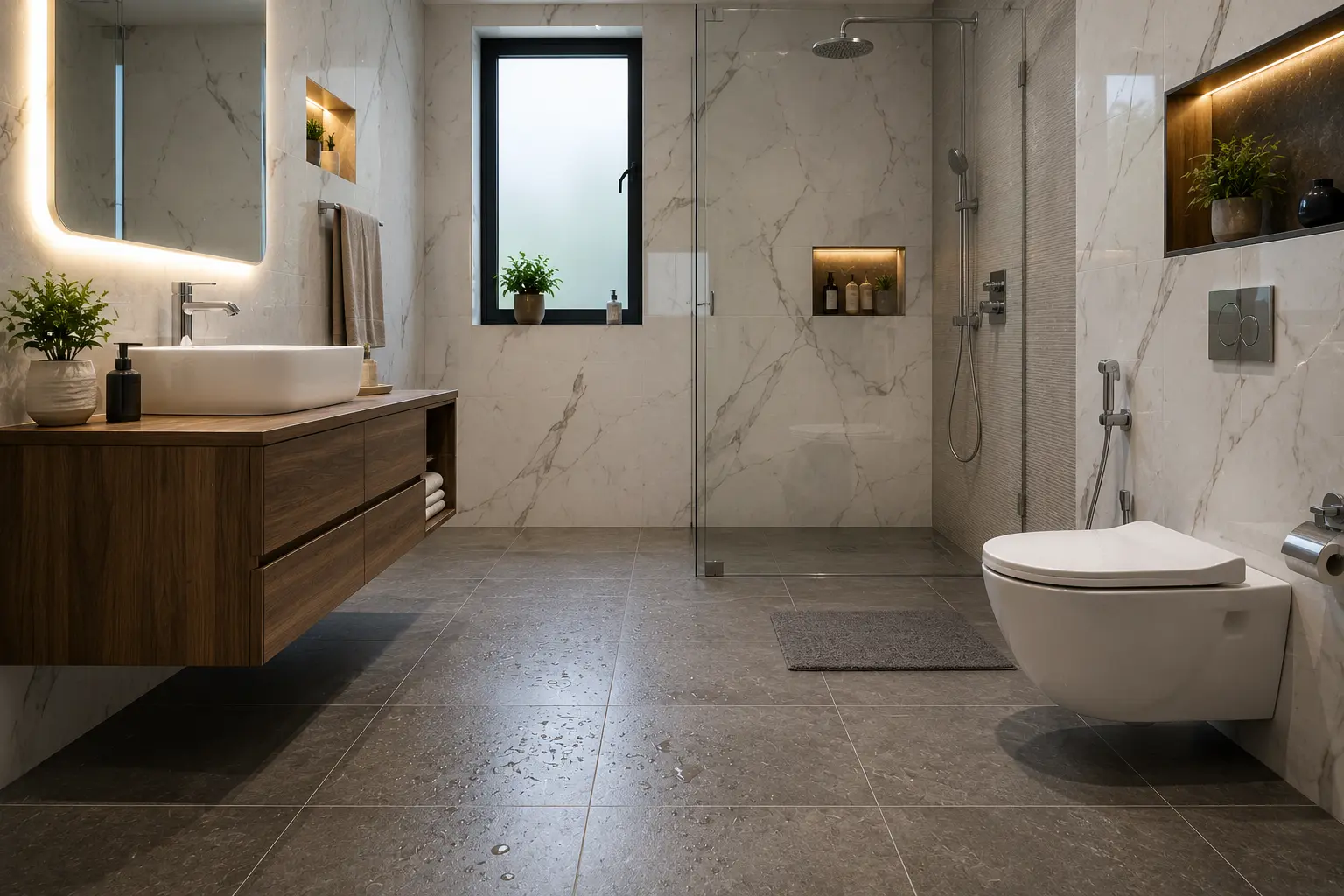
A bathroom in an Indian home is not a calm, dry space. It handles water splashes, coconut oil, soap scum, hard water stains, and daily foot traffic across a floor that is usually wet for part of every morning. That is a tougher environment than most rooms.
The wrong tile finish causes slips. A glossy or polished floor tile, the kind that looks gorgeous in a showroom, becomes a hazard the moment someone steps on it with wet feet. In homes with elderly members or children, this is not a small inconvenience.
The wrong material stains. Ceramic tiles absorb 12 to 16% water by weight. Over time, soap residue and hard water minerals work their way into the tile surface. What starts as a white tile slowly turns grey at the grout lines and dulls across the surface.
The wrong size makes small bathrooms feel even smaller. Most Indian 2BHK apartments have bathrooms under 35 sq. ft. A tile that works well in a hotel lobby makes the same space feel cramped and dated.
Getting the tile right means matching the material, finish, and size to what a bathroom actually does every day. The next sections cover exactly that.
Types of Bathroom Tiles: What Each Material Actually Does
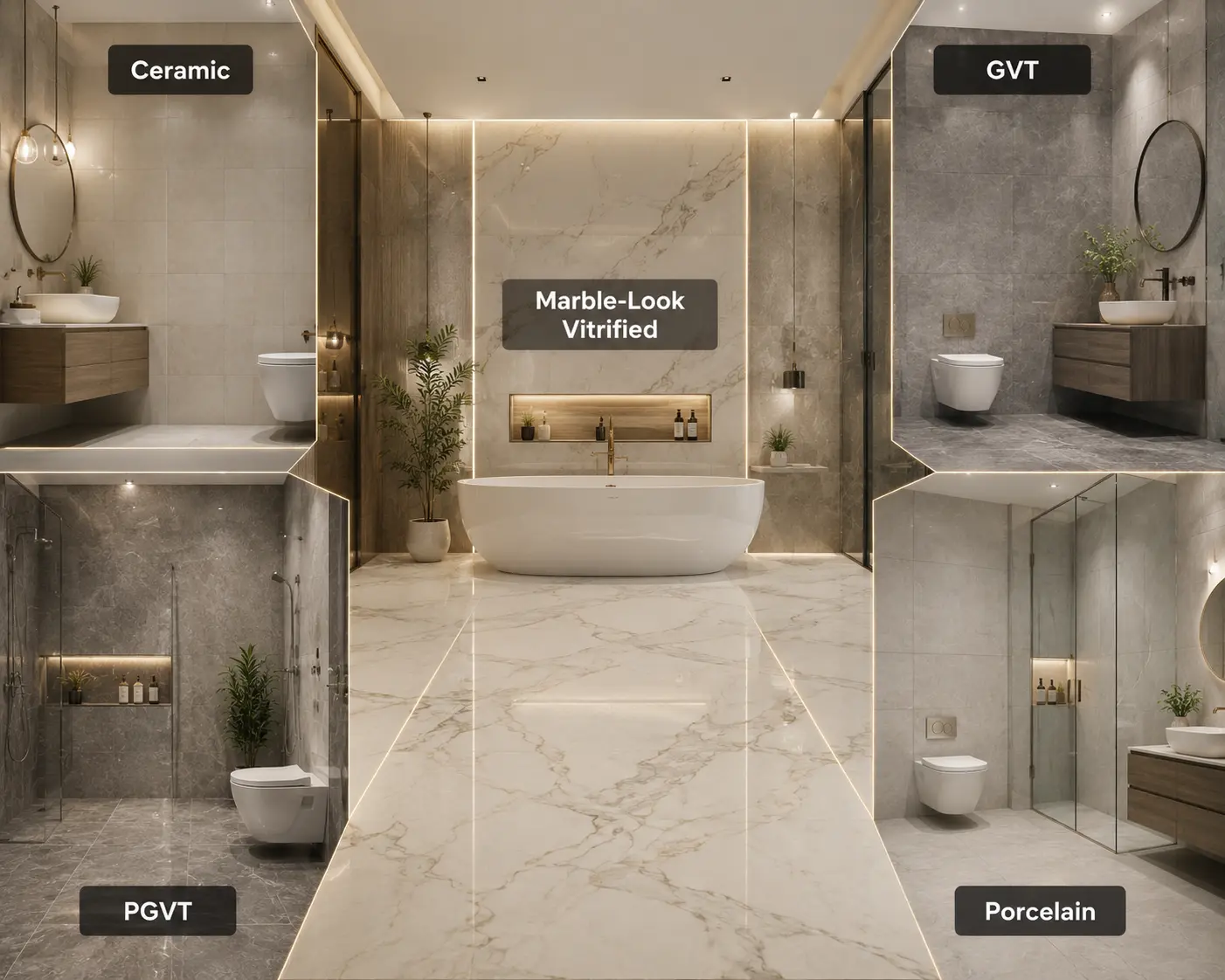
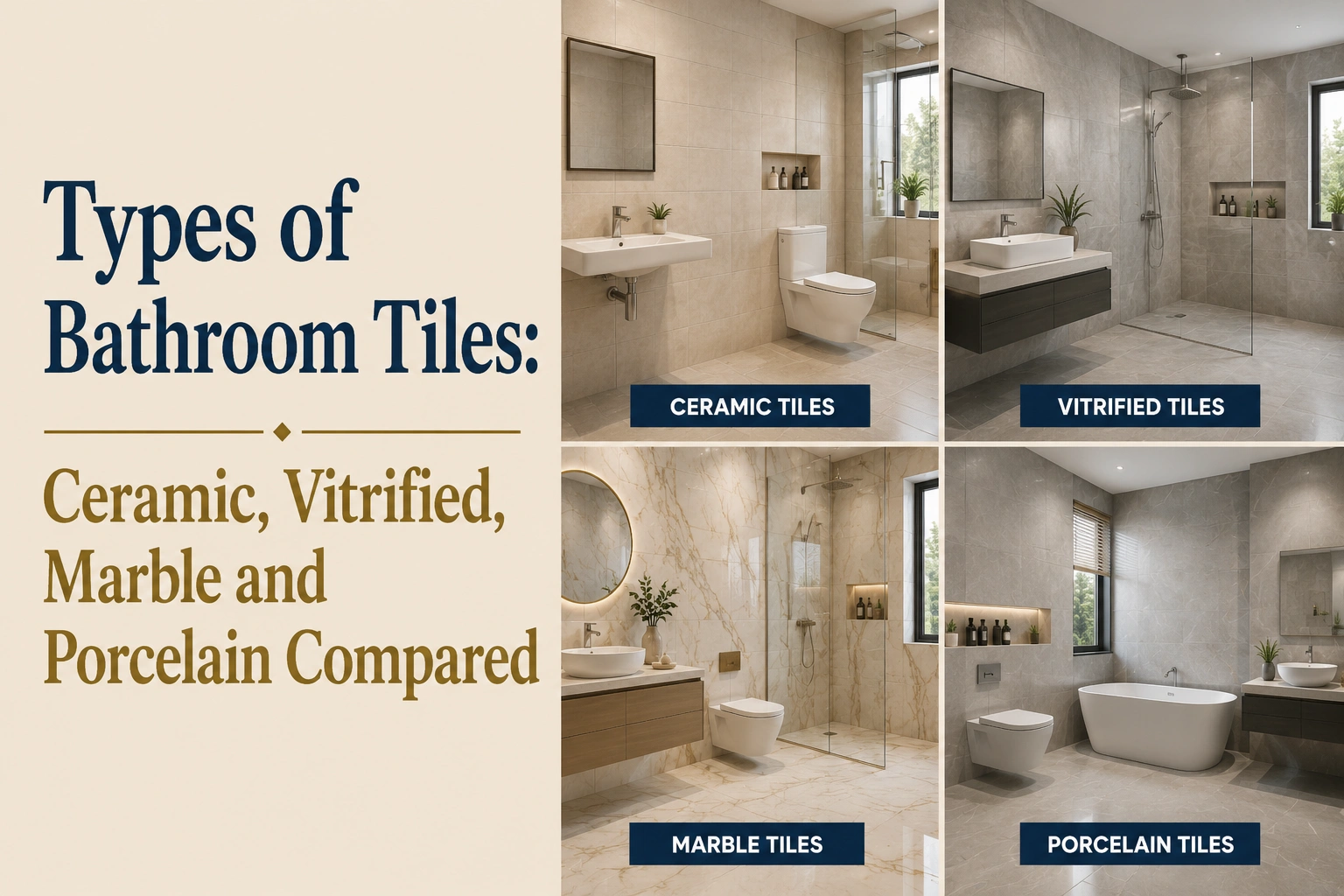
Five tile types cover the large majority of Indian bathroom installations. Each has a different body material, water resistance level, finish range, and price point.
Ceramic Tiles
Ceramic tiles are the most widely used bathroom wall tile in India. They are lightweight, easy to cut, and come in the widest range of printed designs,s including subway patterns, floral prints, and marble effects.
The key constraint is water absorption. Ceramic tiles absorb 12 to 16% water by weight, which is far too high for floor use. On bathroom walls, above the waterline, this absorption is manageable. On floors where water pools daily, the tile body gradually weakens, and the grout stains quickly.
One exception: 300x300 mm (1x1) ceramic tiles can be used on bathroom floors to match a wall tile design. This is the only ceramic size that works on a bathroom floor, and only because the smaller grout grid helps drainage.
Sizes: 300x300 mm (1x1), 300x450 mm (12x18), 300x600 mm (12x24). Note that 300x450 and 300x600 are wall-only. Never use these two sizes on floors.
Typical price range: approximately ₹30 to ₹80 per sq. ft., varies by brand and design.
GVT (Glazed Vitrified Tiles)
GVT tiles are the best all-around choice for bathroom floors in India. They absorb only 0.05% water as per IS 15622 in BIS (Bureau of Indian Standards), which means daily water exposure does not affect the tile body or the surface finish. The glaze layer is factory-applied and locks in colour and pattern permanently.
GVT tiles come in matte, sugar, matte carving, GHR (Glaze High Resistance), and Rain Drops finishes, all of which are anti-skid and safe for wet bathroom floors. This makes them the most versatile bathroom floor option.
They also work on bathroom walls. Large-format GVT in 2x4 (600x1200 mm) on walls with matte GVT tiles on floors is a clean, practical combination used in most new Indian construction.
Sizes for bathroom floors: 400x400 mm (16x16) and 500x500 mm (20x20) are the most common bathroom floor sizes. Both are floor-specific and work well for wet areas. Larger sizes like 2x2 (600x600 mm) and 2x4 (600x1200 mm) also work on bathroom floors with a matte finish.
Typical price range: approximately ₹60 to ₹150 per sq. ft., varies by size, design, and brand.
PGVT (Polished Glazed Vitrified Tiles)
PGVT tiles have the same low water absorption as GVT (0.05%) but with a polished, mirror-like surface finish. They are the go-to choice for bathroom walls where a bright, high-shine look is wanted.
The critical constraint: PGVT must never be used on bathroom floors. The polished surface becomes extremely slippery when wet. This is a safety issue, not a style preference. Using PGVT on a bathroom floor is one of the most common and costly mistakes in Indian bathroom renovations.
On bathroom walls, PGVT in large formats like 2x4 (600x1200 mm) or 32x64 (800x1600 mm) looks clean and bright. The reflective surface also makes small bathrooms feel larger by bouncing light around the space.
Typical price range: approximately ₹60 to ₹150 per sq. ft., varies by size and design.
Porcelain Tiles
Porcelain tiles sit between ceramic and vitrified in terms of water absorption: 2 to 5%. They are denser than ceramic and hold up better in wet areas. In India, porcelain tiles are mostly sold in matte finish, which makes them naturally anti-skid.
Porcelain works well on both bathroom floors and walls. Sizes: 300x300 mm (1x1), 400x400 mm (16x16), 500x500 mm (20x20), 600x600 mm (2x2), 600x1200 mm (2x4), and 200x1000 mm (8x40 wooden-plank style).
Note: GVT and PGVT are vitrified tiles, not porcelain. These are different categories with different manufacturing processes. Never describe GVT or PGVT as porcelain when specifying tiles with a dealer.
Typical price range: approximately ₹90 to ₹220 per sq. ft., varies by brand and design.
Marble-Look Vitrified Tiles
Marble-look vitrified tiles are GVT or PGVT tiles printed with realistic marble veining patterns. They give the look of Italian or Indian marble at a fraction of the cost and with much lower maintenance.
For bathroom walls, PGVT marble-look tiles in 2x4 (600x1200 mm) with polished, high-glossy finish are one of the most requested designs in Indian bathrooms right now. The veined pattern adds visual depth to a plain white bathroom wall.
For bathroom floors, use GVT marble-look tiles in matte or sugar finish. Avoid PGVT marble-look tiles on bathroom floors. The polished surface is slippery regardless of the print design.
Typical price range: approximately ₹80 to ₹250 per sq. ft. for marble-look vitrified, varies by size and design quality.
| Tile Type | Water Absorption | Floor Safe? | Wall Safe? | Wet Area? | Approx. Price (per sq. ft.) |
| Ceramic | 12 to 16% | Only 1x1 (300x300) on bathroom floors | Yes | Wall only | ₹30 to ₹80 |
| GVT | 0.05% | Yes (matte, GHR, Rain Drops finish) | Yes | Yes | ₹60 to ₹150 |
| PGVT | 0.05% | Walls only. NOT on bathroom floors | Yes | Walls only | ₹60 to ₹150 |
| Porcelain | 2 to 5% | Yes (mostly matters) | Yes | Yes | ₹90 to ₹220 |
| Marble-Look Vitrified | 0.05% | GVT marble-look only, matte finish | Yes | Walls only (PGVT) | ₹80 to ₹250 |
Anti-Skid Bathroom Tiles: What to Look for and What to Avoid
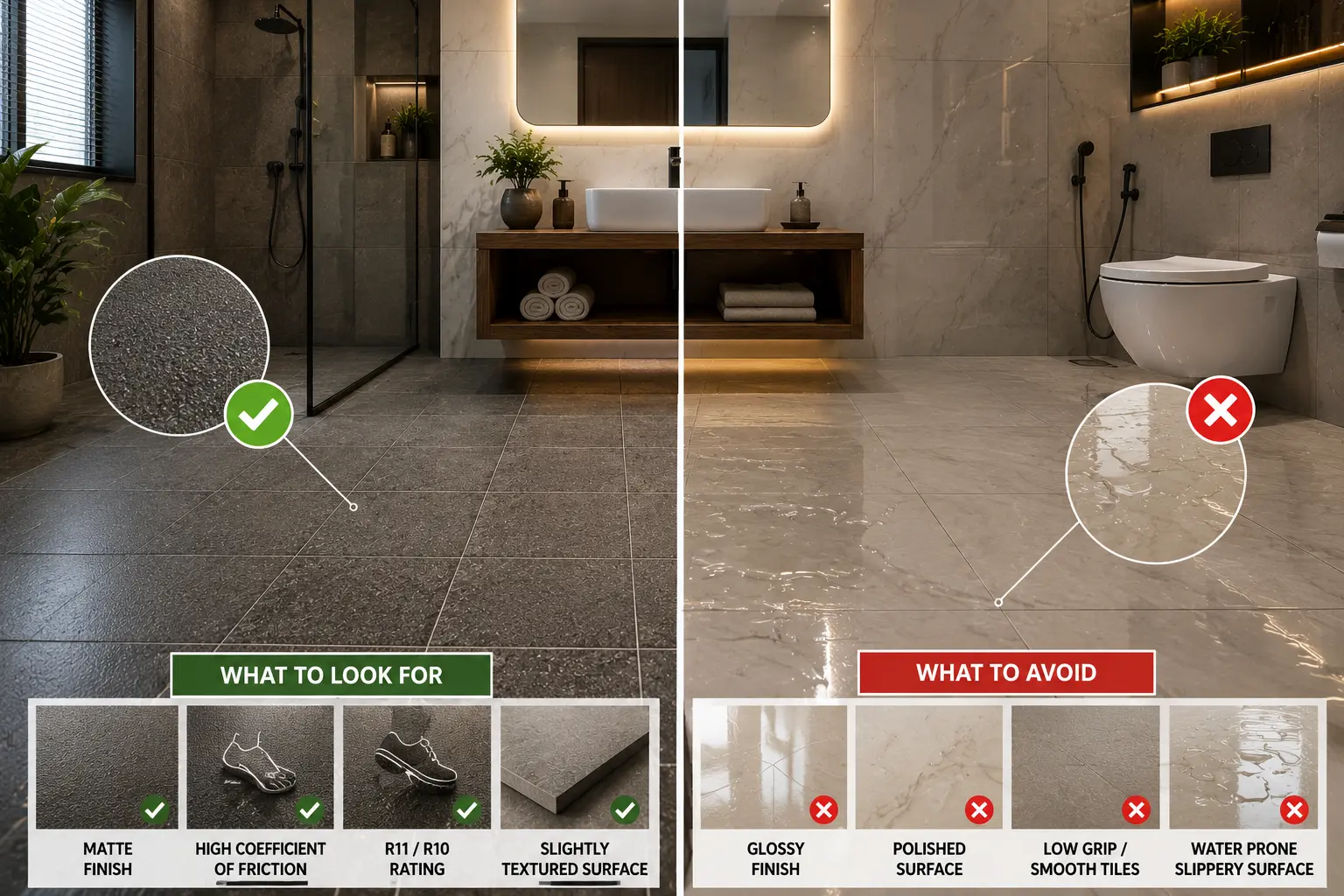
Anti-skid bathroom tiles are not a separate product category. They are defined by their finish. The finish determines grip. Getting this right on bathroom floors is the single most important technical decision in the whole tile selection process.
Finishes that are safe for wet bathroom floors:
- Matte finish: High scratch resistance, anti-skid, the most practical all-round bathroom floor finish
- GHR (Glaze High Resistance): Stone-like textured surface, best grip for bathroom floors with heavy use
- Rain Drops finish: Glossy or matte raised drops on the tile surface, excellent anti-skid texture
- Matte Carving: Matte base with raised glossy veins, anti-skid and visually interesting
- Sugar finish: Transparent glossy drops on a matte base, light texture that also provides grip
Finishes that must not be used on bathroom floors:
- Polished Glossy (PGVT): Mirror finish, very slippery when wet, walls only
- High Glossy / Polished High Glossy: Low scratch resistance, slippery, walls only
- Super High Glossy: Extremely smooth, very slippery, walls only
- Satin Matte: Smooth surface with low reflection but high slipperiness, walls only
- Semi Polished (Baby Polished): Low-gloss but still slippery on wet floors
The R-rating system (R9 to R13) measures slip resistance on tile surfaces. For residential bathroom floors, R10 is the minimum. Matte and GHR finish GVT tiles typically meet or exceed this. Always ask your dealer for the slip rating before buying bathroom floor tiles.
Bathroom Tiles Design Ideas for Indian Homes in 2026
Bathroom tile design in Indian homes has shifted significantly in the last three years. Large formats, minimal grout lines, and neutral tones now dominate new construction and renovation projects.
All-White Minimal Bathrooms
White PGVT tiles in 2x4 (600x1200 mm) on walls with white GVT matte tiles in 16x16 (400x400 mm) on floors is the most common bathroom tiles design in Indian new builds right now. It keeps the space feeling open, works with any fixture colour, and hides hard water stains less than darker tiles.
Pair with light grey epoxy grout to prevent yellowing at the grout lines. White cement grout on white tiles turns beige within months in Indian hard-water conditions.
Grey Concrete-Look Bathrooms
Grey stucco-finish or concrete-look GVT tiles in 2x4 or 2x2 on bathroom walls give a clean, industrial feel that pairs well with black or brushed chrome fittings. For floors, grey matte GVT in 16x16 or 20x20 tiles looks good together.
This combination works especially well in compact Mumbai and Pune 2BHK bathrooms, where the neutral grey palette makes the space feel larger than it is.
Marble-Look Feature Walls
A single marble-look PGVT feature wall behind the vanity or along the shower area, paired with plain matte white tiles on the remaining walls and floor, gives a bathroom a visual anchor without overwhelming the space.
This works well for 3BHK master bathrooms in Bangalore and Hyderabad, where buyers want a high-end look without the maintenance of natural stone.
Small Bathroom Tiles Ideas for Indian Apartments
Most Indian apartment bathrooms are between 25 and 45 sq. ft. In this size, tile choice directly affects how spacious the bathroom feels.
Use larger tiles to reduce grout lines. A 2x2 (600x600 mm) floor tile has fewer grout joints than a 16x16 (400x400 mm) tile in the same space. Fewer joints means the floor reads as one continuous surface, which makes the room feel bigger.
Use the same tile on walls and floor where possible. Matching wall and floor tiles in a small bathroom removes the horizontal visual break that makes a space feel cut in two.
Light colours reflect more light than dark tiles. In a bathroom with one small window or only artificial light, light grey or off-white GVT tiles with matte finish keep the space bright without the upkeep of stark white.
Recommended Tile Sizes for Indian Bathrooms
Size rules for bathroom tiles are strict. Some sizes are wall-only. Some work only on floors. Getting this wrong means buying tiles you cannot use.
| Size (mm) | Alias | Wall or Floor | Best Bathroom Use | Notes |
| 300x300 | 1x1 | Both | Bathroom floors (small format) and walls | Only ceramic size is allowed on bathroom floors |
| 300x450 | 12x18 | Wall only | Bathroom and kitchen walls | Never use on floors |
| 300x600 | 12x24 | Wall only | Bathroom walls, standard Indian wall tile | Never use on floors |
| 400x400 | 16x16 | Floor only | Bathroom floors, balcony, and outdoor | Best anti-skid bathroom floor size |
| 500x500 | 20x20 | Floor only | Bathroom floors, outdoor | Slightly larger version of 16x16 |
| 600x600 | 2x2 | Both | Bathroom walls and floors (matte) | Good for small bathroom floor uniformity |
| 600x1200 | 2x4 | Both | Bathroom walls (PGVT), bathroom floors (GVT matte) | Most popular Indian bathroom wall tile size |
| 800x1600 | 32x64 | Both | Feature walls in large master bathrooms | Use matte finish on floors only |
Ceramic vs Vitrified vs Porcelain: A Direct Comparison
These three tile categories cover the large majority of Indian bathroom choices. Here is how they compare on the factors that matter most for bathrooms.
| Factor | Ceramic | Vitrified (GVT/PGVT) | Porcelain |
| Water absorption | 12 to 16% | 0.05% | 2 to 5% |
| Floor use | Only 300x300 on bathroom floors | Yes (matte/GHR/Rain Drops finish) | Yes (matte finish) |
| Wall use | Yes | Yes | Yes |
| Wet area safety | Wall only | GVT yes. PGVT walls only | Yes |
| Stain resistance | Low to moderate | High | Moderate |
| Design variety | Very high (prints, patterns) | High | Moderate |
| Price range | ₹30 to ₹80 / sq. ft. | ₹60 to ₹150 / sq. ft. | ₹90 to ₹220 / sq. ft. |
| Best for | Bathroom walls on a budget | Bathroom floors and premium walls | Bathroom floors need a natural matte look |
Expert Tips Before Buying Bathroom Tiles
1. Separate your floor tile and wall tile decisions
Floor tiles and wall tiles have different technical requirements. Pick them separately. The floor needs an anti-skid finish and low water absorption. The wall needs a design you like and a surface that cleans easily. Buying the same tile for both areas without checking finish suitability is the most common mistake.
2. Check the finish name, not just the appearance
A tile can look matte in a showroom but carry a satin matte or semi-polished finish that is actually slippery when wet. Ask the dealer to confirm the finish type by name. Matte, GHR, Rain Drops, and Sugar finishes are safe for bathroom floors. Polished, High Glossy, Satin Matte, and Semi Polished are not.
3. Test tiles in your actual bathroom light
Showroom lighting is designed to make tiles look their best. Warm LED lighting in a showroom can make a cold grey tile look beige. Take a sample home and hold it up under your bathroom's actual light source before committing to a large order.
4. Order 10% more than you need
Tile cuts, breakage during laying, and future replacement needs always cost more tiles than the floor area calculation suggests. Order at least 10% extra and keep a few tiles from the same batch. Batch numbers matter because the same tile design can have slight colour variations between batches.
5. Use epoxy grout in wet areas
Standard cement grout absorbs water and stains in wet bathrooms. Epoxy grout is non-porous, stain-resistant, and lasts far longer on bathroom floors and shower areas. The cost difference is small compared to the tile and labour costs. It is worth it.
6. Check rectified vs non-rectified
Rectified tiles have machine-cut, precise edges and can be laid with 2 mm grout lines for a near-seamless look. Non-rectified tiles need 3 to 5 mm grout lines. For large-format bathroom wall tiles in 2x4, rectified edges look noticeably cleaner. Ask your dealer before placing the order.
7. Plan for India-specific conditions
Hard water stains, coastal humidity, and monsoon moisture all affect bathroom tiles differently. In coastal cities like Mumbai, Chennai, and Kochi, high-humidity environments accelerate grout deterioration. Epoxy grout and low-absorption vitrified tiles handle these conditions better than ceramic with cement grout.
Still confused about which bathroom tiles actually work best for Indian homes? Explore our complete bathroom tiles buyer’s guide for practical advice on tile materials, finishes, pricing, modern bathroom tiles design ideas, and smart layout tips before you make a final decision.
Common Mistakes People Make When Choosing Bathroom Tiles
Using polished or glossy tiles on bathroom floors. This is the most frequent and most dangerous mistake. PGVT, High Glossy, and Satin Matte tiles look beautiful in a showroom and cause slips on a wet bathroom floor. Always use matte, GHR, or Rain Drops finish on bathroom floors.
Buying wall-only sizes for the floor. 300x450 mm (12x18) and 300x600 mm (12x24) are wall-only tiles. Laying them on floors does not work: the tile body is not rated for foot traffic load, and the size creates drainage issues. Always check the size constraint before buying.
Picking very dark tiles for a small bathroom. Dark grey or charcoal tiles absorb light in a bathroom that already has limited windows. The space ends up feeling smaller and darker. Use dark tiles as accents, not for full-room coverage in compact bathrooms.
Using white cement grout in hard-water areas. White grout on bathroom floors turns grey or brown within months in cities with hard water. Use a mid-grey epoxy grout that masks hard water deposits and stays clean longer.
Matching tiles only in the showroom. Showroom lighting is controlled. Tile samples that look like a perfect match on a display wall can look mismatched under the different light temperatures of your bathroom. Always test samples at home.
Skipping anti-skid tiles to save cost. The price difference between a glossy and a matte GVT tile in the same size is often under ₹5 to ₹10 per sq. ft. The cost of a fall in a bathroom, on the other hand, is not worth calculating. Anti-skid finish on bathroom floors is not a luxury.
Final Tips Before Buying Bathroom Tiles for Your Home
The right bathroom tiles are not always the most expensive ones or the ones that look best in a showroom. They are the ones that still look good, stay safe underfoot, and clean easily after two years of daily use in an Indian bathroom.
Before finalising your tile selection, write down your bathroom dimensions, your floor and wall areas in sq. ft., the finish type you need for each surface, and your budget per sq. ft. for each. Bring those numbers to the showroom instead of browsing by eye alone.
You can also explore bathroom tiles by finish, size, colour, and category on TilesFinders to compare options from dealers across India and find what fits your bathroom and your budget.
FAQs
GVT (Glazed Vitrified Tiles) with matte, GHR, or Rain Drops finish in matte or textured versions are the best choice for bathroom floors in India. They absorb only 0.05% water, handle daily wet-area exposure without staining, and the anti-skid finish prevents slips. Sizes 400x400 mm (16x16) and 500x500 mm (20x20) are the most practical for Indian bathroom floors. Porcelain in matte finish also works well at a higher price point.
Glossy tiles are good for bathroom walls, not bathroom floors. On walls, a polished or glossy tile looks clean and bright and reflects light well in small bathrooms. On floors, the same glossy finish becomes slippery the moment it is wet. Never use polished, high-glossy, satin matte, or semi-polished finish tiles on bathroom floors.
For small Indian bathrooms under 40 sq. ft., 400x400 mm (16x16) or 600x600 mm (2x2) tiles on the floor keep grout lines manageable and the space looking open. On walls, 600x1200 mm (2x4) PGVT tiles with minimal grout lines make the bathroom feel taller and larger. Avoid 300x300 mm (1x1) on living space bathroom floors, as the dense grout grid makes the room look smaller.
Vitrified tiles (GVT, PGVT) absorb 0.05% water. Porcelain tiles absorb 2 to 5% water. Both are lower than ceramic (12 to 16%, and both work in bathrooms. Vitrified tiles have a wider finish range (matte, sugar, GHR, Rain Drops), which gives more anti-skid options for bathroom floors. Porcelain in India is mostly available in matte finish. GVT and PGVT are stronger than porcelain and are not in the same category: do not describe vitrified tiles as porcelain when specifying with a dealer.
PGVT tiles work well on bathroom walls. They must not be used on bathroom floors. The polished surface is slippery when wet and not safe for floor use in any wet area.
Approximate bathroom tile prices in India in 2026: Ceramic wall tiles ₹30 to ₹80 per sq. ft.; GVT bathroom floor tiles ₹60 to ₹150 per sq. ft.; PGVT bathroom wall tiles ₹60 to ₹150 per sq. ft.; Porcelain tiles ₹90 to ₹220 per sq. ft.; Marble-look vitrified tiles ₹80 to ₹250 per sq. ft. Prices vary by brand, size, finish, and dealer location. Imported tiles start above ₹400 per sq. ft.

See our tile guides first
Set TilesFinders as a preferred source and our buying guides surface ahead of the rest for you.
Add as preferred sourceTakes one tap. Nothing to install.
What Readers Say
I was about to redo my parking area with the wrong tile size until I read this. The layout comparisons saved me from a costly mistake.
We reference TilesFinders guides while briefing clients on material selection. The size and pattern breakdowns are accurate and easy to explain visually.
On site, I get asked about grout spacing all the time. This article gave me a solid reference I now share with my team before every job.
Finally a guide that doesn't just push generic advice. The oil stain removal steps actually worked on our clubhouse driveway tiles.
I run a small construction firm and now send this link to clients directly when they ask about entrance tile sizing. Saves me an hour of explaining.
Good practical detail, though I wish there were more examples for compact apartment entrances specifically, not just villas.
My mother-in-law wanted marble, I wanted vitrified. This blog gave us the neutral comparison we needed to actually decide together.
Detailed without being overwhelming. I appreciated that it covered both cost and maintenance, not just the aesthetics.
Used the algae and hard water removal tips on our terrace tiles after the monsoon. Worked better than what our regular cleaner was doing.
As someone who sources tiles for multiple builder projects, I find these comparisons genuinely useful for vendor conversations, not just consumer content.
Recommended this to a client who kept second-guessing the entrance design. The small vs large layout section settled the debate instantly.
Straightforward and honest, no unnecessary jargon. Would like to see a similar breakdown for outdoor pool-deck tiles next.
We've bookmarked several TilesFinders guides for our design handbook. Reliable source when clients want data, not just opinions.
Two paths, one marketplace.
Get free quotes from verified suppliers.
Share your room, budget, and style. Suppliers in Morbi respond within hours.
Get Free QuotesList your business, reach real buyers.
Put your showroom in front of homeowners searching for tiles right now.
List Your Business