Top 10 Tiles Manufacturers in USA: American Tile Brands
June 03, 2026 69
Sourcing American tile brands? Uncover the 2026 reality of global sourcing vs. domestic production, map ASTM standards, and find the right specialty lines for Indian builds.
The United States is the world's largest tile consuming market, importing over USD 3 billion worth of tiles annually to supply its residential and commercial construction sector. It is not, by contrast, a major tile producing country. Domestic manufacturing covers only a fraction of US tile consumption, and most tiles sold under American brand names are manufactured in Italy, Spain, Turkey, China, or Brazil.
This distinction matters a great deal for Indian buyers researching tiles manufacturers in USA. Many well-known American tile brands are design and distribution companies rather than factories. They develop product collections, manage quality standards, and distribute through dealer networks, but the physical tiles are produced in overseas factories under licence or long-term supply agreements.
There are genuine US-based tile manufacturers, including some with real design contributions to global tile culture. This guide covers ten of the most significant American tile brands and manufacturers in 2026, with an honest account of what each actually produces, where, and why that matters for Indian importers and project buyers who are evaluating US tile brands for premium projects.
Understanding the US Tile Industry: Domestic Production and Global Sourcing
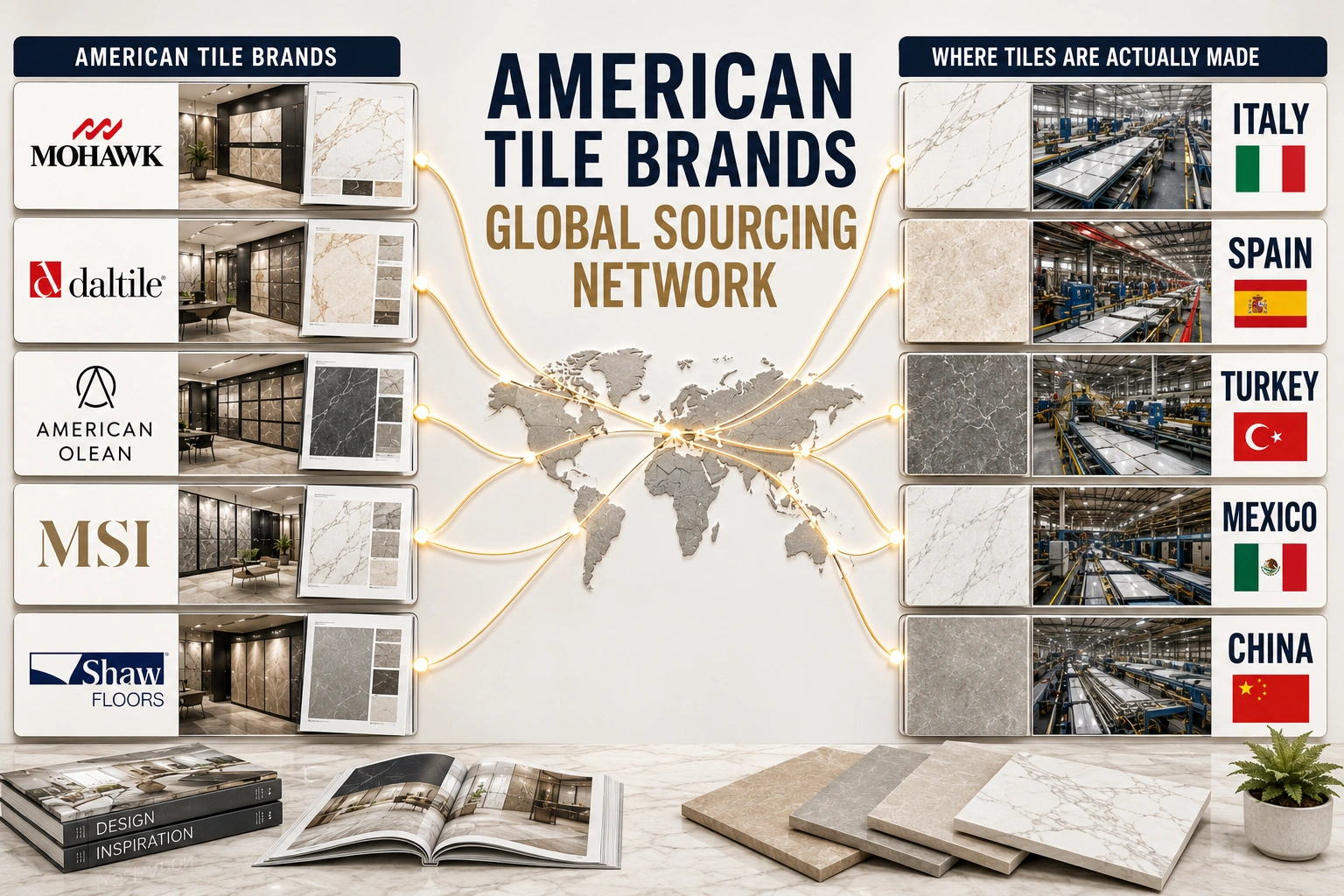
The United States had a significant domestic ceramic tile industry through much of the twentieth century. A combination of cheaper imports from Italy, Spain, and later China progressively displaced US domestic production from the 1980s onward. Today, US-based tile factories produce primarily in specific niche categories: encaustic cement tiles, handmade terracotta, specialty mosaic, and some glazed ceramic wall tile production. For vitrified floor tiles and large format slabs, there is virtually no significant US domestic production.
The Tile Council of North America (TCNA) is the industry association that sets installation and quality standards for tiles sold in the US market. TCNA's handbook is the primary installation reference for tile contractors across North America. TCNA standards are not the same as Indian BIS IS 13630 or European EN 14411, though the underlying tile performance parameters overlap significantly. For Indian importers specifying US-brand tiles on projects, understanding that the TCNA standard covers installation methodology more than tile production quality is an important starting point.
ASTM International, formerly known as the American Society for Testing and Materials, publishes tile product standards used in the US market. ASTM C373 covers water absorption; ASTM C648 covers breaking strength; ASTM C1028 covers slip resistance. These are the US equivalents of the individual test methods covered under EN 14411 and BIS IS 13630. A tile carrying ASTM test certifications provides the same kind of specification confidence as a European CE-marked tile on those specific parameters.
For Indian buyers, the practical takeaway is this: an American tile brand on a tile box tells you about the distributor, the design direction, and the quality standard the brand applies to its sourcing. It does not tell you the tile was made in the USA. Check the country of origin on the tile box or technical data sheet before assuming domestic American manufacture.
Top 10 Tiles Manufacturers and Brands in USA
The table below covers all ten brands and manufacturers. Detailed notes follow for each. The 'Production Reality' column notes where the tiles are actually manufactured.
| # | Brand / Manufacturer | HQ Location | Production Reality | Primary Category |
| 1 | Dal-Tile (Mohawk Industries) | Dallas, Texas | US plants + Mexico + global sourcing | Ceramic wall, glazed floor, large format |
| 2 | American Olean (Mohawk) | Dallas, Texas | US plants + Mexico + global sourcing | Ceramic wall, glazed vitrified floor |
| 3 | Florida Tile | Lexington, Kentucky | Sourced from Italy and Spain | Large format, marble-look, wood-look |
| 4 | Crossville Ceramics | Crossville, Tennessee | Primarily US manufactured | Glazed ceramic and vitrified floor tile |
| 5 | Emser Tile | Los Angeles, California | Sourced from Spain, Italy, Turkey | Marble-look, wood-look, large format |
| 6 | Interceramic | Richardson, Texas | Manufactured in Mexico | Ceramic wall, glazed floor, sanitaryware |
| 7 | Oceanside Glasstile | Vista, California | US manufactured (glass tile) | Glass mosaic, decorative accent tile |
| 8 | Arto Brick | Gardena, California | US manufactured (handmade) | Handmade terracotta, encaustic cement |
| 9 | Fireclay Tile | San Jose, California | US manufactured | Glazed ceramic, recycled content tiles |
| 10 | Ann Sacks Tiles (Kohler Co.) | Portland, Oregon | US + global sourcing, luxury segment | Handmade, glass, natural stone, cement |
1. Dal-Tile (Mohawk Industries)
Dal-Tile is the largest tile manufacturer in North America by production volume and revenue, operating as a subsidiary of Mohawk Industries. The company runs manufacturing plants in Texas, New Jersey, and several locations in Mexico. Their US plant production covers glazed ceramic wall tiles and glazed floor tiles, while their broader product range includes sourced large format tiles and stone products from international manufacturers.
Dal-Tile's domestic ceramic production covers wall tiles in the 12x18 (300x450 mm) and 12x24 (300x600 mm) sizes for bathroom and kitchen applications. These are wall-only sizes and should not be used on floors. Their glazed floor tile range covers 2x2 (600x600 mm) and some 2x4 (600x1200 mm) sizes. For Indian importers evaluating Dal-Tile for a US-based project specification or for brand-name recognition in a premium Indian project context, Dal-Tile's scale and Mohawk Industries' distribution network are notable strengths.
2. American Olean (Mohawk Industries)
American Olean is one of the oldest tile brands in the United States, founded in 1923 in Olean, New York. The brand is now owned by Mohawk Industries and shares manufacturing infrastructure with Dal-Tile. American Olean's product range covers ceramic wall tiles, glazed floor tiles, and some vitrified floor options sourced from international manufacturers. The brand is particularly recognised in the US residential renovation market where its name carries decades of contractor familiarity.
American Olean's ceramic wall tile range in the standard 12x18 and 12x24 sizes covers a wide colour palette for bathroom and kitchen walls. Their glazed floor tile collections include matte and structured finishes in the 2x2 size for bathroom floors and living area floors in residential settings. For Indian buyers, American Olean is less relevant as a direct import option; its significance is primarily as a design reference point for the American residential tile market.
3. Florida Tile
Florida Tile, headquartered in Lexington, Kentucky, is a tile distribution brand that sources its product primarily from European manufacturers in Italy and Spain. The company does not operate domestic US production facilities; it curates tile collections from overseas factories and distributes through a North American dealer network. Florida Tile's range covers large format tiles in 6x4 (1200x1800 mm) and 8x4 (1200x2400 mm) sizes, marble-look vitrified collections in 2x4 format, and wood-look tiles in the 8x48 (200x1200 mm) plank size.
For Indian buyers, Florida Tile's significance is primarily as a brand that has translated Italian and Spanish tile aesthetics into the American market context. The actual tiles are European manufactured and carry CE marking under EN 14411. If a project specification calls for Florida Tile-branded products, the underlying tiles can sometimes be sourced directly from the same European factories at lower cost by working with an Indian importer who has direct European factory relationships.
4. Crossville Ceramics
Crossville Ceramics is one of the more genuinely American tile manufacturers in this list, operating a production plant in Crossville, Tennessee since 1986. The company manufactures glazed ceramic and some vitrified floor tiles domestically and has invested in sustainability programmes including recycled material content in its tile body composition. Crossville holds a notable position in the US sustainable construction market and has LEED-relevant product certifications.
Crossville's glazed floor tile range covers the 2x2 and 2x4 sizes in both matte and polished finishes. Their matte finish glazed tiles are suited for indoor floor and wall applications. The polished finish versions should not be used on wet bathroom floors or outdoor areas where slipperiness is a safety concern. For Indian green building projects seeking LEED credit-eligible tile products from a US manufacturer, Crossville is one of the few names on this list with genuine domestic US production and documented recycled content.
5. Emser Tile
Emser Tile, headquartered in Los Angeles, operates as a large US tile distributor sourcing product primarily from Spain, Italy, and Turkey. The company does not manufacture tiles domestically. Their product range covers marble-look vitrified tiles in 2x4 and 6x4 sizes, wood-look tiles in the 8x48 plank format, large format slabs in 8x4 sizes, and outdoor anti-skid tiles in the 16x16 (400x400 mm) and 20x20 (500x500 mm) sizes with matte finishes. Emser's collection breadth across origins makes it one of the more comprehensive American tile distributors.
For Indian buyers, Emser's relevance is as a design reference and as a sourcing option for US-based project specifications. Their European-sourced tiles carry the same CE marking and EN 14411 certification as tiles bought directly from the Spanish or Italian factories. Emser's outdoor tile range covers tiles rated for external use including pool surrounds and terraces; always confirm the specific tile's outdoor rating from its technical data sheet before specifying for any exposed outdoor application.
6. Interceramic
Interceramic is a US tile brand with manufacturing facilities in Mexico, making it one of the North American producers with actual factory production rather than purely overseas sourcing. The company produces ceramic wall tiles, glazed floor tiles, and sanitaryware from its Mexican plants and distributes through a dealer network across the US market. Their ceramic wall tile range covers the 12x18 and 12x24 sizes in standard bathroom and kitchen applications. These are wall-only sizes.
Interceramic's Mexican manufacturing gives the brand a cost structure between US-sourced tiles and European-sourced tiles, making their glazed floor tile range in the 2x2 size competitively priced for the US mid-market. For Indian importers, Interceramic is primarily relevant when a US project specification calls for this specific brand. Direct import from Interceramic to India is rarely cost-effective given freight and duty structures.
7. Oceanside Glasstile
Oceanside Glasstile, based in Vista, California, is a genuinely US-manufactured specialty tile brand producing glass mosaic tiles and decorative accent tiles from its California facility. The company has been producing handcrafted glass tiles for over three decades and uses a significant percentage of recycled glass content in its production. Their products are used as decorative accent tiles on bathroom walls, kitchen backsplashes, and feature wall applications.
Glass mosaic tiles from Oceanside are wall and backsplash tiles only. They are not floor tiles and should not be specified for floor applications where foot traffic and surface hardness requirements apply. For Indian luxury residential and hospitality projects where a designer is specifying a kitchen backsplash or bathroom feature wall with a handcrafted glass tile element, Oceanside is one of the more recognisable US-origin specialty tile brands. Their product is available through international distributors and select Indian importers of luxury tile materials.
8. Arto Brick
Arto Brick, operating from Gardena, California, is a US manufacturer of handmade terracotta tiles, encaustic cement tiles, and handcrafted glazed ceramic tiles. The company has been making handmade tiles in California since 1966. Their terracotta tile range covers both traditional Mexican-style terracotta and more contemporary cement-look encaustic patterns in the 1x1 (300x300 mm) and larger handmade sizes.
Arto's tiles are used on floor and wall applications in high-end residential projects, boutique hospitality, and architect-specified renovations where a handmade, artisan-quality material is part of the design intent. Terracotta tiles from Arto require sealing before use and regular maintenance, which is different from the maintenance-free characteristics of vitrified tiles. For Indian architects working on heritage renovation projects, boutique resort designs, or luxury villa projects where an artisan tile material is specified, Arto represents the American handmade tile category at its most serious.
9. Fireclay Tile
Fireclay Tile, based in San Jose, California, is a US manufacturer of glazed ceramic wall tiles and floor tiles with a strong focus on sustainability. The company uses recycled materials in its tile body, runs its California kilns on renewable energy sources, and holds recognized environmental certifications for its manufacturing process. Fireclay's glazed ceramic tiles cover wall applications in the standard 12x18 and 12x24 sizes and some floor-rated glazed tiles in the 1x1 (300x300 mm) size.
For Indian green building and LEED-rated projects where the material specification includes recycled content requirements and US-origin sustainable products, Fireclay is one of the most documented American tile manufacturers in terms of its environmental credentials. Their tiles are priced at a significant premium over standard imported ceramics, reflecting the California manufacturing cost base and the sustainability certifications. The brand is distributed internationally through select importers of sustainable building materials.
10. Ann Sacks Tiles (Kohler Company)
Ann Sacks is a luxury tile and stone brand owned by the Kohler Company, headquartered in Portland, Oregon. The brand operates showrooms in major US cities and sources product from a mix of US artisan manufacturers, European factories, and global natural stone suppliers. Ann Sacks is best known for handmade tile collections, glass tile series, encaustic cement tiles, and natural stone mosaics at the highest price tier in the US residential market.
For Indian luxury residential and hospitality projects where a designer is sourcing tiles that carry a recognised American luxury brand name, Ann Sacks is the most prominent option. The brand's showroom-based distribution model means tiles are typically sold at retail or trade pricing through authorised channels rather than through direct import. For Indian importers evaluating Ann Sacks for a premium project, the Kohler Company's Indian operations provide the most direct access point for brand and product information.
Tile Categories and American Brand Specialisations
American tile brands cover a specific set of categories well and have limited or no presence in others. The table below maps the most relevant categories for Indian buyers.
| Category | US Brand Strength | Key Brands | Indian Equivalent | Application |
| Glazed ceramic wall tile | Strong domestic production | Dal-Tile, American Olean, Fireclay | Ceramic wall tile | Bathroom and kitchen walls only (12x18, 12x24) |
| Glazed vitrified floor tile | Moderate, mostly sourced | Dal-Tile, American Olean, Emser | GVT | Indoor floor and wall, dry and wet areas |
| Large format vitrified slab | No US production; sourced | Florida Tile, Emser (from Europe) | Large format GVT | Premium floors, feature walls; polished for dry areas only |
| Glass mosaic accent tile | Strong US production | Oceanside Glasstile, Ann Sacks | No Indian equivalent | Wall and backsplash only; not for floor use |
| Handmade terracotta/cement | Strong US production | Arto Brick, Ann Sacks, Fireclay | No Indian equivalent | Floor and wall; requires sealing and maintenance |
| Recycled content / LEED | US-specific strength | Crossville, Fireclay | No Indian equivalent | All standard applications; documented green credentials |
| Outdoor anti-skid tiles | Sourced from Europe/Turkey | Emser (sourced) | GVT anti-skid | Terraces, pool, compound areas; confirm outdoor rating |
What Indian Buyers Need to Know About American Tile Brands
Most US brands do not manufacture in the USA: Of the ten brands in this list, only Dal-Tile, American Olean (both with US plants), Crossville, Oceanside Glasstile, Arto Brick, and Fireclay have actual US or North American manufacturing. Florida Tile and Emser are purely sourcing and distribution brands. Interceramic manufactures in Mexico. Ann Sacks sources globally. When a project specification says 'American tile brand', confirm whether that means US-manufactured or US-branded before sourcing.
Import economics from USA to India rarely work: Importing tiles directly from US-based brands to India involves US export freight to Indian ports (typically 22 to 35 days), standard Indian customs duty of 20% to 40% on assessable value, IGST at 18%, and port handling charges. For tiles that are themselves sourced from Italy, Spain, or Turkey by the US brand, a direct import from the European factory to India almost always produces a lower landed cost than routing through the US brand's US distribution. The only meaningful reason to import US-brand tiles to India is when a project specification specifically mandates a particular US brand name.
Specialty US categories have no Indian equivalent: Where US brands genuinely add value is in specialty categories that Indian or European manufacturers do not produce: handmade terracotta, encaustic cement tiles, recycled-content glazed ceramics, and artisan glass mosaic. These categories attract a significant price premium but offer design and material authenticity that standard tile production cannot replicate. For Indian architects specifying boutique resort, luxury villa, or heritage renovation projects, these American specialty categories are worth evaluating as accent materials alongside standard vitrified floor tiles.
LEED credit relevance for Indian green buildings: Crossville Ceramics and Fireclay Tile both produce tiles with documented recycled content and environmental certifications that contribute to LEED credit calculations. Indian construction projects pursuing LEED India (administered by IGBC) or LEED v4.1 ratings can use recycled-content tiles from verified US manufacturers as part of their Material and Resources credit documentation. Confirm the specific recycled content percentage and the applicable LEED credit category with the manufacturer before specifying for a rated project.
TCNA and ASTM standards versus BIS IS 13630: US tile standards use ASTM test methods and TCNA installation guidelines. Indian tile standards use BIS IS 13630. The underlying test parameters for water absorption, breaking strength, and slip resistance are broadly aligned because both systems reference the same ISO 13006 international standard. For Indian institutional or government projects that specifically mandate BIS certification, US ASTM certifications are not an automatic substitute. Confirm with the project specification whether ASTM certifications are accepted as equivalent before specifying US-brand tiles.
How US Tile Standards Compare to Indian Standards
| Parameter | US Standard (ASTM) | Indian Standard (BIS IS 13630) | European (EN 14411) | Equivalent? |
| Water absorption | ASTM C373 | IS 13630 Part 1 | EN ISO 10545-3 | Yes, same parameter |
| Breaking strength | ASTM C648 | IS 13630 Part 5 | EN ISO 10545-4 | Yes, same parameter |
| Slip resistance | ASTM C1028 | IS 13630 Part 17 | EN 13845 / DIN | Broadly equivalent |
| Chemical resistance | ASTM C650 | IS 13630 Part 13 | EN ISO 10545-13 | Yes, same parameter |
| Scratch hardness (PEI) | ASTM C1027 | IS 13630 Part 7 | EN ISO 10545-7 | Yes, same method |
| Government mandate | Not mandatory | BIS certification for institutional | CE for EU market | Not interchangeable for Indian govt projects |
Common Misconceptions About American Tile Brands
Assuming Made in USA means manufactured in the USA: Most tiles sold by American brands are manufactured overseas. Check the country of origin on the tile box. A tile branded by an American company but manufactured in China is a Chinese tile for Indian customs purposes and attracts the same duty structure as any other Chinese-origin tile, including any applicable anti-dumping duty on vitrified categories.
Expecting vitrified large format production from US brands: The US has no significant domestic production of large format vitrified tiles in 6x4 and 8x4 sizes. American brands that carry these sizes source them from Italy, Spain, or Turkey. If you need large format tiles for a project, evaluating the European source manufacturer directly is more cost-effective and gives better access to the full collection range than going through a US brand.
Specifying glass mosaic tiles for bathroom floors: Glass mosaic tiles from Oceanside Glasstile, Ann Sacks, and similar US brands are wall, backsplash, and decorative accent tiles. They are not suited for floor applications where breaking strength, slip resistance, and surface hardness under foot traffic are performance requirements. Floor tile specifications require a completely separate tile category even when used in the same bathroom where glass wall tiles are specified.
Using terracotta tiles without sealing: Handmade terracotta tiles from brands like Arto Brick are porous and require proper sealing before use and periodic resealing over their service life. Unsealed terracotta will absorb stains, water, and cleaning chemicals. Indian architects and buyers who specify terracotta for its visual character without planning for the sealing and maintenance schedule create a recurring service problem for the project owner.
Routing European tiles through a US brand when direct European import is cheaper: Florida Tile and Emser distribute European tiles under an American brand umbrella. For Indian importers, buying these tiles through the US brand means paying US distribution margin and then importing from the US, which adds freight and cost compared to sourcing directly from the Spanish or Italian factory. The only reason to buy through the US brand is if a project specification mandates that specific brand name.
Assuming polished vitrified tiles from US brands are safe for wet areas: This rule applies regardless of country of origin. Polished finish vitrified tiles, whether distributed by an American brand or manufactured in Italy, create a slip risk on wet bathroom floors, outdoor wet areas, and pool surrounds. Always specify matte or anti-skid finish for any wet or outdoor floor application.
American Tile Brands and the Indian Market: The Summary
The US tile market is vast but not a major tile manufacturing country by global standards. For Indian buyers, American tile brands are most relevant in three specific situations: when a project specification mandates a named US brand, when specialty categories like handmade terracotta, glass mosaic, or recycled-content ceramics are part of the design intent, or when a project is pursuing LEED certification and needs documented US-manufactured recycled content tiles.
For standard vitrified floor tiles, ceramic wall tiles, and large format slabs, sourcing directly from Indian, Spanish, Italian, or Turkish manufacturers almost always produces better value and faster delivery than routing through American brands whose product is often manufactured in those same countries.
You can compare tiles from verified domestic Indian manufacturers and international brands on TilesFinders, a B2B tiles marketplace connecting Indian construction buyers with quality tile sources across all market segments and origins.
FAQs
The US imports the large majority of its tile consumption. Domestic US tile manufacturing is concentrated in glazed ceramic wall tiles and specialty categories including handmade terracotta, encaustic cement, and glass mosaic. For large format vitrified tiles, full body tiles, and PGVT tiles, there is no meaningful US domestic production. Dal-Tile and American Olean have US production plants for ceramic tile but source their vitrified and large format ranges from overseas manufacturers.
Several American tile brands have a presence in India through the Kohler Company's Indian operations (Ann Sacks is a Kohler brand) and through the Mohawk Industries and Dal-Tile group's growing India distribution activities. Florida Tile and Emser's European-sourced products are sometimes available through Indian importers of Spanish and Italian tiles who carry these brands alongside the original European factory products. Specialty brands like Fireclay Tile and Oceanside Glasstile are available in India through niche importers of sustainable and luxury building materials for premium project specifications.
The Tile Council of North America (TCNA) is the US tile industry association based in Anderson, South Carolina. TCNA publishes the annual Handbook for Ceramic, Glass, and Stone Tile Installation, which is the primary installation reference for tile contractors across North America. TCNA also sets the ANSI A108 installation standard. The TCNA handbook is the US equivalent of the installation guidance found in European EN tile installation standards. TCNA does not certify tile quality; it governs installation methodology and substrate preparation standards.
For most tile categories, importing from US brands to India is not cost-effective compared to sourcing from the original European, Turkish, or Indian manufacturer. Sea freight from US ports to Indian ports runs 25 to 35 days with higher freight costs per container than from Spain or Turkey. Indian import duty applies at the same rate regardless of the tile's US brand name. The only cost-effective cases for US-brand tile import to India are specialty categories like handmade terracotta, glass mosaic, or recycled-content ceramics that have no Indian or European equivalent, or when a project specification specifically mandates a named American brand.
LEED (Leadership in Energy and Environmental Design) is a US green building rating system administered by the US Green Building Council. In India, LEED projects are administered through the Indian Green Building Council (IGBC). Tiles can contribute to LEED Material and Resources credits through documented recycled content (pre-consumer and post-consumer recycled material in the tile body), regional material sourcing credits, and low-VOC adhesive specifications. Crossville Ceramics and Fireclay Tile both produce tiles with documented recycled content and can provide the letter of compliance and recycled content percentage data needed for LEED credit submissions. Indian projects pursuing LEED v4.1 rating can include these tiles in their credit documentation.
US domestic ceramic tile production covers the standard 12x18 (300x450 mm) and 12x24 (300x600 mm) wall tile sizes and the 2x2 (600x600 mm) and some 2x4 (600x1200 mm) floor tile sizes. Specialty handmade tiles from Arto Brick and Fireclay cover the 1x1 (300x300 mm) size and various handmade format sizes depending on the collection. Glass mosaic tiles from Oceanside Glasstile are produced in small mosaic sheet formats. For large format tiles above 2x4, all American brands source from European or Asian manufacturers with no US-based production of these sizes.
The subway tile, a rectangular glazed ceramic tile typically in the 75x150 mm (3x6 inch) format, was first used in the New York City subway system in the early 1900s, installed by American Olean's predecessor company. The format became a standard in US residential bathrooms and kitchens through the twentieth century and has since become one of the most globally recognised tile formats. Today, subway tiles are manufactured in the USA by Dal-Tile and American Olean, in Italy, Spain, Turkey, China, and India. The format is not a protected American product; it is produced globally. Indian manufacturers and importers stock subway tile formats, often in the 75x300 mm or 100x300 mm size as a variation on the original American format.
