How to Choose Bathroom Wall Tiles: A Practical Buyer's Guide
Upgrade your bathroom walls in 2026. Learn how to choose between ceramic and vitrified tiles, pick the right sizes for small spaces, and find the perfect finish to survive hard water.
- Why Your Bathroom Wall Tile Choice Matters
- Ceramic, Vitrified or Porcelain: Which Material Works Best on Bathroom Walls
- Finish Guide: Glossy, Matte, Textured and What Goes Where
- Bathroom Wall Tile Sizes: What Works for Indian Bathrooms
- Bathroom Tiles Design Ideas for Walls in 2026
- Common Mistakes People Make When Choosing Bathroom Wall Tiles
- Final Thoughts
How to Choose Bathroom Wall Tiles: A Practical Buyer's Guide
Bathroom wall tiles are not a background decision. They set the colour, the light, and the feel of a space you use at least twice a day. Get them right, and the bathroom feels clean and calm for years. Get them wrong, and no amount of good fittings or lighting can fix it.
Most buyers pick bathroom wall tiles the same way: a quick showroom visit, a tile that looks bright under display lighting, and an order placed on the same day. The problems start after the tiles go up, when the finish shows every fingerprint, the grout darkens within months, or the room feels half the size it should.
Before choosing wall tiles, it helps to understand how different bathroom tiles perform overall. Our detailed guide on bathroom tiles guide explains everything from materials and finishes to pricing and maintenance.
Why Your Bathroom Wall Tile Choice Matters
Bathroom walls handle more than most people account for. Soap splashes, steam from hot showers, daily cleaning with acid-based products, and, in coastal cities like Mumbai and Kochi, sustained humidity across the monsoon months. A tile that holds up to all of this without staining or dulling is not optional.
The material decides how much water the tile body absorbs. The finish decides whether the surface stains easily or cleans with a quick wipe. The size decides how many grout lines you are committing to maintain, and whether the room feels open or cramped.
In a standard 2BHK apartment bathroom in India, the wall area runs from roughly 60 to 90 sq. ft. That is a significant surface. The tile choice on that surface affects lighting, room scale, and cleaning effort every day for as long as you live there.
Ceramic, Vitrified or Porcelain: Which Material Works Best on Bathroom Walls
Three material categories account for the vast majority of bathroom wall tile installations in Indian homes. Each handles walls differently.
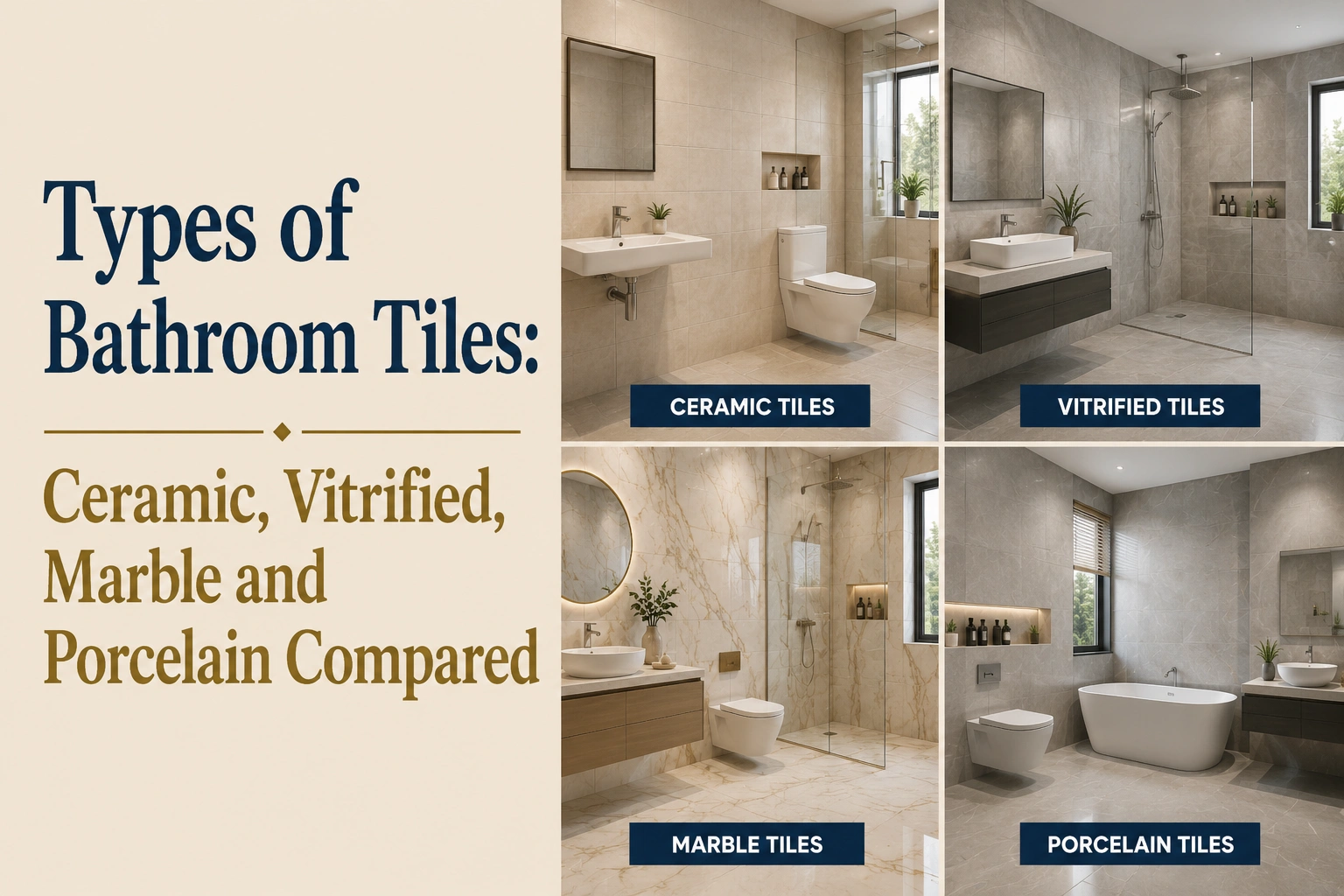
Ceramic Bathroom Tiles
Ceramic bathroom tiles have been the most widely used wall tile in India for decades. They come in the widest range of printed designs, from plain whites and subtle textures to printed marble effects and decorative border strips. They are lightweight, easy to cut on site, and among the lowest-cost wall tile options at approximately ₹30 to ₹80 per sq. ft.
Ceramic tiles absorb 12 to 16% water by weight, which is why they stay on walls and not floors. On bathroom walls above the waterline, this absorption level is manageable. The glaze on the surface provides adequate stain resistance for wall use.
Sizes for bathroom walls: 300x300 mm (1x1), 300x450 mm (12x18), and 300x600 mm (12x24). The 12x18 and 12x24 sizes are wall-only. Never use 300x450 or 300x600 ceramic tiles on floors.
Vitrified Bathroom Tiles (GVT and PGVT)
Vitrified bathroom tiles absorb only 0.05% water (as per IS 15622), which gives them far better stain resistance than ceramic on walls and makes the surface much easier to wipe clean after soap residue builds up.
GVT (Glazed Vitrified Tiles) work on both bathroom walls and floors. PGVT (Polished Glazed Vitrified Tiles) are the right choice for bathroom walls when a polished, mirror-like finish is wanted. Both come in large formats like 2x4 (600x1200 mm) that cover more wall area per tile and reduce grout lines significantly.
One rule that is non-negotiable: PGVT tiles must not be used on bathroom floors. The polished surface is slippery when wet. On bathroom walls, PGVT is safe and looks clean. On bathroom floors, it is a safety risk. This distinction matters when placing an order.
Approximate price range for GVT and PGVT: ₹60 to ₹150 per sq. ft., varies by size, design, and brand.
Porcelain Bathroom Tiles
Porcelain bathroom tiles sit between ceramic and vitrified in water absorption: 2 to 5%. They are denser than ceramic and hold up better in consistently humid bathrooms. In India, porcelain tiles are mostly sold in matte finish.
Porcelain works on both bathroom walls and floors. Sizes include 1x1 (300x300 mm), 16x16 (400x400 mm), 2x2 (600x600 mm), and 2x4 (600x1200 mm), plus the 8x40 (200x1000 mm) wooden-plank format.
Approximate price range: ₹90 to ₹220 per sq. ft. GVT and PGVT are vitrified tiles, not porcelain. These are different categories. Do not describe vitrified tiles as porcelain when specifying with a dealer.
Choosing between ceramic, vitrified, marble-look, and porcelain tiles can get confusing quickly. Our expert guide on types of bathroom tiles breaks down the real differences in a simple way.
| Material | Water Absorption | Wall Use | Best Finish | Approx. Price per sq. ft. |
| Ceramic | 12 to 16% | Yes (wall only) | Glossy, matte, printed | ₹30 to ₹80 |
| GVT (Vitrified) | 0.05% | Yes (wall and floor) | Matte, sugar, matte carving | ₹60 to ₹150 |
| PGVT (Vitrified) | 0.05% | Yes (wall only, NOT floor) | Polished glossy, polished high glossy | ₹60 to ₹150 |
| Porcelain | 2 to 5% | Yes (wall and floor) | Matte (mostly) | ₹90 to ₹220 |
Finish Guide: Glossy, Matte, Textured and What Goes Where
Finish is what you see and touch every day. It also decides how much cleaning effort the wall needs and how forgiving it is under your bathroom's lighting.
| Finish | Best for Bathroom Walls? | Cleaning | Key Characteristic |
| Polished Glossy (PGVT) | Yes, walls only | Easy wipe-down | Mirror-like shine, reflects light well |
| Polished High Glossy (PGVT) | Yes, walls only | Easy but shows fingerprints | Intense mirror finish, very bright |
| Matte (GVT/Porcelain) | Yes, walls and floors | Easy | No shine, hides soap marks, anti-skid |
| Sugar (GVT) | Yes, walls and floors | Easy | Matte base with light sparkle |
| Matte Carving (GVT) | Yes, walls and floors | Moderate (grooves) | Matte surface with raised glossy veins |
| Stucco (GVT) | Yes, walls | Easy | Cement-plaster look, soft texture |
| Textured / Embossed (GVT) | Yes, walls | Moderate (grooves) | Raised surface pattern, visual depth |
| Glossy Carving / Rocker (GVT) | Yes, walls only | Hard (grooves stain) | Grooved veins on polished surface |
Polished and high glossy finishes on bathroom walls look clean in person but show water spots from hard water quickly, especially in Delhi, Jaipur, Ahmedabad, and other cities with high mineral content in the municipal supply. A sugar or matte finish on the same tile hides these marks far better.
Textured bathroom tiles with embossed or carved surfaces add visual interest to a plain wall but collect soap scum in the grooves over time. Use them as feature panels, not across all four walls. A single textured accent wall behind the vanity works well. An entire bathroom in carved or rocker finish becomes a cleaning project.
Bathroom Wall Tile Sizes: What Works for Indian Bathrooms
Size affects how a bathroom looks and how much grout you commit to maintaining. Fewer tiles mean fewer grout lines. Fewer grout lines mean less yellowing and staining over time.
| Size (mm) | Alias | Wall or Floor? | Best Use Case |
| 300x450 | 12x18 | Wall only | Budget bathroom walls, small niches, coordinated sets with 1x1 floor tiles |
| 300x600 | 12x24 | Wall only | Standard Indian bathroom wall tile, widest design range in ceramic |
| 300x300 | 1x1 | Both | Wall tiles, and the only ceramic size usable on bathroom floors |
| 600x600 | 2x2 | Both | Medium bathrooms, wall and floor in matching GVT matte finish |
| 600x1200 | 2x4 | Both | Most popular large-format bathroom wall tile, minimal grout lines |
| 800x1600 | 32x64 | Both | Feature walls in 3BHK master bathrooms, very few grout lines |
For small Indian bathrooms under 40 sq. ft., the 2x4 (600x1200 mm) size on walls works well. The tall format runs from floor to near the ceiling with just one or two tiles, which removes the horizontal grout lines that visually cut a small bathroom in half. Paired with a light colour, this size makes a compact bathroom feel significantly more open.
The 12x24 (300x600 mm) ceramic is the workhorse of the Indian bathroom wall market. It is affordable, comes in a huge range of designs, and fits both budget builds and renovation projects. Most Indian tile dealers stock the widest range in this size.
Bathroom Tiles Design Ideas for Walls in 2026
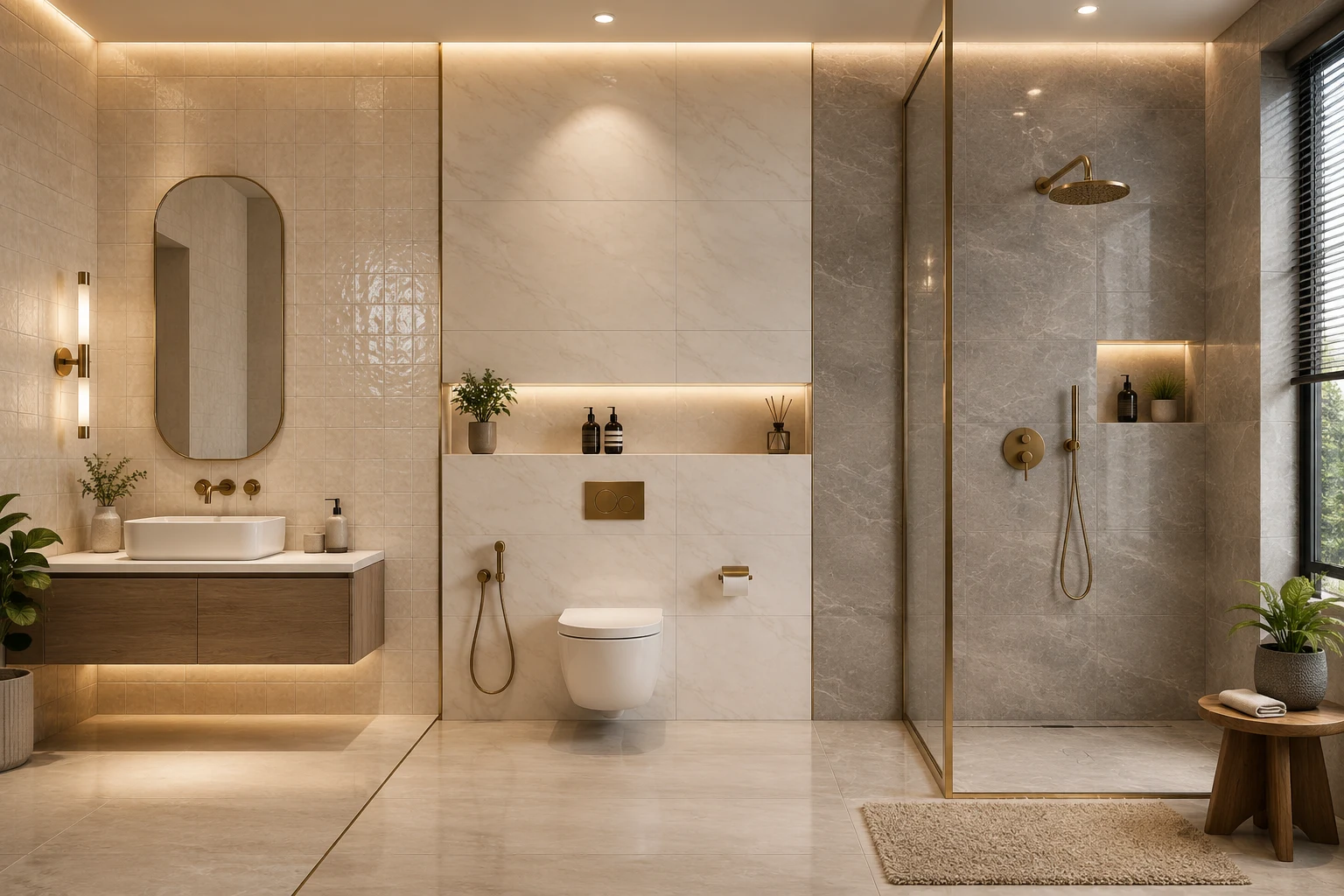
Indian bathroom tiles design has shifted away from busy printed patterns and single-colour solid tiles toward cleaner combinations that photograph well and stay visually fresh for longer.
All-White Walls with a Feature Strip
Plain white ceramic or GVT tiles across all walls, with a single decorative border strip or contrasting colour strip at shoulder height. This is the simplest, most low-maintenance bathroom tiles design and works in every size of Indian bathroom. White matte GVT on walls and white matte GVT on the floor creates a clean, unified look.
Full-Height Marble-Look Wall Tiles
PGVT marble-look tiles in 2x4 (600x1200 mm) running from floor to ceiling on the primary bathroom wall. The veined pattern adds visual depth without printed decoration. Grey veining on white is the most popular combination in Indian 3BHK master bathrooms right now. Pair with a plain matte white tile on secondary walls so the marble-look wall stays as the focal point.
Textured Accent Wall Behind the Vanity
A single accent wall in stucco-finish or embossed GVT tiles behind the vanity or washbasin, with plain matte or glossy ceramic on the remaining walls. Textured bathroom tiles work best as a single focal surface. The cement-plaster look of stucco finish in light grey or off-white is a clean, current choice for Indian bathrooms in 2026.
Small Bathroom Wall Tile Ideas That Open Up the Space
For bathrooms under 35 sq. ft., three things make a visible difference: light colours, large tiles, and vertical layout. Light grey or off-white GVT 2x4 tiles laid vertically on all walls remove most of the horizontal grout lines and make the ceiling feel higher. Avoid dark tiles, busy prints, and contrasting border strips in small bathrooms. These break the wall up visually and make the space feel tighter.
Common Mistakes People Make When Choosing Bathroom Wall Tiles
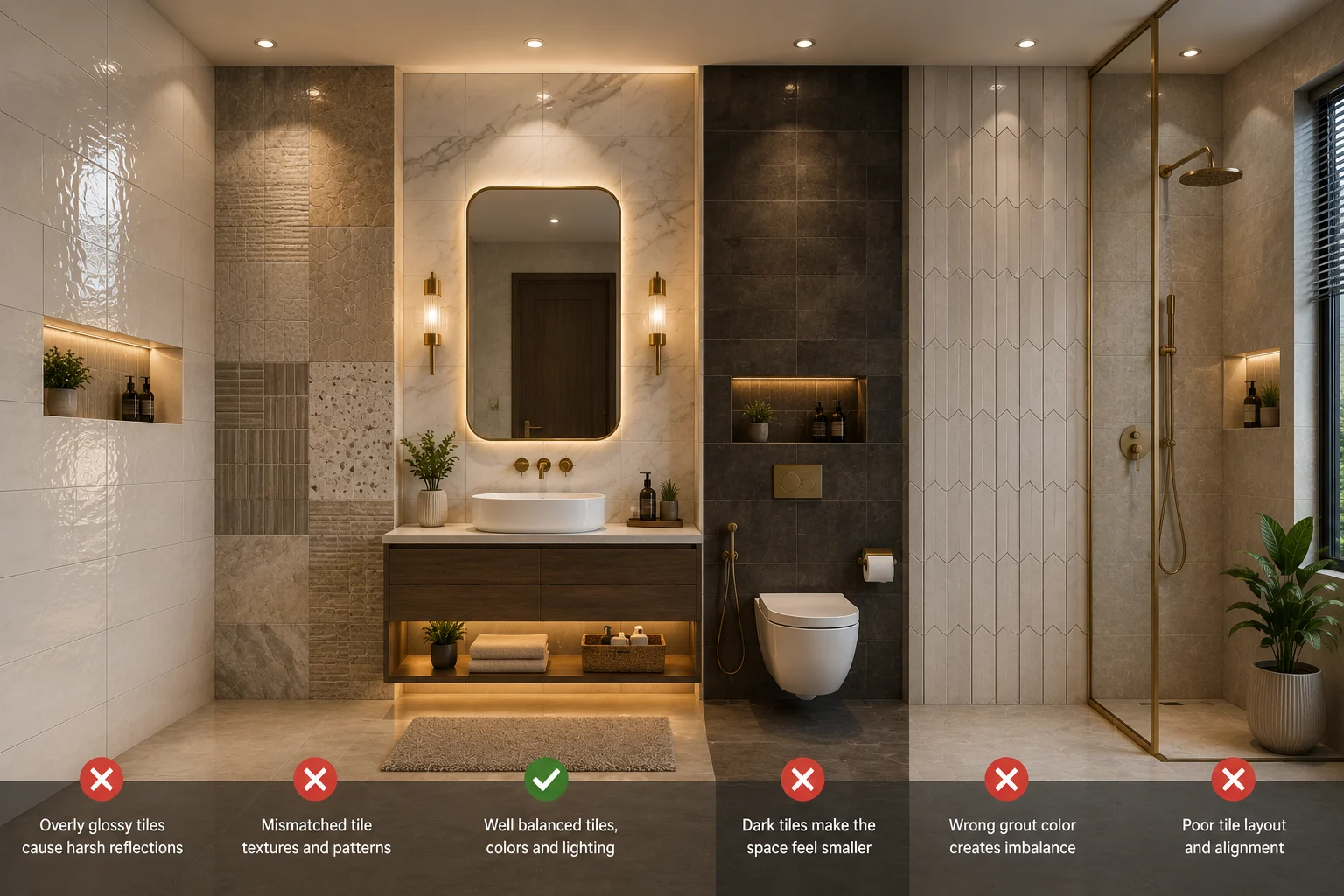
Choosing tiles only under showroom lighting. Showroom lighting is controlled to make tiles look their best. Warm LEDs in a display can make a cool grey tile look beige. Take a sample home and hold it against your bathroom wall under your own light fitting before placing the order.
Using the same tile on walls and floors without checking the finish. A PGVT tile that looks great on a bathroom wall is dangerous on a bathroom floor. The polished finish is slippery when wet. Always confirm with your dealer whether a tile is safe for floor use before laying it in a wet area.
Buying with cement grout in hard-water cities. White cement grout on bathroom walls turns yellow-grey within a year in cities with hard water. Epoxy grout in a mid-grey shade stays cleaner longer and resists the mineral deposits that come with hard water.
Going full coverage with textured or carved tiles. Textured bathroom tiles collect soap residue in their grooves. An accent wall in an embossed or carved finish is a manageable and good-looking choice. Tiling an entire bathroom in carved or glossy carving finish creates a cleaning problem that gets worse over time.
Using wall-only sizes without checking. 300x450 mm (12x18) and 300x600 mm (12x24) are wall-only sizes. Laying them on floors, even in a bathroom where they look right, is technically wrong: the tile body is not rated for foot traffic and the size creates drainage problems. Always confirm size constraints before buying.
Skipping the batch check. The same tile design can have slight colour shifts between production batches. Always buy all wall tiles from the same batch number and order 10% extra for cuts and future replacements. A tile from a different batch two years later will not match.
Final Thoughts
The right bathroom wall tiles are not always the most expensive ones or the ones that look brightest in a showroom. They are the ones that still look clean six months after installation, match your bathroom's actual light conditions, and work with the floor tiles you have already chosen.
Before placing an order, write down your wall area in sq. ft., confirm the finish type with your dealer by name (not just by appearance), and take at least one sample home to check under your own bathroom light.
You can browse bathroom wall tiles by size, finish, material, and colour on TilesFinders to compare options from dealers across India and find what fits your bathroom and your budget.
FAQs
For budget bathroom walls, ceramic tiles in 12x18 (300x450 mm) or 12x24 (300x600 mm) at ₹30 to ₹80 per sq. ft. are the most widely used. For a better finish with easier cleaning, PGVT vitrified tiles in 2x4 (600x1200 mm) with polished, high-glossy finish are the preferred choice in new Indian construction. They absorb only 0.05% water and wipe clean easily after soap residue builds up.
Both work on bathroom walls. Polished glossy PGVT tiles reflect light well and make small bathrooms feel larger, but they show water spots from hard water more visibly than matte tiles. Matte GVT tiles are easier to maintain and hide soap marks better. In cities with hard water like Delhi or Jaipur, matte or sugar finish tiles stay cleaner longer. In bathrooms with less natural light, polished glossy tiles help by bouncing available light around the space.
Large format tiles with fewer grout lines make small bathrooms look bigger. A 2x4 (600x1200 mm) tile on bathroom walls, laid vertically, removes most of the horizontal grout lines that make a small room feel shorter and more cramped. Light colours help too. Light grey or off-white GVT matte tiles in the 2x4 format is the most practical combination for compact Indian apartment bathrooms under 40 sq. ft.
Only if the tile's finish is safe for wet floors. PGVT tiles with polished, high glossy, or satin matte finish are safe on bathroom walls but must not be used on bathroom floors. The polished surface is slippery when wet. GVT tiles with matte, sugar, or GHR finish can be used on both walls and floors. If you want a matching wall and floor look, choose a GVT tile in matte finish. It works on both surfaces safely.
Approximate bathroom wall tile prices in India: ceramic tiles ₹30 to ₹80 per sq. ft.; GVT and PGVT vitrified tiles ₹60 to ₹150 per sq. ft.; porcelain tiles ₹90 to ₹220 per sq. ft.; marble-look vitrified tiles ₹80 to ₹250 per sq. ft.; 3D or textured wall tiles ₹120 to ₹350 per sq. ft. All prices are approximate and vary by brand, design, size, and dealer location.
Textured bathroom tiles work well as accent walls, particularly behind a vanity or along a feature wall. Finishes like stucco, embossed, and matte carving add visual depth to a plain bathroom without the maintenance burden of printed decorative tiles. Avoid using glossy carving or rocker finish tiles across an entire bathroom wall as the grooves are difficult to clean and collect soap residue over time. Use textured tiles on one wall and plain matte or glossy tiles on the others.
Ceramic tiles absorb 12 to 16% water and are used for wall cladding only. Vitrified tiles (GVT and PGVT) absorb 0.05% water, making them more stain-resistant and easier to clean on walls. Ceramic tiles come in a wider range of printed designs at a lower cost. Vitrified tiles are stronger, last longer, and come in larger formats that reduce grout lines. For budget bathroom walls, ceramic in 12x24 is the practical choice. For a better long-term result, PGVT in 2x4 is worth the higher cost.

See our tile guides first
Set TilesFinders as a preferred source and our buying guides surface ahead of the rest for you.
Add as preferred sourceTakes one tap. Nothing to install.
What Readers Say
I was about to redo my parking area with the wrong tile size until I read this. The layout comparisons saved me from a costly mistake.
We reference TilesFinders guides while briefing clients on material selection. The size and pattern breakdowns are accurate and easy to explain visually.
On site, I get asked about grout spacing all the time. This article gave me a solid reference I now share with my team before every job.
Finally a guide that doesn't just push generic advice. The oil stain removal steps actually worked on our clubhouse driveway tiles.
I run a small construction firm and now send this link to clients directly when they ask about entrance tile sizing. Saves me an hour of explaining.
Good practical detail, though I wish there were more examples for compact apartment entrances specifically, not just villas.
My mother-in-law wanted marble, I wanted vitrified. This blog gave us the neutral comparison we needed to actually decide together.
Detailed without being overwhelming. I appreciated that it covered both cost and maintenance, not just the aesthetics.
Used the algae and hard water removal tips on our terrace tiles after the monsoon. Worked better than what our regular cleaner was doing.
As someone who sources tiles for multiple builder projects, I find these comparisons genuinely useful for vendor conversations, not just consumer content.
Recommended this to a client who kept second-guessing the entrance design. The small vs large layout section settled the debate instantly.
Straightforward and honest, no unnecessary jargon. Would like to see a similar breakdown for outdoor pool-deck tiles next.
We've bookmarked several TilesFinders guides for our design handbook. Reliable source when clients want data, not just opinions.
Two paths, one marketplace.
Get free quotes from verified suppliers.
Share your room, budget, and style. Suppliers in Morbi respond within hours.
Get Free QuotesList your business, reach real buyers.
Put your showroom in front of homeowners searching for tiles right now.
List Your Business