Tile Sizes Guide: How to Choose the Right Dimensions for Every Room in Your Indian Home
Find the right tile sizes for every room in Indian homes. Compare floor & wall tile dimensions, finishes, and room-wise size guides for 2026.
-d1476270-6634-42a9-90c8-1f6da025031b.webp)
- Why Tile Size Is the Most Underrated Buying Decision
- How to Read Tile Sizes: mm, Inches, and Trade Names Explained
- Wall-Only vs Floor-Safe Sizes: What Most Buyers Miss
- Living Room and Drawing Room Tile Sizes
- Bedroom Tile Sizes
- Kitchen Tile Sizes
- Bathroom Tile Sizes
- Balcony and Terrace Tile Sizes
- Pooja Room and Corridor Tile Sizes
- Master Reference Table: Right Tile Size for Every Room and Surface
- 6 Rules for Choosing Tile Size in Any Indian Room
- Common Mistakes When Choosing Tile Sizes in India
- Finding the Right Tile Size for Your Home
Most Indian homeowners spend more time choosing the tile design than the tile size. That is the wrong order.
Size affects how large a room feels, the number of grout lines the floor has, the amount of cutting waste generated during installation, and whether the tile is suitable for the surface on which it is being laid. The wrong size on the wrong surface is not just a design mistake. In some cases, it is a safety issue.
This guide provides the ideal tile sizes for every room and surface in an Indian home, ranging from compact 1BHK bathrooms to spacious open-plan living spaces. All sizes are given in both mm and trade names, matched to the correct tile category and finish for each application.
Why Tile Size Is the Most Underrated Buying Decision
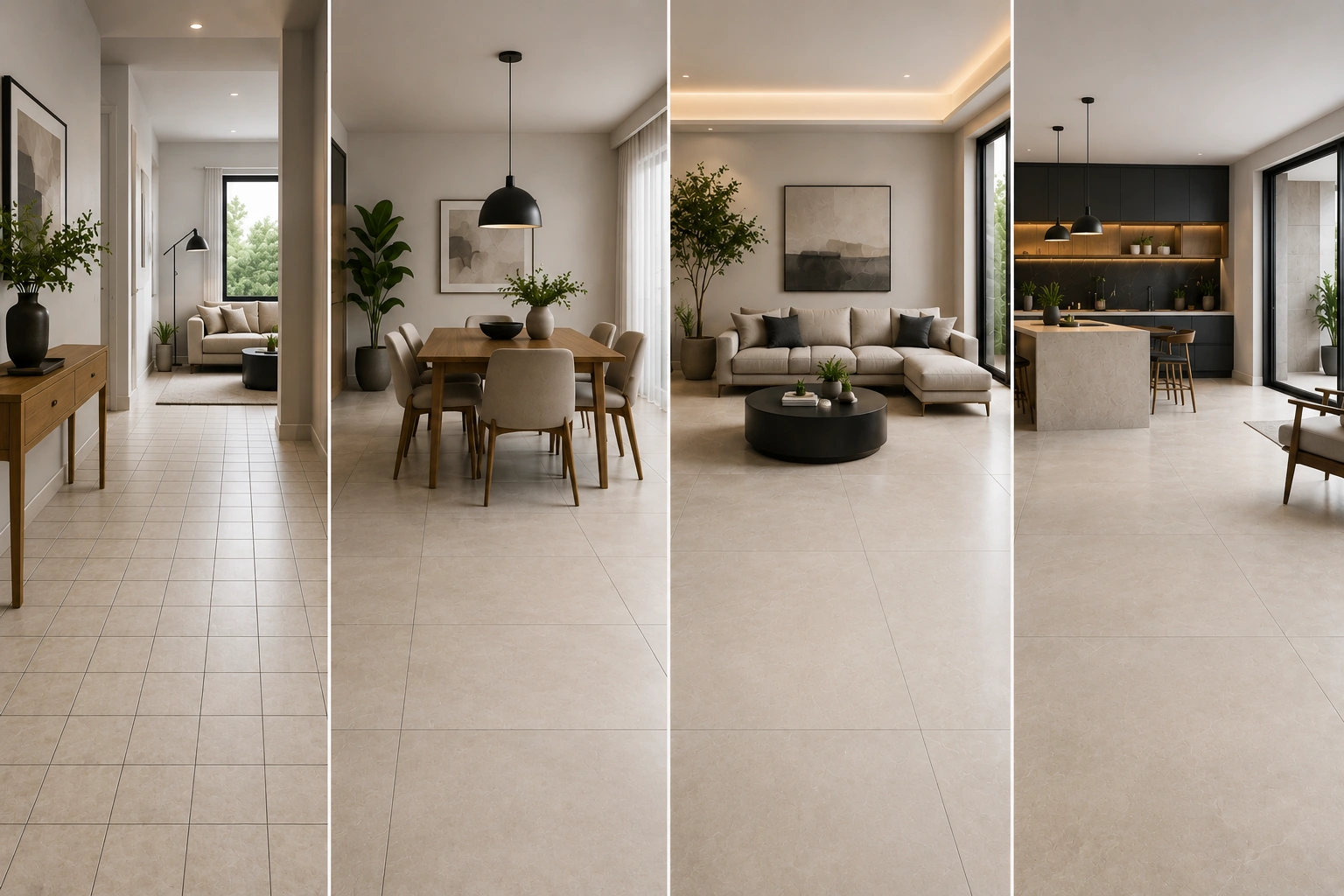
Two homeowners can buy identical marble-look GVT tiles in the same colour. One uses 2x2 (600x600 mm) tiles in a 120 sq ft bedroom. The other uses 2x4 (600x1200 mm) tiles in the same room. The results look completely different. The larger format makes the room feel 20 to 30% more spacious because fewer grout lines break up the visual field.
Size also has technical consequences. A 300x600 mm tile is a wall-only product regardless of how strong it looks in the showroom. Laying it on a floor causes rapid wear, staining, and potential tile breakage because it was not manufactured for floor load distribution. Many Indian homes have cracked bathroom floors traced back to this single specification mistake.
The difference between getting the size right and getting it wrong shows up every single day, in every room, for the entire life of the floor or wall. It is worth the fifteen minutes this guide takes to read.
How to Read Tile Sizes: mm, Inches, and Trade Names Explained
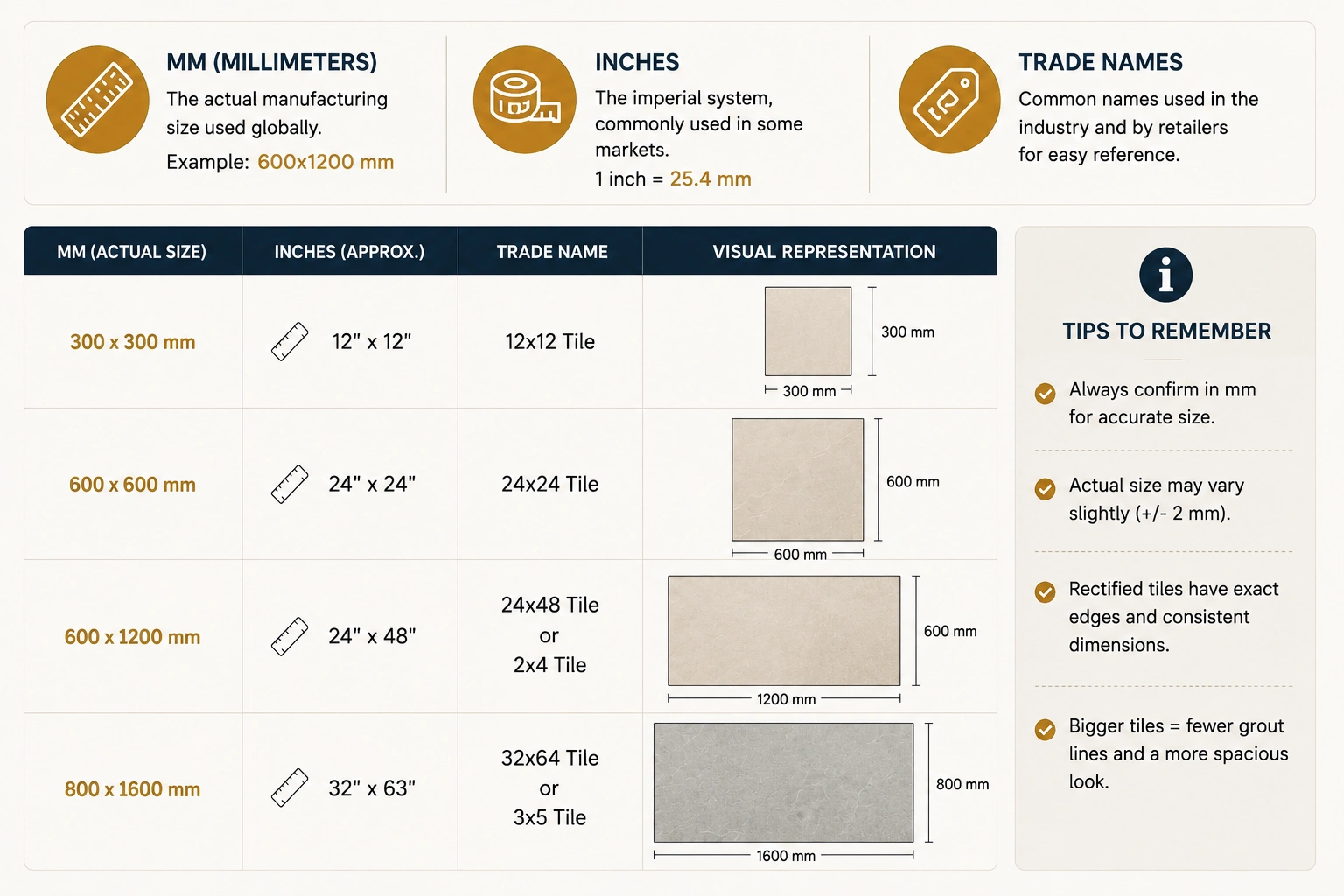
Indian tile sizes are quoted in three ways at dealers and showrooms: millimetres (mm), inches, and trade shorthand. Knowing all three avoids confusion when comparing products across brands or regions.
Size Naming in the Indian Trade
| Size in mm | Size in Inches | Trade Name | Common Name |
|---|---|---|---|
| 300x300 mm | 12x12" | 1x1 | One-by-one |
| 300x450 mm | 12x18" | 12x18 | Twelve-by-eighteen (WALL ONLY) |
| 300x600 mm | 12x24" | 1x2 | One-by-two (WALL ONLY) |
| 400x400 mm | 16x16" | 16x16 | Sixteen-by-sixteen |
| 500x500 mm | 20x20" | 20x20 | Twenty-by-twenty |
| 600x600 mm | 24x24" | 2x2 | Two-by-two |
| 600x1200 mm | 24x48" | 2x4 | Two-by-four |
| 800x1200 mm | 32x48" | 32x48 | Thirty-two by forty-eight |
| 800x1600 mm | 32x64" | 32x64 | Thirty-two by sixty-four |
| 1200x1800 mm | 48x72" | 6x4 | Six-by-four slab |
| 1200x2400 mm | 48x96" | 8x4 | Eight-by-four slab |
| 800x2400 mm | 32x96" | 32x96 | Thirty-two by ninety-six slab |
| 800x3000 mm | 32x120" | 32x120 | Thirty-two by one-twenty slab |
| 200x1200 mm | 8x48" | 8x48 | Plank tile (wood-look) |
| 200x1000 mm | 8x40" | 8x40 | Plank tile (wood-look, shorter) |
Wall-Only vs Floor-Safe Sizes: What Most Buyers Miss
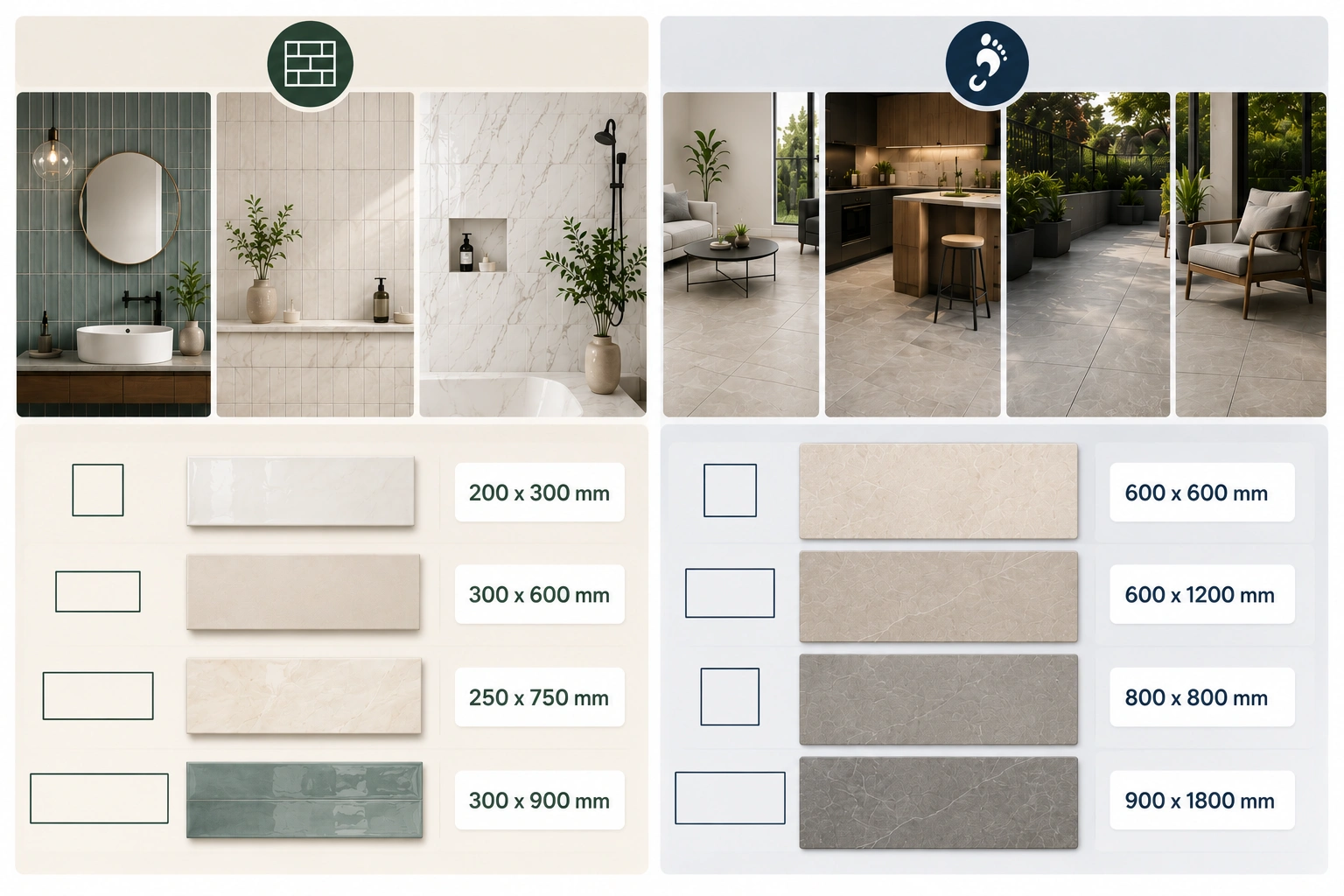
Two sizes are wall-only by technical specification and must never be used on floors:
300x450 mm (12x18): Wall cladding only. Available in ceramic and some GVT. High foot-traffic loads cause edge chipping and tile breakage on floors.
300x600 mm (1x2 / 12x24): Wall-only. One of the most widely sold sizes in India. Despite being rectangular and substantial in hand, this is a wall product. Using it on floors leads to cracking, uneven load distribution, and installer problems.
The 400x400 mm (16x16) and 500x500 mm (20x20) sizes are floor-best: designed for floors, parking, balconies, and terrace applications. They can go on walls but their weight makes installation more demanding and is rarely the practical choice.
Slab sizes (800x2400 mm, 800x3000 mm, 1200x2400 mm) are large-format architectural products for feature walls, kitchen platforms, countertops, and selected premium floor applications. They are not standard floor tiles and require specialist installation with appropriate adhesive systems.
Living Room and Drawing Room Tile Sizes
The living room is the first space visitors see, and the room where tile size has the greatest visual impact. Indian living rooms in 2BHK apartments typically range from 120 to 180 sq ft. 3BHK and independent house drawing rooms go from 180 to 300 sq ft and above.
Small to Mid-Size Living Rooms (up to 180 sq ft)
The 2x2 (600x600 mm) tile is the most common choice for Indian living rooms in this size range. It balances proportion, gives reasonable grout line spacing, and is available in the widest range of designs across GVT and PGVT categories.
The 2x4 (600x1200 mm) tile works well even in smaller living rooms when the room is rectangular and the longer tile dimension is laid along the room's longest axis. The larger format creates fewer grout lines and the space feels longer. Contrary to common belief, large tiles do not overwhelm small rooms when the proportions are managed. They create a quieter visual surface.
Recommended sizes: 2x2 (600x600 mm), 2x4 (600x1200 mm)
Recommended categories: GVT (matte or Posh finish for everyday living rooms), PGVT (polished finish for dry indoor living room floors in premium projects)
Large Living Rooms and Open-Plan Spaces (180 sq ft and above)
For larger open-plan living-dining-kitchen layouts common in 3BHK and 4BHK apartments, 2x4 (600x1200 mm) and 32x48 (800x1200 mm) tiles deliver a strong, seamless floor with fewer joints across the full area.
In independent houses with open-plan living areas above 300 sq ft, 32x64 (800x1600 mm) and 6x4 (1200x1800 mm) slab-format tiles are used for maximum visual continuity. These require a precisely levelled substrate and specialist adhesive installation.
Recommended sizes: 2x4 (600x1200 mm), 32x48 (800x1200 mm), 32x64 (800x1600 mm), 6x4 (1200x1800 mm) for premium large spaces
Recommended categories: GVT, PGVT, Full Body vitrified for premium applications
Feature Walls in the Living Room
TV feature walls and behind-sofa accent walls use different size logic to floors. Vertical large-format tiles in 2x4 (600x1200 mm), 32x64 (800x1600 mm), or 6x4 (1200x1800 mm) reduce horizontal grout lines that would break up the wall's visual flow. For bookmatch feature walls, 6x4 or 8x4 slab formats deliver the most dramatic effect.
Recommended sizes: 2x4 (600x1200 mm), 32x64 (800x1600 mm), 6x4 (1200x1800 mm) for high-impact feature walls.
Bedroom Tile Sizes
Bedrooms in Indian homes carry different requirements to living rooms. They are typically smaller and more intimate spaces, and most families prefer warmer, quieter visual tones. The tile size influences both the room's scale and its sense of comfort.
Master Bedroom
The 2x2 tile is the standard safe choice for master bedrooms in Indian 2BHK and 3BHK apartments of 120 to 160 sq ft. It works well in marble-look, wood-look, and solid tone finishes.
The 2x4 (600x1200 mm) tile in the same room gives a more spacious feel and is increasingly the preferred choice in contemporary Indian interiors. Laying the long axis parallel to the room's longest wall reinforces depth and makes the room read as generously sized.
For wood-look plank tiles, the 8x48 (200x1200 mm) format is the most popular size in Indian master bedrooms. Laid lengthwise, the long plank pattern gives the floor the visual warmth of timber without the maintenance.
Recommended sizes: 2x2 (600x600 mm), 2x4 (600x1200 mm), 8x48 (200x1200 mm) for wood-look plank
Recommended categories: GVT (matte or Posh), PGVT for dry bedroom floors only
Children's Bedrooms and Smaller Rooms
For bedrooms below 100 sq ft (common in 1BHK and compact 2BHK apartments), the 2x2 (600x600 mm) tile keeps proportion balanced. The 2x4 (600x1200 mm) format can still work in a narrow rectangular room when laid along the longer dimension.
Avoid slab formats (800x1600 mm and above) in rooms smaller than 100 sq ft. The tile size exceeds the room's proportion, requires significant cutting, and drives up installation waste and cost without adding visual benefit.
Recommended sizes: 2x2 (600x600 mm), 2x4 (600x1200 mm) for rectangular rooms
Kitchen Tile Sizes
Kitchens in Indian homes have two tiling surfaces with completely different requirements: the floor and the backsplash wall. The right size for one is usually wrong for the other.
Kitchen Floor
Indian kitchen floors see heavy foot traffic, oil spills, dropped utensils, and frequent wet mopping. The 2x2 (600x600 mm) GVT tile with matte or GHR finish is the most practical all-round choice. It handles daily cooking wear, cleans easily, and is available in stone-look and concrete-look designs that suit most Indian kitchen styles.
In open-plan kitchen-dining layouts where the floor runs continuously, using the same 2x4 (600x1200 mm) tile across both spaces creates visual unity and reduces the accumulation of grease and food residue in joints compared to smaller-format tiles with more lines.
Recommended sizes: 2x2 (600x600 mm), 2x4 (600x1200 mm)
Critical finish rule: Matte or GHR finish only for kitchen floors. Never use Glossy, PGVT Polished, or Satin Matte: they are slippery when wet and show every footprint.
Kitchen Backsplash Wall
The backsplash behind the cooking platform and prep counter is a wall surface. This is where subway-style 300x600 mm (1x2) tiles, 300x450 mm (12x18) tiles, and full 600x1200 mm (2x4) GVT wall tiles are the correct choice.
The 300x600 mm (1x2) format in brick-offset layout is the most popular Indian kitchen backsplash size. It cuts cleanly around power sockets and handles grease splatter well when glazed. Some homeowners match the backsplash tile to the kitchen floor tile in a smaller format, which creates a coordinated look without visual monotony.
Recommended sizes: 300x600 mm (1x2), 300x450 mm (12x18) for subway-style backsplash. 600x1200 mm (2x4) for full-height statement walls behind kitchen platforms.
Recommended category: Ceramic (wall use only) for standard backsplash. GVT for full-height feature backsplash walls.
Bathroom Tile Sizes
Bathrooms are where tile size decisions carry the most consequence. Floor tiles in wet areas must be anti-skid and sized correctly. Wall tiles affect the room's perceived width and height. Indian bathrooms in apartments are typically compact (30 to 50 sq ft), which makes size selection especially important.
Bathroom Floor
For bathroom floors, smaller tiles perform better in wet conditions for two reasons: more grout lines provide grip, and smaller tiles are easier to lay with the slight drainage slope that all bathroom floors need toward the drain.
The 300x300 mm (1x1) tile is the traditional standard for Indian bathroom floors and remains a strong choice, particularly in compact bathrooms. Its smaller footprint lets the tile layer maintain drainage slope precisely. In matte, Rain Drops, or GHR finish, it provides reliable anti-skid performance.
The 400x400 mm (16x16) tile works well for slightly larger bathrooms (40 sq ft and above). The 500x500 mm (20x20) is used in larger attached bathrooms and master bathrooms where a more spacious-feeling floor is desired.
Recommended sizes: 300x300 mm (1x1), 400x400 mm (16x16), 500x500 mm (20x20) for larger bathrooms
Critical finish rule: Use matte, Rain Drops, GHR, or anti-skid texture only for bathroom floors. PGVT Polished, Glossy, High Glossy, Semi-Polished, and Satin Matte are dangerously slippery on wet bathroom floors.
Bathroom Walls
The 300x600 mm (1x2) tile is the dominant choice for Indian bathroom walls in 2026. It covers area efficiently, reduces the number of tiles to lay, and gives bathrooms a cleaner, less busy look compared to smaller wall tile formats.
The 300x450 mm (12x18) tile is common in traditional and mid-range bathrooms. The 600x1200 mm (2x4) tile is increasingly used in modern bathrooms for a large-format, hotel-style wall with minimal grout lines. PGVT tiles in polished finish work well on bathroom walls as accent panels and behind mirrors, where their reflective surface bounces light.
Recommended sizes: 300x600 mm (1x2) as standard. 600x1200 mm (2x4) for modern look.
Recommended categories: Ceramic for standard wall use. GVT for feature walls. PGVT for accent panels on walls (not wet zone floors).
Small Bathrooms: What Actually Works
There is a widespread belief that small bathrooms need small tiles. This is only partially true. Small tiles on the floor (300x300 mm) are correct because of drainage slope and grip. But on bathroom walls, larger tiles in 300x600 mm or 600x1200 mm formats actually make the space feel bigger by reducing the number of visible grout lines.
In a compact 35 sq ft Indian bathroom, a full-height 300x600 mm wall tile in off-white or light grey creates an unbroken vertical plane that reads as taller and wider. The same bathroom tiled in 300x300 mm on the walls with dense grout lines feels much more enclosed.
| Surface | Small Bathroom (under 40 sq ft) | Medium Bathroom (40 to 70 sq ft) | Large Bathroom (70 sq ft+) |
|---|---|---|---|
| Floor | 300x300 mm (1x1) | 300x300 mm or 400x400 mm (16x16) | 400x400 mm or 500x500 mm (20x20) |
| Walls | 300x600 mm (1x2) for height effect | 300x600 mm (1x2) or 600x1200 mm (2x4) | 600x1200 mm (2x4) or larger |
| Feature / Accent | 300x600 mm behind mirror only | 600x1200 mm (2x4) accent wall | 800x1200 mm (32x48) feature panel |
Balcony and Terrace Tile Sizes
Balconies and terraces need tiles that perform outdoors: low water absorption, anti-skid finish, and thickness to handle furniture weight and thermal expansion from Indian summer heat. Size choice must account for the drainage slope requirement on all exposed outdoor surfaces.
The 400x400 mm (16x16) tile is the classic Indian balcony floor standard. The square format handles drainage slope easily and cuts cleanly in compact balcony spaces with walls, railings, and drain edges to navigate.
The 500x500 mm (20x20) format is preferred for open terraces of 100 sq ft and above. It reduces grout lines compared to 1x1 tiles while still handling slope requirements well. For large open terraces and society compound areas, the 2x2 (600x600 mm) tile gives a more contemporary finish.
The 2x4 (600x1200 mm) format works on large flat terraces but requires precise substrate levelling and correct expansion joint placement. Without 3 to 4 mm expansion gaps between tiles, the larger format cracks from thermal expansion across Indian summer-to-monsoon temperature cycles.
Recommended sizes: 16x16 (400x400 mm) for compact balconies, 20x20 (500x500 mm) for mid-size terraces, 2x2 (600x600 mm) and 2x4 (600x1200 mm) for large open terraces
Critical reminder: Matte, GHR, Rain Drops, or anti-skid texture finish only for outdoor floors. Glossy, PGVT Polished, or Satin Matte finishes are unsafe on wet outdoor surfaces.
Pooja Room and Corridor Tile Sizes
Pooja Room
Pooja room tiling in Indian apartments is typically a wall surface: a niche panel, feature wall behind the mandir unit, or a dedicated room. For compact apartment pooja niches (3 to 5 sq ft of wall area), the 300x450 mm (12x18) and 1x2 tiles are the most practical because they cut to niche dimensions with minimal waste.
For dedicated pooja rooms of 20 to 40 sq ft, the 2x2 (600x600 mm) floor tile keeps proportion balanced. For walls, the 300x600 mm (1x2) in white, cream, or marble-look is the standard across most Indian homes.
Recommended sizes: 300x600 mm (1x2) or 300x450 mm (12x18) for niches. 2x2 (600x600 mm) for dedicated pooja room floors.
Corridors and Passages
Indian apartment corridors are typically narrow (3 to 4 feet wide) and run from the entrance to bedrooms or the kitchen. A rectangular tile format laid along the corridor's length makes the passage feel longer and less cramped.
The 2x4 (600x1200 mm) tile laid lengthways is a strong choice for corridors. The long rectangle reinforces directional flow. The 8x48 (200x1200 mm) wood-look plank laid along the corridor's length achieves the same effect with warmer visual character.
Recommended sizes: 2x4 (600x1200 mm) or 8x48 (200x1200 mm) wood-look plank laid lengthways
Master Reference Table: Right Tile Size for Every Room and Surface
| Room / Area | Surface | Recommended Sizes | Category | Finish |
|---|---|---|---|---|
| Living Room (up to 180 sq ft) | Floor | 2x2 (600x600), 2x4 (600x1200) | GVT, PGVT | Matte, Posh, or Polished (dry floor) |
| Living Room (180 sq ft+) | Floor | 2x4 (600x1200), 32x48 (800x1200), 32x64 (800x1600) | GVT, PGVT, Full Body | Matte, Posh, or Polished |
| Living Room | Feature Wall | 2x4, 32x64 (800x1600), 6x4 (1200x1800) | GVT, PGVT | Matte Carving, Posh, Polished |
| Master Bedroom | Floor | 2x2 (600x600), 2x4 (600x1200), 8x48 (plank) | GVT, PGVT (dry only) | Matte, Posh, Polished (dry only) |
| Children's Bedroom | Floor | 2x2 (600x600), 2x4 (600x1200) | GVT | Matte |
| Kitchen | Floor | 2x2 (600x600), 2x4 (600x1200) | GVT | Matte, GHR only |
| Kitchen | Backsplash Wall | 300x600 (1x2), 300x450 (12x18) | Ceramic, GVT | Glossy or Matte (wall use) |
| Bathroom (compact) | Floor | 300x300 (1x1), 400x400 (16x16) | GVT, Porcelain | Matte, Rain Drops, GHR ONLY |
| Bathroom | Wall | 300x600 (1x2), 600x1200 (2x4) | Ceramic, GVT, PGVT | Glossy, Matte, Polished (walls only) |
| Balcony (compact) | Floor | 400x400 (16x16) | GVT | Matte, GHR, Rain Drops |
| Terrace (mid-size) | Floor | 500x500 (20x20), 2x2 (600x600) | GVT, Full Body | Matte, GHR |
| Terrace (large) | Floor | 2x4 (600x1200) | GVT, Full Body | GHR, Matte (with expansion joints) |
| Pooja Niche | Wall | 300x600 (1x2), 300x450 (12x18) | Ceramic, GVT | Glossy or Matte |
| Corridor / Passage | Floor | 2x4 (600x1200), 8x48 (200x1200 plank) | GVT | Matte, Posh |
6 Rules for Choosing Tile Size in Any Indian Room
Rule 1: Larger Tiles Make Rooms Feel Bigger, Not Smaller
More grout lines fragment the visual field of a floor. Fewer lines create a quieter, more open surface. In a 120 sq ft bedroom, the 2x4 (600x1200 mm) tile reads as more spacious than 1x1 (300x300 mm) tiles covering the same area. This holds in most standard Indian rooms and is opposite to what many homeowners initially believe.
Rule 2: Bathroom Floors Need Smaller Tiles for Drainage and Grip
The one consistent exception to Rule 1 is bathroom floors. Smaller tiles allow more precise drainage slope installation and provide more grout lines for anti-skid traction. The 300x300 mm (1x1) tile remains the most practical choice for Indian bathroom floors in compact apartments.
Rule 3: 300x450 mm and 300x600 mm Are Wall-Only Sizes
These two sizes account for a large share of wrong floor tile installations in Indian homes. They look and feel substantial in hand at a showroom. But they are wall products. Using them on floors causes edge chipping, tile cracking, and installer complaints that homeowners often blame on poor tile quality when the error is in the specification.
Rule 4: Lay Rectangular Tiles Along the Room's Longest Axis
A 2x4 (600x1200 mm) tile laid along the shorter axis of a room makes it feel shorter. Laid along the longer axis, the same tile reinforces the room's depth and makes it feel more generous. This applies to both floor tiles in bedrooms and corridors, and wall tiles in bathrooms and feature walls.
Rule 5: Match Tile Size to Room Shape, Not Just Room Area
A long narrow room and a wide square room of the same total area need different size thinking. For narrow corridors, rectangular tiles along the length work best. For wide square rooms, a larger square format is more balanced. Do not apply living room tile logic to a narrow kitchen or L-shaped corridor.
Rule 6: Slab Formats Need Specialist Installation
Tile sizes above 1200x1800 mm (6x4) are architectural slabs, not standard tiles. They need a perfectly level substrate, heavy-duty tile adhesive rated for the format, and installers experienced with large-format work. Standard sand-cement mortar for slab formats causes hollow sounds, cracks, and tile failure within months.
Common Mistakes When Choosing Tile Sizes in India
Buying 300x600 mm Tiles for Bathroom Floors. This is the most frequently reported installation mistake in Indian bathrooms. The 300x600 mm (1x2) size is a wall tile. It is not rated for floor load or drainage slope installation in wet areas. Always use 300x300 mm, 400x400 mm, or 500x500 mm for bathroom floors.
Choosing 1x1 Tiles for Large Living Rooms. Small tiles in a large living room create a dense grout grid that fragments the visual space and demands more maintenance. A 2x2 or 2x4 tile achieves a more spacious and contemporary result at a similar cost per sq ft.
Installing Slab-Format Tiles on Unlevelled Substrates. Tiles above 1200x1800 mm need substrate flatness within 3 mm across 3 metres. Most Indian floors with conventional plastering do not meet this standard without a self-levelling compound. Slab tiles on uneven substrates crack at the edges or produce a hollow sound within months.
Mixing Tile Sizes Across Connected Open-Plan Spaces. Open-plan living-dining-kitchen layouts that use different tile sizes in each zone create visual breaks that make the combined space feel smaller and disjointed. One consistent tile size across the full open-plan area creates the seamless, expansive feel the layout is designed to deliver.
Not Buying Enough Extra Tile for Large Formats. A 2x4 (600x1200 mm) tile cut to fit a corner, alcove, or around a kitchen column generates large off-cuts. In rooms with complex shapes, waste can reach 15 to 20% of the measured area. Buying only the exact measured sq ft leads to a shortage, and replacement tiles from a different production batch will not match the shade.
Finding the Right Tile Size for Your Home
The right tile size is not the most popular format or the cheapest option per sq ft. It is about matching the tile's dimensions to the room's proportions, the surface it goes on, and the practical demands of daily Indian home life.
Use the room-by-room sections and the master reference table in this guide as your starting checklist. Take it to the showroom. Ask your dealer to confirm the category and finish against the specific surface you are tiling. And always carry home a few samples to see the size and colour in your room's actual lighting before you finalise.
You can browse tile sizes across all categories on TilesFinders, where products are listed by size, category, finish, and room application. It is a practical starting point for comparing options across verified Indian manufacturers before visiting showrooms.
FAQs
For living rooms up to 180 sq ft, the 2x2 (600x600 mm) and 2x4 (600x1200 mm) tiles give the best balance of proportion and visual spaciousness. For larger living rooms, 2x4 (600x1200 mm) or 32x48 (800x1200 mm) formats are more proportionate. Use GVT in matte or Posh finish, or PGVT Polished for dry indoor living room floors.
Yes. Larger 2x4 (600x1200 mm) tiles work well in rooms as small as 100 sq ft when the room is rectangular and the tile is laid along the longer axis. Fewer grout lines make the visual field quieter and the room feels more spacious. The exception is bathroom floors, where 300x300 mm is a better choice for drainage slope and grip.
Indian bathroom floors work best with 1x1 tiles in compact bathrooms, or 400x400 mm (16x16) in medium-sized bathrooms. For walls, 300x600 mm (1x2) is the standard, with 600x1200 mm (2x4) for modern hotel-style bathrooms. Never use 300x600 mm on bathroom floors, regardless of what the showroom suggests.
Not always. The 300x450 mm and 300x600 mm sizes are wall-only and must not go on floors. The 400x400 mm and 500x500 mm sizes are floor-best. The 600x600 mm and 600x1200 mm sizes work for both walls and floors and are the most flexible formats to work with. Always confirm wall or floor suitability with your supplier before purchasing.
Use 300x300 mm (1x1) with matte or anti-skid finish for the floor. For the walls, use 300x600 mm (1x2) tiles in a lighter colour like off-white, cream, or light grey. The larger wall tile makes the small bathroom feel taller and wider by reducing visible grout lines. Avoid busy patterns and dark colours in compact bathrooms.
Compact balconies suit 400x400 mm (16x16) tiles in GVT matte or GHR finish. Open terraces of 100 sq ft or more suit 500x500 mm (20x20) or 600x600 mm (2x2). Large open terraces can use 600x1200 mm (2x4) with proper expansion joints. Never use Glossy, PGVT Polished, or Satin Matte finishes on any outdoor floor.
Buy 8 to 10% extra for standard rectangular rooms. For complex layouts with angles, alcoves, or many cut-outs, buy 12 to 15% extra. For large-format tiles (800x1200 mm and above), buy 10 to 12% extra as cuts generate large off-cut waste. Always order all tiles from the same production batch for consistent shade and texture.

See our tile guides first
Set TilesFinders as a preferred source and our buying guides surface ahead of the rest for you.
Add as preferred sourceTakes one tap. Nothing to install.
What Readers Say
I was about to redo my parking area with the wrong tile size until I read this. The layout comparisons saved me from a costly mistake.
We reference TilesFinders guides while briefing clients on material selection. The size and pattern breakdowns are accurate and easy to explain visually.
On site, I get asked about grout spacing all the time. This article gave me a solid reference I now share with my team before every job.
Finally a guide that doesn't just push generic advice. The oil stain removal steps actually worked on our clubhouse driveway tiles.
I run a small construction firm and now send this link to clients directly when they ask about entrance tile sizing. Saves me an hour of explaining.
Good practical detail, though I wish there were more examples for compact apartment entrances specifically, not just villas.
My mother-in-law wanted marble, I wanted vitrified. This blog gave us the neutral comparison we needed to actually decide together.
Detailed without being overwhelming. I appreciated that it covered both cost and maintenance, not just the aesthetics.
Used the algae and hard water removal tips on our terrace tiles after the monsoon. Worked better than what our regular cleaner was doing.
As someone who sources tiles for multiple builder projects, I find these comparisons genuinely useful for vendor conversations, not just consumer content.
Recommended this to a client who kept second-guessing the entrance design. The small vs large layout section settled the debate instantly.
Straightforward and honest, no unnecessary jargon. Would like to see a similar breakdown for outdoor pool-deck tiles next.
We've bookmarked several TilesFinders guides for our design handbook. Reliable source when clients want data, not just opinions.
Two paths, one marketplace.
Get free quotes from verified suppliers.
Share your room, budget, and style. Suppliers in Morbi respond within hours.
Get Free QuotesList your business, reach real buyers.
Put your showroom in front of homeowners searching for tiles right now.
List Your Business